01 EXECUTIVE DEPARTMENT
01.02.04.22 • 52:23 Md. R. 1141 (11-14-25)
02 OFFICE OF THE ATTORNEY GENERAL
02.06.04 .01—.06 • 52:6 Md. R.
270 (3-21-25)
05 DEPARTMENT OF HOUSING AND COMMUNITY DEVELOPMENT
05.20.03 .02—.04 • 52:22 Md.
R. 1097 (10-31-25)
05.24.01.01—.04 • 52:13 Md. R. 660 (6-27-25)
07 DEPARTMENT OF HUMAN SERVICES
07.02.25.01—.24 • 51:19 Md. R. 861 (9-20-24)
07.05.01 .02, .09, .14,.17
• 52:23 Md. R. 1142 (11-14-25)
07.05.02 .02, .13
• 52:23 Md. R. 1142 (11-14-25)
08 DEPARTMENT OF NATURAL RESOURCES
08.01.07.10 •
52:17 Md. R 878 (8-22-25)
08.01.10.01—.06 •
52:17 Md. R 878 (8-22-25)
08.01.11.01—.07 • 52:20 Md. R 1005 (10-03-25)
08.02.05.23, .26,.27 • 52:21 Md. R 1028 (10-17-25)
08.02.22.02,.03 • 52:21 Md. R 1028 (10-17-25)
08.03.03.01 • 52:21 Md. R 1030 (10-17-25)
08.07.01.25 •
52:17 Md. R 878 (8-22-25)
08.07.06.25 • 52:17 Md. R 878 (8-22-25)
08.08.05.03 • 52:7 Md. R. 326 (4-4-25)
09 MARYLAND DEPARTMENT OF LABOR
09.03.06.02,.04 • 52:1 Md. R. 27 (1-10-25)
09.03.06.02,.04 • 52:2 Md. R. 79 (1-24-25) (corr)
09.03.06.02,.06,.16
• 51:14 Md. R. 685 (7-12-24)
09.03.09.06 • 52:7 Md. R. 328 (4-4-2025)
09.10.01.07 • 52:20 Md. R 1007 (10-03-25)
09.11.07.01 • 52:12 Md. R. 600 (6-13-25)
09.12.66 .02, .03, .09—.20 • 52:23 Md. R.1143
(11-14-25) (ibr)
09.15.02.04 • 52:17 Md. R 880 (8-22-25)
09.15.02 .11 •
52:22 Md. R. 1098 (10-31-25)
09.22.01.04, .15 • 52:6 Md. R. 273 (3-21-25)
• 52:16
Md. R. 850 (8-8-25)
09.22.01.04,.15 • 52:21 Md. R 1030 (10-17-25)
09.22.02.03, .05 • 52:6 Md. R. 273 (3-21-25)
• 52:16
Md. R. 850 (8-8-25)
09.22.02.03,.05 • 52:21 Md. R 1030 (10-17-25)
09.30.01,.01—.10 • 52:2 Md. R 371 (4-18-25)
09.32.01 .02, .03, .05, .06, .09, .09-1 .11, .12, .16,
,.16-1 .17, .23, .25, .26, • 52:15 Md. R. 814 (7-25-25)
09.34.05.02 • 52:10 Md. R. 441 (5-16-25)
09.34.06.02.—07,.14 • 52:10 Md. R. 441 (5-16-25)
09.34.07.02 • 52:10 Md. R. 441 (5-16-25)
09.34.08.01—.03,.05—.08,.10—.12 • 52:10 Md. R.441
(5-16-25)
09.34.09.02 • 52:10 Md. R. 441 (5-16-25)
09.36.07.01—.13 • 52:6 Md. R. 274 (3-21-25)
09.37.03 .01, .02, .08
• 52:23 Md. R. 1146 (11-14-25)
09.42.01.01—.03 • 52:21 Md. R 1031 (10-17-25)
09.42.02.01—.10 • 52:21 Md. R 1034 (10-17-25)
09.42.03.01—.10 •
52:21 Md. R 1036 (10-17-25)
09.42.04.01—.12 • 52:22 Md. R. 1099 (10-31-25)
09.42.05.01—.05 • 52:21 Md. R 1040 (10-17-25)
10 MARYLAND DEPARTMENT OF HEALTH
Subtitles 01—08 (1st volume)
10.01.01 .01—.12 •
52:23 Md. R. 1147 (11-14-25)
10.01.22 .01—.10 •
52:23 Md. R. 1150 (11-14-25)
10.01.23 .01—.10 •
52:23 Md. R. 1153 (11-14-25)
10.07.01 .01,.38,
.39 • 52:22 Md. R. 1104 (10-31-25)
Subtitle 09 (2nd volume)
10.09.02.07 • 52:5 Md. R. 241 (3-7-25) (ibr)
10.09.11.11 • 52:3 Md. R. 162 (2-7-25)
10.09.12.01,.04—.06 • 52:3 Md. R. 164 (2-7-25)
10.09.24.02,.07,.12 • 52:3
Md. R. 162 (2-7-25)
10.09.28.04,.06 • 52:12 Md. R. 603 (6-13-25)
10.09.37.03 • 52:5
Md. R. 242 (3-7-25)
10.09.43.10,.13 •
52:3 Md. R. 164 (2-7-25)
10.09.53.04,.05 • 51:4 Md. R. 206 (2-23-24)
10.09.53.07 • 52:12 Md. R. 605 (6-13-25)
10.09.54.04, .22 • 52:12 Md. R. 606 (6-13-25)
10.09.76 .04,.05 •
52:5 Md. R. 243 (3-7-25)
10.09.81.41 • 52:17 Md. R 881 (8-22-25)
Subtitles 10—22 (3rd volume)
10.10.01.03 • 52:11 Md. R. 545
(5-30-25)
10.10.02.01 • 52:11 Md. R. 545 (5-30-25)
10.10.03.02—.04 • 52:11 Md. R. 545 (5-30-25)
10.10.04.01,.02 • 52:11 Md. R. 545 (5-30-25)
10.10.05.02,.04,.05 • 52:11 Md. R. 545 (5-30-25)
10.10.06.02,.07,.08,.12,.13 • 52:11 Md. R. 545 (5-30-25)
10.10.07.07 • 52:11 Md. R. 545 (5-30-25)
10.10.08.02 • 52:11 Md. R. 545 (5-30-25)
10.10.12.02,.04,.07 • 52:11 Md. R. 545 (5-30-25)
10.13.04 .02,.03 • 52:22 Md.
R. 1105 (10-31-25)
10.15.04.15,.16 • 52:21 Md. R 1045 (10-17-25)
10.15.06 .03 • 52:22 Md. R. 1106 (10-31-25)
10.15.07 .01 • 52:22 Md. R. 1107 (10-31-25)
10.15.13 .01—.06 • 52:22 Md.
R. 1107 (10-31-25)
10.16.07 .02,.06,.15 • 52:22
Md. R. 1105 (10-31-25)
10.18.06 .02 • 52:22 Md. R.
1109 (10-31-25)
10.19.04 .01—.06, .12 • 52:23
Md. R. 1155 (11-14-25)
Subtitles 23—36 (4th volume)
10.24.06.01—.04 • 52:19 Md. R. 958 (9-19-25)
10.25.07.02,.09—.12 • 51:24 Md. R. 1086 (12-2-24)
10.27.02.01 • 52:12 Md. R. 609 (6-13-25)
10.27.05.07 • 52:12 Md. R. 609(6-13-25)
10.27.06 .05 • 52:22 Md. R. 1109 (10-31-25)
10.27.10.02 • 52:16 Md. R. 856 (8-8-25)
10.27.18.01,.02 • 52:12 Md. R. 609 (6-13-25)
10.27.26.02 • 52:12 Md. R. 609 (6-13-25)
10.28.05.03 • 52:7 Md. R. 334 (4-4-25)
10.28.07.02 • 52:7 Md. R. 334 (4-4-25)
10.28.08.01—.04 • 52:7 Md. R. 334 (4-4-25)
10.28.11.04 • 52:7 Md. R. 334 (4-4-25)
10.28.12.02 • 52:7 Md. R. 334 (4-4-25)
10.32.03.01—.18 • 52:21 Md. R 1046 (10-17-25)
10.32.05.02—.06 •
52:11 Md. R. 563 (5-30-25)
10.32.05 .06 •
52:22 Md. R. 1110 (10-31-25)
10.32.08 .01,.02,.05,.06,.09, .12 • 52:22 Md. R.
1110 (10-31-25)
10.32.10 .01, .02, .04, .05, .05-1, .05-2, .07, .08,
.10—.12
• 52:23
Md. R. 1157 (11-14-25)
10.32.11 .01, .02, .04, .06, .07, .10, .11, .13—.15 •
52:23 Md. R. 1160 (11-14-25)
10.32.20 .02, .03, .06, .10, .11, .14—.16, .18 •
52:23 Md. R. 1162 (11-14-25)
10.32.21 .02,.03-1,.03-2,.05,.10,.11,.20 • 52:22 Md.
R. 1112 (10-31-25)
10.32.25.01—.06 • 52:13 Md. R. 670 (6-27-25)
10.33.01.01—.04 •
52:21 Md. R 1053 (10-17-25)
10.33.02. .01—.14 • 52:21 Md. R 1053 (10-17-25)
10.33.03. .01—.10 • 52:21 Md. R 1053 (10-17-25)
10.33.04.01,.02 •
52:21 Md. R 1053 (10-17-25)
10.33.05.01,.02 •
52:21 Md. R 1053 (10-17-25)
10.33.06.01,.02 •
52:21 Md. R 1053 (10-17-25)
10.33.07.01—.13 •
52:21 Md. R 1053 (10-17-25)
10.33.08.01—.02 •
52:21 Md. R 1053 (10-17-25)
10.34.19 .01—.03, .05—.19 • 52:23 Md. R. 1164
(11-14-25)
Subtitles 37—52 (5th volume)
10.37.01.03 •
51:17 Md. R. 779 (8-23-24)
10.37.10.26 • 52:19 Md. R. 959 (9-19-25)
10.37.13.01—.09 • 52:19 Md. R. 959 (9-19-25)
10.42.01.02, .04, .11• 52:5 Md. R. 245 (3-7-25)
10.42.02.02,06 • 52:14 Md. R 720 (7-11-25)
10.44.01.01—.30 • 52:17 Md. R 882 (8-22-25)
10.44.20 .02 •
52:23 Md. R.1171 (11-14-25)
10.44.36.01—.07 • 52:23 Md. R.1172 (11-14-25) (ibr)
Subtitles 53—69 (6th volume)
10.60.01 .01—.03,.06
• 52:22 Md. R. 1114 (10-31-25)
10.60.02 .01,.04,.05 • 52:22 Md. R. 1114 (10-31-25)
10.65.07.02 •
52:14 Md. R 721 (7-11-25)
10.65.12.01—.05 •
52:14 Md. R 721 (7-11-25)
10.67.01.01 • 52:3 Md. R. 166 (2-7-25)
10.67.06.13 • 52:3 Md. R. 166 (2-7-25)
10.69.01.01—.13 • 52:12 Md. R. 609 (6-13-25)
10.69.02.01—.06 • 52:12 Md. R. 609 (6-13-25)
10.69.03.01—.03 • 52:12 Md. R. 609 (6-13-25)
11 DEPARTMENT OF TRANSPORTATION
Subtitles 1—10
11.04.15.01—.04 • 52:11 Md. R. 568 (5-30-25)
11.08.01 .01 •
52:22 Md. R. 1115 (10-31-25)
11.08.02.01—.05 • 52:22 Md. R. 1115 (10-31-25)
11.08.03.01 • 52:22 Md. R. 1115 (10-31-25)
11.08.04.01—.05 • 52:22 Md. R. 1115 (10-31-25)
Subtitles 11—23 (MVA)
11.11.05.02—.04, .06 • 52:13 Md. R. 682 (6-27-25)
11.11.13.05 • 52:20 Md. R 1008 (10-03-25)
11.13.13.01—.03 • 52:2 Md. R. 126 (1-24-25) (err)
11.14.01.01—.18 •
52:14 Md. R 723 (7-11-25)
11.14.02.01—.29 • 52:14 Md. R 723 (7-11-25)
11.14.03.01—.14 • 52:14 Md. R 723 (7-11-25)
11.14.04.01—.23 • 52:14 Md. R 723 (7-11-25)
11.14.05.01—.11 • 52:14 Md. R 723 (7-11-25)
11.14.06.01—.07 • 52:14 Md. R 723 (7-11-25)
11.15.11.02, .03 • 52:21 Md. R 1075 (10-17-25)
12 DEPARTMENT OF PUBLIC
SAFETY AND CORRECTIONAL SERVICES
12.10.07.01—.11 •
52:22 Md. R. 1119 (10-31-25)
13A STATE BOARD OF EDUCATION
13A.01.05.12 • 52:17 Md. R 889 (8-22-25)
13A.03.08.01—.08 • 52:14 Md. R 783 (7-11-25)
13A.05.04.01—.03 • 52:17 Md. R 889 (8-22-25)
13A.15.01.02 • 51:25 Md. R. 1154 (12-13-24)
13A.15.01.02 •
52:23 Md. R. 1173 (11-14-25)
13A.15.04.03 • 51:25 Md. R. 1154 (12-13-24)
13A.15.04.03 • 52:23 Md. R. 1173 (11-14-25)
13A.15.13.09 • 51:25 Md. R. 1154 (12-13-24)
13A.15.16.01—.10 •
52:23 Md. R. 1173 (11-14-25)
13B MARYLAND HIGHER EDUCATION COMMISSION
13B.02.01.07 •
52:10 Md. R. 470 (5-16-25)
13B.08.20.02—.11, .13 • 52:13 Md. R. 688 (6-27-25)
13B.08.22.02 •
52:10 Md. R. 470 (5-16-25)
14 INDEPENDENT AGENCIES
14.01.04.05 • 51:25 Md. R. 1140 (12-13-24)
14.17.01.01 • 52:23 Md. R. 1177 (11-14-25)
14.17.02.04, .06 • 52:23 Md. R. 1177 (11-14-25)
14.17.05.05 • 52:23 Md. R. 1177 (11-14-25)
14.17.06.02, .04, .05, .11 • 52:23 Md. R. 1177
(11-14-25)
14.17.10.03,.07, .09 • 52:23 Md. R. 1177 (11-14-25)
14.17.11.03, .04, .17, .19 • 52:23 Md. R. 1177
(11-14-25)
14.17.12.02, .03, .11 • 52:23 Md. R. 1177 (11-14-25)
14.17.13.05 • 52:23 Md. R. 1177 (11-14-25)
14.17.14.04 • 52:23 Md. R. 1177 (11-14-25)
14.17.15.02, .05 • 52:23 Md. R. 1177 (11-14-25)
14.17.18.01 • 52:23 Md. R. 1177 (11-14-25)
14.17.21.02 • 52:23 Md. R. 1177 (11-14-25)
14.22.01.05 • 52:6 Md. R. 288 (3-21-25)
14.22.01.09,.15 • 52:21 Md. R 1076 (10-17-25)
14.22.02.02 • 52:6 Md. R. 288 (3-21-25)
• 52:17 Md. R 893 (8-22-25)
• 52:21 Md. R 1076 (10-17-25)
14.39.02.06 • 52:17 Md. R 900 (8-22-25)
14.39.02.12 • 51:23 Md. R. 1046 (11-15-24)
14.41.01.01— 16 • 52:10 Md. R. 472 (5-16-25)
15 MARYLAND DEPARTMENT OF AGRICULTURE
15.01.22.01—.04 •
52:19 Md. R. 973 (9-19-25)
20 PUBLIC SERVICE COMMISSION
20.31.01.02 • 52:6
Md. R. 290 (3-21-25)
20.31.03.04 • 52:6
Md. R. 290 (3-21-25)
26 DEPARTMENT OF THE ENVIRONMENT
Subtitles 08—12 (Part 2)
26.11.09.01,.07 • 52:12 Md. R. 627 (6-13-25)
26.11.43.02 • 52:19 Md. R. 974 (9-19-25) (ibr)
26.11.44.01—.06 •
52:19 Md. R. 976 (9-19-25) (ibr)
Subtitles 13—18 (Part 3)
26.13.01.03—.05 • 52:10 Md. R. 478 (5-16-25)
26.13.02.01, .04, .04-1, .04-7, .05, .06, .07, .07-1,
.11, .13, .16, .19,.23 • 52:10 Md. R. 478 (5-16-25)
26.13.03.01,.01-1,.02,.03-3,.03-4,.03-5,.03-7,.05,.05-4,.06
• 52:10 Md. R. 478 (5-16-25)
26.13.04.01 • 52:10 Md. R. 478 (5-16-25)
26.13.05.01, .04, .05,.14 • 52:10 Md. R. 478
(5-16-25)
26.13.06.01, .02, .05, .22 • 52:10 Md. R. 478
(5-16-25)
26.13.07.01, .02, .02-6, ,17, .20,.20-1—.20-6 • 52:10
Md. R. 478 (5-16-25)
26.13.09.01 • 52:10 Md. R. 478 (5-16-25)
26.13.10.01, .04, .06, .08, .09-1,.14, .16-1, .17, .19,
.20, .25, .32—.49 • 52:10 Md. R. 478 (5-16-25)
26.13.11.01 • 52:10 Md. R. 478 (5-16-25)
27 CRITICAL AREA COMMISSION FOR THE CHESAPEAKE AND ATLANTIC COASTAL
BAYS
27.01.15.01—.06 • 52:17 Md. R 901 (8-22-25)
27.03.01.03,.04 • 52:17 Md. R 901 (8-22-25)
29 MARYLAND STATE
POLICE
29.06.01.02, .05—.09, .14 • 52:3 Md. R. 172(2-7-25) (ibr)
30 MARYLAND INSTITUTE FOR
EMERGENCY MEDICAL SERVICES SYSTEMS (MIEMSS)
30.01.01.02 • 52:6 Md. R. 291 (3-21-25)
30.02.01.01 •
52:6 Md. R. 291 (3-21-25)
30.02.02.02—.09 •
52:6 Md. R. 291 (3-21-25)
31 MARYLAND INSURANCE ADMINISTRATION
31.04.22.03, .08 • 52:5 Md. R. 248 (3-7-25)
33 STATE BOARD OF ELECTIONS
33.05.01.04 • 52:13 Md. R. 690 (6-27-25)
33.07.11.01 • 52:13 Md. R. 690 (6-27-25)
33.14.02.14 • 52:5 Md. R. 249 (3-7-25)
33.14.02.14 • 52:15 Md. R. 821 (7-25-25)
36 MARYLAND STATE LOTTERY AND GAMING CONTROL AGENCY
36.03.10.36 • 51:24 Md. R. 1118 (12-2-24)
• 52:17 Md. R
908 (8-22-25)
36.10.13.39 • 52:17 Md. R 908 (8-22-25)
The Governor
EXECUTIVE ORDER 01.01.2025.20
Declaration
of a State of Emergency
WHEREAS, Due to the
prolonged shutdown of federal government operations, the State of Maryland is
experiencing severe and widespread economic disruption creating emergency
conditions as defined in Section 14-101(c) of the Public Safety Article of the
Maryland Code;
WHEREAS, The federal government is the largest employer in
the State, employing over 250,000 Marylanders;
WHEREAS, Even prior to the federal government shutdown, the
chaotic nature of the federal administration’s mass layoffs of federal
government employees who reside in Maryland and the unlawful termination of
federal grants and contracts already posed significant challenges to Maryland’s
economy;
WHEREAS, The federal administration’s reckless federal
government shutdown has further impacted Maryland’s economy and the critical
services that our families, children, and veterans rely on;
WHEREAS, Thousands of Marylanders are furloughed from their
federal government jobs and not receiving the paychecks they need to support
themselves and their families, and the federal administration is threatening to
break the law by refusing to make these employees whole;
WHEREAS, The total number of claims for unemployment
insurance (“UI”) has increased significantly in Maryland since the beginning of
the shutdown, with over 20,000 claims filed through the Maryland Department of
Labor since October 1, 2025, and 5,200 claims filed for the week ending October
25, 2025;
WHEREAS, The UI program for federal workers has seen over
4,200 claims directly related to the shutdown, and saw over 1,250 initial
claims for the week ending October 25th, the largest weekly number of initial
claims in over six years, compared to the 11 such claims filed by Maryland
residents in an average week of 2024;
WHEREAS, Critical federal benefits, including Supplemental
Nutrition Assistance Program (“SNAP”) benefits that keep more than 680,000
low-income Marylanders from going hungry are imminently set to expire, and the
federal administration is unwilling to ensure their continuation;
WHEREAS, Because of the imminent threat or occurrence of
severe or widespread economic disruption due to the existing and future impacts
of the federal government shutdown and in preparation for all contingencies, an
emergency exists Statewide;
WHEREAS, State agencies may require additional resources and
support to implement proactive actions and meet the public health, welfare, or
safety needs of Maryland residents who are negatively affected by the impacts
of the federal government shutdown;
WHEREAS, In order to
suspend the effect of any statute or rule or regulation to protect the welfare
of Marylanders and facilitate the deployment of requisite resources within
provisions of Maryland law; and
WHEREAS, In order to
fully implement the emergency powers of the Governor to facilitate the
deployment of needed resources, an executive order is necessary and
appropriate.
NOW THEREFORE, I, WES MOORE, GOVERNOR OF THE STATE OF
MARYLAND, BY VIRTUE OF THE AUTHORITY VESTED IN ME BY THE CONSTITUTION AND LAWS
OF MARYLAND, INCLUDING BUT NOT LIMITED TO TITLE 14 OF THE PUBLIC SAFETY ARTICLE
OF THE MARYLAND CODE, AND IN AN EFFORT TO PROTECT THE WELFARE OF MARYLANDERS,
HEREBY DECLARE, BASED ON THE ABOVE FINDINGS, EFFECTIVE IMMEDIATELY, THAT AN
EMERGENCY EXISTS IN THE STATE OF MARYLAND.
GIVEN Under My Hand and the Great Seal of the
State of Maryland, in the City of Annapolis, this 30th Day of October 2025.
WES MOORE
Governor
ATTEST:
SUSAN C. LEE
Secretary of State
[25-23-12]
EXECUTIVE ORDER 01.01.2025.21
Providing
Food for Marylanders and
Preventing Hunger
WHEREAS, On October 30, 2025, a State of Emergency was
declared via Executive Order 01.01.2025.20 due to the widespread economic
disruption and damage to the welfare of Marylanders caused by the prolonged
shutdown of federal government operations, pursuant to Title 14 of the Public
Safety Article of the Maryland Code;
WHEREAS, As a result of the prolonged federal government
shutdown, the federal administration notified the State of Maryland on October
10, 2025, that there will be insufficient funds to pay Supplemental Nutrition
Assistance Program (“SNAP”) benefits for the month of November;
WHEREAS, Over 680,000 low-income Marylanders, including more
than 270,000 children, rely on an average monthly federally funded SNAP benefit
of $180 to purchase healthy food;
WHEREAS, The SNAP benefits program is administered by the
Maryland Department of Human Services, and involves the issuance of monthly
benefits using federal funds to customers that can be used to purchase food at
over 3,800 authorized retailers statewide, including farmers’ markets and small
family-owned corner stores in every one of Maryland’s 24 local jurisdictions;
WHEREAS, The federal administration directed the State of
Maryland to withhold November SNAP benefits from Marylanders;
WHEREAS, The failure of the federal government to fund SNAP
benefits during this prolonged government shutdown creates a hunger crisis in
Maryland, leaving our most vulnerable residents at risk of losing the most
basic human need;
WHEREAS, The reckless actions of the federal administration
leading up to and during the federal government shutdown have also left a
significant number of Marylanders who are not current recipients of SNAP
benefits dependent on food assistance, including federal government employees
who have been furloughed and other workers who have lost wages during the
shutdown; and
WHEREAS, It being necessary to protect the public health and
welfare, the Moore-Miller Administration will address this crisis by using the
Governor’s emergency powers to direct State funds to be used to enhance and
expand critical services at the State’s food banks and other organizations that
provide food assistance to feed people and prevent hunger.
NOW THEREFORE, I,
WES MOORE, GOVERNOR OF THE STATE OF MARYLAND, BY VIRTUE OF THE AUTHORITY VESTED
IN ME BY THE CONSTITUTION AND LAWS OF MARYLAND, INCLUDING BUT NOT LIMITED TO
TITLE 14 OF THE PUBLIC SAFETY ARTICLE, AND IN AN EFFORT TO PROTECT THE PUBLIC
WELFARE, HEREBY PROCLAIM THE FOLLOWING EXECUTIVE ORDER, EFFECTIVE IMMEDIATELY:
Providing Food Assistance and Preventing Hunger
A. Until the State of Emergency is terminated:
1. The provisions of § 7-330(g) and (i) of the State Finance and
Procurement Article of the Maryland Code, authorizing the permissible uses and
expenditures of the Fiscal Responsibility Fund (“FRF”), are hereby suspended
for the purposes of providing relief set forth in this Order; and
2 All other laws and regulations that might otherwise restrict a budget
amendment transferring funds from the FRF to specified State agencies are
hereby suspended for the purposes of providing relief set forth in this Order.
B. Pursuant to Section A of this Order, the Secretary of Budget and
Management shall transfer $10 million from the FRF to the Department of Human
Services to be used to provide funds to organizations that provide food
assistance, so that they may provide food to Marylanders and prevent hunger.
C. The Secretary of Human Services shall distribute the funds
transferred pursuant to this Order to organizations that provide food
assistance in a manner determined by the Secretary of Human Services to be the
most equitable, efficient and effective to provide food to the greatest number
of Marylanders impacted by the federal government shutdown and prevent hunger.
D. The Secretary of Emergency Management shall coordinate with the
Secretary of Human Services and all relevant State departments and agencies as
necessary to organize, manage and distribute the food assistance relief set
forth in this Order.
Ensuring Continuity of Maryland Farms and Families Fund
E. Until the State of Emergency is terminated, the provisions of §
10-2003 of the Agriculture Article of the Maryland Code, that require purchases
at participating farmers markets and farm stands be made with federal benefits
in order to be eligible for matching funds from the Maryland Farms and Families
Fund, are hereby suspended.
F. The Secretary of Agriculture shall effectuate the distribution of the
matching funds from the Maryland Farms and Families Fund.
General Provisions
G. If any provision of this Executive Order or its application to any
person, entity, or circumstance is held invalid by any court of competent
jurisdiction, all other provisions or applications of the Executive Order shall
remain in effect to the extent possible without the invalid provision or
application. To achieve this purpose, the provisions of this Executive Order
are severable.
GIVEN Under My Hand and the Great Seal of the State of Maryland, in the
City of Annapolis, this 30th Day of October 2025.
WES MOORE
Governor
ATTEST:
SUSAN C. LEE
Secretary of State
[25-23-13]
EXECUTIVE ORDER 01.01.2025.22
Providing Supplemental Nutrition
Assistance to Marylanders
WHEREAS, On October
30, 2025, a State of Emergency was declared via Executive Order 01.01.2025.20
due to the widespread economic disruption and damage to the welfare of
Marylanders caused by the prolonged shutdown of federal government operations,
pursuant to Title 14 of the Public Safety Article of the Maryland Code;
WHEREAS, As a result
of the prolonged federal government shutdown, the federal administration failed
to use available funds to timely pay Supplemental Nutrition Assistance Program
(“SNAP”) benefits for the month of November;
WHEREAS, Over 680,000
low-income Marylanders, including more than 270,000 children, who rely on a
monthly federally funded SNAP benefit to purchase healthy food, risk going
hungry;
WHEREAS, On October 31, 2025, two federal district
courts found that the federal administration was acting unlawfully by failing
to use available federal funds to at least partially fund SNAP benefits
nationwide for the month of November;
WHEREAS, Only after
being ordered by a federal court to fulfill the basic governmental function of
keeping people from going hungry, the federal administration has opted to only
partially fund SNAP benefits, which is not enough to ensure that Maryland
families dependent on these benefits have enough to eat during the month of
November;
WHEREAS, The failure
of the federal administration to fully fund SNAP benefits during this prolonged
government shutdown creates a hunger crisis in Maryland, leaving our most
vulnerable residents at risk of losing the most basic human need;
WHEREAS, To prevent
hunger and to maintain the public health and welfare of all Marylanders
impacted by the federal government shutdown, on October 30, via Executive Order
01.01.2025.21, the Moore-Miller Administration ordered that $10 million in
emergency funding be equitably targeted to Maryland food banks and other
organizations that provide food assistance; and
WHEREAS, It being
necessary to protect the public health and welfare, the Moore-Miller
Administration will further address this crisis by using the Governor’s
emergency powers to direct State funds to be used to ensure Marylanders have
access to fully funded SNAP benefits for the month of November.
NOW THEREFORE, I,
WES MOORE, GOVERNOR OF THE STATE OF MARYLAND, BY VIRTUE OF THE AUTHORITY VESTED
IN ME BY THE CONSTITUTION AND LAWS OF MARYLAND, INCLUDING BUT NOT LIMITED TO
TITLE 14 OF THE PUBLIC SAFETY ARTICLE, AND IN AN EFFORT TO PROTECT THE PUBLIC
HEALTH AND WELFARE, HEREBY PROCLAIM THE FOLLOWING EXECUTIVE ORDER, EFFECTIVE
IMMEDIATELY:.
A. Until the State of Emergency is terminated:
1. The provisions of § 7-330(g) and (i) of the
State Finance and Procurement Article of the Maryland Code, authorizing the
permissible uses and expenditures of the Fiscal Responsibility Fund (“FRF”),
are hereby suspended for the purposes of providing relief set forth in this
Order; and
2. All other laws and regulations that might
otherwise restrict a budget amendment transferring funds from the FRF to
specified State agencies are hereby suspended for the purposes of providing
relief set forth in this Order.
B. Pursuant to Section A of this Order, the Secretary of Budget and
Management shall transfer funds from the FRF to the Department of Human
Services in an amount determined in consultation with the Secretary of Human
Services that is necessary to provide supplemental state benefits for emergency
food assistance for current Maryland SNAP customers.
C. The Secretary of Human Services shall
ensure the funds transferred pursuant to this Order are expended in the most
efficient and expeditious manner.
D. If any provision of this Executive Order or its application to any
person, entity, or circumstance is held invalid by any court of competent
jurisdiction, all other provisions or applications of the Executive Order shall
remain in effect to the extent possible without the invalid provision or
application. To achieve this purpose, the provisions of this Executive Order
are severable.
GIVEN Under My Hand and the Great Seal of the State of Maryland, in the
City of Annapolis, this 3rd Day of November 2025.
WES MOORE
Governor
ATTEST:
SUSAN C. LEE
Secretary of State
[25-23-14]
EXECUTIVE ORDER 01.01.2025.23
Maryland Horse
Industry Strategic Planning Initiative
WHEREAS, The Maryland horse industry, also known as
the equine sector, is a vital component of Maryland's cultural heritage,
economic vitality, agricultural landscape, and recreational life;
WHEREAS The Maryland horse industry includes, but
is not limited to, the following sectors: Thoroughbred racing, harness racing,
jousting, horse shows, eventing, recreational riding, therapeutic stables, and
trail riding;
WHEREAS Maryland's horse industry also includes
farriers, small business owners, farmers, feed dealers, tack shops,
veterinarians, owners, trainers, exercise riders, fox chasing clubs,
steeplechase participants, therapeutic riding centers, breeders, horse riding
clubs and teams, 4-H & Pony Club youth programs, rodeo participants, and
racing participants;
WHEREAS The Maryland horse industry contributes
significantly to Maryland's economy through jobs, tourism, education, and land
stewardship with more horses per square mile than any other state in the United
States, generating an annual economic impact of $2.9 billion and maintaining
vitally important open space;
WHEREAS, Over the years, the sectors within
Maryland's horse industry have worked well individually, but not collectively;
and
WHEREAS, A
unified, coordinated approach is vital for the continued growth,
sustainability, and impact of the horse industry statewide.
NOW THEREFORE, I
WES MOORE, GOVERNOR OF THE STATE OF MARYLAND, BY VIRTUE OF THE AUTHORITY VESTED
IN ME BY THE CONSTITUTION AND LAWS OF MARYLAND HEREBY PROCLAIM THE FOLLOWING
EXECUTIVE ORDER EFFECTIVE IMMEDIATELY:
A. Establishment
1. There is hereby established a Horse Industry Strategic Plan
Initiative ("Initiative") to promote growth, financial
sustainability, and a thriving ecosystem within Maryland's horse industry.
2. The Initiative shall be administered by the Maryland Department of
Agriculture, in consultation with:
a. The Secretary of State;
b. The Maryland Racing Commission;
c. The Department of Labor;
d. The Department of Natural Resources; and
e. The Department of Commerce.
3. If requested, all Executive Department agencies shall cooperate
with and assist the Department of Agriculture in carrying out its
responsibilities under this Executive Order.
4. The Department of Agriculture shall staff the Initiative.
B. Strategic Plan.
1. The Initiative, led by the Department of Agriculture, shall develop
a strategic plan to ensure a coordinated and sustainable future for Maryland's
horse industry.
2. The strategic plan shall:
a. Provide a coordinated framework to strengthen, support, and promote
the State's horse ecosystem;
b. Advance policies, programs, and partnerships that ensure the
long-term viability, growth, and sustainability of equine enterprises across
all sections including racing, breeding, sport, recreation, and education; and
c. Develop a recommended strategy to advance the Maryland horse
industry and address the following objectives:
i. Strategic Planning and Policy Guidance;
ii. Economic Development;
iii. Advocacy, Public
Awareness and Promotion;
iv. Education and
Workforce Development;
v. Sustainability and Land
Use;
vi. Health and Welfare;
and
vii. Collaboration and
Communication.
C. Reporting. On or before September 1, 2026,
the Department of Agriculture shall submit a report to the Governor and General
Assembly outlining its progress, recommendations, and strategic priorities for
the Maryland horse industry's ecosystem.
D. General Provisions.
1. This Executive Order shall be implemented in a manner that is
consistent with all applicable statutes and regulations. Nothing in this
Executive Order shall operate to contravene any State or federal law or to
affect the State's receipt of federal funding.
2. If any provision of this Executive Order or its application to any
person, entity, or circumstance is held invalid by any court of competent
jurisdiction, all other provisions or applications of the Executive Order shall
remain in effect to the extent possible without the invalid provision or
application. To achieve this purpose, the provisions of this Executive Order
are severable.
GIVEN Under My Hand and
the Great Seal of the State of Maryland, in the City of Annapolis, this 6th
Day of November 2025.
WES MOORE
Governor
ATTEST:
SUSAN C. LEE
Secretary of State
[25-23-15]
The Judiciary
SUPREME COURT OF MARYLAND
DISCIPLINARY PROCEEDINGS
IN THE SUPREME
COURT OF MARYLAND
DISCIPLINARY
PROCEEDINGS
* * * * * * * * * *
This is to certify that by an Order of this Court dated
October 23, 2025 ASIM ABDUR RAHMAN GHAFOOR (CPF# 9906240136) as of October 23, 2025, Asim Abdur
Rahman Ghafoor has been immediately suspended, and his name has been stricken
from the register of attorneys in this Court. Notice of this action is given in
accordance with Maryland Rule 19-761(b).
* * * * * * * * * *
[25-23-07]
Final Action on Regulations
Symbol Key
• Roman type
indicates text already existing at the time of the proposed action.
• Italic
type indicates new text added
at the time of proposed action.
• Single underline, italic indicates new text added at the time of final
action.
• Single
underline, roman indicates existing text added at the time of final action.
• [[Double
brackets]] indicate text deleted at the time of final action.
Title 08
DEPARTMENT OF NATURAL RESOURCES
Subtitle 02 FISHERIES SERVICE
08.02.13 Fishing
Licenses—Point Assignment, License Revocation and Suspension Schedule and
Criteria, and Hearing Procedure
Authority: Natural Resources Article, §§4-206, 4-220, 4-701, 4-745,
4-1201, and 4-1210 Annotated Code of Maryland
Notice of Final Action
[25-044-F]
On October 28, 2025, the Secretary of Natural Resources adopted
amendments to Regulation .06 under COMAR 08.02.13 Fishing
Licenses—Point Assignment, License Revocation and Suspension Schedule and
Criteria, and Hearing Procedure. This action, which was proposed for
adoption in 52:18 Md. R. 925—928 (September 5, 2025), has been adopted as
proposed.
Effective Date: July 15, 2026.
JOSH KURTZ
Secretary of Natural Resources
08.02.15 Striped Bass
Authority: Natural Resources Article, §4-215, Annotated Code of
Maryland
Notice of Final Action
[25-175-F]
On October 30, 2025, the Secretary of Natural Resources adopted
amendments to Regulation .07 under COMAR 08.02.15 Striped Bass.
This action, which was proposed for adoption in 52:18 Md. R. 928—929 (September
5, 2025), has been adopted as proposed.
Effective Date: November 24, 2025.
JOSH KURTZ
Secretary of Natural Resources
Title 09
MARYLAND DEPARTMENT OF LABOR
Subtitle 20 BOARD OF PLUMBING
09.20.01 State Plumbing Code
Authority: Business Occupations and Professions Article,
§§12-101(p), 12-205(a), and 12-207(a), Annotated Code of Maryland
Notice of Final Action
[25-143-F-I]
On September 25, 2025, the Maryland Board of Plumbing adopted
amendments to Regulation .01 and the repeal of existing Regulations .02—.04,
.06, and .07 under COMAR 09.20.01 State Plumbing Code. This action, which was proposed for adoption
in 52:16 Md. R. 850—851 (August 8, 2025), has been adopted as proposed.
Effective Date: November 24, 2025.
JOSEPH RADTKA
Chair, Maryland Board of Plumbing
Title 10
MARYLAND DEPARTMENT OF HEALTH
Subtitle 09 MEDICAL CARE PROGRAMS
10.09.06 Adult Residential
Substance Use Disorder Services
Authority: Health-General Article, §§2-104(b), 7.5-204(c),
7.5-205(d), 15-105(b), and 15-141.2, Annotated Code of Maryland
Notice of Final Action
[25-075-F]
On October 17, 2025, the Secretary of Health adopted amendments to
Regulation .09 under COMAR 10.09.06 Adult Residential Substance Use
Disorder Services. This action, which was proposed for adoption in 52:9 Md.
R. 409—410 (May 2, 2025), has been adopted as proposed.
Effective Date: November 24, 2025.
MEENA SESHAMANI, MD, PHD
Secretary of Health
10.09.07 Medical Day Care
Services
Authority: Health-General Article, §§2-104(b), 15-103, 15-105, and
15-111, Annotated Code of Maryland
Notice of Final Action
[25-031-F]
On November 3, 2025, the Secretary of Health adopted amendments to
Regulation .08 under COMAR 10.09.07 Medical Day Care Services.
This action, which was proposed for adoption in 52:7 Md. R. 333 (April 4,
2025), has been adopted as proposed.
Effective Date: November 24, 2025.
MEENA SESHAMANI, MD, PHD
Secretary of Health
10.09.27 Home Care for
Disabled Children Under a Model Waiver
Authority: Health-General Article, §§2-104(b), 15-103, 15-105, and
15-141.2, Annotated Code of Maryland
Notice of Final Action
[25-074-F]
On October 17, 2025, the Secretary of Health adopted amendments to
Regulation .06 under COMAR 10.09.27 Home Care for Disabled Children
Under a Model Waiver. This action, which was proposed for adoption in 52:9
Md. R. 410—411 (May 2, 2025), has been adopted as proposed.
Effective Date: November 24, 2025.
MEENA SESHAMANI, MD, PHD
Secretary of Health
10.09.48 Targeted Case
Management for People with Developmental Disabilities
Authority: Health-General Article, §§2-104(b), 15-103, and 15-105,
Annotated Code of Maryland
Notice of Final Action
[25-033-F]
On October 17, 2025, the Secretary of Health adopted amendments to
Regulation .08 under COMAR 10.09.48 Targeted Case Management for
People with Developmental Disabilities. This action, which was proposed for
adoption in 52:7 Md. R. 333—334 (April 4, 2025), has been adopted with the
nonsubstantive changes shown below.
Effective Date: November 24, 2025.
Attorney General’s Certification
In accordance with State Government Article, §10-113, Annotated
Code of Maryland, the Attorney General certifies that the following changes do
not differ substantively from the proposed text. The nature of the changes and
the basis for this conclusion are as follows:
Regulation .08B(6)(b): The Maryland Department of Health will
correct the dates of services period to July 1, 2023 through December 31, 2023.
Regulation .08B(7)(b): The Maryland Department of Health will
correct the dates of services period to July 1, 2023 through December 31, 2023.
.08 Payment Procedures.
A. (proposed text unchanged)
B. Payment Rates.
(1)—(5) (proposed text unchanged)
(6) For all other services rendered to Maryland Medicaid
participants residing in counties other than those listed in §B(7) of this
regulation, providers shall be reimbursed:
(a) (proposed text unchanged)
(b) For dates of service July 1, 2023 through [[June
30, 2024,]] December 31, 2023, $25.54 per unit;
(c)—(d) (proposed text unchanged)
(7) Providers rendering services to Maryland Medicaid participants
residing in Calvert, Charles, Frederick, Montgomery, and Prince George’s
counties shall be reimbursed:
(a) (proposed text unchanged)
(b) For dates of service July 1, 2023 through [[June
30, 2024,]] December 31, 2023, $26.89 per unit;
(c)—(d) (proposed text unchanged)
C.—E. (proposed text unchanged)
MEENA SESHAMANI, MD, PHD
Secretary of Health
10.09.80 Community-Based
Substance Use Disorder Services
Authority: Health-General Article, §§2-104(b), 7.5-204, 7.5-205(d),
7.5-402, 8-204(c)(1), 15-103(a)(1), and 15-105(b), Annotated Code of Maryland
Notice of Final Action
[25-110-F]
On October 17, 2025, the Secretary of Health adopted amendments to
Regulation .08 under COMAR 10.09.80 Community-Based Substance Use
Disorder Services. This action, which was proposed for adoption in 52:12
Md. R. 607—609 (June 13, 2025), has been adopted as proposed.
Effective Date: November 24, 2025.
MEENA SESHAMANI, MD, PHD
Secretary of Health
Subtitle 21 BEHAVIORAL HEALTH
REGULATIONS
Notice of Final Action
[25-071-F]
On October 22, 2025, the Secretary of Health adopted:
(1) Amendments to Regulations .01—03, .05, .06,
.08—10, and .12, and .14 under COMAR 10.21.12 Use of
Quiet Room and Use of Restraint; and
(2) Amendments to Regulations .01—08, .10, and .12
under COMAR 10.21.13 Use of Quiet Room and Use of Seclusion. This action, which was
proposed for adoption in 52:11 Md. R. 550—554 (May 30, 2025), has been adopted
as proposed.
Effective Date: February 14, 2026.
MEENA SESHAMANI, MD, PHD
Secretary of Health
Subtitle 34 BOARD OF PHARMACY
10.34.43 Prescription
Labeling for Blind, Visually Impaired, and Print Disabled Individuals
Authority: Health Occupations Article, §12-501.1 Annotated Code
of Maryland
Notice of Final Action
[25-103-F]
On October 28, 2025, the Secretary of Health adopted new
Regulations .01—.03 under a new chapter, COMAR 10.34.43 Prescription
Labeling for Blind, Visually Impaired, and Print Disabled Individuals. This
action, which was proposed for adoption in 52:13 Md. R. 672—673 (June 27,
2025), has been adopted as proposed.
Effective Date: November 24, 2026.
MEENA SESHAMANI, MD, PHD
Secretary of Health
Subtitle 58 BOARD OF PROFESSIONAL
COUNSELORS AND THERAPISTS
Notice of Final Action
[25-101-F]
On October 23, 2025, the Secretary of Health adopted:
(1) Amendments to Regulation .04 under COMAR 10.58.01
General Regulations; and
(2) Amendments to Regulation .06 under COMAR 10.58.08
Marriage and Family Therapists—Requirements for Licensure.
This action, which was proposed for adoption in 52:12 Md. R.
624—625 (June 13, 2025), has been adopted with the nonsubstantive changes shown
below.
Effective Date: November 24, 2025.
Attorney General’s Certification
In accordance with State Government Article, §10-113, Annotated
Code of Maryland, the Attorney General certifies that the following changes do
not differ substantively from the proposed text. The nature of the changes and
the basis for this conclusion are as follows:
COMAR 10.58.08.06B: These amendments are to clarify the waiver of
examination requirements to be consistent with Health Occupations Article,
§17-306, Annotated Code of Maryland.
10.58.08 Marriage and Family
Therapists—Requirements for Licensure
Authority: Health Occupations Article, §§17-101, 17-205, 17-301,
17-303, 17-306, 17-308, 17-309, 17-507, and 17-509, Annotated Code of Maryland
.06 Licensure Eligibility: Out-of-State Applicants.
A. (proposed text unchanged)
B. Waiver of Examination. The Board [[may]] shall
waive [[any examination]] the requirements for
an applicant [[who satisfies the Board that the applicant]]:
(1) [[Obtained licensure in a state or country that grants a
similar endorsement to licensees of this State; and]] To pass a national certification
examination; and
(2) [[Meets]] Who meets the qualifications otherwise required
by Health Occupations Article, Title 17, Annotated Code of Maryland, and this
chapter.
MEENA SESHAMANI, MD, PHD
Secretary of Health
Title 13A
STATE BOARD OF EDUCATION
Subtitle 07 SCHOOL PERSONNEL
13A.07.01 Comprehensive
Teacher Induction Program
Authority: Education Article, §§2-205(c), 5-206-1, 6-202(b), and
6-117, Annotated Code of Maryland
Notice of Final Action
[25-039-F-I]
On November 4, 2025, the State Board of Education adopted
amendments to Regulations .01—.04, repealed existing Regulations .05
and .09, and amended and recodified existing Regulations .06—.08
to be Regulations .05—.07 under COMAR 13A.07.01 Comprehensive Teacher
Induction Program. This action, which was proposed for adoption in 52:8 Md.
R. 372—376 (April 18, 2025), and reproposed for adoption in 52:17 Md. R.
891—893 (August 22, 2025), has been adopted as reproposed.
Effective Date: November 24, 2025.
CAREY M. WRIGHT, ED.D.
State Superintendent of Schools
Title 20
PUBLIC SERVICE COMMISSION
Subtitle 50 SERVICE SUPPLIED BY
ELECTRIC COMPANIES
20.50.15 Electric
System Planning
Authority: Public Utilities Article, §§1-101, 2-113, 2-121,
7-216, and 7-801—7-804, Annotated Code of Maryland
Notice of Final Action
[25-174-F]
On October 23, 2025, the Public Service Commission adopted new
Regulations .01—.06 under a new chapter, COMAR 20.50.15 Electric
System Planning. This action, which was proposed for adoption in 52:18 Md.
R. 930—935 (September 5, 2025), has been adopted as proposed.
Effective Date: November 24, 2025.
ANDREW S. JOHNSTON
Executive Secretary
Title 33
STATE BOARD OF ELECTIONS
Notice of Final Action
[25-173-F]
On October 27, 2025, the State Board of Elections adopted:
(1) New Regulations .01—.04 under a new chapter, COMAR
33.01.08 Election Plan;
(2) Amendments to Regulation .01 under COMAR 33.03.02
Copies of Registration Lists;
(3) New Regulation .03 under COMAR 33.07.11 Election
Judges;
(4) Amendments to Regulations .05-1 and .09, and new
Regulation .13 under COMAR 33.08.01 Definitions; General Provisions;
(5) Amendments to Regulation .04 under COMAR 33.11.01
Definitions; General Provisions;
(6) Amendments to Regulations .01—.02 under COMAR
33.15.03 Polling Places; and
(7) Amendments to Regulation .02 under COMAR 33.17.02
Early Voting Centers.
This action, which was proposed for adoption in 52:17 Md. R.
904—908 (August 22, 2025), has been adopted as proposed.
Effective Date: November 24, 2025.
JARED DEMARINIS
State Administrator
Proposed Action on Regulations
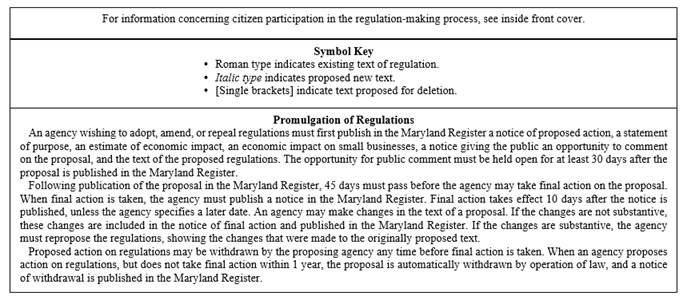 \
\
Title 01
EXECUTIVE DEPARTMENT
Subtitle 02 SECRETARY OF STATE
01.02.04 Charitable
Organizations: Substantive Regulations
Authority: Business Regulation Article, §§6-204 and 6-407(f),
Annotated Code of Maryland
Notice of Proposed Action
[25-242-P]
The Secretary of State proposes to adopt new Regulation .22
under COMAR 01.02.04 Charitable Organizations: Substantive Regulations.
Statement of Purpose
The purpose of this action is to adopt a new regulation to
administer changes to the law regarding the ability of the Secretary of State
to waive or suspend late fees. This action puts into regulation long-standing
practices of the Secretary of State with regards to reviewing and making
determinations about requests from charitable organizations to waive or suspend
late fees; creating guidelines for how to request a late fee waiver or
suspension for a charitable organization; and listing factors that the Secretary
of State may consider when making a determination about a request.
Estimate of Economic Impact
The proposed action has no economic impact.
Economic Impact on Small Businesses
The proposed action has minimal or no economic impact on small
businesses.
Impact on Individuals with Disabilities
The proposed action has no impact on individuals with disabilities.
Opportunity for Public Comment
Comments may be sent to Michael Schlein, Director, Charities and
Legal Services Division, Office of the Secretary of State, 16 Francis Street,
Annapolis, MD 21401, or call 410-260-3863, or email to
[email protected]. Comments will be accepted through December 15,
2025. A public hearing has not been scheduled.
.22 Late Fee Waiver or Suspension.
A. A charitable organization may request the Secretary of State
to waive or suspend a late fee.
B. A request to waive or suspend a late fee must:
(1) Be in writing;
(2) Explain the cause or causes of the charitable organization’s
late filing; and
(3) To the extent such late filing was reasonably preventable,
explain what has been or will be done to prevent future late filings.
C. In addition to the written request submitted in accordance
with §B of this regulation, the Secretary of State may consider, among other
factors and without limitation, the following when determining whether to grant
a request to waive or suspend some or all of a late fee:
(1) Whether the charitable organization has submitted all
required outstanding annual reports to the Secretary of State;
(2) Whether the charitable organization’s registration history
includes previous late filings;
(3) Whether the charitable organization already paid some of the
late fee;
(4) Whether the charitable
organization previously asked for and was granted a late fee waiver or
suspension; and
(5) Whether the charitable organization has the ability to pay
the late fee.
D. If the Secretary of State makes a determination to waive or
suspend some of the late fee, the charitable organization must pay any
remaining late fee within 30 days of notification of the Secretary’s decision.
E. Failure of a charitable organization to fully comply after
being granted partial waiver or suspension of a late fee will result in
revocation of the late fee waiver or suspension.
F. A partial or complete denial of a late fee waiver or
suspension request is not an adverse action under COMAR 01.02.03.05.
SUSAN C. LEE
Secretary of State
Title 07
DEPARTMENT OF HUMAN SERVICES
Subtitle 05 SOCIAL SERVICES
ADMINISTRATION PRIVATE CHILD PLACEMENT AGENCIES
Notice of Proposed Action
[25-244-P]
The Department of Human Services proposes to:
(1) Amend Regulations .02,
.09, .14, and .17 under COMAR 07.05.01 License for
Private Child Placement Agencies; and
(2) Amend Regulations .02 and
.13 under COMAR 07.05.02 Private Foster Care.
Statement of Purpose
The purpose of this action is to bring Maryland into compliance
with the Social Security Act's Title IV-E requirement that convictions for
crimes of violence disqualify prospective foster parents from being certified
as foster parents by private child placement agencies.
Estimate of Economic Impact
The proposed action has no economic impact.
Economic Impact on Small Businesses
The proposed action has minimal or no economic impact on small
businesses.
Impact on Individuals with Disabilities
The proposed action has no impact on individuals with disabilities.
Opportunity for Public Comment
Comments may be sent to Daniel Cohen, Legislative Analyst,
Department of Human Services, 25 S. Charles Street Baltimore, MD 21201-3330, or
call (443) 610-5619, or email to [email protected]. Comments
will be accepted through December 15, 2025. A public hearing has not been
scheduled.
07.05.01 License for Private Child Placement
Agencies
Authority: Human Services
Article, §2-209, Annotated Code of Maryland
Agency
Note: Federal Regulatory Reference: 42 U.S.C. §621 et seq.; 45 CFR 1355—1357
.02 Definitions.
A. (text unchanged)
B. Terms Defined.
(1)—(5)
(text unchanged)
(6) “Criminal
background check” means finger-print based record checks of the criminal
history record information maintained by the State and the criminal history
record information in national crime information databases.
[(6)] (7)—[(10)] (11) (text unchanged)
.09 Screening Employees, Volunteers, and Governing Board Members.
A. Before agency
employment or approval as a volunteer or governing board member, any applying
employee, volunteer, or governing board member who is in close proximity to
children as part of the authorized function of the position is subject to a:
(1) State and federal
criminal background [investigation] check; and
(2) (text unchanged)
B. The agency
shall reject the applying employee, volunteer, or governing board member [shall
be rejected] if:
(1) (text unchanged)
(2) The applicant
refuses to consent to a required criminal background [investigation] check and child protective services clearance;
(3) (text unchanged)
(4) A criminal
background check reveals that an applicant has had a conviction [for]:
(a) [Child]
For child abuse or neglect, a domestically related assault or
battery, any crime against children, rape, sexual assault, sexual offense, [or] homicide, human trafficking, or a crime of violence as defined in Family Law
Article, §5-101, Annotated Code of Maryland;
or
(b) [Assault] Within the 5 years before the application date, for misdemeanor assault or battery that is not
domestically related or a felony offense related to a controlled dangerous
substance [in the 5 years before the application date].
C. Application Restrictions.
(1) Pending
Child Abuse or Neglect Investigation.
(a) If the applicant has a pending
child abuse or neglect investigation, the agency may not proceed with the
application.
(b) The agency may decide to proceed
with the application after the investigation is completed.
(2)
Unresolved Criminal Charge.
(a) If an
applicant has an unresolved criminal charge for a crime listed in §B(4) of this
regulation, the agency may not proceed with the application.
(b) The
agency may decide to proceed with the application after the charge is resolved.
D. (text unchanged)
.14 Employee
Qualifications.
A. [Before offering employment, the agency shall verify the
potential employee's personal] All agency employees shall meet the
qualifications pursuant to this regulation and Regulations .09 and .13 of this
chapter.
B.—C. (text unchanged)
.17 Contractual,
Professional, Volunteer, and Student Services.
A. Contractual
Services.
(1) An individual employed by the agency who is
not a full-time employee shall be bound by the provisions of a contract with
the agency to provide specific, ethical, consistent, and appropriate services.
(2) A contractual employee shall:
[(1)] (a)—[(8)] (h) (text
unchanged)
B. Professional
Services.
(1) The agency shall,
with the concurrence and support of a child's parent or legal custodian, obtain
or document the attempt to obtain professional services that are not available
within the agency as required by the child's individual case plan.
(2) The agency shall ensure that any professional
providing a direct service to a child in care:
(a)—(b)
(text unchanged)
[(2)] (3) The agency shall
document that all professionals providing services to the agency, whether
working directly with children in care or providing consultation to employees
of the agency:
(a)—(b)
(text unchanged)
C. Volunteers. An
agency may use volunteers, including students for field placements or
internships, to perform tasks and duties in the agency and shall:
(1) Develop a written
plan for the use of volunteers that includes:
(a) A description of
duties and responsibilities for volunteers[,];
(b)—(c)
(text unchanged)
(d) The method and
frequency with which the agency will evaluate its volunteers; [and]
(2) Require personal
references, criminal background [investigations] checks, and health checks as required in Regulation .09 of
this chapter;
(3)—(5) (text unchanged)
D. Student Services.
An agency that accepts students for field placements or internships shall:
(1) Have a written
agreement with the student’s school that includes:
(a)—(c)
(text unchanged)
(d) A plan for
orientation and training of the student in the philosophy of the agency, needs
of the children in care and their families, and confidentiality requirements; and
(e) (text unchanged)
(2) (text unchanged)
07.05.02 Private Foster Care
Authority: [Family Law Article, §§5-501—5-503, 5-313,
5-524—5-534, 5-560, and 5-701 et seq.; Courts and Judicial Proceedings Article,
§3-801 et seq.;] Human Services Article, §2-209, Annotated Code
of Maryland
Agency Note: Federal Regulatory Reference: 42 U.S.C. §621 et seq.;
45 CFR 1355—1357
.02 Definitions.
A. (text unchanged)
B. Terms Defined.
(1)—(3) (text unchanged)
(4) “Household” means the home where the applicant or licensed
foster parent lives.
(5) “Household member” means an individual who lives in or is
regularly present in a household.
[(4)] (6)—[(8)] (10) (text
unchanged)
.13 Recommendation for
Certification.
A. The agency's chief administrator or designee shall:
(1)—(2) (text unchanged)
(3) [Deny
certification if an applicant for foster parent certification] Deny
the certification of an applicant as a foster parent or a certified foster
parent’s ability to maintain their certification if the applicant, foster
parent, or any of the applicant’s or foster parent’s household members aged 18
or older:
(a)—(b) (text
unchanged)
[(c) Has a felony conviction for child abuse or neglect,
spousal abuse, a crime against children, rape, sexual assault, human
trafficking, or homicide;
(d) In the 5 years before the date of application for foster parent
certification, has a felony conviction for physical assault, battery, or a
drug-related offense; or]
(c) Has a conviction:
(i) For child abuse or neglect, a domestically related assault
or battery, any crime against children, including child pornography, rape,
sexual assault, sexual offense, homicide, human trafficking, or a crime of
violence as defined in Family Law Article, §5-101, Annotated Code of Maryland;
or
(ii) Within the 5 years before the application date, for
misdemeanor assault or battery that is not domestically related or a felony
offense related to a controlled dangerous substance; or
[(e)] (d) (text
unchanged)
(4) [If a child abuse or neglect investigation is in process,
postpone the decision on certification until the investigation is complete]
Deny foster parent certification if
an applicant has:
(a) A child abuse or neglect investigation that remains
unresolved 120 days after the date on the signed application; or
(b) Any pending criminal charge listed in §A(3)(c) of this regulation that remains unresolved 120 days after the
date on the signed application;
(5)—(8) (text unchanged)
B.—C. (text unchanged)
RAFAEL LÓPEZ
Secretary
Title 09
MARYLAND DEPARTMENT OF LABOR
Subtitle 12 DIVISION OF LABOR AND INDUSTRY
09.12.66 Inflatable Amusement Attractions
Authority: Business Regulation Article, §§3-302, 3-307, 3-313,
Annotated Code of Maryland
Notice
of Proposed Action
[25-146-P-I]
The Commissioner of Labor and Industry
proposes to amend Regulations .02 and .03, adopt new Regulation .09,
amend and recodify existing Regulations .09—.16 and .18—.19 to be
Regulations .10—.17 and .19—.20, respectively, and recodify
existing Regulation .17 to be Regulation .18 under COMAR
.09.12.66 Inflatable Amusement Attractions. This action was considered at a
public meeting of the Maryland Amusement Ride Safety Board held on June 2, 2025
notice of which was provided by posting on the Maryland Department of Labor
website pursuant to General Provisions Article §3-302(c)(3), Annotated Code of
Maryland.
Statement
of Purpose
The purpose of this action is to incorporate
by reference the American Society for Testing and Materials, F2374-22 and amend
related regulations to include reference to applicable sections of F2374-22,
amend to include certain defined terms, clarify certain requirements related to
weather and anchorage, amend certain reporting requirements, update fire
extinguisher requirements and amend to clarify location and clearance
requirements.
Estimate
of Economic Impact
The proposed action has no economic impact.
Economic
Impact on Small Businesses
The proposed action has minimal or no
economic impact on small businesses.
Impact
on Individuals with Disabilities
The proposed action has no impact on
individuals with disabilities.
Opportunity
for Public Comment
Comments may be sent to Jack Mirabella ,
Senior Policy Advisor, Division of Labor and Industry, Maryland Department of
Labor, 10946 Golden West Drive, Hunt Valley, Maryland 21031, or call
443-806-1116, or email to [email protected]. Comments
will be accepted through December 15, 2025. A public hearing has not been
scheduled.
.02 Incorporation by Reference.
In this chapter, the following documents are
incorporated by reference to the extent that they are referenced in this
chapter:
A. [The ASTM International Standards on
Amusement Rides and Devices: 7th Edition, F2374-04 Standard Practice for
Design, Manufacture, Operation, and Maintenance of Inflatable Amusement Devices
(2004) (ASTM F2374-04)] The ASTM
International Standards on Amusement Rides and Devices: F2374-22 Standard
Practice for Design, Manufacture, Operation, and Maintenance of Inflatable
Amusement Devices (2022) (ASTM F2374-22); and
B. The National Electrical Code, ANSI/NFPA
#70-[2005] 2020, which is
incorporated by reference in COMAR 20.50.02.02.
.03 Definitions.
A. (text unchanged)
B. Terms Defined.
(1)—(10) (text unchanged)
(11) “Permanently erected inflatable amusement attraction” means an
inflatable amusement attraction erected in the same location for more than 30
consecutive days.
[(11)](12)—[(13)](14) (text unchanged)
(15) “Sustained wind speed” means wind speed
determined by averaging observed values over a two minute period.
[(14)] (16) (text unchanged)
(17) “Wind gust” means a rapid fluctuation of wind
speed determined by averaging observed values over a two minute period.
.09 Applicability
of ASTM F2374-22.
A. For an inflatable amusement attraction
manufactured after January 1, 2026, in addition to the requirements of this
chapter, the requirements of ASTM F2374-22 shall apply.
B. For an inflatable amusement attraction
manufactured before January 1, 2026, in addition to the requirements of this
chapter, ASTM F2374-22 shall apply except Sections 5.5.5, 5.5.5.1, 5.13, and
6.1.3.
[.09] .10
Operation.
A. (text unchanged)
B. [Except as provided in §C of this
regulation, an owner shall ensure that an inflatable amusement attraction is
operated in accordance with ASTM F2374-04.6.
C.] The owner shall set up and operate
an inflatable amusement attraction in accordance with the following:
(1) Owner requirements for setting up
inflatables amusement attractions.
(a) [Inflatable]
An inflatable amusement [attractions may] attraction shall not be operated when the maximum
sustained wind speed is [25] 15
mph or greater; or
(b) When there are wind gusts lasting 3 seconds
or longer with wind speed of 25 mph or greater in the immediate area where the
inflatable attraction is being operated.
(2)
(text unchanged)
(3) Blowers and inflation tubes shall be
positioned to prevent kinks or bends in the inflation tube; and
(4) [Blowers and inflation tubes may not
impede the ingress to or egress from the inflatable amusement attraction; and
(5)] Inflatable amusement attractions shall be
anchored or secured in accordance with the manufacturer’s specifications or the
following requirements:
(a)—(c) (text unchanged)
(d) Each anchor must be:
(i) At least 1 inch in diameter; and
(ii) Solid in composition;
[(d)](e)
Anchors can be straight stakes, screw stakes, ground weights, or sandbag
ground anchors, and must comply with the following:
(i) If straight stakes are used, they must [range
from 30 inches to 42] be at least
36 inches in length with at least 75 percent or more of the length in the
ground; and
(ii) (text unchanged)
[(e)](f) (text unchanged)
[(f)](g) Tie-downs should not be attached to
motor vehicles; [and]
[(g)](h) Tie-downs should comply with
manufacturer’s specifications or have a minimum tensile strength of 3,700
pounds or 370 pounds safe working load[.];
and
(5) Permanently erected inflatable amusement
attractions shall comply with the following:
(a) The manufacturer’s specifications;
(b) The requirements of ASTM F2374-22.5.6.9.1;
(c) The requirements in subsections B.(1)—(4)
of this subsection; and
(d) If erected with stakes or bolts, the
stakes or bolts shall be inspected prior to each operation to ensure:
(i) Secure anchorage;
(ii) No corrosion of anchorage; and
(iii) No debris near anchorage.
C. Weather conditions and forecast for the zip
code area where the inflatable amusement attraction is operated shall be:
(1)
Set up monitoring.
(a) Monitored prior to set up of the
inflatable amusement attraction; and
(b) Recorded in a written log as provided for
in Section 12(d)(2) of this regulation;
(2) Monitored periodically during operations
using a National Oceanic and Atmospheric Administration weather radio
application or source similar in reliability.
D. Wind speeds shall be monitored prior to the set up of an inflatable amusement attraction and
periodically during operation using an anemometer or other reliable method.
[D.] E. (text unchanged)
[E.] F. General Owner Obligations.
(1) [The owner shall have a prohibition on the
use of drugs and alcohol for operators and attendants during the performance of
their duties.
(2) The owner shall prevent the use of an
inflatable amusement attraction when the attraction is not in operation.] An owner shall comply with ASTM
F2374-22.7.4.
[(3)](2)—[(4)](3) (text unchanged)
[F.] G. Operators.
(1) The owner shall ensure each inflatable
amusement attraction:
(a) [is]
Is under the direct control of an operator who has been trained in
the operation of the assigned inflatable amusement attraction[.]; and
(b) Has the appropriate number of operators in
the appropriate locations as provided for by the manufacturer’s specifications.
(2) The owner shall ensure that a designated
operator:
(a)—(d) (text unchanged)
(e) Has control of the inflatable amusement
attraction at all times; [and]
(f) Enforces applicable restrictions[.]; and
(g) Has no other distractions from the
operator’s responsibilities.
[G.] H. Operator and Attendant
Identification.
(1)—(2) (text unchanged)
(3) Before issuing any identification, the
owner shall train the operator and the attendant in accordance with §[H] I of this regulation.
[H.] I. Operator and Attendant Training.
[(1) The owner shall
provide training to each operator and attendant of an inflatable amusement
attraction.
(2) An owner shall train operators and
attendants in the following:
(a) Specific inflatable amusement attraction
operational policies and procedures consistent with the manufacturer’s
instructions;
(b) Specific duties and responsibilities of
the operator and the attendant;
(c) Emergency procedures in the event of an
abnormal condition, interruption of power, or severe environmental conditions;
(d) Instructions on general safety procedures;
and
(e) Additional instructions considered
necessary by the owner.]
(1) An owner shall comply with the
requirements of ASTM F2374-22.7.8 regarding operator and attendant training;
(2) An operator or attendant shall be trained
on how to monitor the local weather including assessing the wind speeds using
an anemometer or other reliable method; and
(3)
(text unchanged)
[I.] J. Daily Inspection Program.
[(1) The owner shall
ensure that each inflatable amusement attraction is inspected and tested by a
qualified person each day before operation, with a daily preopening inspection
program that complies with this subsection.
(2) The daily preopening inspection program
shall include, but not be limited to, the following:
(a) Inspection and testing of all
user-carrying devices, including tie-downs, anchors, blowers, and electrical
systems;
(b) Inspection and testing of all automatic
and manual safety devices;
(c) Inspection and testing of control devices,
and other equipment provided for safety;
(d) Visual inspection of all fencing, gates,
and guardrails;
(e) Visual inspection of the inflatable
amusement attraction structure, supports, electrical components, and wiring;
(f) Inspection of entrances, exits, stairways,
ramps, and the area surrounding the inflatable amusement attraction; and
(g) Confirmation of functioning communication
system and, where necessary, testing of all communication equipment.]
(1) An owner shall comply with the
requirements of ASTM F2374-22.7.7, except Section 7.7.4;and
(2) Worn and damaged components shall be
repaired or replaced immediately and before operation.
(3)—(4) (text unchanged)
[(5) Worn and damaged
components shall be repaired or replaced immediately and before operation.]
[.10] .11
Injury Reporting and Recording.
A. Injury Reporting.
(1) Whenever a death, in-patient
hospitalization, amputation, compound fracture, broken tooth, or loss of an eye
occurs during the use of an inflatable
amusement attraction:
(a) The person who directly controls the
operation of the inflatable amusement
attraction shall immediately close the inflatable
amusement attraction until it has been inspected by the Commissioner; and
(b) The amusement owner shall report orally or
in writing to the Commissioner within 24 hours:
(i)—(iii) (text unchanged)
(iv) Name and manufacturer of the inflatable amusement attraction;
(v)—(vi) (text unchanged)
(vii) Name, address, and phone number of the inflatable amusement attraction operator
and attendants.
(2) If an owner is unaware of the condition of
a member of the public injured during the operation of an inflatable amusement attraction who was transported away from the
premises by an emergency response vehicle, the owner shall report verbally to
the Commissioner within 24 hours the information required in §A(1)(b) of this
regulation.
B. Injury Recording.
(1) In addition to the reporting requirements
of §A of this regulation, all owners shall maintain an injury log of all
injuries to the public that occur during use of inflatable amusement attractions that require medical treatment by
a physician other than one-time first aid and does not include:
(a)—(b) (text unchanged)
(2) The injury log shall contain the following
information:
(a)—(d) (text unchanged)
(e) Type of inflatable amusement attraction;
(f)—(j) (text unchanged)
(3)—(4) (text unchanged)
(5) An owner shall maintain injury logs on a
calendar year basis [beginning January 1, 2023].
(6) [Beginning January 1, 2024, an]
An owner shall certify the
completeness and accuracy of the information contained on the injury log by
January 15 of the following calendar year.
(7) [Beginning January 1, 2023, an]
An owner shall provide access to
prior years', and the portion completed for the current year, injury log to the
Commissioner.
(8) (text unchanged)
[.11] .12
Records and Reports.
A—C. (text unchanged)
D.
Written Logs.
(1) An owner shall ensure that a written log
is maintained and:
(a) Written log requirements:
(i)
Contain any reports from riders complaining of adverse physical effects or
operating inconsistencies occurring during the operation of an amusement
attraction; and
(ii) Are submitted to the Commissioner when
multiple reports of a particular nature may indicate a pattern are shown in the
log; and
(b) Contains weather reports that reflect
review of the weather forecast prior to each set up of the inflatable amusement
attraction including the date, time, location of operation, and description of
weather conditions.
(2) A copy of the written logs required by
this section shall be made available to the Commissioner upon request.
[.12] .13
Design Criteria.
A. An owner shall ensure that an inflatable
amusement attraction is designed and manufactured in accordance with [the
criteria set forth in ASTM F2374-04.5.] Regulation .09 of this chapter.
B.—C. (text unchanged)
[.13] .14
Access, Egress, and Walking Surfaces.
A.—C. (text unchanged)
[.14] .15
Signage.
[A. When a manufacturer or
the Commissioner requires a restriction on the use of an inflatable amusement
attraction, such as the age or weight of a user, a legible sign indicating the
restriction shall be posted in full view of individuals seeking admission to
the inflatable amusement attraction.
B. The location of the sign shall be:
(1) At the location specified by the
manufacturer;
(2) At the entrance of the inflatable
amusement attraction; or
(3) Close to the inflatable amusement
attraction.] An owner shall comply
with the signage requirements of ASTM F2374-22.7.5.4 excluding “such as, but
not limited to, those listed in 7.9” in Section 7.5.4.1.
[.15] .16
General Environment.
A. Weather-Related and
Environmental Condition Restrictions.
[A.] (1) [All] Except as provided in §A(2)of this
regulation, all manufacturer [wind-related
and] weather-related and environmental condition restrictions
shall be complied with[.]; and
[B.] (2) In the event of lightning, maximum sustained [winds gusting]
wind speed in excess of [25] 15 mph, or wind gusts lasting
3 seconds or longer with wind speed of 25 mph or greater in the immediate area
where the inflatable amusement attraction is operating, a tornado watch, a
severe storm predicted within a 5 mile radius, fire, or other disturbance, an
owner shall implement the following:
[(1)](a) —[(2)](b) (text unchanged)
[C.] B. (text unchanged)
[.16] .17
Fire Protection.
A. (text unchanged)
B. Fire Extinguishers.
(1) An owner shall provide at least one
portable fire extinguisher listed and labeled with a [10-B:C] ABC rating, as defined by the National
Electrical Code, ANSI/NFPA #70, of not less than 10 pound capacity rating.
(2) (text unchanged)
[.18]
.19 Location and Operation.
A. [Assembly and Disassembly.
(1) The assembly and disassembly of an
inflatable amusement attraction shall be performed:
(a) In accordance with the manufacturer’s
procedures and specifications; and
(b) Using only manufacturer specified
components, fasteners, tools, replacement parts, and materials.
(2) During assembly, parts shall be closely
inspected to discover excessively worn or damaged parts.] In addition to the requirements set forth in this section, an owner
shall comply with the installation requirements set forth in ASTM
F2374.22.7562-7.5.6.10.
B. Location.
(1) Placement of the inflatable amusement
attraction at the location where it is to be operated shall ensure that:
[(a) The inflatable
amusement attraction will be on a level and stable surface;
(b)] (a) The inflatable
amusement attraction is compliant with manufacturer specifications;
(b) The inflatable amusement attraction is on a
level and stable surface after consideration of slope, topography and surface
type;
(c) [There is continuous pedestrian
traffic flow] The inflatable
amusement attraction is not placed in a public right of way and away from motor
vehicle traffic; and
(d) [It] The inflatable amusement attraction is accessible by emergency
personnel.
(2) Tie-Downs.
(a) (text unchanged)
(b) The immediate area surrounding the
inflatable amusement attraction shall be clear of:
(i) Trees and shrubs, if they pose a hazard;
(ii) [Trash] Free from debris; and
(iii) (text unchanged)
C. Clearances.
(1) (text unchanged)
(2) Except for conductors supplying power to
the device, an inflatable amusement attraction may not operate under or within
15 feet of any power lines, utilities,
roads, cliffs or bodies of water.
[.19] .20
Electrical Requirements.
A. [Electrical systems, conductors, and
equipment installed on or used in conjunction with inflatable amusement
attractions shall conform to the requirements of the National Electrical Code,
ANSI/NFPA #70-2005.
B. Each owner shall ensure that electrical
systems required to operate the inflatable amusement attractions are maintained
by a qualified person.
C. Wiring Methods.
(1) Flexible cords used with temporary and
portable lights and extension cord sets used in conjunction with inflatable
amusement attractions shall be:
(a) Suitable for location (physical damage);
(b) Suitable for use (outdoor);
(c) Suitable for voltage (insulation rating);
and
(d) Adequate for ampacity (conductor size).
(2) Flexible cords and extension cord sets
shall be continuous without splice or tap between connectors.] In addition to the requirements set forth in
this section, an owner shall comply with the installation requirements set
forth in ASTM F2374-22.2.16.4.
[D.] B. (text unchanged)
DEVKI VIRK
Commissioner of Labor and Industry
Subtitle 37 WORKFORCE DEVELOPMENT AND
ADULT LEARNING
09.37.03 Grant Programs for
the [Law Enforcement Cadet] Public Safety Apprenticeship Program and the
Apprenticeship Career Training Pilot Program for Formerly Incarcerated
Individuals
Authority: Labor and Employment Article, §§11-603 and 11-604,
Annotated Code of Maryland
Notice of Proposed Action
[25-235-P]
The Division of Workforce Development and Adult Learning proposes
to amend Regulations .01, .02, and .08 under COMAR
09.37.03 Grant Programs for the Public Safety Apprenticeship Program and the
Apprenticeship Career Training Pilot Program for Formerly Incarcerated
Individuals.
Statement of Purpose
The purpose of this action is to provide guidance on the Public
Safety Apprenticeship Program. More specifically, the current regulations refer
to the Law Enforcement Cadet Apprenticeship Program, which was updated to be
the Public Safety Apprenticeship Program through the passage of 2024 Maryland
Laws Chapter 709, “Growing Apprenticeships and the Public Safety Workforce
(GAPS) Act” during the 2024 legislative session (Maryland Code Annotated, Labor
and Employment Article, §11-603).
Estimate of Economic Impact
I. Summary of Economic Impact. Public Safety Agencies may
utilize the program to fill workforce vacancies, providing occupations to
jobseekers in those areas and allowing the Public Safety Agencies to more
effectively fulfill their duties.
II. Types of Economic Impact.
|
Impacted Entity
|
Revenue
(R+/R-)
Expenditure
(E+/E-)
|
Magnitude
|
|
A. On issuing agency:
|
NONE
|
|
|
B. On other State agencies:
|
|
|
|
Public Safety Agency
|
(E+)
|
Small
|
|
C. On local governments:
|
|
|
|
Public Safety Agency
|
(E+)
|
Small
|
|
|
Benefit
(+)
Cost
(-)
|
Magnitude
|
|
D. On regulated industries or
trade groups:
|
NONE
|
|
|
E. On other industries or
trade groups:
|
NONE
|
|
|
F. Direct and indirect
effects on public:
|
NONE
|
|
III. Assumptions. (Identified by Impact Letter and Number
from Section II.)
B. Public Safety Agencies within State governments may see an
increase in expenditures due to an increase in staffing associated with the
Program.
C. Public Safety Agencies within local governments may see an
increase in expenditures due to an increase in staffing associated with the
Program.
Economic Impact on Small Businesses
The proposed action has minimal or no economic impact on small
businesses.
Impact on Individuals with Disabilities
The proposed action has no impact on individuals with disabilities.
Opportunity for Public Comment
Comments may be sent to Dylan McDonough, Senior Policy Analyst,
Maryland Department of Labor, 100 S. Charles St., Suite 2000, Tower One,
Baltimore MD 21201, or call 410-767-1890, or email to
[email protected]. Comments will be accepted through December 15,
2025. A public hearing has not been scheduled.
.01 Purpose.
These
regulations prescribe the policies, procedures, and authorizations for
administering the [Law Enforcement Cadet] Public Safety Apprenticeship Program and the Apprenticeship Career Training Pilot
Program for Formerly Incarcerated Individuals.
.02 Definitions.
A. (text unchanged)
B. Terms Defined.
(1)—(5) (text unchanged)
(6) [“Law
enforcement agency” has the meaning set forth in Labor and Employment Article,
§11-603(a)(3), Annotated Code of Maryland.
(7) ] “Program”
means the grant programs for the [Law Enforcement Cadet] Public Safety Apprenticeship Program and the Apprenticeship Career Training Pilot
Program for Formerly Incarcerated Individuals.
(7) “Public
safety agency” has the meaning set forth in
Labor and Employment Article, §11-603(a)(4), Annotated Code of Maryland.
(8) (text unchanged)
.08 Amount of [Law
Enforcement Cadet] Public
Safety Apprenticeship Program
Grant.
A. The maximum amount
that a [Law Enforcement] Public Safety Agency may be
awarded for a Start Up grant [during
a fiscal year] may not exceed [$400,000] $200,000.
B. The maximum amount that a Public Safety Agency may be awarded
for a Stabilization grant may not exceed $5,000 per registered apprentice.
PORTIA WU
Secretary of Labor
Title 10
MARYLAND DEPARTMENT OF HEALTH
Subtitle 01 PROCEDURES
10.01.01 Income Tax Credits
for Preceptors in Areas with Health Care Workforce Shortages
Authority: Tax-General-Article, §10-738, [and] 10-739,
10-739.1, and 10-752, Annotated Code of Maryland
Notice of Proposed Action
[25-232-P]
The Secretary of Health proposes to amend Regulations .02—.06,
.11, and .12, repeal existing Regulations .01,.07—.10,
adopt new Regulation .01, and recodify existing Regulations .11
and .12 to be Regulations .07 and .08 respectively, under COMAR
10.01.01 Income Tax Credits for Preceptors in Areas with Health Care Workforce
Shortages.
Statement of Purpose
The purpose of this action is to update COMAR 10.01.01 in
compliance with House Bill 19/Senate Bill 216, Chapter 416 (2025), which
amended Tax–General Article, §§10-739 and 739.1, Annotated Code of Maryland, to
lower the minimum hours of community-based clinical training from the current
100 rotation hours to 90 rotation hours for program participants precepting
nurse practitioner, registered nurse, and licensed practical nurse students as
previously stated in House Bill 1208,
Chapter 675 (2022). This proposal describes the procedures used by the
Department to administer and manage the Income Tax Credit for Preceptors in
Areas with Health Care Workforce Shortages Programs (Income Tax Credit for
Preceptors program), including the processing of applications and issuance of
income tax credits certificates.
The Income Tax Credit for Preceptors program aims to improve the
healthcare workforce in areas of the State with healthcare workforce shortages
by offering tax credits to licensed healthcare professionals who serve as
preceptors in healthcare workforce shortage areas. The proposed regulations
will streamline the administration and management of the Income Tax Credit for
Preceptors program by adding an appeals process to COMAR 10.01.01, offering an
opportunity for program applicants to challenge the Department’s decision to
disapprove an application in a fair and open process.
In addition, this proposal will amend COMAR 10.01.01 as stipulated
in Tax–General Article, §10-751, Annotated Code of Maryland, under House Bill
1252/Senate Bill 102, Chapter 153 (2021), to expand the definition of
healthcare practitioner to include a list of nursing professions as listed in
House Bill 1208, Chapter 675 (2022), repeal Regulations .07—.10 under current
COMAR 10.01.01, and revise other regulations for efficiency of program
management. The Department views these changes as valuable updates to improve
the administration and performance of the Income Tax Credit for Preceptors
program.
Estimate of Economic Impact
I. Summary of Economic Impact. While the Department is
unable to quantify the extent or magnitude of the economic impact, the
Department anticipates positive economic impacts for both health care
professionals serving as preceptors by expanding the number of eligible student
types who preceptors may qualify to precept for the health care professional to
be eligible for the tax credit. Further, the Department anticipates the
expansion of preceptorship programs in the State will increase the number of
preceptors eligible for these programs, diversify and enhance the student
types, and improve the State’s health care workforce, which reduces the lowers
the number of unfilled health care positions in the State, and positively
impacts the industry.
II. Types of Economic Impact.
|
Impacted Entity
|
Revenue
(R+/R-)
Expenditure
(E+/E-)
|
Magnitude
|
|
A. On issuing agency:
|
NONE
|
|
|
B. On other State agencies:
|
NONE
|
|
|
C. On local governments:
|
NONE
|
|
|
|
Benefit
(+)
Cost
(-)
|
Magnitude
|
|
D. On regulated industries or
trade groups:
|
|
|
|
Health Care Professional Preceptors
|
(+)
|
Indeterminable
|
|
E. On other industries or
trade groups:
|
NONE
|
|
|
F. Direct and indirect
effects on public:
|
|
|
|
General Public
|
(+)
|
Indeterminable
|
III. Assumptions. (Identified by
Impact Letter and Number from Section II.)
D. While the Department is unable to fully quantify the extent of
the economic impact on health care professions serving as preceptors, the
Department anticipates a positive impact on additional health care
professionals who may receive this tax credit.
F. While the Department is unable to fully quantify the extent of
the economic impact on the general public, the Department anticipates that by
authorizing the tax credit for additional student-types, additional students
may be served and thereby, increase the State’s health care workforce.
Additionally, the Department anticipates that more health care professions may
serve as preceptors for additional students.
Economic Impact on Small Businesses
The proposed action has minimal or no economic impact on small
businesses.
Impact on Individuals with Disabilities
The proposed action has no impact on individuals with disabilities.
Opportunity for Public Comment
Comments may be sent to Jordan Fisher Blotter, Director, Office of
Regulation and Policy Coordination, Maryland Department of Health, 201 West
Preston Street, Room 534, Baltimore, Maryland 21201, or call 410-767-0938, or
email to [email protected]. Comments will be accepted through December 15,
2025. A public hearing has not been scheduled.
.01 Purpose.
A. The purpose of this chapter is to establish regulatory
provisions related to the State income tax credit program for the following
qualified health care practitioners who serve as preceptors without
compensation in health care workforce shortage areas:
(1) Physicians;
(2) Advanced practice registered nurses;
(3) Physician assistants;
(4) Registered nurses; and
(5) Licensed practical nurses.
B. This chapter describes the procedures used by the Maryland
Department of Health to assess eligibility of applicants, process applications,
and certify income tax credits for approved applications.
.02 Definitions.
A. (text unchanged)
B. Terms Defined.
(1) “Applicant” means an individual:
(a) Who has submitted an application to the Department [for
an income tax credit for serving as a preceptor] requesting State
income tax credit; and
(b) Whose status for receipt of a tax credit certification
has not yet been determined.
[(2) “Board” means the State Board of Nursing.]
[(3)] (2) (text unchanged).
[(4)] (3) “Health Care Practitioner” means an
individual who is:
[(a) Licensed to practice medicine under Health Occupations
Article, Title 14, Annotated Code of Maryland;
(b) A physician assistant, as defined in Health Occupations
Article, §15-101, Annotated Code Maryland; or
(c) A registered nurse practitioner, as defined in Health
Occupations Article, §8-101, Annotated Code of Maryland.]
(a) A health care practitioner, as defined in Tax-General
Article, §10–752, Annotated Code of Maryland;
(b) An advanced practice registered nurse as defined in Health
Occupations Article, §8-101, Annotated Code of Maryland;
(c) A registered nurse as defined in Health Occupations Article,
§8-101, Annotated Code of Maryland; or
(d) A licensed practical nurse as defined in Health Occupations
Article, §8-101, Annotated Code of Maryland.
[(5)] (4) (text unchanged)
[(6) “Health Personnel Shortage Incentive Grant Program”
means grants to eligible institutions offering educational programs leading to
licensure or certification in health occupations determined to be in short
supply.
(7) “Health professional shortage area” means an area designated by
the Health Resources and Services Administration of the United States
Department of Health and Human Services as having a shortage of primary medical
care providers, dental care providers, or mental health care providers based on
shortages that are geographic or demographic, or based on shortages of
institutional comprehensive health centers, federally qualified health centers,
or public facilities.]
[(8)] (5) (text unchanged)
[(9) “Licensed physician” means an individual who is
licensed to practice medicine under Health Occupations Article, Title 14,
Annotated Code of Maryland.
(10) “Medically Underserved Area” means an area designated by the
Health Resources and Services Administration of the United States Department of
Health and Human Services as having:
(a) Too few primary care providers;
(b) High infant mortality;
(c) High poverty;
(d) High elderly population; or
(e) A combination of §B(9)(a)—(d) of this regulation.
(11) “Medically underserved population” means a population
designated by the Health Resources and Services Administration of the United
States Department of Health and Human Services as having:
(a) Too few primary care providers;
(b) High infant mortality;
(c) High poverty;
(d) High elderly population; or
(e) A combination of §B(10)(a)—(d) of this regulation.
(12) “Nurse practitioner” has the meaning stated in Health
Occupations Article, §8-101, Annotated Code of Maryland.
(13) “Nurse Practitioner Preceptorship Tax Credit Fund” means a
special nonlapsing fund created by a $15 fee for the renewal of a nurse
practitioner certification, regardless of the number of certifications held by
the nurse practitioner.
(14) “Office of Student Financial Assistance” means the office in
the Maryland Higher Education Commission that administers the Health Personnel
Shortage Incentive Grant Program.
(15) “Physician Assistant Preceptorship Tax Credit Fund” means a
special, nonlapsing fund that is not subject to State Finance and Procurement
Article, §7-302, Annotated Code of Maryland, and created by a $15 fee for the
renewal of licenses.]
[(16)] (6) “Preceptor” means a [licensed
physician, who meets the qualifications of a preceptor and provides
instruction, training, and supervision to a medical, nurse practitioner, or
physician assistant, student within a preceptorship program.] health
care practitioner participating in a preceptorship program.
[(17)] (7) “Preceptorship program” [means
an organized system of clinical experience that, for the purpose of attaining
specified learning objectives, pairs:
(a) An enrolled student of a liaison committee on medical
education-accredited medical school in the State or an individual in a
postgraduate medical training program in the State with a licensed physician
who meets the qualifications as a preceptor;
(b) A nurse practitioner student enrolled in a nursing education
program that is recognized by the Board with a nurse practitioner or licensed
physician who meets the qualifications as a preceptor; or
(c) An enrolled student of a physician assistant program in the
State with a health care practitioner who meets the qualifications of a
preceptor.] has the meaning as stated in Tax-General Article,
§§10–738, and 10-752, Annotated Code of Maryland.
[(18)] (8) “Rotation” means a [period
of preceptorship greater than or equal to] minimum of:
(a) 100 hours of community-based clinical training between a:
(i) Medical student and a licensed physician preceptor;
(ii) Physician assistant student and a licensed physician, nurse
practitioner, or physician assistant preceptor in family medicine, general
internal medicine, or general pediatrics practice or setting; or
(b) 90 hours of community-based clinical training between a:
(i) Nurse practitioner student and a licensed physician or nurse
practitioner preceptor;
(ii) A registered nurse student and an advanced practice
registered nurse or registered nurse preceptor; or
(iii) A licensed practical nurse student and an advanced
practice registered nurse, registered nurse, or licensed practical nurse
preceptor.
[(a) 100 hours between a nurse practitioner student
and a licensed physician or nurse practitioner;
(b) 100 hours between a medical student and a licensed
physician; or
(c) 100 hours between a physician
assistant student and a licensed physician, nurse practitioner, or physician
assistant in family medicine, general internal medicine, or general pediatrics.]
[(19)] (9) (text unchanged)
.03 Program Eligibility.
[A. A licensed physician is eligible for an income
tax credit if the individual served without compensation as a:
(1) Physician preceptor in a physician preceptorship program
authorized by an accredited medical school in the State and worked:
(a) A minimum of three rotations, and
(b) In a health care workforce shortage area;
(2) Preceptor in a Board-approved nurse practitioner program and
worked:
(a) A minimum of three rotations and
(b) In a health care workforce shortage area; or
(3) Preceptor in a physician assistant preceptorship program in the
State and worked:
(a) A minimum of three rotations, each consisting of at least 100
hours of community-based clinical training in family medicine, general internal
medicine, or general pediatrics; and
(b) In a health care workforce shortage area.
B. A nurse practitioner is eligible for an income tax credit if the
individual served without compensation as a:
(1) Nurse practitioner preceptor in a Board-approved nurse
practitioner program and worked:
(a) A minimum of three rotations, each consisting of at least 100
hours of community-based clinical training; and
(b) In a health care workforce shortage area; or
(2) Preceptor in a physician assistant preceptorship program in the
State and worked:
(a) A minimum of three rotations, each consisting of at least 100
hours of community-based clinical training in family medicine, general internal
medicine, or general pediatrics; and
(b) In a health care workforce shortage area.
C. A physician assistant is eligible for an income tax credit if
the individual served without compensation as a physician assistant preceptor
in a preceptorship program approved by the Department and worked:
(1) A minimum of
three rotations, each consisting of at least 100 hours of community-based
clinical training in family medicine, general internal medicine, or general
pediatrics; and
(2) In a health care workforce shortage area.]
A healthcare practitioner preceptor in a preceptorship program
is eligible for an income tax credit if the individual served:
A. Without compensation for a minimum of three rotations; and
B. In a health care workforce shortage area.
.04 Application [and Application Process] Procedures.
A. Applicant.
(1) [An applicant shall submit:
(a) A completed application to the Department on the form
designated by the Department; and
(b) Supporting documentation required by the Department.]
By the published deadlines, on the form designated by the Department, an
applicant shall:
(a) Submit a complete application to the Department;
(b) Facilitate submission of application components by all
contributors; and
(c) Provide any supporting documentation as requested by the
Department.
(2) (text unchanged)
(3) An applicant may submit a new application subject to [§C]
§B of this regulation.
[B.] C. The Department shall:
(1) [Approve] Accept applications received during
the application period for Department review;
(2) Approve the application if the:
(a) Application is complete; [and]
(b) Applicant is determined to be eligible; and
(c) Funds are available in the appropriate Fund based on
precepted student type;
(3) Disapprove [the] an application if the application:
[(a) Application is incomplete;]
[(b)] (a) [Applicant fails] Fails
to provide sufficient information or comply with requested documentation
to determine eligibility;
(b) Has the appropriate documentation but is determined to be
ineligible; or
(c) [Applicant provides the appropriate documentation but is
determined ineligible] Does not satisfy the requirements established
by law or the Department; and
(4) Provide the applicant with written notice of the final
disposition of the application within 45 calendar days of receipt of an
application.
[C.] B. The Department shall receive
applications by January 5 for the previous taxable year during which [the
rotation was] rotations were completed.
D. Appeal of Disapproval of Application.
(1) An applicant may appeal the decision to disapprove an
application by submitting an appeal request in writing to the Department within
30 calendar days of the date on the notice of the disapproved application.
(2) If an applicant submits an appeal, the Department, within 60
calendar days of receipt of the appeal, shall:
(a) Sustain or reverse the decision on the application; and
(b) Provide written notice to the applicant:
(i) Indicating whether the decision on the application has been
sustained or reversed; and
(ii) Providing an explanation of the decision.
(3) An applicant may request a hearing within 10 calendar days
after the date of written notice of the Department’s disapproval of an
application as stated in §D(2) of this regulation. Following receipt of the
request, the Department shall follow hearing procedures in accordance with
COMAR 10.01.03.
(4) Failure to be present for the hearing without prior notice,
communication, or approval from the Department may result in:
(a) The appeal nullified and decision sustained;
(b) The hearing on the appeal not being rescheduled; or
(c) Appropriate sanctions as determined by the Department.
.05 Verification and Audit of Income Tax Credits.
A. The Department may:
(1) Request from an applicant [or preceptor]
additional information to verify statements in an application [for an
income tax credit]; and
(2) (text unchanged)
B. (text unchanged)
.06 Income Tax Credits.
[A. On approval of an application, the Department shall
issue an income tax credit certificate to the approved licensed physician in
the amount of $1,000 for each medical student rotation for which the physician
served as a preceptor:
(1) For a minimum of three rotations, each consisting of 100 hours
of community-based clinical training;
(2) Without compensation; and
(3) In a health care workforce shortage area.
B. On approval of an application, the Department shall issue an
income tax credit certificate to the approved nurse practitioner or licensed
physician in the amount of $1,000 for each nurse practitioner student rotation
for which the nurse practitioner or licensed physician served as a preceptor:
(1) For a minimum of three rotations, each consisting of 100 hours
of community-based clinical training;
(2) Without compensation; and
(3) In a health care workforce shortage area.
C. On approval of an application, the Department shall issue an
income tax credit certificate to a physician assistant in the amount of $1,000
for each physician assistant student rotation for which the physician assistant
served as a preceptor:
(1) For a minimum of three rotations, each consisting of at least
100 hours of community-based clinical training in family medicine, general
internal medicine, or general pediatrics;
(2) Without compensation; and
(3) In a health care workforce shortage area.]
A. On approval of an application, the Department shall issue an
income tax credit certificate to the approved healthcare practitioner in the
amount of $1,000 for each qualifying student rotation for which the healthcare
practitioner served as a preceptor.
[D.] B. Income tax credits shall be issued for
the taxable year [as a preceptor] of the application during
which the [nurse practitioner, licensed physician, or physician
assistant] health care practitioner served without compensation.
[E.] C. The total amount of an income tax
credit allowed for an individual in a taxable year may not exceed the:
(1) Maximum credit amount [of $10,000] as
indicated in Tax-General Article, §§10–738, 10-739, 10-739.1, and 10-752,
Annotated Code of Maryland; or
(2) (text unchanged)
[F.] D. Any unused amount of an income tax
credit for a taxable year may not be carried over to any other taxable year
by the preceptor, as referenced in Tax-General Article, §§10–738, 10-739,
10-739.1, and 10-752, Annotated Code of Maryland.
[.11] .07 Responsibilities of the Comptroller.
On notification that an income tax credit certificate has been
issued by the Department, the Comptroller shall transfer an amount equal to the
income tax credit amount stated in the income tax credit certificate from the
Nurse Practitioner Preceptorship Tax Credit Fund, [or]
the Physician Assistant Preceptorship Tax Credit Fund, or [both,] Licensed
Practical Nurse and Registered Nurse Preceptorship Tax Credit Fund, to the
General Fund.
[.12] .08 Expiration of Program.
[A.] B. This chapter remains in effect until [the
earlier of]:
(1) (text unchanged)
(2) [June 30,
2026] Sunset on June 30, 2030.
[B.] A. (text unchanged)
MEENA
SESHAMANI, MD, PHD
Secretary of Health
Subtitle 01
PROCEDURES
10.01.22 Maryland Loan
Assistance Repayment Program for Physicians and Physician Assistants
Authority: Health-General Article, § 24–1701—24-1708, ; and
Health Occupations Article, §§14–207 and 15–206(c), Annotated Code of Maryland
Notice of Proposed Action
[25-217-P]
The Secretary of Health proposes to adopt new Regulations .01—.10
under a new chapter, COMAR 10.01.22 Maryland Loan Assistance Repayment
Program for Physicians and Physician Assistants.
Statement of Purpose
The purpose of this action is to satisfy the requirement of House
Bill 998/Senate Bill 501, Chapter 403 (2020), mandating the Department to
develop regulations for the implementation of the Maryland Loan Assistance
Repayment Program for Physicians and Physician Assistants program, which aims
to enhance the healthcare workforce in areas of healthcare workforce shortages
across the state. The proposed regulations will establish regulatory language
in the assessment of eligibility of potential participants and practice sites,
identify eligible applications for review for program awards, and issue program
awards to selected participants. These regulations also detailed the
distribution and management of awards, participant obligations and fulfillment
of those obligations, and penalties associated with breach of obligations while
participating in the program.
Estimate of Economic Impact
The proposed action has no economic impact.
Economic Impact on Small Businesses
The proposed action has minimal or no economic impact on small
businesses.
Impact on Individuals with Disabilities
The proposed action has no impact on individuals with disabilities.
Opportunity for Public Comment
Comments may be sent to Jordan Fisher Blotter, Director, Office of
Regulation and Policy Coordination, Maryland Department of Health, 201 West
Preston Street, Room 534, Baltimore, Maryland 21201, or call 410-767-0938, or
email to [email protected]. Comments will be accepted through December 15,
2025. A public hearing has not been scheduled.
.01 Purpose.
The purpose of the Maryland Loan Assistance Repayment Program
for Physicians and Physician Assistants is to improve health care access for
all Marylanders by recruiting and retaining health care providers in areas of
Maryland with health care professional shortages through education loan
repayments assistance to program participants.
.02 Definitions.
A. In this chapter, the following terms have the meanings
indicated.
B. Terms Defined.
(1) “Department” means the Maryland Department of Health.
(2) “Education loan” has the meaning stated in Health-General
Article, §24-1701, Annotated Code of Maryland.
(3) “Eligible field of employment” has the meaning stated in
Health-General Article, §24–1704, Annotated Code of Maryland.
(4) “Full-time” means an individual’s work week consists of 40
or more hours at an eligible practice site.
(5) “Guidelines” means the Maryland Loan Repayment Programs
Guidelines and any subregulatory guidance established by the Department.
(6) “Medical resident” means an individual who has completed
medical school and is participating in a post-graduate residency education
program accredited by the Accreditation Council for Graduate Medical Education,
or its successor, or the American Osteopathic Association, or its successor,
who is not licensed to practice medicine in the State.
(7) “Participant” means an individual who has been offered a
Program award and is under a service obligation with the Program.
(8) “Part-time” means an individual’s work week consists of
between 20 to 39 hours at an eligible practice site.
(9) “Physician” has the meaning stated in Health-Occupations
Article, §14-101, Annotated Code of Maryland, who practices medicine either
full-time or part-time.
(10) “Physician assistant” has the meaning stated in
Health-Occupations Article, §15-101, Annotated Code of Maryland, who practices
full-time or part-time.
(11) “Practice site” means a site where a participant provides
clinical services and fulfills their service obligation.
(12) “Primary care” has the meaning stated in Health-General
Article, §24-1701, Annotated Code of Maryland.
(13) “Program” means the Maryland Loan Assistance Repayment
Program for Physicians and Physician Assistants.
(14) “Promissory Note” means a contractual agreement between a
participant and the Department describing disbursement methods, participant
roles and responsibilities, compliance penalties, and other terms as determined
by the Department.
(15) “Service Obligation Agreement” means a contractual
agreement between a participant and the Department specifying participant
service obligations, total and annual Program award amounts, required data and
verifications, penalties for breach, and other terms as determined by the
Department.
.03 Program Eligibility.
A. Eligibility. To be eligible for the program the individual
shall:
(1) Meet the licensure requirements set forth in §B of this
regulation;
(2) Be a United States citizen or national;
(3) Be liable and personally owe educational debt;
(4) Have a valid employment contract with an eligible practice
site in the State that will be in effect by the start of any service obligation
to be fulfilled;
(5) Provide evidence of practice as either part-time or
full-time at that eligible practice site;
(6) Practice full-time or part-time providing health care
services at an eligible practice site, with at least 80 percent of time spent
in direct patient care for a minimum of 45 weeks per year; and
(7) Utilize Program funds for the repayment of eligible
education loans.
B. Licensure Requirements. To be eligible for the program, an
individual shall be one of the following:
(1) A physician possessing active and valid licensure without
restrictions or encumbrances to practice Allopathic Medicine in the State;
(2) A physician possessing active and valid licensure without
restrictions to or encumbrances to practice Osteopathic Medicine in the State;
(3) A physician assistant possessing active and valid licensure
without restriction or encumbrances in the State; or
(4) A final year medical resident who is specializing in primary
care and overseen by a postgraduate training program in the State.
C. Eligibility Restrictions. An individual may not be eligible
for the Program if they have:
(1) A federal or state judgment lien;
(2) Defaulted on any federal or state payment obligations even
if the governmental creditor now considers them to be in good standing;
(3) Breached a prior service obligation to federal, state, or
local government or other entity, even if the obligation is subsequently
satisfied;
(4) Any federal or non-federal debt written off as uncollectible
or received a waiver of any service or payment obligation;
(5) Any outstanding contractual obligations for a health care
professional service to the federal government, another state loan repayment
program, or other entity unless those service obligations are completely
satisfied prior to the commencement of the Program service obligation; and
(6) Received the two maximum awards for service obligations to
the Program.
D. Eligible Practice Sites. An eligible practice site shall:
(1) Be an eligible field of employment in accordance with
Health-General Article, §24–1704, Annotated Code of Maryland;
(2) Be physically located in the State;
(3) Provide services to all patients regardless of their ability
to pay;
(4) Charge for health care professional services at the usual
and customary prevailing rates except for free clinics;
(5) Utilize a financial aid policy of discounts or sliding fee
scale for individuals with limited incomes; and
(6) If applicable to the patient type, accept reimbursement from
Medicare, Maryland Medicaid, and the Maryland Children’s Health Insurance
Program.
.04 Application Procedures.
A. By the published deadlines, on the form designated by the
Department, an applicant shall:
(1) Submit a complete application to the Department;
(2) Facilitate submission of application components by all
contributors; and
(3) Submit any supporting documentation as requested by the
Department.
B. The Department shall disapprove an application if the
application:
(1) Fails to provide sufficient information or comply with
requested documentation;
(2) Has the appropriate documentation but is determined to be
ineligible; or
(3) Does not satisfy the requirements established by law or the
Department.
.05 Participant Selection.
A. The Department shall:
(1) Assess applicant eligibility based on documentation received
by the published deadline;
(2) Require from an applicant additional documentation or use
independent verification means to verify information in the application; and
(3) Score an eligible application based on priority criteria in
accordance with:
(a) Health-General Article, §24–1705, Annotated Code of
Maryland; and
(b) The guidelines established by the Department.
B. An applicant shall respond to an award offer by submitting
all required documentation to the Department within 90 calendar days of notice
of award.
C. Failure of the applicant to provide required documentation
shall result in:
(1) An application determined as ineligible; or
(2) Cancellation of any offered awards.
D. Appeal of Disapproval of Application.
(1) An applicant may appeal the decision to disapprove an
application by submitting an appeal request in writing to the Department within
30 calendar days of the date on the notice of the disapproved application.
(2) If an applicant submits an appeal, the Department, within 60
calendar days, shall:
(a) Sustain or reverse the decision on the application; and
(b) Provide written notice to the applicant:
(i) Indicating whether the decision on the application has been
sustained or reversed; and
(ii) Providing an explanation of the decision.
(3) An applicant may request a hearing within 10 calendar days
after the date of written notice of the Department’s disapproval of an
application as stated in §D(2) of this regulation. When the Department receives
the request, it will follow hearing procedures in accordance with COMAR
10.01.03.
(4) Failure to be present for the hearing without prior notice,
communication, or approval from the Department may result in:
(a) The appeal nullified and decision sustained;
(b) Hearing on the appeal not rescheduled; or
(c) Appropriate sanctions taken as deemed by the
Department.
.06 Award Distribution.
A. The distribution of Program awards shall be based on the
funding prioritization in accordance with Health-General Article, §24–1704(b),
Annotated Code of Maryland.
B. The Department shall prioritize funding for the repayment of
education loans in accordance with Health-General Article, §24–1705(b),
Annotated Code of Maryland.
C. The Department shall annually determine, based on the
availability of funds:
(1) The maximum number of participants for the Program in each
priority area; and
(2) The minimum and maximum amount of loan repayment assistance
awarded.
D. The amount of award offered and paid shall not exceed the
lesser of:
(1) The loan repayment amount specified in the Service
Obligation Agreement; or
(2) A participant's total verified debt from eligible education
loans.
.07 Participant Obligation.
A. A participant shall provide the Department with required
documentation including:
(1) Lender verification of education loan balance;
(2) Documentation of employer verification;
(3) A signed Promissory Note that includes:
(a) The disbursement methods utilized by the Department in the
repayment of education loans;
(b) The roles and responsibilities of the participant in the
disbursement of funds to the lender institution;
(c) Penalties for failing to comply with terms and conditions of
agreements with the Department; and
(d) Other terms as determined by the Department;
(4) A Service Obligation Agreement that includes:
(a) Obligations of the participant;
(b) Total and annual amounts of the Program award;
(c) Completion of data and verifications required by the
Department;
(d) Penalties for breach of the Promissory Note and Service
Obligation Agreements;
(e) Incorporation of the Promissory Note and Program Guidelines;
and
(f) Other appropriate terms as determined by the Department; and
(5) All other documentations as requested by the
Department.
B. A participant shall:
(1) Continue to meet the eligibility requirements as stated in
Regulation .03A and B of this chapter; and
(2) Serve a minimum service obligation as stipulated in the
Service Obligation Agreement with the Department.
C. A final year medical resident shall:
(1) Meet all requirements set forth in §A of this regulation;
(2) Complete residency training in primary care, and begin their
service obligation without interruption; and
(3) Fulfill all requirements of §B of this regulation once the
service obligation commences.
.08 Verification of Service Obligation Fulfillment.
A. The Department shall verify annually during Program
participation, the participant’s compliance with:
(1) The Program Promissory Note;
(2) The Service Obligation Agreement; and
(3) Any subregulatory guidelines developed by the Department.
B. A participant shall respond to annual verification by
submitting all required documentation to the Department within 180 calendar
days of request.
C. The Department shall annually receive confirmation from the:
(1) Approved practice site that the participant provided
services in the previous year and continues to practice at the practice site;
and
(2) Lender institution that the participant has an outstanding
education loan balance that is not in default.
D. For a medical resident in their final year of medical
residence, prior to the disbursement of award payment for the first obligation
cycle, the Department shall:
(1) Receive confirmation from the residency training program
that the participant is specializing in primary care; and
(2) Follow the same verification procedures stated in §§A and B
of this regulation once service obligations by the participant commences.
E. Failure to provide required reverification documentation to
the Department will constitute a breach of agreement with the Department.
.09 Breach of Agreement and Penalties.
A. A participant's failure to comply with the Service Obligation
Agreement and Promissory Note shall constitute a breach of agreement with the
Department.
B. A final year medical resident who fails to begin a service
obligation at the start of the next obligation cycle following the completion
of primary care residency training, shall be in breach of the Service
Obligation Agreement and Promissory Note.
C. Penalties for breach of agreement with the Department shall
be stated in the Service Obligation Agreement and Promissory Note, and may
include:
(1) Financial penalties dependent on the funding source of the
award provided to the participant;
(2) The elimination of future eligibility for the Program; or
(3) Referral of the participant to the Maryland Board of
Physicians for investigation of the participant's violation of breach of
service obligation.
.10 Amendments to a Participant’s Service Obligation.
A. Practice Site Transfer.
(1) The Department may consider practice site transfer requests
during a participant’s service obligation period.
(2) A participant shall submit a site transfer request to the
Department for consideration and receive approval of the site transfer from the
Department prior to a participant’s separation from an approved practice site.
(3) A site transfer request may not be submitted until the
second service obligation year.
B. The Department may consider deferment of a participant’s
service obligation or payment obligation for up to 1 year, if determined by the
Department that compliance by the participant with the terms and conditions of
the Service Obligation Agreement would involve extreme hardship as evidenced
through documentation provided to the Department.
C. Any request by a participant for service obligation
amendments shall follow the written process and procedures as established by
the Department in subregulatory guidance.
D. A decision made by the Department upon request for a service
obligation amendment shall be final.
E. The Department may consider cancellation of a participant
service obligation with evidence under the following circumstances:
(1) Illness or injury that prohibits future possibility of
service; or
(2) Death as determined by a death certificate or other
conclusive evidence of death under State law.
MEENA SESHAMANI, MD, PhD
Secretary of Health
Subtitle
01 PROCEDURES
10.01.23 Maryland Loan
Assistance Repayment Program for Nurses and Nursing Support Staff
Authority: Health-General Article, §24–1901—24-1906, Annotated
Code of Maryland
Notice of Proposed Action
[25-218-P]
The Secretary of Health proposes to adopt new Regulations .01—.10
under a new chapter, COMAR 10.01.23 Maryland Loan Assistance Repayment
Program for Nurses and Nursing Support Staff.
Statement of Purpose
The purpose of this action is to satisfy the requirement of House
Bill 975/Senate Bill 696, Chapter 416, (2022), requiring the Department to
develop regulations for the implementation of the Maryland Loan Assistance
Repayment Program for Nurses and Nursing Support Staff, which aims to enhance
healthcare workforce in areas of healthcare workforce shortages across the
state. The proposed regulations will establish regulatory language in the
assessment of eligibility of potential participants and practice sites,
identify eligible applications for review for program awards, and issue program
awards to selected participants. These regulations also detail the distribution
and management of awards, participant obligations and fulfillment of those
obligations, and penalties associated with breach of obligations while
participating in the program.
Estimate of Economic Impact
The proposed action has no economic impact.
Economic Impact on Small Businesses
The proposed action has minimal or no economic impact on small
businesses.
Impact on Individuals with Disabilities
The proposed action has no impact on individuals with disabilities.
Opportunity for Public Comment
Comments may be sent to Jordan Fisher Blotter, Director, Office of
Regulation and Policy Coordination, Maryland Department of Health, 201 West
Preston Street, Room 534, Baltimore, Maryland 21201, or call 410-767-0938, or
email to [email protected]. Comments will be accepted through December 15,
2025. A public hearing has not been scheduled.
.01 Purpose.
The purpose of the Maryland Loan Assistance Repayment Program
for Nurses and Nursing Support Staff is to improve access to care for all
Marylanders by recruiting and retaining health care providers in health care
professional shortage areas of Maryland through the provision of education loan
repayment assistance to eligible participants in exchange for their service
obligations.
.02 Definitions.
A. In this chapter, the following terms have the meanings
indicated.
B. Terms Defined.
(1) “Department” means the Maryland Department of Health.
(2) “Education loan” has the meaning stated in Health-General
Article, §24-1901, Annotated Code of Maryland.
(3) “Eligible field of employment” has the meaning stated in
Health-General Article, §24–1904, Annotated Code of Maryland.
(4) “Full-time” means an individual’s work week consists of 40
or more hours at an eligible practice site.
(5) “Guidelines” means the Maryland Loan Repayment Programs
Guidelines and any subregulatory guidance established by the Department.
(6) “Nurse” has the meaning stated in Health-General Article,
§24–1901, Annotated Code of Maryland.
(7) “Nursing Support Staff” has the meaning stated in
Health-General-Article, §24–1901, Annotated Code of Maryland.
(8) “Participant” means an individual who has been offered a
Program award and is under a service obligation.
(9) “Part-time” means an individual’s work week consists of
between 20 to 39 hours at an eligible practice site.
(10) “Practice site” means a site where a participant provides
clinical services and fulfills their service obligation.
(11) “Program” means the Maryland Loan Assistance Repayment
Program for Nurses and Nursing Support Staff.
(12) “Promissory Note” means a contractual agreement between a
participant and the Department describing disbursement methods, participant
roles and responsibilities, compliance penalties, and other terms as determined
by the Department.
(13) “Service Obligation Agreement” means a contractual
agreement between a participant and the Department specifying participant
service obligations, total and annual Program award amounts, required data and
verifications, penalties for breach, and other terms as determined by the
Department.
.03 Program Eligibility.
A. Eligibility. To be eligible for the Program, a nurse or
nursing support staff shall:
(1) Be liable and personally owe education loan debt;
(2) Be a United States citizen or national;
(3) Have a valid employment contract with an eligible practice
site in the State that will be in effect by the start of any service obligation
to be fulfilled;
(4) Provide evidence of practice as either part-time or
full-time at the eligible practice site;
(5) Practice full-time or part-time providing health care
services at an eligible practice site, with at least eighty percent of time
spent in direct patient care for at least a minimum of 45 weeks per year;
(6) Utilize Program funds for the repayment of eligible
education loans; and
(7) Possess an active and valid certificate or license to
practice nursing or fulfill a nursing support staff role in the State, without
restrictions or encumbrances.
B. Eligibility Restrictions. To be eligible for the Program, a
nurse or nursing support staff may not have:
(1) Federal or State judgment liens;
(2) Defaulted on any federal or State payment obligations even
if the governmental creditor now considers them to be in good standing;
(3) Breached a prior service obligation to federal, State, or
local government or any other entity, even if the obligation is subsequently
satisfied;
(4) Any federal or non-federal debt written off as uncollectible
or received a waiver of any service or payment obligation;
(5) Any outstanding contractual obligations for health care
professional service to the federal government, another state loan repayment
program, or other entities unless those service obligations are completely
satisfied prior to the commencement of the Program service obligation; and
(6) Received the two maximum awards for service obligations to
the Program.
C. Eligible Practice Sites. An eligible practice site shall:
(1) Be an eligible field of employment in accordance with
Health-General Article, §24–1904, Annotated Code of Maryland;
(2) Be physically located in the State;
(3) Provide services to all patients regardless of their ability
to pay;
(4) Charge for health care professional services at the usual
and customary prevailing rates except for free clinics;
(5) Utilize a financial aid policy of discounts or sliding fee
scale for individuals with limited incomes; and
(6) If applicable to the patient type, accept reimbursement from
Medicare, Maryland Medicaid, and the Maryland Children’s Health Insurance
Program.
.04 Application Procedures.
A. By the published deadline, on the form designated by the
Department, an applicant shall:
(1) Submit a complete application to the Department;
(2) Facilitate submission of application components by all
contributors; and
(3) Submit any supporting documentation as requested by the
Department.
B. The Department shall disapprove an application if the
application:
(1) Fails to provide sufficient information or comply with
requested documentation;
(2) Has the appropriate documentation but is determined to be
ineligible; or
(3) Does not satisfy the requirements established by law or the
Department.
.05 Participant Selection.
A. The Department shall:
(1) Assess applicant eligibility based on documentation received
by the published deadline;
(2) Require from an applicant additional documentation or use
independent verification means to verify information in the application; and
(3) Score an eligible application based on priority criteria in
accordance with:
(a) Health-General Article, §24–1905, Annotated Code of
Maryland; and
(b) The guidelines established by the Department.
B. An applicant shall respond to an award offer by submitting
all required documentation to the Department within 90 calendar days of notice
of award.
C. Failure of the applicant to provide required documentation
shall result in:
(1) An application determined as ineligible; or
(2) Cancellation of any offered award.
D. Appeal of Disapproval of Application.
(1) An applicant may appeal the decision to disapprove an
application by submitting an appeal request in writing to the Department within
30 calendar days of the date on the notice of the disapproved application.
(2) If an applicant submits an appeal, the Department, within 60
calendar days, shall:
(a) Sustain or reverse the decision on the application; and
(b) Provide written notice to the applicant:
(i) Indicating whether the decision on the application has been
sustained or reversed; and
(ii) Providing an explanation of the decision.
(3) An applicant may request a hearing within 10 calendar days
after the date of written notice of the Department’s disapproval of an
application as stated in §D(2) of this regulation. When the Department receives
the request, it will follow hearing procedures in accordance with COMAR
10.01.03.
(4) Failure to be present for the hearing without prior notice,
communication, or approval from the Department may result in:
(a) The appeal nullified and decision sustained;
(b) Hearing on the appeal not rescheduled; or
(c) Appropriate sanctions taken as deemed by the Department.
.06 Award Distribution.
A. The distribution of program awards shall be based on the
funding prioritization in accordance with Health-General Article,
§24-1904.1(a), Annotated Code of Maryland.
B. The Department shall prioritize funding for the repayment of
education loans in accordance with Health-General Article, §24–1904.1(b),
Annotated Code of Maryland.
C. The Department shall annually determine, based on the
availability of funds:
(1) The maximum number of participants for the Program in each
priority area; and
(2) The minimum and maximum amount of loan repayment assistance
awarded.
D. The amount of award offered and paid shall not exceed the
lesser of:
(1) The loan repayment amount specified in the Service
Obligation Agreement; or
(2) A participant's total debt from eligible education loans.
.07 Participant Obligation.
A. A participant shall provide the Department with required
documentation including:
(1) Lender verification of education loan balance;
(2) Documentation of employer verification;
(3) A signed Promissory Note that includes;
(a) The disbursement methods utilized by the Department in the
repayment of education loans;
(b) The roles and responsibilities of the participant in the
disbursement of funds to the lender institution;
(c) Penalties for failing to comply with terms and conditions of
agreements with the Department; and
(d) Other terms as determined by the Department;
(4) A Service Obligation Agreement that includes;
(a) Obligations of the participant;
(b) Total and annual amounts of the Program award;
(c) Completion of data and verifications required by the
Department;
(d) Penalties for breach of the Promissory Note and Service
Obligation Agreements;
(e) Incorporation of the Promissory Note and Program Guidelines;
and
(f) Other appropriate terms as determined by the Department; and
(5) All other documentation as required by the Department.
B. A participant shall:
(1) Continue to meet the eligibility requirements as stated in
Regulation 03A and B of this chapter; and
(2) Serve a minimum service obligation as stipulated in the
Service Obligation Agreement with the Department.
.08 Verification of Service Obligation Fulfillment.
A. The Department shall verify annually during Program
participation, the participant’s compliance with:
(1) The Program Promissory Note;
(2) The Service Obligation Agreement; and
(3) Any subregulatory guidelines developed by the Department.
B. A participant shall respond to annual verification by
submitting all required documentation to the Department within 180 calendar
days of request.
C. The Department shall annually receive confirmation from the:
(1) Approved practice site that the participant provided
services in the previous year and continues to practice at the practice site;
and
(2) Lender institution that the participant has an outstanding
education loan balance that is not in default.
D. Failure to provide required reverification documentation to
the Department will constitute a breach of agreement with the Department.
.09 Breach of Agreement and Penalties.
A. A participant's failure to comply with the Service Obligation
Agreement and Promissory Note shall constitute a breach of agreement with the
Department.
B. Penalties for breach of agreement with the Department shall
be stated in the Service Obligation Agreement and Promissory Note, and may
include:
(1) Financial penalties dependent on the funding source of the
award provided to the participant;
(2) The elimination of future eligibility for the Program; or
(3) Referral of the participant to the Maryland Board of Nursing
for further disciplinary actions.
.10 Amendments to a Participant’s Service Obligation.
A. Practice Site Transfer.
(1) The Department may consider practice site transfer requests
during a participant’s service obligation period.
(2) A participant shall submit a site transfer request to the
Department for consideration and receive approval of the site transfer from the
Department prior to a participant’s separation from an approved practice site.
(3) A site transfer request may not be submitted until the
second service obligation year.
B. The Department may consider deferment of a participant’s
service obligation or payment obligation for up to 1 year if determined by the
Department that compliance by the participant with the terms and conditions of
the Service Obligation Agreement would involve extreme hardship as evidenced
through documentation provided to the Department.
C. Any request by a participant for service obligation
amendments shall follow the written process and procedures as established by
the Department in subregulatory guidance.
D. A decision made by the Department upon request for a service
obligation amendment shall be final.
E. The Department may consider cancellation of a participant
service obligation with evidence under the following circumstances:
(1) Illness or injury that prohibits future possibility of
service; or
(2) Death as determined by a death certificate or other
conclusive evidence of death under State law.
MEENA SESHAMANI, MD, PhD
Secretary of Health
Subtitle 19 DANGEROUS DEVICES AND
SUBSTANCES
10.19.04 Prohibition of
Smoking or Vaping in Public Indoor Areas [Open to the Public]
Authority: Health-General Article, §§24-205 and 24-501—24-511,
Annotated Code of Maryland
Notice of Proposed Action
[25-233-P]
The Secretary of Health proposes to amend Regulations .01—.06
and repeal existing Regulation .12 under COMAR 10.19.04 Prohibition
of Smoking or Vaping in Public Indoor Areas.
Statement of Purpose
The purpose of this action is to update regulations for the Clean
Indoor Air Act (COMAR 10.19.04) pursuant to SB 244—Public Health—Clean Indoor
Air Act—Revisions (2024).
Estimate of Economic Impact
I. Summary of Economic Impact. Businesses, State agencies,
and local governments may incur a negligible cost of purchasing a new sign
indicating that no smoking or vaping is allowed. However, businesses can avoid
even this minimal cost by simply printing out a sign that conforms with the
requirements in lieu of commercially produced signage. MDH has developed sign
templates that comply with the new requirements of SB 244. These signs are
available for download from the Clean Indoor Air Act website: https://health.maryland.gov/phpa/OEHFP/EH/pages/clean-indoor-act.aspx.
Signs are available in both English and Spanish.
II. Types of Economic Impact.
|
Impacted Entity
|
Revenue
(R+/R-)
Expenditure
(E+/E-)
|
Magnitude
|
|
A. On issuing agency:
|
|
|
|
Maryland Department of Health
|
(E+)
|
Minimal
|
|
B. On other State agencies:
|
|
|
|
Other State Agencies
|
(E+)
|
Minimal
|
|
C. On local governments:
|
|
|
|
Local Governments
|
(E+)
|
Minimal
|
|
|
Benefit
(+)
Cost
(-)
|
Magnitude
|
|
D. On regulated industries or
trade groups:
|
|
|
|
Businesses with Indoor Areas Open to the Public
|
(-)
|
Minimal
|
|
E. On other industries or
trade groups:
|
NONE
|
|
|
F. Direct and indirect
effects on public:
|
NONE
|
|
III. Assumptions. (Identified by
Impact Letter and Number from Section II.)
A. Assumes that entities do not already have signage which conforms
to the revised signage requirements.
B. See A above.
C. See A above.
D. See A above.
Economic Impact on Small Businesses
The proposed action has minimal or no economic impact on small
businesses.
Impact on Individuals with Disabilities
The proposed action has no impact on individuals with disabilities.
Opportunity for Public Comment
Comments may be sent to Jordan Fisher Blotter, Director, Office of
Regulation and Policy Coordination, Maryland Department of Health, 201 West
Preston Street, Room 534 Baltimore, Maryland 21201, or call 410-767-0938, or
email to [email protected]. Comments will be accepted through December 15,
2025. A public hearing has not been scheduled.
.01 Scope.
A. This chapter establishes regulations that preserve and improve
the health, comfort, and environment of the people of the State by protecting
the public and employees from involuntary exposure to environmental [tobacco] smoke in indoor areas open to the public, except for those
covered by Health-General Article, §24-205, Annotated Code of Maryland.
B. Nothing in this chapter preempts a county or municipal
government from enacting and enforcing more stringent measures to protect the
public from involuntary exposure to environmental [tobacco] smoke
in indoor areas open to the public.
.02 Definitions.
A. (text unchanged)
B. Terms Defined.
(1) (text unchanged)
(2) “Cannabis” has the meaning stated in the Alcoholic Beverages
and Cannabis Article, §1-101, Annotated Code of Maryland.
[(2)] (3) “Club” means a club as defined in [Article
2B, §1-102(a)(4)] Alcoholic Beverages and Cannabis Article, §1-101,
Annotated Code of Maryland.
[(3)] (4)—[(4)] (5) (text
unchanged)
(6) “Electronic smoking device” has the meaning stated in
Business Regulation Article, §16.7-101, Annotated Code of Maryland.
[(5)] (7) “Environmental [tobacco]
smoke” means the[:] complex mixture formed from the:
(a) [Complex mixture formed from the escaping smoke] Smoke
of a burning tobacco [product;], cannabis, or hemp product, or
exhaled by the smoker; or
(b) [Smoke exhaled by a smoker] Aerosol of an
electronic smoking device or exhaled as electronic smoking device aerosol.
[(6)] (8)—[(8)] (10)
(text unchanged)
(11) “Hemp” has the meaning stated in the Agriculture Article,
§14-101, Annotated Code of Maryland.
[(9)] (12) (text unchanged)
[(10)] (13) “Indoor area open to the public”
means:
(a) (text unchanged)
(b) An indoor area of an establishment licensed or permitted under [Article
2B] the Alcoholic Beverages and Cannabis Article, Annotated
Code of Maryland, for the sale or possession of alcoholic beverages.
[(11)] (14)—[(14)] (17)
(text unchanged)
[(15)] (18) “Smoking” means the burning of a
lighted cigarette, cigar, pipe, or another matter or substance [that
contains tobacco] containing, wholly or in part, tobacco, cannabis,
or hemp.
[(16)] (19)
["Tobacco-containing product" includes bidis, cigarettes,
cigars, cigarillos, kreteks, pipes, or another product or device that contains
tobacco] “Tobacco product” has the meaning stated in Health-General
Article, §13-1001, Annotated Code of Maryland.
(20) “Vaping” means the use of:
(a) An electronic smoking device; or
(b) Any device through which the user inhales aerosol containing
tobacco, cannabis, or hemp.
.03 Exclusions.
This chapter does not apply to:
A.—B. (text unchanged)
C. A hotel or motel room rented to one or more guests, if the total
percent of hotel or motel rooms being rented where smoking or vaping is
allowed, does not exceed 25 percent of the guest rooms in the hotel or motel;
D. A retail tobacco business that is a sole proprietorship, limited
liability company, corporation, partnership, or other enterprise, in which:
(1) The primary activity is the retail sale of [tobacco-containing]
tobacco products and accessories; and
(2) (text unchanged)
E. (text unchanged)
F. A research or educational laboratory [in which smoking is
conducted as a part of scientific research into:
(1) The health effects of tobacco smoke; or
(2) The ability of a cigarette to meet fire safety standards] for
the purpose of conducting scientific research into the health effects of
environmental smoke.
.04 Prohibition of Smoking or Vaping.
Except as provided in Regulation .03 of this chapter, an individual
may not smoke or vape in:
A.—F. (text unchanged)
.05 Owner Requirements.
A. The owner of a bar, club as defined in Regulation [.02B(2)]
.02B of this chapter, restaurant, pub, tavern, retail establishment,
theater, concert hall, athletic facility, financial service institution,
government building, educational institution, museum, or library shall:
(1) Prohibit smoking or vaping in an indoor area open to the
public; and
(2) Post a sign indicating where smoking or vaping is
prohibited as set forth in Regulation .06A of this chapter.
B. An owner of a hotel or motel shall:
(1) Prohibit smoking or vaping in an indoor area open to the
public except where smoking or vaping is permitted under Regulation .03C
of this chapter; and
(2) Post a sign indicating where smoking or vaping is
permitted or prohibited, as set forth in Regulation .06B and C of this chapter.
C. An owner of a vehicle listed in Regulation .04D of this chapter
shall:
(1) Prohibit smoking or vaping in the vehicle; and
(2) Post a sign indicating where smoking or vaping is
prohibited as set forth in Regulation .06D of this chapter.
D. An owner of an establishment containing an indoor area open to
the public not listed in Regulation .05A—C of this chapter shall prohibit
smoking or vaping in an indoor area open to the public.
.06 Posting of Signs.
A. An indoor area open to the public and every public entrance to
an indoor area open to the public where smoking or vaping is prohibited
under Regulation .05A of this chapter shall display conspicuously a “NO SMOKING
OR VAPING” sign that conforms to the requirements of Regulation .06E of
this chapter.
B. A hotel or motel room in which smoking or vaping is
permitted shall display a sign containing the words “SMOKING OR VAPING
PERMITTED IN THIS ROOM” conforming to the following requirements:
(1) The words “SMOKING OR VAPING PERMITTED IN THIS ROOM” are
in capital letters;
(2) The background and the print are in contrasting colors; and
(3) The letters “SMOKING OR VAPING PERMITTED IN THIS ROOM”
on the sign are a minimum of 1 inch in height.
C. An indoor area open to the public and every public entrance to
an indoor area open to the public where smoking is prohibited in a hotel or
motel shall display conspicuously a “NO SMOKING OR VAPING” sign that
conforms to the requirements of Regulation .06E of this chapter.
D. A vehicle where smoking is prohibited under Regulation .04D of
this chapter shall display conspicuously a “NO SMOKING OR VAPING” sign
that conforms to the requirements of Regulation .06E of this chapter.
E. Sign Requirements. A “NO SMOKING OR VAPING” sign:
(1) Shall contain[:
(a) The] the words “NO SMOKING OR VAPING” composed of
letters at least one inch in height;
[(b) The international symbol for “No Smoking”, consisting
of a pictorial representation of a burning cigarette enclosed in a circle with
a bar across the circle; or]
(2) May contain the following symbols:
(a) The international symbol for “no smoking”, consisting of a
pictorial representation of a burning cigarette enclosed in a circle with a bar
across the circle;
(b) The international symbol for “no smoking” and pictorial
representation of an electronic smoking device enclosed in a circle with a bar
across the circle or pictorial representations of an electronic smoking device
and a cannabis leaf, enclosed in separate circles, with a bar across each
circle;
(c) A modified international symbol for “No Smoking”, consisting
of a circle with a bar across the circle, with the circle containing pictorial
representations of a burning cigarette and an electronic smoking device or
electronic smoking device and a cannabis leaf; or
(d) Any combination of §E(2)(a)—(c) of this regulation; and
[(c) A combination of the words “NO SMOKING” and the
international symbol for “No Smoking”; and
(2)]
(3) May contain additional information, such as:
(a) The words, “For information on quitting smoking, call
1-800-QUIT NOW (1-800-784-8669)”; [or]
(b) The words “WARNING: TOBACCO SMOKE CAUSES CANCER AND HEART
DISEASE AND CAN HARM YOUR CHILD.”; or
(c) The words “WARNING: CANNABIS SMOKE CAN HARM LUNG TISSUE AND
HAS MANY OF THE SAME CARCINOGENS AS TOBACCO SMOKE.”
F. (text unchanged)
MEENA SESHAMANI, MD, PHD
Secretary of Health
Subtitle 32 BOARD OF PHYSICIANS
10.32.10 Licensure of
Radiation Therapists, Radiographers, Nuclear Medicine Technologists, and Radiologist Assistants
Authority: Health Occupations Article, §14-5B-03, Annotated Code of
Maryland
Notice of Proposed Action
[25-213-P]
The Secretary of Health proposes to amend Regulations .01, .02,
.04, .05, .05-01, .05-02, .07, .08, and
.10—.12 under COMAR 10.32.10 Licensure of Radiation Therapists,
Radiographers, Nuclear Medicine Technologists, and Radiologist Assistants. This action was considered at a public Board
meeting on April 24, 2024, and June 26, 2024, notice of which was posted to the
Board’s website at https://www.mbp.state.md.us/ pursuant to General Provisions
Article, §3-302(c), Annotated Code of Maryland.
Statement of Purpose
The purpose of this action is to clarify the scope of practice of
radiation therapists regarding sealed and unsealed radiopharmaceuticals for
brachytherapy, replace “radiologist” with “radiologist or radiation
oncologist”, modify the supervisory requirements for certain procedures for
radiology assistants, remove the Joint Review Committee on Education in
Radiologic Technology (JRCERT) accreditation requirement for education
programs, and make various other typographical changes to correct errors.
Estimate of Economic Impact
The proposed action has no economic impact.
Economic Impact on Small Businesses
The proposed action has minimal or no economic impact on small
businesses.
Impact on Individuals with Disabilities
The proposed action has no impact on individuals with disabilities.
Opportunity for Public Comment
Comments may be sent to Jordan Fisher Blotter, Director, Office of
Regulation and Policy Coordination, Maryland Department of Health, 201 West
Preston Street, Room 534 Baltimore, Maryland 21201, or call 410-767-0938, or
email to [email protected]. Comments will be accepted through December 15,
2025. A public hearing has not been scheduled.
.01 Scope.
A. (text unchanged)
B. This chapter does not prohibit:
(1) A radiation therapy, radiography, nuclear medicine technology,
or radiology assistance student enrolled in an educational program [accredited
by JRCERT or NMTCB, or] recognized by the ARRT or its
successor as a radiology assistance education program, from practicing
radiation therapy, radiography, nuclear medicine technology, or
radiology assistance in the educational program;
(2)—(3) (text unchanged)
.02 Definitions.
A. (text unchanged)
B. Terms Defined.
(1)—(5) (text unchanged)
(6) Direct supervision.
(a) (text unchanged)
(b) “Direct supervision” includes, for purposes of meeting the
examination eligibility requirements set out in Regulation .10B of this
chapter, supervision by a:
(i)—(ii) (text unchanged)
(iii) Licensed radiologist or radiation oncologist.
(7)—(8) (text unchanged)
[(9) “JRCERT” means the Joint Review Committee on Education
in Radiologic Technology.]
[(10)] (9)—[(25)] (24)
(text unchanged)
.04 Qualifications for Licensure—Radiographer.
A. (text unchanged)
B. An individual shall be licensed by the Board if the individual:
(1)—(5) (text unchanged)
(6) Has successfully completed and graduated from a[:
(a) Program of radiography which has been accredited by JRCERT or
one of its predecessors or successors; or
(b) Radiographer] radiographer educational program
that is recognized by the ARRT or its successor; [national
certifying body as approved by the Board, if the applicant also provides
documentation satisfactory to the Board, verifying that the applicant:
(i) Possesses a current, active, unrestricted license as a
radiographer in another state or is otherwise recognized as a radiographer in
another state;
(ii) Has full-time practice experience as a radiographer in another
state for at least 3 of the last 5 years immediately preceding the application;
and
(iii) Has no history of public disciplinary action taken, or
pending, against any license currently or previously held or expired;
(7) Submits verification, on a form that the Board requires, from
employers, supervisors or colleagues, that the applicant has satisfactorily
practiced radiography for the length of time specified in §B(6)(b)(ii) of this
regulation;]
[(8)] (7) Has passed the examination in
radiography constructed by the [national certifying body as approved by
the Board] ARRT or its successor; and
[(9)] (8) Has been certified and maintains
current registration or active certification from the [national
certifying body as approved by the Board] ARRT or its successor
at the time of application.
.05 Qualifications for Licensure—Nuclear Medicine Technologist.
A. (text unchanged)
B. An individual shall be licensed by the Board if the individual:
(1)—(5) (text unchanged)
(6) Has successfully completed and graduated from a[:
(a) Program of nuclear medicine technology which has been
accredited by the JRCNMT or one of its predecessors or successors; or
(b) Nuclear] nuclear medicine educational program
that is recognized by the ARRT or its successor, or the NMTCB or its
successor; [national certifying body as approved by the Board, if
the applicant also provides documentation, satisfactory to the Board, verifying
that the applicant:
(i) Possesses a current, active, unrestricted license as a nuclear
medicine technologist in another state or is otherwise recognized as a nuclear
medicine technologist in another state;
(ii) Has full-time practice experience as a nuclear medicine
technologist in another state for at least 3 of the last 5 years immediately
preceding the application; and
(iii) Has no history of public disciplinary action taken, or
pending, against any license currently or previously held or expired;
(7) Submits verification, on a form that the Board requires, from
employers, supervisors or colleagues, that the applicant has satisfactorily
practiced nuclear medicine technology for the length of time specified in
§B(6)(b)(ii) of this regulation;]
[(8)] (7) Has passed the examination in
nuclear medicine technology constructed by the [national certifying body
as approved by the Board] ARRT or its successor, or the NMTCB or its
successor; and
[(9)] (8) Has been certified and maintains
current registration or active certification from the [national
certifying body as approved by the Board] ARRT or its successor, or
the NMTCB or its successor at the time of application.
.05-1 Qualifications for Licensure—Radiation Therapists.
A. (text unchanged)
B. An individual shall be
licensed by the Board if the individual:
(1)—(5) (text unchanged)
(6) Has successfully completed and graduated from a[:
(a) Program of radiation therapy which has been accredited by the
JRCERT or one of its predecessors or successors; or
(b) Radiation] radiation therapy educational program
that is recognized by the ARRT or its successor; [national
certifying body as approved by the Board, if the applicant also provides
documentation, satisfactory to the Board, verifying that the applicant:
(i) Possesses a current, active, unrestricted license as a
radiation therapist technologist in another state or is otherwise recognized as
a radiation therapist in another state;
(ii) Has full-time practice experience as a radiation therapist in
another state for at least 3 of the last 5 years immediately preceding the
application; and
(iii) Has no history of public disciplinary action taken, or
pending, against any license currently or previously held or expired;
(7) Submits verification, on a form that the Board requires, from
employers, supervisors or colleagues, that the applicant has satisfactorily
practiced radiation therapy for the length of time specified in §B(6)(b)(ii) of
this regulation;]
[(8)] (7) Has passed the examination in
radiation therapy constructed by the [national certifying body as
approved by the Board] AART or its successor; and
[(9)] (8) Has been certified and maintains
current registration or active certification from the [national
certifying body as approved by the Board] AART or its successor
at the time of application.
.05-2 Qualifications for Licensure—Radiologist Assistants.
A. (text unchanged)
B. An individual shall be
licensed by the Board if the individual:
(1)—(5) (text unchanged)
(6) Has been educated as follows:
(a) Completed a radiologist assistant educational program that is
recognized by the [national certifying body as approved by the Board]
ARRT or its successor; and
(b) (text unchanged)
(7) Has passed the examination administered by the [national
certifying body as approved by the Board for radiologist assistants] ARRT
or its successor; and
(8) Has been certified and maintains current registration or active
certification from the [national certifying body as approved by the
Board] ARRT or its successor at the time of application.
C. In addition to the requirements specified in §B of this
regulation, an applicant for a license as a radiologist assistant shall have:
(1) (text unchanged)
(2) Completed a radiologist or radiation oncologist-directed
clinical preceptorship as a part of the educational program required by §B(6)
of this regulation;
(3) (text unchanged)
(4) Current certification as a radiologist assistant by the [national
certifying body as approved by the Board] ARRT or its successor.
.07 Scope of Practice—General.
A. Supervision.
(1) (text unchanged)
(2) A licensed radiologist assistant may practice only under the
supervision of a licensed radiologist or radiation oncologist.
B. Administration of Medications or Contrast Media.
(1) A radiation therapist, radiographer, nuclear medicine
technologist, or radiologist assistant may initiate an intravenous line and
administer contrast media with the following supervision:
(a) A radiologist assistant
may administer contrast media under the immediately available direction of a
radiologist or radiation oncologist; and
(b) (text unchanged)
(2) (text unchanged)
C. (text unchanged)
.08 Scope of Practice—Radiation Therapy.
The practice of radiation therapy includes the following:
A.—B. (text unchanged)
C. Scope of practice for brachytherapy and radiopharmaceutical
procedures which includes:
(1)—(4) (text unchanged)
(5) Preparation of sealed radiopharmaceuticals for
therapeutic administration to patients under physician supervision;
(6) Assisting the licensed physician in the preparation and
administration of sealed therapeutic radiopharmaceuticals for
brachytherapy;
(7)—(9) (text unchanged)
(10) Calibration of therapeutic radiopharmaceuticals for dose
accuracy; [and]
(11) Preparation of unsealed radiopharmaceuticals for
therapeutic administration to patients under direct supervision by a licensed
physician if the radiation therapist has received on-site training from an
authorized user; and
D. (text unchanged)
.10 Scope of Practice—Nuclear Medicine Technology.
A.—B (text unchanged)
C. In order to meet the eligibility requirements to sit for the
ARRT or the NMTCB post-primary CT examination, a licensed nuclear medicine
technologist may perform all procedures involving diagnostic CT with or without
intravenous contrast only under the direct supervision of a:
(1)—(2) (text unchanged)
(3) Licensed radiologist or radiation oncologist.
.11 Scope of Practice—Radiologist Assistant.
A. The scope of practice of a radiologist assistant includes the
following activities to obtain the clinical history and physical examination of
the patient:
(1)—(8) (text unchanged)
(9) Report findings related to Regulation .10A(1)—(5) of this
chapter to the supervising radiologist or radiation oncologist.
B. The scope of practice of a radiologist assistant includes the
following general procedures:
(1)—(5) (text unchanged)
(6) Assess patient's vital signs and levels of anxiety and pain and
inform the radiologist or radiation oncologist when appropriate;
(7)—(11) (text unchanged)
(12) Administer contrast agents as prescribed by the radiologist or
radiation oncologist;
(13)—(14) (text unchanged)
C. The scope of practice of
the radiologist assistant includes performing the following examinations and
procedures, including contrast media administration, placement of needle or
catheter, and operation of imaging equipment, under the immediate available
direction of a radiologist or radiation oncologist:
(1)—(3) (text unchanged)
(4) Barium enema; [and]
(5) Evaluation of percutaneous gastric and enteric tubes[.];
(6) Swallowing study;
(7) Cystogram and voiding cystourethrogram; and
(8) Nasoenteric and oroenteric feeding tube placement.
D. The scope of practice of the radiologist assistant includes
performing the following examinations and procedures, including contrast media
administration, placement of needle or catheter, and operation of imaging
equipment, under the on-site supervision of a radiologist or radiation
oncologist:
[(1) Cystogram and voiding cystourethrogram;
(2) Nasoenteric and oroenteric feeding tube placement;]
[(3)] (1)—[(6)] (4) (text
unchanged)
[(7)] (5) Thoracentesis with appropriate image
guidance; [and]
[(8)] (6) Lumbar puncture under fluoroscopic
guidance[.];
(7) Fistulogram; and
(8) Port injection.
E. On a case-by-case basis as specified in Regulation .12 of this
chapter, the Board or its designee may approve a radiologist assistant to
perform one or more of the following procedures under the level of supervision
by a radiologist or radiation oncologist as specified in the request
letter submitted by the radiologist or radiation oncologist and
radiologist assistant:
(1)—(8) (text unchanged)
[(9) Port injection;
(10) Fistulogram,]
[(11)] (9)—[(12)] (10)
(text unchanged)
[(13) Swallowing study;]
[(14)] (11)—[(15)] (12)
(text unchanged)
F. The scope of practice of a radiologist assistant includes the
following post-imaging activities:
(1) Review of imaging procedures, making initial observations, and
communicating observations only to the radiologist or radiation oncologist;
(2)—(3) (text unchanged)
(4) Performance of follow-up patient evaluation, and communication
of findings to the radiologist or radiation oncologist;
(5) (text unchanged)
(6) Writing patient discharge summary for review and co-signature
by the radiologist or the radiation oncologist;
(7)—(8) (text unchanged)
.12 Request for Radiologist Assistant to Perform Advanced
Procedures.
A. (text unchanged)
B. Request. The radiologist or radiation oncologist and
radiologist assistant shall jointly request approval to perform a special
procedure by submitting a letter [which] that includes the
following information:
(1)—(2) (text unchanged)
C. Training and Experience. Documentation of successful completion
of cases of a procedure may include:
(1) (text unchanged)
(2) Other cases performed under the supervision of a radiologist or
radiation oncologist who is present and observing the procedure.
D. Board Approval.
(1) Except as provided in §D(2) of this regulation, a licensed
radiologist assistant may not perform any of the procedures specified in
Regulation .11E of this chapter until the Board or its designee has approved
the special procedure request submitted by the radiologist or radiation
oncologist and radiologist assistant.
(2) (text unchanged)
MEENA SESHAMANI, MD, PhD
Secretary of Health
Subtitle
32 BOARD OF PHYSICIANS
10.32.11 Licensing of
Respiratory Care Practitioners
Authority: Health Occupations Article, §§1-213, 1-606, 14-205(a),
14-5A, and 14-5C-03, Annotated Code of Maryland; Ch. 328, Acts of 2008
Notice of Proposed Action
[25-223-P]
The Secretary of Health proposes to amend Regulations .01, .02,
.04, .06, .07, .10, .11, and .13—.15
under COMAR 10.32.11 Respiratory Care Practitioners. This action was considered at public meetings
on June 28, 2023, and December 20, 2023, notice of which was provided on the
Board’s website at https://www.mbp.state.md.us/ pursuant to General Provisions
Article, §3-302(c), Annotated Code of Maryland.
Statement of Purpose
The purpose of this action is to update regulations for notifying
an unlicensed individual of the Board's notice or issuance of disciplinary
charges and makes other clarifying and technical changes.
Estimate of Economic Impact
The proposed action has no economic impact.
Economic Impact on Small Businesses
The proposed action has minimal or no economic impact on small
businesses.
Impact on Individuals with Disabilities
The proposed action has no impact on individuals with disabilities.
Opportunity for Public Comment
Comments may be sent to Jordan Fisher Blotter, Director, Office of
Regulation and Policy Coordination, Maryland Department of Health, 201 West
Preston Street, Room 534 Baltimore, Maryland 21201, or call 410-767-0938, or
email to [email protected]. Comments will be accepted through December 15,
2025. A public hearing has not been scheduled.
.01 Scope.
A.—D. (text unchanged)
E. This chapter does not apply to an individual practicing
respiratory care who is licensed by and resides in another jurisdiction if:
(1) The individual is participating in the transportation of a
patient from that individual’s jurisdiction of licensure into the State;
(2) The individual practices respiratory care only during the
transportation of the patient;
(3) The individual does not practice respiratory care on another
individual who is not the patient being transported into the State; and
(4) The individual does not practice respiratory care in the
State for more than 14 days within a calendar year.
.02 Definitions.
A. (text unchanged)
B. Terms Defined.
(1)—(2) (text unchanged)
(3) “Applicant” means an individual who applies to the Board for
licensure as a respiratory care practitioner.
[(3)] (4) "Board" means the State
Board of Physicians.
[(4)] (5)—[(6)] (7) (text
unchanged)
(8) “Disciplinary panel” means a panel established under Health
Occupations Article, §14-401, Annotated Code of Maryland, which:
(a) Is composed of 11 Board members; and
(b) Addresses:
(i) Complaints and disciplinary actions against licensed
physicians and allied health professionals;
(ii) Initial licensure decisions; and
(iii) Postdisciplinary licensure reinstatements.
[(7)] (9)— [(13)] (15)
(text unchanged)
.04 Committee.
A. (text unchanged)
B. Chair.
(1) The Committee shall elect a chair from among its members
[once every 2 years].
(2) The chair shall serve for a term of 2 years.
C. [Term.] Tenure.
(1)—(4) (text unchanged)
D. Vacancy. If a vacancy occurs on the Committee, the Board
shall appoint a new member to serve, as provided in §C of this regulation.
E. Quorum.
(1) A majority of the members then serving on the Committee
constitutes a quorum.
(2) Business may not be conducted at a Committee meeting unless
there is a quorum.
[D.] F. The Committee [shall] may
develop and make recommendations to the Board in any matters related to
regulating the practice of respiratory care.[the following areas:
(1) Code of ethics for the practice of respiratory care;
(2) Standards of care for the practice of respiratory care;
(3) Requirements for licensure of a respiratory care practitioner;
(4) Requirements for continuing education of a respiratory care
practitioner; and
(5) Any other matters related to the practice of respiratory care.]
.06 Qualifications for Licensure as a Respiratory Care
Practitioner.
A. The Board shall
license an individual if the individual meets the requirements of §§B and C of
this regulation.
B. An [applicant] individual shall
be licensed by the Board if the individual:
(1) [Be] Is 18 years old or older;
(2) [Be] Is of good moral character;
(3) [Demonstrate] Demonstrates spoken
and written competency in English by any of the following:
(a)—(c) (text unchanged)
(4)—(5) (text unchanged)
[B.] C. An [applicant] individual
shall submit a completed application form, which includes the following
information:
(1) [Chronological list of all activities beginning with the
date the applicant graduated from high school through the date of application,
accounting] A chronological history of practice-related activities as
requested by the Board for:
(a)—(b) (text unchanged)
(2) Any physical or mental condition that currently impairs the
[respiratory care practitioner’s] individual’s ability to
practice respiratory care;
(3) (text unchanged)
(4) Any health professional license for which the [respiratory
care practitioner] individual has applied if the application was
withdrawn for reasons that would be grounds for disciplinary action;
(5) Any action taken against the [respiratory care
practitioner’s] individual’s license by a state licensing or
disciplinary board, or a comparable body in the armed services, including but
not limited to:
(a)—(f) (text unchanged)
(6) Any investigation or charges brought against the [respiratory
care practitioner] individual by a state licensing or
disciplinary board or comparable body in the armed services;
(7) (text unchanged)
(8) Any investigation or charge brought against the individual by:
(a)—(d) (text unchanged)
(9)—(13) (text unchanged)
[C.] D.—[G.] H. (text
unchanged)
[H.] I. If an applicant has not passed the [National
Board for Respiratory Care] National Certifying Board exam for
credentialing as a Certified Respiratory Therapist or a Registered Respiratory
Therapist within the 5 years immediately preceding the applicant’s application
and has not practiced respiratory care for at least 3 of the past 5 years, the
Board may require the applicant to take and pass one of those exams as part of
the application process.
.07 Examination.
A. [The Board] A disciplinary panel may
require an applicant for licensure or a licensee to submit to one or more
physical, mental, or other examinations, by a physician or evaluation program
for treatment of impaired respiratory care practitioners, or both, chosen by [the
Board] a disciplinary panel to determine the applicant's ability
to practice respiratory care.
B. The [applicant or licensee] Board
shall pay the costs of the evaluations required in §A of this regulation.
.10 Standard of Care.
A. In evaluating the standard of care for the practice of a
licensed respiratory care practitioner, the Board [adopts and
incorporates by reference] shall utilize the AARC’s National Clinical
Practice Guidelines.
B. (text unchanged)
.11 Renewal, Reinstatement, and Continuing Education.
A. Renewal.
(1) The term of a license issued by the Board may not exceed 3
years.
[(1)] (2) (text unchanged)
[(2)] (3) An individual who has been licensed by the
Board as a respiratory care practitioner may renew the license [every 2
years] for an additional term on the date specified by the Board by:
(a)—(b) (text unchanged)
(c) Attesting to the completion of at least 16 hours of approved
continuing respiratory care education, earned during the 2-year period
preceding the expiration of the license for respiratory care, as described in
§C of this regulation; [and]
(d) Being of good moral character; and
[(d)] (e) Meeting any additional renewal
requirements set by the Board.
B. Reinstatement.
(1) Except as provided in §B(2) of this regulation, the Board shall
reinstate the license of a respiratory care practitioner if the respiratory
care practitioner:
(a)—(b) (text unchanged)
(c) Documents evidence of at least 16 hours of approved continuing
education in the 2-year period preceding the date of the submission of the
application for reinstatement, as described in §C of this regulation; [and]
(d) Is of good moral character;
(e) Completes a criminal history records check; and
[(d)] (f) Meets any additional requirements
set by the Board for reinstatement of a license.
(2) (text unchanged)
C. Continuing Education.
(1) (text unchanged)
(2) Instead of completing the required continuing education, an
applicant for renewal or reinstatement may substitute passing the examination
for either the certified respiratory therapist or registered respiratory
therapist conducted by the [National Board for Respiratory Care] National
Certifying Board during the 2-year period preceding:
(a)—(b) (text unchanged)
(3) [The Board] A disciplinary panel
may impose a civil penalty of up to $100 per continuing respiratory care
education hour in lieu of a sanction under Health Occupations Article,
§14-5A-17, Annotated Code of Maryland, for a first offense, for the failure of
a licensee to obtain continuing education hours required by the Board.
.13 Denials, Reprimands, Suspensions, and Revocations.
A. Subject to the hearing provisions of Health Occupations Article,
§14-405, Annotated Code of Maryland, [the Board] a disciplinary
panel, on the affirmative vote of a majority of a quorum, may deny [a
license to any applicant] an application for licensure, renewal, or
reinstatement, reprimand any licensee, place any licensee on probation, or
suspend or revoke a license if the applicant or licensee:
(1)—(27) (text unchanged)
(28) Complete a criminal history records check in accordance
with Health Occupations Article, §14-308.1, Annotated Code of Maryland.
B.—C. (text unchanged)
.14 Required Reports.
A. (text unchanged)
B. If the action taken by an employer under §A of this regulation
relates to alcohol or drug impairment, reporting shall [be in compliance]
comply with Health Occupations Article, §14-5A-18(b), (c), and (d),
Annotated Code of Maryland and COMAR 10.32.22.
C.—E. (text unchanged)
.15 Penalties, Fines, and Sanctioning Guidelines.
A. (text unchanged)
B. [The Board] A disciplinary panel may impose
a civil fine of not more than $5,000 on an individual who:
(1)—(2) (text unchanged)
C. (text unchanged)
D. Employment of Unauthorized Individuals.
(1)—(2) (text unchanged)
(3) [The Board] A disciplinary panel
may impose a fine of up to $1,000 for a violation of §D(1) or (2) of this
regulation.
(4) (text unchanged)
E. Failure to Make a Required Report.
(1) [The Board] A disciplinary panel may
impose a fine of up to $1,000 for a hospital, related institution,
alternative health system, or employer who fails to make a report to the Board
required by Regulation .14 of this chapter.
(2) (text unchanged)
F. General Application of Sanctioning Guidelines.
(1) (text unchanged)
(2) Except as provided in §B of this regulation, for violations of
the sections of the Maryland Respiratory Care Practitioners Act listed in the
sanctioning guidelines, [the Board] a disciplinary
panel shall impose a sanction not less severe than the minimum listed in
the sanctioning guidelines nor more severe than the maximum listed in the
sanctioning guidelines for each offense.
(3) (text unchanged)
(4) [The Board] A disciplinary panel may
impose more than one sanction, provided that the most severe sanction neither
exceeds the maximum nor is less than the minimum sanction permitted in the
chart.
(5) (text unchanged)
(6) If a licensee has violated more than one ground for discipline
as set out in the sanctioning guidelines:
(a) (text unchanged)
(b) [The Board] A disciplinary panel may
impose concurrent sanctions based on other grounds violated.
(7) Notwithstanding the sanctioning guidelines set forth in
Regulation .16 of this chapter, in order to resolve a pending disciplinary
action, [the Board] a disciplinary panel and the licensee
may agree to a surrender of license or a consent order with terms, sanction,
and fine agreed to by [the Board] a disciplinary panel,
the administrative prosecutor, and the licensee.
(8) (text unchanged)
(9) If [the Board] a disciplinary panel
imposes a sanction that departs from the sanctioning guidelines as set forth in
Regulation .16 of this chapter, [the Board] a disciplinary
panel shall state its reasons for doing so in its final decision and order.
G. (text unchanged)
H. In addition to any sanction authorized under this regulation,
a disciplinary panel may require a licensee to comply with specified terms and
conditions determined by a disciplinary panel.
[H.] I. [The Board] A
disciplinary panel may impose a fine of $100 for violating Health
Occupations Article, §14-5A-14, Annotated Code of Maryland.
[I.] J. Offenses Related to Continuing [Medical]
Education Credits.
(1) (text unchanged)
(2) Willful Falsification.
(a) If a licensee has willfully falsified an application with
respect to continuing [medical] education credits, the licensee
may be charged under one or more of the following, as appropriate:
(i)—(iii) (text unchanged)
(b) Upon a finding of a violation, [the Board] a
disciplinary panel may impose any discipline authorized under Health
Occupations Article, §14-5A-17, Annotated Code of Maryland, and the sanctioning
guidelines.
(3) Licensees Previously Disciplined Under §I(1) or (2) of this
Regulation.
(a) If a licensee has been previously fined or otherwise
disciplined under §I(1) or (2) of this regulation, the Board may, for a
subsequent offense relating to continuing [medical] education
credits, charge a licensee under one or more of the following, as appropriate:
(i)—(iii) (text unchanged)
(b) Upon a finding of a violation, [the Board] a
disciplinary panel may impose any discipline authorized under Health
Occupations Article, §14-5A-17, Annotated Code of Maryland, and the sanctioning
guidelines for a subsequent offense.
(c) The Board may not apply the sanction described in [§I(1)]
§J(1) of this regulation in determining a sanction for a licensee
previously fined or disciplined for an offense related to continuing [medical]
education credits.
(4) (text unchanged)
[J.] K.
(text unchanged)
MEENA SESHAMANI, MD, PHD
Secretary of Health
Subtitle 32 BOARD OF
PHYSICIANS
10.32.20 Licensure of
Perfusionists
Authority: Health Occupations Article, §§1-221, 1-606, 14-205,
14-5E-01—14-5E-20, and 14-5E-23, Annotated Code of Maryland
Notice of Proposed Action
[25-224-P]
The Secretary of Health proposes to amend Regulations .02, .03,
.06, .10, .11, .14—.16, and .18 under COMAR
10.32.20 Licensure of Perfusionists.
This action was considered at public meetings on October 25, 2023, and
December 20, 2023, notice of which was provided on the Board’s website at
https://www.mbp.state.md.us/ pursuant to General Provisions Article, §3-302(c),
Annotated Code of Maryland.
Statement of Purpose
The purpose of this action is to update regulations for notifying
an unlicensed individual of the Board's notice or issuance of disciplinary
charges and make other clarifying or technical changes.
Estimate of Economic Impact
The proposed action has no economic impact.
Economic Impact on Small Businesses
The proposed action has minimal or no economic impact on small
businesses.
Impact on Individuals with Disabilities
The proposed action has no impact on individuals with
disabilities.
Opportunity for Public Comment
Comments may be sent to Jordan Fisher Blotter, Director, Office of
Regulation and Policy Coordination, Maryland Department of Health, 201 West
Preston Street, Room 534 Baltimore, Maryland 21201, or call 410-767-0938, or
email to [email protected]. Comments will be accepted through December 15,
2025. A public hearing has not been scheduled.
.02 Definitions.
A. (text unchanged)
B. Terms Defined.
(1)—(6) (text unchanged)
(7) “Disciplinary panel” means a panel established under Health
Occupations Article, §14-401, Annotated Code of Maryland, which:
(a) Is composed of 11 Board members; and
(b) Addresses:
(i) Complaints and disciplinary actions against licensed
physicians and allied health professionals;
(ii) Initial licensure decisions; and
(iii) Postdisciplinary licensure reinstatements.
[(7)] (8)—[(13)] (14)
(text unchanged)
(15) “National [certifying board] Certifying Board”
means the American Board of Cardiovascular Perfusion or its successor.
[(15] (16)—[(19)] (20)
(text unchanged)
.03 Perfusion Advisory Committee.
A. The Board shall appoint members of the Committee as follows:
(1) Three individuals who[:]
[(a) On or before September 30, 2013, practice
perfusion and who] are licensed perfusionists-advanced and who:
[(i)] (a) Are certified by a [national
certifying board] National Certifying Board; and
[(ii)] (b) Have a minimum of 2 years of
perfusion experience[; and].
[(b) On or after October 1, 2013, are licensed
perfusionists-advanced;]
(2)—(3) (text unchanged)
B. Chair.
(1) The Committee shall elect a chair from among its members.
(2) The chair shall serve for 2 years.
[B.] C.—[C.] D.
(text unchanged)
[D. Chair. From among its members, the Committee shall elect
a chair every 2 years.]
[F.] E. [The Committee shall
develop and make recommendations to the Board in the following areas:] The
Committee shall develop and make recommendations to the Board in any matter
related to regulating the practice of perfusion in the State.
[(1) Regulations governing the practice of perfusion;
(2) Code of ethics requirements for the practice of perfusion;
(3) Standards of care requirements for the practice of perfusion;
(4) Continuing education requirements for license renewal;
(5) Any other educational or clinical requirements for licensure
and practice as a perfusionist;
(6) At the request of the Board, review selected applications for
licensure as a perfusionist and make recommendations to the Board on the
applications;
(7) At the request of the Board, review complaints against
perfusionists and respond to the Board’s questions; and
(8) Keep a record of the Committee’s proceedings.]
F. The Board shall:
(1) Consider all recommendations of the Committee; and
(2) Provide the Committee with an annual report on disciplinary
matters involving licensees.
.06 [Application] Qualifications for [Initial] Licensure as
a Perfusionist.
A. The Board shall
license an individual if the individual meets the requirements of §B and §C of
this regulation.
[A.] B. [An applicant for either a
license as a perfusionist-basic or perfusionist-advanced] An
individual applying for a license shall:
(1)—(5) (text unchanged)
(6) If applicable, provide documentation of licensure,
certification, or registration from all states and jurisdictions where the
applicant has ever held a license, certificate, or registration in any health
profession; [and]
(7) Have no history of public disciplinary action taken, or
pending, against any license currently or previously held or expired[.];
and
(8) Complete a criminal history records check in accordance with
Health Occupations Article, §14-308.1, Annotated Code of Maryland.
[B.] C. An applicant for a license as:
(1) (text unchanged)
(2) A perfusionist-advanced shall submit satisfactory evidence of
current national certification from the [national certifying board]
National Certifying Board.
.10 Renewal and Reinstatement of Licensure as a
Perfusionist-Advanced.
A. Renewal [Notice. At] Notice. At least 1
month before the license expires, the Board shall send a renewal notice to the
licensed perfusionist-advanced that states:
(1)—(3) (text unchanged)
B. Renewal.
(1) The term of a license issued by the Board may not exceed 3
years.
[(1)] (2)—[(2)] (3) (text
unchanged)
[(3)] (4) An individual who has been licensed
by the Board as a perfusionist-advanced may renew the license every 2 years on
or before the date specified by the Board by:
(a) (text unchanged)
(b) Paying the required renewal fee set by the Board in Regulation
.13 of this chapter; [and]
(c) Attesting to current certification by the [national
certifying board] National Certifying Board[.];
and
(d) Being of good moral character.
C. [Reinstatement. The] Reinstatement. The
Board shall reinstate the license of a perfusionist-advanced who has failed to
renew the license for any reason if the perfusionist-advanced:
(1) [Applies for reinstatement after the date the license
expires] Completes a reinstatement application on a form supplied by
the Board;
(2) Meets [the renewal requirements of §A of this
regulation; and] any additional requirements set by the Board for
reinstatement of a license;
(3) Pays [to the Board the reinstatement fee set by the
Board in Regulation .13 of this chapter.] the required reinstatement
fee and any other applicable fees set by the Board;
(4) Is of good moral character; and
(5) Complete a criminal history records check in accordance with
Health Occupations Article, §14-308.1, Annotated Code of Maryland.
D. (text unchanged)
.11 Continuing Education.
A. (text unchanged)
B. Requirements. A licensed perfusionist-advanced
shall meet continuing education requirements sufficient to maintain current
national certification from the [national certifying board] National
Certifying Board.
C. (text unchanged)
.14 Prohibited Conduct.
A. Subject to the hearing provision of Health Occupations Article,
§14-405, Annotated Code of Maryland, the [Board] disciplinary
panel may deny a license to any applicant, reprimand any licensee, place
any licensee on probation, or suspend or revoke a license if the applicant or
licensee:
(1)—(28) (text unchanged)
(29) Fails to complete a criminal history records check in
accordance with Health Occupations Article, §14-308.1, Annotated Code of
Maryland.
B. Crimes of Moral Turpitude.
(1) On the filing of certified docket entries with the Board by the
Office of the Attorney General, the [Board] disciplinary panel
shall order the suspension of a license if the licensee is convicted of, or
pleads guilty or nolo contendere with respect to, a crime involving moral
turpitude, whether or not any appeal or other proceeding is pending to have the
conviction or plea set aside.
(2) After completion of the appellate process, if the conviction
has not been reversed or the plea has not been set aside with respect to a
crime involving moral turpitude, the [Board] disciplinary
panel shall order the revocation of a license on the certification
by the Office of the Attorney General.
C. Unless the [Board] disciplinary panel
agrees to accept the surrender of a license, a licensed perfusionist may not
surrender the license, nor may the license lapse by operation of law while the
licensee is under investigation or while charges are pending against the
licensee.
.15 Penalties
A. (text unchanged)
B. An individual who violates any provision of this chapter is
subject to a civil fine of not more than $5,000 to be levied by the [Board]
disciplinary panel.
C. (text unchanged)
.16 Investigations, Hearings, and Appeals.
A. Complaints alleging prohibited conduct shall be referred to the [Board]
disciplinary panel to be investigated according to the [Board]
disciplinary panel’s procedures.
B.—D. (text unchanged)
.18 Fines, Penalties, and Sanctioning.
A. General Application of Sanctioning Guidelines.
(1) (text unchanged)
(2) Except as provided in §B of this regulation, for violations of
Health Occupations Article §14-5E-16 Annotated Code of Maryland, listed in the
sanctioning guidelines, the [Board] disciplinary panel shall
impose a sanction not less severe than the minimum listed in the sanctioning
guidelines nor more severe than the maximum listed in the sanctioning
guidelines for each offense.
(3) (text unchanged)
(4) The [Board] disciplinary panel may impose
more than one sanction, provided that the most severe sanction neither exceeds
the maximum nor is less than the minimum sanction permitted in the chart.
(5)—(7) (text unchanged)
B. (text unchanged)
C. Offenses Related to Continuing [Medical] Education
Credits.
(1) Willful Falsification.
(a) If a licensee has willfully falsified an application with
respect to continuing [medical] education credits, the licensee
may be charged under one or more of the following, as appropriate:
(i)—(iv) (text unchanged)
(b) Upon [a] finding [of] a violation,
the Board may impose any discipline authorized under Health Occupations
Article, §14-5E-16, Annotated Code of Maryland, and the sanctioning guidelines.
(2) Licensees Previously Disciplined Under §C(1) of this
regulation.
(a) (text unchanged)
(b) The Board may not apply the sanction described in §C(1) of this
regulation in determining a sanction for a licensee previously disciplined for
an offense related to continuing [medical] education credits.
D. (text unchanged)
MEENA
SESHAMANI, M.D., Ph.D.
Secretary of
Health
Subtitle
34 BOARD OF PHARMACY
10.34.19 Sterile Pharmaceutical Compounding
Authority: Health
Occupations Article, §§12-205, 12-403, 12-503, 12-505, 12-6C-01, and 12-6C-03,
Annotated Code of Maryland
Notice of Proposed
Action
[25-234-P]
The Secretary of Health
proposes to amend Regulations .01—.03 and .05—.19 under COMAR
10.34.19 Sterile Pharmaceutical Compounding. This action was considered by the Board of
Pharmacy at a public meeting held on June 26, 2024, notice of which was given
by publication on the Board’s website at
https://health.maryland.gov/pharmacy/Pages/index.aspx pursuant to General
Provisions Article, §3–302(c), Annotated Code of Maryland.
Statement of Purpose
The purpose of this action
is to:
(1) Update incorporation
by reference documents;
(2) Revise certain
definitions;
(3) Add clarifying and
updated language throughout the chapter to be in compliance with national
standards;
(4) Revise record keeping
requirements;
(5) Clarify and update
buffer room requirements;
(6) Clarify and update
policies and procedures;
(7) Clarify and update
standards for quality assurance; and
(8) Update required
reference materials.
Estimate of Economic Impact
The proposed action has no economic impact.
Economic Impact on Small Businesses
The proposed action has minimal or no economic impact on small
businesses.
Impact on Individuals with Disabilities
The proposed action has no impact on individuals with
disabilities.
Opportunity for Public Comment
Comments may be sent to Jordan Fisher Blotter, Director, Office of
Regulation and Policy Coordination, Maryland Department of Health, 201 West
Preston Street, Room 534 Baltimore, Maryland 21201, or call 410-767-0938, or
email to [email protected]. Comments will be accepted through December 15,
2025. A public hearing has not been scheduled.
.01 Scope.
This chapter applies to a [licensed] pharmacy licensed
in Maryland engaging in:
A. Compounding or mixing sterile prescription solutions or
suspensions to be administered [parenterally or by irrigation,
inhalation, or intraocular routes; and] by:
(1) Injection or infusion;
(2) Irrigations for internal body cavities;
(3) Ophthalmic;
(4) Pulmonary inhalation;
(5) Baths and soaks for live organs and tissues; or
(6) Implant routes;
B. Compounding of Hazardous Drugs when U.S. Pharmacopeia (USP)
General Chapter 797 Pharmaceutical Compounding––Sterile Preparations states
that U.S. Pharmacopeia (USP) Chapter 800 Hazardous Drugs––Handling in
Healthcare Settings would apply; and
[B.] C. Compounding of radiopharmaceuticals, [except
where] when U.S. Pharmacopeia (USP) General Chapter 797
Pharmaceutical Compounding––Sterile Preparations [addresses
radiopharmaceuticals, U.S. Pharmacopeia (USP) Chapter 821 Radioactivity, and
U.S. Pharmacopeia (USP) Chapter 823 Radiopharmaceuticals for Positron
Emission Tomography––Compounding] states that USP
Chapter 825 Radiopharmaceuticals––Preparation, Compounding, Dispensing, and
Repackaging would apply.
.02 Incorporation by Reference.
In this chapter, the following documents are incorporated by
reference:
A. U.S. Pharmacopeia (USP) General Chapter 797 Pharmaceutical
Compounding— Sterile Preparations (USP 797 Standards), which has been
incorporated by reference in [21 U.S.C. §351(b)] 21 U.S.C.
§353a (as amended)[.];
[B. U.S. Pharmacopeia (USP) General Chapter 795
Pharmaceutical Compounding—Non-Sterile Preparations (USP 795 Standards), which
has been incorporated by reference in 21 U.S.C. §351(b) (as amended).
C. U.S. Pharmacopeia (USP) Chapter 821 Radioactivity, which has
been incorporated by reference in 21 U.S.C. §351(b) (as amended).
D. U.S. Pharmacopeia (USP) Chapter 823 Radiopharmaceuticals for
Positron Emission Tomography—Compounding, which has been incorporated by
reference in 21 U.S.C. §351(b) (as amended).]
B. U.S. Pharmacopeia
(USP) General Chapter 800 Hazardous Drugs––Handling in Healthcare Settings (USP
800 Standards), which has been incorporated by reference in 21 U.S.C. §353a (as
amended); and
C. U.S. Pharmacopeia (USP) Chapter 825 Radiopharmaceuticals –
Preparation, Compounding, Dispensing, and Repackaging, which has been
incorporated by reference in 21 U.S.C. §353a (as amended).
.03 Definitions.
A. (text unchanged)
B. Terms Defined.
(1) Active Pharmaceutical Ingredient.
(a) “Active pharmaceutical ingredient” means any substance or
mixture of substances intended to be used in the compounding of a preparation,
thereby becoming the active ingredient in that preparation, and furnishing
pharmacological activity or other direct effect in:
(i) The diagnosis;
(ii) The cure;
(iii) The mitigation;
(iv) The treatment;
(v) The prevention of disease in humans and animals; or
(vi) How the structure and function of the body is affected.
(b) “Active pharmaceutical ingredient” does not include a
conventionally manufactured drug product that is typically manufactured from an
active pharmaceutical ingredient.
[(1)] (2) (text unchanged)
[(2) “Antineoplastic” means an agent that prevents the
development, growth, or proliferation of malignant cells.]
(3) “Anteroom” means [the area, room, or rooms where
personnel perform hand hygiene and garbing immediately adjacent to the
designated clean room where the compounding of sterile preparations is] an
International Standards Organization Class 8 or cleaner room with fixed walls
and doors where personnel hand hygiene, garbing procedures, and other
activities that generate high particulate levels may be performed. The
anteroom is the transition room between the unclassified area of the facility
and the buffer room.
(4) (text unchanged)
(5) “Beyond-use date” means the date, or hour and the date,
after which a CSP must not be used, stored, or transported. The date is
determined from the date and time the preparation is compounded.
[(5)] (6) "Biological safety cabinet
" means a ventilated containment unit:
(a)—(b) (text unchanged)
[(6) “Clean room” means a room with an International
Standards Organization Class 5 environment or an International Standards
Organization Class 7 environment that meets US Pharmacopeia 797 Standards,
inside which compounding occurs within an International Standards Organization
Class 5 engineering control device such as a laminar airflow workstation or a
biological safety cabinet.]
(7) “Buffer room” means an International Standards Organization
Class 7 or cleaner room with fixed walls and doors where primary engineering
controls that generate and maintain an International Standards Organization
Class 5 environment are physically located. The buffer room may only be
accessed through the anteroom or another buffer room.
(8) “Classified area” means an area that maintains an air
quality classification based on the ISO standards required by US Pharmacopeia
797 Standards.
(9) “Cleanroom suite” means a classified area that consists of
both an anteroom and a buffer room.
[(7)] (10) “[Closed system vial
transfer] Closed-system drug-transfer device” means a [closed
system drug transfer] a drug-transfer device that
mechanically[, not by means of vents or filters,] prohibits the
transfer of environmental contaminants into the system and the escape of [hazardous
drug aerosols or vapors into the environment] hazardous drugs or
vapor concentrations outside of the system.
[(8)] (11) “Compounded sterile preparation (CSP)”
means [sterile medication preparations, such as intravenous, epidural,
and intraocular medications, compounded in the pharmacy using currently
accepted aseptic compounding techniques under acceptable compounding conditions]
a medication preparation intended to be sterile that is created by
combining, admixing, diluting, pooling, reconstituting, repackaging,
assembling, or otherwise altering a drug product or bulk drug substance.
[(9)] (12) “Compounding” means the [preparation,
mixing, assembling, packaging, or labeling of a drug] process of
combining, admixing, diluting, pooling, reconstituting, repackaging,
assembling, or otherwise altering a drug product or bulk drug substance to
create a sterile preparation:
(a)—(c) (text unchanged)
[(10)] (13) “Compounding aseptic isolator”
means [an enclosed positive or negative pressure environment especially
designed for sterile preparation compounding that maintains a physical barrier
between the workspace and the operator] a type of restricted access
barrier that uses high efficiency particulate air filtration to provide an ISO
Class 5 unidirectional air environment designed for compounding of sterile
non-hazardous drugs.
(14) “Compounding aseptic containment isolator” means a type of
restricted-access barrier that uses high efficiency particulate air filtration
to provide an ISO Class 5 unidirectional air environment designed for the
compounding of sterile hazardous drugs.
[(11) “Controlled environment” means a designated area for
compounding sterile preparations that consists of a clean room and an anteroom.
(12) “Cytotoxic” means drug entities that are damaging or
debilitating to cells, tissues, or organs.]
[(13)] (15) “Designee” means a public agency
or private entity recognized by the Board to conduct sterile compounding
inspections that is trained in:
(a)—(b) (text unchanged)
(c) Both [§B(13)(a)] §B(15)(a) and (b) of this
regulation.
(16) “Dynamic operating conditions” means conditions in the
compounding area in which operating personnel are present and simulating or
performing compounding activities.
(17) “Expiration” means the time period during which a
manufactured product is expected to remain stable, or retain its identity,
strength, quality, and purity, when it is properly stored according to its
labeled storage conditions.
(18) “Hazardous drug” means a drug included on the National
Institute for Occupational Safety and Health list of antineoplastic and other
hazardous drugs in healthcare settings, which are identified by at least one of
the following six criteria:
(a) Carcinogenicity;
(b) Teratogenicity or developmental toxicity;
(c) Reproductive toxicity in humans;
(d) Organ toxicity at low dose in humans or animals;
(e) Genotoxicity; or
(f) New drugs that mimic existing hazardous drugs in structure
or toxicity.
(19) “Healthcare practitioner intermediary” means an entity or
person that connects healthcare providers with patients, payers, or other
relevant parties.
(20) “High efficiency particulate air filtration” means a
filtration system that has the ability to capture particles at its most
penetrating particle size and removing 99.97 percent of particles at .03
micrometers.
(21) “International Organization for Standardization class”
means an air-quality classification from the International Organization for
Standardization.
(22) “Laminar airflow system” means a device or zone within a
buffer room that provides an International Standards Organization Class 5 or
better air quality environment for sterile compounding. The system provides a
unidirectional high efficiency particulate air-filtered airflow.
[(14)] (23) “Laminar [air flow
workstation] airflow workbench” means [an ISO Class 5
("Class 100") laminar airflow hood inside which sterile compounding
occurs] a device that is a type of laminar airflow system that
provides an International Standards Organization Class 5 or better air quality
environment for sterile compounding. The device provides a unidirectional high
efficiency particulate air-filtered airflow.
[(15) “Media fill verification” means a process of practical
examination to verify the aseptic technique of personnel or an aseptic process
by manual manipulation of microbiological growth media which simulates
compounding processes and techniques used in actual compounding procedures.]
(24) “Media-fill test” means a simulation used to qualify
processes and personnel engaged in sterile compounding to ensure that the
processes and personnel are able to prepare compounding sterile preparations
without contamination.
(25) “National Institute for Occupational Safety and Health
list” means the list maintained by the National Institute for Occupational
Safety and Health of antineoplastic and other hazardous drugs used in
healthcare.
[(16)] (26)—[(18)] (28) (text
unchanged)
(29) “Primary engineering control” means a device or zone that
provides an International Standards Organization Class 5 air quality
environment for sterile compounding.
[(19)] (30) (text unchanged)
[(20) “Risk level” means a risk level of low, medium, or
high as defined in US Pharmacopeia 797 Standards.]
(31) “Restricted-access barrier system” means an enclosure that
provides high efficiency particulate air-filtered International Standards
Organization Class 5 unidirectional air that allows for the ingress or egress,
or both, of materials through defined openings that have been designed and
validated to preclude the transfer of contamination, and that generally are not
to be opened during operations.
(32) “Secondary engineering control” means a space which
provides a classified area where primary engineering controls are placed.
[(21)] (33) “Sterile” means free from [living]
viable microorganisms [or any other contaminants].
[(22)] (34) “Sterile compounding” means [compounding
of biologics, diagnostics, drugs, nutrients, and radiopharmaceuticals that,
under USP 797 Standards, are prepared using aseptic techniques] the
process of combining, admixing, diluting, pooling, reconstituting, repackaging,
assembling, or otherwise altering a drug product or bulk drug substance to
create a preparation using aseptic techniques in accordance with US
Pharmacopeia 797 Standards.
[(23)] (35) “Total parenteral nutrition” means
providing [caloric] nutritional needs by the parenteral
route for a patient who is unable to ingest sufficient calories.
[(24) “US 795 Standards” means standards set forth in the US
Pharmacopeia (USP) General Chapter 795 Pharmaceutical Compounding—Non-Sterile
Preparations.]
[(25)] (36) (text unchanged)
(37) “US Pharmacopeia 800 Standards” means the standards set
forth in US Pharmacopeia General Chapter 800 Hazardous Drugs––Handling in
Healthcare Settings.
(38) “US Pharmacopeia 825 Standards” means the standards set
forth in US Pharmacopeia General Chapter 825 Radiopharmaceuticals––Preparation,
Compounding, Dispensing, and Repackaging.
.05 General Requirements.
A licensed supervising pharmacist who has appropriate
practical and didactic training in compounding sterile preparations, [clean
room] cleanroom technology, laminar flow technology, quality
assurance techniques, and clinical application of intravenous drug therapy
shall control and supervise the section of the pharmacy that prepares
compounded sterile preparations and is responsible for, at a minimum, the
following:
A.—B. (text unchanged)
C. Labeling of containers of compounded sterile preparations
compounded within or dispensed by the pharmacy;
D. Recording of transactions of the pharmacy as may be applicable
to State and federal laws and regulations, as may be necessary to maintain
accurate control over, and accountability for, pharmaceutical materials; [and]
E. [Ensuring that licensed pharmacists meeting the
requirements of §A of this regulation, or registered pharmacy technicians under
direct supervision of a licensed pharmacist meeting the requirements of §A of
this regulation, prepare, compound, and dispense compounded sterile
preparations] Overseeing an initial and ongoing training and
competency program for all staff with duties within the cleanroom in accordance
with US Pharmacopeia 797 Standards and Regulation .14 of this chapter;
F. Ensuring engineering controls and equipment utilized for
compounding meet the US Pharmacopeia 797 Standards and Regulation .09 of this
chapter;
G. Ensuring policies and procedures, provided in US Pharmacopeia
797 Standards and Regulation .12 of this chapter, are implemented, maintained,
and reviewed on an annual basis; and
H. Overseeing a quality assurance and quality control program to
monitor:
(1) Adherence to policies and procedures;
(2) Prevention and detection of errors and quality issues;
(3) Investigation of complaints and reported adverse events; and
(4) Corrective actions and recall programs.
.06 Special Handling, Packaging, Labeling, and Beyond Use Dating.
A. The pharmacy shall make available special handling and packaging
materials to maintain container integrity and drug stability of the prepared
prescription orders, including [antineoplastic or other]
hazardous sterile preparations, during handling and administration to the
patient including:
(1) A reasonable effort to provide tamper-evident packaging [if
appropriate to setting] on compounded sterile preparations;
(2) Proper in-transit storage consistent with preparation labeling;
[and]
(3) For medications not distributed to a Healthcare Practitioner
Intermediary, the enclosure of information to inform the patient if the
prescription is a temperature sensitive medication that is at risk for damage
due to extreme hot or cold temperatures or moisture; and
[(3)] (4) (text unchanged)
B. The dispensed container for any compounded sterile preparation
shall include labeling according to [Maryland] State
law and regulations, in addition to the following information [that is
required by federal law]:
(1) The date of the preparation unless otherwise
readily retrievable from prescription records;
(2)—(8) (text unchanged)
(9) The name or identifying initials of the [pharmacist]
individual who [checked or] prepared the compounded
sterile preparation and the pharmacist who checked the compounded
sterile preparation unless otherwise readily retrievable from prescription
records;
(10) (text unchanged)
(11) The [beyond-use/expiration dating] beyond-use
date and time of the compounded sterile preparation, and if no time is
stated, the time is presumed to be at 11:59 p.m. of the stated [beyond
use] date;
(12) (text unchanged)
(13) A pertinent warning consistent with applicable federal and
State law [that cytotoxic preparations are biohazardous, when applicable]
of the presence of hazardous drugs including instructions for safe handling
and proper disposal.
C. A pharmacy compounding sterile [infusion]
preparations shall provide a 24-hour telephone number to allow its patients or
other health care providers who may be administering its prescriptions to
contact its pharmacists.
[D. Expiration or Beyond-Use Dating. In the absence of
direct testing evidence, as detailed in the Stability Criteria and Beyond Use
Dating section of US Pharmacopeia 795 Standards, the pharmacist shall use
"beyond-use dating" as determined by US Pharmacopeia 797 Standards
and reference materials as cited in Regulation .16 of this chapter.]
D. Beyond-use Dates.
(1) A pharmacy shall use timeframes for beyond-use dates as
determined by US Pharmacopeia 797 Category 1 or 2 Standards; and
(2) Beyond-use dates greater than those set forth in US
Pharmacopeia 797 Category 1 or 2 Standards shall comply with US Pharmacopeia
797 Category 3 Standards and appropriate reference materials cited in
Regulation .16 of this chapter.
.07 Record-Keeping Requirements.
A. (text unchanged)
B. Compounded Sterile Preparations Records.
(1) For a pharmacy preparing compounded sterile preparations, the
following records shall be maintained for at least 5 years:
(a) The training and competency evaluation of:
(i) Pharmacy employees in sterile preparation
procedures; and
(ii) Non-pharmacy employees responsible for the maintenance and
cleaning of the cleanroom;
(b) (text unchanged)
(c) Incubator temperatures when in use;
[(c)] (d) Certification of the [sterile
compounding environment] classified area, including ISO 5
workstations [and the clean and anterooms] cleanrooms, and
other controlled rooms, such as hazardous drug storage areas;
[(d)] (e) Other daily facility quality
control logs specific to the pharmacy's policies and procedures, [for
example,] such as:
(i) [cleaning] Cleaning logs for
facilities and equipment;
(ii) Cleanroom pressures; and
(iii) Temperature and humidity;
[(e)] (f) Records documenting inspection for
expired or recalled pharmaceutical preparations, components, or raw
ingredients;
[(f) Preparation records including compounding work sheets,
and records of the registered pharmacy technicians' checking/sign-off process;
and
(g) Preparation records including compounding work sheets and
records of the pharmacists' checking/sign-off process.]
(g) Trending of microbiological growth and actions taken for
adverse trending;
(h) Investigations, corrective actions, and preventative
measures for any adverse event;
(i) Certificates of analysis of active pharmaceutical ingredient
components of compounded sterile preparations, and microbial growth;
(j) Safety data sheets of active pharmaceutical ingredients
utilized in the process of sterile compounding and other chemicals and cleaning
agents utilized in the cleanroom suite;
(k) Documentation of recalls initiated by the pharmacy of
compounded sterile products;
(l) Compounding and preparation records, including:
(i) Worksheets;
(ii) Processing checklists;
(iii) Procedure sign-off forms; and
(iv) Final check logs;
(m) Master formulation record as described by US Pharmacopeia
797 Standards for all compounded sterile preparations prepared from nonsterile
ingredients or compounded sterile preparations prepared for more than one
patient; and
(n) The results and documentation of applicable end product
sterilization, testing, and validation.
(2) In addition to the records requirement in §B(1) of this
regulation, for batch compounded sterile preparations, a pharmacy compounding
sterile batch preparations for future use shall have records indicating the:
(a)—(b) (text unchanged)
(c) Expiration dates of components;
(d) Drug/diluent amounts; [and]
(e) Assigned beyond-use dates; and
[(e)] (f) (text unchanged)
[(3) A pharmacy shall maintain records of media fill
verification results for 5 years.]
.08 Batch Preparation.
A. A [pharmacist] pharmacy may prepare batched
sterile preparations for future use [in limited quantities supported by
prior valid prescriptions or physician orders] before receiving a valid written
prescription or medication order.
B. Batch preparation of specific compounded sterile preparations is
acceptable if the pharmacy:
(1) [Pharmacist can document a] Compounds limited
quantities based on a documented history of valid prescriptions or
physician orders that have been generated solely within an established
professional prescriber-patient-pharmacist relationship; and
(2) [Pharmacy maintains] Maintains the
prescription on file for [such preparations] each compounded
sterile preparation dispensed.
C. Batch preparation labeling shall meet the requirements of
Regulation .06 of this chapter.
D. Record keeping of batch preparations shall meet the
requirements of Regulation .07 of this chapter.
.09 Minimum Facility Requirements.
A. [Controlled Environment] Classified Area.
(1) The pharmacy shall have a [controlled environment]
classified area that meets USP 797, 800, or 825 Standards,
as applicable.
(2) [A pharmacist] The pharmacy shall ensure
that the [controlled environment] classified area is:
(a) (text unchanged)
(b) Used only for the preparation of compounded sterile
preparations, or [such] other tasks that require a [controlled
environment] classified area.
(3) The [permit holder] pharmacy shall ensure
that the [controlled environment] classified area is:
(a) (text unchanged)
(b) Air conditioned to maintain [a] the
temperature and humidity of the [controlled environment] classified
area according to USP 797 [standards] Standards.
(4) If compounding occurs outside of a cleanroom, the area and
procedures shall meet US Pharmacopeia 797 Standards for a segregated
compounding area or for immediate use administration.
B. [Controlled Environment—Clean Room] Buffer Room.
The [permit holder] pharmacy shall ensure that the [clean]
buffer room in the [controlled environment] classified
area:
(1) Meets USP 797 Standards for design and USP 797 Standards for
performance criteria quality [standards] for [clean] buffer
rooms;
(2)—(3) (text unchanged)
(4) If [cytotoxic agents] hazardous drugs are [routinely]
used in [compounding] compounded preparations, contains
room or rooms equipped with special pressurization requirements consistent with
USP 797 and 800 Standards [and the National Institute for
Occupational Safety and Health (NIOSH) standards];
(5) Has in place appropriate environmental engineering control
devices capable of maintaining USP 797 Standards for air-quality [standards]
during [normal compounding activity] routine operations and
under dynamic operating conditions; and
(6) Contains the following equipment:
(a) [A laminar airflow workstation or other suitable]
Primary engineering controls validated to maintain International
Standards Organization (ISO) Class 5 compounding environment during routine
operations and under dynamic operating conditions;
(b) Waste containers that are approved by the Occupational Safety
and Health Administration (OSHA) for used needles and syringes, and for [chemotherapy]
hazardous drug waste; and
(c) (text unchanged)
C. [Controlled Environment — ]Anteroom. The [permit
holder] pharmacy shall ensure that the anteroom in the [controlled
environment] classified area:
(1) (text unchanged)
(2) Contains the following equipment:
(a) A sink with hot and cold running water[;]:
(i) At least a meter away from a primary engineering control
within a segregated compounding area; or
(ii) If outside the cleanroom suite, the pharmacy shall have a
policy and procedure on how to maintain hand hygiene while entering the
cleanroom and donning protective garb;
(b) Waste containers [for personal protective
equipment]; and
(c) An eyewash station or sink design suitable for flushing
an eye injury[; and].
[(d) A hazardous waste spill kit, if applicable.]
[D. The requirements specified in §§B(1) and C(1) of this
regulation are not applicable if a compounding aseptic isolator is used to
compound sterile preparations in accordance with the:
(1) Compounding aseptic isolator conditions set forth in USP 797
Standards; and
(2) Isolator vendor or manufacturer specifications.]
.10 Minimum Requirements for Equipment.
A. The [permit holder] pharmacy shall provide
at least the following equipment that is maintained in working order:
(1) (text unchanged)
(2) A sink [and wash area in the anteroom] for
hand hygiene and if applicable, cleaning equipment;
(3) Appropriate waste containers for:
(a) (text unchanged)
(b) [Cytotoxic] Hazardous drug waste including
disposable [apparel] personal protective equipment used in
its preparation, if applicable;
(4) [Laminar air flow workstation or compounding aseptic
isolator] Primary engineering controls that [meets]
meet USP 797 Standards, dedicated for products other than [antineoplastics]
hazardous drugs;
(5) If applicable to types of preparations compounded, biological
safety cabinet, or compounding aseptic containment isolator that meets
USP 797 Standards, dedicated for use with [antineoplastics or other]
hazardous or radiopharmaceutical sterile preparations;
(6) (text unchanged)
(7) A [device] dedicated space or equipment
for light/dark field examination.
[B. If used, the permit holder shall provide the following
equipment that is maintained in working order, calibrated, or certified where
appropriate:
(1) Autoclave;
(2) Automated compounding devices (for example, total parenteral
nutrition compounding pumps);
(3) Electronic balance;
(4) Convection oven;
(5) Thermometers or other temperature device; and
(6) Incubator.]
B. All equipment, devices, and monitoring tools utilized in the
sterile compounding process shall be:
(1) Maintained in working order;
(2) Calibrated; and
(3) Certified, where appropriate.
.11 Minimum Requirements for Supplies.
A pharmacy engaging in compounding sterile preparations shall
maintain adequate stock levels of the following supplies according to USP 797
Standards, including but not limited to:
A. [Personal protective equipment] Garb for
sterile compounding including:
(1)—(6) (text unchanged)
(7) Other garb and personal protective equipment for
handling hazardous drugs as required per US Pharmacopeia 800 Standards;
B. (text unchanged)
C. [Disinfectant cleaning] Cleaning agents as
specified in USP 797 Standards[,] including [70
percent sterile isopropyl alcohol;]:
(1) Disinfectant and sporicidal cleaning agents; and
(2) Water, if utilized as part of the primary engineering
control cleaning process, such as for rinsing surfaces or diluting cleaning
agents, which shall be sterile;
D. (text unchanged)
E. Hand washing materials, including [antimicrobial skin
cleanser;]:
(1) Nail picks;
(2) Antimicrobial skin cleanser; and
(3) Alcohol-based hand rub;
F. [Adequate equipment and materials for antineoplastic or
cytotoxic agent spills] 70 percent sterile isopropyl or ethyl alcohol;
G. Supplies necessary for the aseptic preparation of compounded
sterile preparations; [and]
H. A hazardous waste spill kit, if applicable; and
[H.] I. Closed system vial transfer devices
(CSTD), as required for [cytotoxic] hazardous drug
compounding, if applicable.
.12 Minimum Requirements for Policies and Procedures.
A. The [permit holder] pharmacy shall ensure
that [the] a supervising pharmacist [or the
pharmacist's designee] shall maintain a policy and procedure manual,
reviewed annually, that sets forth in detail the [permit holder's]
pharmacy’s standard operating procedures with regard to compounding
sterile preparations.
B. The [permit holder] pharmacy shall [insure]
ensure that the policy and procedure manual that sets forth the
standard operating procedures with regard to compounding sterile preparations
is implemented and adhered to.
C. The policy and procedure manual shall include policies and
procedures governing the following:
(1) A risk-management program which includes documentation of
outcomes including, but not limited to:
[(a) An incident reporting system;]
(a) Environmental excursions;
(b) [An adverse] Adverse drug [reaction
reporting system] reactions; [and]
(c) [A preparation] Preparation contamination [reporting
system]; and
(d) Recalls of compounded sterile preparations prepared by the
pharmacy.
(2)—(3) (text unchanged)
(4) Sanitation and cleaning standards and procedures [including
monitoring for bacterial microorganisms to demonstrate effectiveness of
cleaning activities];
(5) [Reference] Maintenance and availability of
reference materials as set forth in Regulation .16 of this chapter;
(6) Information concerning drug:
(a)—(d) (text unchanged)
(e) [Beyond-use/expiration] Beyond-use dating;
(f) Release testing and verification;
[(f)] (g)—[i] (j) (text
unchanged)
(7) (text unchanged)
(8) Facility and equipment control monitoring as set forth in
Regulation .07 of this chapter;
(9) Facility certification and viable testing program, as
described by US Pharmacopeia 797 Standards;
[(8)] (10)—[(9)] (11)
(text unchanged)
[(10)] (12) [Verification of training
and competency guidelines;] Training verification procedures,
including:
(a) Gloved thumb and fingertip sampling;
(b) Visual observation for adherence to aseptic technique; and
(c) Media-fill testing with post gloved fingertip and thumb, and
surface sampling;
[(11) Compounding process media fill verification
procedures;]
[(12)] (13) Description of appropriate garb donning
and doffing processes;
[(13)] (14) (text unchanged)
[(14)] (15) Personnel responsibilities[;]
including:
(a) Pharmacists who are not physically involved in the
compounding process;
(b) Compounding staff; and
(c) Cleaning and maintenance staff who have access to the
cleanroom;
[(15)] (16) Patient education, [if
appropriate] unless in an inpatient setting;
[(16)] (17) [Protocol] Protocols
and procedures to maintain the integrity of the [interior work area
of the laminar air flow workstations] of the cleanroom suite and the
primary engineering controls;
[(17)] (18) [Written procedures as
applicable for handling] Handling [antineoplastic agents
and other] of hazardous [substances] drugs as
per US Pharmacopeia 800 Standards, if applicable, including:
(a) (text unchanged)
(b) A statement that compounding shall be conducted within a
properly certified biological safety cabinet or [negative pressure]
compounding aseptic containment isolator;
(c) Proper use of personal protective [attire]
equipment; and
(d) Proper techniques to prevent both contamination of the
preparation and chemical exposure of the individual preparing the [prescription]
medication;
(19) Segregation of biological and hazardous material from other
compounding activities to prevent cross-contamination, if applicable;
[(18)] (20) [Written procedures as
applicable for the] The disposal of infectious materials or
materials containing [cytotoxic residues, or] hazardous drugs
or waste, as per USP 800 Standards, if applicable;
[(19)] (21) (text unchanged)
[(20)] (22) [Written documentation of
policies and procedures assuring] Assurance of the sterility and
stability of compounded sterile preparations including end-product testing
and sterilization, if applicable.
.13 [Attire] Cleanroom Garbing.
[A.] When compounding sterile preparations,
individuals shall comply with the following standards:
[(1)] A. Sequencing of garbing that complies
with USP 797 and 800 Standards, as applicable;
[(2)] B. Thorough [hand-washing] handwashing
before gowning;
[(3)] C. Wearing [clean room] cleanroom
garb inside the designated area at all times, which consists of:
[(a)] (1)—[(b)] (2) (text
unchanged)
[(c)] (3) A face mask; [and]
[(d)] (4) Shoe covers; and
(5) Other personal protective equipment required for the
handling and preparation of hazardous drugs, in accordance with US Pharmacopeia
800 Standards;
[(4)] D. [Clean room] Cleanroom
garb, with the exception of sterile gloves, shall be donned and removed outside
the designated [clean room] cleanroom area;
E. Personal protective equipment and garb required for the
handling and preparation of hazardous drugs shall be removed, in accordance
with US Pharmacopeia 800 Standards;
[(5)] F. All jewelry that can be physically
removed, shall be removed;
[(6)] G. Sterile powder-free gloves are
required; [and]
[(7)] H. Make-up, cosmetic lotions, creams,
ointments, false nails, and other cosmetic accessories may not be worn in
the [clean room] cleanroom[.]; and
I. Nails shall be natural and short, not extending past the nail
bed;
[B. The requirements of this regulation are not applicable
if a compounding aseptic isolator is used to compound sterile preparations in
accordance with USP 797 Standards and isolator vendor/manufacturer
specifications.]
.14 Training of Staff, Patient, and Caregiver.
A. The [pharmacist] pharmacy shall make
counseling available to the patient or primary caregiver, or both, concerning:
(1) [proper] Proper use of compounded
sterile preparations and related supplies [furnished] dispensed
by the pharmacy[.];
(2) Signs of contamination or other issues seen in CSPs; and
(3) Proper disposal of:
(a) Excess medications;
(b) Biohazards;
(c) Sharps; and
(d) Hazardous drug waste.
B. The [permit holder] pharmacy shall ensure
that pharmacy personnel engaging in compounding sterile preparations are
trained and demonstrate competence in the safe handling and compounding of [compounded]
sterile preparations [and parenteral solutions], including [cytotoxic
agents] hazardous drugs, if applicable.
C. The [permit holder] pharmacy shall maintain
records of training and demonstrated competence for individual employees for 5
years.
D. The [permit holder] pharmacy shall ensure
the continuing competence of pharmacy personnel engaged in compounding sterile
preparations.
E. A pharmacy that compounds sterile preparations shall comply with
the following training requirements:
(1) The pharmacy shall establish and follow a written program of annual
training and performance evaluation designed to ensure that individuals
working in the designated area have the knowledge and skills necessary to
perform the assigned tasks properly and include at least the following:
(a) Aseptic technique [media fill verification at a
frequency defined by risk level as described in]with gloved fingertip
and thumb sampling, and media-fill testing with post gloved thumb and
fingertip and surface sampling at a minimum frequency defined by USP 797
Standards[:];
[(i) 12 months for low and medium risk; and
(ii) 6 months for high risk;]
(b) (text unchanged)
(c) [Compounding sterile preparation] Sterile
compounding documentation process;
(d) (text unchanged)
(e) Aseptic preparation procedures, including principles of
unidirectional airflow;
(f) Proper hand cleansing, gowning, and gloving techniques;
(g) General conduct [in] within the controlled
area;
(h) Cleaning, sanitizing, and maintaining:
(i) [equipment] Equipment used in the [controlled]
classified area; and
(ii) The cleanroom suite;
(i) Sterilization techniques [for high risk preparations;
and], if applicable;
(j) Container[, equipment,] and closure system
selection[.]; and
(k) Identifying and reporting problems, failures, and errors to
designated individuals.
(2) Individuals assigned to the [controlled] classified
area shall successfully complete practical skills training in aseptic technique
and aseptic area practices prior to compounding medication for patients.
(3) Evaluations shall include:
(a)—(b) (text unchanged)
(c) [Media fill verification] Media-fill
testing with gloved fingertip and thumb sampling, and surface sampling as
set forth in §E(1)(a) of this regulation.
(4) A pharmacy with only one pharmacist performing compounding
shall establish and maintain training and competencies through a third party
who is competent in the requirements set forth in this chapter and US
Pharmacopeia 797 Standards.
(5) Ensuring that all individuals who enter the cleanroom for
cleaning, maintenance, or any other reason shall, at a minimum, have
demonstrated competence and understanding of appropriate garbing, hand hygiene,
conduct, and duties within the cleanroom.
(6) Ensuring that all individuals responsible for handling,
storing, packing, and transporting of CSPs shall be trained in duties
associated with their position.
(7) The completion, upon initial hire, evaluations as set forth
in §E(1) of this regulation, including three passing consecutive gloved
fingertip and thumb samplings.
.15 Quality Assurance.
The [permit holder] pharmacy shall ensure that
the [compounded sterile preparation] CSP retains its
potency and sterility throughout the assigned [“beyond use” dating
period] beyond-use date through a written quality assurance
program that includes:
A. (text unchanged)
B. The [phases of compounded sterile preparation] sterile
compounding process, distribution, storage, administration, and directions
for use for each type of preparation dispensed;
[C. Environmental sampling for microbial organisms in
laminar air flow workstations and clean rooms is performed according to methods
and schedules specified by USP 797 Standards and if microbial contamination is
suspected, for example, in the event of positive media fill verification
results;]
[D.] C. [Laminar air flow workstations,
biological safety cabinets, and compounding aseptic isolators certified] Primary
engineering controls certification by a trained and qualified operator,
according to US Pharmacopeia 797 Standards;
[E.] D. [Clean room and anteroom]
Secondary engineering control certification by a trained and qualified
operator according to [USP] US Pharmacopeia 797 Standards;
E. Environmental sampling for microbial organisms is performed
according to methods and schedules specified by US Pharmacopeia 797 Standards;
F. Trending of microbial growth observed during viable testing;
G. A formal written process for reviewing and investigating
environmental excursions occurring, both with personnel and within the
cleanroom, including suspected sources of contamination, corrective and
preventative actions, follow-up actions, associated recalls, and reporting to
State and federal agencies, as required by law or regulation;
[F.] H. The proper disposal in accordance with
accepted professional standards and applicable State and federal laws of unused
drugs and materials used in the preparation of compounded sterile preparations,
including [antineoplastic agents and hazardous materials;]:
(1) Hazardous drugs;
(2) Radiopharmaceutical waste; and
(3) Any potentially contaminated materials;
[G.] I. A [formal] written
review process to document, report, and evaluate compliance with
this chapter; and
[H.] J. A process that complies with
applicable [USP 797] US Pharmacopeia Standards for
performing sterility, [checks or] potency, pyrogen and
endotoxin testing, or [both] other quality attributes,
for applicable compounded sterile preparations.
.16 Reference Library.
Minimum reference materials in a pharmacy shall include:
A. [U.S. Pharmaceutical] United States
Pharmacopeia, General Chapter 797[,] Pharmaceutical
Compounding—Sterile Preparations[,];
B. United States Pharmacopeia, General Chapter 800 Hazardous
Drugs––Handling in Healthcare Settings;
C. United States Pharmacopeia, General Chapter 825
Radiopharmaceuticals––Preparation, Compounding, Dispensing, and Repackaging;
D. [and other] Other applicable
reference materials in order to perform sterile compounding;
[B.] E. Reference materials containing drug
stability and compatibility data; [and]
[C.] F. Reference materials concerning drug
interactions and incompatibility[.]; and
G. Reference materials containing drug dosing for veterinary
patients, if applicable.
.17 Minimum Requirements for Inspections.
A. (text unchanged)
B. The pharmacy shall provide as part of the inspection process:
[(1) Quality assurance testing reports;
(2) Documentation of reporting adverse events as required in
Regulation .18 of this chapter;
(3) Microbial testing of a sampling of the sterile compounded
preparations of the pharmacy if applicable according to USP 797 Standards; and]
(1) Documents, reports, and information required in accordance
with this chapter; and
[(4)] (2) (text unchanged)
C. [Within 90 days before the date of application,
inspections of nonresident pharmacies may be conducted by:] Non-resident
Pharmacies. Within 90 days before the date of application, inspections may be
conducted by:
(1)—(3) (text unchanged)
D.—E. (text unchanged)
F. The Board may reference guidance documents issued by the
United States Food and Drug Administration (FDA) when inspecting and reviewing
compounding practices not specifically outlined in this chapter or a chapter of
US Pharmacopeia.
.18 Reporting Requirements Pharmacies.
A pharmacy shall:
A. Document and perform routine testing as required by [USP]
US Pharmacopeia 797 Standards for the appropriate [risk
levels] categories of sterile compounded preparations; and
B. Report to the Board within 5 calendar days:
(1)—(4) (text unchanged)
(5) Disciplinary actions taken against a pharmacist or
technician who is an owner, operator, or employee of the pharmacy; and
(6) Disciplinary actions taken against any other [known]
permit, or any other authorization, held by the pharmacy permit holder.
.19 Office Use.
Unless otherwise authorized, a person that prepares and distributes
sterile compounded medications for office use into, out of, or within the State
shall hold:
A. A manufacturer’s permit or other [permit] registration
as designated by the U.S. Food and Drug Administration to ensure the
safety of sterile compounded medications for office use; and
B. (text unchanged)
MEENA SESHAMANI, MD, PHD
Secretary of Health
Subtitle 44 BOARD OF DENTAL EXAMINERS
10.44.20 Fees
Authority: Health Occupations Article, §§4-205, 4-207, 4-304, 4-304.1,
4-309.1, 4-311.1, 4-505, and 12-102.1, Annotated Code of Maryland; Ch.469,
Acts of 2006
Notice of Proposed Action
[25-243-P]
The Secretary of Health proposes to amend Regulation .02
under COMAR 10.44.20 Fees. This
action was considered by the Board of Dental Examiners at a public meeting held
on October 4, 2023, notice of which was given under the Notice of Public
Meetings link on the Board’s website pursuant to General Provisions Article,
§3-302(c), Annotated Code of Maryland.
Statement of Purpose
The purpose of this action is to establish new fees for the
Expanded Function Dental Assistants, a new certification type administered by
the Board in accordance with House Bill 968, Health Occupations—Dental
Assistants—Certification and Regulation, 2022, Chapter 364.
Estimate of Economic Impact
I. Summary of Economic Impact. This proposal establishes the
fee schedule for Expanded Function Dental Assistants. The fee schedule outlines
fees for initial applications, renewals, late renewals and reinstatements. As
this is a new licensure type, the Board is unable to estimate how many
individuals may be interested in pursuing the Expanded Function Dental
Assistant certification.
II. Types of Economic Impact.
|
Impacted Entity
|
Revenue
(R+/R-)
Expenditure
(E+/E-)
|
Magnitude
|
|
A. On issuing agency:
|
|
|
|
Board of Dental Examiners
|
(R+)
|
Indeterminable
|
|
B. On other State agencies:
|
NONE
|
|
|
C. On local governments:
|
NONE
|
|
|
|
Benefit
(+)
Cost
(-)
|
Magnitude
|
|
D. On regulated industries or
trade groups:
|
|
|
|
Expanded Function Dental Assistants
|
(-)
|
Indeterminable
|
|
E. On other industries or
trade groups:
|
NONE
|
|
|
F. Direct and indirect
effects on public:
|
NONE
|
|
III. Assumptions. (Identified by Impact Letter and Number
from Section II.)
A. Expanded Function Dental Assistant is a new certification type
for the Board. The fees in this proposal are $35 for the initial application,
$68 for certificate renewal, $50 late renewal, and $118 for reinstatement. As
this is a new certification, the Board cannot estimate the extent of the demand
for this new certificate. Nevertheless, this action will increase revenue for
the Board.
D. See A.
Economic Impact on Small Businesses
The proposed action has minimal or no economic impact on small
businesses.
Impact on Individuals with Disabilities
The proposed action has no impact on individuals with
disabilities.
Opportunity for Public Comment
Comments may be sent to Jordan Fisher Blotter, Director, Office of
Regulation and Policy Coordination, Maryland Department of Health, 201 West
Preston Street, Room 534 Baltimore, Maryland 21201, or call 410-767-0938, or
email to [email protected]. Comments will be accepted through December 15,
2025. A public hearing has not been scheduled.
.02 Fee Schedule.
The following fees are established
by the Board:
A.—H. (text unchanged)
I. Initial application fee for
expanded function dental assistants:
(1) Initial application fee for
orthodontic expanded function dental assistants…$35;
(2) Initial application fee for
general duties expanded function dental assistants…$35;
J. Certificate renewal fee for
expanded function dental assistants:
(1) Certificate renewal fee for
orthodontic expanded function dental assistants…$68;
(2) Certificate renewal fee for
general duties expanded function dental assistants…$68;
K. Late renewal fee for expanded
function dental assistants:
(1) Late renewal fee for
orthodontic expanded function dental assistants…$50;
(2) Late renewal fee for general
duties expanded function dental assistants…$50;
L. Reinstatement fee for expanded
function dental assistants:
(1) Reinstatement fee for
orthodontic expanded function dental assistants…$118;
(2) Reinstatement fee for general
duties expanded function dental assistants…$118;
[I.] M.—[HH.] LL. (text
unchanged)
MEENA SESHAMANI, MD, PHD
Secretary
of Health
Subtitle 44 BOARD OF
DENTAL EXAMINERS
10.44.36 Private Dental
Offices—Infection Control
Authority: Health Occupations Article, §§4-101 and
4-205(c)(1)(v), Annotated Code of Maryland
Notice of Proposed Action
[25-225-P-I]
The Secretary of Health proposes to adopt new Regulations .01—.07
under a new chapter, COMAR 10.44.36 Private Dental Offices—Infection Control. This action was considered by the Board of
Dental Examiners at a public meeting held on May 7, 2025, notice of which was
given under the Notice of Public Meetings link on the Board’s website pursuant
to General Provisions Article, §3-302(c), Annotated Code of Maryland.
Statement of Purpose
The purpose of this action is to:
(1) Require that each private dental office designate a licensed
dentist to be the supervising dentist responsible for certain infection control
activities within the private dental office;
(2) Require that the supervising dentist register with the Board;
(3) Delineate the infection control activities that are the
responsibility of the supervising dentist and those infection control
activities that are the responsibility of those dentists who are not
supervising dentists; and
(4) Permit the Board to charge a fee for the registration of a
supervising dentist.
Estimate of Economic Impact
The proposed action has no economic impact.
Economic Impact on Small Businesses
The proposed action has minimal or no economic impact on small
businesses.
Impact on Individuals with Disabilities
The proposed action has no impact on individuals with disabilities.
Opportunity for Public Comment
Comments may be sent to Jordan Fisher Blotter, Director, Office of
Regulation and Policy Coordination, Maryland Department of Health, 201 West
Preston Street, Room 534, Baltimore, Maryland 21201, or call 410-767-0938, or
email to [email protected]. Comments will be accepted through December 15,
2025. A public hearing has not been scheduled.
Editor’s Note on Incorporation by Reference
Pursuant to State Government
Article, §7-207, Annotated Code of Maryland, the Guidelines for Infection
Control in Dental Health-Care Settings – 2003 (Morbidity and Mortality Weekly
Report (MMWR): Recommendations and Reports, 2003; v. 52; no. 17, Centers for
Disease Control and Prevention (CDC, Atlanta, GA)) has been declared a document generally
available to the public and appropriate for incorporation by reference. For
this reason, it will not be printed in the Maryland Register or the Code of
Maryland Regulations (COMAR). Copies of this document are filed in special
public depositories located throughout the State. A list of these depositories
was published in 52:2 Md. R. 53 (January 24, 2025), and is available online at
www.dsd.maryland.gov. The document may also be inspected at the office of the
Division of State Documents, 16 Francis Street, Annapolis, Maryland 21401.
.01 Definitions.
A. In this chapter, the following terms have the
meanings indicated.
B. Terms Defined.
(1) “CDC Guidelines” means the Centers for Disease
Control and Prevention Guidelines for Infection Control in Dental Health-Care
Settings—2003.
(2) “Practice dentistry” has the meaning stated in
Health Occupations Article, §4-101, Annotated Code of Maryland.
(3) “Private dental office” has the meaning stated
in Health Occupations Article, §4-308, Annotated Code of Maryland.
(4) “Standard and transmission based precautions”
means the minimum infection control prevention practices that apply to all
patient care, regardless of suspected or confirmed infection status of the
patient, in any setting where health care is delivered.
(5) “Supervising dentist” means a dentist licensed
in the State, including a solo practitioner, who is responsible for all
infection control activities within a private dental office as set forth in
this chapter.
.02 Incorporation by Reference.
Guidelines for Infection Control in Dental
Health-Care Settings—2003 (Morbidity and Mortality Weekly Report (MMWR):
Recommendations and Reports, 2003; v. 52; no. 17, Centers for Disease Control
and Prevention (CDC, Atlanta, GA)) is incorporated by reference.
.03 Supervising Dentist—Board Registration.
A. Each owner of a private dental office shall
designate a licensed dentist to be the supervising dentist for the private
dental office.
B. A supervising dentist designated under §A of
this regulation shall:
(1) Complete the registration required by the Board
on a form provided by the Board; and
(2) Be responsible for all infection control
activities within the private dental office.
C. If a supervising dentist for a private dental
office relinquishes the supervising dentist’s responsibilities under §B(2) of
this regulation, for any reason, the owner of the private dental office shall
immediately designate an interim supervising dentist who shall be responsible
for all infection control within the private dental office until a new
supervising dentist for the private dental office registers with the Board.
D. An interim supervising dentist may remain an
interim supervising dentist for no more than 45 calendar days prior to the
registration of a subsequent supervising dentist.
E. “The responsibilities of a supervising dentist
set forth in this regulation is not considered the practice of dentistry.
F. This regulation may not be construed to prevent
an unlicensed individual from assisting with regulatory compliance consistent
with Health Occupations Article, §4-103(e)(12), Annotated Code of Maryland.
G. The Board may charge a fee not to exceed the fee
set forth in COMAR 10.44.20 for the registration and any subsequent
registrations of supervising dentists.
.04 Display of Registration.
The owner of a private dental office shall display
the name of the supervising dentist and the name of the interim supervising
dentist, if applicable, conspicuously in the office on the form provided by the
Board.
.05 Supervising Dentist—Infection Control
Activities.
A. The supervising dentist in a private dental
office shall be responsible for the following infection control activities:
(1) Adherence to the CDC Guidelines in their
individual capacity as described in Regulation .06 of this chapter;
(2) The provision and accessibility of sufficient
and appropriate:
(a) Personal protective equipment including but not
limited to:
(i)
Gloves;
(ii) Masks;
(iii) Eyewear; and
(iv) Gowns;
(b) Hand soaps and hand scrubs;
(c) Puncture-resistant sharps containers located in
close proximity to where they are to be used;
(d) Products for cleaning and disinfecting
environmental surfaces that are approved by the Environmental Protection Agency
or its successor;
(e) Periodic water quality testing to ensure that
water meets Environmental Protection Agency regulatory standards for drinking
water;
(f) Sterilization monitoring of reusable dental
equipment and instruments in accordance with the manufacturer’s instructions
for use, including:
(i) Biological spore testing;
(ii) Chemical monitoring; and
(iii) Mechanical monitoring;
(g) Maintenance of a biohazard waste removal
contract for the office; and
(h) Signage for patient waiting areas for those
exhibiting symptoms of respiratory infection.
B. In addition to the activities set forth in §A of
this regulation, a supervising dentist shall be responsible for the training of
clinical staff upon hire and before engaging in clinical duties, and at
minimum, annually.
C. The training of clinical staff shall include
training regarding:
(1) Standard and transmission based
precautions;
(2) Hand hygiene;
(3) Personal protective equipment;
(4) Respiratory hygiene/cough etiquette;
(5) Sharps safety;
(6) Safe injection practices;
(7) Sterilizing and disinfecting clinical contact
and housekeeping surfaces;
(8) Spore testing;
(9) Water quality testing; and
(10) The Occupational Safety and Health
Administration Bloodborne Pathogens Standard as set
forth in 29 C.F.R. §1910.1030.
D. A supervising dentist shall ensure that
evidence-based written policies and procedures, based upon current CDC
Guidelines, regulatory requirements, and other relevant guidance documents, are
developed, maintained, and readily available for review by the office’s
clinical staff.
E. The policies and procedures referred to in §D of
this regulation shall be updated either annually or more often if appropriate,
to reflect new evidence, guidelines, or regulatory requirements.
F. A supervising dentist shall maintain adequate
written records of the activities set forth in §§A—E of this regulation in each
office for which the records apply.
G. A supervising dentist who practices clinical
dentistry shall, for their own practice of dentistry, be responsible for all
infection control activities in the dental office including those activities
that are not considered structural infection control or those that do not
impact the entirety of the private dental office.
.06 Individual Dentist Responsibilities.
Notwithstanding the responsibilities of a
supervising dentist set forth in Regulation .05 of this chapter, an individual
dentist who is not a supervising dentist shall be responsible for infection
control activities in the control of the individual dentist including:
A. Use of adequate personal protective equipment;
and
B. Sterilization of instruments.
.07 Violations.
Violations of this chapter constitutes
unprofessional conduct and may result in disciplinary action against a dentist
as set forth in Health Occupations Article, §4-315, Annotated Code of Maryland.
MEENA
SESHAMANI, MD, PHD
Secretary of Health
Title 13A
STATE BOARD OF EDUCATION
Subtitle 15 FAMILY CHILD CARE
Notice of Proposed Action
[25-200-P]
The State Board of Education proposes to:
(1) Amend Regulation .02 under COMAR 13A.15.01 Scope and
Definitions;
(2) Amend Regulation .03 under COMAR 13A.15.04
Operational Requirements; and
(3) Adopt new Regulations .01—.10 under a new chapter, COMAR
13A.15.16 Educational Programs in Nonpublic Nursery Schools.
At this time, the State Board of Education is withdrawing a
previously proposed action to this chapter which was published in 51:25 Md. R.
1154—1157 (December 13, 2024).
This action was considered by the State Board of Education at their
July 29, 2025 meeting.
Statement of Purpose
The purpose of this action is to allow family child care programs
to operate as a nonpublic nursery school. As a result, family child care
providers would also be eligible to participate in an approved preparation
program and therefore in public pre-kindergarten.
Estimate of Economic Impact
I. Summary of Economic Impact. The purpose of the amendments
to the family child care regulations found in COMAR 13A.15 is to add a
nonpublic nursery school component similar to what already exists in the Child
Care Center, Letter of Compliance, and Large Family Child Care Home regulations. The economic impact of this change may
include added costs to MSDE for processing applications and added costs to
family child care providers who choose to add an education program to their
business. Giving this option to family
child care providers may make them more competitive with the other types of
child care facilities, because now parents will have the option to keep their
child in a small home-like setting while also having access to an education
program for school readiness. To the
extent operating a nonpublic nursery school is more expensive (e.g.,
curriculum, additional staff), a secondary impact could be increased tuition at
family child care homes that choose to participate.
II. Types of Economic Impact.
|
Impacted Entity
|
Revenue
(R+/R-)
Expenditure
(E+/E-)
|
Magnitude
|
|
A. On issuing agency:
|
|
|
|
Maryland State Department of Education
|
(E+)
|
$520,000
|
|
B. On other State agencies:
|
NONE
|
|
|
C. On local governments:
|
NONE
|
|
|
|
Benefit
(+)
Cost
(-)
|
Magnitude
|
|
D. On regulated industries or trade groups:
|
|
|
|
Nonpublic Nursery Schools
|
(+)
|
$3,280,000
|
|
E. On other industries or trade groups:
|
NONE
|
|
|
F. Direct and indirect effects on public:
|
NONE
|
|
III. Assumptions. (Identified by Impact Letter and Number
from Section II.)
A. Application review and approval: an aggregate cost of $520,000 –
each application takes 40 hours to process, including binder review and site
visit, at $26 an hour for licensing staff (estimate of $1,040 per application
for 500 nursery schools estimated to apply).
D. Child care homes up-front cost of curriculum, instructional
materials and equipment: an aggregate cost of $3,280,000 (estimate of $6,560
per nursery school for 500 nursery schools estimated to apply).
Economic Impact on Small Businesses
The proposed action has a meaningful economic impact on small
businesses. An analysis of this economic impact follows:
If a family child care home chooses to operate as a nonpublic
nursery school, the provider will be required to meet both the educational
program administrator requirements and teacher requirements. The provider would
also need to purchase curriculum, instructional materials, and equipment at an
estimated cost of $5,000 to $6,560 per nursery school.
Impact on Individuals with Disabilities
The proposed action has no impact on individuals with disabilities.
Opportunity for Public Comment
Comments may be sent to Keisha Maxwell, Administrator of Policy and
Special Projects, Division of Early Childhood, Maryland State Department of
Education, 200 West Baltimore Street, Baltimore, MD 21201, or call
410-767-7852, or email to [email protected]. Comments will
be accepted through December 15, 2025. A public hearing has not been scheduled.
Open Meeting
Final action on the proposal will be considered by the State Board
of Education during a public meeting to be held on January 27, 2026 at 9:00 am,
at 200 West Baltimore Street, Baltimore, MD 21201.
13A.15.01 Scope and Definitions
Authority: Education Article, §§9.5-301—9.5-308, 9.5-310—9.5-312,
9.5-320, 9.5-321 and 9.5-414; Family Law Article, §§5-550—5-558; General
Provisions Article, §4-333; Human Services Article, §1-202; Annotated Code of
Maryland
Agency Note: Federal Statutory Reference — Americans with
Disabilities Act of 1990 (42 U.S.C. §12101 et seq.); Pro-Children Act of 1994
(20 U.S.C. §6081 et seq.); Child Care Development Block Grant (45 CFR Parts 98
and 99 and 42 U.S.C. 9858 et seq.);Social Security Act §418 (42 U.S.C. 618)
.02 Definitions.
A. (text unchanged)
B. Terms Defined.
(1)—(22) (text unchanged)
(23)“Nursery school” means an
educational program:
(a) For children who are 2
years old, 3 years old, 4 years old, or any sequence of these ages; and
(b) That, unless approved by
the Department before July 1, 2007, to operate for more than 6 hours per day,
may not operate in excess of 6 hours per day.
[(23)](24)—[(26)](27) (text unchanged)
(28)“Preschooler” means a
child who:
(a) Is 2 years old or older;
and
(b) Does not attend
kindergarten or a higher grade.
[(27)](29)—[(31)](33) (text unchanged)
(34)“School age child” means
a child younger than 13 years old who attends a public or nonpublic school in
grades kindergarten or above.
[(32)](35)—[(36)](39) (text unchanged)
13A.15.04 Operational Requirements
Authority: Education Article, §§9.5-301—9.5-308, 9.5-310—9.5-312,
9.5-320, and 9.5-321; General Provisions Article, §4-333; Human Services
Article, §1-202; Annotated Code of Maryland
Agency Note: Federal Statutory Reference—Americans with
Disabilities Act of 1990 (42 U.S.C. §12101 et seq.); Pro-Children Act of 1994
(20 U.S.C. §6081 et seq.); Child Care Development Block Grant (45 CFR Parts 98
and 99 and 42 U.S.C. 9858 et seq.); Social Security Act §418 (42 U.S.C. 618)
.03 Child Capacity.
A.—C. (text unchanged)
D. [The] Except as provided in §E of this
regulation, the maximum total capacity of a family child care home may not
exceed eight children, of whom not more than four may be younger than 2 years
old.
E. The maximum total capacity
of a family child care home in which the provider also operates an educational
program may not exceed eight children, of whom not more than two may be younger
than 2 years old.
[E.] F. (text unchanged)
13A.15.16
Educational Programs in Nonpublic Nursery Schools
Authority: Education
Article, §§9.5-301—9.5-308, 9.5-310—9.5-312, 9.5-320, 9.5-321 and 9.5-414;
Family Law Article, §§5-550—5-558; General Provisions Article, §4-333; Human
Services Article, §1-202; Annotated Code of Maryland
Agency Note: Federal
Statutory Reference—Americans with Disabilities Act of 1990 (42 U.S.C. §12101
et seq.); Pro-Children Act of 1994 (20 U.S.C. §6081 et seq.); Child Care
Development Block Grant (45 CFR Parts 98 and 99 and 42 U.S.C. 9858 et seq.);
Social Security Act §418 (42 U.S.C. 618)
.01 Purpose and Scope.
This chapter establishes requirements for approval to operate an
educational program in a nonpublic nursery school located in a residence that
is registered as a family child care home.
.02
Definitions.
A. In this chapter, the following terms have the meanings indicated.
B. Terms Defined.
(1) “Certificate of approval” means the document issued by the State
Board to the legal authority responsible for governing and operating a school
if the school has met the requirements of this chapter.
(2) “Child care home registration” means the document issued by the
Department pursuant to this subtitle that authorizes the recipient to operate a
family child care home.
(3) “Class” means a group of students scheduled to report regularly to
a teacher at a particular time and place for the implementation of an
educational program.
(4) “Department” means the State Department of Education.
(5) “Department representative” means an individual designated by the
Department to determine compliance with this chapter.
(6) “Educational program” means an organized program of instruction
that:
(a) Is provided by a
teacher; and
(b) Meets the
requirements of Regulation .07 of this chapter.
(7) “Institution of higher education (IHE)” means a college or
university that is accredited by an accrediting commission of one of the
regional associations of colleges and schools.
(8) “Montessori program” means an educational program based on the
pedagogical philosophy of Dr. Maria Montessori, as reflected in the program’s
teacher qualifications, curriculum, instructional methods, and materials and
equipment.
(9) “Nursery school” means an educational program for children who are
2 years old, 3 years old, 4 years old, or any consecutive sequence of these
ages.
(10) “Office” means the central office or a regional office of the
Department’s Division of Early Childhood, Office of Child Care.
(11) “State Board” means the Maryland State Board of Education.
(12) “Teacher” means a family child care provider:
(a) Provides instruction to children enrolled in an educational
program; and
(b) Meets the requirements of Regulation .06B of this chapter.
.03 Approval to Operate an Educational Program—General Requirements.
A. A family child care provider may be approved to operate an
educational program in a nonpublic nursery school only if:
(1) The provider holds a valid registration to operate a family child
care home; and
(2) The educational program would not be operated in the living space
of the residence where the child care home is located.
B. Unless a provider chooses to cease operating an educational program,
approval to operate the program, once granted, shall continue as long as the:
(1) Child care home registration remains in effect;
(2) Educational program is operated according to the terms under which
approval to operate was granted; and
(3) Provider remains in full compliance with all applicable
requirements of this chapter.
C. Approval to operate an educational program in a nonpublic nursery
school becomes void if the nonpublic nursery school’s approval is suspended or
revoked, or the child care home registration is suspended or revoked and the
provider:
(1) Does not appeal the suspension or revocation action; or
(2) Appeals the suspension or revocation action and the action is
upheld through the administrative hearing process or notice of deficiencies
hearing before the State Board in accordance with Education Article, §2-206,
Annotated Code of Maryland.
D. A provider who has ceased operating an educational program subject
to the requirements of this chapter shall promptly return to the office the
child care home registration that certifies approval to operate the educational
program.
E. A certificate of approval to operate an educational program that was
issued to the provider prior to January 1, 2012, shall remain in effect.
.04 Approval to Operate an Educational Program—Specific Requirements.
A. Application for Approval.
(1) Application for approval shall be made in a manner and form and
according to timelines established by the office.
(2) The applicant shall submit all information that the office
considers necessary in order to ascertain compliance with the requirements of
this chapter.
(3) A provider who is already approved to operate an educational
program may not apply for approval to operate another educational program if
the educational program for which the provider is currently approved is not in
full compliance with all applicable requirements of this chapter.
B. When the office is satisfied that the requirements of this chapter
have been met, the office shall issue to the applicant a child care home
registration that certifies approval to operate an educational program.
C. The child care home registration shall specify the terms under which
approval to operate an educational program has been granted, including the:
(1) Hours, days, and months of approved operation; and
(2) Ages of children who may be enrolled in the program.
D. If the provider intends to
change the terms under which approval has been granted, the provider shall:
(1) Notify the office in writing at least 60 days before the occurrence
of any change or changes; and
(2) Furnish any information the office considers necessary to approve
the change or changes planned by the provider.
E. A provider may not seek approval of a change in the terms of the
approval under any one or combination of the following circumstances:
(1) The educational program demonstrates an area or areas of
noncompliance;
(2) The office has received and is investigating a complaint alleging
that the educational program is in violation of one or more regulations under
this chapter;
(3) The office is implementing a sanction or an enforcement action
against the child care home registration; or
(4) A deficiency hearing is pending before the State Board in
accordance with Education Article, §2-206, Annotated Code of Maryland.
F. Notwithstanding the requirement established in §E of this
regulation, a provider may seek approval of a change in the terms of the
approval if approval of the change is the means for the provider to demonstrate
compliance with this chapter.
G. A provider may not implement a change in the terms of approval until
the office has issued a revised child care home registration that reflects the
change.
H. A provider shall inform the office in writing at least 30 days
before the provider ceases operating an educational program.
.05 Compliance and Inspections.
A. Continued approval to operate an educational program is conditioned
on the provider’s maintaining compliance with this chapter.
B. To evaluate compliance with this chapter, the office may inspect the
educational program, with or without prior notice to the provider, at any time
during the approved hours of operation of the program.
C. During an inspection, the provider shall permit the Department
representative access to any activity, person, material, document, or other
information or source of information connected with the educational program
that is considered necessary by the Department representative for the purpose
of the inspection.
D. Following each inspection of the educational program, the office
shall provide the provider with a written report of all findings of the
inspection.
E. If the educational program fails to demonstrate compliance with the
requirements of this chapter, the office shall notify the provider in writing
of the:
(1) Regulation or regulations with which the program does not
demonstrate compliance;
(2) Fact or facts that demonstrate the program’s noncompliance with
each regulation;
(3) Action or actions the provider is required to take to demonstrate
compliance with each regulation; and
(4) Date by which the program is required to demonstrate compliance
with each regulation.
F. Sanctions.
(1) Failure to maintain compliance with applicable requirements of this
chapter may result in a sanction by the office, including restriction,
suspension, or revocation of the approval to operate the educational program.
(2) Sanctions against an educational program located in a child care
home may be severable.
.06 Personnel Qualifications.
A. Educational Program Administrator.
(1) The family child care provider shall serve as the educational
program administrator who is responsible for the day-to-day administration of
the educational program.
(2) The educational program administrator at a minimum shall meet the
standards established in §B(3) of this regulation.
(3) The provider shall have a written position description that states
the duties and responsibilities of the educational program administrator.
(4) The educational program administrator shall have sufficient time
during each educational program day to carry out the duties and
responsibilities stated in the written position description of the educational
program administrator.
B. Teachers.
(1) The family child care provider shall serve as the teacher to
implement the educational program in each class.
(2) A teacher, shall meet the requirements of §B(3) of this regulation.
(3) A teacher who provides instruction in language and literacy
development, mathematical and scientific thinking, or social studies shall hold
or have completed:
(a) A bachelor’s degree from an IHE;
(b) 120 semester hours of college credit from an IHE; or
b) A foreign credential that is determined by the Department to be
equivalent to a bachelor’s degree from an IHE; and
(4) In addition to meeting the requirements of §B(3) of this
regulation, a teacher employed in a Montessori program shall also hold a
Montessori diploma for the level of the individual’s assignment.
(5) If the degree, college credit, or foreign credential required under
§B(3) of this regulation does not include at least 6 semester hours of approved
early childhood coursework, the teacher shall, in addition:
(a) Hold or have completed:
(i) The Child Development Associate Credential issued by the Child
Development Associate National Credentialing Program; or
(ii) Six semester hours, 90 clock hours or their equivalent of approved
preservice training; or
(b) Be certified by the Department as a teacher for early childhood in
nursery through third grade.
(6) An individual approved as a teacher by the Department before July
1, 2010, shall remain qualified for that position as long as the individual is
continuously employed as a teacher.
(7) A teacher in an educational program shall complete at least 12
clock hours of approved continued training per full year of employment,
measured from date of hire, in that position.
C. An individual who provides assistance to a teacher in a class is not
required to meet the requirements of §B(3) or (7) of this regulation.
D. Written Statement of Teacher Qualifications. A provider shall:
(1) Maintain a written statement of their qualifications; and
(2) On request by a parent or legal guardian of a child enrolled, or
being considered for enrollment, in the educational program, give to the parent
or legal guardian a written statement of the family child care provider’s
qualifications.
.07 Educational Program.
A. Program. The provider shall implement and maintain at the nonpublic
nursery school a written curriculum of the nonpublic nursery school’s
educational program for the development of skills for each approved nursery
school age in the following areas:
(1) Personal and social development;
(2) Language and literacy development;
(3) Mathematical and scientific thinking;
(4) Social studies;
(5) The arts; and
(6) Physical development and health.
B. Instructional Materials and Equipment. The provider shall own and
maintain the nonpublic nursery school instructional materials and equipment
required to implement the written curriculum of the educational program
specified in §A of this regulation.
.08 Child Records.
A. The provider shall maintain a cumulative record for each child
enrolled in the educational program.
B. Each child’s record shall include the:
(1) Nonpublic nursery school’s name;
(2) Nonpublic nursery school’s address;
(3) Nonpublic nursery school’s telephone number;
(4) Child’s first, middle, and last names;
(5) Child’s month, day, and year of birth;
(6) Child’s home address;
(7) Month, day, and year the child initially entered the educational
program;
(8) Age on enrollment in the educational program;
(9) Month, day, and year the child withdrew from the educational
program, if applicable;
(10) Child’s performance information in each curricular area;
(11) Code for the meaning of performance information; and
(12) Number of days the child attended in each school year.
C. The requirements of §B(1)-(8) of this regulation are met by
compliance with child record requirements set forth at COMAR 13A.15.03.04C.
D. Age of Admission.
(1) Except as provided by §D(2) of this regulation, a child shall be 2
years old, 3 years old, or 4 years old on or before September 1 of a school
year to be age-eligible for admission during that school year to a nonpublic
nursery school program approved under this chapter.
(2) A nonpublic nursery school may adopt policies and procedures
permitting, on request by a child’s parent or guardian, and if a nonpublic
nursery school determines that a child demonstrates capabilities warranting
early admission, a:
(a) Two-year-old child to be admitted to a 3-year-old nursery school
program; or
(b) Three-year-old child to be admitted to a 4-year-old nursery school
program.
.09 Health, Fire Safety, and Zoning.
A. A provider shall obtain and maintain documentation verifying current
compliance with health, fire safety, and zoning regulations applicable to a
nonpublic nursery school.
B. The requirements of §A of this regulation are met by complying with
pertinent health, fire safety, and zoning requirements set forth under this
subtitle.
.10 Procedures and Sanctions for Noncompliance—Educational Programs.
If the Department
believes that a nonpublic nursery school does not meet the conditions or
standards on which the certificate of approval of the school was based, the
Department shall implement procedures and sanctions for noncompliance approved
by the State Board.
CAREY M. WRIGHT, ED.D.
State Superintendent of
Schools
Title 14
INDEPENDENT AGENCIES
Subtitle
17 MARYLAND CANNABIS ADMINISTRATION
Notice of Proposed
Action
[25-247-P]
The Maryland Cannabis Administration proposes
to:
(1) Amend Regulation .01 under COMAR
14.17.01 Definitions;
(2) Amend Regulation .04 and adopt new
Regulation .06 under COMAR 14.17.02 General Regulations;
(3) Amend Regulation .05 under COMAR
14.17.05 Application Process and Issuance of Licenses;
(4) Amend Regulations .02, .04, .05,
and .11 under COMAR 14.17.06 Standard Cannabis Licenses;
(5) Amend Regulations .03, .07,
and .09 under COMAR 14.17.10 Cannabis Grower Operations;
(6) Amend Regulations .03, .04, .17,
and .19 under COMAR 14.17.11 Cannabis Processor Operations;
(7) Amend Regulations .02, .03, and
.11 under COMAR 14.17.12 Cannabis Dispensary Operations;
(8) Amend Regulation .05 under COMAR
14.17.13 Cannabis Products;
(9) Amend Regulation .04 under COMAR
14.17.14 Complaints, Enforcement, Record Keeping, and Inspections of Cannabis
Businesses;
(10) Amend Regulations .02 and .05
under COMAR 14.17.15 Cannabis Business Agents;
(11) Amend Regulation .01 under COMAR
14.17.18 Finished Product Packaging; and
(12) Amend Regulation .02 under COMAR
14.17.21 Fees.
Statement of Purpose
The purpose of this action
is to reduce regulatory burdens for conditional licensees by extending the
conditional license period from 18 to 24 months, reducing agent badging fees to
$25, permitting walk-up windows at standard dispensaries, and permitting the
production of high dose liquid edibles for the medical market. This action also
includes a number of other policy updates and clarifications to improve health,
safety, and compliance, including but not limited to granting pilot program
authority for MCA, establishing grower
and processor decontamination protocols, and defining certain terms.
Estimate of Economic Impact
I. Summary of Economic Impact. In Fiscal Year (FY) 2026, the
proposed regulatory changes will have an estimated $131,751 net negative
economic impact on the Maryland Cannabis Administration (MCA) budget. This
amount represents decreases incurred through reduced registration fees for cannabis
agents, ancillary business agents, independent testing laboratories and their
employees, in addition to reductions in fees collected from edible cannabis
product permit application fees. These reductions will translate into direct
savings for cannabis licensees and ancillary businesses operating in Maryland’s
cannabis industry.
II. Types of Economic Impact.
|
Impacted Entity
|
Revenue
(R+/R-)
Expenditure
(E+/E-)
|
Magnitude
|
|
A. On issuing agency:
|
|
|
|
Maryland Cannabis
Administration
|
(R-)
|
131751
|
|
B. On other State agencies:
|
NONE
|
|
|
C. On local governments:
|
NONE
|
|
|
|
Benefit
(+)
Cost
(-)
|
Magnitude
|
|
D. On regulated industries or
trade groups:
|
|
|
|
Cannabis licensees and
registrants
|
(+)
|
131751
|
|
E. On other industries or
trade groups:
|
NONE
|
|
|
F. Direct and indirect
effects on public:
|
NONE
|
|
III. Assumptions. (Identified by Impact Letter and Number
from Section II.)
A.
(1) MCA is projecting that 2,981 current cannabis, ancillary
business, and independent testing laboratory agents will need to renew their
agent registration during FY 2026. MCA is also projecting that 1,044 new
cannabis, ancillary business, and independent testing laboratory agents will
register with the Administration over the next fiscal year as approximately 50
conditional licensees are anticipated to become operational during FY 2026. The
1,044 figure assumes the new cannabis and ancillary businesses will hire agents
at the same or proportional rates to existing licensees but that they will only
be 50 percent staffed during FY 26.
(2) The analysis assumes that all 3 micro dispensary conditional
licensees will become operational in FY26 and that they will each employ 10
agents, the maximum number of employees permitted for the micro dispensary
license per Alcoholic Beverages and Cannabis Article, §6-401(c)(2)(iii),
Annotated Code of Maryland.
(3) Newly licensed micro grower and processor businesses have yet
to become operational, so employment data is limited because it is a new
license type for the State. MCA estimated their workforce size compared to the
standard licensees that operate today using their maximum permitted output,
relative to the median output of standard growers and processors. For micro
growers, Alcoholic Beverages and Cannabis Article, §36-401(c)(2)(i), Annotated
Code of Maryland, institutes a maximum
canopy size of 10,000 square feet, which equates to 27 percent of the median
canopy size of standard growers in 2023. Similarly, Alcoholic Beverages and
Cannabis Article, §36-401(c)(2)(ii), Annotated Code of Maryland, restricts microprocessors
to processing 2,000 pounds of cannabis each year, amounting to 55 percent of
the average quantity of cannabis processed and shipped from processors to other
cannabis licensees in FY24. These percentages were applied to the average
number of registered agents for standard processors and growers to roughly
estimate the number of registered agents MCA could expect for microprocessors
and growers.
(4) To calculate the estimated number of new ancillary business
registrants, including new independent testing laboratory employees, MCA
calculated the average number of ancillary business registrants per ancillary
business (12) and then applied a ratio of the existing number of cannabis
licensees (152) to existing registered ancillary businesses (27) to calculate
that with 50 new licensees becoming operational, it is reasonable to assume
that 9 new ancillary businesses will become operational to help support the
growing industry. Given the length of time for a laboratory to receive
accreditation, MCA does not anticipate any new independent testing labs to
register during FY 26.
(5) MCA is aware that three of the four registered independent
testing laboratories will need to renew their registration in FY26.
(6) Currently, 18 of 24 (75 percent) licensed processors hold
edible cannabis product permits. This percentage was applied to the number of
conditionally licensed processors set to become operational in FY26 to
calculate the estimated change in revenue from edible cannabis product
permitting.
(7) To date, the MCA has only received one application for cannabis
research and development and zero applications for cannabis-related academic
research, as such the changes in revenue related to the reduction in associated
fees was ignored in this analysis.
D. See above
Economic Impact on Small Businesses
The proposed action has a meaningful economic impact on small
businesses. An analysis of this economic impact follows:
To the extent cannabis licensee and registrants qualify as small
businesses, they will share in the cost savings due to reduce agent badging
fees and elimination of annual edible kitchen permits.
Impact on Individuals with Disabilities
The proposed action has no impact on individuals with disabilities.
Opportunity for Public Comment
Comments may be sent to Alison Butler, Deputy Chief, Policy &
Government Affairs, Maryland Cannabis Administration, 849 International Drive
Linthicum Heights, MD 21090, or call n/a, or email to [email protected].
Comments will be accepted through December 14, 2025. A public hearing has not
been scheduled.
14.17.01 Definitions
Authority: Alcoholic Beverages and Cannabis Article, §36-101,
Annotated Code of Maryland
.01 Definitions.
A. (text unchanged)
B. Terms Defined
(1)—(9) (text unchanged)
(9-1) “Cartoon” means any drawing, illustration,
computer-generated image or other depiction that:
(a) Includes any of the following:
(i) The use of comically exaggerated features;
(ii) The attribution of human characteristics to animals,
plants, or other objects, or the similar use of anthropomorphic technique;
(iii) The attribution of animal, plant, or other object
characteristics to humans; or
(iv) The attribution of unnatural or extra-human abilities or
characteristics to humans, plants, animals or other objects; or
(b) The Administration determines to be especially appealing to
persons under the age of 21.
(10)—(44) (text unchanged)
(45) Residence.
(a) “Residence” means a house, condominium, apartment, or any other
dwelling unit under [legal control] legal possession of an
individual.
(b) (text unchanged)
[(c) “Residence” does not mean a short-term rental, hotel,
hostel, or other property being occupied for a period of less than 90 days.]
(46)—(58) (text unchanged)
14.17.02 General Regulations
Authority: Alcoholic Beverages and Cannabis Article, §§36-201,
36-401, and 36-403, Annotated Code of Maryland
.04 Technical Authority.
The Maryland Cannabis Administration’s Technical Authority for
Cannabis Testing [(Effective January 2024)] (Effective
February 2025), or Technical Authority, is incorporated by reference.
.06 Pilot Authority.
The Administration may require licensees to participate in pilot
programs to test efficacy of proposed initiatives to improve regulation of
cannabis, provided the following criteria are met.
A. Pilot participants shall be selected according to objective
criteria as determined by the Administration.
B. No documents produced by a licensee as part of the pilot
program may be used to gather a compliance case against a licensee.
C. The Administration shall provide a minimum of 30 days’ notice
to any licensee selected to participate prior to the start date of pilot
participation.
D. The Administration shall maintain strict confidentiality and
data protection standards for all data collected, created, or maintained under
any pilot program. Such standards shall include:
(1) Restricting data collection and use to the explicit,
legitimate purposes of the pilot program; and
(2) Using appropriate encryption, access controls, and other
measures to prevent unauthorized disclosure or misuse.
14.17.05 Application Process and Issuance
of Licenses
Authority: Alcoholic Beverages and Cannabis Article, §§36-202,
36-401, 36-404, and 36-505, Annotated Code of Maryland
.05 Issuance of a License or Rescission of a Conditional License.
A. Conditional License Period.
(1) The conditional license period:
(a) (text unchanged)
(b) Expires [18] 24 months after the day that
conditional license was issued or at the end of an extension granted by the
Administration.
(2)—(8) (text unchanged)
B. Rescission of a Conditional License. The Administration may
rescind a conditional license if a conditional licensee, or any individual or
entity included in the supplemental license application:
(1)—(5) (text unchanged)
(6) Failed to become licensed and operational within:
(a) [18] 24 months after the day the
conditional license was issued; or
(b) (text unchanged)
(7)—(8) (text unchanged)
C.—E. (text unchanged)
F. The Administration may suspend, fine, restrict, or revoke a
license, including a conditional license, if:
(1)—(4) (text unchanged)
14.17.06 Standard Cannabis Licenses
Authority: Alcoholic Beverages and Cannabis Article, §§36-202—203,
36-401, 36-405—36-407, 36-411, 36-503, and 36-802, Annotated Code of Maryland
.02 Term of License and
License Renewal.
A.—K. (text unchanged)
L. The Administration may specify the format and manner for all
required licensee and conditional licensee submissions.
.04 Transfer of Ownership Interest in a License.
A.—C. (text unchanged)
D. The Administration shall deny transfer of an interest for any
proposed transferee:
[(1) If the payment of taxes due in any jurisdiction is in
arrears;]
[(2)] (1)—[(4)] (3) (text
unchanged)
E. The Administration may deny transfer of an interest for any
proposed transferee if the [transferee]:
(1) Transferee or an individual with ownership or control of
the transferee has been convicted of or pleaded nolo contendere to a crime
involving moral turpitude, whether or not any appeal or other proceeding is
pending to have the conviction or plea set aside[.];
(2) Payment of taxes due in any jurisdiction is in arrears.
F.—J. (text unchanged)
.05 Management Agreements.
A. [Definition.] Definitions.
(1) In this regulation, the following [term has] terms
have the meaning indicated.
(2) [Term] Terms Defined.
(a) Management Agreement.
(i) “Management agreement” means an arrangement between a
management company and a licensee for the provision of services, including but
not limited to consulting, advisory, or marketing services related to the
licensee’s operations.
(ii) “Management agreement” does not include arrangements for
legal, financial, or other services that do not delegate operational aspects of
the business to the service provider.
(b) “Management company” means an entity that provides
management services to a licensed entity.
B.—H. (text unchanged)
.11 Licensee Co-Location.
A (text unchanged)
B. Terms Defined.
(1) “Co-located licensee” means a grower or processor licensee
who has entered an agreement to share a licensed premises.
(2)—(3) (text unchanged)
C. [Two or more] A maximum of three [grower
or processor] licensees may enter an agreement to share a licensed
premises, provided [at least]:
(1) Provided at least one of the licensees operates in the
region in which they were awarded a license; and
(2) The licensees are growers or processors.
D.—H. (text unchanged)
14.17.10 Cannabis Grower Operations
Authority: Alcoholic Beverages and Cannabis Article, §§36-202,
36-203, 36-401, 36-402, and 36-410, Annotated Code of Maryland
.03 Cannabis Grower Controls.
A.—E. (text unchanged)
F. Corrective and Preventive Action.
(1) If a grower’s test results indicate an overall failure rate as
determined and published by the Administration, the grower shall:
(a) Conduct an investigation to determine the root cause of
repeated tests outside action limits;
(b) Decontaminate all areas, including rooms, equipment, and
surfaces used for cultivation;
(c) Provide, in the manner designated by the Administration:
(i) A report of the investigation; and
(ii) The licensee’s plan to correct and prevent future
contamination; and
(d) If applicable, update and implement standard operating
procedures needed to ensure passing samples in the future.
(2) The Administration may require a grower to:
(a) Conduct further investigation; and
(b) Implement additional procedures to prevent future
contamination.
.07 Visitor to the Premises.
A.—C. (text unchanged)
D. A firefighter, a rescue squad member, law enforcement
officer, or emergency medical services personnel who is actively responding to
a call for emergency services is not subject to §A(1)—(3) of this regulation.
.09 Standard Operating Procedures.
A. A grower shall establish written standard operating procedures
in accordance with this subtitle to include all aspects of:
(1)—(14) (text unchanged)
(15) Harvesting, drying, curing; [and]
(16) Research and development procedures[.];
(17) Decontamination, including but not limited to:
(a) Preventing contamination;
(b) Investigating decontaminating after repeated tests falling
outside action limits; and
(c) Remediation steps and resulting environmental analysis.
[(17)] (18) (text unchanged)
B. (text unchanged)
14.17.11 Cannabis Processor Operations
Authority: Alcoholic Beverages and Cannabis Article, §§36-202,
36-203, and 36-401, Annotated Code of Maryland
.03 Cannabis Processor
Facility Operations.
A. (text unchanged)
B. Receipt of Products Containing Cannabis.
(1) (text unchanged)
(2) Hemp.
(a)—(b) (text unchanged)
(c) A licensed processor shall [follow]:
(i) After placing an order to acquire hemp and before accepting
delivery of hemp, submit a request for Administration approval to acquire hemp
in the manner specified by the Administration.
(ii) Follow the process for receiving cannabis established
in this regulation.
C.—E. (text unchanged)
.04 Cannabis Product
Processing.
A.—D. (text unchanged)
E. Contamination Correction and Prevention.
(1) If a processor’s test results indicate the presumptive
presence of a pathogen, the processor shall:
(a) Conduct environmental swab testing as required by the
Administration’s Technical Authority;
(b) Conduct an investigation to determine the root cause of contamination;
(c) Decontaminate all areas, including rooms, equipment, and
surfaces used for cannabis product processing;
(d) Provide, in the manner designated by the Administration:
(i) A report of the investigation; and
(ii) The licensee’s corrective action plan; and
(e) If applicable, update and implement standard operating
procedures needed to ensure passing samples in the future.
(2) The Administration may require a processor to:
(a) Conduct further investigation; and
(b) Implement additional
procedures to prevent future contamination.
.17 Visitor to the Premises.
A.—C. (text unchanged)
D. A firefighter, a rescue squad member, law enforcement
officer, or emergency medical services personnel who is actively responding to
a call for emergency services is not subject to §A(1)—(3) of this regulation.
.19 Standard Operating Procedures.
A. A processor shall establish standard operating procedures for
all aspects of:
(1)—(10) (text unchanged)
(11) Decontamination, including but not limited to:
(a) Preventing contamination;
(b) Investigating decontaminating after presumptive positive
pathogen detection; and
(c) Remediation steps and resulting environmental analysis.
[(11)] (12)—[(12)] (13) (text
unchanged)
B. (text unchanged)
14.17.12 Cannabis Dispensary Operations
Authority: Alcoholic Beverages and Cannabis Article, §§36-202,
36-203, 36-401, and 36-410, Annotated Code of Maryland
.02 Standard Cannabis Dispensary.
A.—M. (text unchanged)
N. Visitors.
(1)—(3) (text unchanged)
(4) A firefighter, a rescue squad member, law enforcement
officer, or emergency medical services personnel who is actively responding to
a call for emergency services is not subject to §N(1)(a)—(c) of this
regulation.
O. [To provide drive-through dispensing services, a standard
dispensary shall:] Drive-through or Walk-up Dispensing Services.
(1) A dispensary providing drive-through or walk-up dispensing
services shall:
[(1)] (a) Dispense through a window or
other opening in the exterior wall of a dispensary that enables a registered
dispensary agent to serve an adult-use consumer, a qualifying patient, or a
registered caregiver [who drives a vehicle to the dispensary]
without a:
[(a)] (i) (text unchanged)
[(b)] (ii) [Qualifying] If
applicable, qualifying patient, registered caregiver, or adult-use consumer
leaving their vehicle;
[(2)] (b) (text unchanged)
[(3)] (c) Meet all other requirements for a
dispensary service area, including:
[(a)] (i)—[(d)] (iv) (text
unchanged)
[(4)] (d) (text unchanged)
(e) Only fulfill pre-orders in compliance with Regulation .08 of
this chapter through the drive-through or walk-up dispensing method.
(2) A dispensary that provides both drive-through and walk-up
dispensing services shall designate separate windows or openings for each type
of service.
P. To provide curbside pick-up, a standard dispensary shall:
(1)—(2) (text unchanged)
(3) Only fulfill pre-orders in compliance with Regulation .08 of
this chapter; and
[(3)] (4) Adhere to:
(a) Its standard operating procedures; and
(b) Dispensing requirements in Regulation .04 of this chapter[;
and
(c) If fulfilling an online order, Regulation .08 of this chapter].
.03 Micro Dispensary.
A. A micro dispensary may store its inventory in up to three
storage facilities:
(1) [A storage facility that] That it controls
and operates, in accordance with [§C] §D of this
regulation;
(2) [A storage facility controlled] Controlled
and operated by a licensed grower, processor, or incubator space, in accordance
with [§C] §D of this regulation; or
(3) [A storage facility controlled] Controlled
and operated by a licensed standard dispensary, in accordance with Regulation
.02 of this chapter.
B. A micro dispensary storing inventory in a storage facility
controlled and operated by another licensee shall:
(1) Ensure each licensee’s cannabis inventory is physically
separated and only accessible to the licensee’s agents and owners;
(2) Have equal, independent, and unique control over access to
its cannabis inventory, including the ability to add or remove its badged
agents to access any area or container in which their cannabis or cannabis
products are stored; and
(3) Have equal independent and unique access to its video
surveillance recordings, which shall be recorded and saved as required by §K of
this regulation or COMAR 14.17.12.02L, whichever applies.
[B.] C. (text unchanged)
[C.] D. [If a micro dispensary operates
its own storage facility, the] Except as specified in §A(3) of this
regulation, a micro dispensary storage facility shall adhere to the
following requirements:
(1)—(2) (text unchanged)
[D.] E. Delivery Operations.
(1) A micro dispensary shall [verify]:
(a) Verify that the individual placing the order is a
consumer who is at least 21 years old, a qualifying patient, or a
registered caregiver prior to order placement, using an ordering system that
complies with Regulation .08 of this chapter[.]; and
(b) Obtain consent from patients, caregivers, and consumers to
be captured on video during delivery.
(2)—(4) (text unchanged)
(5) Agents conducting deliveries shall wear a [body]
camera that records video-only surveillance for the duration of the time
they are operating a delivery vehicle that contains cannabis or cannabis
products and making deliveries.
(6)—(10) (text unchanged)
[E. When purchasing cannabis from another licensee, a micro
dispensary shall coordinate with the licensee to create an electronic manifest
to record the chain of custody for each cannabis shipment in accordance with
COMAR 14.17.09.03E and F.]
F. A micro dispensary shall:
(1) [Ensure that its stock of cannabis is timely and
accurately tracked] Timely and accurately track its stock of cannabis
in the seed-to-sale tracking system from the time it is acquired by the micro
dispensary to the time it is delivered and dispensed to a qualifying patient,
registered caregiver, or adult-use consumer;
(2) [At least daily, monitor video surveillance recorded by
the delivery agent’s body camera and the camera installed inside the delivery
vehicle] Ensure that all cannabis other than that being packaged or
dispensed during hours of operation is kept in the storage facility; [and]
(3) At least daily, monitor]
Follow its standard operating procedure for examining at specified regular
interval the GPS records of all delivery vehicles, including stops made
along the delivery route.
(4) When purchasing cannabis from another licensee, coordinate
with the licensee to create an electronic manifest to record the chain of
custody for each cannabis shipment in accordance with COMAR 14.17.09.03E and F.
G.—H. (text unchanged)
I. A micro dispensary owner shall be a registered agent if they
work or volunteer in any operational areas of the premises, including delivery
vehicles.
J. Global Positioning System (GPS) and Video Surveillance Record
Requirements.
(1) [Recordings of security] GPS and video
surveillance recordings [as] required in this regulation
shall be:
(a)—(d) (text unchanged)
(2) Violation.
(a) Failure to provide the Administration with any GPS or [recording
of] video surveillance record within 48 hours of a request from
the Administration is a violation of COMAR 14.17.14.04.
(b) (text unchanged)
K. Visitors.
(1) When a visitor is admitted to the operations zone of the
premises, a registered dispensary agent shall:
(a) Log the visitor in and out;
(b) Retain with the log a photocopy of the visitor’s
government-issued identification;
(c) Continuously, physically supervise the visitor while they
are on the premises; and
(d) Ensure that the visitor does not touch any cannabis.
(2) The dispensary shall maintain a log of all visitors to the
operations zone for 2 years.
(3) An Administration investigator is not subject to the visitor
requirements in this section.
(4) A firefighter, a rescue squad member, or emergency services
personnel who is actively responding to a call for emergency services is not
subject to §K(1)(a)—(c) of this regulation.
.11 Standard Operating Procedures.
A. A dispensary shall establish standard operating procedures in
accordance with this subtitle for all aspects of:
(1)—(10) (text unchanged)
(11) If applicable:
(a)—(c) (text unchanged)
(d) Drive-through or walk-up window dispensing; [and]
(e) Curbside dispensing[.]; and
(f) Examining at a specified regular interval GPS records of all
delivery vehicles, including stops made along the delivery route.
B. (text unchanged)
14.17.13 Cannabis Products
Authority: Alcoholic Beverages and Cannabis Article, §§36-202,
36-203, and 36-203.1, Annotated Code of Maryland
.05 Edible Cannabis Products.
A.—F. (text unchanged)
G. High Potency Edible Cannabis Products.
(1)—(3) (text unchanged)
(4) Edible products produced with approval by the Administration
under §B(4) of this regulation may not contain more than:
[(a) Be a liquid edible product as described in §D of this
regulation; or
(b) Contain more than:
(i)] (a)—[(ii)] (b) (text
unchanged)
(5)—(6) (text unchanged)
H. (text unchanged)
14.17.14 Complaints,
Enforcement, Record Keeping, and Inspections of Cannabis Businesses
Authority: Alcoholic Beverages and Cannabis Article, §§36-202,
36-203, and 36-901, Annotated Code of Maryland
.04 Discipline and Enforcement.
A.—C. (text unchanged)
D. The Administration may fine, suspend, restrict, revoke, or
otherwise sanction any cannabis licensee [or], registrant,
or agent for:
(1)—(5) (text unchanged)
14.17.15 Cannabis Business Agents
Authority: Alcoholic Beverages and Cannabis Article, §§36-202,
36-203, 36-501, and 36-1001—36-1003, Annotated Code of Maryland
.02 Registration.
A—D. (text unchanged)
E. The Administration may:
(1) Disqualify as an agent an individual who has been convicted of
or pleaded nolo contendere to a crime involving moral turpitude, whether or not
any appeal or other proceeding is pending to have the conviction or plea set
aside; [and]
(2) Revoke the registration of an agent who is convicted of or
pleads nolo contendere to a crime involving moral turpitude, whether or not any
appeal or other proceeding is pending to have the conviction or plea set aside[.];
and
(3) Disqualify as an agent an individual who previously had a
registration revoked under Alcoholic Beverages and Cannabis Article, §36-202(a)(7),
Annotated Code of Maryland, or for good cause.
F. (text unchanged)
.05 Training.
A.—B. (text unchanged)
C. [On an annual basis] Within 90 days of
employment start date and annually thereafter, a registered agent employed
by a cannabis licensee shall complete a responsible vendor training program
that:
(1)—(2) (text unchanged)
D.—E. (text unchanged)
14.17.18 Finished Product Packaging
Authority: Alcoholic Beverages and Cannabis Article, §§36-202,
36-203, and 36-203.1, Annotated Code of Maryland
.01 Definitions.
A. (text unchanged)
B. Terms Defined.
[(1) “Cartoon” means a drawing showing the features of the
subject in a simplified or exaggerated way.]
[(2)] (1)—[(6)] (5) (text
unchanged)
14.17.21 Fees.
Authority: Alcoholic Beverages and Cannabis Article, §§36-202,
36-205, and 36-403, Annotated Code of Maryland
.02 Fees.
A.—B. (text unchanged)
C. Registration fees:
(1) Cannabis agent fees:
(a) Registration fee to be paid every 2 years — [$50]
$25; and
(b) (text unchanged)
(2) Independent testing laboratory fees:
(a) Laboratory registration fee to be paid every 2 years — [$5,000]
$500;
(b) Employee registration fee to be paid every 2 years — [$50]
$25; and
(c) (text unchanged)
(3) Registrant:
(a) (text unchanged)
(b) Agent registration fee to be paid every 2 years — [$50]
$25; and
(c) (text unchanged)
(4) Research and development fees:
(a) Academic research institution fees:
(i)—(ii) (text unchanged)
(iii) Academic research representative registration fee — [$50]
$25; and
(iv) (text unchanged)
(b) Research and development entity fees:
(i)—(ii) (text unchanged)
(iii) Research and development representative registration fee — [$50]
$25; and
(iv) (text unchanged)
(5) (text unchanged)
D.—E. (text unchanged)
F. Edible cannabis product permit [fees:
(1) Application] application fee —$1,000[; and
(2) Annual permit fee —$500].
G.—H. (text unchanged)
TABATHA
ROBINSON
Executive Director
Errata
COMAR 08.02.05
At 52:21 Md. R. 1028 (October 17, 2025), column 1, lines 8 and 9 from the
top:
For:
(1) Regulations .23, .26, and .27 under COMAR 08.02.05
Fish and Regulations; and
Read:
(1) Regulations .23, .26, and .27 under COMAR 08.02.05
Fish; and
[25-23-05]
COMAR 10.21
At 52:11 Md. R. 550 (May 30, 2025), column 1, lines11 and 12 from the
top:
For: Subtitle 21 Mental
Hygiene Regulations
Read: Subtitle 21 [Mental
Hygiene] Behavioral Health Regulations
[25-23-10]
Special Documents
DEPARTMENT OF THE ENVIRONMENT
SUSQUEHANA RIVER BASIN
COMMISSION
Commission Meeting
AGENCY: Susquehanna
River Basin Commission.
ACTION: Notice.
SUMMARY: The Susquehanna River Basin Commission will
conduct its regular business meeting on December 4, 2025 in Harrisburg,
Pennsylvania. Details concerning the
matters to be addressed at the business meeting are contained in the
Supplementary Information section of this notice. Also, the Commission
published a document in the Federal Register on October 3, 2025
concerning its public hearing on October 29, in Harrisburg, Pennsylvania.
DATES: The meeting
will be held on Thursday, December 4, 2025 at 9:00 a.m.
ADDRESSES: This public
meeting will be conducted in person and digitally from the Susquehanna River
Basin Commission at 4423 North Front Street, Harrisburg, Pennsylvania.
FOR FURTHER INFORMATION
CONTACT: Jason E. Oyler, General Counsel and Secretary
to the Commission, telephone: 717-238-0423; fax: 717-238-2436.
SUPPLEMENTARY INFORMATION: The business
meeting will include actions or presentations on the following items:
(1) Adoption Resolution
2025-07 approving the 2026 Fee Schedule;
(2) Approval of contract and
grants;
(3) Adopt Resolution 2025-08
for the emergency certificate extension for Mott’s LLP – Aspers Plant; and
(4) 21 actions on 14
regulatory program projects.
This
agenda is complete at the time of issuance, but other items may be added, and
some stricken without further notice. The listing of an item on the agenda does
not necessarily mean that the Commission will take final action on it at this
meeting. When the Commission does take final action, notice of these actions
will be published in the Federal Register after the meeting. Any actions
specific to projects will also be provided in writing directly to project
sponsors.
The meeting will be conducted both in person and digitally at the
Susquehanna River Basin Commission, 4423 North Front Street, Harrisburg,
Pennsylvania. The public is invited to
attend the Commission’s business meeting. The public may access the Business
Meeting remotely via Zoom : https://us02web.zoom.us/j/81256961855?pwd=JjtXeSxCauchJQlToIUFaqxovbT55N.1 Meeting ID 812 5696 1855; Passcode: SRBC4423! or via telephone: 929-436-2866 or 301-715-8592.
A public hearing and written comment period was provided for the actions
on the 14 projects and the comment period on those proposed actions is
closed. Written comments pertaining to
all other items on the agenda at the business meeting may be mailed to the
Susquehanna River Basin Commission, 4423 North Front Street, Harrisburg,
Pennsylvania 17110-1788, or submitted electronically at the link Business Meeting Comments.
Comments are due to the
Commission for all items (other than the proposed project actions subject to
the public hearing) on the business meeting agenda on or before December 1,
2025. Comments will not be accepted at the business meeting noticed herein.
Authority: Pub. L. 91-575,
84 Stat. 1509 et seq., 18 CFR Parts 801, 806, and 808.
Dated: October 29, 2025
JASON E. OYLER,
General Counsel and Secretary to the Commission
[25-23-06]
WATER AND SCIENCE
ADMINISTRATION
WATER AND SCIENCE ADMINISTRATION
Water Quality Certification 25-WQC-0029
Anne Arundel County Department of Public Works
2662 Riva Rd
Annapolis, MD 21401
Add’l. Info: Pursuant to COMAR 26.08.02.10F(3)(c), The
Maryland Department of the Environment is providing notice of its issuance of a
Water Quality Certification 25-WQC-0029.
Location:
Carrs Creek, Deale, MD 20751
The purpose of the project is
to improve navigable access by:
Description of Authorized
Work:
- Mechanically maintenance dredging the main
channel and both segments of Carrs Creek as follows:
(a) Segment A—a 1,300 foot
long by 50 foot wide channel to a depth of 4.5 feet at mean low water;
(b) Segment B—a 1,772 foot
long by 42 foot wide channel to a depth of 4 feet at mean low water;
(c) Segment C—a 502 foot long
by 38 foot wide channel to a depth of 3.5 feet at mean low water.
- Transporting
and depositing approximately
6,872 cubic yards of material to the following Anne Arundel County DMP
Sites: South County DMP site, and Idlewilde DMP site; and,
- Providing periodic maintenance dredging for six
years.
The WQC and its attachments
may be viewed at the following link:
https://mde.maryland.gov/programs/Water/WetlandsandWaterways/Pages/WQC.aspx
Appeal of Final Decision: This Water Quality Certification is a final agency
decision. Any person aggrieved by the Department’s decision to issue this WQC
may appeal such decision in accordance with COMAR 26.08.02.10F(4). A request
for appeal shall be filed with the Department within 30 days of publication of
the final decision and specify in writing the reason why the final decision
should be reconsidered. A request for appeal shall be submitted to: Secretary
of the Environment, Maryland Department of the Environment, 1800 Washington
Boulevard, Baltimore, MD 21230. Any request for an appeal does not stay the
effectiveness of this WQC.
Contact: Mel
Throckmorton at [email protected] or 410-375-2803.
[25-23-08]
WATER AND SCIENCE ADMINISTRATION
Water Quality Certification 25-WQC-0032
Jefferson
Patterson Park and Museum
c/o Jason
Leavitt
489 Main
St
PO Box
657
Prince
Frederick, MD 20678
Add’l.
Info: Pursuant
to COMAR 26.08.02.10F(3)(c), The Maryland Department of the Environment is
providing notice of its issuance of a Water Quality Certification 25-WQC-0032.
Location: This project is
located at 10515 Mackall Rd., St. Leonard, MD 20685
The purpose of this project is to control shore
erosion.
Description of Authorized Work:
To fill, grade, and plant marsh vegetation by
emplacing 860 cubic yards of sand, 11,406 square feet of
spartina alterniflora, 2,803 square feet of spartina
patens, and a series of six breakwaters that will consist of
the following; a 120-foot long by 19-foot wide stone
spur, a 110-foot long by 18-foot wide stone breakwater;
a 98-foot long by 18-foot wide stone breakwater; a
96-foot long by 18-foot wide stone breakwater; a 103-foot
long by 18-foot wide stone breakwater; a 145-foot long
by 18-foot wide stone spur, all extending a maximum
of 36 feet channelward of the mean high water line.
The WQC and
its attachments may be viewed at the following link: https://mde.maryland.gov/programs/Water/WetlandsandWaterways/Pages/WQC.aspx
Appeal of
Final Decision: This Water Quality Certification is a final agency decision. Any person
aggrieved by the Department’s decision to issue this WQC may appeal such
decision in accordance with COMAR 26.08.02.10F(4). A request for appeal shall
be filed with the Department within 30 days of publication of the final
decision and specify in writing the reason why the final decision should be
reconsidered. A request for appeal shall be submitted to: Secretary of the
Environment, Maryland Department of the Environment, 1800 Washington Boulevard,
Baltimore, MD 21230. Any request for an appeal does not stay the effectiveness
of this WQC.
Contact: Justin Bereznak at [email protected] or 410-537-3782
[25-23-09]