Title 08
DEPARTMENT OF NATURAL RESOURCES
Subtitle 01 OFFICE OF THE SECRETARY
08.01.11 Coast Smart
Council
Authority: Natural Resources Article, 3-1001, 3-1006, and
3-1009, Annotated Code of Maryland
Notice of Final Action
[25-193-F]
On November 19, 2025, the Secretary of Natural Resources adopted
new Regulations .01 .07 under a new chapter, COMAR 08.01.11 Coast
Smart Council. This action, which was proposed for adoption in 52:20 Md. R.
1005 1007 (October 3, 2025), has been adopted as proposed.
Effective Date: December 11, 2025.
JOSH KURTZ
Secretary of Natural Resources
Title 09
MARYLAND DEPARTMENT OF LABOR
Subtitle 15 STATE BOARD OF HEATING,
VENTILATION, AIR-CONDITIONING, AND REFRIGERATION CONTRACTORS
09.15.02 General Regulations
Authority: Business Regulation Article, 9A-205(a)(1) and
9A-309(e), Annotated Code of Maryland
Notice of Final Action
[25-155-F]
On October 8, 2025, the State Board of Heating, Ventilation,
Air-Conditioning, and Refrigeration Contractors adopted amendments to
Regulation .04 under COMAR 09.15.02 General Regulations. This
action, which was proposed for adoption in 52:17 Md. R. 880 881 (August 22,
2025), has been adopted as proposed.
Effective Date: December 11, 2025.
WINFIELD JONES
Chair, Board of HVACR Contractors
Subtitle 32 UNEMPLOYMENT INSURANCE
09.32.01 Obligations of
Employers
Authority: Labor and Employment Article, 8-101, 8-206, 8-305, 8-421,
8-601, 8-602, 8-605.1, 8-613, 8-614, 8-625, 8-626, 8-1002.1, and 8-1005,
Annotated Code of Maryland
Notice of Final Action
[25-152-F]
On October 3, 2025, the Maryland Department of Labor adopted
amendments to Regulations .02, .03, .05, .06, .09,
.11, .12, .16, .17, .23, .25, and .26
and new Regulations .09-1 and .16-1 under COMAR 09.32.01
Obligations of Employers. This action, which was proposed for adoption in
52:15 Md. R. 814 817 (July 25, 2025), has been adopted as proposed.
Effective Date: December 11, 2025.
PORTIA WU
Secretary of Labor
Title 10
MARYLAND DEPARTMENT OF HEALTH
Subtitle 09 MEDICAL CARE PROGRAMS
10.09.28 Applied Behavior
Analysis Services
Authority: Health-General Article, 2-104(b), 2-105(b), 15-103,
and 15-105, Annotated Code of Maryland
Notice of Final Action
[25-108-F]
On November 14, 2025, the Secretary of Health adopted amendments
to Regulations .04 and .06 under COMAR 10.09.28 Applied
Behavior Analysis Services. This action, which was proposed for adoption in
52:12 Md. R. 603 605 (June 13, 2025), has been adopted with the nonsubstantive
changes shown below.
Effective Date: December 11, 2025.
Attorney General s Certification
In
accordance with State Government Article, 10-113, Annotated Code of Maryland,
the Attorney General certifies that the following changes do not differ
substantively from the proposed text. The nature of the changes and the basis
for this conclusion are as follows:
Regulation .06G: The Maryland Department of Health updated the
effective period of these rates from July 1, 2023 through January 1, 2024 to
July 1, 2023 through December 31, 2023 as there is a rate increase that took
effect January 1, 2024 as noted in H.
.06 Payment Procedures.
A. E. (text unchanged)
F. (proposed text unchanged)
G. Effective July 1, 2023 through [[January 1,
2024]] December 31, 2023, reimbursement for ABA services
covered under this chapter is as follows:
(1) (13) (proposed text unchanged)
H. I. (proposed text unchanged)
MEENA SESHAMANI, MD, PHD
Secretary of Health
10.09.81 Increased Community
Services (ICS) Program
Authority: Health-General Article, 2-104(b), 15-103, and 15-105,
Annotated Code of Maryland
Notice of Final Action
[25-165-F]
On November 14, 2025, the Secretary of Health adopted the repeal of
existing Regulation .41 and new Regulation .41 under COMAR
10.09.81 Increased Community Services (ICS) Program. This action, which was
proposed for adoption in 52:17 Md. R. 881 882 (August 22, 2025), has been
adopted as proposed.
Effective Date: December 11, 2025.
MEENA SESHAMANI, MD, PHD
Secretary of Health
Subtitle 10 LABORATORIES
Notice of Final Action
[25-092-F]
On November 12, 2025, the Secretary of Health adopted:
(1) Amendments to Regulation .03 under COMAR 10.10.01
General;
(2) Amendments to Regulation .01 under COMAR 10.10.02
Medical Laboratories General;
(3) Amendments to Regulations .02 and .04 under COMAR
10.10.03 Medical Laboratories Licenses;
(4) The repeal of existing Regulations .01 and .02
under COMAR 10.10.04 Medical Laboratories;
(5) Amendments to Regulations .02, .04, and .05
under COMAR 10.10.05 Medical Laboratories Proficiency Testing;
(6) Amendments to Regulations .02, .07, .08, .12,
and .13 and the repeal of existing Regulation .06 under COMAR
10.10.06 Medical Laboratories Quality Assurance;
(7) Amendments to Regulation .07 under COMAR 10.10.07
Medical Laboratories Personnel;
(8) Amendments to Regulation .02 under COMAR 10.10.08
Medical Laboratories Sanctions; and
(9) Amendments to Regulations .02, .04, and .07
under COMAR 10.10.12 Medical Laboratories Public Health HIV Testing Programs.
This action, which was proposed for adoption in 52:11 Md. R.
545 550 (May 30, 2025), has been adopted as proposed.
Effective Date: March 1, 2026.
MEENA SESHAMANI, MD, PHD
Secretary of Health
Subtitle 37 HEALTH SERVICES COST
REVIEW COMMISSION
Notice of Final Action
[25-184-F]
On November 12, 2025, the Health Services Cost Review Commission
adopted:
(1) Amendments to Regulation .26 under COMAR 10.37.10
Rate Application and Approval Procedures; and
(2) New Regulations .01 .09 under a new chapter, COMAR
10.37.13 Patient Rights and Obligations; Hospital Credit and Collection and
Financial Assistance Policies.
This action, which was proposed for adoption in 52:19 Md. R.
959 973 (September 19, 2025), has been adopted as proposed.
Effective Date: December 11, 2025.
JOSHUA SHARFSTEIN
Chairman
Title 11
DEPARTMENT OF TRANSPORTATION
Subtitle 11 MOTOR VEHICLE
ADMINISTRATION ADMINISTRATIVE PROCEDURES
11.11.13 Ignition Interlock
Program
Authority: Transportation Article, 12-104(b), 16-205.1, 16-404.1,
and 21-902.2, Annotated Code of Maryland
Notice of Final Action
[25-166-F]
On November 18, 2025, the Administrator of the Motor Vehicle
Administration adopted amendments to Regulation .05 under COMAR
11.11.13 Ignition Interlock Program. This action, which was proposed for
adoption in 52:20 Md. R. 1008 (October 3, 2025), has been adopted as proposed.
Effective Date: December 11, 2025.
CHRISTINE NIZER
Administrator
Title 15
MARYLAND DEPARTMENT OF AGRICULTURE
Subtitle 01 OFFICE OF THE SECRETARY
15.01.22 Class 4
Limited Winery License Exemption for Maryland-Grown Agricultural Products
Authority: Agriculture Article, 2-103; and Alcoholic Beverages and
Cannabis Article, 2-206; Annotated Code of Maryland.
Notice of Final Action
[25-169-F]
On November 6, 2025, the Maryland Department of Agriculture adopted
new Regulations .01 .04 under a new chapter, COMAR 15.01.22 Class 4
Limited Winery License Exemption for Maryland-Grown Agricultural Products.
This action, which was proposed for adoption in 52:19 Md. R. 973 974 (September
19, 2025), has been adopted as proposed.
Effective Date: December 11, 2025.
STEVEN A. CONNELLY
Deputy Secretary
Title 27
CRITICAL AREA COMMISSION FOR THE CHESAPEAKE AND ATLANTIC COASTAL BAYS
Subtitle 01 CRITERIA FOR LOCAL
CRITICAL AREA PROGRAM DEVELOPMENT
Notice of Final Action
[25-145-F]
On November 5, 2025, the Critical Area Commission for the
Chesapeake and Atlantic Coastal Bays adopted
(1) New Regulations .01 .06 under a new chapter, COMAR
27.01.15 Enforcement, under Subtitle 01
Criteria for Local Critical Area Program Development;
(2) Regulations .03 and .04 under COMAR 27.03.01
Project Applications.
This action, which was proposed for adoption in 52:17 Md. R.
901 904 (August 22, 2025), has been adopted with the nonsubstantive changes
shown below.
Effective Date: December 11, 2025.
Attorney General s Certification
In accordance with State Government Article, 10-113, Annotated
Code of Maryland, the Attorney General certifies that the following changes do
not differ substantively from the proposed text. The nature of the changes and
the basis for this conclusion are as follows:
COMAR 27.01.15.04D: The
purpose of this change is to clarify that a bond, other financial security, or
an alternate procedure approved by the Critical Area Commission is required
when restoration or mitigation exceeds 1,000 square feet. This edit conforms
with the statutory authority for restoration or mitigation requirements.
Therefore, the change is clarifying in nature and does not change the intent or
impact of this provision.
.04
Fees and Penalties.
A. C. (proposed text unchanged)
D. A jurisdiction [[may]] shall require
a bond or other financial security for restoration or mitigation that exceeds
1,000 square feet or $1,000, or adopt procedures approved by the
Commission that ensure the restoration or mitigation is properly completed.
ERIK FISHER
Chair
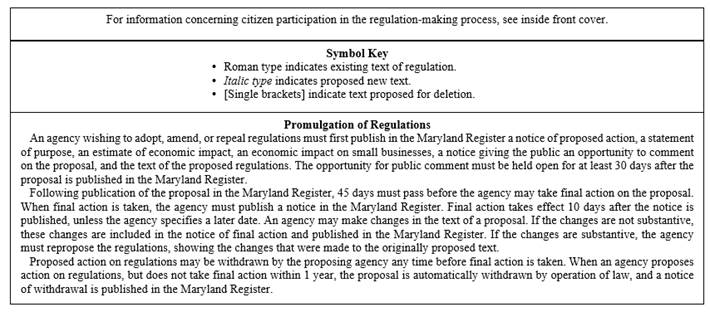
Proposed Action on Regulations
Title 08
DEPARTMENT OF NATURAL RESOURCES
Subtitle 02 FISHERIES SERVICE
08.02.11 Fishing in Nontidal
Waters
Authority: Natural Resources Article, 4-602, Annotated Code of
Maryland
Notice of Proposed Action
[25-241-P]
The Secretary of Natural Resources proposes to amend Regulations .01
and .03 under COMAR 08.02.11 Fishing in Nontidal Waters.
Statement of Purpose
The purpose of this action is to modify trout fishing areas on
Beaver Creek in Washington County and to eliminate the catch-and-return bass
area on the North Branch of the Potomac River.
The proposed action modifies the uppermost put-and-take trout
fishing area on Beaver Creek by moving the boundary downstream from a private
farm lane to the upstream side of the I-70 West on-ramp bridge. This is
necessary because the upper boundary is currently on private property and the
landowner no longer allows public access to their property. Shifting the upper
boundary downstream to I-70 W adjusts the uppermost put-and-take section to
areas where public angler access is allowed.
The proposed action clarifies the rules for a small section of
Beaver Creek that currently has three sections with different rules.
Specifically, the proposed action extends the catch-and-release artificial fly
fishing section on Beaver Creek to the downstream side of the bridge at U.S.
Route 40 and modifies the lower put-and-take trout fishing area on Beaver Creek
by moving the boundary from Beaver Creek Road to the downstream side of the
bridge at U.S. Route 40. Changing the boundaries of these areas eliminates a
section of the creek that does not have special management rules. This change
is necessary because having three separate management areas in such a
short distance is confusing for anglers.
This change will simplify the rules in the area and reduce confusion about
where and when anglers can harvest trout. The change will also protect stocked
trout from being
harvested during the put-and-take closure
period and ensure more trout are available to anglers for opening day.
The proposed action eliminates the catch-and-return bass area on
the North Branch of the Potomac River. The designated area extends from the
spillway in Cumberland, Maryland upstream approximately 25 miles to the U.S.
Route 220 Bridge at Keyser, West Virginia. The Department continuously
evaluates freshwater fishing regulations for efficacy based on fishery
monitoring efforts and habitat assessments. After the initial introduction, the
smallmouth bass fishery in this portion of the North Branch of the Potomac
River was characterized by faster growth rates, a desirable size distribution,
and a higher density of fish. Recent surveys indicate that with the
improvements in upstream water quality relating to temperature (i.e., colder
temperatures), smallmouth bass growth rates have slowed significantly and the
fishery now has a contracted, downstream distribution compared to their initial
range following introduction. Age and growth data suggest that the catch and
return regulation has become ineffective since smallmouth bass now only rarely
reach quality size or the statewide minimum size for harvest (12 inches).
Because few fish will survive to reach a quality size, catch and release
regulations are no longer expected to improve the overall quality of the fishery
or meet angler expectations for a catch and release fishery.
Estimate of Economic Impact
The proposed action has no economic impact.
Economic Impact on Small Businesses
The proposed action has minimal or no economic impact on small
businesses.
Impact on Individuals with Disabilities
The proposed action has no impact on individuals with disabilities.
Opportunity for Public Comment
Comments may be sent to Trout
and Bass Regulations, Regulatory Staff, Maryland Department of Natural
Resources Fishing and Boating Services, 580 Taylor Ave., E-4, Annapolis, MD
21401, or call 410-260-8300, or email to [email protected]
or complete the comment form at
https://dnr.maryland.gov/fisheries/Pages/regulations/changes.aspx. Comments
will be accepted through January 2, 2026. A public hearing has not been
scheduled.
.01 Trout Fishing and Management Areas.
A. (text unchanged)
B. Put-and-Take Trout Fishing Areas.
(1) (4) (text unchanged)
(5) Except as provided in C(1) of this regulation the following
areas are designated as put-and-take trout fishing areas and are subject to the
provisions in B(1) (3) of this regulation:
|
|
Closure
Periods
|
|
(a) (k) (text
unchanged)
|
|
|
(l) Washington County:
|
|
|
(i) Beaver
Creek from the [downstream side of
the bridges located on the private farm lane below the Albert Powell State
Trout Hatchery] upstream side of the bridge at the I-70
West on-ramp downstream to Black Rock Creek; and from [Beaver Creek Road] the
downstream side of the bridge at U.S. Route 40 downstream to the
confluence with Antietam Creek
|
1
|
|
(ii) (ix)
(text unchanged)
|
|
|
(m) (n) (text unchanged)
|
|
C. Catch-and-Return Trout Fishing Areas.
(1) (3) (text unchanged)
(4) Areas Limited to Artificial Fly Fishing Only.
(a) (text unchanged)
(b) Areas subject to provisions of this section are:
(i) (text unchanged)
(ii) Beaver Creek, Washington County. From the confluence with
Black Rock Creek downstream [approximately
1 mile to a red post located 0.1 mile above Beaver Creek Road] to the downstream side of the U.S. Route 40
bridge ; and
(iii) (text unchanged)
D. J. (text unchanged)
.03 Special Fisheries
Management Areas.
A. B. (text unchanged)
C. Catch-and-Return Bass Areas.
(1) (text unchanged)
(2) The areas subject to the provisions of this section are the:
(a) (text unchanged)
(b) Monocacy River from the Potomac River upstream to Buckeystown
Dam; and
(c) Patapsco River from Interstate 70 downstream to Maryland Route
144 (Frederick Road)[; and
(d) North Branch of the Potomac River, from the spillway in
Cumberland upstream 25 miles to the U.S. Route 220 Bridge at Keyser, West
Virginia].
JOSH KURTZ
Secretary of Natural
Resources
Title 09
MARYLAND DEPARTMENT OF LABOR
Subtitle 03 COMMISSIONER OF FINANCIAL
REGULATION
09.03.16 Virtual
Currency Kiosks
Authority: Financial Institutions Article, 2-105.1, and
12-1209, Annotated Code of Maryland
Notice of Proposed Action
[25-238-P]
The Commissioner of Financial Regulation proposes to adopt new
Regulations .01 .10 under new chapter, COMAR 09.03.16 Virtual
Currency Kiosks.
Statement of Purpose
The purpose of this action is to enable Maryland s virtual currency
kiosk laws as a result of the Legislature s adoption of Ch. 117 (S.B. 305),
Acts of 2025, which created a registration requirement for virtual currency
kiosk operators and created a registration requirement for each virtual
currency kiosk.
This action establishes the Office of Financial Regulation s
(OFR s) registration regulations by adding:
(1) Definitions for certain undefined terms used for virtual
currency kiosks;
(2) A description of the registration procedure for kiosk operators
and kiosks;
(3) Procedures for fee refunds;
(4) A description of the fraud prevention requirements;
(5) A description of the communications and notice requirements;
(6) A description of the lighting, safety, and signage required;
(7) A description of the screen disclosures timing;
(8) A description of the information required on receipts;
(9) A description of the annual report required.
Estimate of Economic Impact
I. Summary of Economic Impact. The economic impact of the
proposed action is expected to be positive.
II. Types of Economic Impact.
|
Impacted Entity
|
Revenue
(R+/R-)
Expenditure
(E+/E-)
|
Magnitude
|
|
A.
On issuing agency:
|
NONE
|
|
|
B.
On other State agencies:
|
NONE
|
|
|
C.
On local governments:
|
NONE
|
|
|
|
Benefit
(+)
Cost
(-)
|
Magnitude
|
|
D.
On regulated industries or trade groups:
|
|
|
|
Virtual
Currency Kiosk Operators
|
(-)
|
Moderate
|
|
E.
On other industries or trade groups:
|
NONE
|
|
|
F.
Direct and indirect effects on public:
|
|
|
|
Consumers
|
(+)
|
Impactful
|
III. Assumptions. (Identified by
Impact Letter and Number from Section II.)
D. The statute establishes a registration fee. The proposed action
sets that fee similar to the licensing fee for money transmitters.
Additionally, as required in the statute, each location must be registered to
ensure consumers and law enforcement can verify a location is registered. The
statute sets requirements for lighting and disclosures which the proposed
action sets similar to banking atms. Some entities may need to upgrade lighting
or reprogram kiosks. The proposed action may, in some cases, increase
record-keeping and compliance costs for regulated entities. The Commissioner
cannot provide exact estimates of these costs for any individual regulated
entity.
F. It is expected that the public will directly benefit from the
proposed disclosures and ability to verify the location is registered as well
as by establishing a process for a fee refund in the event a transaction was
induced fraudulently.
Economic Impact on Small Businesses
The proposed action has minimal or no economic impact on small
businesses.
Impact on Individuals with Disabilities
The proposed action has no impact on individuals with disabilities.
Opportunity for Public Comment
Comments may be sent to Amy
Hennen, Assistant Commissioner for Policy, Office of Financial
Regulation, 100 S. Charles St. Tower 1, Suite 5300, Baltimore, MD 21231, or
call 4102306094, or email to [email protected]. Comments will be accepted
through January 2, 2026. A public hearing has not been scheduled.
.01 Scope.
Scope. This chapter governs Kiosks, as such term is defined
herein, and the conduct of any person operating a Kiosk in the State.
.02. Definitions.
A. In this chapter, the following terms have the meanings
indicated.
B. Terms Defined
(1) Commissioner has the meaning stated in Financial
Institutions Article, 1-101, Annotated Code of Maryland.
(2) Electronic Notice of Fraud means any
(a) Any electronic communication from a User to an Operator
expressing a concern that a transaction the User conducted using a Virtual
Currency Service provided through the Operator s Kiosk was a Fraudulent Transaction; and
(b) Sent to an Operator using either:
(i) A process established on the Operator s website for
submitting a Notice of Fraud through the website; or
(ii) An email address the Operator uses for receiving Notices of
Fraud.
(3) Fee means any cost, charge, fee, or other expenses,
however defined, collected by or on behalf of an Operator and collected from or
charged to any User in connection with obtaining:
(a) A Virtual Currency Service from a Kiosk; or
(b) Any money transmission involving virtual currency
facilitated through a Kiosk.
(4) Fixed Location Kiosk means a Kiosk the Operator intends to
operate at a single location for the calendar year in which the Kiosk is
registered hereunder.
(5) Fraud means:
(a) Any common law fraud;
(b) An intentional act or attempt to obtain something of value
from a person through threats, willful misrepresentation, or representations
made with a reckless disregard for the truth; or
(c) Any willful false or reckless representation of a material
fact, whether by words or by conduct, by false, reckless, or misleading
allegations, or by concealment of that which should have been disclosed, which
causes a person to act, or fail to act, to the detriment of the person s
interest.
(6) Fraudulent Transaction means any transaction involving a
User who obtains a Virtual Currency Service from a Kiosk in connection with the
transaction if the User engaged in the transaction because of Fraud perpetrated
by another person.
(7) Kiosk.
(a) Kiosk means a virtual currency kiosk
(b) Kiosk includes any Fixed Location Kiosk and Mobile Kiosk.
(8) Mail means first class United States mail, postage
prepaid.
(9) Mobile Kiosk means a Kiosk the Operator intends to operate
at more than one location for the calendar year in which the Kiosk is
registered.
(10) Money Transmission has the meaning stated in Financial
Institutions Article, 12-401, Annotated Code of Maryland.
(11) NMLS has the meaning stated in Financial Institutions
Article, 1-101, Annotated Code of Maryland.
(12) Non-Electronic Notice of Fraud means:
(a) Any verbal or written communication from a User to an
Operator which expresses a concern that the transaction the User conducted with
a Virtual Currency Service provided through the Operator s Kiosk was a
Fraudulent Transaction; and
(b) Sent to an Operator in any manner that does not constitute
an Electronic Notice of Fraud.
(13) Notice of Fraud means any:
(a) Electronic Notice of Fraud; and
(b) Non-electronic Notice of Fraud.
(14) Operator means a Virtual Currency Kiosk Operator.
(15) User.
(a) User means any
person using a Kiosk located in the State to obtain a Virtual Currency Service.
(b) User includes a person who authorizes a third party to
obtain a Virtual Currency Service using a Kiosk on behalf of the User.
(16) Receipt means the receipt an Operator must dispense or
display to a User under Financial Institutions Article 12-1204, Annotated Code
of Maryland.
(17) Registration Fee means any fee imposed by the
Commissioner to:
(a) Register as an Operator; or
(b) Register a Kiosk.
(18) State means the state of Maryland.
(19) Virtual Currency has the meaning stated in Financial
Institutions Article, 12-1201, Annotated Code of Maryland.
(20) Virtual Currency Address means an alphanumeric identifier
representing a destination for a virtual currency transfer that is associated
with a virtual currency wallet.
(21) Virtual Currency Kiosk has the meaning stated in
Financial Institutions Article, 12-1201, Annotated Code of Maryland.
(22) Virtual Currency Kiosk Operator has the meaning stated in
Financial Institutions Article, 12-1201, Annotated Code of Maryland.
(23) Virtual Currency Service has the meaning stated in
Financial Institutions Article, 12-1201, Annotated Code of Maryland.
(24) Virtual Currency Wallet means a software application or
other mechanism providing a means for holding, storing and transferring virtual
currency.
.03 Registration.
A. Registration of Operator.
(1) A person may not operate a Kiosk in the State after January
1, 2026, unless registered as an Operator with the Commissioner.
(2) A person shall register through NMLS with the Commissioner
as an Operator:
(a) On or before January 1, 2026, if operating a Kiosk in the
State on or before that date; or
(b) Prior to operating a Kiosk in the State after January 1,
2026.
(3) A person registering as an Operator shall pay:
(a) The Commissioner a non-refundable Registration Fee of
$2,000; and
(b) Any cost or fee required by NMLS.
(4) A person registering as an Operator shall provide through
NMLS:
(a) The legal name of the Operator and any trade name used by
the Operator in accordance with Financial Institutions Article 2-121,
Annotated Code of Maryland;
(b) The address of the operator s principal executive office;
(c) The names of any persons directly or indirectly holding an
ownership share of 10 percent or more of the operator;
(d) A flow of funds for all Virtual Currency Services the
Operator will offer through its Kiosks; and
(e) Any other information the Commissioner requests.
B. Registration of Kiosks.
(1) An Operator may not operate a Kiosk in the State on or after
January 1, 2026, unless the Operator has registered that Kiosk with the
Commissioner.
(2) A person shall register each Kiosk operated in the State
through NMLS with the Commissioner:
(a) On or before January 1, 2026, if operating that Kiosk in the
State on or before that date; or
(b) Prior to operating that Kiosk in the State after January 1,
2026.
(3) An Operator registering a Kiosk shall pay:
(a) The Commissioner a non-refundable Registration Fee of $200
for each registered Kiosk; and
(b) Any fee required by NMLS.
(4) An Operator registering a Kiosk shall provide through NMLS:
(a) Unique identifying information for the Kiosk, such as the
manufacturer name, model number, serial number, or asset tag;
(b) If the Kiosk is a Fixed Location Kiosk, the address at which
the Kiosk will be operated;
(c) If the Kiosk is a Mobile Kiosk:
(i) The address of each location at which the Operator expects
to operate the Kiosk for more than 30 calendar days; and
(ii) The geographic area encompassing the locations at which the
Operator expects to operate the Kiosk for 30 calendar days or less;
(d) A description of all services to be provided by the Kiosk;
and
(e) Any other information the Commissioner requests.
(5) An Operator shall designate a Kiosk intended for use as a
Fixed Location Kiosk as a Fixed Location Kiosk through NMLS in accordance with
the process the Commissioner requires.
(6) An Operator shall designate a Kiosk intended for use as a
Mobile Kiosk as a Mobile Kiosk through NMLS in accordance with the process the
Commissioner requires.
(7) An Operator may only operate a Kiosk at the address or, if a
Mobile Kiosk, in the geographic area listed for that Kiosk in NMLS.
(8) An Operator may change the designation of a Kiosk as either
a Mobile Kiosk or a Fixed Location Kiosk through NMLS by:
(a) Changing the designation through the process the
Commissioner requires;
(b) Paying any required fee; and
(c) Updating the Kiosk s location information.
(9) Contemporaneously with changing a Kiosk s location, an
Operator must update information in NMLS to accurately reflect the new
location.
C. Term of Registrations and Renewals.
(1) The term of any registration under this regulation shall:
(a) Begin the day the Operator completes the registration in
NMLS; and
(b) Expire on December 31 of the year:
(i) The Operator completes the registration, if completed before
November 1; or
(ii) Succeeding the year the Operator completes the
registration, if completed between November 1 and December 31.
(2) On or after November 1 of each year, registration as an
Operator and for each individual Kiosk under this regulation may be renewed for
a 1-year term if the Operator:
(a) Is otherwise entitled to be registered;
(b) Completes the renewal process established through NMLS;
(c) Provides through NMLS any information the Commissioner
requests as part of the renewal;
(d) Submits through NMLS the annual report required by
Regulation .08 of this chapter;
(e) Pays any fees imposed by NMLS;
(f) Pays the Commissioner a non-refundable Registration Fee of
$2,000 to register as an Operator; and
(g) Pays the Commissioner a non-refundable Registration Fee of
$200 for each Kiosk the Operator intends to operate in the State.
D. A person may not renew registration for a Kiosk unless the
person has renewed its registration as an Operator.
E. All Registration Fees shall be paid to the Commissioner
through NMLS.
F. Money Transmission.
(1) Registration as an Operator does not exempt a person from
licensure under Financial Institutions Article, Title 12, Subtitle 4, Annotated
Code of Maryland, if one or more Kiosks operated by the Operator facilitate
money transmission.
(2) Possession of a license, or exemption from licensure, under
Financial Institutions Article, Title 12, Subtitle 4, Annotated Code of
Maryland, does not exempt a person from registration under Financial
Institutions Article, Title 12, Subtitle 12, Annotated Code of Maryland, if
that person operates a Kiosk offering virtual currency services.
(3) A Kiosk shall be deemed to facilitate money transmission if
it is capable of facilitating money transmission, regardless of whether the
Operator purports to offer money transmission services through that kiosk,
unless the Operator disables this function and prevents such facilitation.
(4) An Operator offering
both Virtual Currency Services and money transmission through a Kiosk shall
fully comply with all applicable provisions of:
(a) Financial Institutions Article, Title 12, Subtitle 4,
Annotated Code of Maryland, and all regulations issued thereunder; and
(b) Financial Institutions Article, Title 12, Subtitle 12,
Annotated Code of Maryland, and all regulations issued thereunder.
G. Other Services.
(1) An Operator may only
offer the following services through a Kiosk:
(a) Virtual Currency Services;
(b) Money transmission, provided the Operator complies with the
licensing provisions of Financial Institutions Article, Title 12, Subtitle 4,
Annotated Code of Maryland; and
(c) Any other service State law expressly authorizes an operator
to offer through a Kiosk.
(2) Any service offered
through a Kiosk must comply with all State law relating to that service,
including all applicable licensing or registration requirements.
.04 Fee Refunds for Fraudulent Transactions.
A. Scope.
(1) This regulation governs the procedure by which a User may
request a Fee Refund on a transaction the User alleges is a Fraudulent
Transaction.
(2) A User s rights under this regulation are in addition to any
rights a User may have under any applicable law.
B. Definitions.
(1) In this regulation, the following terms have the meanings
indicated.
(2) Terms Defined.
(a) Fee Refund means a refund under this regulation of the Fee
charged to that User.
(b) Refund Claim means a User s claim for a Fee Refund.
(c) Refund Denial means an Operator s denial of a Refund
Claim.
(d) Written Confirmation means a written confirmation of a
verbally given Notice of Fraud.
C. Notice of Fraud by User.
(1) An Operator shall treat any Notice of Fraud as a Refund
Claim.
(2) A User must provide a Notice of Fraud to an Operator no more
than 90 calendar days after the alleged Fraudulent Transaction.
(3) A Notice of Fraud is sufficient for this regulation if it:
(a) Includes the User s name;
(b) Provides a copy of the Receipt or otherwise provides
information sufficient to identify the Virtual Currency Services the User
obtained through the Operator s Kiosk; and
(c) Contains a brief description of why the User believes the
transaction was a Fraudulent Transaction.
(4) An Operator may not engage in any act or subterfuge to make
it difficult for a User to provide a Notice of Fraud.
D. Place of Notice.
(1) An Operator must offer a User:
(a) At least one method to submit an Electronic Notice of Fraud;
and
(b) At least one method to submit a Non-electronic Notice of
Fraud.
(2) The Operator shall conspicuously include information on its
website and in any promotional materials explaining how a User may submit:
(a) An Electronic Notice of Fraud; and
(b) A Non-electronic Notice of Fraud.
(3) An Operator may require the User to submit a Non-electronic
Notice of Fraud only to a telephone number or address disclosed on the Receipt,
provided that the Operator:
(a) Has reasonable procedures to redirect a User to the
specified telephone number or address if the User attempts to provide a
Non-electronic Notice of Fraud by other means;
(b) Has reasonable procedures to route any written
Non-electronic Notice of Fraud the Operator receives at any other address to
the department or personnel responsible for investigating and resolving a
Refund Claim; and
(c) Conspicuously displays the designated telephone number or
address for a User to provide a Non-electronic Notice of Fraud on any website
the Operator maintains.
(4) If a User provides a written Notice of Fraud to an address
other than the address designated by the Operator and the Operator receives
such Notice of Fraud:
(a) The Operator must process the Notice of Fraud as a Refund
Claim in accordance with this regulation; and
(b) The time frame for investigating and resolving the Refund
Claim shall begin 5 business days after the Operator s receipt of the Notice of
Fraud at the incorrect address.
E. Written Confirmation.
(1) An Operator may require a User to provide Written
Confirmation of a verbal Non-electronic Notice of Fraud within 30 calendar days
of the verbal Non-electronic Notice of Fraud.
(2) An Operator requiring a Written Confirmation under this
Section shall:
(a) At the time of the verbal Non-electronic Notice of Fraud:
(i) Inform the User that the Operator must receive a Written
Confirmation; and
(ii) Inform the User that the Operator will mail the User a
notice concerning the Written Confirmation; and
(b) Within 3 business days of the verbal Non-electronic Notice
of Fraud, mail the User written notice stating:
(i) The Operator requires a Written Confirmation;
(ii) A specific date at least 30 calendar days after the date of
the notice by which the User must submit the Written Confirmation;
(iii) The address to send the Written Confirmation; and
(iv) The User s failure to timely provide a Written Confirmation
may result in a Refund Denial.
(3) An Operator may not require the Written Confirmation to
include information inconsistent with the definition of a Non-electronic Notice
of Fraud.
(4) A User who verbally provides a Non-electronic Notice of
Fraud within the time frame established by E(2) of this regulation has timely
submitted a Notice of Fraud.
(5) If a User fails to provide the Written Confirmation within
30 calendar days of the Operator s full compliance with E(2) of this
regulation:
(a) The Operator may mail written notice to the User:
(i) Informing the User that the Operator has not received the
Written Confirmation;
(ii) Requiring the User to provide the Written Confirmation
within 30 calendar days of the notice; and
(iii) Informing the User the Operator may deny the Refund Claim
if the User fails to provide the Written Confirmation within 30 calendar days
of the notice.
(b) A User s failure to provide a timely Written Confirmation
following the Operator s compliance with E(5)(a) of this regulation
constitutes grounds to issue a Refund Denial.
F. Investigation and Resolution.
(1) Except as otherwise expressly set forth in this regulation,
an Operator shall have 30 calendar days from receipt of a Notice of Fraud to
investigate and resolve the Refund Claim.
(2) If the Operator requested a Written Confirmation in
compliance with E of this regulation, the Operator shall have 30 calendar days
from receipt of the Written Confirmation to investigate and resolve the Refund
Claim.
(3) In connection with its investigation of a Refund Claim, an
Operator may:
(a) Inquire if the User filed a police report;
(b) Inquire if the User possesses any documents or
communications relating to the alleged Fraudulent Transaction; and
(c) Request copies of any police report filed or documents
possessed by the User and relating to the alleged Fraudulent Transaction.
(4) In connection with its investigation of a Refund Claim, an
Operator may not:
(a) Require the filing of a police report;
(b) Require the User to provide copies of a filed police report
or documents relating to the alleged Fraudulent Transaction;
(c) Imply that a failure to file a police report, provide copies
of a filed police report, or provide copies of documents relating to the
alleged Fraudulent Transaction will impact the Refund Claim;
(d) Issue a Refund Denial based on a failure to file a police
report, failure to provide copies of a filed police report, or failure to
provide copies of documents relating to the to the alleged Fraudulent
Transaction; or
(e) Charge any cost, fee, or other amount to investigate and
resolve a Refund Claim.
(5) A User shall reasonably
cooperate with the Operator s investigation of a Refund Claim by answering
questions concerning the Fraudulent Transaction.
(6) Within 3 business days
of completing its investigation, an Operator shall resolve a Refund Claim by
mailing the User either:
(a) A Refund Denial; or
(b) A statement granting the Refund Claim.
(7) A Refund Denial must:
(a) Generally describe the Operator s investigative process;
(b) List any facts the Operator relied on for the Refund Denial;
(c) Describe any other factors the Operator relied on for the
Refund Denial;
(d) Inform the User of the right to file a complaint regarding
the Refund Denial with the Commissioner; and
(e) Provide the User with a link or other information needed to
reach the Commissioner.
(8) An Operator may not issue a Refund Denial based on any of
the following:
(a) User s negligence;
(b) User s failure to consider or act upon warnings and
disclosures provided by the Operator;
(c) User s responses to questions posed by the Operator when the
User obtained the Virtual Currency Services; or
(d) User submission of a Notice of Fraud for a prior
transaction.
(9) A Fee Refund shall be issued promptly in United States
currency.
(10) A User receiving a Refund Denial may file a complaint with
the Commissioner.
(11) A complaint concerning a Refund Denial must be filed with
the Commissioner within 3 years of the User s receipt of the Refund Denial.
.05 Fraud Prevention.
A. An Operator shall maintain restrictions that prevent more
than one User of the Operator from using the same virtual currency wallet.
B. An Operator shall have the ability to prevent designated
virtual currency wallets from being used at any Kiosk of the Operator.
C. An Operator shall use an established third party that
specializes in performing blockchain analyses to preemptively perform such
analyses to identify and prevent high risk or sanctioned virtual currency
wallets from being used by Users at Kiosks of the Operator.
D. An Operator shall establish, in the Operator s policies and
procedures, a risk-based method of monitoring Users on a post-transaction
basis.
E. An Operator shall designate and employ a chief compliance
officer.
.06 Communications and Notices.
A. An Operator shall provide all required notices and
communications to a User under this chapter using information the Operator
collects from the User under Financial Institutions Article, 12-1204 (c),
Annotated Code of Maryland.
B. This regulation does not apply to:
(1) the Receipt; and
(2) any notices or communications this chapter requires the
Operator to:
(a) physically place on the Kiosk; or
(b) display on a Kiosk screen.
C. An Operator shall provide reasonable procedures for a User to
securely change contact information the User previously supplied to the
Operator.
D. An Operator shall provide reasonable procedures for a User to
select the User s preferred method of communication.
E. The User s selection of a preferred method of communication
shall not relieve an Operator of any duty to provide information in a manner
expressly required by this chapter.
.07 Lighting, Safety, and Signage.
A. Each Kiosk operated in the State by an Operator shall comply
with Financial Institutions Article, 1-402 (b), (c) and 1-402.1, Annotated
Code of Maryland for each Kiosk it operates.
B. For the purposes of this regulation only, the Operator shall
treat the Kiosk as an automated teller machine.
C. The exceptions contained in Financial Institutions Article,
1-402 (a), Annotated Code of Maryland do not apply to a Kiosk.
D. An Operator shall evaluate the safety of each Kiosk,
regardless of location.
E. The required safety evaluation need not consider the factors
identified in Financial Institutions Article, 1-402(b)(2), Annotated Code of
Maryland, for a Kiosk located in a building meeting the requirements of
Financial Institutions Article, 1-402 (a)(2)(i), Annotated Code of Maryland.
F. Each Kiosk operated in the State shall conspicuously display
signage stating: This Kiosk offers services relating to virtual currencies.
The Maryland Commissioner of Financial Regulation will accept all questions or
complaints regarding this Kiosk, operated by (name of Operator and NMLS unique
identifier) at (address of Commissioner), phone (toll-free phone number of the
Commissioner), or https://labor.maryland.gov/finance/
. You may confirm registration of this Kiosk with the Maryland Commissioner of
Financial Regulation at (NMLS consumer access website).
.08 Screen Disclosures.
A. All required on-screen notices and disclosures under
Financial Institutions Article 12-1201 et. seq., Annotated Code of Maryland,
and this chapter shall:
(1) Remain on the Kiosk screen for a minimum of:
(a) Four seconds if the notice or disclosure contains 12 or less
words; or
(b) One second for every 3 words, or fractions thereof,
contained in the notice or disclosure; and
(2) Require User action to advance to another screen.
B. For the purposes of calculating the time period a notice or
disclosure must remain on a screen pursuant to Part A of this regulation, the
words contained in a notice or disclosure include words that require scrolling
to view.
.09 Receipts.
A. In addition to information required by Financial Institutions
Article, 12-1204, Annotated Code of Maryland, a Receipt shall include:
(1) The name of, and
contact information for, the Operator, including, but not limited to, the
Operator's business address and a customer service telephone number established
by the Operator to answer questions and register complaints;
(2) The Operator s NMLS
unique identifier;
(3) The User s name;
(4) The date of the
transaction reflected in the Receipt;
(5) The amount of such
virtual currency transaction expressed in United States currency;
(6) The exchange rate for
the transaction, if applicable;
(7) The virtual currency
address for that virtual currency transaction;
(8) The full unique
transaction hash or identification number associated with the transaction;
(9) The public virtual
currency address of the User;
(10) Any fee charged by the Operator;
(11) Any tax collected by the Operator for such virtual currency
transaction;
(12) If the transaction reflected in the Receipt involves money
transmission, the recipient s name and virtual currency address;
(13) A statement that the User may request a Fee Refund of any
Fee charged in connection with a Fraudulent Transaction by submitting a Notice
of Fraud;
(14) A statement explaining how a User may submit a Notice of
Fraud, including any address or phone number the Operator has designated
pursuant to Regulation .03 of this chapter for submitting a Notice of Fraud;
and
(15) A statement the Maryland Commissioner of Financial
Regulation will accept all questions or complaints regarding the Kiosk, at
(address of Commissioner), phone (toll-free phone number of the Commissioner),
or https://labor.maryland.gov/finance/.
B. The Receipt shall be provided in English and in the any other
language principally used by the Operator to advertise its services or transact
business on the Kiosk.
C. The Kiosk shall offer the User the ability to elect to
receive the Receipt electronically at the time of the transaction;
D. If the User does not elect electronic delivery of the
Receipt, the Receipt shall be delivered to the User in retainable form at the
time of the transaction.
E. An Operator shall maintain all transactional data required
for a Receipt for a period of 7 years from the date of the transaction.
F. A Receipt that satisfies the requirements of this Regulation
shall be deemed to satisfy the requirements contained in COMAR 09.03.14.16C for
a virtual currency transaction conducted on a Kiosk that involves money
transmission.
G. Compliance with COMAR 09.03.14.16C does not relieve an
Operator of any additional requirements imposed by this regulation.
.10 Annual Report.
A. An Operator shall prepare an annual report listing the
following information for each Kiosk it maintains:
(1) Information sufficient
to identify that Kiosk;
(2) The total number of
transactions and the total dollar amount of transactions processed by that
Kiosk;
(3) If the Kiosk was not
operating for the full 12 months covered by the annual report, information
sufficient to determine the timeframe in which the Operator operated that Kiosk
in the State;
(4) The number of Notices
of Fraud received for that Kiosk;
(5) If the Kiosk is a
Mobile Kiosk, the location of the Mobile Kiosk at the time of the transaction
described in each Notice of Fraud;
(6) The number and dollar
amount of Refund Denials issued for that Kiosk;
(7) The number and dollar
amount of Fee Refunds issued for that Kiosk; and
(8) The dollar amount of
Fees subject to Notices of Fraud for that Kiosk.
B. The Annual Report required by this regulation:
(1) Should include
information with respect to each Kiosk for the lesser of:
(a) The preceding 12 months; or
(b) The timeframe in which that Kiosk offered Virtual Currency
Services in the State; and
(2) May run for any 12
consecutive monthly period ending no earlier than September 1 of the current
calendar year.
C. The Operator shall submit this annual report to the
Commissioner through NMLS:
(1) At the time the
Operator renews its Operator registration in accordance with Regulation .03 of
this chapter; or
(2) On or before December
31st of the current calendar year if the Operator does not intend to renew its
Operator registration in accordance with Regulation .03 of this chapter.
ANTONIO
SALAZAR
Commissioner
Subtitle 10 RACING COMMISSION
09.10.03 Prohibited Acts
Authority: Business Regulations Article, 11-210, Annotated Code of
Maryland
Notice of Proposed Action
[25-250-P]
The Maryland Racing Commission proposes to amend Regulation .01-2
and adopt new Regulation .01-3 under COMAR 09.10.03 Prohibited Acts. This action was considered at a public
meeting of the Maryland Racing Commission held on October 8, 2025
Statement of Purpose
The purpose of this action is to have a threshold of TCO2 that
judges and stewards can use to fine or suspend participants if the horse tests
over the threshold.
Estimate of Economic Impact
The proposed action has no economic impact.
Economic Impact on Small Businesses
The proposed action has minimal or no economic impact on small
businesses.
Impact on Individuals with Disabilities
The proposed action has no impact on individuals with disabilities.
Opportunity for Public Comment
Comments may be sent to Christopher Merz, Executive Director,
Maryland Racing Commission, 300 E Towsontown Blvd, Towson, MD 21286,, or call
443-571-2855, or email to [email protected]. Comments will be
accepted through January 2, 2026. A public hearing has not been scheduled.
.01-2 [Medical Records] Alkalinization or Use/Administration of
an Alkalinizing Agent.
[The health and medical record of a horse
shall include the name of the horse and all medications, drugs, substances, or
procedures administered by an individual or prescribed or administered by a
veterinarian for up to the previous 3 years.] Alkalinization or
Use/Administration of an alkalinizing agent is prohibited on Race Day.
A. A threshold concentration of total carbon dioxide (TCO2)
in the blood of a horse in excess of 37 mmol constitutes prima facie evidence
of alkalinization or Use/Administration of an alkalinizing agent.
B. A threshold concentration of total carbon dioxide (TCO2)
in the blood of a horse in excess of 39 mmol administered Furosemide
constitutes prima facie evidence of alkalinization or Use/Administration of an
alkalinizing agent.
.01-3 Medical Records.
The health and medical record of a horse shall include the name
of the horse and all medications, drugs, substances, or procedures administered
by an individual or prescribed or administered by a veterinarian for up to the
previous 3 years.
GEORGE MAHONEY
Chair, Maryland Racing Commission
Subtitle
11 REAL ESTATE COMMISSION
09.11.01 General Regulations
Authority: Business
Occupations and Professions Article, 17-208, 17-303, 17-306, 17-315, and
17-528, Annotated Code of Maryland
Notice of Proposed
Action
[25-204-P]
The Maryland Real Estate
Commission proposes to amend Regulation .23 under COMAR 09.11.01 General
Regulations. This action was
considered by the Commission on September 17, 2025.
Statement of Purpose
The purpose of this action
is to revise the course time requirement in the regulation from 3 to 1.5 clock
hours so that the regulation is consistent with new statutory language.
Estimate of Economic Impact
The proposed action has no economic impact.
Economic Impact on Small Businesses
The proposed action has minimal or no economic impact on small
businesses.
Impact on Individuals with Disabilities
The proposed action has no impact on individuals with disabilities.
Opportunity for Public Comment
Comments may be sent to Scott Lederer, Executive Director, Maryland
Real Estate Commission, Division of Occupations and Professions, Maryland Dept.
of Labor, 100 S. Charles St. Baltimore, MD 21201, or call 410-230-6227, or
email to [email protected]. Comments will be accepted through January
2, 2026. A public hearing has not been scheduled.
Open Meeting
Final action on the proposal
will be considered by Maryland Real Estate Commission during a public meeting
to be held on January 21, 2026 at 10:30 AM. To access the meeting using video
conferencing go to meet.google.com/vtv-pycu-uep To access the meeting by dialing in from a
phone: (US) +1 225-629-3031 PIN: 134830845.
.23 Broker Supervision Course.
A licensee who is designated as a broker, branch office manager, or
team leader shall complete a [3]1.5
clock-hour course that includes the requirements of broker supervision under
COMAR 09.11.06.01B(8)(i) within 90 days of the effective date of the
designation if the licensee has not completed that course during the previous 4
years.
DEMETRIA SCOTT
Chair, Maryland Real Estate Commission
Title 10
MARYLAND DEPARTMENT OF HEALTH
Subtitle 01 PROCEDURES
10.01.07 Petitions for
Adoption, Amendment, or Repeal of Regulations
Authority: State Government Article, 10-122 and 10-123;
Health-General Article, 2-104; Annotated Code of Maryland
Notice of Proposed Action
[25-258-P]
The Secretary of Health proposes to amend Regulation .04,
amend and recodify existing Regulations .01, .02, .06, .07,
.08, and .10 to be Regulations .02, .01, .05,
.06, .07, and .08, respectively, and repeal existing
Regulations .05 and .09 under COMAR 10.01.07 Petitions for
Adoption, Amendment, or Repeal of Regulations.
Statement of Purpose
The purpose of this action is to provide clarifying changes and
technical updates to regulations governing Petitions for Adoption, Amendment,
or Repeal of Regulations submitted to the Maryland Department of Health. Review
of these regulations were conducted in accordance with the Regulatory Review
and Evaluation Act. Comprehensive updates to this chapter have not been
completed since 1993.
Estimate of Economic Impact
The proposed action has no economic impact.
Economic Impact on Small Businesses
The proposed action has minimal or no economic impact on small
businesses.
Impact on Individuals with Disabilities
The proposed action has no impact on individuals with disabilities.
Opportunity for Public Comment
Comments may be sent to Jordan Fisher Blotter, Director, Office of
Regulation and Policy Coordination, Maryland Department of Health, 201 West
Preston Street, Room 534 Baltimore, Maryland 21201, or call 410-767-0938, or
email to [email protected]. Comments will be accepted through January 2,
2026. A public hearing has not been scheduled.
[.02] .01 Scope.
This chapter applies to all petitions submitted to the Department
to promulgate, amend, or repeal a regulation over which the Secretary has
rulemaking authority in accordance with State Government Article, 10-122,
Annotated Code of Maryland.
[.01] .02 Definitions.
A. In this chapter, the following [words] terms
have the meanings indicated.
B. Terms Defined.
(1) (2) (text unchanged)
(3) Petitioner means an interested person filing a petition to
the Department to promulgate, amend, or repeal a regulation.
[(3)] (4) Regulation has the [same]
meaning [as] stated in State Government Article, [ 10-101(e)]
10-101, Annotated Code of Maryland.
[(4)] (5) (text unchanged).
.04 Form and Submission of Petition.
[A petition may be in any written form chosen by the
petitioner, and shall include:
A. A detailed description of the regulation which the petitioner
requests the Department to promulgate, amend, or repeal;
B. A statement in support of the petition; and
C. The name, address, and telephone number of the petitioner.]
A. A petition shall be in writing and include:
(1) A detailed description of the regulation which the
petitioner requests the Department to promulgate, amend, or repeal;
(2) If a request for amendment or repeal, a citation to the
affected regulation;
(3) A statement in support of the petition; and
(4) The petitioner s:
(a) Name;
(b) Signature;
(c) Address; and
(d) Telephone number.
B. A petition shall be submitted by the petitioner to the
Director of the Department s Office of Regulation and Policy Coordination via
email or U.S. Mail.
[.06] .05 Disposition and Notification Requirements.
A. Disposition of Petition. Within 60 days after receipt of
a petition, the Secretary shall [either deny the petition, stating in
writing the reasons for denial, or initiate rulemaking proceedings.]:
(1) Deny the petition; or
(2) Initiate rulemaking proceedings.
B. Notification Requirements.
(1) If the Secretary denies the petition, the Secretary shall
provide in writing the reason for denial in accordance with Regulation .06 of
this chapter.
(2) If the Secretary initiates rulemaking proceedings, the
Secretary shall provide in writing notification to the petitioner:
(a) Upon the intent to initiate rulemaking proceedings;
(b) Upon publication of the proposed action in the Maryland
Register; and
(c) Upon final disposition through either publication of a
notice of final action in the Maryland Register or discontinuation of
rulemaking.
(3) If the Secretary discontinues rulemaking proceedings the
written notification provided to the petitioner in accordance with B(2) of
this regulation shall state the reasons for discontinuation.
C. The Secretary shall provide the written notification required
under B of this regulation to any other individual requesting notification.
[.07] .06 Reasons for Denial of a Petition.
The Secretary may deny a petition [to promulgate, amend, or repeal a
regulation,] for any reason permitted by law, including, but not limited
to:
A. E. (text unchanged)
[.08] .07 Rulemaking Proceedings.
A. Rulemaking proceedings may include any type of action which the
Secretary is authorized or required by law to take when promulgating, amending,
or repealing regulations, including:
(1) (4) (text unchanged)
(5) Reproposal of the regulation if the Secretary determines that,
before final adoption, the proposed regulation [needs to] should
be altered and [that it is substantially different] any part
of the proposed text differs substantively from its original text; or
(6) (text unchanged)
B. (text unchanged)
C. Upon final disposition, the Secretary shall provide the
notification required to the petitioner in accordance with Regulation .05 of
this chapter.
[.10] .08 Files of Petitions for Regulations.
The Department shall maintain a file of all petitions submitted and
their disposition. This file shall be available for public inspection [as
provided in State Government Article, 10-611 10-630, Annotated Code of
Maryland] in accordance with General Provisions Article, 4-201 4-206,
Annotated Code of Maryland.
MEENA SESHAMANI, MD, PHD
Secretary of Health
Subtitle 07 HOSPITALS
10.07.01 Acute General
Hospitals and Special Hospitals
Authority: Health-General Article, 19-307.2, 19-308, 19-308.6,
19-308.8, 19-318 19-320, 19-323, 19-342, 19-349.1, and 19-380 19-385; Insurance
Article, Title 4, Subtitle 4; Public Safety Article, 14-110.1; Annotated Code
of Maryland
Notice of Proposed Action
[25-259-P-I]
The Secretary of Health proposes to amend Regulations .02, .08,
.09, .28, and .30 under COMAR 10.07.01 Acute General
Hospitals and Special Hospitals.
Statement of Purpose
The purpose of this action is to update incorporation by reference
materials for COMAR 10.07.01. This action will update the references in
Regulations .02 and .30 to be in compliance with Guidelines for Design and
Construction of Hospitals published by The Facilities Guidelines Institute
(2022 Edition). This proposed action will address concerns brought forth by the
regulated hospital and hospital construction industry. The current
incorporation utilizes the 2014 edition. This change will update the IBR to the
2022 edition, providing clarity to the hospital and hospital construction
industry. Additionally, Regulations .08, .09, and .28, are being updated to reference the current
Joint Commission Hospital Accreditation Standards. The current incorporation
utilizes the 2009 Joint Commission Accreditation Standards.
Estimate of Economic Impact
The proposed action has no economic impact.
Economic Impact on Small Businesses
The proposed action has minimal or no economic impact on small
businesses.
Impact on Individuals with Disabilities
The proposed action has no impact on individuals with disabilities.
Opportunity for Public Comment
Comments may be sent to Jordan Fisher Blotter, Director, Office of
Regulation and Policy Coordination, Maryland Department of Health, 201 West
Preston Street, Room 534 Baltimore, Maryland 21201, or call 410-767-0938, or
email to [email protected]. Comments will be accepted through January 2,
2026. A public hearing has not been scheduled.
Editor s Note on Incorporation by Reference
Pursuant to State Government
Article, 7-207, Annotated Code of Maryland, the Guidelines for Design and
Construction of Hospitals, The Facilities Guidelines Institute (2022
Edition); has been declared a document generally available to the public
and appropriate for incorporation by reference. For this reason, it will not be
printed in the Maryland Register or the Code of Maryland Regulations (COMAR).
Copies of this document are filed in special public depositories located
throughout the State. A list of these depositories was published in 52:2 Md. R.
53 (January 24, 2025), and is available online at www.dsd.maryland.gov. The
document may also be inspected at the office of the Division of State
Documents, 16 Francis Street, Annapolis, Maryland 21401.
.02 Incorporation by Reference.
The following documents are incorporated by reference:
[The] A. Guidelines for [the]
Design and Construction of Hospitals [and Outpatient Facilities],
The Facilities Guidelines Institute [(2014 Edition),](2022
Edition); and [is incorporated by reference, with the following
exceptions:
A. 2.3 Specific Requirements for Freestanding Emergency Department,
pp. 211 213;
B. 3.3 Specific Requirements for Freestanding Outpatient Diagnostic
and Treatment Facilities, pp. 295 296;
C. 3.4 Specific Requirements for Freestanding Birthing Center, pp.
297 302;
D. 3.5 Specific Requirements for Freestanding Urgent Care Centers,
pp. 303 306; and
E. 3.6 Specific Requirements for Freestanding Cancer Treatment
Facilities, pp. 307 309.]
B. 2025 Hospital Accreditation Standards, Elements of
Performance, The Joint Commission, (December 15, 2024).
.08 Complaint Investigations.
A. (text unchanged)
B. Complaints.
(1) (2) (text unchanged)
(3) If the Department determines that the hospital has not
satisfactorily addressed the referred complaint or if the complaint alleges the
existence of a life-threatening deficiency, the Department shall conduct an
independent investigation. When conducting its independent investigation, the
Department shall use the standards adopted by the Secretary under this
subtitle and:
(a) For an accredited hospital, [the standards of review of
The Joint Commission] the hospital accreditation standards of the
accreditation organization that accredits the hospital;
(b) For an accredited special rehabilitation hospital, [the
standards of review of the Commission on Accreditation of Rehabilitation
Facilities] the service standards adopted by the Secretary in
Regulation .10 of this chapter; or
(c) For a nonaccredited hospital, the standards adopted by the
Secretary [under this subtitle] in Regulation .09 of this
chapter.
.09 Service Standards Nonaccredited Hospitals.
A. Acute General Hospitals and Special Hospitals. Nonaccredited
acute general and special hospitals shall comply with [.The 2013] The Joint Commission s Hospital
Accreditation Standards [(July Update, The Joint Commission, One
Renaissance Blvd., Oakbrook, Illinois 60181), is incorporated by reference.].
B. (text unchanged)
.28 Emergency and Disaster Plan.
A. A licensed acute general hospital or special hospital shall
comply with the Emergency Management standards outlined in [the] The
Joint Commission s Hospital Accreditation Standards [(2009 Edition),
pages 47 68 with the exception of standard EM.02.02.13, pages 61 65.].
B. C. (text unchanged)
.30 Physical Environment.
A. The facility shall be in compliance with:
(1) The Facilities Guidelines Institute's Guidelines for [the]
Design and Construction of Hospitals [and Outpatient Facilities (2014)];
and
(2) (text unchanged)
B. (text unchanged)
MEENA SESHAMANI, MD, PHD
Secretary of Health
Subtitle 09 MEDICAL CARE PROGRAMS
Notice of Proposed Action
[25-260-P]
The Secretary of Health proposes to:
(1) Amend Regulation .11 under COMAR 10.09.11 Maryland
Children's Health Program;
(2) Amend Regulations .02, .07, and .12 under COMAR
10.09.24 Medical Assistance Eligibility; and
(3) Amend Regulations .10 and .13 under COMAR
10.09.43 Maryland Children's Health Program (MCHP) Premium.
At this time, the Secretary of Health is
withdrawing a previously proposed action which was published in 52:3 Md. R.
162 164 (February 7, 2025).
Statement of Purpose
The purpose of this action is to:
(1) Establish an Express Lane Eligibility (ELE) program to
streamline and expedite enrollment of eligible individuals in the Maryland
Medicaid Assistance Program and MCHP in accordance with Ch. 282 (S.B. 26), Acts
of 2023, Maryland Medical Assistance Program, Maryland Children s Health
Program, and Social Services Programs Eligibility and Enrollment and
Workgroup on Low Income Utility Assistance;
(2) Provide continuous eligibility for individuals under the age of
19 and enrolled in Medicaid or CHIP in accordance with the Consolidated
Appropriations Act, 2023 (CAA); and
(3) Update the regulations to no longer disenroll children during
their continuous eligibility period due to nonpayment of premiums under the
MCHP Premium program, a continuation of the practice under the COVID-19 Public
Health Emergency.
Estimate of Economic Impact
The proposed action has no economic impact.
Economic Impact on Small Businesses
The proposed action has minimal or no economic impact on small
businesses.
Impact on Individuals with Disabilities
The proposed action has no impact on individuals with disabilities.
Opportunity for Public Comment
Comments may be sent to Jordan Fisher Blotter, Director, Office of
Regulation and Policy Coordination, Maryland Department of Health, 201 West
Preston Street, Room 534 Baltimore, Maryland 21201, or call 410-767-0938, or
email to [email protected]. Comments will be accepted through January 2,
2026. A public hearing has not been scheduled.
10.09.11 Maryland Children s Health
Program
Authority: Health-General Article, 2-104(b), 15-101(f), 15-103,
15-105, and 15-301 et seq., Annotated Code of Maryland, Ch. 202, Acts of 2003
.11 Certification Periods.
A. C. (text unchanged)
D. Individuals may be certified for a period of continuous
eligibility as described in COMAR 10.09.24.12.
10.09.24 Medical Assistance Eligibility
Authority: Estates and Trusts Article, 14.5-1002; Health-General
Article, 2-104(b), 2-105(b), 15-103, 15-105, 15-121, and 15-401 15-407;
Annotated Code of Maryland
.02 Definitions.
A. (text unchanged)
B. Terms Defined.
(1) (45) (text unchanged)
(45-1) Postpartum period means[:
(a) The] the period of time beginning on the date a
pregnancy ends and ending on the last day of the 12th month [in
which the 60-day period ends; or] following the end of pregnancy.
[(b) Effective for 5 years beginning April 1, 2022, the
period of time beginning on the date a pregnancy ends and ending on the last
day of the 12th month following the end of pregnancy.]
(46) (63) (text unchanged)
.07 Consideration of Income.
A. (text unchanged)
B. Definitions.
(1) (2) (text unchanged)
(3) Federal Supplemental Nutrition Assistance Program (SNAP) ,
formerly the Food Stamp Program, has the meaning stated in COMAR 07.03.17.01.
[(3)] (4) [(4)] (5) (text
unchanged)
C. E. (text unchanged)
F. Current Eligibility. In considering income for current
eligibility, the following rules apply:
(1) (2) (text unchanged)
(3) For participants currently enrolled in both the Program and
SNAP:
(a) The Program may renew the individual s Medicaid eligibility
using household income as determined by SNAP without conducting a separate
income determination; and
(b) An individual is determined eligible when the participant
is:
(i) Younger than 19 years old and has a SNAP verified income at
or below 200 percent of the federal poverty level for individuals in a MAGI
coverage group;
(ii) Younger than 19 years old and has a SNAP verified income at
or below 300 percent of the federal benefit rate for individuals in a MAGI
exempt coverage group; or
(iii) Between 19 to 64 years old and has a SNAP verified income
at or below 138 percent of the federal poverty level for individuals in a MAGI
coverage group;
[(3)] (4) When a member of a MAGI exempt
assistance unit works for less than 12 months but receives an annual salary, is
self-employed, or has irregular or seasonal earning, the amount to be
considered is one-half the expected annual income based on the prior year's
gross income; and
[(4)] (5) (text unchanged)
G. L. (text unchanged)
.12 Post-Eligibility Requirements.
A. D. (text unchanged)
E. Continuous Eligibility for Children.
(1) The Department shall establish continuous eligibility
periods for individuals who are:
(a) Younger than 19 years old; and
(b) Eligible and enrolled for mandatory or optional coverage.
(2) Individuals who are in a period of continuous eligibility
shall, with the exception of the circumstances in E(4) of this regulation,
maintain coverage despite any change in circumstance that would otherwise
preclude eligibility.
(3) The period of continuous eligibility shall:
(a) Begin on the first day of the month in which initial
eligibility was determined or a renewal of eligibility is approved as a result
of redetermination; and
(b) Remain in effect for a 12-month period or for individuals
covered under COMAR 10.09.62, until birth.
(4) An individual s eligibility may be redetermined during their
continuous eligibility period if one or more of the following changes in
circumstances occur:
(a) The individual attains the maximum age specified in E(1)(a)
of this regulation;
(b) The individual or the individual s representative requests a
voluntary termination of eligibility;
(c) The individual ceases to meet the residency requirements
established in Regulation .05-3 of this chapter;
(d) The individual dies; or
(e) The Department or its designee determines that eligibility
was erroneously granted at the most recent determination, redetermination, or
renewal of eligibility due to one or more of the following:
(i) Agency error; or
(ii) Fraud, abuse, or perjury attributed to the individual or
the individual s representative.
10.09.43 Maryland Children s Health
Program (MCHP) Premium
Authority: Health-General Article, 2-104(b), 15-101(f),
15-103(a)(2), 15-301.1, and 15-302 15-304; Insurance Article, 15-1208,
15-1213, 15-1406, and 27-220; Annotated Code of Maryland; Ch. 202, Acts of 2003
.10 Certification Periods.
A. C. (text unchanged)
D. Individuals may be certified for a period of continuous
eligibility as described in COMAR 10.09.24.12.
.13 Program Participation
Requirements Family Contribution.
A. E. (text unchanged)
[F. Consequences of Nonpayment.
(1) If payment is not waived or due date adjusted due to hardship,
the applicant shall make payment in full not later than 30 days after the date
of issuance of a request for payment.
(2) If the applicant fails to comply with F(1) of this regulation:
(a) The individual shall have eligibility terminated, effective the
first day of the month following the month for which payment was due; and
(b) The case shall be referred to the Central Collections Unit of
the Department of Budget and Management for collection.
(3) An individual whose eligibility was terminated due to failure
to pay the Department as specified in D(2)(d) of this regulation is ineligible
for participation in MCHP Premium until 90 days from the notice date of
termination or the date payment has been made in full, whichever is sooner.]
MEENA SESHAMANI, MD, PHD
Secretary of Health
10.09.23 Early and Periodic
Screening, Diagnosis and Treatment (EPSDT) Services
Authority: Health-General Article, 2-104(b), 15-103, 15-105, and
15-141.2, Annotated Code of Maryland
Notice of Proposed Action
[25-257-P]
The Secretary of Health proposes to amend Regulation .04
under COMAR 10.09.23 Early and Periodic Screening, Diagnosis and Treatment
(EPSDT) Services.
Statement of Purpose
The purpose of this action is to update outdated language related
to lead poisoning treatment. This action lowers the threshold for environmental
lead investigations from a confirmed elevated blood lead level (EBLL) of 5
μg/dL to 3.5 μg/dL, the current Maryland EBLL, or the Centers for
Disease Control and Prevention (CDC) Blood Level Reference Value (BLRV),
whichever is lower.
Estimate of Economic Impact
The proposed action has no economic impact.
Economic Impact on Small Businesses
The proposed action has minimal or no economic impact on small
businesses.
Impact on Individuals with Disabilities
The proposed action has no impact on individuals with disabilities.
Opportunity for Public Comment
Comments may be sent to Jordan Fisher Blotter, Director, Office of
Regulation and Policy Coordination, Maryland Department of Health, 201 West
Preston Street, Room 534 Baltimore, Maryland 21201, or call 410-767-0938, or
email to [email protected]. Comments will be accepted through January 2,
2026. A public hearing has not been scheduled.
.04 Covered Services.
A. C. (text unchanged)
D. Additional Medically Necessary Plan of Treatment Services.
(1) (text unchanged)
(2) EPSDT services covered under D of this regulation include:
(a) (g) (text unchanged)
(h) Environmental lead investigations, as specified in COMAR
26.16.02.04 and .05 when there is a confirmed elevated blood lead level of [5]
the lower of the following values:
(i) 3.5 micrograms or greater per deciliter, the
current Maryland elevated blood lead level; or
(ii) The Centers for Disease Control and Prevention blood lead
reference value;
(i) (k) (text unchanged)
MEENA SESHAMANI, MD, PHD
Secretary of Health
Subtitle 11 MATERNAL AND CHILD HEALTH
10.11.08 [Abortion Care
Disclosure] Sensitive Health Services
Authority: Health-General Article, 4 302.5, Annotated Code of
Maryland
Notice of Proposed Action
[25-251-P]
The Secretary of Health proposes to amend Regulations .01, .02,
and .04, adopt new Regulation .06, and recodify existing
Regulation .06 to be Regulation .07 under COMAR 10.11.08
Sensitive Health Services.
Statement of Purpose
The purpose of this action is to establish gender-affirming care as
legally protected health care, restricting related health services information
from being shared, unless certain limited exceptions apply, without the written
consent of the patient. Additionally, this action updates COMAR 10.11.08 to
reflect the most current medical codes for mifepristone medication. The
amendments to COMAR 10.11.08 will:
(1) Revise the chapter title of 10.11.08 to reflect that the
chapter is related to sensitive health services;
(2) Amend chapter language to include gender-affirming care;
(3) Amend medical codes listed for mifepristone medication; and
(4) Add text to establish the restriction of certain (CPT) codes.
Estimate of Economic Impact
I. Summary of Economic Impact. Health Information Exchanges
(HIEs) and Electronic Health Networks (EHNs), also referred to as
clearinghouses, may experience an increase in costs related to updating the
lists of codes subject to data privacy restrictions and its infrastructure.
II. Types of Economic Impact.
|
Impacted Entity
|
Revenue
(R+/R-)
Expenditure
(E+/E-)
|
Magnitude
|
|
A. On issuing agency:
|
NONE
|
|
|
B. On other State agencies:
|
NONE
|
|
|
C. On local governments:
|
NONE
|
|
|
|
Benefit
(+)
Cost
(-)
|
Magnitude
|
|
D. On regulated industries or
trade groups:
|
|
|
|
(1) Electronic Health
Networks
|
(-)
|
Indeterminable
|
|
(2) Health Information
Exchanges
|
(-)
|
Indeterminable
|
|
E. On other industries or
trade groups:
|
NONE
|
|
|
F. Direct and indirect
effects on public:
|
NONE
|
|
III. Assumptions. (Identified by Impact Letter and Number
from Section II.)
D(1). See D(1) above.
D(2). As of July 30, 2025, the Maryland Health Care Commission
(MHCC) has registered 16 health information exchanges (HIEs) and certified 32
electronic health networks (EHNs). Almost all EHNs operate as a health care
clearinghouse and only disclose legally protected health information for the
adjudication of claims, a permitted disclosure under Health-General Article,
4-302.5, Annotated Code of Maryland. HIEs and EHNs (vendors), which exchange
legally protected health information for other purposes, have developed, or are
currently developing, the technological capabilities to filter and restrict
certain data based on the current code list. The addition of new codes may not
require the same technological development time and resources. Vendors have
unique systems and processes, and approaches to filtering and restricting
legally protected health information varies. Therefore, the costs associated
with updating the code list subject to data privacy restrictions and related
infrastructure will also vary.
Economic Impact on Small Businesses
The proposed action has minimal or no economic impact on small
businesses.
Impact on Individuals with Disabilities
The proposed action has no impact on individuals with disabilities.
Opportunity for Public Comment
Comments may be sent to Jordan Fisher Blotter, Director, Office of
Regulation and Policy Coordination, Maryland Department of Health, 201 West
Preston Street, Room 534 Baltimore, Maryland 21201, or call 410-767-0938, or
email to [email protected]. Comments will be accepted through January 2,
2026. A public hearing has not been scheduled.
.01 Purpose.
This chapter:
A. (text unchanged)
B. Lists the:
(1) [mifepristone] Mifepristone data,
and diagnosis, procedure, and related codes for abortion care that are subject
to the restrictions on the disclosure of health care information; and
(2) Diagnosis, procedure, and related codes for gender-affirming
treatment that are subject to the restrictions on the disclosure of health care
information;
C. D. (text unchanged)
.02 Definitions.
A. (text unchanged)
B. Terms Defined.
(1) (text unchanged)
(2) Gender-affirming treatment has the meaning stated in
Health-General Article, 15-151, Annotated Code of Maryland.
[(2)](3) [(5)](6) (text
unchanged)
.04 Mifepristone Data Codes.
A health information exchange and an electronic health network
shall restrict the disclosure of mifepristone data Healthcare Common Procedure
Coding System (HCPCS) codes and medication codes listed in the tables below.
A. (text unchanged)
B. List of Medication Codes.
|
National Drug Code
|
Trade Name and Description
|
Labeler/Manufacturer
|
|
[64875-0001-01] 64875000101
|
Mifeprex[(oral mifepristone)], 1 x 1-tablet
carton
|
Danco
|
|
64875000103
|
Mifeprex, alternate pack
configuration with multiple cartons
|
Danco
|
|
[43393-001]
|
[Generic mifepristone tablets]
|
[GenBIOPro]
|
|
[43393-001-06]
|
[Generic mifepristone tablets]
|
[GenBIOPro]
|
|
[4339300106] 43393000106
|
Generic mifepristone [tablets], 6 x 1-tablet
cartons
|
[GenBIOPro] GenBioPro
|
|
43393000101
|
Generic mifepristone, 1 x 1-tablet carton
|
GenBioPro
|
.06 Gender-Affirming Treatment Codes.
A. A health information exchange and an electronic health
network shall restrict the disclosure of the gender-affirming treatment medical
diagnosis codes and current procedural terminology (CPT) codes listed in B below.
B. List of Medical Diagnosis Codes.
|
International Classification of Diseases, Tenth Revision,
Clinical Modification (ICD-10-CM) Code
|
Description
|
|
F64.0
|
Transsexualism
|
|
F64.1
|
Dual role transvestism
|
|
F64.2
|
Gender identity disorder of childhood
|
|
F64.8
|
Other gender identity disorders
|
|
F64.9
|
Gender identity disorder, unspecified
|
MEENA SESHAMANI, MD, PHD
Secretary of Health
Subtitle
26 BOARD OF ACUPUNCTURE
Notice of Proposed
Action
[25-261-P]
The Secretary of Health
proposes to amend:
(1) Regulations .03
and .06 under COMAR 10.26.03 Code of Ethics; and
(2) Regulations .02,
.05, and .10 under COMAR 10.26.04 Rules of Procedure for Board
Hearings.
This action was considered
by the Board of Acupuncture at a public meeting held on September 9, 2025,
notice of which was given by publication on the Board s website at
health.maryland.gov/back/Pages/Index.aspx pursuant to General Provisions
Article, 3 302(c), Annotated Code of Maryland.
Statement of Purpose
The purpose of this action
is to:
(1) Remove obsolete
language;
(2) Make clarifying
changes; and
(3) Update sanctioning
guidelines.
Estimate of Economic Impact
The proposed action has no economic impact.
Economic Impact on Small Businesses
The proposed action has minimal or no economic impact on small
businesses.
Impact on Individuals with Disabilities
The proposed action has no impact on individuals with disabilities.
Opportunity for Public Comment
Comments may be sent to Jordan Fisher Blotter, Director, Office of
Regulation and Policy Coordination, Maryland Department of Health, 201 West
Preston Street, Room 534 Baltimore, Maryland 21201, or call 410-767-0938, or
email to [email protected]. Comments will be accepted through January 2,
2026. A public hearing has not been scheduled.
10.26.03 Code of Ethics
Authority: Health Occupations Article, 1A-205 and 1A-206, Annotated
Code of Maryland
.03 Standards of Practice.
A. B. (text unchanged)
C. A licensee shall:
(1) (6) (text unchanged)
(7) Cooperate with [a
lawful] an investigation conducted by the Board, including:
(a) (d) (text unchanged)
(8) (text unchanged)
D. (text unchanged)
.06 Records, Confidentiality, and Informed Consent.
A licensee shall:
A. F. (text unchanged)
G. [Effective January 1,
2006, maintain] Maintain all patients' records in English; and
H. If requested by the Board, [effective
January 1, 2006,] provide an English
language translation of the records by a Board approved translator, at the
licensee's expense.
10.26.04 Rules of Procedure for Board
Hearings
Authority: Health Occupations Article, 1A-205, 1A-309, 1A-310,
and 1A-314; State Government Article, 10-206; Annotated Code of Maryland
.02 Definitions.
A. (text unchanged)
B. Terms Defined.
(1) (10) (text unchanged)
(11) Complaint.
(a) (text unchanged)
(b) Complaint includes, but is not limited to:
(i) (viii) (text unchanged)
(ix) A webpage or other
published content;
[(ix)] (x) [(xiv)] (xv) (text unchanged)
(12) (19) (text unchanged)
(20) Investigation means the gathering of information about an applicant or after the Board
receives a complaint against a licensee, which is necessary for the Board to
determine whether there is reasonable cause to deny an application or charge a licensee with a violation of the
Maryland Acupuncture Act.
(21) (46) (text unchanged)
.05 Proceedings Under Health Occupations Article, 1A-309,
Annotated Code of Maryland.
A. B. (text unchanged)
C. Charges and Notice of Initial Denial.
(1) (text unchanged)
(2) Service is completed when the document is:
(a) Sent by U.S. first-class mail;
[(a)] (b) Sent by certified mail to the
address the respondent is required to maintain with the Board; [or]
[(b)] (c) Hand delivered [in person]
in-person or by courier[.]; or
(d) Sent by electronic means with a read receipt.
(3) (5) (text unchanged)
D. E. (text unchanged)
.10 Sanctioning Guidelines.
A. (text unchanged)
B. Range of Sanctions.
|
VIOLATON
|
MINIMUM SANCTION
|
MAXIMUM SANCTION
|
MINIMUM PENALTY
|
MAXIMUM PENALTY
|
|
(1) (5) (text
unchanged)
|
|
|
|
|
|
(6)
Knowingly violates any provision of:
(a) Health Occupations Article, Title 1A,
Annotated Code of Maryland; or
(b) This subtitle;
|
Reprimand
|
Revocation
|
$0
|
$5,000
|
|
[(6)] (7) [(7)] (8) (text unchanged)
|
|
|
|
|
|
(9) For an
act that would be grounds for disciplinary action under this section and has
been:
(a)
Disciplined by the licensing or disciplinary authority of any state or
country; or
(b)
Convicted or disciplined by a court of any state or country;
|
Reprimand
|
Revocation
|
$0
|
$5,000
|
|
[(8)] (10) [(11)] (13) (text unchanged)
|
|
|
|
|
|
(14) Fails
to display the notice required under Health Occupations Article, 1A-313,
Annotated Code of Maryland;
|
Reprimand
|
Probation
|
$0
|
$5,000
|
|
[(12)] (15) [(15)] (18) (text unchanged)
|
|
|
|
|
C. (text unchanged)
MEENA SESHAMANI, MD, PHD
Secretary of Health
Subtitle 34 BOARD OF PHARMACY
10.34.02 Examination for
Licensure and Professional Experience Programs
Authority: Health Occupations Article, 12-205 and 12-302,
Annotated Code of Maryland
Notice of Proposed Action
[25-264-P]
The Secretary of Health proposes to amend Regulations .02
and .03 under COMAR 10.34.02 Examination for Licensure and
Professional Experience. This action
was considered by the Board of Pharmacy at a public meeting held on August 20,
2025, notice of which was given by publication on the Board s website at
https://health.maryland.gov/pharmacy/Pages/index.aspx pursuant to General
Provisions Article, 3 302(c), Annotated Code of Maryland.
Statement of Purpose
The purpose of this action is to:
(1) Clarify and update examination requirements; and
(2) Clarify and update when applicants may take Exam II.
Estimate of Economic Impact
The proposed action has no economic impact.
Economic Impact on Small Businesses
The proposed action has minimal or no economic impact on small
businesses.
Impact on Individuals with Disabilities
The proposed action has no impact on individuals with disabilities.
Opportunity for Public Comment
Comments may be sent to Jordan Fisher Blotter, Director, Office of
Regulation and Policy Coordination, Maryland Department of Health, 201 West
Preston Street, Room 534 Baltimore, Maryland 21201, or call 410-767-0938, or
email to [email protected]. Comments will be accepted through January 2,
2026. A public hearing has not been scheduled.
.02 Definitions.
A. (text unchanged)
B. Terms Defined.
(1) (text unchanged)
(2) Foreign school or college of pharmacy means a
school or college of pharmacy that is not located in any state of the United
States.
[(2)] (3) Licensure examinations means the
Board-administered or Board-approved examinations required of applicants for
licensure which include the following:
(a) Exam I: North American Pharmacist Licensure Examination
(NAPLEX);
[(i) Part I: NAPLEX, and
(ii) Part II: Pharmacy Law Test;]
(b) Exam II: Pharmacy Law Test through either:
(i) The Uniform Multistate Pharmacy Jurisprudence Examination
(UMPJE) and the Maryland Pharmacy Law webinar and post-webinar test; or
(ii) The Maryland Multistate Pharmacy Jurisprudence Examination
(MPJE); and
(c) Exam III:
(i) Prescreening Test of Oral English Competency[,];
or
(ii) Test of Oral English Competency.
.03 Licensure Examinations.
[A. An applicant may take Exam I upon satisfactory proof
that the applicant has graduated, or is expected to graduate at the completion
of the immediate semester, from a school or college of pharmacy that has been:
(1) Approved by the Board; or
(2) Accredited by the American Council on Pharmaceutical Education.
B. An applicant may not receive a license until the applicant has
provided satisfactory proof to the Board of the applicant's graduation from a
college or school of pharmacy approved by the Board or accredited by the
American Council on Pharmaceutical Education.
C. Passing Grades Exam I.
(1) The passing grade for each of the two parts of the Exam I is
75.
(2) If a candidate receives a passing grade on Part I or Part II of
Exam I, the candidate is not required to retake that part unless the passing
grade was received more than 1 year before the date the candidate successfully
completed all of the other examination requirements set forth in this
regulation.
D. Passing Grades Exam II.]
A. Examination Eligibility.
(1) An applicant may be approved by the Board to take Exam I
upon satisfactory proof that the applicant has graduated, or is expected to
graduate at the completion of the immediate semester, from a school or college
of pharmacy that has been:
(a) Approved by the Board; or
(b) Accredited by the American Council on Pharmaceutical
Education (ACPE).
(2) Beginning May 1, 2027, an applicant may be approved by the
Board to take Exam II upon satisfactory proof that the applicant has graduated
from, or has successfully completed the didactic portion of the core curriculum
of a school or college of pharmacy that has been:
(a) Approved by the Board; or
(b) Accredited by the American Council on Pharmaceutical
Education (ACPE).
B. An applicant may not receive a license until the applicant
has:
(1) Obtained passing scores on Exam I, Exam II, and Exam III, as
applicable; and
(2) Provided satisfactory proof to the Board of the applicant s
graduation from a college or school of pharmacy approved by the Board or
accredited by the American Council on Pharmaceutical Education (ACPE).
C. Passing Scores Exam I and Exam II.
(1) The passing score for Exam I is 75.
(2) II Passing Scores.
(a) For the Maryland Multistate Pharmacy Jurisprudence
Examination (MPJE) the passing score is 75.
(b) For the Uniform Multistate Pharmacy Jurisprudence
Examination (UMPJE) the passing score is 75.
(c) Maryland Pharmacy Law Webinar and Post-Webinar Exam.
(i) The passing score is 85.
(ii) The Maryland Pharmacy Law webinar and post-webinar exam
shall provide unlimited attempts to pass the exam in one sitting provided that
the applicant reviews the webinar after each failed attempt at the exam.
(iii) There may not be a fee associated with the Maryland
Pharmacy Law webinar and post-webinar exam.
(3) If a candidate receives a passing score on Exam I or Exam
II, the candidate is not required to retake that exam unless the passing score
was received more than 2 years before the date the candidate successfully
completed all of the other examination requirements set forth in this
regulation.
D. Passing Score Exam III.
(1) (7) (text unchanged)
E. Graduates of a Foreign School or College of Pharmacy.
(1) In addition to the other examination requirements set forth
in this regulation, an applicant who has graduated from a foreign school or
college of pharmacy shall:
(a) Be approved to take the Foreign Pharmacy Graduate
Equivalency Examination (FPGEE); and
(b) Obtain the Foreign Pharmacy Graduate Education Committee
(FPGEC) Certificate.
(2) The passing score for the FPGEE is 75.
(3) Upon successful completion of the FPGEE and submission of
the FPGE Certificate, an applicant may be approved by the Board to take Exam I
and Exam II.
MEENA SESHAMANI, MD, PHD
Secretary of Health
Subtitle 65 BOARD OF MASSAGE THERAPY
EXAMINERS
Notice of Proposed Action
[25-265-P]
The Secretary of Health proposes to amend:
(1) Regulations .06, .07, and .09 under COMAR
10.65.01 General Regulations;
(2) Regulations .04 and .05 under COMAR 10.65.02
Rules of Procedure for Board Hearings; and
(3) Regulations .02, .03, .05, and .06
under COMAR 10.65.03 Code of Ethics.
This action was considered by the Board of Massage Therapy
Examiners at a public meeting held on September 24, 2025, notice of which was
given by publication on the Board s website at
health.maryland.gov/massage/Pages/home.aspx pursuant to General Provisions
Article, 3 302(c), Annotated Code of Maryland.
Statement of Purpose
The purpose of this action is to:
(1) Repeal the requirements for initial registrations pursuant to
Chs. 705 and 706, Acts of 2022;
(2) Make clarifying changes;
(3) Add a definition and guidelines for sexual misconduct in the
Code of Ethics;
(4) Add draping requirements during a massage; and
(5) Clarify written consent requirements.
Estimate of Economic Impact
The proposed action has no economic impact.
Economic Impact on Small Businesses
The proposed action has minimal or no economic impact on small
businesses.
Impact on Individuals with Disabilities
The proposed action has no impact on individuals with disabilities.
Opportunity for Public Comment
Comments may be sent to Jordan Fisher Blotter, Director, Office of
Regulation and Policy Coordination, Maryland Department of Health, 201 West
Preston Street, Room 534 Baltimore, Maryland 21201, or call 410-767-0938, or
email to [email protected]. Comments will be accepted through January 2,
2026. A public hearing has not been scheduled.
10.65.01 General Regulations
Authority: General Provisions Article, 4-333(c); Health
Occupations Article, 6-101, 6-102, 6-201 6-206, 6-301 6-306, and 6-504;
Annotated Code of Maryland
.06 Application for Licensure [or Registration].
A. (text unchanged)
[B. On or before
September 30, 2024, to be a registered massage practitioner, an applicant
shall:
(1) Complete the application provided by the Board;
(2) Pay the application fee as specified in COMAR 10.65.07; and
(3) Submit one recent 2 inch by 2 inch passport type photograph on
a solid white background of the applicant;
(4) Submit a completed criminal background check;
(5) Provide evidence that the applicant is:
(a) Of good moral character; and
(b) 18 years old or older;
(6) Pass the State Board of Massage Therapy Examiners Jurisprudence
Examination, which is administered by the Board, with a score of at least 75
percent;
(7) Have sent directly to the Board by the administering authority
proof of having passed a Board-approved examination;
(8) Have copies of official transcripts sent directly to the Board
by the school from which the applicant graduated that documents completion of a
program of at least 600 classroom hours in massage therapy education that is:
(a) Approved by the Board;
(b) Endorsed by:
(i) The Commission on Massage Therapy Accreditation (COMTA); or
(ii) An equivalent entity that accredits both institutions of
postsecondary education and programs offering instruction in massage therapy;
and
(c) Accredited by an institutional accreditation agency recognized
by the United States Department of Education;
(9) Provide documentation of having satisfactorily completed the
requirements listed in Regulation .07 of this chapter;
(10) Provide documentation of current certification of
qualification in CPR, at a minimum at the Basic Life Support (BLS) level; and
(11) Have verification of status sent directly to the Board by the
issuing state, if certified, licensed, or registered to practice massage
therapy in another state.]
[C.] B. The Board may not
issue a license [or registration] if the criminal history record
information required under Health Occupations Article, 6-303(b), Annotated
Code of Maryland, has not been received.
[D. On or after October
1, 2024, the Board may not issue an initial registration to practice as a
registered massage practitioner.]
[E.] C. On [or before October 31, 2026, on] a request made on an application
approved by the Board, the Board shall convert the registration of an
individual registered by the Board as a registered massage practitioner to a
license to practice massage therapy if the individual complies with regulations
under this subtitle.
[F.] D. (text unchanged)
.07 Required Massage Therapy Education and Training.
A. (text unchanged)
[B. Classroom Training:
RMPs.
(1) An applicant for a registration to practice massage therapy
shall provide documentation of graduation from a Board-approved program of at
least 600 hours for the study of massage therapy that includes the following
areas of content:
(a) Anatomy, physiology, and kinesiology;
(b) Massage therapy theory;
(c) Contraindications and pathology;
(d) Professional ethics;
(e) Health and hygiene;
(f) Research;
(g) Supervised hands-on techniques; and
(h) Clinical assessment and documentation.
(2) Cardiopulmonary resuscitation (CPR) shall be included but does
not count towards the 600-hour minimum.
(3) An applicant may attend more than one training institution, if
the applicant graduates from a school requiring satisfactory completion of a
minimum of 600 classroom hours in massage therapy education.]
[C.] B. Education and
Training in a Foreign Country.
(1) The Board may grant a license [or registration] to
practice massage therapy to an applicant who completed an educational program
in a foreign country if the applicant:
(a) (b) (text unchanged)
(2) (3) (text unchanged)
.09 Registration.
[A. The Board shall:
(1) Issue an initial registration until September 30, 2024, to an
approved applicant that:
(a) Is not valid for more than 2 years; and
(b) Expires on the date set by the Board; or
(2) Notify an applicant not approved for registration, by a letter
which specifies the reason or reasons for disapproval.]
[B.] A. (text unchanged)
[C. The Board may not
issue a registration if the criminal history records information required under
Health Occupations Article, 3 302.1, Annotated Code of Maryland, has not been
received.]
[D.] B. (text unchanged)
10.65.02 Rules of Procedure for Board
Hearings
Authority: Health Occupations Article, 6-206, 6-309, and 6-310;
State Government Article, 10-206; Annotated Code of Maryland
.04 Pre-hearing Procedures.
A. (text unchanged)
B. Oaths and
Subpoenas. The Board may administer oaths and compel the attendance of
witnesses and the production of physical evidence before it from witnesses upon
whom process is served anywhere within the State as in civil cases in the
circuit court of the county or of Baltimore City, by subpoena issued over the
signature of the [President or
Secretary] Board Chair or Chair s designee and the seal of the Board. Upon a
request by a party and statement under oath that the testimony or evidence is
necessary to their defense, the Board shall issue a subpoena on their behalf.
C. J. (text unchanged)
.05 Conduct of the Hearing.
A. Duties of Presiding Officer.
(1) (3) (text unchanged)
(4) The [President, or
the President s] Board Chair or Chair s designee, shall
be the presiding officer, and shall have complete charge of the hearing, permit
the examination of witnesses, admit evidence, rule on the admissibility of
evidence, and adjourn or recess the hearing from time to time.
(5) (6) (text unchanged)
B. D. (text unchanged)
10.65.03 Code of Ethics
Authority: Health Occupations Article, 1-212, 6-102, 6-206, and
6-308, Annotated Code of Maryland
.02 Definitions.
A. (text unchanged)
B. Terms Defined.
(1) (3) (text unchanged)
(4) Sexually exploitative relationship means when sexual contact
occurs in an existing therapeutic relationship between the massage therapist
and the client or between the instructor and the student, or within [a period of time] 6 months after formal
termination of the therapeutic or instructor-student relationship where the
client or student may still be vulnerable to the power imbalance that exists in
the relationship between the licensee or registrant and the client or student,
even if the relationship may appear to be mutually consensual.
(5) Sexual misconduct means any unwelcome behavior of a sexual nature
that is committed without consent or by force, intimidation, coercion, or
manipulation.
[(5)] (6) (text unchanged)
.03 Standards of Practice.
A. C. (text unchanged)
D. A licensee or registrant may not:
(1) (2) (text unchanged)
(3) Engage in:
(a) [a] A commercial activity that conflicts with the duties of a licensee
or registrant;
(b) Therapeutic deception; or
(c) Non bona fide treatment;
(4) (6) (text unchanged)
E. Draping.
(1) Draping is required for all massage sessions.
(2) At all times, the client s genitals and gluteal cleft shall
remain covered.
(3) The therapist may not reach under the drape or touch any
area without explicit consent.
F. Termination of Massage Session. Either the therapist or the
client has the right to end the session or professional relationship
at any time.
G. Except as otherwise provided by law, a licensed massage
therapist or a registered massage practitioner may not practice massage therapy
under a name other than the name on the license or registration issued by the Board.
.05 Professional Boundaries.
A. (text unchanged)
B. A licensee or registrant may not:
(1) Exploit a relationship with a client, staff member, or student
for the licensee s or registrant s personal advantage, including, but not
limited to, a personal, sexual, romantic, or financial relationship; or
(2) Engage in a sexually intimate act with a client[; or
(3) Engage in sexual
misconduct that includes, but is not limited to:
(a) Therapeutic deception;
(b) Non bona fide treatment; or
(c) A sexually exploitative relationship].
C. Sexual Misconduct. A licensee or registrant may not engage in
sexual misconduct of either a verbal or a physical nature that includes, but is
not limited to:
(1) Sexual behavior with a client in the context of a
professional evaluation, treatment, procedure, or other service to the client,
regardless of the setting in which professional service is provided;
(2) Sexual behavior with a client under the pretext of
diagnostic or therapeutic intent or benefit;
(3) Requesting sexual favors of a client;
(4) Touching a client in a sexual manner;
(5) Therapeutically unnecessary discussion of sexual matters or
other verbal conduct of a sexual nature while treating a client;
(6) Taking photographs or videotapes of a client for sexual
purposes;
(7) Sexual behavior that would be considered unethical or
unprofessional;
(8) A sexually exploitive relationship;
(9) Failing to provide privacy for disrobing;
(10) Using the relationship with the client to initiate or
solicit a dating, romantic, or sexual relationship;
(11) Having nonconsensual sexual contact with a coworker or
employee;
(12) Encouraging a client or key third party to masturbate in
the presence of the therapist or masturbation by the therapist while a client
or key third party is present;
(13) Offering to provide practice-related services in exchange
for sexual favors; or
(14) Exposing the therapist s breasts, genitals, or any
sexualized body part.
.06 Records, Confidentiality, and Informed Consent.
A licensee or registrant shall:
A. E. (text unchanged)
F. Comply with applicable federal and State laws for human research
programs; [and]
G. Comply with applicable provisions of Health-General Article,
Title 4, Subtitle 3, Annotated Code of Maryland[.];
H. Obtain written consent to
provide breast massage or intra-oral massage; and
I. Obtain written parental
consent to provide massage therapy services to a minor.
MEENA SESHAMANI, MD, PHD
Secretary of Health
Title 11
DEPARTMENT OF TRANSPORTATION
Subtitle
15 MOTOR VEHICLE ADMINISTRATION VEHICLE REGISTRATION
11.15.14 Certificates of Title
Authority: Transportation
Article, 12-104(b), 13-106, 13-108.1, and 13-110, Annotated Code of
Maryland
Notice of Proposed
Action
[25-222-P]
The Administrator of the
Motor Vehicle Administration proposes to amend Regulations .02, .04 .06,
and .08 under COMAR 11.15.14 Certificates of Title.
Statement of Purpose
The purpose of this action
is to amend current regulatory language to clarify the definition of
certificate of title , to allow the acceptance of an electronic record as an
ownership document, and to update existing regulatory language to match the current
statute for the issuance of certificates of titles for a vehicle with a
mechanic s lien.
Estimate of Economic Impact
The proposed action has no economic impact.
Economic Impact on Small Businesses
The proposed action has minimal or no economic impact on small
businesses.
Impact on Individuals with Disabilities
The proposed action has no impact on individuals with disabilities.
Opportunity for Public Comment
Comments may be sent to Tracey C. Sheffield, Regulations
Coordinator, MVA, 6601 Ritchie Highway N.E. Room 200 Glen Burnie, MD 21062, or
call 4107687545, or email to [email protected]. Comments will be
accepted through January 2, 2026. A public hearing has not been scheduled.
.02 Definitions.
A. (text unchanged)
B. Terms Defined.
(1) (4) (text unchanged)
(5) Certificate of Title.
(a) "Certificate of title" means a document or
electronic record evidencing ownership and commonly associated with motor
vehicles.
(b) (text unchanged)
(6) (8) (text unchanged)
.04 Used Vehicles Sold by a Dealer.
A. An applicant for a certificate of title to be issued for a
used vehicle sold by a dealer shall provide the Administration with:
(1) A properly assigned certificate of title or other acceptable
ownership document or electronic record from the jurisdiction in which
the vehicle was last registered;
(2) (6) (text unchanged)
B. C. (text unchanged)
.05 Used Vehicles Sold or Transferred from Someone Other Than
a Dealer.
A. An applicant for a certificate of title for a used vehicle
transferred from someone other than a dealer shall provide the Administration
with a:
(1) Properly assigned certificate of title or other ownership [documentation]
document or electronic record acceptable to the Administration from the
jurisdiction in which the vehicle was last registered; and
(2) (text unchanged)
B. (text unchanged)
.06 Used Vehicles Transferred from Another Jurisdiction to
Maryland.
A. An applicant for a certificate of title for a used vehicle
presently titled in the applicant's name in another jurisdiction and who is now
applying for a Maryland certificate of title shall provide the Administration
with an:
(1) Out-of-State title or
other acceptable ownership document or electronic record from the
jurisdiction where the vehicle was last registered; and
(2) (text unchanged)
B. The Administration shall refuse to issue a certificate of
title if:
(1) (text unchanged)
(2) The out-of-State title or other acceptable ownership
document or electronic record is held by a lien holder and the lien
holder refuses to relinquish the title or other ownership document to the
Administration;
(3) (13) (text unchanged)
.08 Vehicles Being Titled Because of Mechanic's Lien.
A. An applicant for a certificate of title for a vehicle
being titled due to a mechanic's lien shall provide the Administration with:
(1) (text unchanged)
(2) A certification by the garage owner or the person having
the lien, [and the auctioneer,] including the odometer disclosure
as required by COMAR 11.13.06[,] on a form provided by the
Administration[, that the auction was held in compliance with Commercial
Law Article, Title 16, Annotated Code of Maryland];
(3) A certification on a form provided by the Administration by
the auctioneer that the auction was held in compliance with Commercial Law
Article, Title 16, Annotated Code of Maryland;
[(3)](4) (text unchanged)
[(4)](5) A certification that a
newspaper advertisement has run once a week for the 2 consecutive weeks
immediately preceding the sale, in a newspaper of general circulation in the
county or city where the [vehicle was repaired or originally stored]
the sale is to be held, with the last advertisement appearing
the week immediately preceding the sale;
[(5)](6) A copy of the newspaper advertisement
as required by [ A(4)] A(5) of this regulation;
[(6)](7) (text unchanged)
[(7)](8) Proof that notice was provided to the
individual who left the vehicle for repairs, the vehicle owner, the lien
holders, and the Administration by submitting:
(a) Signed receipts for a certified or registered letter in
a format prescribed by the Administration [sent to the individual who
left the vehicle for repairs, the vehicle owner, the lien holder, and the MVA
or the unopened,];
(b) Unopened, undeliverable certified or
registered letter or letters; [and] or
(c) Proof from the United States Postal Service of delivery or a
refusal to sign receipt for a certified or registered letter;
[(8)](9) The national vehicle history report;
and
(10) If issued, a copy of the lienholder notice required by Commercial
Law Article, 16-203, Annotated Code of Maryland, and proof that the notice was
sent via registered or certified mail.
B. The Administration shall refuse to issue a certificate of
title if:
(1) (2) (text unchanged)
(3) [The receipt for the certified or registered
letter sent to the owner, lien holder, or individual who left the vehicle for
repairs was signed by someone other than the person to whom the letter was
addressed;
(4)] The provided national vehicle history report
shows that the vehicle was stolen and the reporting police agency has not
issued a recover report;
[(5)](4) [(8)](7) (text
unchanged)
[(9)](8) The vehicle was not advertised
in a newspaper as specified in [ A(4)] A(5)of this
regulation;
[(10)](9) [(12)](11) (text
unchanged)
[(13)](12) The vehicle was previously
salvaged in this State or another state, with a brand reflecting "Not
Rebuildable Parts Only Not To Be Retitled" or an equivalent brand; [or]
[(14)](13) The Administration has been
notified that action in accordance with Commercial Law Article, 16-206,
Annotated Code of Maryland, is being taken and that the Administration has
received notification of the action before the close of the business day following
the action; or
(14) The Administration requested the mechanic lienor send a
post-auction notice to the individual who left the vehicle for repairs, the
vehicle owner or lien holder and the mechanic lienor did not send the requested
notice or did not provide proof of notice as specified in A(8) of this
regulation.
CHRISTINE NIZER
Administrator
Title 12
DEPARTMENT OF PUBLIC SAFETY AND CORRECTIONAL SERVICES
Subtitle
03 OPERATIONS
12.03.02 Religious Services
Authority: Correctional
Service Article; 2-109(c), 3-205, 4-208, and 5-201, Annotated Code of
Maryland
Notice of Proposed
Action
[25-192-P]
The Secretary of Public
Safety and Correctional Services, in cooperation with the Commissioner of
Correction, Commissioner of Pretrial Detention and Services, and Director of
Patuxent Institution, proposes to repeal existing Regulations .01 .11 and
adopt new Regulations .01 .11 under COMAR 12.03.02 Religious Services.
Statement of Purpose
The purpose of this action
is to revise the Department s policy as it relates to the administration of the
Religious Diet Program (RDP) and prescribed medical diets. This change is
intended to preserve an incarcerated individual s rights to observe the tenets
of a declared religion and to receive a diet that is medically appropriate.
Updates to this chapter ensure compliance with the Federal Religious Land Use
and Institutionalized Persons Act (RLUIPA), and replace the term inmate with
the term incarcerated individual to align with amendments to Correctional
Services Article, 1-101, Annotated Code of Maryland, effective October 1,
2023.
Estimate of Economic Impact
The proposed action has no economic impact.
Economic Impact on Small Businesses
The proposed action has minimal or no economic impact on small
businesses.
Impact on Individuals with Disabilities
The proposed action has no impact on individuals with disabilities.
Opportunity for Public Comment
Comments may be sent to Elizabeth Bartholomew, Director of Policy
and Regulation, Department of Public Safety and Correctional Services, 6776
Reisterstown Road, Ste. 320, Baltimore, MD 21215, or call 443-519-6113, or
email to [email protected]. Comments will be accepted through
January 2, 2026. A public hearing has not been scheduled.
.01 Definitions.
A. In this chapter, the
following terms have the meanings indicated.
B. Terms Defined.
(1) Business day means a day other than a Saturday, Sunday,
State Holiday, or day on which State administrative offices are closed.
(2) Ceremonial meal means a
religious meal associated with the commemoration of a formal religious or
sacred observance.
(3) Chief Medical Officer
(CMO) means the highest ranking healthcare professional responsible for the
administration of the Department of Public Safety and Correctional Services
(Department s) medical, mental, and dental healthcare services.
(4) Commissary manager
means the individual responsible for a facility commissary or the Department
contract monitor for a commissary vendor.
(5) Enhanced meal means a
dinner meal with additional portions of food provided in addition to the
regular meal to meet the minimum daily nutritional needs during a religious
observance of fasting.
(6) Halal diet means food
that is certified by a recognized Muslim Certification Agency.
(7) Health Services
Administrator (HSA) means a medical professional responsible for planning,
directing, and coordinating the healthcare operations within a healthcare
facility.
(8) High religious
observance means the:
(a) Jewish high holy days of
Rosh Hashanah, Yom Kippur, and Passover; and
(b) Islamic high holy month
of Ramadan.
(9) Incarcerated individual
has the meaning stated in Correctional Services Article, 1-101, Annotated Code
of Maryland.
(10) Kosher diet means food
that is certified by a recognized Orthodox Jewish Certification Agency.
(11) Passover means a
holiday that celebrates the deliverance of the ancient Hebrews from slavery.
(12) Registered religious
preference is the faith group with which the incarcerated individual is
affiliated within the Department s Religious Services Program.
(13) Religious diet means a
dietary option that:
(a) Meets or exceeds
established nutritional standards based on the Dietary Reference Intake, Food
and Nutrition Board, Institute of Medicine, Nutritional Academies, for ages 19 50
years old and above, with the exception of iron for pregnant females;
(b) Conforms to dietary
restrictions of the incarcerated individual s designated faith group; and
(c) Cannot be met by the
Department s standard menu.
(14) Religious Diet Program
(RDP) means a food services operation within the Department that is
administered by the Chief of Religious Services and the Director of Food
Services.
(15) Seasonal observance
means a worship or celebration recognized annually at a specific time of year,
which, unlike a routine observance, has specific value to a particular
religious group.
(16) Seder Plate.
(a) Seder Plate means a
ceremonial plate for the Seder service that is separate from the special
Passover meal and is provided during Passover Seder service.
(b) Seder Plate for the
Jewish, Messianic House of Yahweh, Assemblies of Yahweh, and Hebrew Israelites
faith groups consists of:
(i) Matzo;
(ii) Roasted lamb bone;
(iii) Bitter herb horseradish
and romaine lettuce;
(iv) Parsley and celery or
boiled potato;
(v) Chopped, mixed apples and
nuts with grape juice; and
(vi) A cup of salt water.
.02 Chaplaincy.
A. Exercise of Religious
Belief.
(1) Within security and
program limitations, the Commissioner of Correction, Commissioner of Pretrial
and Detention Services, and the Director of Patuxent Institution shall ensure
that each incarcerated individual has reasonable opportunity to exercise personal
religious beliefs.
(2) The Commissioner of
Correction, Commissioner of Pretrial and Detention Services, and the Director
of Patuxent Institution shall ensure that each religion receives equal access
to religious services.
B. Incarcerated individual
participation in religious programming is voluntary.
C. The Commissioner of
Correction, Commissioner of Pretrial and Detention Services, and the Director
of Patuxent Institution shall ensure that religious services are conducted by
chaplains or approved religious volunteers, or both, and are available to the
general incarcerated individual population.
D. Religious activities are
subject to supervision by facility security staff.
E. Ceremonial Meal.
(1) A holy day or seasonal
observance may be held with a meal if the meal is part of the holy day or
observance based on religious tradition or mandate.
(2) Each
Department-recognized religious faith group may have one ceremonial meal in a
calendar year.
(3) An incarcerated
individual may attend only one ceremonial meal during the calendar year.
(4) A ceremonial meal shall
be served in the food service facility, except when the managing official, or a
designee, approves another location.
(5) Facility food services is
the only source of food items for use with a ceremonial meal.
(6) The facility chaplain
shall coordinate with Food Services to ensure:
(a) Appropriate ritual food
items are available for the ceremonial meal; and
(b) At least 60 days are
afforded for preparation for the ceremonial meal.
(7) Holy day or seasonal
observances may be held for incarcerated individuals in special confinement
housing if operational capabilities of the facility permit without jeopardizing
facility safety and security.
.03 Religious Diet Program
General.
A. The Department shall make
reasonable accommodations to provide incarcerated individuals in each
correctional facility under the Department s authority with dietary options
that meet accepted religious dietary requirements.
B. The Department s RDP
consists of the following two meal platforms:
(1) The Halal diet that shall
be offered to an incarcerated individual who has designated the incarcerated
individual s religious faith as one of the following Islamic faith groups:
(a) Shi ite;
(b) Sunni;
(c) Nation of Islam;
(d) Moorish Science Temple
(all recognized groups); or
(e) Other recognized
religions that have the same basic tenets that require the Halal diet; and
(2) The Kosher diet that
shall be offered to an incarcerated individual who has designated the
incarcerated individual s religious faith as one of the following faith groups:
(a) Jewish;
(b) House of Yahweh;
(c) Assemblies of Yahweh;
(d) Messianic Jewish;
(e) Hebrew Israelites; or
(f) Other recognized
religions that have the same basic tenets that require the Kosher diet.
C. In October of each
calendar year, the facility chaplain, or a designee, shall:
(1) Prepare an annual
religious services plan for the next calendar year;
(2) Include in the religious
services plan the dates for high religious observance, seasonal observances,
fasting periods, and programs for each recognized faith group that requires a
special ceremonial diet; and
(3) Distribute the annual
religious services plan to the managing official, or a designee.
D. The Director of Food
Service, or a designee, shall:
(1) Ensure that the RDP dietary platforms are certified by an
appropriate authority;
(2) Ensure that the RDP meets or exceeds minimum daily
nutritional requirements established and approved by the Academy of Nutrition
and Dietetics as they relate to food service in a correctional facility;
(3) Provide correctional dietary managers with a copy of the RDP
menu, as well as announcements, updates, and changes to ensure that the RDP
maintains compliance with both religious and nutritional dietary requirements;
(4) Ensure that correctional dietary managers and food service
contractors are adhering to RDP requirements regarding the use of designated
Kosher emblem tape; and
(5) Ensure that a correctional dietary manager does not alter
the RDP menu except where seasonal availability of fresh produce or unexpected
unavailability of canned or frozen food items warrants acceptable substitution.
E. A correctional dietary
manager may make temporary nutritionally equal substitutions if the
substitutions are:
(1) Based on the availability of seasonal produce; and
(2) In accordance with the Department s Dietary Program.
F. An incarcerated
individual:
(1) May abstain from regularly offered food items that the
incarcerated individual believes to be prohibited by the incarcerated
individual s religion; and
(2) Abstaining from certain food items under E(1) of this
regulation may:
(a) Still achieve a balanced diet by eating food items that are
not prohibited by religious beliefs that are being offered to the incarcerated
individual population;
(b) Not be served pork, pork items, and foods prepared with pork
renderings; and
(c) Choose to participate in the master cycle meat menu or the
lacto-ovo vegetarian menu.
G. An incarcerated individual
who voluntarily withdraws or is involuntarily removed from the RDP in
accordance with provisions under Regulations .05 and .06 of this chapter:
(1) May request a lacto-ovo vegetarian menu for nonreligious
reasons; and
(2) May not be reconsidered for the RDP until existing
RDP-related sanctions end and the incarcerated individual files a request in
accordance with Regulation .04 of this chapter.
H. The managing official may
suspend the delivery of an incarcerated individual s RDP meal for up to 48
hours during a:
(1) Declared emergency where halal or kosher meals are
unavailable; or
(2) Lockdown of a housing area where the RDP participant is
assigned.
I. The facility shall provide
an RDP bag lunch for an RDP incarcerated individual assigned to a work crew
outside the facility.
J. Prescribed Medical Diets.
(1) An incarcerated individual prescribed a medical diet may
request to participate in the RDP by following the RDP request process
described in Regulation .04 of this chapter using the Religious Diet
Application Form.
(2) If an incarcerated individual discloses a food allergy or a
currently prescribed medical diet on the Religious Diet Application Form, the
facility chaplain shall submit the incarcerated individual s RDP application to
the facility s HSA and facility s designated dietary officer.
(3) The RDP application of an incarcerated individual with a
food allergy or a prescribed medical diet shall be reviewed on a case-by-case
basis by the Department s CMO, or CMO s designee, and a Department registered
and licensed dietitian nutritionist.
(4) If the CMO, or CMO s designee, and a Department registered
and licensed dietitian nutritionist determine that the RDP is compatible with
the prescribed medical diet with reasonable modification, the incarcerated
individual may opt to receive an RDP diet that meets the nutritional and
therapeutic requirements of the prescribed medical diet.
(a) Reasonable modification includes, but is not limited to the:
(i) Omission or substitution of foods to which the incarcerated
individual is allergic;
(ii) Increase of the caloric value of a meal during periods of
religious fasting; or
(iii) Adjustment of scheduled meal delivery times during periods
of religious fasting.
(b) Reasonable modification does not include a dietary change
with no medical or religious rationale as determined by the Chief of Religious
Services, CMO, and a Department registered and licensed dietitian nutritionist.
(5) If the CMO, or CMO s designee, and a Department registered
and licensed dietitian nutritionist determine the requested RDP is incompatible
with, and cannot be modified to meet the nutritional and therapeutic
requirements of the incarcerated individual, the CMO or CMO s designee shall:
(a) Explain to the incarcerated individual the nature of the
incompatibility and the available options set forth in I(6)(a) and (b); and
(b) Be responsive to any questions or concerns communicated by
the incarcerated individual.
(6) After the incarcerated individual and the facility chaplain
have been notified of the determination made by the CMO, or CMO s designee, and
a Department registered and licensed dietitian regarding the RDP application,
the incarcerated individual may choose one of the following:
(a) Remain on the prescribed medical diet and withdraw their RDP
request; or
(b) Refuse the prescribed medical diet and participate in the
RDP without any modification.
(7) Refusal of a prescribed medical diet.
(a) An incarcerated individual who refuses a prescribed medical
diet shall be counseled and required to sign an acknowledgment indicating the
incarcerated individual s informed consent and understanding of the potential
adverse consequences of refusing the prescribed medical diet.
(b) Prior to requiring the incarcerated individual to sign the
acknowledgment, the CMO or designee shall ensure that the incarcerated
individual is competent to make an informed decision concerning the
incarcerated individual s refusal of the medical diet.
(8) An incarcerated individual currently prescribed a medical
diet shall, before participating in a period of religious fasting:
(a) Review health and medical diet concerns with the facility s
medical staff;
(b) If applicable, sign an acknowledgment indicating the
incarcerated individual s informed consent and understanding of the potential
adverse consequences of refusing the prescribed medical diet for the period of
the religious fasting; and
(c) After the period of the religious fasting ends, return to
the applicable medical diet, if the medical condition warranting the diet still
exists.
.04 Requesting and Processing
an Incarcerated Individual s Request to Participate in the Religious Diet
Program.
A. An incarcerated individual
seeking to participate in the RDP shall submit a completed Religious Diet
Application Form to the facility chaplain, or a designee.
B. Upon receipt of a
Religious Diet Application Form under A of this regulation, the facility
chaplain, or a designee, shall:
(1) Meet with the
incarcerated individual to:
(a) Review with the
incarcerated individual the requested RDP platform;
(b) Review with the
incarcerated individual the Religious Diet Agreement, specifically the
violation and sanction section;
(c) Inform the incarcerated
individual that violation of RDP requirements may result in the incarcerated
individual's involuntary suspension from the RDP independent of the
incarcerated individual disciplinary process;
(d) Inform the incarcerated
individual that the incarcerated individual is required to reapply for
participation in the RDP every 2 years;
(e) Obtain information from
the incarcerated individual concerning the incarcerated individual s registered
religious preference and the reasoning for the request to participate in the
RDP; and
(f) Discuss other applicable
information used in connection with the RDP request;
(2) Use information provided
by the incarcerated individual in connection with the incarcerated individual s
records and other available documentation to determine if the incarcerated
individual is a designated participant in a Department-recognized faith group
that requires a diet that can only be satisfied by the RDP; and
(3) Use forms approved by the
Chief of Religious Services to record:
(a) Information obtained from
the incarcerated individual; and
(b) RDP information provided
to the incarcerated individual.
C. When processing an
incarcerated individual's request to participate in the RDP, the facility
chaplain, or a designee:
(1) Shall complete a review
of all forms and applicable information obtained in connection with the
incarcerated individual's RDP application;
(2) Shall, based on the
available information concerning the application to participate in the RDP,
determine if the incarcerated individual is eligible to participate in the RDP
based on the incarcerated individual's recognized participation in a religious
faith group listed under Regulation .03 of this chapter;
(3) May not deny an
incarcerated individual s application to participate in the RDP because the
incarcerated individual is assigned to special confinement housing or a medical
unit;
(4) May deny an incarcerated
individual s application to participate in the RDP because the incarcerated
individual falsified information;
(5) May require additional
information from the incarcerated individual to complete or supplement the
incarcerated individual s RDP application;
(6) Shall decide based on all
information available and considered to approve or deny the incarcerated
individual s RDP application; and
(7) Shall document the
decision to approve or deny the incarcerated individual s request to
participate on the RDP application.
D. Upon completion of an
incarcerated individual s request to participate in the RDP, the facility
chaplain or a designee shall:
(1) If a request for RDP
participation is denied:
(a) Meet with the
incarcerated individual and provide the reason for the denial;
(b) Record the date of the
meeting to discuss the denial on the form approved by the Chief of Religious
Services; and
(c) Ensure that the completed
paperwork is forwarded to Case Management for inclusion in the incarcerated
individual s base file; or
(2) If a request for RDP
participation is approved:
(a) Meet with the
incarcerated individual to obtain the incarcerated individual s signature on a
Religious Diet Agreement Form;
(b) Forward a copy of the
incarcerated individual s completed Religious Diet Agreement Form to the
Correctional Food Services manager for the incarcerated individual s facility;
and
(c) Forward the completed
paperwork to Case Management for inclusion in the incarcerated individual s
base file.
.05 Voluntary Withdrawal from
the RDP.
A. An incarcerated individual
may voluntarily withdraw from participation in the RDP.
B. An incarcerated individual
voluntarily withdrawing from the RDP, as soon as possible after deciding not to
participate, shall notify the facility chaplain, in writing on a form approved
by the Chief of Religious Services:
(1) That the incarcerated
individual is voluntarily withdrawing from the RDP; and
(2) The reason for
withdrawing from the RDP.
C. Upon receipt of
notification under B of this regulation, the facility chaplain, or a designee,
shall meet with the incarcerated individual submitting the notification to
advise the incarcerated individual that:
(1) Once voluntarily removed
from the RDP, except for provisions under C(3) and (4) of this regulation, the
incarcerated individual may not re-apply for RDP participation for 1 year from
the date voluntary removal was accepted;
(2) Except for provisions
under C(3) and (4) of this regulation, once an incarcerated individual has
requested voluntary withdrawal from the RDP three times, the incarcerated
individual may not re-apply for participation in the RDP until after 2 years from
the date of the last voluntary withdrawal from the RDP; and
(3) An incarcerated
individual voluntarily withdrawing from the RDP may continue to participate in
other faith group religious observances and ceremonial meals.
(4) An incarcerated
individual who has a medical condition that cannot be accommodated through
reasonable modification may:
(a) Voluntarily withdraw from the RDP; or
(b) Immediately reapply to
the RDP if the medical condition resolves.
D. A facility chaplain, or a
designee, processing an incarcerated individual s voluntary withdrawal from the
RDP shall:
(1) Record the approval on a
form approved by the Chief of Religious Services;
(2) Record the meeting and
conditions of the incarcerated individual s voluntary withdrawal discussed with
the incarcerated individual as required under C of this regulation on a form
approved by the Chief of Religious Services;
(3) Within 5 business days of
the date the incarcerated individual s voluntary withdrawal request is
processed:
(a) Notify the correctional
dietary manager of the incarcerated individual s withdrawal; and
(b) Provide the correctional
dietary manager with an updated list of RDP participants; and
(4) Forward the completed
forms recording the voluntary withdrawal to Case Management for inclusion in
the incarcerated individual s base file.
.06 Involuntary Suspension
from the RDP.
A. An incarcerated individual
may be involuntarily removed from the RDP independent of the incarcerated
individual disciplinary process for violating the agreed upon conditions of
participation in the RDP.
B. An employee with knowledge
that an incarcerated individual enrolled in the RDP has consumed or purchased
from the commissary a food item that is not part of the incarcerated
individual s approved RDP dietary platform shall report the allegation:
(1) In a manner or on a form
approved by the Chief of Religious Services; and
(2) To the facility chaplain,
or a designee.
C. Upon receipt of an
allegation under B of this regulation, the facility chaplain, or a designee,
shall:
(1) Review the allegation;
and
(2) Handle the allegation in
accordance with provisions under D of this regulation.
D. A facility chaplain, or a
designee, handling an alleged RDP agreement violation shall:
(1) Meet and discuss the
alleged RDP agreement violation with the incarcerated individual;
(2) Determine if the
incarcerated individual violated the agreed-to RDP conditions.
E. If determining that a
violation of the RDP conditions did occur, except for provisions under
Regulation .05C(3) of this chapter, determine a sanction as follows:
(1) First offense, the
incarcerated individual shall be:
(a) Counseled regarding commissary or food
items that may be purchased or consumed under the RDP;
(b) Required to sign a new RDP agreement
acknowledging understanding the consequences of a second offense; and
(c) Permitted to continue in the RDP;
(2) Second offense, the
incarcerated individual shall be:
(a) Counseled regarding
commissary or food items that may be purchased or consumed under the RDP;
(b) Suspended from the RDP
for 90 days; and
(c) Upon completion of the
90-day suspension, required to sign a new RDP agreement acknowledging
understanding the consequences of a third offense before being permitted to
participate in the RDP following the 90-day suspension; or
(3) Third offense, the
incarcerated individual shall be:
(a) Counseled regarding
commissary or food items that may be purchased or consumed under the RDP;
(b) Suspended from the RDP
for 1 year; and
(c) Upon completion of the
1-year suspension, required to reapply to participate in the RDP in accordance
with procedures established under this chapter; and
(4) Meet with the affected
incarcerated individual to:
(a) Discuss the decision, any
imposed sanctions, and the impact of continued violations of the agreed-to RDP
conditions; and
(b) Obtain the incarcerated
individual's signature on a new RDP Agreement form;
(5) Document the process and
meetings in a manner or on a form approved by the Chief of Religious Services;
and
(6) If after 5 business days
from the date the incarcerated individual is notified of a decision, the
incarcerated individual does not appeal the facility chaplain s, or a
designee s, action:
(a) Forward a copy of the
documentation to Case Management for inclusion in the incarcerated individual's
base file; and
(b) If the decision results
in changes to notification previously made to the facility s correctional
dietary manager, within 5 business days of the end of the period for filing an
appeal, provide written notification of the appropriate updates to the facility
correctional dietary manager.
F. An incarcerated individual
involuntarily suspended from the RDP may continue to participate in other faith
group religious observances and ceremonial meals.
.07 Appeal of Involuntary
Suspension from the RDP.
A. An incarcerated individual
may appeal a facility chaplain s, or a designee s, decision made in accordance
with Regulation .06 of this chapter.
B. An incarcerated individual
filing an appeal under A of this regulation shall:
(1) File the appeal within 10
business days of the date of the adverse decision;
(2) Submit the appeal on a
form or in a manner approved by the Chief of Religious Services to the facility
chaplain, or a designee; and
(3) Remain in the RDP during
the appeal process.
C. Within 10 business days of
receipt of an appeal under B of this regulation, the facility chaplain, or a
designee, shall:
(1) Attach the incarcerated
individual s appeal to other forms completed as part of the action taken by the
facility chaplain, or a designee, to remove the incarcerated individual from
the RDP;
(2) Provide a written
recommendation regarding the appeal that includes the reason and support for
the recommendation; and
(3) Forward the documents to
the managing official, or a designee.
D. Within 10 business days of
receipt of an appeal under C(3) of this regulation, the managing official, or
a designee, shall:
(1) Review and, if necessary,
obtain additional information concerning the documents received;
(2) Decide to:
(a) Affirm the original
decision and sanction;
(b) Affirm the original
decision and reduce the original sanction; or
(c) Overturn the original
finding that a violation occurred;
(3) Provide a written
decision that includes the reason and support for the decision; and
(4) Forward the documents to
the facility chaplain, or a designee.
E. Upon receipt of a decision
under D(4) of this regulation, the facility chaplain, or a designee, shall
comply with applicable requirements established under D(2) of this regulation.
.08 Re-admittance to the RDP
Following Involuntary Suspension.
A. An incarcerated individual
who was previously involuntarily suspended from the RDP for 1 year may re-apply
to participate in the RDP.
B. An incarcerated individual
reapplying for the RDP following being involuntarily suspended from the RDP for
1 year shall be readmitted if the incarcerated individual:
(1) Has completed the period
of suspension related to the involuntary suspension;
(2) Makes a request in
accordance with provisions under Regulation .04 of this chapter; and
(3) Is approved for the RDP
in accordance with provisions under Regulation .04 of this chapter.
.09 RDP Commissary Products.
A. RDP-approved food products
shall be available from the commissary.
B. The commissary manager
shall ensure that food items approved for use with the RDP are:
(1) Certified by the
appropriate recognized religious certification authority; and
(2) Appropriately marked on
the commissary products list to identify the RDP diet platform to which the
items apply.
C. An incarcerated individual
approved for participation in the RDP, as an agreed-to condition of
participation in the RDP, may only purchase commissary food items approved for
the specific RDP diet platform for which the incarcerated individual has been
approved.
D. If requested by the
commissary manager, the facility chaplain, or a designee, shall provide the
commissary manager:
(1) With a list of
incarcerated individuals approved for the RDP; and
(2) Indicate for each
incarcerated individual on the list the RDP platform for which the incarcerated
individual is approved.
E. If a facility chaplain, or
a designee, has knowledge that an incarcerated individual is allegedly
violating the agreed-to terms for participation in the RDP, the chaplain, or a
designee, shall address the alleged violation according to procedures established
under Regulation .06 of this chapter.
.10 Halal Diet Platform
Requirements.
A. The RDP Halal Diet
platform is a lacto-ovo vegetarian diet that is Halal Certified.
B. At a minimum, 30 days
before the observance of Ramadan, the facility chaplain, or a designee, shall
inform the facility s correctional dietary manager, or a designee, of the
following to ensure that an incarcerated individual who will observe the ceremonial
fasting (dawn to sunset) is provided with:
(1) If needed, an early
breakfast served before dawn; and
(2) A late dinner served
immediately after sunset that consists of an enhanced meal as prescribed by the
Office of Food Services.
C. Daily during the Ramadan
observance, the facility chaplain, or a designee, shall inform the correctional
dietary manager, or a designee, of changes to the list of incarcerated
individuals approved to participate in the observance.
D. The commissary manager
shall:
(1) Ensure that appropriate
Ramadan food items, traditionally used breaking a fast, such as dried date
palms (dates), are available for purchase by the incarcerated individuals a
minimum of 60 days before the Ramadan observance; and
(2) Advise the facilities
when the Ramadan food items, including dried dates, are available for purchase
and the cost of each item.
E. A facility chaplain, or a
designee, shall notify the facility s Islamic incarcerated individual
population, at least 60 days before the Ramadan observance, of the availability
of the Ramadan food items, including dried dates, and the cost of each item.
.11 Kosher Diet Platform
Requirements.
A. Food service employees and
applicable food services contractor staff in a facility that provides the RDP
Kosher platform diet shall be trained in the Kosher Diet procedures according
to the following:
(1) On an annual basis, a
mandatory RDP Kosher platform training shall be provided for all food service
employees and contractors;
(2) RDP Kosher platform
training shall be provided for newly hired food service employees and
contractors within 60 days of hiring;
(3) Upon completing the
Kosher Diet training, a food service employee shall sign and date the Food
Service Staff Religious Diet Training Acknowledgement form; and
(4) Food service personnel
shall prepare Kosher Diet food in the area specifically designated for that
purpose.
B. If an incarcerated
individual worker is assigned to prepare Kosher Diet meals, the facility s
correctional dietary manager, or a designee, shall:
(1) Provide the incarcerated
individual worker with Kosher Diet training that is required under A of this
regulation and approved by the Director of Food Services, or a designee;
(2) Upon completion of the
training, ensure that the incarcerated individual worker signs and dates the
Food Service incarcerated Individual Worker Religious Diet Training
Acknowledgement form;
(3) Ensure that each
incarcerated individual worker meets:
(a) Annual COMAR requirements
for medical screening, as related to food handling and preparation;
(b) Requirements established
in the Food Service Manual, such as training in sanitation and inspections,
Hazard Analysis and Critical Control Points, health and safety codes, personal
hygiene, foodborne illness, care and use of equipment, and food temperatures;
and
(c) Other applicable
statutory, regulatory, policy, and procedural requirements; and
(4) Supervise the
incarcerated individual worker assigned to prepare Kosher Diet meals.
C. A food item used for the
RDP Kosher Diet platform, except fresh fruits and vegetables, shall be
certified by a recognized orthodox standard accepted by the Department s
Religious Services Program.
D. Kosher Diet Hot Entree
Availability and Preparation.
(1) A hot RDP Kosher Diet
platform entree shall:
(a) Be available and served
at a minimum six times during a week (Sunday Friday); and
(b) Include Kosher certified,
purchased precooked, or dehydrated food items whenever possible.
(2) Only Kosher Diet approved
equipment that is clearly marked RDP may be used to rehydrate and heat items
for the Kosher Diet.
(3) A food service employee
or incarcerated individual worker may not:
(a) Cook or reheat a
non-Kosher Diet platform food item in the Kosher Diet preparation area; or
(b) Use a pot, utensil,
electric burner, or microwave oven that has been designated and marked RDP
for the Kosher Diet platform for any other purpose.
E. Kosher Beverages.
Beverages available for the general population, such as soda from the
dispenser, pure juice with the exception of grape, nonflavored coffee or tea,
water, and milk are currently Kosher-certified and may be used as part of the
RDP Kosher Diet platform.
F. Kosher Food Storage.
(1) Upon delivery of an RDP
Kosher Diet platform food product, a food service employee or incarcerated
individual worker having been trained in the Kosher Diet procedures shall place
the Kosher Diet products in a designated location for staging or storage until
the product is to be used.
(2) An RDP Kosher Diet
platform refrigerated food product shall be stored in a:
(a) Separate, clearly
identified, and RDP marked refrigerated unit or freezer; or
(b) Common refrigerator or
freezer that has space designated and marked for Kosher Diet platform food
products.
(3) An RDP Kosher Diet dry
storage food product shall be:
(a) Stored in a dry storage
location separate from food that is not part of the RDP Kosher Platform and
clearly identified as RDP ; or
(b) Placed in a designated
and marked RDP area of a common dry food storage location, and clearly
identified as RDP .
G. Serving Trays and
Utensils.
(1) RDP identified reusable
serving trays, covers, and cups shall be used for the RDP Kosher Diet platform
as follows:
(a) Items are to be stored
separately from non-Kosher Diet platform items; and
(b) In the absence of
reusable items, Styrofoam disposable items are acceptable.
(2) Kosher Diet serving
trays, covers, and cups shall be washed and sanitized before non-Kosher Diet
platform equipment.
(3) Dish water shall be
drained from sinks and clean water shall be used to wash an RDP Kosher Diet
platform item.
H. Kosher Diet Platform Food
and Utensil Handling.
(1) A food service utensil
used to prepare, serve, or transport RDP Kosher Diet platform food items shall
be stored, handled, used, and cleaned separately from non-Kosher Diet platform
food utensils.
(2) A utensil used for the
RDP Kosher Diet platform shall be:
(a) Marked with RDP ;
(b) Washed and sanitized in
the pot and pan area before non-Kosher Diet platform utensils have been
cleaned; and
(c) Stored in a separate:
(i) Area in the tool room
identified as the Kosher Diet area; or
(ii) Tool box clearly marked
as RDP within a common tool room.
(3) A three-compartment sink
shall be washed, rinsed, sanitized, and refilled with clean water before an RDP
Kosher Diet platform utensil is cleaned in the sink.
(4) A food service employee
or incarcerated individual worker may not handle non-Kosher Diet food items
while preparing or cooking RDP Kosher Diet platform food items.
(5) A food service employee
or incarcerated individual worker handling non-Kosher Diet food items before
entering the Kosher Diet food preparation area to prepare kosher food shall:
(a) Wash hands thoroughly;
(b) Change into a clean
apron; and
(c) Put on clean gloves.
I. Serving RDP Kosher Diet
Platform Food Items.
(1) An RDP Kosher Diet
platform food item shall be:
(a) Prepared in advance of
the meal period and, except for the RDP Kosher Diet platform hot entree, placed
under refrigeration in RDP designated refrigeration; and
(b) Prior to being served,
placed on serving trays designated for the RDP Kosher Diet platform.
(2) Except for beverages
currently certified as Kosher, incarcerated individuals participating in the
RDP Kosher Diet platform may not select or be served non-RDP Kosher Diet
platform food or beverages.
J. Kosher Specific
Requirements for the Passover Observance.
(1) Religious diet
accommodations provided for Passover meals shall meet or exceed basic
nutritional requirements.
(2) During the Passover
observance, RDP Kosher Diet platform meals shall consist of Kosher-for-Passover
approved food items, as follows:
(a) Breakfast shall consist
of Kosher-for-Passover:
(i) Cereal;
(ii) Coffee;
(iii) Sugar;
(iv) Jelly or honey;
(v) Matzo;
(vi) Fresh milk;
(vii) Hard boiled eggs
(processed or cooked prior to the start of the Passover period); and
(viii) Fresh fruit;
(b) On Sunday through Friday
of the Passover observance, lunch and dinner trays shall consist of a
Kosher-for-Passover entree and Kosher-for-Passover vegetables (with the
exception of legumes and foods containing soy, corn, or a derivative of either
food);
(c) When the Passover Seder
falls on a Friday or Saturday evening, the Seder meal shall include the hot
entree that is not prepared until after the Kosher preparation area has been
made Kosher-for-Passover acceptable in accordance with the RDP Kosher Diet
training handouts that detail:
(i) Kosher-for-Passover
preparation; and
(ii) Pre-Passover
notification reminders from the Director of Food Services regarding Passover
preparation; and
(d) When the Passover Seder
does not fall on a Friday or Saturday, on Saturdays (Sabbath) during the
Passover observance the lunch and dinner meals shall consist of an entree of:
(i) Kosher-for-Passover
American cheese, cottage cheese, tuna, sardines and condiments; or
(ii) Boiled eggs with
assorted fresh vegetables and fruit.
(3) Seder Service and Seder
Plate.
(a) The facility chaplain or
a designee shall determine if each participating congregative faith group will
observe the Seder in full.
(b) During the first 2 nights
of Passover when the Seder service is held, in addition to the special Passover
meals, a Seder plate shall be provided to each participating congregative faith
group, as follows:
(i) For congregational Seder
services, each table shall be provided one Seder plate, generally four
incarcerated individuals per table whether the Seder service is held in the
dining area, chapel, or another meeting room; and
(ii) In special confinement
housing units, each incarcerated individual shall be provided a Seder plate.
K. No later than January 10
of each year, the Chief of Religious Services shall forward in writing or by
email the dates that Passover is observed to the managing official, or a
designee, Director of Food Services, and facility chaplain, or a designee, of
each correctional facility.
L. The Director of Food
Services shall notify correctional dietary managers of the dates Passover is
observed.
M. Nine weeks before the
beginning of the Passover observance, the facility chaplain, or a designee,
shall meet with the incarcerated individuals of the groups that observe
Passover to provide the official dates that Passover is observed that year.
N. Eight weeks before the
date of the start of Passover, incarcerated individuals who want to observe
Passover shall:
(1) Make the request using a
form approved by the Chief of Religious Services; and
(2) Submit the completed form
to the facility chaplain, or a designee.
O. The commissary manager
shall:
(1) Ensure that
Kosher-For-Passover items are available for purchase by an incarcerated
individual at a minimum of 60 days before the Passover observance; and
(2) Advise the facility
chaplain, or a designee, of the dates the Kosher-For-Passover items are
available for purchase and the cost.
P. Kosher-for-Passover
Facility Preparation.
(1) Seven weeks before the
beginning of the Passover observance, a facility chaplain or a designee shall
notify the correctional dietary manager of the expected number of incarcerated
individuals participating in the Passover observance.
(2) The correctional dietary
manager shall ensure sufficient Kosher-for Passover related food items are
ordered from vendors supplying items for the Passover observance, and
restocking when necessary.
(3) The correctional dietary
manager shall, to the extent possible, ensure that the order of Passover food
items includes extra portions to accommodate last minute changes to the number
of participating incarcerated individuals based on new intakes.
(4) Eight days before
Passover, each kitchen and related areas used to prepare and serve meals during
Passover shall be made Kosher and only Kosher for Passover food may be prepared
and served from the Kosher kitchens and related areas.
Q. A managing official, or a
designee, may not change the dates or menu of the planned Passover observance,
except during an emergency and after consulting with the Director of Food
Services and the Office of Religious Services.
R. An incarcerated individual
observing Passover shall only be provided RDP Kosher-For-Passover approved food
items and beverages.
S. If changes occur during
Passover, the Office of Religious Services shall provide the correctional
dietary manager with changes to the list of incarcerated individuals who are
participating in the special Passover ceremonial meals.
CAROLYN J. SCRUGGS
Secretary of Public Safety and
Correctional Services
Title 13A
STATE BOARD OF EDUCATION
Subtitle 04 SPECIFIC SUBJECTS
13A.04.13 Program in Physical
Education
Authority: Education Article, 2-205(c) and (h), 7-205.2, 7-409,
and 7-4B-01 7-4B-06, Annotated Code of Maryland
Notice of Proposed Action
[25-255-P]
The State Board of Education proposes to amend Regulations .01
and .02 under COMAR 13A.04.13 Program in Physical Education. This action was considered by the State Board
of Education at its September 30, 2025 meeting.
Statement of Purpose
The purpose of this action is to align regulations with the new
national physical education standards.
Estimate of Economic Impact
I. Summary of Economic Impact. The economic impact will vary
across local education agencies based on proposed amendments to COMAR
13A.04.13. Maryland s 24 local education agencies are required to provide
teachers with physical education curriculum guides and courses of study for
schools in their jurisdiction. To the extent that they must be updated, the
expenditures can be completed using existing resources.
II. Types of Economic Impact.
|
Impacted Entity
|
Revenue
(R+/R-)
Expenditure
(E+/E-)
|
Magnitude
|
|
A. On issuing agency:
|
|
|
|
Maryland State Department of
Education
|
(E-)
|
Minimal
|
|
B. On other State agencies:
|
NONE
|
|
|
C. On local governments:
|
|
|
|
Local Education Agencies
|
(E+)
|
Unknown
|
|
|
Benefit
(+)
Cost
(-)
|
Magnitude
|
|
D. On regulated industries or
trade groups:
|
NONE
|
|
|
E. On other industries or
trade groups:
|
NONE
|
|
|
F. Direct and indirect
effects on public:
|
NONE
|
|
III. Assumptions. (Identified by Impact Letter and Number
from Section II.)
A. MSDE will provide updated technical assistance, guidance, and
tools. This work will be supported through existing funds.
C. In alignment with COMAR 13A.04.13 and the State Framework for
Physical Education, Maryland s local education agencies (LEAs) must procure
and/or develop standards-based physical education curricula and instructional
programs. Costs will vary based on the extent to which their programs will need
to be updated and can likely be absorbed with existing funds.
Economic Impact on Small Businesses
The proposed action has minimal or no economic impact on small
businesses.
Impact on Individuals with Disabilities
The proposed action has an impact on individuals with disabilities
as follows:
The amendments strengthen opportunities for students with
disabilities by providing teachers with developmentally appropriate guidance,
ensuring that all students receive meaningful experiences and equitable
learning opportunities to succeed in developing physical literacy and lifelong
health.
Opportunity for Public Comment
Comments may be sent to Jason Semanoff, Director of Comprehensive
Health and Physical Education, Maryland State Department of Education, 200 West
Baltimore Street, Baltimore, MD 21201, or call 410-767-0327, or email to
[email protected]. Comments will be accepted through January 2,
2026. A public hearing has not been scheduled.
Open Meeting
Final action on the proposal will be considered by the State Board
of Education during a public meeting to be held on January 27, 2026 at 9:00 am,
at 200 West Baltimore Street, Baltimore, MD 21201.
.01 Physical Education Instructional Programs for Grades
Prekindergarten 12.
A. B. (text unchanged)
C. Maryland Physical Education Content Standards. [Students]
All students shall:
(1) [Demonstrate competency in a variety of motor skills and
movement patterns] Develop a variety of motor skills;
(2) [Apply knowledge of concepts, principles, strategies,
and tactics related to movement and performance] Apply knowledge
related to movement and fitness concepts;
(3) [Demonstrate the knowledge and skills to achieve and
maintain a health-enhancing level of physical activity and fitness] Develop
social skills through movement; and
(4) [Exhibit responsible personal and social behavior that
respects self and others; and] Develop personal skills, identify
personal benefits of movement, and choose to engage in physical activity.
[(5) Recognize the value of physical activity for health,
enjoyment, challenge, self-expression and social interaction.]
D. Curriculum Documents. Consistent with Education Article,
2-205(h) and 7-409, Annotated Code of Maryland, each local school system
shall provide comprehensive physical education curriculum documents for the
elementary and secondary schools under its jurisdiction that:
(1) (2) (text unchanged)
(3) Include standards-based instructional assessments that:
(a) (text unchanged)
(b) Align to [outcomes] the grade-span learning
indicators in the State Framework;
(c) Monitor a student s cognitive, affective, social, and
psychomotor progress;
(d) (f) (text unchanged)
E. G. (text unchanged)
.02 Certification Procedures.
By September [2016] 2030 and each 5 years
after that, each local superintendent of schools shall certify to the State
Superintendent of Schools that the instructional programming within grades
prekindergarten 12 meets, at a minimum, the requirements set forth in
Regulation .01 of this chapter.
CAREY M. WRIGHT, ED.D.
State Superintendent of
Schools
Subtitle 12 EDUCATOR LICENSURE
13A.12.02 Teachers
Authority: Education Article, 2-205, 2-303(g), 6-701 6-708,
8-3A-03 and 8-701 8-708, Annotated Code of Maryland
Notice of Proposed Action
[25-254-P]
The State Board of Education proposes to amend Regulation .03
under COMAR 13A.12.02 Teachers.
This action was considered by the State Board of Education at its
September 30, 2025 meeting.
Statement of Purpose
The purpose of this action is to expand the pathways to initial
teacher licensure in both fine arts and secondary content areas. The proposed
pathways require candidates to demonstrate subject matter expertise, complete
pedagogical coursework, and pass a test of teaching ability.
Estimate of Economic Impact
The proposed action has no economic impact.
Economic Impact on Small Businesses
The proposed action has minimal or no economic impact on small
businesses.
Impact on Individuals with Disabilities
The proposed action has no impact on individuals with disabilities.
Opportunity for Public Comment
Comments may be sent to Kelly Meadows, Assistant State
Superintendent, Maryland State Department of Education, 200 West Baltimore
Street, Baltimore, MD 21201, or call 410-767-0386, or email to
[email protected]. Comments will be accepted through January 2, 2026.
A public hearing has not been scheduled.
Open Meeting
Final action on the proposal will be considered by the State Board
of Education during a public meeting to be held on January 27, 2026 at 9:00 am,
at 200 West Baltimore Street, Baltimore, MD 21201.
.03 Pathways to Teacher Licensure.
A. [In-State] Pathways to Initial Teacher Licenses. Applicants
shall meet the requirements of one pathway to earn initial teacher licensure.
(1) Maryland Approved Program. Teacher candidates who complete a
Maryland approved educator preparation program as set forth in COMAR 13A.07.06
shall meet the following requirements:
(a) (e) (text unchanged)
(f) [Beginning on July 1, 2025, meet] Meet one
of the following qualifications:
(i) (text unchanged)
(ii) Completion of a comprehensive local school system teacher
induction program that meets the requirements listed under [ C(2)] B(2)
of this regulation.
(2) (text unchanged)
(3) Experienced Nonpublic School Teacher. Experienced teacher
candidates working in Maryland nonpublic schools approved under COMAR 13A.09.09
shall meet the following requirements:
(a) (b) (text unchanged)
(c) [Beginning on July 1, 2025, meet] Meet one
of the following qualifications:
(i) (ii) (text unchanged)
(iii) Complete a comprehensive induction program under [ C(2)]
B(2) of this regulation if the individual is employed by a Maryland
local school system; or
(iv) (text unchanged)
(d) (text unchanged)
[B. Out-of-State Pathways to Initial Teacher License.]
[(1)] (4) Out-of-State Teacher Preparation
Program. Teacher candidates who complete a teacher preparation program in
another state or foreign country shall meet the following requirements:
(a) (b) (text unchanged)
(c) [Beginning on July 1, 2025, meet] Meet one
of the following qualifications:
(i) (ii) (text unchanged)
(iii) Complete a comprehensive induction program under [ C(2)]
B(2) of this regulation if the individual is employed by a Maryland
local school system; or
(iv) (text unchanged)
(d) (text unchanged)
[(2)] (5) Out-of-State License. Teacher
candidates who hold a valid professional license/certificate from another state
or foreign country shall meet the following requirements:
(a) (b) (text unchanged)
(c) [Beginning on July 1, 2025, meet] Meet one
of the following qualifications:
(i) (ii) (text unchanged)
(iii) Complete a comprehensive induction program under [ C(2)]
B(2) of this regulation if the individual is employed by a Maryland
local school system; or
(iv) (text unchanged)
(d) (text unchanged)
[(3)] (6) (text unchanged)
(7) Fine Arts Transcript Analysis. Individuals with content
expertise in the areas of art, dance, music, or theater shall:
(a) Obtain a bachelor s degree or higher in the fine arts
content area being sought;
(b) Obtain a bachelor s degree or higher in a fine arts area
related to the area of licensure being sought, and 3 years of satisfactory
content-related occupational experience, which may include satisfactory
post-secondary teaching experience; or
(c) Obtain a bachelor s degree or higher in any field with:
(i) At least 24 semester hours of content coursework in the fine
arts license area sought; or
(ii) A passing score as established by the State Superintendent
of Schools on a content assessment approved by the State Board of Education and
3 years of content-related occupational experience, which may include
satisfactory post-secondary teaching experience in the area to be taught;
(d) Complete 21 semester hours of credits of professional
education coursework from an institution of higher education or through
Department-approved continuing professional development credits, to include 3
credits for each of the following:
(i) Methods of teaching;
(ii) Introduction to special education;
(iii) Human growth and development;
(iv) Assessment;
(v) Literacy in the content area;
(vi) Culturally responsive teaching/multicultural
education/strategies for multilingual learners; and
(vii) Classroom management; and
(e) Meet one of the following qualifications:
(i) Obtain a passing score as established by the State
Superintendent of Schools on a nationally recognized, portfolio-based
performance assessment approved by the State Board of Education;
(ii) Obtain effective, or comparable, ratings on two, year-end
evaluations if the individual is employed by a Maryland local school system,
State-operated school, or approved nonpublic school approved under COMAR
13A.09.10; or
(iii) Complete a comprehensive induction program under B(2) of
this regulation if the individual is employed by a Maryland local school
system.
(8) Secondary Content Transcript Analysis. To earn a 7-12 grade
band license, individuals with secondary content expertise shall meet the
following requirements:
(a) Obtain a bachelor s degree or higher:
(i) In the content area being sought;
(ii) In any field with a minimum of 24 semester hours of content
coursework in the area of license sought;
(iii) In any field with 3 years of content-related occupational
experience and a passing score as established by the State Superintendent of
Schools on a content assessment approved by the State Board of Education; or
(iv) In any field with 3 years of experience teaching at an
accredited institution of higher education in the content area sought; and
(b) Complete 21 semester hours of credits of professional
education coursework from an institution of higher education or through
Department-approved continuing professional development credits, to include 3
credits for each of the following:
(i) Methods of teaching;
(ii) Introduction to special education;
(iii) Human growth and development;
(iv) Assessment;
(v) Literacy in the content area;
(vi) Culturally responsive teaching/multicultural
education/strategies for multilingual Learners; and
(vii) Classroom management; and
(c) Meet one of the following qualifications:
(i) Obtain a passing score as established by the State
Superintendent of Schools on a nationally recognized, portfolio-based
performance assessment approved by the State Board of Education;
(ii) Obtain effective, or comparable, ratings on two, year-end
evaluations if the individual is employed by a Maryland local school system,
State-operated school, or approved nonpublic school approved under COMAR
13A.09.10; or
(iii) Complete a comprehensive induction program under B(2) of
this regulation if the individual is employed by a Maryland local school
system.
[C.] B. (text unchanged)
CAREY M. WRIGHT, ED.D.
State Superintendent of
Schools
Title 18
DEPARTMENT OF ASSESSMENTS AND TAXATION
Subtitle 02 REAL PROPERTY ASSESSMENTS
18.02.03 Agricultural Use
Assessments
Authority: Tax-Property Article, 2-201, 2-202, and 8-209,
Annotated Code of Maryland
Notice of Proposed Action
[25-132-P]
The Department of Assessments and Taxation proposes to amend Regulation
.03 under COMAR 18.02.03 Agricultural Use Assessments.
Statement of Purpose
The purpose of this action is to amend existing regulatory language
to clarify the use of the term Silviculture, ensure accurate spelling, and
explicitly require a Forest Management Plan or Forest Conservation and
Management Agreement (FCMA) for silvicultural activities; and to provide
greater specificity for the categories of "Raising of ornamental
plants" and "Aquaculture."
Estimate of Economic Impact
The proposed action has no economic impact.
Economic Impact on Small Businesses
The proposed action has minimal or no economic impact on small
businesses.
Impact on Individuals with Disabilities
The proposed action has no impact on individuals with disabilities.
Opportunity for Public Comment
Comments may be sent to Adam Lewis, State Supervisor, Real Property
Division, Department of Assessments and Taxation, 700 E. Pratt Street, 2nd
Floor Suite 2100, Baltimore, MD 21202, or call 443-240-7304, or email to
[email protected]. Comments will be accepted through January 2, 2026. A
public hearing has not been scheduled.
.03 Approved Agricultural Activities.
A. Approved agricultural activities are as follows:
(1) (6) (text unchanged)
(7) Ornamental horticulture with the raising and marketing of
ornamental trees, shrubs, plants, and flowers, including aquatic plants;
[(7) Raising ornamental shrubs, plants, and flowers,
including aquatic plants;]
(8) Aquaculture with the raising and marketing of aquatic
organisms such as fish and shellfish; and
(9) Silviculture, as defined in Regulation .06 A(4) or (5) of
this chapter.
B. (text unchanged)
ALLISON SMART
Assistant Attorney
General
18.02.03 Agricultural Use
Assessments
Authority: Tax-Property Article, 2-201, 2-202, and 8-209,
Annotated Code of Maryland
Notice of Proposed Action
[25-133-P]
The Department of Assessments and Taxation proposes to amend
Regulation .06 under COMAR 18.02.03 Agricultural Use Assessments.
Statement of Purpose
The purpose of this action is to: alter the criteria for qualifying
woodland parcels under certain agricultural and forestry programs by clarifying
that parcels must consist of at least 5 contiguous acres of woodland to be
eligible for associated benefits as stipulated under Tax Property Article,
8-209(h)(v), Annotated Code of Maryland; prohibit the use of alternative
methods to meet the minimum acreage requirement; and establish that parcels
enrolled in a Forest Conservation Management Agreement (FCMA) that do not meet
the minimum size standard will remain assessed at the market rate for the
duration of the agreement.
Estimate of Economic Impact
The proposed action has no economic impact.
Economic Impact on Small Businesses
The proposed action has minimal or no economic impact on small
businesses.
Impact on Individuals with Disabilities
The proposed action has no impact on individuals with disabilities.
Opportunity for Public Comment
Comments may be sent to Adam Lewis, State Supervisor, Real Property
Division, Department of Assessments and Taxation, 700 E Pratt St. Ste 2100.
Baltimore, MD 21202, or call 4432407304, or email to [email protected].
Comments will be accepted through January 2, 2026. A public hearing has not
been scheduled.
.06 Woodland.
A. A woodland parcel of 5 acres or more shall receive
agricultural use assessment only if it is:
[A.](1) [F.](6) (text
unchanged)
B. A woodland parcel less than 5 acres cannot be combined with
another woodland parcel to establish an agricultural land unit as defined in
Regulation .01B(3) of this chapter in order to meet the minimum parcel size of
5 acres.
ALLISON SMART
Assistant Attorney
General
18.02.10 Open Space Easement Valuation
Authority: Tax-Property Article, 2-201, 2-202, 8-209, 8-209.1,
8-219, and 9-107, Annotated Code of Maryland
Notice of Proposed Action
[25-120-P]
The Maryland Department of Assessments and Taxation proposes to amend
Regulation .01 under COMAR 18.02.10 Open Space Easement
Valuation.
Statement of Purpose
The purpose of this action is to bring COMAR 18.02.10.01 into
parity with current State law.
Estimate of Economic Impact
The proposed action has no economic impact.
Economic Impact on Small Businesses
The proposed action has minimal or no economic impact on small
businesses.
Impact on Individuals with Disabilities
The proposed action has no impact on individuals with disabilities.
Opportunity for Public Comment
Comments may be sent to Adam Lewis, State Supervisor of Real
Property Assessments, Department of Assessments and Taxation, 700 E Pratt St.
Ste 2100, Baltimore, MD 21202, or call 443-240-7304, or email to
[email protected]. Comments will be accepted through January 2, 2026. A
public hearing has not been scheduled.
.01 Valuation.
[A. The current determined value of land subject to a
perpetual or long-term easement, as defined by Tax-Property Article, 8-219,
Annotated Code of Maryland, is $1,000 per acre.]
[B.] The value of conservation property subject to
a perpetual easement, as defined by Tax-Property Article, 8-209.1,
8-219, and 9-107, Annotated Code of Maryland, [is determined by
Tax-Property Article, 8-209.1, Annotated Code of Maryland,] shall be
valued at a rate equivalent to the highest rate that is used to value land that
is eligible for agricultural use assessment under Tax Property Article, 8 209,
Annotated Code of Maryland, and is set forth in COMAR 18.02.03.08.
JOSHUA GREENBERG
Director of Government
Affairs
Title 20
PUBLIC SERVICE COMMISSION
Subtitle
50 SERVICE SUPPLIED BY ELECTRIC COMPANIES
20.50.14 Energy Storage
Authority:
Public Utilities Article, 1-101, 2-113, 2-121, 7-207, 7-216, 7-216.1, 7-219,
7 1001, and 7-1005, Annotated Code of Maryland
Notice of Proposed
Action
[25-037-P-I]
The Public Service
Commission proposes to adopt new
Regulations .01 .13 under a new chapter, COMAR 20.50.14 Energy
Storage. This action was considered
by the Public Service Commission at a scheduled rule-making (RM 85) meeting
held on September 10, 2025 notice of which was given under General Provisions
Article, 3-302, Annotated Code of Maryland.
Statement of Purpose
The purpose of this action
is to:
(1) Describe the
conditions required and the standards that are applicable for energy storage
devices under COMAR 20.50.14.01;
(2) Add definitions needed
to implement the requirements of this chapter under COMAR 20.50.14.02;
(3) Incorporate an IBR
document under COMAR 20.50.14.03;
(4) Set requirements for
program administration, including the following:
(a) The proposal and
setting of targets;
(b) Counting of energy
storage devices for enrollment and registration;
(c) Requirements for
energy storage devices supplying grid services;
(d) Conditions under which
pre-existing energy storage devices may participate in the Maryland Energy
Storage Program;
(e) General Maryland
Energy Storage Program administration; and
(f) The handling of
complaints under COMAR 20.50.14.04;
(5) Set requirements for
the enrollment and registration of electric company owned front-of-the meter
energy storage devices in the Maryland Energy Storage Program under COMAR
20.50.14.05;
(6) Set requirements for
the enrollment and registration of behind-the-meter energy storage devices in
the Maryland Energy Storage Program under COMAR 20.50.14.06;
(7) Set requirements for
the enrollment and registration of
non-electric company owned front-of-the-meter energy storage devices in the
Maryland Energy Storage Program under COMAR 20.50.14.07;
(8) Describe exemptions
from this chapter and set general requirements for the request of waivers to
specific requirements in this chapter under COMAR 20.50.14.08;
(9) Set stakeholder
engagement and participation requirements for front-of-the-meter energy storage
devices and to comply with applicable notification and public meeting
requirements of the Renewable Energy Certainty Act under COMAR 20.50.14.09;
(10) Set safety, siting,
and environmental requirements for front-of-the-meter energy storage devices
and to comply with applicable siting requirements of the Renewable Energy
Certainty Act under COMAR 20.50.14.10;
(11) Set requirements for
state agency review of energy storage device applications under COMAR
20.50.14.11;
(12) Set requirements for
Public Service Commission approvals for front-of-the-meter energy storage
devices and to comply with applicable Commission approval requirements of the
Renewable Energy Certainty Act under COMAR 20.50.14.12; and
(13) Set requirements for
annual reporting of energy storage device enrollments and registrations and
assessments of initiatives within the Maryland Energy Storage Program under
COMAR 20.50.14.13.
Estimate of Economic
Impact
I. Summary of Economic Impact. The energy storage industry
will benefit from the program through initiatives launched by State agencies
and investor-owned electric companies to procure energy storage devices in
addition to providing potential deployment incentives and grid services tariffs
for energy storage devices to provide grid needs. These benefits are
inestimable at this time.
II. Types of Economic Impact.
|
Impacted Entity
|
Revenue
(R+/R-)
Expenditure
(E+/E-)
|
Magnitude
|
|
A. On issuing agency:
|
|
|
|
Public Service Commission
|
(E+)
|
Inestimable
|
|
B. On other State agencies:
|
|
|
|
Power Plant Research Program
(PPRP), Dept. of Natural Resources, Dept. of Agriculture, Dept. of Business
and Economic Development, Office of Planning, Dept. of Transportation,
Maryland Energy Administration (MEA), and Dept. of the Environment
|
(E+)
|
Inestimable
|
|
C. On local governments:
|
NONE
|
|
|
|
|
|
|
|
Benefit
(+)
Cost
(-)
|
Magnitude
|
|
D. On regulated industries or
trade groups:
|
|
|
|
Regulated investor-owned electric companies
|
(-)
|
Inestimable
|
|
E. On other industries or
trade groups:
|
|
|
|
Energy storage development industry
|
(-)
|
Inestimable
|
|
F. Direct and indirect
effects on public:
|
|
|
|
General public and small businesses
|
(-)
|
Inestimable
|
III. Assumptions. (Identified by Impact Letter and Number
from Section II.)
A. The Maryland Public Service Commission (PSC) will incur both
one-time and recurring annual costs to implement the Maryland Energy Storage
program and the energy storage requirements in the Renewable Energy Certainty
Act. Senate Bill 931 (SB931) restructures the approval and siting process for
energy storage devices in Maryland by limiting local zoning restrictions and
expediting regulatory reviews. The bill also expands public notification
requirements which will create new and incremental workloads for PSC Staff.
Staff anticipate a surge in projects and Certificates of Public Convenience and
Necessity (CPCNs) per year, given the requirements of the bill and the need for
public hearings in local counties where the energy storage projects will be
built. The additional requirements introduced by this proposed action address
various aspects of the Renewable Energy Certainty Act (Senate Bill 931/House
Bill 1036) which passed in the 2025 session of the Maryland General Assembly
and is codified in Public Utilities Article, 7-219, Annotated Code of
Maryland. The estimated costs to implement these proposed actions are
consistent with what PSC Staff has already outlined in its fiscal notes and are
not over and above the anticipated expenditures to implement the Act and the
Maryland Energy Storage Program. PSC Staff s resource requests, as provided in
its fiscal notes, include funding for four 4.0 FTEs: 1.0 Assistant General
Counsel II, 1.0 Staff Attorney II, 1.0 Engineer III, and 1.0 Public Utility Law
Judge I. Additionally, a one-time
payment of $500k is requested for contractual services.
B. The Power Plant Research Program (PPRP) and the State Agencies
(i.e., Department of Natural Resources, Department of Agriculture, Department
of Business and Economic Development, Office of Planning, Department of
Transportation, Maryland Energy Administration (MEA), and the Department of the
Environment) coordinated by PPRP will incur costs for the review and
recommendations to the Commission associated with energy storage device
applications 20 megawatt-hours or greater. The proposed regulations will increase
state agency workload but will still be within the existing staffing and
budgeted resources except for PPRP. PPRP originally requested two FTEs to
fulfill energy storage CPCN reviews, as well as $400,000 annually for
contractual services to support those reviews. PPRP maintains that two FTE will
be required for the MESP program, as well as 0.5 FTE support from the Office of
the Attorney General (OAG) that was not previously requested. Contractual
support can also be maintained at the $400,000 level.
In addition, the Office of People's Counsel (OPC) will incur both
one-time and recurring annual costs to implement the Maryland Energy Storage
program and the Renewable Energy Certainty Act. The one-time costs involve the
labor associated with participation in a Workgroup to design and implement the
program and the associated regulations.
The recurring annual costs are associated with Commission hearings and
subsequent Commission orders that are expected to occur annually. The proposed
regulations may increase OPC's workload but are still expected to be within the
OPC s existing staffing and budgeted resources. If CPCN applications are higher
in volume than they anticipate, OPC might need to engage consultant support.
D. Regulated investor-owned electric companies will incur both
one-time and recurring annual costs to implement the Maryland Energy Storage
Program and the energy storage requirements in the Renewable Energy Certainty
Act. The one-time costs involve the labor associated with participation in a
Workgroup to design and implement the program and the associated regulations.
The recurring annual costs are associated with Commission hearings and
compliance with subsequent orders that are expected to occur continuously.
Because the Maryland Energy Storage Program consists of various ownership and
operating models, various energy storage technologies and device types
including front-of-the meter and behind-the-meter device types in addition to
various initiatives which may be administered by a combination of state
agencies and/or electric companies, costs to implement these regulations is
inestimable at this time. Regulated
investor-owned electric companies may benefit from the Maryland Energy Storage
Program through the implementation of initiatives that provide grid benefits
which may off-set the need for more expensive solutions. These costs and
benefits are inestimable at this time.
E. The energy storage industry will benefit from the initiatives
launched by state agencies and investor-owned electric companies to procure
energy storage devices in Maryland Energy Storage Program initiatives in
addition to future deployment incentives and grid services tariffs for energy
storage devices to provide grid needs. These benefits are inestimable at this
time. Some energy storage developers may incur additional costs to comply with
Renewable Energy Certainty Act notification, public hearing, and siting
requirements. These costs are inestimable at this time.
F. The general public and small businesses will incur both costs
and benefits associated with the Maryland Energy Storage Program and the energy
storage requirements of the Renewable Energy Certainty Act. Energy storage
initiatives associated with the Maryland Energy Storage Program will require
funding, with some of this funding which may be off-set by federal and state
grants. However, the general public and small businesses will also benefit from
these energy storage devices. These costs and benefits and their resultant rate
impacts, either positive or negative, are inestimable at this time.
Economic Impact on Small Businesses
The proposed action has a meaningful economic impact on small
businesses. An analysis of this economic impact follows:
The general public and small businesses will incur both costs and
benefits associated with the Maryland Energy Storage Program. Energy storage
initiatives associated with the Maryland Energy Storage Program will require
funding, with some of this funding from utility surcharges or increased rates
which may be off-set by federal and state grants. The general public and small
businesses will also benefit from utility initiatives in the program that
provide them the ability to enroll and register energy storage devices in the
Maryland Energy Storage Program through incentives and grid services tariffs
that provide compensation to them for control of their energy storage devices
during certain time periods. These costs and benefits are inestimable at this
time.
Impact on Individuals with Disabilities
The proposed action has no impact on individuals with disabilities.
Opportunity for Public Comment
Comments may be sent to Andrew S. Johnston, Executive Secretary,
Public Service Commission, 6 St. Paul Street, 16th Floor Baltimore, MD 21202,
or call 410-767-8067, or email to [email protected]. Comments will be
accepted through January 2, 2026. A public hearing has not been scheduled.
Editor s Note on Incorporation by Reference
Pursuant to State Government
Article, 7-207, Annotated Code of Maryland, the NFPA 855, Standard for the
Installation of Stationary Energy Storage Systems, 2023 has been declared a
document generally available to the public and appropriate for incorporation by
reference. For this reason, it will not be printed in the Maryland Register or
the Code of Maryland Regulations (COMAR). Copies of this document are filed in
special public depositories located throughout the State. A list of these
depositories was published in 52:2 Md. R. 53 (January 24, 2025), and is
available online at www.dsd.maryland.gov. The document may also be inspected at
the office of the Division of State Documents, 16 Francis Street, Annapolis,
Maryland 21401.
.01 Applicability.
A. This chapter applies
to the following:
(1) All front-of-the
meter energy storage devices in Maryland pursuant to Public Utilities Article,
7 219, Annotated Code of Maryland.
(2) Any energy storage
devices eligible to be enrolled or registered in the Maryland Energy Storage
Program pursuant to Public Utilities Article, 7-216.1, Annotated Code of
Maryland.
B. Electric vehicles that are part of a renewable on-site
generating system and mobile energy storage devices are ineligible for
registration in the
Maryland Energy Storage Program pursuant to Public Utilities Article, 7-1005(E)(2)(II)(1), Annotated
Code of Maryland.
C. A virtual power plant or microgrid is ineligible for registration in the Maryland Energy Storage Program as a
stand-alone energy storage device.
D. Any energy storage
device that constitutes part of a virtual power plant, microgrid, or a
renewable on-site generating system, except as specified in Regulation .01B of
this chapter, is eligible to register in the Maryland Energy Storage Program or enroll in Administrator
Initiatives.
E. Electric company owned energy storage devices used for
substation control, support, and emergency back-up of utility equipment and
facilities are exempt from the requirements of this chapter.
F. An energy storage device as defined in Public Utilities
Article, 7-216, Annotated Code of Maryland that off-sets grid demand, but does
not deliver energy to the grid, shall not be subject to the requirements of in
Regulation .03 of this chapter, except for G of this regulation and other
conditions as determined by the Commission for inclusion in a Maryland Energy Storage Program Initiative.
(1) The applicant shall make a filing with the Commission
regarding the technical details of its proposed energy storage device and the
applicant s rationale for inclusion in a Maryland Energy Storage Program
Initiative.
(2) The Commission shall determine the next steps
necessary to consider the matter as a special case in the Maryland Energy
Storage Program.
G. Applicable Standards.
Unless otherwise specified by the Commission, an energy storage device shall,
to the extent applicable, comply with the provisions in the National Fire Protection
Association (NFPA) 855 Standard for the Installation of Stationary Energy
Storage Systems, 2023 Edition, which is incorporated by reference in Regulation
.03 of this chapter.
.02 Definitions.
A. Terms Defined.
(1) Administrator means an approved electric company,
state agency, or Commission approved entity responsible for the enrollment in
and general administration of an initiative under the Maryland Energy Storage
Program.
(2) Affected community
means the residential individuals, organizations, and other entities located
within 1 mile of the proposed location of an energy storage device.
(3) Applicant means an energy storage device owner that
submits an application to an administrator to enroll in an initiative in the Maryland Energy Storage Program or to
construct a front-of-the-meter energy storage device.
(4) Behind-the-meter
energy storage device means an energy storage device that is installed on the
customer side of an electric company meter and serves a particular electric
company customer electric load.
(5) Construction has the meaning stated in Public
Utilities Article, 7-207(a)(3), Annotated Code of Maryland.
(6) Cost-effective means having projected benefits that
are greater than projected costs while considering other factors as determined
by the Commission.
(7) Delivery year has the meaning stated in Public
Utilities Article, 7-216.1, Annotated Code of Maryland and is a planning
period consisting of the 12 months beginning June 1 and extending through May
31 of the following year.
(8) Deployment incentive mechanism means an incentive or
rebate provided by an administrator to accelerate the deployment of
cost-effective energy storage devices providing grid services as part of the
Maryland Energy Storage Program and not a
payment for performance or specific operations.
(9) Distributed energy resource has the meaning stated
in COMAR 20.50.09.02.
(10) Electric company has the meaning stated in Public
Utilities Article, 1-101, Annotated Code of Maryland.
(11) Energy storage device has the meaning stated in
Public Utilities Article, 7-216, Annotated Code of Maryland and may be
classified by market segment for the purposes of registration in the Maryland
Energy Storage Program or enrollment in Administrator Initiatives.
(12) Enrollment means the acceptance by an administrator
of an application of an energy storage device in an initiative for a delivery
year and occurs in parallel with the PJM Interconnection LLC or the electric
company s interconnection process.
(13) Front-of-the-meter
energy storage device means an energy storage device where there is no load on
the customer side of the meter beyond loads required to operate the energy
storage device and includes:
(a) A separate electrical isolation device to prevent the flow
of electricity when required for operation or maintenance;
(b) A separate energy measurement meter;
(c) At least one inverter; and
(d) The ability to be operated in an independent manner from
other energy storage devices.
(14) Generating station
has the meaning stated in COMAR 20.79.01.02.
(15) Grid services means the dispatch and control of an
energy storage device to provide service to the electric company s electric
grid pursuant to an electric company tariff, service contract between the
electric company and the owner of a registered energy storage device, or
providing transmission-level grid services by participating in PJM
Interconnection LLC wholesale markets.
(16) Grid services mechanism means pay-for-performance
compensation from an electric company to owners of energy storage devices
registered in the Maryland Energy Storage Program that provide grid services to
the electric system.
(17) Initiative means an administrator s
Commission-approved structure in which energy storage devices can enroll that
offers a mechanism targeted at a specific market segment.
(18) Long-duration energy storage system (LDES) means an
energy storage device capable of continuously discharging electricity at its
full rated capacity for 10 hours or longer but less than 24 hours.
(19) Market segment means the categorization of energy
storage devices in the Maryland Energy Storage Program as front-of-the-meter
electric transmission, front-of-the meter electric distribution, or
behind-the-meter electric distribution.
(20) Maryland energy storage program means the initiatives and
registrations that the Commission established to meet State energy storage
targets pursuant to Public Utilities Article, 7-216.1, Annotated Code of
Maryland.
(21) Mechanism means a procurement mechanism, a grid
services mechanism, or a deployment incentive mechanism and may be implemented
as a tariff, grant, rebate, or a contract.
(22) Microgrid means a network that can consist of
interconnected loads, distributed energy resources, and energy storage devices
within clearly defined electrical boundaries that acts as a single controllable
network with respect to the electric system and that can be disconnected from
the electric distribution or transmission system to operate independently.
(23) Multi-day energy storage (Multi-day ES) means an
energy storage device capable of continuously discharging electricity at its
full rated capacity for 24 hours or longer.
(24) Notice to affected
community means by advertisement in a newspaper of general circulation in the
county or municipal corporation affected by the application and on two types of
social media platforms.
(25) Overburdened
community has the same meaning as defined in Environment Article, 1 701, Annotated Code of
Maryland.
(26) Ownership and operations model means the role that
third-parties and electric companies play in owning and operating energy
storage devices and may include, but are not limited to:
(a) A third-party ownership and operations model;
(b) An electric company ownership and operations model;
(c) An electric company owned and third party-operated
model;
(d) A third-party owned and electric company operated
model; and
(e) An
electric company ownership and leaseback model.
(27) Parcel means a lot
or group of lots devoted to a particular use including open spaces required or
used in connection with that particular use.
(28) Pre-existing energy storage device means an energy
storage device that is in-service or under construction prior to the effective
date of this chapter.
(29) Procurement mechanism means a competitive
solicitation by an administrator for energy storage devices providing grid
services or a contract established by an administrator for grid services from
energy storage devices.
(30) Registrant means the person that obtains
registration of an energy storage device in the Maryland Energy Storage
Program.
(31) Registration means the counting of an energy
storage device in the Maryland Energy Storage Program energy storage device
targets stated in Public Utilities Article, 7-216.1, Annotated Code of
Maryland as of the date it is in-service.
(32) Renewable on-site generating system has the meaning
stated in Public Utilities Article, 7-1001(i), Annotated Code of Maryland.
(33) Short-duration energy storage (SDES) means an
energy storage device capable of continuously discharging electricity at its
full rated capacity for less than 10 hours.
(34) Technology type means all types of electric storage
device technologies, regardless of their size, storage medium, or operational
purpose as classified in Public Utilities Article, 7-216, Annotated Code of
Maryland.
(35) Unclassified technology type means a technology
that is not stated in Public Utilities Article, 7-216, Annotated Code of
Maryland.
(36) Underserved
community has the same meaning as defined in Environment Article, 1 701, Annotated Code of Maryland.
(37) Virtual power plant means a collection of
distributed energy resources, potentially including energy storage devices,
that can provide grid services when aggregated together and coordinated with
grid operations.
.03
Incorporation by Reference.
In this chapter, NFPA
855, Standard for the Installation of Stationary Energy Storage Systems, 2023
is incorporated by reference.
.04
Maryland Energy Storage Program Administration.
A. Targets.
(1) Targets for the
cost-effective deployment of new energy storage devices may be established by
the Commission in a manner as determined by the Commission or the legislature.
(2) The Commission may
assign an administrator individual targets in a manner as determined by the
Commission to help meet state energy storage targets pursuant to Public
Utilities Article, 7-216.1, Annotated Code of Maryland and to support state
policy goals in Public Utilities Article, 7 801 and 7 802, Annotated Code of
Maryland.
(3) An administrator
shall propose to the Commission achievable goals for the enrollment of
cost-effective energy storage devices in its initiatives in a manner as
determined by the Commission.
(a) Targets may be
proposed for front-of-the-meter and behind-the-meter energy storage device
initiative installations.
(b) Targets may be
proposed for energy storage device initiative installations on the electric
distribution system and the electric transmission system.
(c) Targets
may be proposed for energy storage device deployment using different ownership
and operating models.
(d) Targets may consider
energy storage device characteristics including but not limited to attributes
such as SDES, LDES, and Multi-day ES durations.
(e) Targets
may be proposed by electric companies for performance incentive mechanisms for
goal achievement and the establishment of retail tariffs to support the
Maryland Energy Storage Program.
(4) An administrator
shall meet its assigned targets in a cost-effective manner.
(5) If an administrator
determines at any time that it cannot meet its assigned targets
cost-effectively, the administrator shall make a filing with the Commission
seeking to reduce the targets, pursuant to Public Utilities Article, 7-216.1,
Annotated Code of Maryland or propose an alternative.
B. Counting for
Enrollment and Registration.
(1) Administrators shall
develop applications to enroll energy storage devices in an initiative.
(2) An energy storage
device is enrolled in an initiative on the date the administrator sends
notification of enrollment to the applicant.
(3) An administrator
shall use information regarding energy storage device enrollments to determine
the amount of energy storage devices required to meet end of delivery year
targets.
(4) The Maryland Energy
Storage Program Manager shall use information regarding registered energy
storage devices to determine if end of delivery year targets were met.
(5) A pre-existing energy
storage device shall be registered in the Maryland Energy Storage Program on
the date it is discovered and cannot be enrolled in an initiative offering a
deployment incentive mechanism or a procurement mechanism.
(6) To enroll in an
initiative offering a procurement mechanism or a deployment mechanism, an
energy storage device shall provide grid services.
(7) An administrator
shall not double count an energy storage device participating in two mechanisms
for reporting purposes pursuant to Regulation .13 of this chapter.
(8) An energy storage
device shall not be enrolled in an initiative offering a deployment incentive
mechanism and a procurement mechanism at the same time.
(9) An energy storage
device may enroll in an electric company initiative offering a grid services
mechanism and be registered in the Maryland Energy Storage Program and counted
towards the targets stated in the Public Utilities Article, 7-216.1, Annotated
Code of Maryland without enrolling in an initiative offering a procurement
mechanism or deployment incentive mechanism.
(10) An energy storage
device that is eligible for a deployment incentive mechanism shall receive a
deployment incentive from the administrator only after the energy storage
device is registered in the Maryland Energy Storage Program.
(11) An electric company
shall not enroll an electric-company-owned energy storage device in an
initiative in which it is the administrator unless approved by the Commission.
(12) An electric company
may enroll an electric company-owned energy storage device in an initiative in
which it is not an administrator.
C. Grid Services.
(1) Each electric company
shall implement necessary retail tariffs or service contracts for energy
storage devices to provide grid services and to support initiative targets
assigned by the Commission.
(2) Retail tariffs that
include grid services shall also recognize the unique role that energy storage
plays in reducing peak demand in the development of demand charges.
(3) Energy storage
devices providing transmission-level grid services under PJM Interconnection
LLC tariffs shall be counted toward achieving the Maryland Energy Storage
Program targets set forth in Public Utilities Article, 7-216.1, Annotated Code
of Maryland.
D. Pre-Existing Energy
Storage Devices.
(1) Pre-existing energy
storage devices are not eligible to participate in an initiative offering a
deployment incentive mechanism or a procurement mechanism.
(2) Pre-existing energy
storage devices are eligible to participate in a grid services mechanism.
(3) Pre-existing energy
storage devices participating in a grid services mechanism shall be registered
in the Maryland Energy Storage Program as a pre-existing energy storage device.
E. Administration.
(1) An administrator
shall be approved by the Commission in a manner as determined by the
Commission.
(a) An electric company
may provide administration for an initiative it creates or contract with a
third party to provide administration on its behalf.
(b) A State agency may
provide administration for an initiative it creates or contract with a third
party to provide administration on its behalf.
(2) The Commission shall
assign a Commission person, whether internal or contracted, to serve as the
Maryland Energy Storage Program Manager to:
(a) Coordinate with
administrators on federal and State funding requests;
(b) Manage and report on
the status of meeting energy storage targets stated in the Public Utilities
Article, 7-216.1, Annotated Code of Maryland;
(c) Coordinate
and develop initiative target allocation recommendations; and
(d) Advise the Commission
on the plans of their initiatives.
(3) An administrator
shall post information on applying for an initiative on an administrator s
website and through other standard promotional methods, as appropriate, and all
promotional efforts shall include information to enable prospective owners of eligible
energy storage devices to apply for initiatives.
(4) An electric company
may identify desired locations for energy storage devices on its website and
update this information at least annually.
(5) An administrator
shall issue a notice to an energy storage device applicant following its
approval or denial for enrollment in its initiative.
(6) An administrator
shall make reasonable efforts to apply for all applicable State and federal
grants, rebates, tax credits, loan guarantees, and other similar benefits as
the benefits become available to help offset the cost of its initiative.
(7) An administrator
shall also update initiative data as required in Regulation .13 of this
chapter.
F. Complaints. Any person
may file a complaint with the Commission s Executive Secretary regarding
fairness, transparency, conflicts of interest, and timely resolutions, among
other things.
.05 Electric Company Owned Front-Of-The
Meter Energy Storage Device Enrollment and Registration in the Maryland Energy
Storage Program.
A. All energy storage
devices owned by an electric company that inject power into the electric system
shall be considered registered in the Maryland Energy Storage Program at the
in-service date as reported to the Maryland Energy Storage Program Manager by
the electric company. Electric company-owned pre-existing energy storage
devices are registered as provided in Regulation .04(B) of this chapter.
B. Prior to the
commencement of the stakeholder engagement and participation requirements
pursuant to Regulation .09 of this chapter, the electric company shall file a
notification with the Commission containing information about the energy
storage device. The date of this notification shall be the energy storage
device enrollment date provided that the energy storage device is enrolled in
an initiative.
C. An electric
company-owned energy storage device shall be subject to the stakeholder
engagement and participation requirements for front-of-the-meter energy storage
device applicants in Regulation .09 of this chapter and shall also be subject
to the safety, siting, and environmental requirements for front-of-the-meter
energy storage devices in Regulation .10 of this chapter, except to the extent
exempted under Regulation .08G of this chapter, and the Department of Natural Resources Power
Plant Research Program review and recommendations in Regulation .11 of this
chapter, except to the extent exempted under Regulation .08G of this chapter.
D. An electric
company-owned energy storage device shall be subject to Commission approvals in
Regulation .12 of this chapter, except to the extent exempted under Regulation
.08G of this chapter.
.06
Behind-The-Meter Energy Storage Device Enrollment and Registration in the Maryland Energy Storage Program.
A. All applicants seeking
to enroll an energy storage device in an initiative offering a behind-the-meter
mechanism shall submit an application to an administrator prior to the
beginning of construction, except for pre-existing energy storage devices seeking
to enroll in a grid services mechanism, which may submit an application before
or after construction.
B. An application seeking
to enroll in a behind-the-meter mechanism shall include an attestation by the
applicant that:
(1) The energy storage
device shall meet the definition of an energy storage device in the Public
Utilities Article, 7-216, Annotated Code of Maryland.
(2) At the time of
enrollment, the energy storage device s planned electrical capacity in
kilowatts and energy in kilowatt-hours that can be delivered to the grid or
offset grid demand.
(3) The energy storage
device shall meet NFPA 855 standards, if applicable, in addition to any other
applicable federal and State requirements and local codes and standards.
(4) The energy storage
device applicant shall meet a specified in-service date.
C. An administrator shall deny any application for
enrollment in a mechanism if the conditions in B of this regulation, as
applicable, are not met and shall provide the applicant an explanation for
denial to aid the applicant in curing and resubmitting the application.
D. The enrollment date shall be the date the administrator
notifies the applicant that its application is approved.
E. The date of registration in the Maryland Energy Storage
Program is the in-service date, as noted in a certificate of completion to be
tendered by the Program Administrator. Pre-existing energy storage devices are
registered as required in Regulation .04(B) of this chapter.
F. Should an applicant not meet the expected in-service
date within 60 days of the certificate of completion, an administrator shall
provide notification to an applicant that its enrollment will be withdrawn
unless a request for extension is submitted to the administrator within 30 days
and a notice is submitted to the electric company with a new projected
in-service date.
(1) An administrator may
approve an extension request for good cause or otherwise deny the request if
good cause is not provided.
(2) An applicant may
appeal to the Commission an administrator s decision regarding an extension by
filing an appeal with the Commission's Executive Secretary.
.07 Non-Electric Company Owned
Front-Of-The-Meter Energy Storage Device Enrollment and Registration in the Maryland Energy Storage Program.
A. All energy storage devices that are not owned by an
electric company seeking to enroll in a procurement mechanism or deployment
incentive mechanism shall submit an application form with an administrator
prior to beginning construction.
B. All non-electric company front-of-the meter energy
storage device applications to enroll in a deployment incentive mechanism or
procurement mechanism shall include an attestation that:
(1) The energy storage
device meets the definition of an energy storage device in the Public
Utilities Article, 7-216, Annotated Code of Maryland.
(2) The energy storage
device is not a pre-existing energy storage device.
(3) At the time of
enrollment, the energy storage device s planned electrical capacity in
kilowatts and energy in kilowatt-hours that can be delivered to the grid.
(a) If an energy storage
device does not have capacity ratings in kilowatts and energy ratings in
kilowatt-hours supplied by a manufacturer, the applicant shall provide these
ratings in kilowatts and kilowatt-hours in a document describing the calculation
methodology and showing the rating calculations.
(b) These capacity and
energy rating calculations shall be certified by a professional engineer
licensed in Maryland.
(4) The applicant shall
make reasonable efforts to meet a specific in-service date.
(5) The energy storage
device shall have a position in either the PJM new services queue or have filed
an interconnection request with the electric company.
C. An administrator shall deny any application for
enrollment if the conditions in B of this regulation, as applicable, are not
met and shall provide the applicant an explanation for the denial to aid the
applicant in curing and resubmitting the application.
D. An administrator shall make a proposal when seeking
Commission approval of an initiative for project maturity requirements to avoid
speculative projects entering into enrollment.
E. The registration date is the in-service date stated on
a certificate of completion tendered by the administrator.
F. Should an applicant for a deployment incentive
mechanism initiative not meet the expected in-service date within 60 days of
the certificate of completion, an administrator shall provide notification to
an applicant that its enrollment will be withdrawn unless a request for
extension is submitted to the administrator.
(1) An administrator may
approve an extension request for good cause or otherwise deny the request if
good cause is not provided.
(2) An applicant may
appeal an administrator s decision regarding an extension to the Commission by
filing an appeal with the Commission's Executive Secretary.
G. Should an applicant for a procurement mechanism
initiative or a grid services mechanism initiative fail to meet the expected
in-service date the terms and conditions of the executed contract apply.
H. Non-electric company-owned front-of-the meter energy
storage devices enrolling in an initiative shall be subject to the stakeholder
engagement and participation requirements for all front-of-the-meter energy
storage devices in Regulation .09 of this chapter and shall be subject to the
safety, siting, and environmental requirements for front-of-the-meter energy
storage devices in Regulation .10 of this chapter and the Department of Natural
Resources Power Plant Research Program review and recommendations in Regulation
.11 of this chapter, except
to the extent exempted under Regulation
.08G of this chapter.
I. Non-electric company owned front-of-the meter energy
storage devices shall be subject to Commission approvals in Regulation .12 of
this chapter, except to
the extent exempted under Regulation
.08G of this chapter.
.08
Exemptions and Waivers from Regulations for Front-Of-The-Meter Energy Storage
Devices.
A. A front-of-the-meter energy storage device applicant or
registrant or an electric utility proposing a front-of-the-meter energy storage
device may request from the Commission, a waiver or to be exempted from a
requirement of this chapter that is not applicable to its energy storage
device.
B. All waiver requests shall state whether the energy
storage device is currently:
(1) Operational,
including the in-service date;
(2) Under construction,
including the projected in-service date; or
(3) Proposed, including
the expected construction start date and projected in-service date.
C. All waiver requests shall describe the energy storage
device s technical and operational characteristics and explain why those
characteristics, or other factors, make a requirement of the regulation
inapplicable or would result in undue hardship.
D. All waiver requests
shall be served on the electric company with jurisdiction over the electric
system to which the energy storage device seeks to enroll or register in an
initiative or submits an application for Commission Energy Storage Construction
Approvals and Waivers for energy storage devices not seeking to enroll in an
initiative.
E. For waiver requests for front-of-the-meter energy
storage devices equal to or greater than 20 megawatt-hours per parcel, the
waiver request shall be subject to state agency review pursuant to Regulation
.11C of this chapter.
F. For waiver requests for front-of-the-meter energy
storage devices under 20 megawatt-hours per parcel, the Commission shall either
approve, approve with modifications, or deny the waiver request after notice
and an opportunity for public comment. The Commission may set a date for
consideration of the waiver request at a hearing in the Commission s
Administrative Docket.
G. An energy storage device that is
approved in a Certificate of Public Convenience and Necessity (CPCN) proceeding
conducted pursuant to
Public Utilities Article, 7-207, Annotated Code of Maryland shall be enrolled by an
administrator in the Maryland Energy Storage Program upon Commission approval
of the CPCN and shall be registered by the Maryland Energy Storage Program
Manager upon being placed in-service. The energy storage device is otherwise
exempt from the engagement, safety, environmental, and siting regulations in
Regulations .09, .10, .11 and .12 of this chapter that are replicated in the
CPCN review process.
H. A waiver request may
cover multiple energy storage devices provided that all applicable sections of
this regulation are followed.
.09 Stakeholder Engagement and Participation
Requirements for Front-Of-The-Meter Energy Storage Devices.
A. General Stakeholder Engagement and Participation Requirements Under Public Utilities Article, 7-219(c)
and (d), Annotated Code of Maryland.
(1) The applicant or
electric company, for a utility-owned energy storage device, shall provide
immediate notice to affected communities on submission of an application for
approval of the construction of a front-of-the-meter energy storage device to:
(a) The governing body of
each county or municipal corporation in which any portion of the energy storage
device is to be constructed;
(b) The governing body of
each county or municipal corporation within 1 mile of the proposed location of
the energy storage device;
(c) Each member of the
General Assembly representing any part of a county in which any portion of the
energy storage device is proposed to be constructed;
(d) Each member of the
General Assembly representing any part of a county within 1 mile of the
proposed location of the energy storage device; and
(e) The affected
communities that are within 1 mile of the proposed location of the energy
storage device.
(2) The applicant or
electric company, for a utility-owned energy storage device, shall:
(a) Hold at least two
public meetings in the affected community if the proposed location of the
front-of-the-meter energy storage device is in an area considered to be an
overburdened community or underserved community.
(b) Be exempt from
meeting the requirements of A(2)(a) of this regulation if an owner of a
proposed front-of-the-meter energy storage device is located within the
boundaries of an existing electricity generating station.
B. Stakeholder Engagement and Participation for Proposed Energy Storage Devices with 20
Megawatt-Hours or Greater Energy Storage Device Capacity Total Sited Per Parcel.
(1) This section applies
to an applicant or electric company, for a utility-owned energy storage device,
with proposed energy storage devices greater than or equal to 20 megawatt-hours
storage capacity total sited per parcel regardless of energy storage device
technology.
(2) A minimum of 90 days
prior to submitting an application for enrolling in an initiative or prior to
filing for a zoning variance or permits, whichever is earlier, an applicant or
electric company, for a utility-owned energy storage device, shall take the
following steps to engage and consult with the county or municipal corporation
in which any portion of the energy storage device is proposed to be located.
(a) Submit to the
affected county or municipal corporation and each owner of land on which the
energy storage device is located and owner of adjacent land, a conceptual site
plan for the energy storage device.
(b) Submit to the
affected county or municipal corporation a request for a meeting. The applicant
shall make a good faith effort to meet with the staff of the affected county or
municipal corporation.
(c) Submit to the
affected county or municipal corporation a request for a preliminary report
containing the following:
(i) A statement or finding whether the proposed energy
storage device is consistent with the current comprehensive plan of the county
or municipal corporation;
(ii) A statement or finding whether the proposed energy
storage device is consistent with the current zoning ordinance of the county or
municipal corporation; and
(iii) Suggestions for improving or modifying the
application prior to submission of the application to the initiative
administrator.
(d) If the applicant or
electric company, for a utility-owned energy storage device, makes any material
changes to the energy storage device as submitted to the administrator under
this regulation, the applicant shall provide notice of the changes to the
county or municipal corporation in which any portion of the energy storage
device is proposed to be located.
(e) The applicant shall
submit to the Department of Natural Resources Power Plant Research Program any
report or other information received on their energy storage device from the
county or municipal corporation in which any portion of the energy storage
device is proposed to be located before filing an application for enrollment in
an initiative or submits an application for Commission Energy Storage
Construction Approvals and Waivers for energy storage devices not seeking to
enroll in an initiative.
(3) The applicant or electric company, for a utility-owned energy storage device, shall, a minimum of 60 days prior
to filing an application for enrollment, submitting an application for Commission
Energy Storage Construction Approvals and Waivers for energy storage devices
not seeking to enroll in an initiative, or prior to filing for a zoning
variance or permits, whichever is earlier, meet with affected communities for
the purposes of public engagement and participation. The applicant or
electric company, for a utility-owned energy storage device, shall provide 14
days notice to affected communities and:
(a) If the proposed
location of the front-of-the-meter energy storage device is in an area
considered to be an overburdened community or underserved community, the
applicant or electric company, for a utility-owned energy storage device, shall
hold at least two public meetings in the affected community; and
(b) An owner of a
proposed front-of-the-meter energy storage device that is located within the
boundaries of an existing electricity generating station shall be exempt from
meeting the requirements of B(3)(a) of this regulation.
(4) The applicant or electric company, for a utility-owned energy storage device, shall
submit to the Commission any
report received on their energy storage device from the affected communities in
which any portion of the energy storage device is proposed to be located
including the following information:
(a) A description of the
time, place, and manner in which the applicant held the public meeting with
members of the affected communities;
(b) A description of the
manner in which the applicant provided notice to the affected communities of
the proposed public meeting with members of the affected communities;
(c) A copy of any meeting
sign-in sheet voluntarily indicating persons of interest; and
(d) A description of any
terms, incentives, or resolutions reached between the applicant and the
affected communities.
(5) Affected communities including residential
individuals, organizations, affected county or municipal corporations may also
file information with the Commission on their position supporting, opposing, or
requesting modifications to a front-of-the-meter energy storage device.
(6) The applicant or
electric company, for a utility-owned energy storage device, may respond within
30 days of the Commission s receipt of such information from affected
communities, residential individuals, organizations, affected counties or
municipal corporations.
.10
Safety, Siting, and Environmental Requirements for Front-Of-The-Meter Energy
Storage Devices.
A. Applicability.
This regulation applies to all front-of-the meter energy storage devices
unless exempted pursuant to Regulation .08 of this chapter.
B. Minimum Safety, Siting, and Environmental Requirements.
(1) An energy storage
device that will not be constructed at an electricity generating station,
electric substation, or commercial or industrial location shall meet the site
requirements of Public Utilities Article, 7-219(e), Annotated Code of
Maryland.
(2) An energy storage device shall adhere to the design,
construction, operation, and maintenance standards in NFPA 855, if applicable,
which is incorporated by reference in this chapter. The scope of NFPA 855
applies only to the technologies and energy storage devices of certain size
thresholds whether owned and operated by an applicant or registrant.
(a) The applicant or
registrant shall include an attestation from a professional engineer licensed
in Maryland that its proposed energy storage device shall comply with the
standards in NFPA 855, if applicable.
(b) If an applicant or
registrant states that NFPA 855 is not applicable to the energy storage device
technology utilized, the applicant or registrant shall include an attestation
that the energy storage device shall be designed, constructed, installed, operated,
and maintained in accordance with any applicable standards, regulations, and
codes, in addition to complying with all state and local building, fire, and
zoning requirements, and shall include a copy of the applicable standards,
regulations, and codes with its application.
(c) In cases where the
adherence with NFPA 855 or other applicable standards, regulations, and codes
are not applicable, the applicant or registrant may seek a waiver pursuant to
Regulation .08 of this chapter.
(3) An energy storage device shall have hazard mitigation
and firefighting preparedness plans that include hazard mitigation,
firefighting water needs, and fire tests.
(4) An energy storage device shall have emergency
preparedness plans and procedures including pre-incident plans, emergency
procedures, periodic safety inspections, first responder response, and
training.
(5) An energy storage device shall comply with all
applicable codes and standards.
.11
Department of Natural Resources Power Plant Research Program Review on Behalf
of the State Agencies for Front-Of-The-Meter Energy Storage Devices.
A. State Agency Application Review Coordinated by the
Power Plant Research Program.
(1) An applicant with proposed energy storage devices 20
megawatt-hours storage capacity or greater total sited per parcel, regardless
of energy storage device technology, shall no later than 45 days prior to
filing an application for enrollment in an initiative, submitting an application for Commission
Energy Storage Construction Approvals and Waivers for energy storage devices
not seeking to enroll in an initiative, or prior to filing for a zoning variance or permits, whichever
is earlier, consult with the staff of the Department of Natural Resources Power
Plant Research Program to provide an overview of the proposed energy storage
device.
(2) The Department of Natural Resources Power Plant
Research Program review shall include the minimum safety, siting, and
environmental requirements in Regulation .10 of this chapter.
(3) Other potential factors for which the Department of
Natural Resources Power Plant Research Program may request information include
the following.
(a) Environmental
information required under COMAR 20.79.03.02.
(b) Natural Resources
information required under COMAR 20.79.03.03.
(c) Socioeconomic
information required under COMAR 20.79.03.04.
(d) EJSCREEN Reports
pursuant to COMAR 20.79.03.05.
(e) Plans for compliance
which are subject to COMAR 26.02.03.02 noise assessment regulations.
(f) Plans for compliance
with all state and local building, fire, and zoning requirements.
(g) Information on grid
reliability impacts.
(h) Decommissioning
plans, if applicable, to ensure there is an appropriate financial surety
instrument to cover the projected cost of decommissioning less projected
salvage value at the end of projected project life. Electric companies are
exempt from decommissioning requirements.
(i) Any additional
information required by the Department of Natural Resources Power Plant
Research Program for state agency review which shall not be unreasonably
denied.
B. State Agency Application Recommendations.
(1) The State agencies shall consider in its
recommendation to the Commission, the information received from the applicant
regarding stakeholder engagement and participation of counties, municipal
corporations, or an affected community. The Department of Natural Resources Power Plant Research Program shall
upon request, provide the Maryland Office of People s Counsel the information
it collected from the applicant.
(2) An energy storage device owner may respond within 30
days of the Commission s receipt of such information from the State
agencies.
(3) The State agencies shall file with the Commission
within 4 months of receipt of all required information, a recommendation on
whether the energy storage device enrollment in the Maryland Energy Storage Program or an application for Commission Energy Storage
Construction Approvals and Waivers for energy storage devices not seeking to
enroll in an initiative should
be approved, approved with modifications, or denied.
(4) The State agencies shall also include any recommended
conditions.
(5) An applicant shall
have 10 days to agree or disagree with these State agency recommended
conditions in a filing to the Commission.
C. State Agency Waiver Reviews. The State agencies shall
also consider waiver requests for front-of-the-meter energy storage devices
equal to or greater than 20 megawatt-hours per parcel pursuant to Regulation
.08 of this chapter and make recommendations to the Commission within 4 months
of receipt of all required information to approve, approve with modifications,
or deny the waiver request.
.12
Commission Approvals for Front-Of-The-Meter Energy Storage Devices.
A. Pursuant to Public
Utilities Article, 7 219(B), Annotated Code of Maryland, a person may not
begin construction of a front-of-the-meter energy storage device unless the
construction has been approved by the Commission.
B. Hearings and Approvals.
(1) State agency recommendations coordinated by the
Department of Natural Resources Power Plant Research Program pursuant to
Regulation .11 of this chapter may be considered by the Commission in its
Administrative Docket within 60 days of filing of the state agency
recommendations unless there is a filing by any other state agency, county,
municipal corporation, an affected community, or any other stakeholder opposing
the state agency recommendations that necessitates an evidentiary hearing.
(2) The Commission may approve, deny, or approve
modifications to an application or a waiver request within 30 days of a hearing
in either the Commission s Administrative Docket or at an evidentiary hearing
as determined by the Commission.
C. Compliance and Revocation of Approval. If an energy storage device enrolled in an
initiative is found to be in violation of any conditions approved for its
inclusion, its approval may be revoked by the administrator and the energy
storage device removed from enrollment in the initiative pursuant to a
Commission determination.
D. Appeals. Within 30
days of the filing of an appeal, the Commission may consider any motions to
appeal any decisions. No change in an energy storage device s application
status, enrollment status, or registration status shall be made until the
appeal is adjudicated by the Commission.
.13
Annual Reporting.
A. Starting September 1 of the year after the Commission
approves the first administrator s initiative, an administrator shall file the
following information for the prior delivery year with the Commission
segregated by market segment, ownership, and operating model, technology type,
and SDES, LDES, Multi-day ES durations:
(1) The
following information regarding applications, enrollments, registrations,
awards, and removals from initiatives:
(a) Total number of energy storage device initiative
applications;
(b) Total kilowatts of energy storage device applications;
(c) Total kilowatt-hours of energy storage device applications;
(d) Total number of energy storage devices enrolled for each
delivery year;
(e) Total kilowatts of energy storage devices enrolled for each
delivery year;
(f) Total kilowatt-hours of energy storage devices enrolled for
each delivery year;
(g) Total number of energy storage devices registered;
(h) Total kilowatts of energy storage devices registered;
(i) Total kilowatt-hours of energy storage devices registered;
(j) Total number of denied energy storage device applications;
(k) Total kilowatts of denied energy storage applications;
(l) Total kilowatt-hours of denied energy storage applications;
(m) Total number of energy storage devices removed from
initiative enrollment or registration by delivery year for any reason;
(n) Total kilowatts of energy storage devices removed from an
initiative enrollment or registration by delivery year for any reason;
(o) Total kilowatt-hours of energy storage devices removed from
an initiative enrollment or registration by delivery year for any reason;
(p) Total kilowatts of energy storage device deployment
incentives awarded in the prior delivery year;
(q) Total kilowatt-hours of energy storage device deployment
incentives awarded in the prior delivery year;
(r) Total dollars for energy storage device deployment
incentives awarded in the prior delivery year;
(s) Total kilowatts for energy storage device procurement
mechanisms awarded in the prior delivery year;
(t) Total kilowatt-hours for energy storage device procurement
mechanisms awarded in the prior delivery year; and
(u) Total dollars for energy storage device procurement
mechanisms awarded in the prior delivery year;
(2) The
following information regarding pre-existing energy storage devices:
(a) Total number of pre-existing energy storage devices
discovered in the prior delivery year;
(b) Total kilowatts of pre-existing energy storage devices
discovered in the prior delivery year; and
(c) Total kilowatt-hours of pre-existing energy storage devices
discovered in the prior delivery
year;
(3)
Initiative administrative costs in the prior delivery year;
(4)
Cumulative totals that include data from previous annual reports for the
information in A(1), (2), and (3) of this regulation;
(5)
Initiative assessments containing the following information:
(a)
Initiative assessment regarding evaluation, measurement and verification
benefit/costs expected and benefit/costs received in the prior delivery year;
and
(b)
Initiative assessment regarding equity impacts of the initiative in the prior
delivery year, including:
(i) Total number, total kilowatts and kilowatt-hours of energy
storage devices providing benefits to underserved communities;
(ii) Percentage of number, total kilowatts and kilowatt-hours of
energy storage devices providing benefits to underserved communities; and
(iii) A description of actions taken to promote or incentivize
initiative participation in underserved communities and any metrics used for
monitoring underserved community participation; and
(6) Cumulative
totals that include data from previous annual reports for the information in A(2)(a)
and (b) of this regulation.
B. Maryland Energy Storage Program Annual Report. The
Maryland Energy Storage Program Manager shall annually each October 1 file a
report with the Commission that summarizes the information in A(1) and (2) of this regulation.
ANDREW S. JOHNSTON
Executive
Secretary
Title 26
DEPARTMENT OF ENVIRONMENT
Subtitle
09 MARYLAND CO2 BUDGET TRADING PROGRAM
Notice of Proposed
Action
[25-206-P-I]
The Secretary of the
Environment proposes to:
(1) Amend Regulations .02 .04
under COMAR 26.09.01 General Administrative Provisions;
(2)
Amend Regulations .03, .06, .07, .10, and .11 under
COMAR 26.09.02 Applicability, Determining Compliance, and Allowance
Distribution;
(3) Repeal existing
Regulations .01 .09 under COMAR 26.09.03 Offsets Projects; and
(4) Amend Regulations .03
and .06 under COMAR 26.09.04 Auctions.
Statement of Purpose
The purpose of this action
is to amend the Maryland CO2 Budget Trading Program. RGGI is
comprised of ten states in the Northeast and Mid-Atlantic regions and is
composed of individual CO2 Budget Trading Programs in each RGGI
participating state. These states adopted market-based carbon dioxide (CO2)
cap-and-invest programs designed to reduce emissions of CO2, a
greenhouse gas, from fossil fuel-fired electricity generators with a nameplate
capacity of 25 megawatts or greater. Each participating state s CO2
Budget Trading Program is based on the RGGI Model Rule, which was developed to
provide guidance to states as they implemented the RGGI program. RGGI participating states have concluded a
third Program Review, which is a comprehensive evaluation of program successes,
program impacts, the potential for additional reductions, and imports and
emissions leakage.
Amendments to the RGGI
Model Rule were developed by the RGGI state staff as part of the third Program
Review and a consensus agreement was reached in 2025. This effort was supported by an extensive
regional stakeholder process that engaged the regulated community,
environmental non-profits, and other organizations with technical expertise in
the design of cap-and-invest programs.
Maryland s CO2
Budget Trading Program is being amended to incorporate changes to the RGGI
Model Rule. A summary of the amendments
to the RGGI Program, as outlined in the RGGI Model Rule, are discussed below.
Amendments to the
regulations will implement the policy changes to the cap and stability
mechanisms from the Program Review, remove offsets, eliminate obsolete
accounting mechanisms for industrial sources and long-term contracts, and
address miscellaneous clerical changes. There is no corresponding federal
standard to this proposed action.
CO2 budget
sources subject to the requirements of the Maryland CO2 Budget
Trading Program will be affected.
Compliance requirements
for CO2 budget sources subject to the Maryland CO2 Budget
Trading Program will remain the same.
Emission Reduction Summary
The changes to the size
and structure of the regional cap and allowance apportionments will result in
emissions reductions. The regional emissions cap in 2027 will be equal to
69,806,919 tons and will decline by an average of 8,538,789 tons per year, which
is approximately 10.5 percent of the 2025 budget, thereafter through 2033.
Then, from 2034 through 2037 the cap will decline by 2,386,204 tons of CO2
annually, which is approximately 3 percent of the 2025 budget. Subsequent years
are set to match the 2037 emissions cap.
Estimate of Economic Impact
I. Summary of Economic Impact. The participating RGGI
states conduct economic analyses utilizing the REMI model to determine the
overall impact on the RGGI region from these changes. The most recent analysis
from August 2025 showed that the estimated economic impact across the 10-state
RGGI region is an increase in gross state product between $20.4 billion and
$21.1 billion from 2025 to 2040; an increase in disposable personal income
between $8.9 billion and $13.2 billion from 2025 to 2040; and an increase in
employment between 24,900 job-years and 176,500 job-years from 2025 to 2040.
II. Types of Economic Impact.
|
Impacted Entity
|
Revenue
(R+/R-)
Expenditure
(E+/E-)
|
Magnitude
|
|
A.
On issuing agency:
|
|
|
|
(1) MDE
|
(R+)
|
Positive
Estimation
|
|
B.
On other State agencies:
|
|
|
|
(1) MEA
|
(R+)
|
$250.4M
to $734.1M
|
|
(2) Other State Agencies
|
(R+)
|
Positive
Estimation
|
|
C.
On local governments:
|
|
|
|
(1) N/A
|
(R+)
|
Positive
Estimation
|
|
|
Benefit
(+)
Cost
(-)
|
Magnitude
|
|
D.
On regulated industries or trade groups:
|
|
|
|
(1) Power Sector (zero carbon)
|
(+)
|
Positive
Estimation
|
|
(2) Construction
|
(+)
|
Positive
Estimation
|
|
(3) Power Sector (fossil fuel)
|
(-)
|
$250.4M
to $734.1M
|
|
E.
On other industries or trade groups:
|
|
|
|
(1) Commercial
|
(+)
|
$97.44
to $39.00 cost/business/
year
|
|
(2) Industrial
|
(+)
|
$348.48
to $140.64 cost/business/
year
|
|
F.
Direct and indirect effects on public:
|
|
|
|
(1)
Public Health Benefits
|
(+)
|
Positive
Estimation
|
|
(2)
Workers
|
(+)
|
Net
increase in jobs in MD
|
|
(3) Households
|
(+)
|
$10.08
to $4.08 cost/household/year
|
III. Assumptions. (Identified by Impact Letter and Number
from Section II.)
A(1). Maryland Energy Administration (MEA) allocates some SEIF
funds to the Department to implement climate change programs. As the fund
increases more revenues can be allocated to these programs.
B(1). SEIF revenues are projected to increase as a result of
higher allowance prices even though Maryland s CO2 allowance budget
decreases. MEA is responsible for the administration of Maryland s portion of
the RGGI auction proceeds. The projected cumulative revenue is based on
economic modeling of future allowance prices and the quantity of allowances
available each year from 2028 2037.
B(2). A number of programs funded through SEIF are administered by
other state agencies. As the fund increases more revenues can be allocated to
these programs.
C(1). A number of programs funded through SEIF are specific to
local governments, including revolving loan programs and energy efficiency
programs. As the fund increases more revenues can be allocated to these
programs.
D(1). Zero-carbon electricity generators compete with fossil
fuel-fired generators in the regional electricity market. Since the RGGI carbon
price increases costs for those competing fossil-fired generators but does not
affect zero-carbon generators, the zero-carbon generators will benefit.
Furthermore, some SEIF funds are reinvested in clean and renewable energy.
D(2). The construction industry will benefit from the increased
spending on energy efficiency improvements to homes, businesses and government
buildings.
D(3). The power sector will be responsible for buying the
allowances necessary to comply with the regulation. This will increase their
operating costs. The exact expenditures will depend on Maryland source
emissions during the time period, as well as the number of allowances those
sources continue to hold from prior periods, which the Department expects to be
substantial. Sources allowance holdings are protected as confidential business
information, so the Department cannot know how many banked allowances Maryland
sources hold. The Department therefore uses the cumulative MD allowance
revenues from 2028 2037 as a proxy for Maryland source allowance expenditures
here.
E(1). Analysis performed by the RGGI participating states projects
the region-wide yearly commercial energy bill will be lower by $39.00 to $97.44
on average across the time period 2028 2037, depending on the influence of
broader trends across the energy markets.
E(2). Analysis performed by the RGGI participating states projects
the region-wide yearly industrial energy bill will be lower by $140.64 to
$348.48 on average across the time period 2028 2037, depending on the influence
of broader trends across the energy markets.
F(1). There are unquantified, but likely substantial, public
health benefits that will result from lowering GHGs in Maryland. Improved air
quality will result in lower health risks to the Maryland population. The RGGI
states did not perform public health modeling, but as carbon emissions and
fossil fuel consumption decrease, emission of co-pollutants will decrease, as
well.
F(2). Analysis performed by the RGGI participating states projects
net gains in both overall economic output and overall employment across the
RGGI region as a result of the lower cap.
F(3). Analysis performed by the RGGI participating states projects
the region-wide yearly residential energy bill will be lower by $4.08 to $10.08
on average across the time period 2028 2037, depending on the influence of
broader trends across the energy markets.
Economic Impact on Small Businesses
The proposed action has minimal or no economic impact on small
businesses.
Impact on Individuals with Disabilities
The proposed action has no impact on individuals with
disabilities.
Opportunity for Public Comment
Comments may be sent to Luke Wisniewski, Market-Based Program
Administrator, Department of the Environment, 1800 Washington Boulevard,
Baltimore, Maryland 21230, or call 410-537-4231, or email to
[email protected]. Comments will be accepted through January 6,
2026. A public hearing will be held on virtually by the Maryland Department of
the Environment on January 6, 2026 at 10AM. Visit the Department's website for
the virtual public hearing details: https://mde.maryland.gov/programs/regulations/air/Pages/reqcomments.aspx
Editor s Note on Incorporation by Reference
Pursuant to State Government
Article, 7-207, Annotated Code of Maryland, the New York State
Renewable Energy Standard Biomass Power Guide, June 2018has been declared a
document generally available to the public and appropriate for incorporation by
reference. For this reason, it will not be printed in the Maryland Register or
the Code of Maryland Regulations (COMAR). Copies of this document are filed in
special public depositories located throughout the State. A list of these
depositories was published in 52:2 Md. R. 53 (January 24, 2025), and is
available online at www.dsd.maryland.gov. The document may also be inspected at
the office of the Division of State Documents, 16 Francis Street, Annapolis,
Maryland 21401.
26.09.01 General Administrative Provisions
Authority: Environment Article, 1-101, 1-404, 2-103, and
2-1002(g), Annotated Code of Maryland
.02 Definitions.
A. (text unchanged)
B. Terms Defined.
(1) (13) (text unchanged)
[(14) "Award" means an allocation of CO 2
allowances by the Department:
(a) Which are recorded in the general account of a project sponsor;
or
(b) Which are recorded in the compliance account of a recipient of
allowances from the Clean Generation Set-aside Account.]
[(14-1)] (14) (text unchanged)
(15) Billing meter means a measurement device used to measure
electric or thermal output for commercial billing under a contract where the owners
of the facility selling the electric or thermal output [is a]
must be different [owner] from the [person] owners
of the party purchasing the electric or thermal output.
(16) (24) (text unchanged)
(25) CO 2 allowance retirement account means a general
account administered by the Department to hold CO 2 allowances that
have been permanently retired from the Voluntary Renewable Set-aside Account [,
the Limited Industrial Exemption Set-aside Account,] or the CO 2
Allowance Contingency Account.
(26) CO 2 allowance tracking system or COATS means the
system that records allocations, deductions, and transfers of CO 2
allowances which may also be used to track [CO 2 emissions
offset projects,] CO 2 allowance prices, and emissions from
affected sources.
(27) CO 2 allowance transfer deadline means [midnight
of the March 1 occurring after the end of the relevant control period and each
relevant control period.] the deadline by which CO 2
allowances must be submitted for recordation in a CO 2 budget
source s compliance account for the source to meet the requirements of COMAR
26.09.02.03K for a control period or interim control period, occurring at:
(a) Midnight of the March 1 after the end of the relevant
control period or interim control period; or
(b) If the relevant March 1 is not a business day, the deadline
is midnight of the first business day thereafter.
(28) (text unchanged)
(29) CO 2 budget emissions limitation means the
tonnage equivalent of the CO 2 allowances available for compliance
deduction for a CO 2 budget source for a control period or twice
the CO 2 allowances available for an interim control period.
(30) CO 2 budget permit means a permit issued to a CO
2 budget source or CO 2 budget unit that specifies the
requirements applicable to the source or to each CO 2 budget unit,
and to the owners and operators and the CO 2 authorized account
representative of the CO 2 budget source or CO 2 budget
unit.
(31) (33) (text unchanged)
(34) CO 2 cost containment reserve tier 1 allowance
or CO 2 CCR tier 1 allowance means a CO 2
allowance that is offered for sale at an auction by the Department for the
purpose of containing the cost of CO 2 allowances, subject to the
requirements of B(34-2) of this regulation, and is separate from, and
additional to, a CO 2 allowance allocated from the Maryland CO
2 Budget Trading Program [base and adjusted] budgets.
(34-1) CO 2 cost containment reserve tier 2
allowance or CO 2 CCR tier 2 allowance means a CO 2
allowance that is offered for sale at an auction by the Department for the
purpose of containing the cost of CO 2 allowances, subject to the
requirements of B(34-3) of this regulation, and is separate from, and
additional to, a CO 2 allowance allocated from the Maryland CO
2 Budget Trading Program budgets.
[(34-1)] (34-2) CO 2 cost
containment reserve tier 1 trigger price, or CCR tier 1 trigger
price means the minimum price at which CO 2 CCR tier 1 allowances
are offered for sale by the Department at an auction, and shall be:
(a) [$10.00] $19.50 per CO 2
allowance for calendar year [2017] 2027; and
(b) Each calendar year thereafter [through 2020], the
CCR tier 1 trigger price shall be [1.025] 1.07
multiplied by the CCR tier 1 trigger price from the previous calendar
year, rounded to the nearest whole cent as follows:
(i) [$10.25] $20.87 for [2018] 2028;
(ii) [$10.51] $22.33 for [2019] 2029;
[and]
(iii) [$10.77] $23.89 for [2020]
2030;
(iv) $25.56 for 2031;
(v) $27.35 for 2032;
(vi) $29.26 for 2033;
(vii) $31.31 for 2034;
(viii) $33.50 for 2035;
(ix) $35.85 for 2036; and
(x) $38.36 for 2037.
[(c) $13.00 per CO 2 allowance for calendar year
2021; and
(d) Each calendar year thereafter, the CCR trigger price shall be
1.07 multiplied by the CCR trigger price from the previous calendar year,
rounded to the nearest whole cent as follows:
(i) $13.91 for 2022;
(ii) $14.88 for 2023;
(iii) $15.93 for 2024;
(iv) $17.04 for 2025;
(v) $18.23 for 2026;
(vi) $19.51 for 2027;
(vii) $20.88 for 2028;
(viii) $22.34 for 2029; and
(ix) $23.90 for 2030.]
[(34-2) "CO 2 emissions containment reserve
allowance, or CO 2 ECR allowance" means a CO 2
allowance that is withheld from sale at an auction by the Department for the
purpose of additional emission reduction in the event of lower than anticipated
emission reduction costs.
(34-3) "CO 2 emissions containment reserve trigger
price, or ECR trigger price" means the price below which CO 2
allowances will be withheld from sale by the Department or its agent at an
auction. The ECR trigger price shall be:
(a) $6.00 for calendar year 2021; and
(b) For each calendar year thereafter, the ECR trigger price shall
be 1.07 multiplied by the ECR trigger price from the previous calendar year,
rounded to the nearest whole cent as follows:
(i) $6.42 for 2022;
(ii) $6.87 for 2023;
(iii) $7.35 for 2024;
(iv) $7.86 for 2025;
(v) $8.42 for 2026;
(vi) $9.00 for 2027;
(vii) $9.63 for 2028;
(viii) $10.31 for 2029; and
(ix) $11.03 for 2030.]
(34-3) CO 2 cost containment reserve tier 2 trigger
price, or CCR tier 2 trigger price means the minimum price at which CO 2
CCR tier 2 allowances are offered for sale by the Department at an auction, and
shall be:
(a) $29.25 per CO 2 allowance for calendar year 2027; and
(b) Each calendar year thereafter, the CCR tier 2 trigger price
shall be 1.07 multiplied by the CCR tier 2 trigger price from the previous
calendar year, rounded to the nearest whole cent as follows:
(i) $31.30 for 2028;
(ii) $33.49 for 2029;
(iii) $35.83 for 2030;
(iv) $38.34 for 2031;
(v) $41.02 for 2032;
(vi) $43.89 for 2033;
(vii) $46.96 for 2034;
(viii) $50.25 for 2035;
(ix) $53.77 for 2036; and
(x) $57.53 for 2037.
(34-4) (text unchanged)
(34-5) CO 2 emission offset project means:
(a) A historical project that allowed the Department to
determine how many CO 2 offset allowances to record to a sponsor s
general account related specific emission reductions outside of the electricity
sector;
(b) Can no longer be approved for the Maryland CO 2
Budget Trading Program; and
(c) CO 2 offset allowances created before January 1,
2027 are eligible to meet the compliance deduction and subject to the relevant
compliance deduction limitations.
(35) (text unchanged)
(36) CO 2 offset allowance means a CO 2
allowance that is:
(a) [Awarded to the project sponsor of a CO 2
emissions offset project] Determined by the Department to have been
recorded, by a participating state prior to January 1, 2027, in the general
account of the sponsor of a CO 2 emissions offset project; and
(b) [Subject] Is subject to the relevant
compliance deduction limitations.
(37) (40) (text unchanged)
(41) Compliance account means a budget source's CO 2
account in which the CO 2 allowances are held and made available for
use by the source for a control period [and each] or
interim control period for the purpose of meeting the source's CO 2
budget emissions limitation.
[(42) "Conflict of interest" means a situation
that may arise with respect to an individual in relation to any specific
project sponsor, CO 2 emissions offset project or category of offset
projects, such that the individuals other activities or relationships with
other persons or organizations render or may render the individual incapable of
providing an impartial certification opinion, or otherwise compromise the
individuals objectivity in performing certain functions.
(43) "Consistency application" means all applicable
information required by this subtitle and provided by a project sponsor to the
Department for approval of a CO 2 offset project.
(44) "Consistency determination" means an approval given
by the Department when the submitted information for a CO 2 offset
project meets all of the applicable requirements of this subtitle.
(45) "Cooperating regulatory agency" means a regulatory
agency in a state or other United States jurisdiction that is not a
participating state that has entered into a memorandum of understanding with
the appropriate regulatory agencies of all participating states to carry out
certain obligations relative to CO 2 emissions offset projects in
that state or United States jurisdiction, including but not limited to the
obligation to perform audits of offset project sites, and report violations of
this subtitle.]
[(46)] (42) [(48)] (44)
(text unchanged)
[(49) "Cooperating regulatory agency" means a
regulatory agency in a nonparticipating state or United States jurisdiction,
that has entered into a memorandum of understanding with the appropriate
regulatory agencies of all participating states to carry out certain
obligations relative to CO 2 emissions offset projects in that state
or United States jurisdiction, including the obligation to perform audits of
offset project sites and report violations.]
[(49-1)] (45) [(54)] (53)
(text unchanged)
[(55) "First control period adjustment for banked
allowances" means, for allocation years 2014 through 2020, an adjustment,
applied to the Maryland CO 2 Budget Trading Program base budget, to
address the surplus allowances from allocation years 2009, 2010, and 2011 held
in general and compliance accounts, including compliance accounts established
pursuant to the CO 2 Budget Trading Program, that are in addition to
the aggregate quantity of first control period CO 2 emissions from
all CO 2 budget sources in all of the participating states.
Allowances in accounts opened by participating states are not included.
(56) "Forest offset project" means an offset project
involving reforestation, improved forest management, or avoided conversion.
(57) "Forest offset project data report" means the report
prepared by a project sponsor each year that provides the information and
documentation required by COMAR 26.09.03.04 or the forest offset protocol.
(58) "Forest offset protocol" means the protocol titled
"Regional Greenhouse Gas Initiative Offset Protocol U.S. Forest Projects,
June 13, 2013".]
[(59)] (54) [(62)] (58)
(text unchanged)
[(63) "Global warming potential (GWP)" means a
numerical measure of the radiative efficiency or heat-absorbing ability of a
particular gas, relative to that of CO 2 , after taking into account
the decay rate of each gas, relative to that of CO 2 , and
consistent with the values used in the Intergovernmental Panel on Climate
Change, Fifth Assessment Report, Climate Change 2013: The Physical Science
Basis, Chapter 8 "Anthropogenic and Natural Radiative Forcing",
Section 8.7 "Emission Metrics" (pages 710-720).]
[(64)] (59) [(65)] (60)
(text unchanged)
[(66) "Intentional Reversal" means any reversal of
a forest offset project caused by a forest owner's negligence, gross
negligence, or willful intent, including harvesting, development, and harm to
the area within the offset project boundary.]
[(67)] (61) [(68-1)] (63)
(text unchanged)
[(69)] (64) Limited Industrial Exemption [Set-aside
Account] means [a general account established by the Department
from which allowances will be held for retirement for] industrial
generators of at least 25 megawatts which have taken a permit condition that
limits the unit s annual electrical output to the electric grid to less than or
equal to 10 percent of its annual gross generation.
[(70)] (65) [(71)] (66)
(text unchanged)
[(72) "Maryland CO 2 Budget Trading Program
adjusted budget" means the number of CO 2 allowances available
for allocation and auction annually, determined in accordance with COMAR
26.09.02.03I and the CO 2 Budget Trading Program. CO 2
allowances allocated under the Maryland CO 2 Budget Trading Program
adjusted budget are separate from:
(a) CO 2 offset allowances allocated to project
sponsors; and
(b) CO 2 CCR allowances offered for sale at an auction.]
[(72-1)] (67) Maryland CO 2 Budget
Trading Program base budget is specified in COMAR 26.09.02.03A, and does not
include [the following additional allowances:] CO 2
CCR tier 1 and CO 2 CCR tier 2 allowances offered for sale at an
auction.
[(a) CO 2 offset allowances allocated to project
sponsors; and
(b) CO 2 CCR allowances offered for sale at an auction.]
[(72-2)] (68) Minimum reserve price shall
be, except for CO 2 CCR tier 1 and CO 2 CCR
tier 2 allowances:
(a) [$2.00] $9.00 in calendar year [2014]
2027; and
(b) For each calendar year thereafter, the minimum reserve price
from the previous calendar year multiplied by [1.025] 1.07,
rounded to the nearest whole cent as follows:
(i) $9.63 for 2028;
(ii) $10.30 for 2029;
(iii) $11.02 for 2030;
(iv) $11.79 for 2031;
(v) $12.62 for 2032;
(vi) $13.50 for 2033;
(vii) $14.45 for 2034;
(viii) $15.46 for 2035;
(ix) $16.54 for 2036; and
(x) $17.70 for 2037.
[(73)] (69) [(75-2)] (73)
(text unchanged)
[(76) "Offset project" means all equipment,
materials, items, or actions directly related to the reduction of CO 2
equivalent emissions or the sequestration of carbon specified in a consistency
application.]
[(77)] (74) [(81-1)] (79)
(text unchanged)
[(82) "Project commencement" means:
(a) For an offset project involving physical construction, other
work at an offset project site, or installation of equipment or materials, the
date of the beginning of the activity;
(b) For an offset project that involves the implementation of a
management activity or protocol, the date on which the activity is first
implemented or protocol first utilized; or
(c) For an offset project involving reforestation, improved forest
management, or avoided conversion, the date specified in section 3.2 of the
forest protocol.
(83) "Project sponsor" means the CO 2
authorized account representative for the general account of the relevant
offset project or CO 2 emissions credit retirement.]
[(84)] (80) [(86-2)] (86)
(text unchanged)
[(86-3) "Reporting Period" means the period of
time covered by a forest offset project data report, where:
(a) The first reporting period for an offset project in an initial
crediting period may consist of 6 to 24 consecutive months; and
(b) All subsequent reporting periods in an initial crediting and
all reporting periods in any renewed crediting period must consist of 12
consecutive months.]
(87) Reserve price means the minimum acceptable price at which a
CO 2 allowance will be sold in a given auction, defined as either
the minimum reserve price, the CCR tier 1 trigger price, or the CCR tier
2 trigger price.
(88) (text unchanged)
[(89) "Reversal" means the intentional or
unintentional release of CO 2 emissions from an offset project for
which offset allowances have previously been issued.
(90) "Second control period adjustment for banked
allowances" means, for allocation years 2015 through 2020, a reduction in
the Maryland CO 2 Budget Trading Program base budget by the number
of allowances equal to the number of 2012 and 2013 allowances held in general
and compliance accounts established pursuant to the CO 2 Budget
Trading Programs, that are in excess of the aggregate tons of 2012 and 2013
emissions from all CO 2 Budget sources in all of the participating
states. Allowances in accounts opened by participating states are not included.]
[(91)] (89) (text unchanged)
[(92) "Third adjustment for banked allowances"
means, for allocation years 2021 through 2025, an adjustment applied to the
Maryland CO 2 Budget Trading Program base budget to address
allowances held in general and compliance accounts, including compliance
accounts established pursuant to the CO 2 Budget Trading Program,
but not including accounts opened by participating states, that are in addition
to the aggregate quantity of emissions from all CO 2 budget sources
in all of the participating states at the end of the fourth control period in
2020 and as reflected in the CO 2 Allowance Tracking System on March
17, 2021.]
[(93)] (90) [(94)] (92)
(text unchanged)
[(95) "Unintentional Reversal" means any reversal
of a forest offset project, including by wildfires or disease, that is not the
result of the forest owners negligence, gross negligence, or willful intent.]
[(96)] (93) (text unchanged)
[(96-1) "Verification" means the verification by
an independent verifier that certain parts of a CO 2 emissions
offset project consistency application and/or measurement, monitoring or
verification report conforms to the requirements of this subtitle.]
[(96-2)] (94) [(100)] (98)
(text unchanged)
.03 Incorporation by Reference.
A. (text unchanged)
B. Documents Incorporated.
[(1) 10 CFR Part 430, as amended.
(2) 40 CFR Part 60, Subpart Cc and Subpart WWW, as amended.]
[(3)] (1) [(4)] (2)
(text unchanged)
[(5) American Society of Agricultural and Biological
Engineers, ASABE D384.2, Manure Production and Characteristics, March 2005.]
[(6)] (3) [Antares Group, Inc., for New
York State Energy Research and Development Authority,] New York State
Renewable [Portfolio] Energy Standard [,]
Biomass [Guidebook, Appendix B, May 2006] Power Guide, June
2018.
[(7) Intergovernmental Panel on Climate Change, Fifth
Assessment Report, Climate Change 2013: The Physical Science Basis, Chapter 8
Anthropogenic and Natural Radiative Forcing , Section 8.7 Emission Metrics
(pages 710-720)
(8) Regional Greenhouse Gas Initiative Offset Protocol U.S. Forest
Projects, June 13, 2013.
(9) U.S. Environmental Protection Agency (EPA), Inventory of U.S.
Greenhouse Gas Emissions and Sinks, 1990-2010, EPA (430-R-12-001), Annex 3,
Table A-180, April 15, 2012.
(10 U.S. Environmental Protection Agency (EPA), Methods for the
Chemical Analysis of Water and Wastes (MCAWW) (EPA/600/4-79-020), Method Number
160.4, Volatile Residue by Muffle Furnace, 1971.
(11) U.S. Geological Survey (USGS), Marvin J. Fishman and Linda C.
Friedman, editors, Methods for the Determination of Inorganic Substances in
Water and Fluvial Sediments, Techniques of Water-Resources Investigations of
the United States Geological Survey, Book 5, Chapter A1, Method Number I-3750,
Solids, residue on evaporation at 105 degrees C, total, gravimetric, 1985.]
.04 Selection and
Responsibilities of CO 2 Budget Source Compliance Account Authorized
Account Representatives.
A. K. (text unchanged)
L. Delegation by CO 2 Authorized Account Representative
or Alternate CO 2 Authorized Account Representative.
(1) (text unchanged)
(2) In order to delegate authority to make an electronic
submission, the CO 2 authorized account representative or alternate
CO 2 authorized account representative shall submit a notice of
delegation in a format prescribed by the Department that includes the
following:
(a) (b) (text unchanged)
(c) For each electronic submission agent, a list of the [type]
types of electronic submissions for which authority is delegated to that
individual; and
(d) The following certification statements by the CO 2
authorized account representative or alternate CO 2 authorized
account representative:
(i) "I agree that any electronic submission by an individual
identified in this notice of delegation and of a type listed for the electronic
submission agent in this notice of delegation and that is made [when]
while I am a CO 2 authorized account representative or
alternate CO 2 authorized account representative, as appropriate,
and before this notice of delegation is superseded by another notice of
delegation under COMAR 26.09.01.04L shall be deemed to be an electronic
submission by me."; and
(ii) "Until this notice of delegation is superseded by another
notice of delegation, I agree to maintain an email account and to notify the
Department immediately of any change in email address unless all delegation
authority by me under COMAR 26.09.01.04L is terminated".
(3) (7) (text unchanged)
(8) In order to delegate authority to review information in the CO
2 allowance tracking system in accordance with L(6) and (7) of this
regulation, the CO 2 authorized account representative or alternate
CO 2 authorized account representative, as appropriate, must submit
to the Department a notice of delegation, in a format prescribed by the
Department that includes the following:
(a) (b) (text unchanged)
(c) For each such natural person, a list of the type of information
under L(6) and (7) of this regulation for which reviewing authority is
delegated to him or her; and
(d) The following certification statements by such CO 2
authorized account representative or alternate CO 2 authorized
account representative:
(i) "I agree that any information that is reviewed by a
natural person identified in this notice of delegation and of a type listed for
such information accessible by the reviewer in this notice of delegation and
that is made [when] while I am a CO 2
authorized account representative or alternate CO 2 authorized
account representative, as appropriate, and before this notice of delegation is
superseded by another notice of delegation under COMAR 26.09.01.04L shall be
deemed to be reviewed by me."
(ii) "Until this notice of delegation is superseded by another
notice of delegation under COMAR 26.09.01.04L, I agree to maintain an e-mail
account and to notify the Department [or its agent] immediately
of any change in my e-mail address unless delegation authority by me under
COMAR 26.09.01.04L is terminated."
(9) (10) (text unchanged)
26.09.02 Applicability,
Determining Compliance, and Allowance Distribution
Authority: Environment Article, 1-101, 1-404, 2-103, and
2-1002(g), Annotated Code of Maryland
.03 Distribution of CO 2 Allowances and Compliance.
A. The Maryland CO 2 Budget Trading Program consists of
allowances to cover CO 2 emissions for the following:
(1) [18,671,045] 12,663,369 tons for [2018]
2027;
(2) [17,931,922] 11,080,448 tons for [2019]
2028;
(3) [17,483,623] 9,497,527 tons for [2020]
2029;
(4) [16,790,271] 7,914,605 tons for [2021]
2030;
(5) [16,281,475] 6,331,684 tons for [2022]
2031;
(6) [15,772,679] 4,748,763 tons for [2023]
2032;
(7) [15,263,882] 3,165,842 tons for [2024]
2033;
(8) [14,755,086] 2,713,579 tons for [2025]
2034;
(9) [14,246,290] 2,261,316 tons for [2026]
2035;
(10) [13,737,494] 1,809,053 tons for [2027]
2036; and
(11) [13,228,698] 1,356,790 tons for [2028;]
2037 and each succeeding calendar year.
[(12) 12,719,902 tons for 2029; and
(13) 12,211,106 tons for 2030 and each succeeding calendar year.]
B. CO 2 Allowances Available for Allocation. For the allocation
[years 2014 through 2031] year 2027 and each succeeding
calendar year, the Maryland CO 2 Budget Trading Program [adjusted]
base budget shall be the maximum number of allowances available for
allocation in a given allocation year, except for [CO 2
offset allowances and] CO 2 CCR tier 1 and CO 2
CCR tier 2 allowances.
C. Cost Containment Reserve Allocation. [The Department
shall allocate CO 2 CCR allowances, separate from and in addition to
the Maryland CO 2 Budget Trading Program base budget set forth in A
of this regulation, to the Consumer Energy Efficiency Account. The CCR
allocation is for the purpose of containing the cost of CO 2
allowances. The Department shall allocate CO 2 CCR allowances in the
following manner:]
(1) [The Department shall initially allocate 1,135,217 CO
2 CCR allowances for calendar year 2014] The Department shall
allocate CO 2 CCR tier 1 and CO 2 CCR tier 2 allowances,
separate from and in addition to the Maryland CO 2 Budget Trading
Program base budget set forth in A of this regulation, to the Consumer Energy
Efficiency Account. The CCR allocation is for the purpose of containing the
cost of CO 2 allowances.
[(2) On or before January 1, 2015, and each calendar year
thereafter through 2020, the Department shall allocate CO 2 CCR
allowances sufficient to replenish Maryland s 22.6 percent proportional share
of the CCR.]
[(3)] (2) On or before January 1, [2021]
2027, and each calendar year thereafter, the Department shall allocate 2,130,856
current vintage year [CCR allowances equal to the following:] CO
2 CCR tier 1 and 2,130,856 CO 2 CCR tier 2 allowances, and
withdraw the number of CO 2 CCR tier 1 and CO 2 CCR tier
2 allowances that remain in the Maryland CO 2 Budget Trading Program
at the end of the prior calendar year.
[(a) 2,236,466 CCR allowances for 2018, 2019, and 2020;
(b) 1,679,027 CCR allowances for 2021;
(c) 1,628,147 CCR allowances for 2022;
(d) 1,577,267 CCR allowances for 2023;
(e) 1,526,388 CCR allowances for 2024;
(f) 1,475,508 CCR allowances for 2025;
(g) 1,424,629 CCR allowances for 2026;
(h) 1,373,749 CCR allowances for 2027;
(i) 1,322,869 CCR allowances for 2028;
(j) 1,271,990 CCR allowances for 2029; and
(k) 1,221,110 CCR allowances for 2030 and each succeeding calendar
year.]
[(4)] (3) (text unchanged)
D. [Emissions Containment Reserve Withholding. The
Department shall convert or transfer any CO 2 allowances that have
been withheld from any auction(s) into the Emissions Containment Reserve
Account. The ECR withholding is for the purpose of additional emissions
reduction in the event of lower than anticipated emissions reduction costs. The
Department shall withhold CO 2 ECR allowances in the following
manner.
(1) If the condition in COMAR 26.09.04.06B(4)(a) is met at an
auction, then the maximum number of CO 2 ECR allowances that will be
withheld from that auction will be equal to the following, minus the total
quantity of CO 2 ECR allowances that have been withheld from any
prior auction(s) in that calendar year:
(i) 1,679,027 for 2021;
(ii) 1,628,148 for 2022;
(iii) 1,577,268 for 2023;
(iv) 1,526,388 for 2024;
(v) 1,475,509 for 2025;
(vi) 1,424,629 for 2026;
(vii) 1,373,749 for 2027;
(viii) 1,322,870 for 2028;
(ix) 1,271,990 for 2029; and
(x) 1,221,111 for 2030 and each succeeding calendar year.
(2) Any CO 2 ECR allowances withheld from an auction
will be transferred into the Emission Containment Reserve Account.
(3) Allowances that have been transferred into the Emission
Containment Reserve Account shall not be withdrawn.] Repealed.
E. (text unchanged)
F. [Adjustment for First Control Period Banked Allowances.
By January 15, 2014, the Department shall establish the adjustment for first
control period banked allowances as 1,863,361 allowances applicable to
allocation years 2014 through 2020.] Repealed.
G. [Adjustment for Second Control Period Banked Allowances.
On March 15, 2014, the Department shall establish the adjustment for second
control period banked allowances as 3,106,578 allowances applicable to
allocation years 2015 through 2020.] Repealed.
H. [Third Adjustment for Banked Allowances. On March 15,
2021, the Department shall establish the third adjustment for banked allowances
quantity for allocation years 2021 through 2025 through the application of the
following formula:
TABA = ((TA - TAE)/5) x RS%
Where:
(1) TABA is the third adjustment for banked allowances quantity in
tons;
(2) TA, third adjustment, is the total quantity of allowances of
vintage years prior to 2021 held in general and compliance accounts, including
compliance accounts established pursuant to the CO 2 Budget Trading
Program, but not including accounts opened by participating states, as
reflected in the CO 2 Allowance Tracking System (COATS) on March 15,
2021;
(3) TAE, third adjustment emissions, is the total quantity of 2018,
2019, and 2020 emissions from all CO 2 budget sources in all participating
states, reported pursuant to the CO 2 Budget Trading Program as
reflected in the CO 2 Allowance Tracking System (COATS) on March 15,
2021;
(4) RS% is Maryland s budget divided by the regional budget.]
Repealed
I. [CO 2 Budget Trading Program Adjusted Budgets.
(1) On April 15, 2019 the Department shall establish the Maryland
CO 2 Budget Trading Program adjusted budgets for the 2018 through
2020 allocation years as follows:
(a) 13,701,106 allowances in 2018;
(b) 12,961,983 allowances in 2019; and
(c) 12,513,684 allowances in 2020.
(2) On April 15, 2021, the Department shall establish the Maryland
CO 2 Budget Trading Program adjusted budgets for the 2021 through
2025 allocation years by the following formula:
AB = BB TABA
Where:
(a) AB is the Maryland CO 2 Budget Trading Program
adjusted budget;
(b) BB is the Maryland CO 2 Budget Trading Program base
budget; and
(c) TABA is the third adjustment for banked allowances quantity in
tons.
(3) After making the determinations required by I(1) and (2) of
this regulation, the Department will post on the Department website the CO
2 trading program adjusted base budgets for the 2021 through 2025
allocation years.] Repealed.
J. General Distribution of CO 2 Allowances.
(1) The Department shall open and manage a general account for the
following:
[(a) The Limited Industrial Exemption Set-aside Account;]
[(b)] (a) [(d)] (c)
(text unchanged)
(2) (text unchanged)
(3) The Department shall allocate CO 2 allowances from
the Consumer Energy Efficiency Account to each of the following accounts,
except as directed in [COMAR 26.09.02.09] Regulation .09 of
this chapter, so that the total number of allowances in each account is:
[(a) The following number of allowances in the Limited
Industrial Set-aside Account;
(i) 3,465,101 for 2018;
(ii) 2,976,734 for 2019;
(iii) 2,488,367 for 2020;
(iv) 2,000,000 for 2021 and each succeeding calendar year.]
[(b)] (a) [(c)] (b)
(text unchanged)
(4) (text unchanged)
K. Demonstrating Compliance.
(1) (text unchanged)
(2) As of the CO 2 allowance transfer deadline for an
interim control period, the owners and operators of each CO 2 budget
source and each CO 2 budget unit at the source shall hold, in the
sources compliance account for deduction under K of this regulation, CO 2
allowances for no less than 50 percent of the total number of tons of CO
2 emissions for the interim control period from all CO 2
budget units at the source.
(3) (4) (text unchanged)
(5) The identification of available CO 2 allowances for
compliance deduction by serial number or by default is as follows:
(a) (text unchanged)
(b) In the absence of an identification or in the case of a partial
identification of available CO 2 allowances by serial number, the
Department shall deduct CO 2 allowances for a control period or
interim control period in the following descending order:
(i) (ii) (text unchanged)
(iii) Subject to the relevant compliance deduction limitations
identified in K(3)(c) of this regulation, any CO 2 offset
allowances transferred and recorded in the compliance account, in chronological
order, or, in the event that some, but not all, CO2 offset
allowances from a particular allocation year are to be deduced, CO 2
offset allowances shall be deducted by serial number, with lower serial number
CO 2 offset allowances deducted before higher serial number
allowances; and
(iv) (text unchanged)
(6) (9) (text unchanged)
.06 Limited Industrial Exemption [Set-aside Account].
A. The Department shall administer the Limited Industrial Exemption
[Set-aside Account] in accordance with the procedures of this
regulation.
B. A CO 2 budget source is exempt from the requirements
of Regulation [.03E] .03K of this chapter if it meets the
following criteria:
(1) (3) (text unchanged)
C. E. (text unchanged)
F. [On the January 1 following the date that the Department
granted an exemption to a CO 2 budget source and on January 1 each
year after that, the Department shall retire the number of CO 2
allowances in the Limited Industrial Exemption Set-aside Account equal to the
average number of CO 2 tons emitted by the exempt CO 2
budget source over the most recent 3 calendar years for which data are
available. The Department shall retire CO 2 allowances from the
Limited Industrial Exemption Set-aside Account to the CO 2 Allowance
Retirement Account.] On or after January 1, 2027, the Department may
reallocate any CO 2 allowances previously allocated for retirement
on behalf of CO 2 budget sources eligible for the Limited Industrial
Exemption to the Consumer Energy Efficiency Account.
[G. After the Department has retired CO 2
allowances from the Limited Industrial Exemption Set-aside Account for the
proceeding calendar year, the Department shall supplement the remaining
allowances in the account by transferring from the Consumer Energy Efficiency
Account the number of allowances needed to restore the balance of the Limited
Industrial Exemption Set-aside Account to the amount described in Regulation
.03J(3)(a) of this chapter for that calendar year.]
.07 Long Term Contract Set-aside Account.
A. I. (text unchanged)
J. The Long Term Contract Set-aside Account shall expire on
January 1, 2027.
.10 Monitoring Requirements.
[A. General Requirements and Prohibitions.
(1) The owner or operator of a CO 2 budget unit shall:
(a) Install monitoring systems to monitor CO 2
concentration, stack gas flow rate, oxygen concentration, heat input, and fuel
flow rate;
(b) Install all monitoring systems in accordance with 40 CFR Part
75, except for equation G-1 in Appendix G;
(c) Record, report, and verify the data from the monitoring
systems; and
(d) Install and certify the monitoring system on or before the
following dates:
(i) For a CO 2 budget unit that commences commercial
operation before July 1, 2008, the owner or operator shall comply on or before
January 1, 2009; and
(ii) For a CO 2 budget unit that commences commercial
operation or constructs a new stack or flue on or after July 1, 2008, the owner
or operator shall comply by January 1, 2009, or 90 operating days after the
date on which the unit commences commercial operation.
(2) The owner or operator of a CO 2 budget unit that
does not meet the applicable compliance date shall, in accordance with the
provisions in 40 CFR 75.31(b)(2) or (c)(3), or 2.4 of Appendix D, determine,
record, and report maximum potential or, as appropriate, minimum potential for
the following:
(a) CO 2 concentration;
(b) CO 2 emissions rate;
(c) Stack gas moisture content;
(d) Fuel flow rate; and
(e) Any other parameter required to determine CO 2 mass
emissions.
(3) The owner or operator of a CO 2 budget unit that
does not meet the applicable compliance date for any monitoring system shall
determine, record, and report substitute data using the applicable missing data
procedures in 40 CFR Part 75 Subpart D, or Appendix D, instead of the maximum potential
values or, as appropriate, minimum potential values for a parameter, if the
owner or operator demonstrates that there is continuity between the data
streams for that parameter before and after the construction or installation.
(4) An owner or operator of a CO 2 budget unit or a
non-CO 2 budget unit monitored under 40 CFR 75.72(b)(2)(ii) may
not:
(a) Use any alternative monitoring system, alternative reference
method, or any other alternative for the required continuous emissions
monitoring system without having obtained prior written approval from the
Department;
(b) Operate the unit so as to discharge, or allow to be discharged,
CO 2 emissions to the atmosphere without accounting for all
emissions in accordance with the applicable provisions of this chapter and 40
CFR Part 75;
(c) Disrupt the operation of the CEMS, any portion of the CEMS, or
any other approved emissions monitoring method, and thereby avoid monitoring
and recording CO 2 mass emissions discharged into the atmosphere,
except for periods of recertification or periods when calibration, quality
assurance testing, or maintenance is performed; or
(d) Permanently discontinue use of the approved CEMS unless the
owner or operator monitors emissions with a system approved in accordance with
this chapter and 40 CFR Part 75.
B. Initial Certification and Recertification Procedures.
(1) For purposes of this subtitle only, the owner or operator of a
CO 2 budget unit is exempt from demonstrating compliance with the
initial certification requirements of 40 CFR 75.20 for a monitoring system if
the following conditions are met:
(a) The monitoring system has been previously certified in
accordance with 40 CFR 75.20; and
(b) The applicable quality assurance and quality-control
requirements of 40 CFR 75.21 and Appendix B and Appendix D of 40 CFR Part 75
are fully met for the certified monitoring system.
(2) The recertification provisions of this regulation apply to a
monitoring system exempt from the initial certification requirements of this
regulation.
(3) If the Department has previously approved a petition under 40
CFR 75.72(b)(2)(ii) or 40 CFR 75.16(b)(2)(ii)(B) pursuant to 40 CFR 75.13
for apportioning the CO 2 emissions rate measured in a common stack
or a petition under 40 CFR 75.66 for an alternative requirement in 40 CFR Part
75, the CO 2 authorized account representative shall resubmit the
petition to the Department to determine whether the approval applies under this
chapter.
(4) The owner or operator of a CO 2 budget unit shall
comply with the initial certification and recertification procedures for a CEMS
and an excepted monitoring system under 40 CFR Part 75, Appendix D.
(5) The owner or operator of a unit that qualifies to use the low
mass emissions excepted monitoring methodology in 40 CFR 75.19 or that
qualifies to use an alternative monitoring system under 40 CFR Part 75, Subpart
E, shall comply with this regulation.
C. Requirements for Recertification.
(1) When the owner or operator replaces, modifies, or changes a
CEMS that the Department determines significantly affects the ability of the
system to accurately measure or record CO 2 mass emissions or to
meet the quality assurance and quality control requirements of 40 CFR 75.21 or
Appendix B, the owner or operator shall recertify the monitoring system
according to 40 CFR 75.20(b).
(2) When the owner or operator replaces, modifies, or changes the
flue gas handling system or the unit's operation in a manner that the
Department determines has significantly changed the flow or concentration
profile, the owner or operator shall recertify the CEMS according to 40 CFR
75.20(b).
(3) Approval Process for Initial Certifications and
Recertification. The procedures in 40 CFR 75.20(b)(5) and (g)(7) apply for
recertifications. The CO 2 authorized account representative shall
submit to the Department:
(a) A written notice of the dates of certification; and
(b) A recertification application for each monitoring system,
including the information specified in 40 CFR 75.63.
(4) Provisional Certification Data.
(a) The provisional certification data for a monitor shall be
determined in accordance with 40 CFR 75.20(a)(3).
(b) A provisionally certified monitor may be used for a period not
to exceed 120 days after receipt of the complete certification application for
the monitoring system or component.
(c) Data measured and recorded by the provisionally certified
monitoring system or component is considered valid quality assured data,
retroactive to the date and time of provisional certification, if the
Department does not issue a notice of disapproval within 120 days of receipt of
the complete certification application.
D. Certification Application Approval Process.
(1) The Department shall issue a written notice of approval or
disapproval of the certification application to the owner or operator within
120 days of receipt of the complete certification application.
(2) If the Department does not issue the notice within the 120-day
period, each monitoring system that meets the applicable performance
requirements of 40 CFR Part 75 and is included in the certification application
shall be deemed certified for use.
(3) If the certification application is complete and shows that
each monitoring system meets the applicable performance requirements of 40 CFR
Part 75, the Department shall issue a written notice of approval of the
certification application within 120 days of receipt.
(4) If the certification application is not complete, the
Department shall issue a written notice of incompleteness that sets a
reasonable date by which the CO 2 authorized account representative
is to submit the additional information required to complete the certification
application.
(5) If the CO 2 authorized account representative does
not comply with the notice of incompleteness by the specified date, the
Department may issue a notice of disapproval.
(6) If the Department issues a notice of disapproval of a
certification application or a notice of disapproval of certification status,
the owner or operator shall substitute the following values for each
disapproved monitoring system, for each hour of unit operation during the
period of invalid data beginning with the date and hour of provisional
certification and continuing until the time, date, and hour specified under 40
CFR 75.20(a)(5)(i) or 75.20(g)(7):
(a) For units using or intending to monitor for CO 2
mass emissions using heat input or for units using the low mass emissions
excepted methodology under 40 CFR 75.19, the maximum potential hourly heat
input of the unit; or
(b) For units intending to monitor for CO 2 mass
emissions using a CO 2 pollutant concentration monitor and a flow
monitor, the maximum potential concentration of CO 2 and the maximum
potential flow rate of the unit under 40 CFR Part 75, Appendix A, 2.1.
(7) The CO 2 authorized account representative shall
submit a notification of certification retest dates and a new certification
application. The owner or operator shall repeat all certification tests or
other requirements that were failed by the monitoring system, as indicated in
the Department's notice of disapproval, not later than 30 operating days after
the date of issuance of the notice of disapproval.
E. Initial Certification and Recertification Procedures for Low
Mass Emissions Units Using the Excepted Methodologies under 40 CFR 75.19.
(1) The owner or operator of a unit qualified to use the low mass
emissions excepted methodology under 40 CFR 75.19 shall meet the applicable
certification and recertification requirements of 40 CFR 75.19(a)(2) and
75.20(h).
(2) If the owner or operator of this unit elects to certify a fuel
flow meter system for heat input determinations, the owner or operator shall
also meet the certification and recertification requirements in 40 CFR
75.20(g).
F. Certification and Recertification Procedures for Alternative
Monitoring Systems. For each unit for which the owner or operator intends to
use an alternative monitoring system approved by the Department, 40 CFR Part
75, Subpart E, shall be used to comply with the applicable notification and
application procedures of 40 CFR 75.20(f).
G. Out-of-Control Periods and Decertification Audit.
(1) When any monitoring system fails to meet the quality assurance
and quality control requirements or data validation requirements of 40 CFR Part
75, data shall be substituted using the applicable procedures in 40 CFR Part
75, Subpart D, Appendix D.
(2) Audit Decertification.
(a) Whenever both an audit of a monitoring system and a review of
the initial certification or recertification application reveal that any
monitoring system should not have been certified or recertified because it did
not meet a particular performance specification or the applicable provisions of
40 CFR Part 75, both at the time of the initial certification or
recertification application submission and at the time of the audit, the
Department shall issue a notice of disapproval of the certification status of
the monitoring system.
(b) By issuing the notice of disapproval, the certification status
of the monitoring system is prospectively revoked.
(3) The data measured and recorded by the monitoring system may not
be considered valid quality-assured data from the date of issuance of the
notification of the revoked certification status.]
A. The owner or operator of a CO 2 budget unit shall
install monitoring systems to monitor CO 2 mass emissions including
CO2 concentration, stack gas flow rate, oxygen concentration, heat
input, and fuel flow rate.
B. The owner or operator of a CO 2 budget unit shall
install all monitoring systems in accordance with 40 CFR Part 75.13, 75.71, and
75.72 except for equation G-1 in Appendix G.
C. The owner or operator of a CO 2 budget unit shall
record, report, and verify the data from the monitoring systems in accordance
with A and B of this regulation.
.11 Record Keeping and Reporting.
A. C. (text unchanged)
D. CO 2 Budget Units that Burn Eligible Biomass.
(1) (4) (text unchanged)
(5) Fuel sampling methods and fuel sampling technology shall be
consistent with the New York State Renewable [Portfolio] Energy
Standard Biomass [Guidebook, September 2011] Power Guide, June
2018.
E. Additional Requirements to Provide Output Data.
(1) (2) (text unchanged)
(3) Report of Net Electrical Output. A CO 2 budget unit
shall submit the net electrical output to be used to the Department in
accordance with this regulation. A CO 2 budget source whose
electrical output is not used in the independent system operator (ISO) energy
market settlement determinations shall propose a method for quantification of
net electrical output.
(4) (text unchanged)
F. I. (text unchanged)
26.09.04 Auctions
Authority: Environment Article, 1-101, 1-404, 2-103, and
2-1002(g), Annotated Code of Maryland
.03 Consumer Energy Efficiency Account.
A. (text unchanged)
B. The Department shall administer the Account in such a manner
that allowances allocated to the Account or transferred to it from [the
Limited Industrial Exemption Set-aside Account,] the Long Term Contract
Set-aside Account, the Voluntary Renewable Set-aside Account, the Clean
Generation Set-aside Account, or the [CO] CO 2
Allowance Contingency Account may be offered for sale in [CO] CO
2 allowance auctions as described in COMAR 26.09.02.
C. D. (text unchanged)
.06 Auction of CO 2 Allowances.
A. (text unchanged)
B. General Requirements.
(1) The Department shall include the following information in the
auction notice for each auction:
(a) The number of CO 2 allowances offered for sale at
the auction, not including any CO 2 CCR tier 1 or CO 2
CCR tier 2 allowances;
(b) The number of CO 2 CCR tier 1 allowances that
will be offered for sale at the auction if the condition of B(2)(a) of this
regulation is met;
(c) The number of CO 2 CCR tier 2 allowances that
will be offered for sale at the auction if the condition of B(2)(c) of this
regulation is met;
[(c)] (d) (text unchanged)
[(d)] (e) The CCR tier 1 trigger price
for the auction; and
[(e) The maximum number of CO 2 allowances that
may be withheld from sale at the auction if the condition of B(4)(a) of this
regulation is met; and]
(f) The [ECR] CCR tier 2 trigger price for the
auction.
(2) The Department or its agent shall follow these rules for the
sale of CO 2 CCR allowances:
(a) CO 2 CCR tier 1 allowances shall only be sold
at an auction in which total demand for allowances, above the CCR tier 1
trigger price, exceeds the number of CO 2 allowances available for
purchase at the auction, not including any CO 2 CCR tier 1 or
tier 2 allowances;
(b) If the condition of B(2)(a) of this regulation is met at an
auction, then the number of CO 2 CCR tier 1 allowances
offered for sale by the Department at the auction shall be equal to the number
of CO 2 CCR tier 1 allowances in the Consumer Energy
Efficiency Account at the time of the auction;
(c) CO 2 CCR tier 2 allowances shall only be sold at
an auction in which total demand for allowances, above the CCR tier 2 trigger
price, exceeds the number of CO 2 allowances available for purchase
at the auction, not including any CO 2 CCR tier 2 allowances;
(d) If the condition of B(2)(c) of this regulation is met at an
auction, then the number of CO 2 CCR tier 2 allowances offered for
sale by the Department at the auction shall be equal to the number of CO 2
CCR tier 2 allowances in the Consumer Energy Efficiency Account at the time of
the auction;
[(c)] (e) After all of the CO 2 CCR
tier 1 allowances in the Consumer Energy Efficiency Account have been
sold in a given calendar year, no additional CO 2 CCR tier 1 allowances
will be offered for sale at any auction for the remainder of that calendar
year, even if the condition of B(2)(a) of this regulation is met at an
auction;
(f) After all of the CO 2 CCR tier 2 allowances in
the Consumer Energy Efficiency Account have been sold in a given calendar year,
no addition CO 2 CCR allowances will be offered for sale at any
auction for the remainder of that calendar year, even if the condition of
B(2)(c) of this regulation is met at an auction;
[(d)] (g) At an auction in which CO 2
CCR tier 1 allowances are sold, but no CO 2 CCR tier 2
allowances are sold, the reserve price for the auction shall be the CCR tier
1 trigger price; [and]
(h) At an auction in which CO 2 CCR tier 2 allowances
are sold, the reserve price for the auction shall be the CCR tier 2 trigger
price;
[(e)] (i) If the condition of B(2)(a) of this
regulation is not satisfied, no CO 2 CCR tier 1 or CO2 CCR tier 2
allowances shall be offered for sale at the auction, and the reserve price
for the auction shall be equal to the minimum reserve prices; and
(j) If the condition of B(2)(c) of this regulation is not
satisfied, no CO 2 CCR tier 2 allowances shall be offered for sale
at the auction, and the reserve price for the auction shall be determined as
follows:
(i) If the condition of B(2)(a) of this regulation is met, the
reserve price shall be equal to the CCR tier 1 trigger price; and
(ii) If the condition of B(2)(a) of this regulation is not met,
the reserve price shall be equal to the minimum reserve price.
(3) (text unchanged)
[(4) The Department or its agent shall follow these rules
for the withholding of CO2 ECR allowances from an auction:
(a) CO2 ECR allowances shall only be withheld from an auction if
the demand for allowances would result in an auction clearing price that is
less than the ECR trigger price prior to the withholding from the auction of
any ECR allowances;
(b) If the condition in B(4)(a) of this regulation is met at an
auction, then the maximum number of CO 2 ECR allowances that may be
withheld from that auction will be equal to the quantity described in COMAR
26.09.02.03D(1) minus the total quantity of CO 2 ECR allowances that
have been withheld from any prior auction in that calendar year; and
(c) Any CO 2 ECR allowances withheld from an auction
will be transferred into the Emission containment reserve account.]
SERENA MCILWAIN
Secretary of the Environment
Notice of Proposed Action
[25-179-P]
The Secretary of the
Environment proposes to amend:
(1) Regulation .19
under COMAR 26.11.02 Permits, Approvals, and Registration; and
(2) Regulation .02
under COMAR 26.28.02 Benchmarking and Reporting.
Statement of Purpose
The purpose of this action
is to update permit and reporting fees per legislation recently passed in the
2025 session. The Maryland Department of the Environment (MDE or the
Department) proposes to increase the emissions-based rate fee for our Air and
Radiation Administration s Operating Permits and remove an expired maximum
$500,000 annual cap on permit to operate fees for any source as well as add an
annual reporting fee under the Subtitle Building Energy Performance Standards
(BEPS).
This action will not be
submitted to the U.S. Environmental Protection Agency (EPA) for approval as
part of Maryland's State Implementation Plan (SIP).
Background.
Per the Federal Clean Air
Act (CAA) of 1989, facilities with significant sources of air pollution or
those that have the potential to cause harm, based on the nature of their
emissions, are required to obtain an operating permit. MDE has collected emissions-based
fees from sources having a federal or a state operating permit, and these fees
have been deposited into the Maryland Clean Air Fund ( the Fund or CAF )
since that time. The Fund is a special revenue fund that began receiving
receipts from penalties on July 1, 1988, and later from emission-based
operating permit fees. The Fund's revenues are for activities under Title 2 of
the Environment Article related to identifying, mitigating, monitoring,
reducing, and regulating air pollution in Maryland, including program
development of these activities. Historically, MDE s overall clean air programs
were funded through a mixture of funding sources: the Clean Air Fund, federal
grants, reimbursable funds from the Maryland Department of Transportation and the
Maryland Department of Natural Resources, and general funds.
COMAR 26.11.02.19
establishes annual fees for pollution sources that are required to obtain a
federal Title V - Part 70 Operating Permit or an Air Quality State Permit to
Operate. The annual fee consists of a base fee plus an emissions-based fee for
each ton of regulated emissions from the source. State Permit to Operate
sources include asphalt plants, academic institutions, crematories, and
aggregate operations. Title V - Part 70 Operating Permit sources are the
largest air pollution sources in the State. These sources include power plants,
cement plants, chemical plants, and federal facilities. In addition to large
emission sources, certain smaller, environmentally significant sources are
required to obtain Title V - Part 70 Operating Permits (e.g. incinerators and
landfills).
Per the Climate Solutions
Now Act (CSNA) of 2022, Maryland, specifically the Department, is required to
establish BEPS for covered buildings to achieve zero net direct greenhouse gas
emissions and energy use intensity standards by 2040. On May 25, 2025, House
Bill 49 was enacted under the Environmental Article II, 17(c) of the Maryland
Constitution. Among other alterations to the BEPS program that will be enacted
via future rulemakings after extensive study, House Bill 49 requires MDE to
update COMAR 26.28 to include a $100 annual reporting fee for a building
subject to BEPS. This fee is indexed to the consumer price index and as such
adjusted for inflation each year. The fee covers the administrative costs of
implementing the BEPS program.
On May 13, 2025, Governor
Moore signed Senate Bill 250 or the Department of the Environment - Fees,
Penalties, Funding, and Regulation Act enacting into law an increase of the
emissions-based fee from not exceeding $50.00 per ton to not exceeding $200.00
per ton and removing a $2M cap on carrying over unused funds in the Clean Air
Fund at the end of each fiscal year. Effective June 1, 2025, the
emissions-based fee rate has increased to $200.00 per ton and may be adjusted
in the future to reflect changes in the Consumer Price Index (CPI). For
information purposes, the CPI adjustment increase applied on January 1, 2025
was 3.2 percent. The Act also removes an expired maximum $500,000 annual cap on
permit to operate fees for any source. Additionally, the Act locks in the Clean
Air Funds by adding the following under the Environmental Article 2 107(c)(4)
MONEY DEPOSITED INTO THE FUND IS NOT SUBJECT TO 7 302 OF THE STATE FINANCE
AND PROCUREMENT ARTICLE AND MAY NOT REVERT TO THE GENERAL FUND OF THE STATE. This
supports the activities of the Department and solidifies the funding for the
Clean Air Act programs.
Following these
legislative changes, MDE needs to amend regulation COMAR 26.11.02.19 and COMAR
26.28.02.02 to align with the adopted laws.
Sources Affected
Air pollution sources
located throughout the State that are required to maintain a federal Title V -
Part 70 Operating Permit or a State Permit to Operate will be affected. There
are currently 108 Title V - Part 70 Operating Permit sources and 368 State Permit
to Operate sources regulated by the MDE Air and Radiation Administration.
Buildings covered by BEPS, generally those 35,000 square feet or larger in the
State of Maryland, will need to file a report and pay the $100 per year per
building. Requirements
The proposed amendments to
COMAR 26.11.02.19 provide for emission rate fees to be calculated at $200.00
per ton and to remove an outdated cap applied to facilities until 2009.
Implementation effective dates are set to meet the legislative requirements. The
emission fee shall be adjusted annually beginning in 2027 per the Consumer
Price Index (as calculated per B(5) of COMAR 26.11.02.19).
The proposed amendments to
COMAR 26.28.02.02 require each building that is 35,000 square feet or larger
and subject to BEPS to pay the Department a $100 fee, starting in 2026. The fee
is due June 1 of each year. Buildings will need to do this in addition to the
existing requirements to submit their annual benchmarking report to be in
compliance with the regulation. This fee is adjusted by the Consumer Price
Index each year.
Projected Emission
Reductions
COMAR 26.11.02.19 is an
emissions-based fee schedule for sources with a federal Title V - Part 70
Operating Permit or State Permit to Operate. This amendment does not affect
emissions but rather determines a fee based on actual emissions emitted. This
amendment does not directly affect the emissions from BEPS-covered buildings.
However, the fee will support the implementation of the BEPS program, which has
substantial projected emissions reductions.
Federal Equivalent
Standard
MDE is required by the EPA
to collect sufficient fees to fund all reasonable Title V federal operating
permit program costs (See 40 CFR 70.9). There is no corresponding federal
requirement relating to emission-based fees for State Permits to Operate. There
is no corresponding federal requirement relating to the annual reporting fee
for BEPS.
Estimate of Economic Impact
I. Summary of Economic Impact. This action codifies the
Department of the Environment Fees, Penalties, Funding, and Regulation Act.
This action adjusts an air emissions fee that will affect permitted air
emissions sources in Maryland by increasing emission-based fees for those
sources required to pay such fees and will provide revenue to MDE to administer
the required permit program. The majority of permitted affected sources are not
small businesses and the increase is not expected to be impactful. This action
will have a minimal economic impact on local governments. Owners of
BEPS-covered buildings, which could include small businesses, local government,
and others, will see a minimal economic impact from the $100 per building per
year reporting fee.
II. Types of Economic Impact.
|
Impacted Entity
|
Revenue
(R+/R-)
Expenditure
(E+/E-)
|
Magnitude
|
|
A. On issuing agency:
|
|
|
|
Maryland Department of the
Environment
|
(R+)
|
$2.6
million per year
|
|
B. On other State agencies:
|
NONE
|
|
|
C. On local governments:
|
NONE
|
|
|
|
Benefit
(+)
Cost
(-)
|
Magnitude
|
|
D. On regulated industries or
trade groups:
|
|
|
|
Undefined
|
(-)
|
$2.6
million per year
|
|
E. On other industries or
trade groups:
|
NONE
|
|
|
F. Direct and indirect
effects on public:
|
NONE
|
|
III. Assumptions. (Identified by
Impact Letter and Number from Section II.)
A. This action will add revenue to MDE. The permit fees are
estimated at $1.9M per year as calculated utilizing emissions of regulated
pollutants from affected sources for the previous 2 years. The BEPS
benchmarking annual reporting fees are estimated at $700,000 based on the
approximately 7,000 covered buildings in the State, that are not in Montgomery
County or are expected to be exempt.
D. This action will affect permitted air emissions sources in
Maryland. The fee increase will impact approximately 470 sources with an
estimated total cost of $1.9M per year, and about 7,000 covered buildings with
an estimated total cost of $700,000 due to the $100 per year benchmarking
report fee. Some of the buildings and permitted facilities are owned by local
governments, the State of Maryland, and the federal government.
Economic Impact on Small Businesses
The proposed action has minimal or no economic impact on small
businesses.
Impact on Individuals with Disabilities
The proposed action has no impact on individuals with disabilities.
Opportunity for Public Comment
Comments may be sent to Carolyn Jones, Chief, Division of
Regulation Development, MDE, Air and Radiation Administration, 1800 Washington
Blvd, 7th Floor, Baltimore MD, 21230, or call 410-537-4210, or email to
[email protected]. Comments will be accepted through January 5,
2026. The Department of the Environment will hold a virtual public hearing on
the proposed action on January 5, 2026 at 1pm. See the Department s website for
virtual hearing information, https://mde.maryland.gov/programs/Regulations/air/Pages/reqcomments.aspx
Subtitle 11 AIR QUALITY
26.11.02 Permits, Approvals, and Registration
Authority: Environment Article, 1-101, 1-404, 1-601 1-606,
2-101 2-103, 2-301 2-303, and 2-401 2-404, Annotated Code of Maryland
.19 Fee Schedule: Title V Permit or a State Permit to Operate.
A. (text unchanged)
B. Method of Calculating Fees.
(1) The emission-based fee prescribed in A of this regulation
shall be calculated by multiplying the total weight of actual annual emissions
in tons of regulated emissions times an amount in dollars per ton as prescribed
below:
[(a) From January 1, 1997 through September 30, 2008: $25
per ton as increased pursuant to B(6) of this regulation;]
[(b)] (a) From October 1, 2008 through [December
31, 2008] May 31, 2025: $50 per ton as increased pursuant to
B(5) of this regulation;
(b) From June 1, 2025 through December 31, 2026: $200 per ton;
and
(c) Beginning January 1, [2009] 2027: [$50]
$200 per ton as increased pursuant to [ B(6)] B(5)
of this regulation.
(2) (text unchanged)
[(3) Effective October 1, 2008 through December 31, 2009,
the maximum annual permit to operate fee for each plant or facility is
$500,000.]
[(4)] (3) Except as provided in [ B(5)]
B(4) of this regulation, the total weight of annual emissions used
to calculate the annual permit fee is based on the total actual emission
tonnages as certified by the source and verified by the Department. Annual
emissions shall be rounded off to the nearest ton.
[(5)] (4) [(6)] (5) (text
unchanged)
C. E. (text unchanged)
Subtitle
28 BUILDING ENERGY PERFORMANCE STANDARDS
26.28.02 Benchmarking and
Reporting
Authority: Environment Article, 1-404, 2-301, 2-302, 2-1205,
2-1602, Annotated Code of Maryland
.02 Reporting Requirements of Building Owners.
A. D. (text unchanged)
E. Annual Reporting Fee.
(1) A building owner shall pay an annual reporting fee for each
covered building as defined in Environment Article, 2-1601, Annotated Code of
Maryland.
(2) The annual reporting fee is due by June 1st of each year
beginning in 2026.
(3) In 2026, the annual reporting fee is $100.
(4) Beginning in 2027 and each year thereafter, the annual
reporting fee is $100 as adjusted for inflation pursuant to E(5) of this
regulation.
(5) Consumer Price Index.
(a) The annual reporting fee rate set forth in this chapter
shall be increased each calendar year by the percentage, if any, by which the
Consumer Price Index for the most recent calendar year exceeds the Consumer
Price Index for the previous calendar year.
(b) The Consumer Price Index for any calendar year is the
12-month average of the Consumer Price Index for all urban consumers published
by the U.S. Department of Labor.
SERENA MCILWAIN
Secretary of the
Environment