
|
Maryland Register
Issue Date: June 12, 2026 Volume 53 • Issue 12 • Pages 507 — 572
Governor Judiciary General Assembly Regulatory Review and Evaluation Regulations Special Documents General Notices
|
| Pursuant to State Government Article, §7-206, Annotated Code of Maryland, this issue contains all previously unpublished documents required to be published, and filed on or before May 11, 2026 5 p.m.
Pursuant to State Government Article, §7-206, Annotated Code of Maryland, I hereby certify that this issue contains all documents required to be codified as of May 11, 2026. Gail S. Klakring Administrator, Division of State Documents Office of the Secretary of State |

|
Information About the Maryland
Register and COMAR
MARYLAND REGISTER
The Maryland Register is an official State publication published every
other week throughout the year. A cumulative index is published quarterly.
The Maryland Register is the temporary supplement to the Code of
Maryland Regulations. Any change to the text of regulations published in COMAR, whether by adoption, amendment,
repeal, or emergency action, must first be published in the Register.
The following information is also published regularly in the Register:
• Governor’s Executive Orders
• Attorney General’s Opinions in full text
• Open Meetings Compliance Board Opinions in full text
• State Ethics Commission Opinions in full text
• Court Rules
• District Court Administrative Memoranda
• Courts of Appeal Hearing Calendars
• Agency Hearing and Meeting Notices
• Synopses of Bills Introduced and Enacted
by the General Assembly
• Other documents considered to be in the public interest
CITATION TO THE
MARYLAND REGISTER
The Maryland Register is cited by volume, issue, page number, and date.
Example:
• 19:8 Md. R. 815—817 (April 17,
1992) refers to Volume 19, Issue 8, pages 815—817 of the Maryland Register
issued on April 17, 1992.
CODE OF MARYLAND
REGULATIONS (COMAR)
COMAR is the official compilation of all regulations issued by agencies
of the State of Maryland. The Maryland Register is COMAR’s temporary
supplement, printing all changes to regulations as soon as they occur. At least
once annually, the changes to regulations printed in the Maryland Register are
incorporated into COMAR by means of permanent supplements.
CITATION TO COMAR
REGULATIONS
COMAR regulations are cited by title number, subtitle number, chapter
number, and regulation number. Example: COMAR 10.08.01.03 refers to Title 10,
Subtitle 08, Chapter 01, Regulation 03.
DOCUMENTS INCORPORATED
BY REFERENCE
Incorporation by reference is a legal device by which a document is made
part of COMAR simply by referring to it. While the text of an incorporated
document does not appear in COMAR, the provisions of the incorporated document
are as fully enforceable as any other COMAR regulation. Each regulation that
proposes to incorporate a document is identified in the Maryland Register by an
Editor’s Note. The Cumulative Table of COMAR Regulations Adopted, Amended or
Repealed, found online, also identifies each regulation incorporating a
document. Documents incorporated by reference are available for inspection in
various depository libraries located throughout the State and at the Division
of State Documents. These depositories are listed in the first issue of the
Maryland Register published each year. For further information, call
410-974-2486.
HOW TO RESEARCH REGULATIONS
An
Administrative History at the end of every COMAR chapter gives information
about past changes to regulations. To determine if there have been any
subsequent changes, check the ‘‘Cumulative Table of COMAR Regulations Adopted,
Amended, or Repealed’’ which is found online at http://www.dsd.state.md.us/PDF/CumulativeTable.pdf.
This table lists the regulations in numerical order, by their COMAR number,
followed by the citation to the Maryland Register in which the change occurred.
The Maryland Register serves as a temporary supplement to COMAR, and the two
publications must always be used together. A Research Guide for Maryland
Regulations is available. For further information, call 410-260-3876.
SUBSCRIPTION
INFORMATION
For subscription forms for the Maryland Register and COMAR, see the back
pages of the Maryland Register. Single issues of the Maryland Register are $15.00
per issue.
CITIZEN PARTICIPATION IN
THE REGULATION-MAKING PROCESS
Maryland citizens and other interested
persons may participate in the process by which administrative regulations are
adopted, amended, or repealed, and may also initiate the process by which the
validity and applicability of regulations is determined. Listed below are some
of the ways in which citizens may participate (references are to State
Government Article (SG),
Annotated
Code of Maryland):
• By submitting data or views on proposed
regulations either orally or in writing, to the proposing agency (see
‘‘Opportunity for Public Comment’’ at the beginning of all regulations
appearing in the Proposed Action on Regulations section of the Maryland
Register). (See SG, §10-112)
• By petitioning an agency to adopt, amend,
or repeal regulations. The agency must respond to the petition. (See SG
§10-123)
• By petitioning an agency to issue a
declaratory ruling with respect to how any regulation, order, or statute
enforced by the agency applies. (SG, Title 10, Subtitle 3)
• By petitioning the circuit court for a
declaratory judgment
on
the validity of a regulation when it appears that the regulation interferes
with or impairs the legal rights or privileges of the petitioner. (SG, §10-125)
• By inspecting a certified copy of any
document filed with the Division of State Documents for publication in the
Maryland Register. (See SG, §7-213)
Maryland
Register (ISSN 0360-2834).
Postmaster: Send address changes and other mail to: Maryland Register, State
House, Annapolis, Maryland 21401. Tel. 410-260-3876. Published biweekly, with
cumulative indexes published quarterly, by the State of Maryland, Division of
State Documents, State House, Annapolis, Maryland 21401. The subscription rate
for the Maryland Register is $225 per year (first class mail). All
subscriptions post-paid to points in the U.S. periodicals postage paid at
Annapolis, Maryland, and additional mailing offices.
Wes Moore, Governor; Susan C. Lee, Secretary of State; Gail S. Klakring, Administrator; Tracey A. Johnstone, Editor,
Maryland Register; Tarshia N.
Neal, Subscription Manager; Tami
Cathell, Help Desk, COMAR and Maryland Register Online.
Front cover: State House,
Annapolis, MD, built 1772—79.
Illustrations by Carolyn Anderson, Dept. of General Services
Note: All products purchased are for
individual use only. Resale or other compensated transfer of the information in
printed or electronic form is a prohibited commercial purpose (see State
Government Article, §7-206.2, Annotated Code of Maryland). By purchasing a
product, the buyer agrees that the purchase is for individual use only and will
not sell or give the product to another individual or entity.
Closing Dates for the
Maryland Register
Schedule of Closing Dates and
Issue Dates for the
Maryland Register ................................................................ 510
COMAR Research Aids
Table of Pending Proposals ....................................................... 511
Index of COMAR Titles Affected in
This Issue
COMAR
Title Number and Name Page
08 Department of Natural Resources ............................ 530, 533
10 Maryland Department of Health ............................. 530, 545
11 Department of Transportation ......................................... 566
13A State Board of Education ............................................... 531
14 Independent Agencies ................................................... 567
20 Public Service Commission ........................................... 523
31 Maryland Insurance Administration ............................... 531
36 Maryland State Lottery and Gaming Control
Agency ...................................................................... 532
PERSONS
WITH DISABILITIES
Individuals
with disabilities who desire assistance in using the publications and services
of the Division of State Documents are encouraged to call (410) 974-2486, or
(800) 633-9657, or FAX to (410) 974-2546, or through Maryland Relay.
Use of
In-State Wood for Publicly Funded State Construction Projects
Creation
of the Maryland Immigrant Rights Protection Task Force
DISCIPLINARY
PROCEEDINGS.............................. 522
Emergency Action on Regulations
SERVICE
SUPPLIED BY ELECTRIC COMPANIES
Small
Generator Facility Interconnection Standards
08 DEPARTMENT OF NATURAL
RESOURCES
BOATING—SPEED
LIMITS AND OPERATION OF VESSELS
10 MARYLAND DEPARTMENT OF
HEALTH
Acute
General Hospitals and Special Hospitals
MARYLAND
HEALTH CARE COMMISSION
User
Fee Assessment of Payers, Hospitals,
and Nursing Homes
MARYLAND
HEALTH CARE COMMISSION
Maryland
Trauma Physician Services Fund
.
BOARD
OF MASSAGE THERAPY EXAMINERS
Appeals
to the State Board of Education
.
31 MARYLAND INSURANCE
ADMINISTRATION
INSURANCE
PRODUCERS AND OTHER INSURANCE PROFESSIONALS
License
Application Procedures
36 MARYLAND STATE LOTTERY
AND GAMING CONTROL AGENCY
Video
Lottery Technical Standards
Proposed Action on Regulations
08 DEPARTMENT OF NATURAL
RESOURCES
Open
Seasons, Bag Limits for Game Birds
and Game Animals
General
Wildlife Hunting Regulations
10 MARYLAND DEPARTMENT OF
HEALTH
Public
Swimming Pools and Spas
11 DEPARTMENT OF
TRANSPORTATION
MOTOR
VEHICLE ADMINISTRATION—VEHICLE REGISTRATION
Four
or More Axle Dump Service Vehicles
PRESCRIPTION
DRUG AFFORDABILITY BOARD
Implementation
and Monitoring of Upper
Payment Limits
WATER
AND SCIENCE ADMINISTRATION
Water Quality
Certification 25-WQC-0042
CANNABIS
PUBLIC HEALTH ADVISORY COUNCIL
STATE
COLLECTION AGENCY LICENSING BOARD
DEPARTMENT
OF THE ENVIRONMENT/AIR AND RADIATION ADMINISTRATION
MARYLAND
HEALTH BENEFIT EXCHANGE
DEPARTMENT
OF HOUSING AND COMMUNITY DEVELOPMENT
MARYLAND
STATE LOTTERY AND GAMING CONTROL COMMISSION
MARYLAND
HEALTH CARE COMMISSION
BOARD
OF OCCUPATIONAL THERAPY PRACTICE
COMAR
Online
The Code of Maryland
Regulations is available at www.dsd.state.md.us as a free service of the Office
of the Secretary of State, Division of State Documents. The full text of
regulations is available and searchable. Note, however, that the printed COMAR
continues to be the only official and enforceable version of COMAR.
The Maryland Register is
also available at www.dsd.state.md.us.
For additional
information, visit www.dsd.maryland.gov, Division of State Documents, or call us at (410) 974-2486 or 1 (800)
633-9657.
Availability
of Monthly List of
Maryland Documents
The Maryland Department of
Legislative Services receives copies of all publications issued by State
officers and agencies. The Department prepares and distributes, for a fee, a
list of these publications under the title ‘‘Maryland Documents’’. This list is
published monthly, and contains bibliographic information concerning regular
and special reports, bulletins, serials, periodicals, catalogues, and a variety
of other State publications. ‘‘Maryland Documents’’ also includes local
publications.
Anyone wishing to receive ‘‘Maryland Documents’’ should write to: Legislative Sales, Maryland Department of Legislative Services, 90 State Circle, Annapolis, MD 21401.
CLOSING DATES AND ISSUE DATES THROUGH
December 2026†
|
Issue |
Emergency and Proposed Regulations 5
p.m.* |
Notices,
etc. 10:30
a.m. |
Final Regulations 10:30
a.m. |
|
2026 |
|
|
|
|
June 26 |
June 8 |
June 15 |
June 17 |
|
July 10 |
June 22 |
June 29 |
July 1 |
|
July 24 |
July 6 |
July 13 |
July 15 |
|
August 7 |
July 20 |
July 27 |
July 29 |
|
August 21 |
August 3 |
August 10 |
August 12 |
|
September 4 |
August 17 |
August 24 |
August 26 |
|
September18** |
August 31 |
September 4 |
September 9 |
|
October 2 |
September14 |
September21 |
September23 |
|
October 16 |
September28 |
October 5 |
October 7 |
|
October 30** |
October 9 |
October 19 |
October 21 |
|
November 13 |
October 26 |
November 2 |
November 4 |
|
November30*** |
November 9 |
November16 |
November18 |
|
December 11 |
November23 |
November30 |
December 2 |
|
December28*** |
December 7 |
December14 |
December16 |
† Please
note that this table is provided for planning purposes and that the Division of
State Documents (DSD) cannot guarantee submissions will be published in an
agency’s desired issue. Although DSD strives to publish according to the
schedule above, there may be times when workload pressures prevent adherence to
it.
* Also note that proposal deadlines are for
submissions to DSD for publication
in the Maryland Register and do not take into account
the 15-day AELR review period. The due date for documents containing 8 to 18
pages is 48 hours before the date listed; the due date for documents exceeding
18 pages is 1 week before the date listed.
NOTE: ALL DOCUMENTS MUST BE SUBMITTED IN TIMES NEW
ROMAN, 9-POINT, SINGLE-SPACED FORMAT. THE PAGE COUNT REFLECTS THIS FORMATTING.
** Note closing date changes due
to holidays.
*** Note issue date changes due to holidays.
The regular closing date for Proposals and
Emergencies is Monday.

Cumulative Table of COMAR Regulations
Adopted, Amended, or Repealed
This table, previously printed in the Maryland Register lists the regulations, by COMAR title, that have been adopted, amended, or repealed in the Maryland Register since the regulations were originally published or last supplemented in the Code of Maryland Regulations (COMAR). The table is no longer printed here but may be found on the Division of State Documents website at www.dsd.state.md.us.
Table of Pending Proposals
The table below lists proposed changes to COMAR regulations. The proposed changes are listed by their COMAR number, followed by a citation to that issue of the Maryland Register in which the proposal appeared. Errata and corrections pertaining to proposed regulations are listed, followed by “(err)” or “(corr),” respectively. Regulations referencing a document incorporated by reference are followed by “(ibr)”. None of the proposals listed in this table have been adopted. A list of adopted proposals appears in the Cumulative Table of COMAR Regulations Adopted, Amended, or Repealed.
02 OFFICE OF THE
ATTORNEY GENERAL
02.01.05.02, .04 • 53:9 Md. R. 415 (5-01-26)
02.01.11.01—.03 • 53:9 Md. R. 416 (5-01-26)
05 DEPARTMENT OF HOUSING AND COMMUNITY DEVELOPMENT
05.24.01.01—.04 • 52:13 Md. R. 660 (6-27-25)
08 DEPARTMENT OF NATURAL RESOURCES
08.02.01.13 • 53:11 Md. R. 488 (5-29-26)
08.02.05.14
• 53:12 Md. R. 533
(6-12-26)
08.02.05.16
• 53:11 Md. R. 489
(5-29-26)
08.02.13.03,
.05 • 53:10 Md. R.
461 (5-15-26)
08.03.02.02,
.27, .28, .30 • 53:12
Md. R. 534 (6-12-26)
08.03.03.03—.05,
.07, .08 • 53:12 Md.
R. 535 (6-12-26)
08.03.04.05
• 53:12 Md. R. 543
(6-12-26)
08.03.06.08
• 53:12 Md. R. 543
(6-12-26)
08.03.07.06.,
12 • 53:12 Md. R. 543
(6-12-26)
08.03.10.02,
.17 • 53:12
Md. R. 543 (6-12-26)
08.03.10.09 • 53:11 Md. R. 489 (5-29-26)
09 MARYLAND DEPARTMENT OF LABOR
09.03.09.06 • 52:7 Md. R. 328 (4-4-25)
09.03.10.01, .06 • 53:7 Md. R. 331 (4-3-26)
09.08.01.01, .03,
.04, .28 • 53:2 Md. R. 70
(1-23-26)
09.08.06.02 • 53:2 Md. R. 70 (1-23-26)
09.08.07.02 • 53:2 Md. R. 70 (1-23-26)
09.10.03.01-2,
.01-3 • 52:24 Md. R 1206
(12-01-25)
09.11.07.01 • 52:12 Md. R. 600 (6-13-25)
• 53:6 Md. R. 295 (3-20-26)
09.14.06.16 • 53:6 Md. R. 296 (3-20-26)
09.19.02.04 • 53:1 Md. R. 31 (1-09-26)
09.19.02.04 • 53:8 Md. R. 359 (4-17-26)
09.22.02.03, .05 • 52:6 Md. R. 273 (3-21-25)
• 52:16 Md. R. 850 (8-8-25)
09.30.01, .01—.10 • 52:2 Md. R 371 (4-18-25)
09.38.01.05 • 53:3 Md. R. 125 (2-6-26)
10 MARYLAND DEPARTMENT OF HEALTH
Subtitles 01—08 (1st volume)
10.01.07.01, .02, .04—.10 • 52:24 Md.R 1207 (12-01-25) (ibr)
Subtitle 09 (2nd volume)
10.09.02.07 • 53:8 Md. R. 360 (4-17-26) (ibr)
10.09.08.01 • 53:5 Md. R. 248 (3-06-26)
10.09.10,. 01, .07,.08, .12—.15, .31 • 53:8 Md. R.
360 (4-17-26)
10.09.29.01, .04 •
53:5 Md. R. 248 (3-06-26)
10.09.45.02—.04, .08 •
53:5 Md. R. 248 (3-06-26)
10.09.59.05, .06 • 53:5 Md. R. 248 (3-06-26)
10.09.89.02, .03, .05,.07,.09—.18 • 53:5 Md. R. 251
(3-06-26)
10.09.90.02, .07, .08, .11, .13 • 53:5 Md. R. 256
(3-06-26)
10.09.90.17 • 53:5 Md. R. 248 (3-06-26)
Subtitles 10—22 (3rd volume)
10.17.01.01—.03,
.05—55 • 53:12 Md. R. 545 (6-12-26) (ibr)
10.21.32.01—.16 • 53:11 Md. R. 490 (5-29-26)
Subtitles 23—36 (4th volume)
10.25.17.01—.07 • 53:9 Md. R. 416 (5-01-26)
10.27.02.01 • 52:12 Md. R. 609 (6-13-25)
10.27.05.07 • 52:12 Md. R. 609 (6-13-25)
10.27.10.02 • 52:16 Md. R. 856 (8-8-25)
10.27.12.02, .05, .06, .09 • 53:9 Md. R. 418
(5-01-26)
10.27.18.01,.02 • 52:12 Md. R. 609 (6-13-25)
10.27.26.02 • 52:12 Md. R. 609 (6-13-25)
10.27.27.01, .04,
.06; .07 • 53:9 Md. R. 418 (5-01-26)
10.32.05.02—.06 • 52:11 Md. R. 563 (5-30-25)
10.32.25.01—.06 • 52:13 Md. R. 670 (6-27-25)
10.34.02.02, .03 • 52:24 Md. R 1215 (12-01-25)
10.34.02.03 • 53:10 Md. R. 463 (5-15-26)
10.34.19.01—.03, .05—.19 • 52:23 Md. R. 1164 (11-14-25)
Subtitles 37—52 (5th volume)
10.38.12.01—.05 • 53:11 Md. R. 495 (5-29-26)
10.41.02.02, .04 • 53:9 Md. R. 420 (5-01-26)
10.41.03.02, .03, .06 • 53:9 Md. R. 420 (5-01-26)
10.41.05.02, .04, .05—.08 • 53:9 Md. R. 420 (5-01-26)
10.41.07.02—.05 • 53:9 Md. R. 420 (5-01-26)
10.41.08.01-1, .02—.15 • 53:9 Md. R. 420 (5-01-26)
10.41.11.01, .06, .07, .09, .10, .13 • 53:9 Md. R.
420 (5-01-26)
10.41.12.03, .04 • 53:9 Md. R. 420 (5-01-26)
10.42.02.02,06 • 52:14 Md. R 720 (7-11-25)
10.44.01.01—.30 • 52:17 Md. R 882 (8-22-25)
10.44.20.02 • 52:23 Md. R.1171 (11-14-25)
10.52.12.05 • 53:5 Md. R. 257 (3-06-26)
Subtitles 53—69 (6th volume)
10.63.07.01—.14 •
53:11 Md. R. 497 (5-29-26)
10.65.07.02 • 52:14 Md. R 721 (7-11-25)
10.65.12.01—.05 • 52:14 Md. R 721 (7-11-25)
10.67.03.08 • 53:9
Md. R. 425 (5-01-26)
10.67.04.02, .03-2,
.20 • 53:9 Md. R. 425 (5-01-26)
10.67.06.07, .28 •
53:9 Md. R. 425 (5-01-26)
10.67.08.02 • 53:5
Md. R. 248 (3-06-26)
10.67.09.02, .04 • 53:9 Md. R. 425 (5-01-26)
10.69.01.01—.13 • 52:12 Md. R. 609 (6-13-25)
10.69.02.01—.06 • 52:12 Md. R. 609 (6-13-25)
10.69.03.01—.03 • 52:12 Md. R. 609 (6-13-25)
11 DEPARTMENT OF TRANSPORTATION
Subtitles 1—10
11.03.01.01-1, .12 • 53:6 Md. R. 297 (3-20-26)
11.03.02.01 • 53:6 Md. R. 297 (3-20-26)
11.04.15.01—.04 • 52:11 Md. R. 568 (5-30-25)
Subtitles 11—23 (MVA)
11.11.05.02—.04, .06 • 52:13 Md. R. 682 (6-27-25)
11.13.13.01—.03 • 52:2 Md. R. 126 (1-24-25) (err)
11.14.01.01—.18 •
52:14 Md. R 723 (7-11-25)
11.14.02.01—.29 • 52:14 Md. R 723 (7-11-25)
11.14.03.01—.14 • 52:14 Md. R 723 (7-11-25)
11.14.04.01—.23 • 52:14 Md. R 723 (7-11-25)
11.14.05.01—.11 • 52:14 Md. R 723 (7-11-25)
11.14.06.01—.07 • 52:14 Md. R 723 (7-11-25)
11.15.20.02,
.04, .05 • 53:12 Md.
R. 566 (6-12-26)
11.15.27.02,
.04—.08 • 53:12
Md. R. 566 (6-12-26)
12 DEPARTMENT OF PUBLIC
SAFETY AND CORRECTIONAL SERVICES
12.08.03.01—.06 • 53:8 Md. R. 363 (4-17-26)
13A STATE BOARD OF EDUCATION
13A.01.02.07 • 53:8 Md. R. 365 (4-17-26)
13A.02.01.05 • 53:8 Md. R. 366 (4-17-26)
13A.12.05.05, .06, .10 • 53:8 Md. R. 367 (4-17-26)
13A.02.01.01 • 52:26 Md. R. 1350 (12-26-25)
13A.02.10.01—.16 • 53:4 Md. R. 202 (2-20-26)
13A.05.01.03, .08 • 53:10 Md. R. 464 (5-15-26)
13A.05.04.01—.03 • 52:17 Md. R 889 (8-22-25)
• 53:3 Md. R. 126 (2-6-26)
13A.07.14.07 • 53:10 Md. R. 464 (5-15-26)
13A.08.01.05 • 53:4 Md. R. 207 (2-20-26)
13A.08.01.10-1 • 53:3 Md. R. 127 (2-6-26)
13A.15.01.02 • 52:23 Md. R. 1173 (11-14-25)
13A.15.04.03 • 52:23 Md. R. 1173 (11-14-25)
13A.15.16.01—.10 •
52:23 Md. R. 1173 (11-14-25)
14 INDEPENDENT AGENCIES
14.01.06.01—.04 • 53:12 Md. R. 567 (6-12-26)
14.04.05.05 • 53:6 Md. R. 299 (3-20-26)
14.04.11.01,.02 • 53:6 Md. R. 299 (3-20-26)
14.22.01.01, .02, .10 • 53:9 Md. R. 427 (5-01-26)
14.22.02.02 • 53:9 Md. R. 427 (5-01-26)
14.23.01.01, .19 • 53:3 Md. R. 128 (2-6-26)
14.35.15.08 • 53:7 Md. R. 332 (4-3-26)
14.39.02.06 • 52:17 Md. R 900 (8-22-25)
14.39.02.06, .09 • 53:10 Md. R. 465 (5-15-26)
15 MARYLAND DEPARTMENT OF
AGRICULTURE
15.03.08.01, .05 • 53:11 Md. R. 497 (5-29-26)
15.06.04.02—.07 • 53:2 Md. R. 81 (1-23-26) (ibr)
15.20.07.03, .05 • 53:11 Md. R. 499 (5-29-26)
17 DEPARTMENT OF BUDGET AND MANAGEMENT
17.04.03.22 • 53:8 Md. R. 367 (4-17-26)
17.04.11.31 • 53:1 Md. R. 38 (1-09-26)
18 DEPARTMENT OF
ASSESSMENTS AND TAXATION
18.02.03.05 • 53:6 Md. R. 301 (3-20-26)
19A STATE ETHICS
COMMISSION
19A.06.01.01,.02 • 53:6 Md. R. 301 (3-20-26)
19A.06.02.01 • 53:6 Md. R. 301 (3-20-26)
19A.06.03.01 • 53:6 Md. R. 301 (3-20-26)
19A.06.04.01—.08 • 53:6 Md. R. 301 (3-20-26)
21 STATE PROCUREMENT REGULATIONS
21.01.01.01 • 53:8
Md. R. 368 (4-17-26)
21.01.02.01 • 53:8
Md. R. 368 (4-17-26)
21.01.03.01, .01-1 •
53:8 Md. R. 368 (4-17-26)
21.02.01.04, .05 •
53:8 Md. R. 368 (4-17-26)
21.05.01.01 • 53:8
Md. R. 368 (4-17-26)
21.05.02.04, .07, .16 •
53:8 Md. R. 368 (4-17-26)
21.05.03.03 • 53:8
Md. R. 368 (4-17-26)
21.05.06.01—.03 •
53:8 Md. R. 368 (4-17-26)
21.05.07.01, .03, .04,
.05 • 53:8 Md. R. 368 (4-17-26)
21.05.08.02 • 53:8
Md. R. 368 (4-17-26)
21.05.09.05 • 53:8
Md. R. 368 (4-17-26)
21.05.10.05 • 53:8
Md. R. 368 (4-17-26)
21.05.12.03, .04 •
53:8 Md. R. 368 (4-17-26)
21.05.13.01, .03, .05,
.06, .07, .08 • 53:8 Md. R. 368 (4-17-26)
21.05.15.01—.05 •
53:8 Md. R. 368 (4-17-26)
21.06.07.01, .09, .10 •
53:8 Md. R. 368 (4-17-26)
21.06.09.05 • 53:8
Md. R. 368 (4-17-26)
21.06.10.01—.05 •
53:8 Md. R. 368 (4-17-26)
21.07.01.18, .19, .24,
.27, .28 • 53:8 Md. R. 368 (4-17-26)
21.07.02.05-1, .10,
.11 • 53:8 Md. R. 368 (4-17-26)
21.07.04.02 • 53:8
Md. R. 368 (4-17-26)
21.10.04.04 • 53:8
Md. R. 368 (4-17-26)
21.11.01.01, .06 •
53:8 Md. R. 368 (4-17-26)
21.11.03.01, .03, .04,
.07, .08, .09, .11, .12, .13, .15, .17 • 53:8 Md. R. 368 (4-17-26)
21.11.05.01, .06, .07 •
53:8 Md. R. 368 (4-17-26)
21.11.07.08, .11 •
53:8 Md. R. 368 (4-17-26)
21.11.12.03, .04 •
53:8 Md. R. 368 (4-17-26)
21.12.02.05 • 53:8
Md. R. 368 (4-17-26)
21.13.01.02, .03, .15 •
53:8 Md. R. 368 (4-17-26)
24 DEPARTMENT OF COMMERCE
24.05.01.06, .08, .10 • 53:1 Md. R. 42 (1-09-26)
26 DEPARTMENT OF THE ENVIRONMENT
Subtitles 01—07 (Part 1)
26.04.14.01—.12 • 53:3 Md. R. 129 (2-6-26)
Subtitles 08—12 (Part 2)
26.11.09.01, .07 • 52:12 Md. R. 627 (6-13-25)
Subtitles 13—18 (Part 3)
26.13.01.03—.05 • 52:10 Md. R. 478 (5-16-25)
26.13.02.01, .04, .04-1, .04-7, .05, .06, .07, .07-1, .11, .13, .16, .19,.23 • 52:10 Md. R. 478 (5-16-25)
26.13.03.01,.01-1,.02,.03-3,.03-4,.03-5,.03-7,.05,.05-4,.06 • 52:10 Md. R. 478 (5-16-25)
26.13.04.01 • 52:10 Md. R. 478 (5-16-25)
26.13.05.01, .04, .05,.14 • 52:10 Md. R. 478 (5-16-25)
26.13.06.01, .02, .05, .22 • 52:10 Md. R. 478 (5-16-25)
26.13.07.01, .02, .02-6, ,17, .20,.20-1—.20-6 • 52:10 Md. R. 478 (5-16-25)
26.13.09.01 • 52:10 Md. R. 478 (5-16-25)
26.13.10.01, .04, .06, .08, .09-1,.14, .16-1, .17, .19, .20, .25, .32—.49 • 52:10 Md. R. 478 (5-16-25)
26.13.11.01 • 52:10 Md. R. 478 (5-16-25)
26.16.08.05 • 52:26 Md. R. 1352 (12-26-25)
33 STATE BOARD OF ELECTIONS
33.05.01.04 • 52:13 Md. R. 690 (6-27-25)
33.07.07.01—.03 • 52:25 Md. R. 1280 (12-12-25)
33.07.11.01 • 52:13 Md. R. 690 (6-27-25)
33.14.02.14 • 52:5 Md. R. 249 (3-7-25)
• 52:15 Md. R. 821 (7-25-25)
33.22.01.01 • 53:7 Md. R. 334 (4-3-26)
33.22.02.01 • 53:7 Md. R. 334 (4-3-26)
34 DEPARTMENT OF
PLANNING
34.04.07.02, .03, .05 • 52:25 Md. R. 1285 (12-12-25)
36 MARYLAND STATE LOTTERY AND GAMING CONTROL AGENCY
36.03.06.01, .03 • 52:26 Md. R. 1353 (12-26-25)
36.03.10.38 • 52:26 Md. R.1353 (12-26-25)
36.07.04.14 •
52:26 Md. R. 1353 (12-26-25)
36.07.06.08 •
52:26 Md. R. 1353 (12-26-25)
36.10.10.01 •
52:26 Md. R.1353 (12-26-25)
36.10.13.29, .41 •
52:26 Md. R. 1353 (12-26-25)
36.10.13.39 • 52:17 Md. R 908 (8-22-25)
Use of In-State Wood for Publicly Funded State Construction Projects
WHEREAS, Maryland’s nationally acclaimed Sustainable Forestry Act of 2009 recognizes the ecological importance of sustainably managed forests to the health of the Chesapeake Bay watershed;
WHEREAS, Maryland’s forest industry is integral to the sustainable management of the State’s forest system which encompasses approximately 41 percent—about 2.6 million acres—of the State’s total land acreage and operates under rigorous State and federal regulatory oversight;
WHEREAS, The forest products industry generates an estimated $4 billion in total economic impact annually, supports between 13,000-18,000 jobs, and represents a vital manufacturing sector that underpins many of Maryland’s rural economies;
WHEREAS, Maryland’s forest industry faces significant global market pressures, including trade disruptions, tariffs, volatile shipping costs and intense international competition, all of which threaten the long-term economic viability of this critical resource-based industry;
WHEREAS, Timber growth in Maryland
consistently exceeds timber harvests, meaning that the State’s forests add more
wood volume each year that is removed through harvesting or land-use
conversion, reflecting sustained forestry recovery and sound forest management practices;
WHEREAS,
Maryland spends billions of taxpayer dollars annually on State and local public
construction projects in which wood products are frequently specified, and
increased reliance on, or preference for, in-State wood, i.e. wood grown
and harvested in Maryland, can reduce overall project costs.
NOW
THEREFORE,I, WES MOORE, GOVERNOR OF THE STATE OF MARYLAND, BY VIRTUE OF THE
AUTHORITY VESTED IN ME BY THE CONSTITUTION AND LAWS OF MARYLAND, HEREBY DIRECT
THE DEPARTMENT OF GENERAL SERVICES, IN COORDINATION WITH THE DEPARTMENTS OF
AGRICULTURE, COMMERCE AND NATURAL RESOURCES, TO TAKE ALL APPROPRIATE AND
NECESSARY STEPS TO PROMOTE THE USE OF IN-STATE WOOD WHEN WOOD IS A REQUIRED,
PREFERRED, OR OPTIMAL BUILDING MATERIAL AND/OR ACCESSORY TO CONSTRUCTION, IN
ALL PUBLICLY FUNDED STATE CONSTRUCTION PROJECTS THIS DAY FORWARD.
GIVEN UNDER MY HAND AND THE GREAT SEAL OF THE STATE OF MARYLAND, in the City of Annapolis, this 1st day of June, 2026.
WES MOORE
Governor
ATTEST:
SUSAN C. LEE
Secretary of State
[26-12-18]
Creation of the Maryland Immigrant Rights Protection Task Force
WHEREAS,
The Maryland immigrant community is a vital part of the State’s cultural and
economic fabric, with 17% of Maryland’s population being foreign born, 9.5% of
U.S.-born residents having at least one immigrant parent, and 21.7% of the
State’s labor workforce being composed of immigrants;
WHEREAS,
Many immigrant Marylanders have long faced discrimination and
substandard services in areas such as consumer and legal services, employment,
and housing, due to factors such as language barriers and unfamiliarity with
their rights;
WHEREAS,
The State is committed to protecting all residents from becoming victims of
crime, to holding all those who prey on the vulnerable accountable, and to
building a safer and more equitable Maryland that leaves no one behind;
WHEREAS,
The federal government’s heightened immigration
enforcement actions have further emboldened unscrupulous actors to take
advantage of or discriminate against immigrant Marylanders, using new schemes
to target immigrants for exploitation;
WHEREAS,
These rights violations not only harm immigrant individuals
and families, they also distort markets, impede fair
competition, diminish the safety and security of all Marylanders; and
WHEREAS,
Addressing fraud and exploitation among immigrant Marylanders
requires a whole-of-government approach, with collaboration among State
agencies and partnership with the Office of the Attorney General, the Office of
the Comptroller, other State leaders, as well as local governments, community
organizations, and the private sector.
NOW THEREFORE, I, WES MOORE, GOVERNOR OF THE STATE OF MARYLAND, BY
VIRTUE OF THE AUTHORITY VESTED IN ME BY THE CONSTITUTION AND LAWS OF MARYLAND,
HEREBY PROCLAIM THE FOLLOWING EXECUTIVE ORDER EFFECTIVE IMMEDIATELY:
A. Establishment.
1. There is a Maryland Immigrant Rights Protection Task Force (“Task
Force”) to address fraud and exploitation of immigrant Marylanders.
2. The Task Force shall be
administered by the Maryland Governor’s Office of Immigrant Affairs (the
“Office”), in consultation with the Office of the Attorney General and the
Office of the Comptroller.
B. Membership.
1. The task force shall consist of:
i. The Secretary of Labor or the Secretary’s designee;
ii. The Executive Director of the
Maryland Commission on Civil Rights, or the Executive Director’s designee;
iii. The Secretary of Housing and Community Development or the
Secretary’s designee;
iv. The Secretary of Budget and
Management or the Secretary’s designee;
v. The Executive Director of the Governor’s Office of Crime Prevention and Policy or
the Executive Director’s designee;
vi. The Special Secretary of the Governor’s Office of Community Initiatives, or the
Special Secretary’s designee; and
vii. The Secretary of Social and Economic Mobility or the Secretary’s
designee.
2. The Office shall also
coordinate with designees identified by the Office of the Attorney General and
the Office of the Comptroller to serve as Task Force members.
3. At its discretion, the Office
may invite to participate in the Task Force representatives from:
i. The Maryland Judiciary;
ii. Office of the State Prosecutor;
iii. Local government entities; and
iv. Community stakeholder organizations.
4. The Director of the Office or
the Director’s designee shall serve as the Chair of the Task Force.
C. Administration.
1. The Task Force shall meet at
times and places to be determined by the Chair but no less than quarterly.
2. The Task Force may form
subcommittees at the discretion of the Chair to carry out the duties set forth
in this Order.
3. The Office shall staff the
Task Force.
4. If requested, all Executive
Department agencies shall cooperate with and assist the Office in carrying out
its responsibilities under this Order.
D. Duties.
1. Under the Office’s leadership,
the Task force shall engage stakeholders to assess common barriers and
challenges that immigrant Marylanders face in enforcing their rights under
State and local law in the workplace, as consumers, as tenants, and as
taxpayers, as well as rights as victims and witnesses of crime.
2. The Task Force shall identify
and recommend strategies to strengthen:
i. Multilingual outreach and rights education for immigrant communities;
ii. Investigations and enforcement under State and local
anti-discrimination and anti-retaliation laws involving non-citizen victims and
witnesses, such as the ability to conduct multilingual investigations;
iii. Coordination among state and local agencies, including criminal law
enforcement when appropriate;
iv. Referrals to legal services, mediation, and other strategies to
expand access to justice.
E. Reporting.
1. Interim Report. The Task Force
shall submit an initial report by July 15, 2026, describing its findings based
on testimony from immigrants and advocates, research, and additional input from
governmental and non-governmental stakeholders. The initial report shall
provide a record of the fraud and exploitation crisis currently facing
Maryland’s immigrant communities, identify gaps in legal authorities, and
inform the Task Force’s strategies to identify solutions to these and other
issues.
2. Final Report. By May 31, 2027,
the Task Force shall submit a final report on strategies that State agencies
and other Task Force members are taking, and can take, to protect immigrant
Marylanders, including outreach and education, investigations and enforcement,
and internal / external referrals. The Task Force’s final report shall also
assess the impact of collective efforts to strengthen strategies for recourse
available to immigrant Marylanders, with the goal of a more secure and
prosperous future for immigrants across the State.
F. General Provisions.
1. This Executive Order shall be
implemented in a manner that is consistent with all applicable statutes and
regulations. Nothing in this Executive Order shall operate to contravene any
State or federal law or to affect the State's receipt of federal funding.
2. If any provision of this
Executive Order or its application to any person, entity, or circumstance is
held invalid by any court of competent jurisdiction, all other provisions or
applications of the Executive Order shall remain in effect to the extent
possible without the invalid provision or application. To achieve this purpose,
the provisions of this Executive Order are severable.
GIVEN Under My Hand and the Great Seal of the State Of Maryland, in the
City of Annapolis this 6th day of June 2026.
WES MOORE
Governor
ATTEST:
SUSAN C. LEE
Secretary of State
[26-12-19]
For additional up-to-date
information concerning bills introduced in the General Assembly, log on to http://mlis.state.md.us and click on Bill Information and Status. You may then enter a specific bill number for
information about that bill. You may
also click on Senate Synopsis or House Synopsis for the most recent synopsis
list for each house, or click on Synopsis Index for a
listing of all bill synopses since the beginning of the legislative session.
CH0590 SB0325 (Enrolled) Sen Augustine. Land Use - Permitting - Development Rights
(Maryland Housing Certainty Act).
CH0591 HB0548 (Enrolled) Del Behler, et al. Land Use - Permitting - Development Rights
(Maryland Housing Certainty Act).
CH0592 HB0894 (Enrolled) The Spkr (Admin), et al. Land Use - Transit-Oriented Development -
Alterations (Maryland Transit and Housing Opportunity Act).
CH0593 HB1582 (Amended) Chr W&M (Dept). Education - Program of Educational
Accountability - Alterations (Comprehensive Outcomes and Measures of Progress
for Supporting Schools (COMPASS Act)).
CH0594 HB0849 (Amended) Del Mireku-North, et al. Child Care Scholarship Program - Freeze in
Enrollment - Exceptions and Waitlist.
CH0595 HB1321 (Amended) Del Palakovich Carr, et al. Child Care Scholarship Program - Application
Process and Copays - Alterations.
CH0596 HB0525 (Enrolled) Del Boafo, et al. County Boards of Education - Student
Electronic Communication Device Use Policy - Establishment (Joanne C. Benson
Maryland Phone-Free Schools Act).
CH0597 HB0235 (Amended) Chr ECM (Dept). Housing and Community Development -
Neighborhood Business Development Program - Local Approval Requirement.
CH0598 SB0218 (Enrolled) Chr Education, Energy, and the Environmen. State Superintendent of Schools - Prolonged
State of Emergency - Authority to Declare.
CH0599 HB0288 (Amended) Chr W&M (Dept). State Superintendent of Schools - Prolonged
State of Emergency - Authority to Declare.
CH0600 SB0048 (Amended) Chr B&T (Dept). Education - Public School Construction -
Alterations.
CH0601 SB0769
Chr
B&T (Dept). University System of
Maryland - Academic Facilities Bonding Authority.
CH0602 SB0311 (Enrolled) The Pres (Accountability and Implementati. Education - The Blueprint for Maryland's
Future - Revisions.
CH0603 SB0767 (Amended) Sen Ferguson. Property Tax - Credit for Commercial
Buildings Rented to Small Businesses.
CH0604 HB1364 (Amended) Del Pena-Melnyk, et al. Public Health - Mammograms - Arterial
Calcification Notice.
CH0605 SB0892 (Amended) Sen Gile, et al. Health Occupations, Public Health, and
Insurance - Menopause - Provider Training Coverage Requirements, Policy
Initiatives, and Access to Care.
CH0606 HB1365 (Amended) Del Pena-Melnyk, et al. Health Occupations, Public Health, and
Insurance - Menopause - Provider Training Coverage Requirements, Policy
Initiatives, and Access to Care.
CH0607 SB0776 (Amended) Sen Smith, et al. Commission on the House of Reformation and
Instruction for Colored Children - Establishment.
CH0608 HB0552 (Enrolled) Del J. Long, et al. Commission on the House of Reformation and
Instruction for Colored Children - Establishment.
CH0609 SB0323 (Amended) Sen Smith, et al. Juvenile Court - Jurisdiction, Detention, and
Confinement (Youth Charging Reform Act).
CH0610 HB1096 (Amended) Del J. Long, et al. Property Tax Credits - Notice Through
Property Tax Bill.
CH0611 HB0994 (Enrolled) Del Boafo, et al. Business Regulation - Travel Services -
Special Fund, Fees, and Surety Requirement (Don't You Worry (Wurie) Act).
CH0612 SB0001 (Enrolled) Sen Augustine, et al. Public Safety - Law Enforcement Officers -
Face Coverings and Identification.
CH0613 SB0324 (Amended) Sen Augustine. Higher Education - Public Senior Higher
Education Institutions - Direct Admission Program and Study.
CH0614 SB0428 (Enrolled) Sen Augustine. Maryland Medical Assistance Program and
Health Insurance - Collaborative Care Model - Cost Sharing Prohibition.
CH0615 HB0746 (Amended) Del Bagnall, et al. Maryland Medical Assistance Program and
Health Insurance - Collaborative Care Model - Cost Sharing Prohibition and
Coverage Requirements.
CH0616 SB0238
Sen
Augustine. School Psychologist
Interstate Licensure Compact.
CH0617 HB0340
Del
Mireku-North, et al. School Psychologist
Interstate Licensure Compact.
CH0618 HB0748 (Amended) Dels Mireku-North and Palakovich Carr. Publicly Funded Prekindergarten - Early
Childhood Educator Career Ladder for Private Providers - New Pathways.
CH0619 SB0851
Anne
Arundel County Senators. Anne Arundel
County - Property Tax Credit - Rural Legacy Program.
CH0620 HB0320
Del
Behler, et al. Anne Arundel County -
Property Tax Credit - Rural Legacy Program.
CH0621 HB0586 (Amended) Del Behler, et al. County Boards of Library Trustees -
Membership - Student Member.
CH0622 SB0535 (Enrolled) Sen King.
County Boards of Library Trustees - Membership - Student Member.
CH0623 HB0561 (Enrolled) Dels Palakovich Carr and McCaskill. Maryland Child Care Credential Program -
Extension of Funding.
CH0624 SB0467 (Amended) Sen King.
Maryland Child Care Credential Program - Extension of Funding.
CH0625 SB0378 (Enrolled) Sen Guzzone, et al. Public Libraries - Young Readers Matching
Grant Program, Funding, and Services.
CH0626 SB0587 (Amended) Sen Guzzone, et al. Maryland Patient Safety Center Fund - Funding.
CH0627 SB0379
Sen
Guzzone. Recovery Residence Grant
Program - Funding.
CH0628 HB0445 (Amended) Del Martinez, et al. Maryland Medical Assistance Program and
Health Insurance - Coverage for Orthoses and Prostheses (So Every
Body Can Move Act).
CH0629 SB0276 (Amended) Sen Beidle, et al. Maryland Medical Assistance Program and
Health Insurance - Coverage for Orthoses and Prostheses (So Every
Body Can Move Act).
CH0630 HB0575 (Enrolled) Del Wilkins, et al. Public Schools - Student Attendance - Excused
or Discretionary Absences for Civic Engagement.
CH0631 SB0941 (Enrolled) Sen Henson. Safe and Healthy Homes for All Act.
CH0632 HB1218 (Amended) Dels Wilkins and Phillips. Safe and Healthy Homes for All Act.
CH0633 SB0597 (Enrolled) Sen Hester, et al. Higher Education - Maryland Artificial
Intelligence Partnership.
CH0634 SB0720 (Enrolled) Sen Hester, et al. Education - Artificial Intelligence -
Guidelines, Professional Development, and Collaborative (Artificial
Intelligence Ready Schools Act).
CH0635 HB0776
Del
Ruff, et al. Juvenile Law - Child in
Need of Supervision - Mandatory Petition (NyKayla Strawder Memorial Act).
CH0636 SB0891 (Amended) Sen Gile, et al. Health, Health Insurance, and Health
Occupations - Perinatal Behavioral Health Conditions.
CH0637 HB1118 (Enrolled) Del White Holland, et al. Health, Health Insurance, and Health
Occupations - Perinatal Behavioral Health Conditions.
CH0638 SB0890 (Enrolled) Sen Gile.
Insurance - Captive Insurers - Premium Receipts Tax Study.
CH0639 SB0685 (Enrolled) Sen Gile.
State Department of Education - Sexual Abuse and Sexual Misconduct Model
Response Policy - Requirements.
CH0640 HB0396 (Enrolled) Del Pasteur, et al. Residential Child Care Programs - Education
of Children and Training of Child and Youth Care Practitioners.
CH0641 SB0402 (Enrolled) Sen Brooks, et al. Residential Child Care Programs - Education
of Children and Training of Child and Youth Care Practitioners.
CH0642 SB0058 (Enrolled) Sen Brooks, et al. Property Tax Credit - Retail Service Station
Conversions.
CH0643 HB0161 (Amended) Del Ruth, et al. Property Tax Credit - Retail Service Station
Conversions.
CH0644 HB0102 (Amended) Del Patterson. Education - Dependent Children of Active
Service Members - Advance Enrollment Procedures.
CH0645 SB0263 (Amended) Sen Brooks, et al. Education - Dependent Children of Active
Service Members - Advance Enrollment Procedures.
CH0646 HB1611 (Amended) Del Pippy, et al. Property Tax - Credit for Dwelling House of
Disabled Veterans and Surviving Spouses - Income Eligibility.
CH0647 HB0842 (Amended) Del Griffith, et al. Property Tax Credit - Surviving Spouse of
Military Service Member.
CH0648 HB0326
Del
Ebersole. Education - Maryland Center
for School Safety - Anonymous Reporting System.
CH0649 HB0828 (Enrolled) Del Ebersole. State Board of Education - Membership -
Employee of a County Board of Education.
CH0650 SB0521 (Amended) Sen Kramer. Health Insurance - Material Changes to
Provider Networks - Notification and Special Enrollment Period.
CH0651 HB0684 (Amended) Chr HLT (Dept). Health Insurance - Material Changes to
Provider Networks - Notification and Special Enrollment Period.
CH0652 HB0282
Chr
JUD (Dept). Adult Protective Services –
Modifications.
CH0653 SB0182
Chr
JPR (Dept). Adult Protective Services -
Modifications.
CH0654 SB0199 (Amended) Sens Simonaire and Guzzone. Individuals With Disabilities and
Service-Disabled Veterans Boating Fund - Eligible Companions.
CH0655 HB0439 (Amended) Del Kaufman, et al. Office of the Deaf and Hard of Hearing and
Maryland Advisory Council on Deaf and Hard of Hearing - Renaming.
CH0656 HB0866 (Amended) Del Kaufman, et al. Workgroup for the Deaf, Deafblind, and Hard
of Hearing - Extension.
CH0657 HB0882
Dels
Kaufman and Taveras. Consumer Health
Information - Termination Date and Mandatory Funding for the State's Consumer
Health Information Hub - Repeal.
CH0658 HB0634 (Amended) Del Kaufman, et al. Police Training - Autism and Dementia (LEAD
Act of 2026).
CH0659 SB0745 (Amended) Sen McKay, et al. Police Training - Autism and Dementia (LEAD
Act of 2026).
CH0660 SB0252
Sen
West. Maryland Legal Services
Corporation - Board of Directors - Membership.
CH0661 HB0330
Del
Kaufman. Maryland Legal Services
Corporation - Board of Directors - Membership.
CH0662 HB0216 (Amended) Del Kaufman, et al. Criminal Law - Benefits Exploitation.
CH0663 SB0140 (Enrolled) Sen West.
Criminal Law - Benefits Exploitation.
CH0664 SB0012 (Enrolled) Sen West.
Residential Rental Apartments - Air-Conditioning Requirement.
CH0665 SB0507 (Amended) Sen Zucker, et al. Public Schools - Individuals With Disabilities - Accessibility and Emergency Planning.
CH0666 HB0311 (Amended) Del Kaufman, et al. Public Schools - Individuals With Disabilities - Accessibility and Emergency Planning.
CH0667 SB0698 (Amended) Sen McCray. Vehicle Laws - Dangerous Accumulations of
Snow and Ice - Removal From Exposed Vehicle Surfaces.
CH0668 HB0474 (Amended) Del Patterson, et al. Vehicle Laws - Dangerous Accumulations of
Snow and Ice - Removal From Exposed Vehicle Surfaces
(Clear Before You Drive Act).
CH0669 HB1587 (Enrolled) Del Patterson. Gaming - Operation of Electronic Instant
Bingo Machines and Report by State Lottery and Gaming Control Agency.
CH0670 HB0623
Del
Patterson, et al. Education - Purple
Star Schools Program and Purple Star Colleges Program.
CH0671 SB0709
Sen
Carozza, et al. Education - Purple Star
Schools Program and Purple Star Colleges Program.
CH0672 SB0486
Sen
Carozza, et al. Higher Education -
Maryland Graduate and Professional Scholarship Program - Eligible Institutions.
CH0673 HB1075
Del
Smith. Higher Education - Maryland
Graduate and Professional Scholarship Program - Eligible Institutions.
CH0674 HB1076 (Enrolled) Del Smith.
Higher Education Institutions - Over-the-Counter Contraception - Access
and Reporting.
CH0675 SB0532 (Amended) Sens Kagan and Feldman. Higher Education Institutions -
Over-the-Counter Contraception - Access and Reporting.
CH0676 HB0057 (Amended) Del Vogel.
Public Schools - Maryland Civic Excellence Program - Established.
CH0677 SB0204 (Enrolled) Sen Kagan, et al. Public Schools - Maryland Civic Excellence
Program - Established.
CH0678 HB0168 (Enrolled) Del Vogel.
Housing and Community Development - Affordable Housing - Educator
Workforce Housing and Municipal Corporations.
CH0679 SB0101 (Amended) Sen Bailey, et al. Higher Education - Loan Repayment and
Scholarships for Correctional Officers.
CH0680 HB0852 (Amended) Del Sample-Hughes, et al. Higher Education - Scholarships for
Correctional Officers.
CH0681 SB0285 (Amended) Sens Carozza and Bailey. Higher Education - Scholarships for
Correctional Officers.
CH0682 SB0292 (Enrolled) Sen Bailey. County Boards of Education - Student
Transportation - Sunset Repeal and Study.
CH0683 HB0319 (Amended) Del Sample-Hughes. County Boards of Education - Student
Transportation - Sunset Repeal and Study.
CH0684 HB0945 (Amended) Del Sample-Hughes, et al. Nursing Homes and Assisted Living Facilities
- Notification of Investigations and Establishment of the Health Care Quality
Improvement Initiative.
CH0685 SB0461 (Enrolled) Sen McCray. Supplemental Nutrition Assistance Program -
Heat and Eat Program - Study.
CH0686 SB0607 (Amended) Sen McCray, et al. Income Tax - Subtraction Modification for
Public Safety Retirement Income - Amount.
CH0687 SB0982
Sen
McCray. Mutual Insurance Holding
Companies - Conversion to Mutual Insurers.
CH0688 HB1616
Del
Rogers. Mutual Insurance Holding
Companies - Conversion to Mutual Insurers.
CH0689 SB0194 (Amended) Sen Simonaire, et al. Income and Property Tax Incentives - Members
and Veterans of the Space Force - Application.
CH0690 SB0109 (Amended) Sen Simonaire, et al. Anne Arundel County - Residential Property
Tax Payment Deferrals - Eligibility.
CH0691 HB0606
Del
Nkongolo, et al. Anne Arundel County -
Residential Property Tax Payment Deferrals - Eligibility.
CH0692 HB0677
Del
Nkongolo, et al. Reduction Facilities
and Veterans Service Organizations - Hydrolyzed and Soil Remains - Immunity.
CH0693 SB0042
Sen
Simonaire. Reduction Facilities and
Veterans Service Organizations - Hydrolyzed and Soil Remains - Immunity.
CH0694 SB0242 (Enrolled) Sen Simonaire, et al. Modernizing Civil Relief for Service Members
Act.
CH0695 SB0006 (Amended) Sens Kramer and Lam. State Personnel - Collective Bargaining -
Nontenure Track Faculty.
CH0696 SB0739 (Enrolled) Sen Kramer. Climate Change, Homeowner's Insurance, and
Emergency Management - Study.
CH0697 HB1219 (Enrolled) Del Fraser-Hidalgo, et al. Climate Change, Homeowner's Insurance, and
Emergency Management - Study.
CH0698 HB0805
Del
Solomon, et al. Building Homes Act.
CH0699 HB0742
Del
Solomon. Growing Family Child Care
Opportunities Program - Funding.
CH0700 SB0503
Sen
King. Growing Family Child Care
Opportunities Program - Funding.
CH0701 SB0646 (Amended) Sen King.
Public School System Contracts - Prohibited Provisions.
CH0702 SB0410 (Enrolled) Sen King, et al. Public Libraries - State Library Resource
Center - Funding.
CH0703 HB0660
Del
D. Jones, et al. Public Libraries -
State Library Resource Center - Funding.
CH0704 HB1280 (Amended) Del Wims, et al. Supporting Our Caregiver Infrastructure
Program - Feasibility Study.
CH0705 SB0809 (Amended) Sen King.
Supporting Our Caregiver Infrastructure Program - Feasibility Study.
CH0706 SB0808 (Amended) Sen King.
Health Insurance - Provider Panels - Requirements.
CH0707 HB1093 (Amended) Del Cullison, et al. Health Insurance - Provider Panels -
Requirements.
CH0708 SB0839 (Amended) Sen Ready.
Medical Assistance Programs - Drug Dispensing - Cost-of-Dispensing
Survey.
CH0709 HB1470 (Enrolled) Del Cullison. Medical Assistance Programs - Drug Dispensing
- Cost-of-Dispensing Survey.
CH0710 SB0847
Sens
Carozza and Mautz. Wicomico County -
Property Tax Credit - Salisbury Neighborhood Housing Services, Inc..
CH0711 HB0889
Wicomico
County Delegation. Wicomico County -
Property Tax Credit - Salisbury Neighborhood Housing Services, Inc..
CH0712 HB0845 (Enrolled) Wicomico County Delegation. Higher Education - Student Financial
Assistance - Alterations to Scholarship Programs.
CH0713 SB0728 (Enrolled) Sens Carozza and Mautz. Higher Education - Student Financial
Assistance - Alterations to Scholarship Programs.
CH0714 HB0191 (Enrolled) Del Wims.
Consumer Protection - Retail Transactions for Essential Consumer Goods -
Cash Payments.
CH0715 HB1466
Del
Wims. Department of Housing and
Community Development - Appraisal Gap From Historic
Redlining Financial Assistance Program - Qualified Properties.
CH0716 SB0691
Sen
McKay. Real Property - Termination of
Residential Real Estate Contracts - Contingency Clauses.
CH0717 SB0747 (Enrolled) Sen McKay.
Condominiums - Unit Owner Responsibility for Damage or Destruction and
Mandatory Insurance Coverage.
CH0718 HB1148 (Amended) Del Kaiser, et al. Property Taxes - Tax Sales, Legacy Protection
Program, and Tax Credits.
CH0719 SB0765 (Enrolled) Sen Zucker, et al. Property Taxes - Tax Sales, Legacy Protection
Program, and Tax Credits.
CH0720 SB0339
Sen
Lewis Young. Maryland School for the
Deaf - Membership of Board of Trustees - Alterations.
CH0721 HB1052
Del
Feldmark. Maryland School for the Deaf -
Membership of Board of Trustees - Alterations.
CH0722 HB0457 (Amended) Del Feldmark, et al. Institutions of Higher Education - Provision
of Menstrual Hygiene Products - Requirement.
CH0723 HB1305 (Amended) Del Kaiser, et al. State Child Welfare System - Reporting.
CH0724 SB0509 (Enrolled) Sen Rosapepe, et al. Higher Education - Workforce Pell Grant
Program - Implementation.
CH0725 SB0829 (Enrolled) Sen Waldstreicher. Residential-in-Commercial-Zone Laws - Study
(Bring Back Main Street Act).
CH0726 HB1137 (Amended) Del Allen.
Residential-in-Commercial-Zone Laws - Study (Bring Back Main Street Act).
CH0727 HB0571 (Enrolled) Del Allen.
Nonprofit Housing Corporations - Taxes and Special Assessments
Exemptions - Alterations.
CH0728 HB0325 (Amended) Del Guyton. Education - Professional Standards and
Teacher Education Board - Composition.
CH0729 HB0500 (Amended) Del Hartman, et al. Sales and Use Tax - Precious Metal Bullion or
Coins - Exemption.
CH0730 SB0309 (Enrolled) Sen Jennings, et al. Sales and Use Tax - Precious Metal Bullion or
Coins - Exemption.
CH0731 SB0193 (Enrolled) Sen Corderman. Washington County - Sales and Use Tax
Exemption - Target Redevelopment Area.
CH0732 HB0430 (Amended) Del Kerr, et al. Family Child Care Providers - Reserve
Component Members - Substitute Provider.
CH0733 SB0524 (Amended) Sen M. Washington (BCA). Juvenile Records - Access by Baltimore City
Mayor's Office.
CH0734 SB0420 (Enrolled) Sen M. Washington. Public Institutions of Higher Education -
Pregnant and Parenting Students - Plan and Reporting.
CH0735 HB0006 (Enrolled) Del Kerr.
Public Institutions of Higher Education - Pregnant and Parenting
Students - Plan and Reporting.
CH0736 HB1091 (Amended) Del Kerr, et al. Health Insurance and Dental Plan
Organizations - Dentists - Assignment of Benefits and Reimbursement of
Nonpreferred Providers.
CH0737 SB0813 (Enrolled) Sen Hayes.
Health Insurance and Dental Plan Organizations - Dentists - Assignment
of Benefits and Reimbursement of Nonpreferred Providers.
CH0738 SB0814
Sen
Hayes. Residential Property - Service
Agreement - Defunct Service Providers.
CH0739 SB0819
Sen
Hayes. Judicial In Rem Tax Foreclosure -
Notice Requirements.
CH0740 HB1110
Del
Lewis. Judicial In Rem Tax Foreclosure -
Notice Requirements.
CH0741 HB0816 (Amended) Del Taylor, et al. Maryland Automobile Insurance Fund -
Affordability Program and Industry Automobile Insurance Association Assessments.
CH0742 SB0469 (Enrolled) Sen Hayes.
Maryland Automobile Insurance Fund - Affordability Program and Industry
Automobile Insurance Association Assessments.
CH0743 SB0657
Sen
Henson. Maryland Higher Education
Commission - Practical Applications of Real Estate Appraisal (PAREA) Grant
Program - Established.
CH0744 HB0919
Del
Taylor, et al. Maryland Higher Education
Commission - Practical Applications of Real Estate Appraisal (PAREA) Grant
Program - Established.
CH0745 SB0760
Sens
Watson and West. Real Property -
Recordation and Land Records - Revisions.
CH0746 HB0951
Del
Holmes. Real Property - Recordation and
Land Records - Revisions.
CH0747 HB0810 (Enrolled) Del Taylor, et al. Study to Evaluate Blockchain-Based Real
Property Lease and Title Recordation and Verification.
CH0748 SB0168 (Enrolled) Sen Watson. Study to Evaluate Blockchain-Based Real
Property Lease and Title Recordation and Verification.
CH0749 HB1216
Del
Phillips. Insurance – Certificates of
Guarantee for County Bond Requirements – All Counties.
CH0750 SB0651 (Amended) Sen Henson, et al. Real Property – Transfer–on–Death Deed –
Establishment.
CH0751 HB0738 (Enrolled) Del Phillips, et al. Real Property - Transfer-on-Death Deed -
Establishment.
CH0752 SB0937 (Enrolled) Sen Henson. Landlord and Tenant - Residential Leases -
Prospective Tenant Criminal History Records Check (Maryland Fair Chance Housing
Act).
CH0753 HB0405 (Amended) Del Terrasa, et al. Condominiums and Homeowners Associations -
Governing Documents - Electric Vehicle Recharging Equipment.
CH0754 SB0729 (Amended) Sen Henson. Real Property - Access to Counsel in
Evictions Program - Expansion.
CH0755 SB0805
Sen
Hettleman. Income Tax - Student Loan
Debt Relief Tax Credit - Alterations.
CH0756 SB0253
Sen
Hettleman. Baltimore County Public
Library - Collective Bargaining - Supervisory Employees.
CH0757 HB0388
Del
Forbes, et al. Baltimore County Public
Library - Collective Bargaining - Supervisory Employees.
CH0758 HB0546 (Enrolled) Del Wolek, et al. Primary and Secondary Education - Educator
Professional Development - Course on Well-Being and Flourishing.
CH0759 HB0811 (Enrolled) Del Wolek.
Aging-in-Place Programs - Grants - Multigenerational Third Places (
Village Multigenerational Third Places Act).
CH0760 SB0530
Sen
Hettleman. Aging-in-Place Programs -
Grants - Multigenerational Third Places (Village Multigenerational Third Places
Act).
CH0761 SB0340 (Amended) Sen Hettleman. Office of the Long-Term Care Ombudsman -
Mandatory Appropriation.
CH0762 HB0671 (Amended) Dels Shetty and Lopez. Office of the Long-Term Care Ombudsman -
Mandatory Appropriation.
CH0763 HB1490 (Amended) Del Shetty, et al. Family Investment Program - Temporary Cash
Assistance - Good Cause and Adequate Reason Exceptions.
CH0764 SB0668 (Enrolled) Sen Harris, et al. Children's Cabinet Fund - Renaming and
Funding for Grants to Local Management Boards.
CH0765 HB0680 (Enrolled) Del Shetty, et al. Children's Cabinet Fund - Renaming and
Funding for Grants to Local Management Boards.
CH0766 SB0529 (Enrolled) Sen Harris. Southern Maryland Early College Teacher
Pathway Program Workgroup - Establishment.
CH0767 HB1430 (Enrolled) Dels Chang and Stonko. Maryland Public Charter School Program -
School Facilities - Funding.
CH0768 HB0854 (Amended) Dels Boyce and Barnes. School Construction - Nonpublic Special
Education School Renovation Program - Established.
CH0769 HB0359 (Amended) Del Roberson, et al. Property Tax Credit - Urban Agricultural
Property - Alterations.
CH0770 HB0306
Dels
Qi and Hill. Vehicle Laws -
Manufacturers and Dealers - Prices Listed on Dealer Websites (Jack Fitzgerald
Price Transparency Act).
CH0771 SB0334 (Amended) Sen Love, et al. Criminal Law - Firearm Crimes - Machine Gun
Convertible Pistols.
CH0772 HB0315 (Enrolled) Del Stewart. Landlord and Tenant - Discrimination in
Housing for Income-Based Housing Subsidies and Positive Rental History
Reporting.
CH0773 SB0335 (Enrolled) Sen Love, et al. Landlord and Tenant - Discrimination in
Housing for Income-Based Housing Subsidies and Positive Rental History
Reporting.
CH0774 HB0141 (Enrolled) Del Foley.
State Personnel - Collective Bargaining - Graduate Assistants.
CH0775 HB0014 (Enrolled) Del Foley.
County Boards of Education - Bullying, Harassment, or Intimidation -
Information Collection and Reporting Requirements.
CH0776 HB0200 (Amended) Del Lehman, et al. Sale of Residential Real Property - Required
Flood Risk Disclosure.
CH0777 HB0753 (Enrolled) Del Lehman, et al. Tax Sales - Homeowner Protections - Revisions.
CH0778 HB0573 (Enrolled) Del Taveras, et al. Fair Housing and Housing Discrimination -
Regulations, Intent, and Discriminatory Effect.
CH0779 HB0956 (Amended) Del Rosenberg. Condominiums - Buildings More Than 40 Years
Old - Study.
CH0780 HB0809 (Enrolled) Del Rosenberg. Walter Sondheim Jr. Public Service Internship
Scholarship Program - Funding.
CH0781 HB0591 (Amended) Del Beauchamp, et al. Wicomico County - Highway Pedestrian Safety
Act.
CH0782 HB1330
Dels
Hornberger and Wims. Homeowners’
Property Tax Credit – Year–Round Application.
CH0783 HB1554
Dels
Hornberger and Sample-Hughes. Sales and
Use Tax - Electricity for Agriculture Purposes - Study and Report.
CH0784 SB0198 (Amended) Sen A. Washington, et al. Prince George's Community College - Aerospace
and Aviation Systems Technology Programs - Feasibility Study.
CH0785 SB0864
Sen
A. Washington. Higher Education -
Tuition Exemption for Foster Care Recipients - Eligibility.
CH0786 SB0865 (Amended) Sen A. Washington. Workgroup on the Affordability of Private
Passenger Automobile Insurance – Extension and Alteration of Membership and
Duties.
CH0787 SB0794 (Amended) Sens Lam and Gile. Health Insurance - Special Enrollment Period
for Pregnancy - Coverage Effective Date.
CH0788 SB0169
Sen
Lam, et al. Hospitals - Emergency
Pregnancy-Related Medical Conditions - Procedures.
CH0789 HB0372
Del
Lopez. Hospitals - Emergency
Pregnancy-Related Medical Conditions - Procedures.
CH0790 HB1326 (Enrolled) Del Wilson, et al. Child Abuse and Neglect - Disclosure of
Reports and Records.
CH0791 HB0497 (Enrolled) Del Simpson, et al. Family Law - Temporary and Final Protective
Orders - Duration.
CH0792 HB1300 (Enrolled) Del Hill, et al. African American Heritage Preservation
Program and Maryland Commission for Women - Renaming and Alterations.
CH0793 HB1249
Del
Hill. Certified Recovery Residences -
Refusing Services to Individuals Receiving Medication-Assisted Treatment -
Prohibition.
CH0794 HB1087
Del
S. Johnson. Health Care Facilities -
Surgical Smoke - Smoke Evacuation Systems.
CH0795 HB1387 (Amended) Del Coley, et al. Maryland Automobile Insurance Fund - Fund
Producer Commission Rate.
CH0796 SB0637 (Amended) Sen Jackson. Maryland Automobile Insurance Fund - Fund
Producer Commission Rate.
CH0797 HB1540 (Amended) Del Harrison, et al. University of Maryland Capital Region Medical
Center - Funding - Repeal of Termination Date.
CH0798 HB0003 (Enrolled) Del Schindler, et al. Higher Education - Student Financial
Assistance - Dependents of State or Local Public Safety Employees (Maryland
Fallen Heroes Tuition Benefits Act).
CH0799 HB1530 (Amended) Del Woorman, et al. Higher Education - Undocumented Students -
Out-of-State Tuition Exemption Eligibility.
CH0800 HB0211 (Amended) Baltimore County Delegation. Baltimore County – Property Tax Credit –
Fraternal Order of Police Lodge 34.
CH0801 SB0030 (Amended) Baltimore County Senators. Baltimore County - Property Tax Credit -
Fraternal Order of Police Lodge 34.
CH0802 HB0929 (Amended) Carroll County Delegation. Carroll County - Office of Permits and
Inspections - Denial of Commercial Permit or License for Unpaid Personal
Property Taxes.
CH0803 SB0450 (Amended) Carroll County Senators. Carroll County - Office of Permits and
Inspections - Denial of Commercial Permit or License for Unpaid Personal
Property Taxes.
CH0804 SB0573
Charles
County Senators. Charles County -
Governing Bodies of Common Ownership Communities - Member Training.
CH0805 HB0936 (Enrolled) Montgomery County Delegation. Montgomery County Public Schools - Jane E.
Lawton Local Food Procurement MC 7-26.
CH0806 HB1243 (Enrolled) Prince George's County Delegation. Prince George's County - Personal Property
Tax Exemption for Small Manufacturers PG 423-26.
CH0807 HB0783
Washington
County Delegation. Washington County -
Property Tax Credit - Platoon 22, Incorporated.
CH0808 SB0501
Washington
County Senators. Washington County -
Property Tax Credit - Platoon 22, Incorporated.
CH0809 SB0497
Washington
County Senators. Property Tax - City of
Hagerstown and the Hagerstown Multi-Use Sports and Events Facility, Inc. -
Exemption.
CH0810 HB0846
Washington
County Delegation. Property Tax - City
of Hagerstown and the Hagerstown Multi-Use Sports and Events Facility, Inc. -
Exemption.
CH0811 HB1457
Washington
County Delegation. Washington County -
Juveniles - Truancy Reduction Pilot Program.
CH0812 SB0715
Washington
County Senators. Washington County -
Juveniles - Truancy Reduction Pilot Program.
CH0813 SB0636
Sen
M. Washington (BCA). Baltimore City -
Alcoholic Beverages Licenses - Revisions.
CH0814 HB1425
Del
Clippinger. Baltimore City - Alcoholic
Beverages Licenses - Revisions.
CH0815 HB0121 (Amended) Baltimore County Delegation. Baltimore County - Alcoholic Beverages - Sale
for Off-Premises Consumption.
CH0816 SB0072
Sen
Jackson. Baltimore County - Alcoholic
Beverages - Sale for Off-Premises Consumption.
CH0817 HB0456
Howard
County Delegation. Howard County -
Alcoholic Beverages - Gift Basket Permit Ho. Co. 2-26.
CH0818 SB0076 (Amended) Sen Simonaire, et al. Anne Arundel County - Alcoholic Beverages -
Class C (Veterans' Organization) Licenses - Membership.
CH0819 HB0727
Del
Rogers, et al. Anne Arundel County -
Alcoholic Beverages - Class C (Veterans' Organization) Licenses - Membership.
CH0820 HB0754
Wicomico
County Delegation. Wicomico County -
Alcoholic Beverages - Class B (Golf Course) License - Hours of Sale.
CH0821 SB0700
Wicomico
County Senators. Wicomico County -
Alcoholic Beverages - Class B (Golf Course) License - Hours of Sale.
CH0822 SB0972 (Amended) Sen Hayes.
Baltimore City - 40th Alcoholic Beverages District - Authorizations and
Revisions.
CH0823 HB0406
Prince
George's County Delegation. Prince
George's County - Alcoholic Beverages - Multiple Licenses Prohibition -
Exceptions PG 313-26.
CH0824 HB0558 (Amended) Prince George's County Delegation. Prince George's County - Alcoholic Beverages
- Wine Festival Licenses PG 316-26.
CH0825 HB0664 (Amended) Cecil County Delegation. Cecil County - Alcoholic Beverages -
Alteration of License Quota.
CH0826 SB0897 (Amended) Cecil County Senators. Cecil County - Alcoholic Beverages -
Alteration of License Quota.
CH0827 SB0802
Sen
McKay. Garrett County - Alcoholic
Beverages Act of 2026.
CH0828 HB1203
Del
Hinebaugh. Garrett County - Alcoholic
Beverages Act of 2026.
CH0829 SB0414
Sen
Beidle. Anne Arundel County - Alcoholic
Beverages - Consumption-Only Nonprofit Swim Club License.
CH0830 HB0874
Del
Simmons. Anne Arundel County - Board of
License Commissioners - Alterations.
CH0831 SB0398
Anne
Arundel County Senators. Anne Arundel
County - Board of License Commissioners - Alterations.
CH0832 HB1474 (Amended) Baltimore County Delegation. Baltimore County - Alcoholic Beverages
Licenses - Transfers and Conversions.
CH0833 SB0974
Caroline
County Senators. Caroline County -
Alcoholic Beverages - Inspector.
CH0834 HB1101 (Amended) Worcester County Delegation. Worcester County - Alcoholic Beverages -
Temporary To-Go Event Permit and Class C Per Diem Municipal To-Go Beer, Wine,
and Liquor License.
CH0835 SB0846 (Amended) Sen Carozza. Worcester County - Alcoholic Beverages -
Temporary To-Go Event Permit and Class C Per Diem Municipal To-Go Beer, Wine,
and Liquor License.
CH0836 HB1526 (Amended) Carroll County Delegation. Carroll County - Alcoholic Beverages - Class
1 Distillery On-Premises Consumption Permit.
CH0837 HB0583
Prince
George's County Delegation. Prince
George’s County – Alcoholic Beverages – Notice of Issuance of Class C Per Diem
Beer, Wine, and Liquor License PG 319–26.
CH0838 HB0443 (Amended) Prince George's County Delegation. Prince George's County - Alcoholic Beverages
- Class B-SEC (Small Event Center) License PG 312-26.
CH0839 SB0681
Sen
Carozza. Worcester County - Board of
License Commissioners - Membership.
CH0840 HB0914
Dels
Hartman and Anderson. Worcester County -
Board of License Commissioners - Membership.
CH0841 SB0684
Harford
County Senators. Harford County -
Alcoholic Beverages - Class HC (Health Club) License - Hours of Sale.
CH0842 HB0991
Harford
County Delegation. Harford County -
Alcoholic Beverages - Class HC (Health Club) License - Hours of Sale.
CH0843 SB0927
Sen
Hayes, et al. Baltimore City - Alcoholic
Beverages - Related Event Promoter's Permit.
CH0844 HB0998 (Enrolled) Del Clippinger. Baltimore City – Alcoholic Beverages – 46th
Alcoholic Beverages District.
CH0845 SB0642 (Enrolled) Sen Ferguson. Baltimore City - Alcoholic Beverages - 46th
Alcoholic Beverages District.
CH0846 SB0852 (Enrolled) Anne Arundel County Senators. Anne Arundel County – Alcoholic Beverages –
Barbershop and Beauty Salon License.
CH0847 HB1286 (Amended) Del Behler, et al. Anne Arundel County - Alcoholic Beverages -
Barbershop and Beauty Salon License.
CH0848 SB0361 (Amended) Sen Attar.
Baltimore City – Alcoholic Beverages – License Extension.
CH0849 HB0348 (Amended) Del Rosenberg, et al. Baltimore City - Alcoholic Beverages -
License Extension.
CH0850 HB0682 (Amended) Del Pruski. Anne Arundel County – Alcoholic Beverages –
Golf Course License and Sports Activity Venue Licenses.
CH0851 SB0441 (Amended) Anne Arundel County Senators. Anne Arundel County - Alcoholic Beverages -
Golf Course License and Sports Activity Venue Licenses.
CH0852 SB0401 (Amended) Anne Arundel County Senators. Anne Arundel County - Board of License
Commissioners and Part-Time Inspectors - Compensation.
CH0853 HB0512 (Enrolled) Del Pruski. Anne Arundel County - Board of License
Commissioners and Part-Time Inspectors - Compensation.
CH0854 HB0519
Del
Pruski. Anne Arundel County - Alcoholic
Beverages - Entertainment Permits.
CH0855 SB0400
Anne
Arundel County Senators. Anne Arundel
County - Alcoholic Beverages - Entertainment Permits.
CH0856 SB0396 (Amended) Anne Arundel County Senators. Anne Arundel County - Board of License
Commissioners - Chief Inspector - Compensation.
CH0857 SB0399
Anne
Arundel County Senators. Anne Arundel
County - Alcoholic Beverages Licenses - Class C Per Diem License Fees.
CH0858 HB0522
Del
Pruski. Anne Arundel County - Alcoholic
Beverages Licenses - Class C Per Diem License Fees.
CH0859 SB0442
Anne
Arundel County Senators. Anne Arundel
County - Population Ratio Quota for Class A (Off-Sale) and Class D (Off-Sale)
Licenses - Exemption.
CH0860 HB0999
Del
Clippinger. Alcoholic Beverages - Class
9 Limited Distillery License - Alteration.
CH0861 SB0807 (Enrolled) Sen Bailey. Alcoholic Beverages - Class 8 Farm Brewery
Licenses.
CH0862 SB0803 (Enrolled) Sen Beidle. Alcoholic Beverages - Class 3 Wineries and
Class 4 Limited Wineries - Alterations.
CH0863 SB0013
Sen
Simonaire. Alcoholic Beverages - License
Fee Refund Requirements - Alterations.
[26-12-14]
* * * * * * * * * *
This is to certify that by an Order of this Court dated May 26, 2026 RICHARD
J. TAPPAN (CPF# 2010060009) as of
May 26, 2026, Richard J. Tappan’s name has been replaced on the register of
attorneys permitted to practice law in the Supreme Court of Maryland. Notice of
this action is given in accordance with Maryland Rule 19-761(b).
* * * * * * * * * * *
This is to certify that by an Order
of this Court dated May 26, 2026 STEVE LARSON-JACKSON (CPF# 9507200006)
as of May 26, 2026, Steve
Larson-Jackson has been immediately suspended, and his name has been stricken
from the register of attorneys in this Court. Notice of this action is given in
accordance with Maryland Rule 19-761(b).
* * * * * * * * * * *
This is to certify that by an Order
of this Court dated May 27, 2026 LOUIS BERNARDO ANTONACCI (CPF#
1706150001) as of May 27, 2026,
Louis Bernardo Antonacci has been immediately suspended, and his name has been
stricken from the register of attorneys in this Court. Notice of this action is
given in accordance with Maryland Rule 19-761(b).
* * * * * * * * * * *
This is to certify that by an Order
of this Court dated May 27, 2026 SUSAN
WERNER SCOFIELD (CPF# 9506210370) as of May 27, 2026, Susan Werner Scofield has been disbarred by
consent, effective immediately and her name has been stricken from the register
of attorneys in this Court. Notice of this action is given in accordance with
Maryland Rule 19-761(b).
* * * * * * * * * * *
[26-12-15]
Emergency Action on Regulations
Symbol Key
• Roman
type indicates text existing before emergency status was granted.
• Italic
type indicates new text.
• [Single brackets] indicate deleted text.
Emergency Regulations
Under State
Government Article, §10-111(b), Annotated Code of Maryland, an agency may
petition the Joint Committee on Administrative, Executive, and Legislative
Review (AELR), asking that the usual procedures for adopting regulations be set
aside because emergency conditions exist. If the Committee approves the
request, the regulations are given emergency status. Emergency status means
that the regulations become effective immediately, or at a later time specified
by the Committee. After the Committee has granted emergency status, the
regulations are published in the next available issue of the Maryland Register.
The approval of emergency status may be subject to one or more conditions,
including a time limit. During the time the emergency status is in effect, the
agency may adopt the regulations through the usual promulgation process. If the
agency chooses not to adopt the regulations, the emergency status expires when
the time limit on the emergency regulations ends. When emergency status
expires, the text of the regulations reverts to its original language.
Title 20
PUBLIC SERVICE COMMISSION
Subtitle 50 SERVICE SUPPLIED BY ELECTRIC COMPANIES
20.50.09 Small Generator Facility Interconnection Standards
Authority: Public Utilities Article, §§2-113, 2-121, 5-101, 5-303, 7-306, 7-306.2, and 7-1004 , Annotated Code of Maryland
Notice of Emergency Action
[26-003-E]
The Joint Committee on
Administrative, Executive, and Legislative Review has granted emergency status
to amendments to Regulations .02, .05, .06, and .09—.14
under COMAR 20.50.09 Small Generator Facility Interconnection Standards.
Emergency status began: May 12, 2026.
Emergency status
expires: October 10, 2026.
Estimate of Economic Impact
I. Summary of Economic Impact. The proposed regulations primarily affect the Public Service Commission (PSC) by requiring the implementation of an Interconnection Ombudsman role, initially filled by existing engineers, possibly requiring an additional engineer long-term. No other State agencies will incur fiscal needs for additional resources associated with implementing the proposed action. Municipal utilities may face marginally increased costs for process improvements. Residential solar/energy storage customers and grid-scale interconnection customers will benefit from streamlined interconnection processes. This will also help grid-scale interconnection customers meet federal tax credit expiration deadlines to offset the impacts of H.R.1, Public Law No: 119-21. These proposed actions will also have unestimated benefits to reliability and electric rates for all customers while helping achieve Maryland’s decarbonization goals quicker. Maryland electric utilities will incur unestimated additional costs to implement new processes.
II. Types of Economic Impact.
|
Impacted Entity |
Revenue
(R+/R-) Expenditure (E+/E-) |
Magnitude |
|
A. On issuing agency: |
|
|
|
Maryland Public Service Commission (PSC) |
(E+) |
$129,924
annually starting in FY2027. |
|
B. On other State agencies: |
NONE |
|
|
C. On local governments: |
|
|
|
Municipal Utilities in Maryland (i.e., Berlin, Thurmont, City of Hagerstown, Easton, and Williamsport) |
(E+) |
Marginal
|
|
|
Benefit
(+) Cost
(-) |
Magnitude |
|
D. On regulated industries or trade groups: |
|
|
|
Interconnection customers such as solar and energy storage developers |
(+) |
Unestimated
|
|
E. On other industries or trade groups: |
|
|
|
Maryland Electric Utilities including electric cooperatives and municipal utilities |
(-) |
Unestimated
|
|
F. Direct and indirect effects on public: |
|
|
|
Maryland Residential Customers |
(+) |
Unestimated
|
III. Assumptions. (Identified by Impact Letter and Number from Section II.)
A. Impacts of the proposed action on the PSC are marginal except for the implementation of the Interconnection Ombudsman role which in the short term for the duration of the emergency action will be assumed by PSC Engineering Division engineers. Longer term, an additional Engineer IV, Grade 19, Step 10 ($129,924 annual cost) is estimated starting in FY2027 to fulfill the Interconnection Ombudsman role.
No other State agencies will incur fiscal needs for additional resources associated with implementing the proposed action.
C. Municipal Utilities in Maryland will incur additional expenditures to make interconnection process improvements. Due to the low volume of interconnection requests in these smaller utilities, these costs are estimated to be marginal.
D. Utility-scale interconnection customers will reap benefits from these proposed regulations by streamlined interconnection processes which will remove interconnection obstacles. These benefits are unestimated.
E. Maryland electric utilities will incur additional costs to implement new processes required by these regulations. These costs are unestimated.
F. Residential customers installing solar and energy storage systems will reap benefits from these proposed regulations by streamlined interconnection processes which will remove interconnection obstacles. In addition, all Maryland customers should benefit from impacts of additional solar and energy storage development on reliability, electric rates, and decarbonization. These benefits are unestimated.
Economic Impact on Small Businesses
The emergency action has minimal or no economic impact on small
businesses.
.02 Definitions.
A. (text unchanged)
B. Terms Defined.
(1)—(12) (text
unchanged)
(13) “Distributed energy resource” means any
geographically dispersed energy resource located on an electric distribution
system that produces electricity or offsets electrical demand including but not limited to small generator facilities, energy
storage devices, energy efficiency devices, and demand response devices.
(14)—(32) (text
unchanged)
(33) “Interconnection ombudsman” means a designated Commission
representative to assist interconnection customers in managing disputes with
utilities during the interconnection process.
[(33)] (34)—[(34)]
(35) (text unchanged)
(36) “Level 4 analysis report”
means the written record prepared by an electric utility that applies the
utility’s analysis template to a specific interconnection request and that sets
forth the methodology, assumptions, findings, and conclusions of the Level 4
analysis performed for that request.
(37) “Level 4 analysis template” means a standardized format,
developed and maintained by an electric utility, that identifies the categories
of study, criteria, limits, data fields, and explanatory elements necessary to
document the methodology and results of a Level 4 analysis in a consistent and
transparent manner.
[(35)] (38)—[38] (41) (text unchanged)
[(39)] (42) “Minor equipment
modification” means a change to the proposed small generator facility that [does
not have a significant impact on safety or reliability of the electric
distribution system.] meets
the following criteria.
(a) No Adverse Impact. The modification does not negatively
affect the cost or schedule associated with the interconnection process or the
safety and reliability of the electric distribution system.
(b) Equivalent Equipment Substitution. If applicable, the
modification involves the replacement of equipment with equipment of similar or
improved ratings, impedances, efficiencies, or capabilities as originally
specified.
(c) No Increase in Output. The modification does not increase
the net power flow injection or the AC output capacity of the small generator
facility.
(d) No Point of Interconnection Change. The physical location of
the point of interconnection remains the same unless minor location shifts are
agreed by the utility and the interconnection customer.
(e) Based on Study Results. Equipment changes agreed upon by the
utility and the interconnection customer that are necessary based on the
results of an interconnection study.
[(40)] (43)—[(50)]
(53) (text unchanged)
[(51)] (54) Proposed
Use.
(a) (text unchanged)
(b) “Proposed use” for a small generator facility includes a
combination of electric generators and energy storage devices charging and discharging profiles
operating in specified operational control modes during specified time periods.
[(52)] (55)—[(66)]
(69) (text unchanged)
[(67)] (70)
“Technical interconnection requirement” or “TIR” means a public-facing document
available on an electric company's website that specifies interconnection
technical review criteria and distributed energy resource functional settings and an electric company’s Level 4 analysis template.
[(68)] (71)—[(75)]
(78) (text unchanged)
.05 [Interconnection Request Processing Fees.] Tariff Fees and
Non-Tariff Charges.
A.—C. (text unchanged)
D. A utility shall invoice an applicant for applicable
non-tariff fees and charges including study fees and upgrade cost payments
specified in this chapter within 30 days of a signed agreement. All other
tariff fees shall be charged and collected in accordance with the utility
tariff.
.06 General Requirements.
A.—B. (text unchanged)
C. Utility Provided Information.
(1) (text unchanged)
[(2) The information provided by the utility on its website shall include studies and other materials useful to an understanding of the feasibility of interconnecting a small generator facility on the utility electric distribution system, except to the extent providing the materials would violate security requirements or confidentiality agreements, or be contrary to law.
(3) For projects with a nameplate capacity over 20kW, the utility shall:
(a) Provide the applicant an opportunity to request a pre-application report, which may require payment of a fee listed in the utility’s tariff;
(b) Publicly post the fee amount on the utility’s website; and
(c) Provide the pre-application report within 20 business days, once the fee is paid.
(4) The pre-application report shall rely largely on pre-existing utility data and shall, at a minimum, include the following items:
(a) Initial proposed point of interconnection of the small generator facility, including address or GIS coordinates;
(b) Closest electrical facilities to the initial proposed point of interconnection of the small generator facility, including voltage level, feeder identification, substation, and including distance to that substation;
(c) Amount of generation hosting capacity available on the closest feeder, if this information is in possession of or easily obtainable by the utility; and
(d) Any other items specified by the Commission.]
(2) The information provided by the utility in
pre-application reports shall include materials useful to an understanding of
the feasibility of interconnecting a distributed energy resource on the utility
electric system except to the extent providing the materials are not restricted
due to Critical Energy/Electric Infrastructure Information (CEII) requirements
pursuant to 18 CFR §388.113 or confidentiality agreements or be contrary to
law.
(3) For projects with a nameplate capacity over 20 kW, the
utility shall:
(a) Provide a prospective applicant an opportunity to
request a baseline pre-application report even if they do not meet the site
control requirements in Regulation .06E of this chapter which may require
payment of a fee listed in the utility’s tariff;
(b) Publicly post the fee amount on the utility’s website;
and
(c) Provide the baseline pre-application report within 10 business days once the fee is paid.
(4) The baseline pre-application report shall rely largely
on pre-existing utility data and shall include the following items:
(a) Initial proposed point of interconnection of the
distributed energy resource as specified in an area defined by GIS coordinates,
an address or within a parcel requested by a prospective applicant, which may
include an address;
(b) Closest electrical facilities to the initial proposed
point of interconnection of the distributed energy resource including voltage
level, feeder identification, substation, and linear distance to that
substation;
(c) Amount of hosting capacity available on the closest
feeder; and
(d) Any other information the utility deems relevant to the
prospective applicant.
(5) For projects connected at primary voltage, the utility
shall:
(a) Provide the prospective applicant an opportunity to
request a more detailed pre-application report even if they do not meet the
site control requirements in Regulation .06E of this chapter which shall
require payment of a separate fee that is listed in the utility’s tariff for
the additional information provided;
(b) Publicly post the fee amount on the utility’s website;
and
(c) Provide the more detailed pre-application report
within 20 business days once the fee is paid.
(6) The more detailed pre-application report shall include
the following items:
(a) Tentative proposed point of interconnection of the
distributed energy resource as specified in an area defined by GIS coordinates,
an address, or within a parcel requested by a prospective applicant, which may
include an address;
(b) Closest electrical facilities to the initial proposed
point of interconnection of the small generator facility including voltage
level, feeder identification, substation, and linear distance of a proposed
point of interconnection specified by the prospective interconnection customer
to that substation;
(c) Aggregate existing export capacity (MW) at the initial
proposed point of interconnection specified by the prospective applicant
including information on any substation/area bus, transformer bank, circuit or
line section that limits the export capacity;
(d) Aggregate queued export capacity (MW) proposing to
interconnect to the substation/area bus or transformer bank, circuit or line
section associated with the initial proposed point of interconnection specified
by the prospective applicant;
(e) Whether the proposed distributed energy resource is located
on an area, spot, or radial network;
(f) Nominal voltage at the point of interconnection;
(g) The linear distance where three-phase power is closest
available to the initial proposed point of interconnection specified by the
prospective applicant;
(h) Based on the proposed
point of interconnection specified by the prospective applicant, other
potential constraints that have been identified and published in a utilities
Electric System Plan or Annual Electric System Plan Update pursuant to COMAR
20.50.15 such as, but not limited to, electrical dependencies at that location,
short circuit interrupting capacity issues, power quality, or stability issues,
if any;
(i) Any other points of interconnection and associated rated
capacities (MW) used for electric system planning of the substation/area bus or
transformer bank, and circuit or line section associated that may be feasible
as an alternative to the initial proposed point of interconnection specified by
the prospective applicant shall be provided upon request at the utility’s
discretion for which a utility may require a separate detailed pre-application
report and fee if the prospective applicant agrees to the additional study of
another point of interconnection;
(j) Any other items specified by the prospective applicant that
are deemed reasonable at the sole discretion of the utility for which a utility
may require additional fees upon agreement by the prospective applicant if the
information is not readily available and requires additional research or
studies; and
(k) Any other information the utility deems relevant to the prospective interconnection customer.
[(5)] (7) (text unchanged)
D. (text
unchanged)
E. [If an applicant is not currently a customer of the
utility at the location for the proposed small generator facility, upon request
from the utility, the applicant shall provide proof of site control evidenced
by a property tax bill, deed, lease agreement, contract, or other acceptable
document.] If an applicant is
not currently a customer of the utility at the location for the proposed small
generator facility, the utility shall require the applicant to provide proof of
site control. A utility shall accept the following as proof of site control:
(1) An executed lease agreement;
(2) A signed option to purchase or lease;
(3) A property tax bill;
(4) A deed;
(5) A contract;
(6) Other acceptable document providing evidence of property
ownership; or
(7) A notarized certification form as determined by the
Commission.
F.—L. (text unchanged)
M. Interconnection [Studies] Studies, Queues, and Applicant Information.
[(1) If requested by the applicant, the utility shall provide the applicant copies of any interconnection studies performed in analyzing an interconnection request.
(2) An applicant may provide any other prospective applicant copies of interconnection studies to aid in streamlining a future utility review.
(3) Queue position for all small generator facilities shall be prioritized based on the date the interconnection request is submitted.
(4) Each utility shall publicly and electronically provide an interconnection queue, updated monthly, that includes the following information about each interconnection request for any small generator facility with a nameplate capacity greater than 500 kW:
(a) Size (MW or kW);
(b) Proposed circuit number and substation;
(c) County and zip code;
(d) Interconnection request received date;
(e) Queue position on the system’s proposed circuit number and substation;
(f) Review status;
(g) Interconnection request approved date; and
(h) Any other information requested by the Commission.
(5) A small generator facility shall remain on the list for at least 3 years after the interconnection request was approved by the utility, unless subsequently cancelled or removed from the interconnection queue pursuant to §N of this regulation.
(6) A utility may provide any additional information to a prospective applicant if the utility determines that doing so would streamline the utility’s review of an interconnection request.]
(1) Upon request of the applicant, the utility shall
provide the applicant with copies of available interconnection studies prepared
in connection with the interconnection request except where disclosure is
restricted by Critical Energy/Electric Infrastructure Information (CEII)
requirements under 18 C.F.R. §388.113, confidentiality agreements, or
applicable law. The utility may require the applicant to execute a non‑disclosure
agreement as a condition of disclosure.
(2) Each utility shall publicly and electronically provide
an interconnection queue updated monthly that includes the following
information about each interconnection request for any small generator facility
requesting interconnection at primary voltage:
(a) Nameplate size (MW or kW);
(b) Export capacity (MW or kW);
(c) Fuel type or storage;
(d) Exporting or non-exporting;
(e) Proposed circuit number and substation;
(f) Voltage;
(g) City, county, and zip code;
(h) Date interconnection request received or deemed complete as
determined by the utility;
(i) Status (Pending review,
Withdrawn, Study, Design/Construction, Permission to operate);
(j) Feasibility study completion date;
(k) System impact study completion date;
(l) Facilities study completion date;
(m) Interconnection agreement execution date;
(n) Certificate of completion (COC) date;
(o) Permission to operate date; and
(p) Any other information directed by the Commission.
(3) Each utility shall provide the interconnection queue data
listed in §M(2) of this regulation in a sortable spreadsheet upon request from
a prospective interconnection customer that contacts the electric company using
the contact information available on a utility’s website pursuant to §C(1) of
this regulation.
(4) A small generator facility shall remain on the list
for at least 3 years after the interconnection request was approved by the
utility unless subsequently cancelled or removed from the interconnection queue
pursuant to §N of this regulation or for not meeting payment milestones after
the utility provides a reasonable opportunity for the applicant to cure. Queue
position may not be forfeited or otherwise impacted by any pending dispute
submitted under the provisions of Regulation .13 of this chapter.
(5) A utility may provide any additional information to a prospective applicant if the utility determines that it is beneficial to prospective applicants.
[(7)] (6) (text unchanged)
N. (text unchanged)
O. Smart Inverters.
(1)—(11) (text
unchanged)
(12) Upon request, an interconnection customer shall be given an
option by a utility to use a site-specific volt-watt inverter settings profile
to address voltage constraints to avoid interconnection request denial or to
avoid the need for a hosting capacity upgrade project.
P. Flexible Interconnection Options.
(1) (text unchanged)
(2) Inadvertent Export for Energy Storage Devices.
[(a) Small generator facilities using Level 3 interconnection requests are non-exporting systems and are not allowed to utilize inadvertent exports.]
[(b)] (a)—[(f)]
(e) (text unchanged)
(3) (text unchanged)
(4) Limited Export Agreements.
(a) By January 1, 2025, a utility shall publish on its interconnection website a description of their limited export agreement policies and provide a process for interconnection customers to request these agreements to avoid the need for a hosting capacity upgrade project to accommodate an interconnection request, including the following:
(i) Limited export agreements shall be made available upon request [only to Level 2 and Level 4 interconnection customers;].
(ii)—(iii) (text
unchanged)
(b)—(c) (text
unchanged)
(5)—(8) (text
unchanged)
Q. Hosting Capacity.
(1) Utilities shall establish hosting capacity policies subject to the following requirements:
(a)—(d) (text
unchanged)
(e) [A utility shall report their closed circuits,
restricted circuits, and reserve hosting capacity in their hosting capacity
reporting system.] A utility shall report
their circuit and feeder designations, substation names, voltage levels, and
available hosting capacity which may be represented as a range in a color-coded
map in addition to closed circuits, restricted circuits, and reserve hosting
capacity and hosting capacity fees in their hosting capacity reporting system
unless a waiver for good cause is obtained from the Commission.
(i) A utility shall publish updates in their hosting
capacity reporting system on a quarterly basis starting in January 2027 unless
a waiver for good cause is obtained from the Commission.
(ii) A utility shall have a plan to publish hosting
capacity reporting system updates on a monthly basis and shall report on
progress toward implementing monthly hosting capacity reporting system updates
in their annual interconnection reports pursuant to Regulation .14 of this
chapter.
(2)—(3) (text
unchanged)
[(4) A utility shall have a procedure for calculating hosting capacity accounting for either gross peak or gross minimum loading based on good engineering practice.
(5) The utility shall perform a representative sample of hosting
capacity calculation validation checks at least annually, or more frequently in
areas experiencing significant growth or distributed energy resource
penetration. The hosting capacity calculation validation check frequency shall
account for the utility's experience, good engineering practices, and judgment.]
R.—S. (text unchanged)
.09 Level 1 Review.
A.—B. (text unchanged)
C. Unless the utility determines and demonstrates that a small generator facility cannot be interconnected safely or reliably to its electric distribution system, including after utility consideration of temporary limited export agreements or temporary operation in a non-export mode and other conditions where applicable, the utility shall approve the interconnection request and provide a permission to operate notice or a temporary permission to operate notice, if applicable, within 20 business days of receipt of acceptable documents, subject to the following conditions:
(1)—(2) (text
unchanged)
(3) The witness test has been successfully completed or waived
by the utility; [and]
(4) The applicant has signed an interconnection agreement[.];
and
(5) A temporary permission to operate notice shall have a sunset
date proposed by the applicant and agreed by the utility as a condition of
approving the temporary permission to operate notice.
D.— E. (text unchanged)
.10 Level 2 Review.
A.—F. (text unchanged)
G. Interconnection Agreement.
(1)—(4) (text
unchanged)
(5) The utility shall approve the interconnection request including
after utility consideration of temporary limited export agreements or temporary
operation in a non-export mode and other conditions, where applicable,
and provide a permission to operate notice or a temporary permission
to operate notice, if applicable, within 20 business days of receipt of
acceptable documents, subject to the following conditions:
(a)—(c) (text
unchanged)
(d) Upon request of the utility, the applicant provides one or
more photographs of the small generator facility site location, components,
metering equipment, and other related facilities and equipment; [and]
(e) There is a successful completion of the witness test, if
conducted by the utility[.]; and
(f) A temporary permission to operate notice shall have a sunset
date proposed by the applicant and agreed by the utility as a condition of
approving the temporary permission to operate notice.
H. (text unchanged)
.11 Level 3 Review.
A.—D. (text unchanged)
E. Interconnection Agreement.
(1)—(4) (text
unchanged)
(5) The utility shall approve the interconnection request including after utility consideration of
temporary limited export agreements or temporary operation in a non-export mode
and other conditions, where applicable, and provide a
permission to operate notice or
a temporary permission to operate notice, if applicable, within 20 business days of receipt of
acceptable documents, subject to the following conditions:
(a)—(c) (text
unchanged)
(d) Upon request of the utility, the applicant provides one or more
photographs of the small generator facility site location, components, metering
equipment, and other related facilities and equipment; [and]
(e) There is a successful completion of the witness test, if
conducted by the utility[.]; and
(f) A temporary permission to operate notice shall have a sunset
date proposed by the applicant and agreed by the utility as a condition of
approving the temporary permission to operate notice.
F. (text unchanged)
.12 Level 4 Study Review.
A.—D. (text unchanged)
E. Interconnection Feasibility, Interconnection System
Impact, and Interconnection Facilities Studies.
(1) Interconnection Feasibility Study.
(a)—(e) (text
unchanged)
(f) The utility may require a study [deposit of the
lesser] fee of up to 100 percent of estimated nonbinding
good faith study costs [or $1,000].
(i) This good faith estimate shall be itemized including whether
the study needs to be outsourced to external engineering contractors and the
associated estimate.
(ii) During the conduct of the study, the utility shall promptly
inform an interconnection customer when they determine if projected costs are
expected to exceed this good faith estimate.
(iii) At the study’s conclusion, the utility shall reconcile
estimated costs with actual costs and require either true-up payments or
provide reimbursements to the interconnection customer.
(g) (text unchanged)
(2) Interconnection System Impact Study.
(a)—(f) (text
unchanged)
(g) The utility may require a study [deposit of the
lesser] fee of up to [50] 100 percent
of estimated nonbinding good faith study costs [or $3,000].
(i) This good faith estimate shall be itemized including whether
the study needs to be outsourced to external engineering contractors and the
associated estimate.
(ii) During the conduct of the study, the utility shall promptly
inform an interconnection customer when they determine if projected costs are
expected to exceed this good faith estimate.
(iii) At the study’s conclusion, the utility shall reconcile
estimated costs with actual costs and require either true-up payments or
provide reimbursements to the interconnection customer.
(h) (text unchanged)
(3) Interconnection Facilities Study.
(a)—(d) (text
unchanged)
(e) The utility may require a study [deposit of the
lesser] fee of up to [50] 100 percent
of estimated nonbinding good faith study costs [or $10,000].
(i) This good faith estimate shall be itemized including whether
the study needs to be outsourced to external engineering contractors and the
associated estimate.
(ii) During the conduct of the study, the utility shall promptly
inform an interconnection customer when they determine if projected costs are
expected to exceed this good faith estimate.
(iii) At the study’s conclusion, the utility shall reconcile estimated costs with actual costs and require either true-up payments or provide reimbursements to the interconnection customer.
(f)—(g) (text
unchanged)
(4) Level 4 Analysis Template and Reports.
(a) An electric utility shall use a utility specific level 4
analysis template to communicate the methodology and results of a level 4
analysis. This template shall address the needs of each utility and be
developed with consideration given to the inherent differences among
investor-owned electric companies, electric cooperatives, and municipal
electric utilities.
(b) The level 4 analysis template shall include any necessary
analysis elements from the feasibility, impact, and facility studies specified
in this section.
(c) The level 4 analysis template shall include study category,
criteria, limit, a pass/fail study result, and written description of study
results.
(d) For each interconnection request subject to a level 4
analysis per the criteria of the electric utility, the electric utility shall
prepare an analysis report using its template.
(e) An electric utility may charge the interconnection customer
a fee to recover its costs to conduct the level 4 analysis report.
(f) The level 4 analysis report fee shall be listed on the
utility’s website.
(g) An electric utility may elect not to provide a level 4
analysis report to the interconnection customer if the interconnection customer
is not required to fund system upgrades or does not cause an adverse impact to
the electrical system.
(h) A level 4 analysis template shall be included in an electric
utility’s technical interconnection requirements and published on an electric
company’s website.
(i) An electric utility’s technical interconnection requirements
including a level 4 analysis template shall be accepted without Commission
review or approval unless the Commission decides to initiate a formal review
should cause arise.
F. Combined Interconnection Studies. A utility and
interconnection customer may agree to combined interconnection studies as
follows:
(1) A utility and interconnection customer may agree to combine
the interconnection feasibility study with the interconnection system impact
study;
(2) The interconnection
system impact study with the interconnection facilities study; and
(3) The interconnection
feasibility study, interconnection system impact study, and the interconnection
facilities study under the following conditions.
(a) The combined study shall include all the analytical
requirements in Regulation .12E for the separate studies while eliminating
redundancies between these different studies required to complete the
interconnection study process.
(b) The combined study duration should not be greater than the
duration to complete the combined studies as compared to if the studies were
performed separately.
(c) The combined study fee should not be greater than the total
fee to complete the combined studies as compared to if the studies were
performed separately.
(i) This good faith estimate shall be itemized including whether
the study needs to be outsourced to external engineering contractors and the
associated estimate.
(ii) During the conduct of the study, the utility shall promptly
inform an interconnection customer if projected costs are expected to exceed
this good faith estimate.
(iii) At the study conclusion, the utility shall reconcile
estimated costs with actual costs and require either true-up payments or
provide reimbursements to the interconnection customer.
(d) Within 5 days of an agreement between the utility and the
interconnection customer to combine studies, the utility shall send the
applicant a combined study agreement using a form that includes an outline of
the scope of the combined study and a nonbinding good faith study fee estimate
of the cost to perform the combined study up to 100 percent of estimated
combined study costs.
(e) The date that the combined study shall be completed and the
results transmitted to the interconnection customer shall be mutually agreed
and included in the combined study agreement that is signed by the parties. All
other timelines in §E of this regulation are exempted and superseded by the
timelines established in the combined study agreement.
[F.] G. Interconnection
Agreement.
(1)—(3) (text
unchanged)
(4) After the interconnection agreement is signed by the
applicant and utility, interconnection of the small generator facility shall
proceed according to any milestones agreed to by the applicant and utility in
the interconnection agreement[.] unless mutually agreed.
(a) Any changes to the start of small generator facility
milestones in an interconnection agreement shall be documented and mutually
agreed by both an interconnection customer and a utility.
(i) A failure to achieve a mutually agreed construction start
date or a commercial operation date due to utility imposed delays shall be
reported pursuant to Regulation .14C(3) of this chapter.
(ii) A failure to achieve a mutually agreed construction start
date or a commercial operation date due to failure of an interconnection
customer to meet its requirements shall not be reported pursuant to Regulation
.14C(3) of this chapter.
(iii) A utility shall document the cause of all failures to
achieve a mutually agreed construction start date or a commercial operation
date. These records may be inspected by the Commission, upon request, if
necessary for dispute resolution pursuant to Regulation .13 of this chapter.
(b) Parallel construction of an interconnection customer’s
facilities and utility facilities identified in the interconnection facilities
study shall not be prohibited in an interconnection agreement except to the
extent that interconnection facilities may not be able to be fully constructed
until the interconnection customer has built their facilities at or near the
point of interconnection.
(5) The utility shall approve the interconnection request [and
provide a permission to operate notice] including after utility consideration of
temporary limited export agreements or temporary operation in a non-export mode
and other conditions, where applicable,
and provide a permission to
operate notice or a temporary permission to operate notice,
if applicable, within
20 business days of receipt of acceptable documents, subject to the following
conditions:
(a)—(c) (text
unchanged)
(d) Upon request of the utility, the applicant provides one or
more photographs of the small generator facility site location, components,
metering equipment, and other related facilities and equipment; [and]
(e) There is a successful completion of the witness test, if
conducted by the utility[.]; and
(f) A temporary permission to operate notice shall have a sunset
date proposed by the applicant and agreed by the utility as a condition of
approving the temporary permission to operate notice.
[G.] H. (text unchanged)
.13 Dispute Resolution.
A. The [applicant] interconnection customer
and utility shall attempt to resolve all disputes regarding interconnection as
provided in this regulation promptly, equitably, and in a good faith manner.
B. Dispute Resolution Before the Commission.
(1) If a dispute arises, the [applicant] interconnection customer
or utility may seek [immediate] formal resolution through
the procedures of COMAR 20.32.01.
(2) [Dispute]
Alternatively, dispute
resolution [shall] may be conducted in an informal,
expeditious manner mediated by
the Commission's interconnection ombudsman to reach resolution with minimal costs
and delay.
(3) [If a dispute arises involving technical
matters regarding the interconnection process, dispute resolution shall be
delegated to the Commission’s Engineering Division.] If the dispute resolution request pursuant to
§B(2) of this regulation could result in the loss of funding or other adverse
consequences if not expedited, the interconnection ombudsman may at its
discretion establish a rapid response team of utility representatives and
interconnection customer representatives to resolve the dispute expeditiously.
(4) If a satisfactory resolution of the dispute mediated by the
interconnection ombudsman is not achieved between the interconnection customer
and the utility, the interconnection customer or utility may seek formal
resolution through the procedures of COMAR 20.32.01.
C. Pursuit of a formal dispute
resolution process pursuant to
COMAR 20.32.01 may
not affect an [applicant] interconnection customer with regard to
consideration of an interconnection request or an [applicant's] interconnection customer’s queue position.
D. Any deadline imposed by the regulations in this
chapter, which is directly affected by any issue in [dispute,] a formal dispute resolution process pursuant
to COMAR 20.32.01, shall be suspended until resolution of
the dispute.
E. If a satisfactory resolution of the formal dispute pursuant to the
procedures of COMAR 20.32.01 is
not achieved between the [applicant] interconnection customer and utility, the [applicant]
interconnection customer or utility may request a hearing,
pursuant to Public Utilities Article, §3-102, Annotated Code of Maryland.
.14 Record Retention and Reporting Requirements.
A.—B. (text unchanged)
C. A utility shall file not later than April 1 of each [year]
year, unless
otherwise directed by the Commission, a report entitled
“Annual Small Generator Interconnection Report” to the Commission containing
the following information for the preceding calendar year:
(1)—(2) (text
unchanged)
(3) Missed Deadlines.
[(3)] (a) The
number of interconnection requests that were not processed within the deadlines
established for Level 1, Level 2, Level 3, and Level 4 reviews and permission
to operate notices and
temporary permission to operate notices in this chapter[;].
(b) The number of mutually agreed construction start dates or
commercial operation dates for Level 4 projects pursuant to Regulation .12F(4)
of this chapter.
(4)—(7) (text
unchanged)
(8) The current utility status and future plans and
schedule for implementation of hosting capacity reporting systems or
improvements to existing hosting capacity reporting systems including progress toward implementing monthly
hosting capacity reporting system updates pursuant to Regulation .06Q(1) of
this chapter;
(9)—(11) (text
unchanged)
D.—F. (text unchanged)
ANDREW S. JOHNSTON
Executive Secretary
Symbol Key
• Roman type
indicates text already existing at the time of the proposed action.
• Italic
type indicates new text added
at the time of proposed action.
• Single underline, italic indicates new text added at the time of final
action.
• Single
underline, roman indicates existing text added at the time of final action.
• [[Double
brackets]] indicate text deleted at the time of final action.
Title 08
DEPARTMENT OF NATURAL RESOURCES
Subtitle 18 BOATING—SPEED LIMITS AND OPERATION OF VESSELS
Authority: Natural Resources Article, §8-725.9, Annotated Code of Maryland
Notice of Final Action
[26-034-F]
On June 2, 2026, the Secretary of Natural Resources adopted amendments to Regulation .04 under COMAR 08.18.01 General. This action, which was proposed for adoption in 53:8 Md. R. 358 (April 17, 2026), has been adopted as proposed.
Effective Date: June 22, 2026.
JOSH KURTZ
Secretary of Natural Resources
Title 10
MARYLAND DEPARTMENT OF HEALTH
10.04.01 Local Health Services Funding
Authority: Health-General Article, §2-302, Annotated Code of Maryland
Notice of Final Action
[26-009-F]
On May 27, 2026, the Secretary of Health adopted amendments to Regulations .01 and .04 under COMAR 10.04.01 Local Health Services Funding. This action, which was proposed for adoption in 53:4 Md. R. 192—193 (February 20, 2026), has been adopted as proposed.
Effective Date: July 1, 2026.
MEENA SESHAMANI, MD, PhD
Secretary of Health
10.07.01 Acute General Hospitals and Special Hospitals
Authority: Health-General Article, §§19-2602 and 20-2002, Annotated Code of Maryland
Notice of Final Action
[25-228-F]
On May 21, 2026, the Secretary of Health adopted amendments to Regulation .01 and new Regulations .38 and .39 under COMAR 10.07.01 Acute General Hospitals and Special Hospitals. This action, which was proposed for adoption in 52:22 Md. R. 1104—1105 (October 31, 2025), has been adopted as proposed.
Effective Date: June 22, 2026.
MEENA SESHAMANI, MD, PHD
Secretary of Health
Subtitle 25 MARYLAND HEALTH CARE COMMISSION
10.25.03 User Fee Assessment of Payers, Hospitals, and Nursing Homes
Authority: Health-General Article, §19-111, Annotated Code of Maryland
Notice of Final Action
[26-025-F]
On May 21, 2026, the Maryland Health Care Commission adopted amendments to Regulation .02 under COMAR 10.25.03 User Fee Assessment on Payers, Hospitals, and Nursing Homes. This action, which was proposed for adoption in 53:7 Md. R. 332 (April 3, 2026), has been adopted as proposed.
Effective Date: June 22, 2026.
JOAN GELRUD
Chair
Subtitle 25 MARYLAND HEALTH CARE
COMMISSION
10.25.10 Maryland Trauma Physician Services Fund
Authority: Health-General Article, §§19-103(c), 19-130, and 19-207, Annotated Code of Maryland
Notice of Final Action
[26-006-F]
On May 21, 2026, the Maryland Health Care Commission adopted amendments to Regulation .07 under COMAR 10.25.10 Maryland Trauma Physician Services Fund. This action, which was proposed for adoption in 53:6 Md. R. 296—297 (March 20, 2026), has been adopted as proposed.
Effective Date: June 22, 2026.
JOAN GELRUD
Chair
Subtitle 65 BOARD OF MASSAGE THERAPY EXAMINERS
Authority: Health Occupations Article, §§6-101(f)(2)(ii) and
6-206(a)(1), Annotated Code of Maryland
Notice of Final Action
[26-028-F]
On June 2, 2026, the Secretary of Health adopted new Regulations .01—.04 under a new chapter, COMAR 10.65.12 Handheld Tools. This action, which was proposed for adoption in 53:8 Md. R. 363 (April 17, 2026), has been adopted with the nonsubstantive changes shown below.
Effective Date: June 22, 2026.
Attorney General’s Certification
In accordance with State Government Article, §10-113, Annotated Code of Maryland, the Attorney General certifies that the following changes do not differ substantively from the proposed text. The nature of the changes and the basis for this conclusion are as follows:
COMAR 10.65.12.01: This amendment corrects a typographical error.
.01 Scope.
Pursuant to Health Occupations Article, §6-101(f)(2)(ii),
Annotated Code of Maryland, this chapter establishes standards for the use of
instrument-assisted soft tissue manipulation techniques, also known as handheld
tools, by a licensed massage therapist or a registered massage [[therapist]]
practitioner.
MEENA SESHAMANI, MD, PHD
Secretary of Health
Title 13A
STATE BOARD OF EDUCATION
Subtitle 01 STATE SCHOOL ADMINISTRATION
13A.01.05 Appeals to the State Board of Education
Authority: Education Article, §§2-205, 4-205, 6-202, and 7-305;
State
Government Article, §§10-122 and 10-201 et seq.; Annotated Code of Maryland
Notice of Final Action
[26-018-F]
On May 28, 2026, the State Board of Education adopted amendments to Regulation .12 and new Regulation .13 under COMAR 13A.01.05 Appeals to the State Board of Education. This action, which was proposed for adoption in 53:6 Md. R. 298—299 (March 20, 2026), has been adopted as proposed.
Effective Date: June 22, 2026.
CAREY M. WRIGHT, ED.D.
State Superintendent of Schools
Title 31
MARYLAND INSURANCE ADMINISTRATION
Subtitle 03 INSURANCE PRODUCERS AND OTHER INSURANCE PROFESSIONALS
31.03.20 License
Application Procedures
Authority: Insurance Article, §§ 10-101, 10-102, 10-103, 10-104,
10-105, 10-107, 10-111, 10-112, 10-201, 10-202, 10-203, 10-204, 10-205, 10-207,
10-305, 10-401, 10-402, 10-403, 10-404, 10-405, 10-406, 10-407, 10-410, Annotated
Code of Maryland
Notice of Final Action
[26-035-F]
On May 20, 2026, the Maryland Insurance Administration adopted new Regulations .01—.03 under a new chapter, COMAR 31.03.20 Insurance Producers and Other Insurance Professionals. This action, which was proposed for adoption in 53:7 Md. R. 334 (April 3, 2026), has been adopted as proposed.
Effective Date: June 22, 2026.
MARIE GRANT
Insurance Commissioner
Title 36
MARYLAND STATE LOTTERY AND GAMING CONTROL AGENCY
Subtitle 04 VIDEO LOTTERY TERMINALS
36.04.01 Video Lottery Technical Standards
Authority: State Government Article, §§9-1A-02, 9-1A-04, 9-1A-15, 9-1A-22, and 9-1A-24, Annotated Code of Maryland
Notice of Final Action
[26-042-F]
On June 4, 2026, the Maryland State Lottery and Gaming Control Agency adopted amendments to Regulation .13 under COMAR 36.04.01 Video Lottery Technical Standards. This action, which was proposed for adoption in 53:8 Md. R. 387 (April 17, 2026), has been adopted as proposed.
Effective Date: June 22, 2026.
JOHN MARTIN
Director
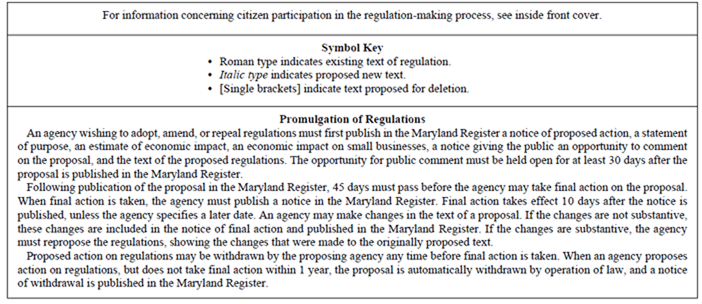
Title 08
DEPARTMENT OF NATURAL RESOURCES
Authority: Natural Resources Article, §4-215, Annotated Code of Maryland
Notice of Proposed Action
[26-059-P]
The Secretary of Natural Resources proposes to amend Regulation .14
under COMAR 08.02.05 Fish.
Statement of Purpose
The purpose of this action is to modify regulations for Spanish mackerel. The proposed action establishes a commercial catch limit of 500 pounds per vessel per day or trip, whichever is longer, regardless of the number of licensees on board the vessel when the National Oceanic and Atmospheric Administration (NOAA) Fisheries announces a closure of the northern fishery. The proposed action also updates the public notice provision by changing the requirement to publish a notice in a daily newspaper of general circulation to posting the notice on the Department’s website.
When commercial landings have reached the commercial quota for the Atlantic migratory group Spanish mackerel northern zone, NOAA Fisheries announces a closure of the Spanish mackerel northern fishery. The northern zone for Atlantic migratory group Spanish mackerel includes federal waters from North Carolina through New York. When federal waters close, the Atlantic States Marine Fisheries Commission (ASMFC) Interstate Fishery Management Plan for Spanish Mackerel (FMP) allows states to implement a bycatch in state waters. Since 2020, the Department has implemented a 500-pound commercial catch limit after NOAA Fisheries closes the northern fishery. This limit is consistent with North Carolina, the Potomac River Fisheries Commission, and Virginia. Implementing the bycatch is necessary to prevent the quota from being further exceeded, while allowing a minimal bycatch amount of Spanish mackerel to be landed to avoid dead discards.
Changing the requirement for publishing public notices issued to implement the ASMFC FMP from the newspaper to the Department’s website allows the Department to make changes in a timely manner if future actions are taken by ASMFC. The public notice would continue to be disseminated through various other media (social media, email lists, publishing in the Maryland Register, etc.) so that an affected individual has a reasonable opportunity to be informed.
Estimate of Economic Impact
I. Summary of Economic Impact. There is a very small impact on the Department and on newspaper companies.
II. Types of Economic Impact.
|
Impacted Entity |
Revenue
(R+/R-) Expenditure (E+/E-) |
Magnitude |
|
A. On issuing agency: |
|
|
|
Maryland Department of Natural Resources |
(E-) |
$200
per year |
|
B. On other State agencies: |
NONE |
|
|
C. On local governments: |
NONE |
|
|
|
Benefit
(+) Cost
(-) |
Magnitude |
|
D. On regulated industries or trade groups: |
NONE |
|
|
E. On other industries or trade groups: |
|
|
|
Newspaper Companies |
(-) |
$200
per year |
|
F. Direct and indirect effects on public: |
NONE |
|
III. Assumptions. (Identified by Impact Letter and Number from Section II.)
A. The Department currently spends approximately $200 each year to publish the Spanish mackerel public notice in the newspaper. The proposed action removes the newspaper requirement, resulting in a savings of approximately $200 each year for the Department.
E. There is a very small impact on newspaper companies. The Department currently spends approximately $200 each year to publish the Spanish mackerel public notice in the newspaper. The proposed action removes the newspaper requirement, resulting in a loss of approximately $200 each year for newspaper companies.
Economic Impact on Small Businesses
The proposed action has minimal or no economic impact on small businesses.
Impact on Individuals with Disabilities
The proposed action has no impact on individuals with disabilities.
Opportunity for Public Comment
Comments may be sent to Spanish Mackerel Regulations, Regulatory Staff, Maryland Department of Natural Resources Fishing and Boating Services, 580 Taylor Avenue, E-4, Annapolis, MD 21401, or call 410-260-8300, or email to [email protected] or complete the comment form at https://dnr.maryland.gov/fisheries/pages/regulations/changes.aspx#mackerel. Comments will be accepted through July 13, 2026. A public hearing has not been scheduled.
.14 Spanish Mackerel.
A. (text unchanged)
B. Commercial Fishery.
(1) (text unchanged)
(2) Catch Limit.
(a) [No] Prior to the closure of the northern zone in federal waters for Atlantic migratory group Spanish mackerel, not more than 3,500 pounds of Spanish mackerel may be landed per vessel per day or trip, whichever is longer, regardless of the number of licensees on board the vessel.
(b) Upon closure of the northern zone in federal waters for
Atlantic migratory group Spanish mackerel, not more than 500 pounds of Spanish
mackerel may be landed per vessel per day or trip, whichever is longer,
regardless of the number of licensees on board the vessel.
(3) (text unchanged)
C. General.
(1) The Secretary may establish or modify catch limits, [or] size limits, or [open or close a season as required by] seasons for Spanish mackerel to implement the Atlantic States Marine Fisheries Commission Interstate Fishery Management Plan for Spanish Mackerel by [publishing] issuing a public notice [in a daily newspaper of general circulation at least 48 hours in advance of the modification, stating the effective hour and date] on the Department’s website.
(2) The public notice shall state its effective hour and date
and shall be published on the Department’s website at least 48 hours in advance
of the effective hour and date.
[(2)] (3) The Secretary shall make a reasonable effort to disseminate a public notice issued under this section through various other media so that an affected [person] individual has a reasonable opportunity to be informed.
(4) A violation of the restrictions set by the Secretary in
accordance with this section is a violation of this regulation.
JOSH KURTZ
Secretary of Natural
Resources
08.03.02 Use of Wildlife Areas
Authority: Natural Resources Article, §10-808, Annotated Code of Maryland
Notice of Proposed Action
[26-056-P]
The Secretary of Natural Resources proposes to amend Regulations .02,
.27, .28, and .30 under COMAR 08.03.02 Use of Wildlife
Areas.
Statement of Purpose
The purpose of this action is to add the newly acquired property known as Swanson Creek to the state Wildlife Management Area (WMA) system and establish hunting restrictions for the property. Swanson Creek WMA is located in Charles County. The amendments also revise nomenclature and locations for certain WMAs and updates the regulations to reflect current and long-standing policy as it relates to hunting on certain WMAs and purchasing shooting range permits.
Estimate of Economic Impact
The proposed action has no economic impact.
Economic Impact on Small Businesses
The proposed action has minimal or no economic impact on small businesses.
Impact on Individuals with Disabilities
The proposed action has no impact on individuals with disabilities.
Opportunity for Public Comment
Comments may be sent to John Moulis, Wildlife and Heritage Service, Department of Natural Resources, P.O. Box 68 Wye Mills, MD 21679, or call 410-829-8612, or email to [email protected]. Comments will be accepted through July 13, 2026. A public hearing has not been scheduled.
.02 Wildlife Management Area
System.
A. (text unchanged)
B. Wildlife Management Areas.
|
Name of Area |
County |
|
Avondale—Devil Island |
(text
unchanged) |
|
[Dierrsen] Dierssen |
Montgomery |
|
Earleville—Indian Springs |
(text
unchanged) |
|
Islands of the Potomac |
Allegany, Frederick, Montgomery,
Washington |
|
Isle of Wight—Nanjemoy Creek |
(text
unchanged) |
|
Nanticoke River |
Dorchester,
Wicomico |
|
Old Bohemia—Strider |
(text
unchanged) |
|
Swanson
Creek |
Charles |
|
Tall [Oak] Oaks |
Queen
Anne's |
|
Tar Bay—Wetipquin |
(text
unchanged) |
C. Hunting is allowed on Wildlife Management Areas in accordance with the provisions of this chapter except on the following WMAs:
(1)—(3) (text unchanged)
(4) Dierssen;
[(4)](5)— [(6)](7) (text unchanged)
[(7)](8) Kent Island Research Center; [and]
[(8)](9) Little Patuxent Oxbow[.];
(10) McIntosh Run; and
(11) Tall Oaks.
.27 Permit Hunting Areas.
A. (text unchanged)
B. Wildlife Management Areas.
(1) (text unchanged)
(2) From September 1 to February 28 and during spring turkey season, a person may not enter or hunt on the following WMAs without a valid public hunting permit from the Service:
(a)—(d) (text unchanged)
(e) Hugg-Thomas; and
[(f) McIntosh Run; and]
[(g)](f) Strider.
(3) From September 1 to February 28 and during spring turkey season, a person may not hunt without a valid public hunting permit from the Service on the following WMAs:
(a) Cheltenham;
[(a)](b) Grove Farm;[ and]
[(b)](c) Old Bohemia[.]; and
(d) Swanson Creek.
(4) (text unchanged)
C.—F. (text unchanged)
.28 Hunting Restrictions on
Certain Wildlife Management Areas.
A. Deer may be hunted only with archery equipment on the following WMAs:
(1)—(2) (text unchanged)
(3) Johnson WMA;[ and]
(4) Ridenour Swamp[.]; and
(5) Swanson Creek.
B.—H. (text unchanged)
[I. Only deer and dove may be hunted on Cheltenham WMA.]
.30 Designated Shooting Range
Permits — Wildlife Management Area Lands.
A. (text unchanged)
B. Permit fees are:
(1) $5 for a [resident or nonresident individual younger than 18 years old] one day pass; and
(2) $20 for [a resident individual 18 years old or older;]
an annual permit.
[(3) $10 for an individual who possesses a current, valid Maryland hunting license;
(4) $5 for a one-day pass regardless of residency; and
(5) $25 for a nonresident 18 years old or older.]
C. [A] An annual permit is valid from August 1 or date of issue [to December 31 of each year] through July 31 annually.
D.—G. (text unchanged)
JOSH KURTZ
Secretary of Natural
Resources
08.03.03 Open Seasons, Bag Limits for Game Birds and Game Animals
Authority: Natural Resources Article, §§10-205, 10-405, 10-410, 10-415, Annotated Code of Maryland
Notice of Proposed Action
[26-071-P]
The Secretary of Natural Resources proposes to repeal existing
Regulations .03—.05, .07, and .08 and adopt new
Regulations .03—.05, .07, and .08 under COMAR 08.03.03
Open Seasons, Bag Limits for Game Birds and Game Animals.
Statement of Purpose
The purpose of this action is to establish the season dates and bag limits for the 2026—2027 and 2027—2028 hunting seasons for forest game, upland game, fur-bearing mammals, white-tailed deer, and sika deer. Hunting season dates and bag limits for most species are similar to previous hunting seasons with some exceptions. The river otter bag limit has been combined in the non-coastal zones and is now two otters per day with a total of two per season for these areas combined. The fisher bag limit has been increased to four fishers per day with a season limit also of four. Long-tailed weasel seasons and bag limits are now the same as fisher.
Estimate of Economic Impact
The proposed action has no economic impact.
Economic Impact on Small Businesses
The proposed action has minimal or no economic impact on small businesses.
Impact on Individuals with Disabilities
The proposed action has no impact on individuals with disabilities.
Opportunity for Public Comment
Comments may be sent to Brian Eyler, Wildlife and Heritage Services, Department of Natural Resources, 14038 Blairs Valley Road, Clear Springs, MD 21722, or call 301-842-0332, or email to [email protected]. Comments will be accepted through July 13, 2026. A public hearing has not been scheduled.
.03 Forest Game.
|
Species |
Open Season, Subject to Regulation .01D of this Chapter |
Location |
Bag Limits |
Possession Limit |
|
A. Black Bear (Permit Required). |
October 26,
2026 — October 31, 2026 October 25,
2027 — October 30, 2027 |
In Allegany, Frederick,
Garrett, and Washington Counties |
1 per day with no more than 1 per permitted bear hunting team |
1 per season with no more than 1 per permitted bear hunting
team |
|
B. Ruffed Grouse. |
||||
|
(1) In General. |
October 3, 2026 — December 31, 2026 October 2,
2027 — December 31, 2027 |
In all counties |
2 per day |
4 |
|
(2) Hunting with the
Aid of Raptors and a Falconry Permit. |
October 1, 2026 — March 31, 2027 October 1,
2027 —March 31, 2028 |
In all counties |
2 per day |
4 |
|
C. Black, Eastern
Fox, Gray, Piney, or Red Squirrel Total. |
||||
|
(1) In General. |
September 5, 2026 — February 28, 2027 September 4,
2027 — February 29, 2028 |
In all counties |
6 per day |
12 |
|
(2) Hunting with the
Aid of Raptors and a Falconry Permit. |
September 1, 2026 — March 31, 2027 September 1,
2027 — March 31, 2028 |
In all counties |
6 per day |
12 |
|
D. Delmarva Fox
Squirrel. |
Closed season |
In all counties |
0 |
0 |
|
E. Wild Turkey. |
||||
|
(1) Fall Season Either Sex. |
October 31,
2026 — November 8, 2026 October 30,
2027 —November 7, 2027 |
Allegany, Garrett,
and Washington Counties only |
1 turkey per season |
1 turkey either sex per fall/winter season combined |
|
(2) Winter Season Either Sex. |
January 21, 2027 — January 23, 2027 January 20,
2028 — January 22, 2028 |
In all counties |
1 turkey per season provided none was taken in the fall season |
|
|
(3) Spring Season. |
April 19, 2027 — May 24, 2027 April 18,
2028 — May 23, 2028 |
In all counties |
1 bearded turkey
per day |
2 bearded turkeys
per spring season |
|
(4) Spring Season Junior Hunt. |
April 17, 2027 — April 18, 2027 April 15,
2028 — April 16, 2028 |
In all counties |
1 bearded turkey
per day |
|
.04 Upland Game.
|
Species |
Open Season, Subject to Regulation .01D of this Chapter |
Location |
Bag Limits |
Possession Limit |
|
A. Crow. |
August 15 — March 15, hunting allowed Wednesday, Thursday, Friday,
and Saturday only |
In all counties |
No limit |
No limit |
|
B. Pheasant. |
||||
|
(1) In General. |
November 7, 2026 — February 28, 2027 November 6,
2027 — February 29, 2028 |
In all counties |
2 per day (either sex) |
4 |
|
(2) Hunting with the
Aid of Raptors and a Falconry Permit. |
November 1, 2026 — March 31, 2027 November 1,
2027 — March 31, 2028 |
In all counties |
2 per day (either
sex) |
4 |
|
C. Quail. |
||||
|
(1) Western Zone —
Private Land and Lands Owned or Managed by DNR. |
November 7, 2026 — January 15,
2027 November 6, 2027 — January 15, 2028 |
In that portion
of the State west of the Chesapeake Bay and Susquehanna River, excluding Allegany
and Garrett Counties |
6 per day |
12 in all counties and zones combined |
|
(2) Eastern Zone — Private Land. |
November 7, 2026 — January 15,
2027 November 6, 2027 — January 15, 2028 |
In that portion
of the State east of the Chesapeake Bay and Susquehanna River |
||
|
(3) Eastern Zone — Lands Owned or Managed by
DNR. |
Closed season |
In that portion of the State east of the Chesapeake Bay and
Susquehanna River |
0 |
0 |
|
(4) Allegany and Garrett Counties. |
Closed season |
In Allegany and Garrett Counties |
0 |
0 |
|
(5) Hunting with the
Aid of Raptors and a Falconry Permit. |
November 1, 2026 — March 31, 2027 November 1,
2027 — March 31, 2028 |
In all counties,
except on lands owned or managed by DNR east of the Chesapeake Bay and Susquehanna
River |
4 per day |
8 |
|
(6) Hunting with the
Aid of Raptors and a Falconry Permit on Lands Owned or Managed by DNR. |
Closed season |
In that portion of the State east of the Chesapeake Bay and
Susquehanna River |
0 |
0 |
|
D. Rabbits. |
||||
|
(1) Eastern Cottontail
Rabbit. |
|
|
|
|
|
(a) In General. |
November 7, 2026 — February 28,
2027 November 6, 2027 — February 29, 2028 |
In all counties |
4 per day |
8 |
|
(b) Hunting with
the Aid of Raptors and a Falconry Permit. |
November 1, 2026 — March 31, 2027 November 1,
2027 — March 31, 2028 |
In all counties |
4 per day |
8 |
|
(2) Snowshoe Hare. |
Closed season |
In all counties |
0 |
0 |
|
E. Woodchuck. |
August 1 — July
31 |
In all counties |
No limit |
No limit |
.05 Fur-Bearing Mammals.
|
Species |
Open Season, subject to COMAR 08.03.03.01D |
Location |
Bag Limits |
Possession Limit |
|
A. Beaver. |
|
|
|
|
|
(1) In General. |
December 15, 2026 — March 15,
2027 December 15, 2027 — March 15, 2028 |
In all counties,
except Garrett and Allegany Counties |
No limit |
No limit |
|
(2) Allegany and Garrett
Counties. |
December 1, 2026 — March 15,
2027 December 1, 2027 — March 15, 2028 |
In Allegany and Garrett counties |
No limit |
No limit |
|
B. Bobcat. |
Closed season |
In all counties |
0 |
0 |
|
C. Coyote. |
||||
|
(1) Firearms, Archery, and Airgun Hunting. |
August 1 — July
31 (May be hunted day and night) |
In all counties |
No limit |
No limit |
|
(2) Trapping. |
October 31, 2026 — February 15,
2027 November 1, 2027 — February 15, 2028 |
In that portion of the State west of the Chesapeake Bay and
Susquehanna River |
No limit |
No limit |
|
November 14, 2026 — February 28,
2027 November 15, 2027 — February 29, 2028 |
In that portion
of the State east of the Chesapeake Bay and Susquehanna River |
No limit |
No limit |
|
|
D. Fisher. |
October 31, 2026 — February 1,
2027 November 1, 2027 — February 1, 2028 |
In all counties |
4 per day |
4 per season |
|
E. Fox (Red and
Gray) — Firearms, Archery, and Airgun Hunting, and Trapping. |
October 31, 2026 — February 15,
2027 November 1, 2027 — February 15, 2028 |
In Allegany, Anne Arundel, Baltimore, Calvert, Carroll, Frederick,
Garrett, Harford, Howard, Montgomery, Prince George's, St. Mary's, and Washington
Counties |
No limit |
No limit |
|
November 14, 2026 — February 28,
2027 November 15, 2027 — February 29, 2028 |
In Caroline, Cecil, Kent, Queen Anne's, Somerset, Talbot, Wicomico,
and Worcester Counties |
No limit |
No limit |
|
|
August 1 — July 31 |
In Charles and
Dorchester Counties |
No limit |
No limit |
|
|
F. Muskrat and
Mink — Trapping Only. |
November 14, 2026 — February 15,
2027 November 15, 2027 — February 15, 2028 |
In Allegany, Carroll, Frederick, Garrett, Howard, and Washington
Counties |
No limit |
No limit |
|
December 15, 2026 — March 15,
2027 December 15, 2027 — March 15, 2028 |
In Baltimore, Cecil, Harford, Kent, Queen Anne's, Somerset,
and Worcester Counties |
No limit |
No limit |
|
|
January 1, 2027 — March 15,
2027 January 1, 2028 — March 15, 2028 |
In Anne Arundel, Calvert, Caroline, Charles, Dorchester, Montgomery,
Prince George's, St. Mary's, Talbot, and Wicomico Counties |
No limit |
No limit |
|
|
G. Nutria. |
August 1 — July
31 |
In all counties |
No limit |
No limit |
|
H. Otter —
Trapping Only. |
December 1, 2026 — March 15,
2027 December 1, 2027 — March 15, 2028 |
In Allegany and Garrett Counties |
2 per day |
2 per season |
|
December 15, 2026 — March 15,
2027 December 15, 2027 — March 15, 2028 |
In Carroll, Frederick,
Howard, Montgomery, and Washington Counties |
|||
|
In all other counties |
10 per day |
10 per season |
||
|
I. Raccoon and
Opossum. |
||||
|
(1) Chasing — No Kill. |
August 1, 2026 — October 14, 2026 March 16, 2027 — July 31, 2027 August 1, 2027 — October 14, 2027 March 16,
2028 — July 31, 2028 |
In all counties |
|
|
|
(2) Firearms, Archery, Airgun, and Dog Hunting. |
October 15, 2026 — March 15, 2027 October 15,
2027 — March 15, 2028 (May be hunted day and night) |
In all counties |
No limit |
No limit |
|
(3) Trapping. |
October 31, 2026 — March 15, 2027 November 1,
2027 — March 15, 2028 |
In that portion
of the State west of the Chesapeake Bay and Susquehanna River |
No limit |
No limit |
|
November 14, 2026 — March 15,
2027 November 15, 2027 — March 15, 2028 |
In that portion of the State east of the Chesapeake Bay and
Susquehanna River |
No limit |
No limit |
|
|
J. Skunk. |
||||
|
(1) Firearms, Archery, and Airgun Hunting. |
October 31, 2026 — March 15,
2027 November 1, 2027 — March 15, 2028 |
In all counties |
No limit |
No limit |
|
(2) Trapping. |
October 31, 2026 — March 15,
2027 November 1, 2027 — March 15, 2028 |
In all counties |
No limit |
No limit |
|
K. Long-Tailed
Weasel — Trapping. |
October 31, 2026 — February 1,
2027 November 1, 2027 — February 1, 2028 |
In all
counties |
4 per day |
4 per season |
L. On lands owned or controlled by the Department in Caroline, Dorchester,
Somerset, Talbot, Wicomico, and Worcester Counties, only leaseholders or their appointees
may hunt or trap furbearers between November 15 and March 15.
.07 White-Tailed Deer.
A. The following lands are owned or controlled by the Department
in Region A as defined in Regulation .06A of this chapter:
(1) Billmeyer-Belle Grove WMA;
(2) Cunningham Swamp WMA;
(3) Dan’s Mountain WMA;
(4) Deep Creek Lake State Park (designated areas only);
(5) Green Ridge State Forest;
(6) Indian Springs WMA;
(7) McCoole Fishery Management Area;
(8) Mount Nebo WMA;
(9) Potomac-Garrett State Forest;
(10) Prather's Neck WMA;
(11) Rocky Gap State Park (designated areas only);
(12) Sang Run State Park (designated areas only);
(13) Savage River State Forest;
(14) Sideling Hill WMA;
(15) Warrior Mountain WMA;
(16) Wolf Den Run State Park (designated areas only);
(17) Woodmont;
(18) Youghiogheny River Reservoir CWMA; and
(19) Youghiogheny Wild River Natural Environmental Area.
B. The Suburban Deer Management Zone is defined as the area that
encompasses Anne Arundel, Baltimore, Howard, Montgomery, and Prince George’s Counties.
|
|
Season Dates,
Subject to Regulation .01D of this Chapter |
Season Bag
Limits |
|
C. Antlered. |
||
|
(1) Archery Season. |
|
|
|
(a) Region A as Defined in Regulation
.06A of this Chapter. |
||
|
|
January 8,
2027 — January 10, 2027 February 1,
2027 — February 3, 2027 (use of primitive weapons only, subject to §F of this
regulation) January 7,
2028 — January 9, 2028 February 1,
2028 — February 3, 2028 (use of primitive weapons only, subject to §F of this
regulation) |
1 antlered |
|
(b) Statewide. |
||
|
|
September 11, 2026 — October 21, 2026 October 25, 2026 (Sunday counties only) October 26, 2026 — November 27, 2026 December 14, 2026 — December 18, 2026 January 3,
2027 (Sunday counties only) January 4,
2027 — January 7, 2027 January 11,
2027 — January 31, 2027 February 1,
2027 — February 3, 2027 (use of primitive weapons only, subject to §F of this
regulation) September 10, 2027 — October 20, 2027 October 24, 2027 (Sunday counties only) October 25, 2027 — November 26, 2027 December 13,
2027 — December 17, 2027 January 2, 2028 (Sunday counties only) January 3,
2028 — January 6, 2028 January 10,
2028 — January 31, 2028 February 1,
2028 — February 3, 2028 (use of primitive weapons only, subject to §F of this
regulation) |
|
|
(2) Muzzleloader Season. |
||
|
|
October 22, 2026 — October 24, 2026 December 19,
2026 — January 2, 2027 February 1,
2027 — February 3, 2027 (use of primitive weapons only, subject to §F of this
regulation) October 21, 2027 — October 23, 2027 December 18, 2027 — January 1, 2028 February 1,
2028 — February 3, 2028 (use of primitive weapons only, subject to §F of this
regulation) |
1 antlered, except during the October segment
in Region A as defined in Regulation .06A of this chapter. A total of 1 deer,
antlered or antlerless may be taken. |
|
(3) Firearms Season. |
||
|
(a) Region B as Defined in Regulation
.06A of This Chapter. |
1 antlered |
|
|
|
January 8, 2027 — January 9, 2027 January 10,
2027 (Sunday counties only) January 7, 2028 — January 8, 2028 January 9,
2028 (Sunday counties only) |
|
|
(b) Statewide. |
||
|
|
November 28,
2026 — December 12, 2026 November 27,
2027 — December 11, 2027 |
|
|
(4) All Seasons Combined. |
||
|
(a) No more than one antlered white-tailed deer having fewer than three
antler points 1 inch or longer on each antler present may be taken per license
year. (i)
Hunters that possess, or are eligible to possess, a Resident or Nonresident Junior
Hunting License are exempt from this requirement. (ii)
Hunters that are 16 years old or younger and possess an Apprentice Hunting License
are exempt from this requirement. (b) One additional Bonus antlered white-tailed
deer may be taken in Region B, as defined in Regulation .06A of this chapter,
per license year for all seasons combined subject to §§G—H of this regulation. |
No more than 2
antlered deer may be taken per license year with any combination of bow, muzzleloader,
and firearms bag limits. |
|
|
D. Antlerless. |
||
|
(1) Region A as Defined in Regulation .06A
of this Chapter. |
||
|
(a) Archery Season. |
||
|
|
September 11, 2026 — October 21, 2026 October 25, 2026 — November 27, 2026 December 14, 2026 — December 18, 2026 January 3,
2027 — January 31, 2027 February 1,
2027 — February 3, 2027 (use of primitive weapons only, subject to §F of this
regulation) September 10, 2027 — October 20, 2027 October 24, 2027 — November 26, 2027 December 13, 2027 — December 17, 2027 January 2,
2028 — January 31, 2028 February 1,
2028 — February 3, 2028 (use of primitive weapons only, subject to §F of this
regulation) |
Up to 3 antlerless.
See §D(1)(d) of this regulation. |
|
(b) Muzzleloader Season. |
||
|
|
October 22,
2026 — October 24, 2026 December 26,
2026 — January 2, 2027 February 1,
2027 — February 3, 2027 (use of primitive weapons only, subject to §F of this
regulation) October 21, 2027 — October 23, 2027 December 25,
2027 — January 1, 2028 February 1,
2028 — February 3, 2028 (use of primitive weapons only, subject to §F of this
regulation) |
Up to 3 antlerless.
§D(1)(d) of this regulation. During the October segment, a total of 1 deer, antlered
or antlerless, may be taken. |
|
(c) Firearms Season. |
||
|
|
December 5,
2026 — December 12, 2026 December 4,
2027 — December 11, 2027 |
Up to 2 antlerless.
See §D(1)(d) of this regulation. |
|
(d) All Seasons Combined. |
||
|
|
No more than 2
antlerless deer may be taken in Region A, as defined in Regulation .06A of
this chapter, per license year during September — January with any combination
of bow, muzzleloader, and firearms bag limits. One additional antlerless deer
may be taken during the February dates. No more than 1 antlerless deer total may
be taken during the February dates and no more than 1 antlerless deer may be harvested
per day in any season. |
|
|
(2) Region B as Defined in Regulation .06A
of this Chapter. |
||
|
(a) Archery Season. |
||
|
|
September 11, 2026 — October 21, 2026 October 25, 2026 (Sunday counties only) October 26, 2026 — November 27, 2026 December 14,
2026 — December 18, 2026 January 3, 2027 (Sunday counties only) January 4, 2027 — January 7, 2027 January 11,
2027 — January 31, 2027 February 1,
2027 — February 3, 2027 (use of primitive weapons only, subject to §F of this
regulation) September 10, 2027 — October 20, 2027 October 24, 2027 (Sunday counties only) October 25, 2027 — November 26, 2027 December 13,
2027 — December 17, 2027 January 2, 2028 (Sunday counties only) January 3, 2028 — January 6, 2028 January 10,
2028 — January 31, 2028 February 1,
2028 — February 3, 2028 (use of primitive weapons only, subject to §F of this
regulation) |
15 antlerless (Unlimited antlerless
in the Suburban Deer Management Zone as defined in §B of this regulation) |
|
(b) Muzzleloader Season. |
||
|
|
October 22, 2026 — October 24, 2026 October 26,
2026 — October 31, 2026 December 19,
2026 — January 2, 2027 February 1,
2027 — February 3, 2027 (use of primitive weapons only, subject to §F of this
regulation) October 21, 2027 — October 23, 2027 October 25,
2027 — October 30, 2027 December 18,
2027 — January 1, 2028 February 1,
2028 — February 3, 2028 (use of primitive weapons only, subject to §F of this
regulation) |
10 antlerless |
|
(c) Firearms Season. |
||
|
|
November 28, 2026 — December 12, 2026 January 8, 2027 — January 9, 2027 January 10,
2027 (Sunday counties only) November 27, 2027 — December 11, 2027 January 7, 2028 — January 8, 2028 January 9,
2028 (Sunday counties only) |
10 antlerless |
|
E. Junior Deer Hunt. |
||
|
(1) Region A as Defined in Regulation .06A
of this Chapter. |
||
|
Antlered or Antlerless. |
November 14, 2026 — November 15, 2026 November 13,
2027 — November 14, 2027 |
1 deer |
|
(2) Region B as Defined in Regulation .06A
of This Chapter. |
||
|
Antlered or Antlerless. |
November 14, 2026 November 15,
2026 (Sunday counties only) November 13, 2027 November 14,
2027 (Sunday counties only) |
3 deer Not more than
1 antlered |
F. Use of Primitive Weapons During February Dates.
(1) A hunter may only use a primitive weapon as defined in COMAR
08.03.01.01B(29) and in accordance with COMAR 08.03.04.05I.
(2) Hunters may not harvest more than one antlered deer per day within
the prescribed bag limit.
(3) A deer taken with a primitive weapon shall count towards the
respective bow or muzzleloader season's bag limits, except in Region A, as defined
in Regulation .06A of this chapter, in which one additional antlerless deer may
be taken.
G. A hunter may only harvest one antlered deer per license year,
including the Bonus antlered deer, that has antlers with fewer than three antler
points 1 inch or longer on each antler.
(1) Hunters who possess, or are eligible to possess, a Resident
or Nonresident Junior Hunting License are exempt from this requirement.
(2) Hunters who are 16 years old or younger and possess an Apprentice Hunting License are exempt from this requirement.
H. Bonus Antlered Deer Stamp.
(1) Before taking a Bonus antlered white-tailed deer, hunters
shall first purchase a Bonus Antlered Deer Stamp.
(2) Persons exempt from needing a hunting license under Natural Resources
Article, §10-301(c), Annotated Code of Maryland, do not need to purchase a Bonus
Antlered Deer Stamp.
(3) One Bonus antlered white-tailed deer may be taken per license
year, for all seasons combined. The Bonus antlered white-tailed deer may not be
taken on the same day that another antlered deer is taken under the prescribed bag
limit.
(4) In accordance with the defined regions in Regulation .06A of
this chapter, the Bonus Antlered Deer Stamp may be used in Region A, provided that
prior to the use of the Bonus Antlered Deer Stamp:
(a) No more than two antlered deer were taken Statewide and no more
than one antlered deer was taken in Region A; and
(b) Any previously harvested antlered deer in Region A was taken
in a different weapon season than the Bonus deer.
(5) The Bonus antlered white-tailed deer may be taken in any weapon
season except the October muzzleloader season.
.08 Sika Deer.
|
|
Season
Dates, Subject to Regulation .01D of this Chapter |
Season Bag Limits |
|
A. Archery Season. |
||
|
Statewide. |
September 11, 2026 — October 21, 2026 October 25, 2026 (Sunday counties only) October 26, 2026 — November 27, 2026 December 14,
2026 — December 18, 2026 January 3, 2027 (Sunday counties only) January 4, 2027 — January 7, 2027 January 11,
2027 — January 31, 2027 February 1,
2027 — February 3, 2027 (use of primitive weapons only, subject to §E of this
regulation) September 10, 2027 — October 20, 2027 October 24, 2027 (Sunday counties only) October 25, 2027 — November 26, 2027 December 13,
2027 — December 17, 2027 January 2, 2028 (Sunday counties only) January 3, 2028 — January 6, 2028 January 10,
2028 — January 31, 2028 February 1,
2028 — February 3, 2028 (use of primitive weapons only, subject to §E of this
regulation) |
3 deer Not more than
1 antlered. |
|
B. Muzzleloader
Season. |
||
|
(1) Region B as Defined in Regulation .06A
of this Chapter. |
||
|
Antlerless. |
October 26,
2026 — October 31, 2026 October 25,
2027 — October 30, 2027 |
3 deer Not more than
1 antlered. |
|
(2) Statewide. |
||
|
Antlered or Antlerless. |
October 22, 2026 — October 24, 2026 December 19,
2026 — January 2, 2027 February 1,
2027 — February 3, 2027 (use of primitive weapons only, subject to §E of this
regulation) October 21, 2027 — October 23, 2027 December 18,
2027 — January 1, 2028 February 1,
2028 — February 3, 2028 (use of primitive weapons only, subject to §E of this
regulation) |
|
|
C. Firearms Season. |
||
|
Statewide. |
November 28,
2026 — December 12, 2026 January 8,
2027 — January 9, 2027 January 10,
2027 (Sunday counties only) November 27,
2027 — December 11, 2027 January 7,
2028 — January 8, 2028 January 9,
2028 (Sunday counties only) |
3 deer Not more than
1 antlered. |
|
D. Junior Deer
Hunt. |
||
|
Statewide. |
November 14, 2026 November 15,
2026 (Sunday counties only) November 13, 2027 November 14,
2027 (Sunday counties only) |
1 antlered or 1 antlerless |
E. Use of Primitive Weapons During February Dates.
(1) A hunter may only use a primitive weapon as defined in COMAR
08.03.01.01B(29) and in accordance with COMAR 08.03.04.05I.
(2) Hunters may not harvest more than one antlered deer per day within
the prescribed bag limit.
(3) A deer taken with a primitive weapon shall count towards the
respective bow or muzzleloader season's bag limits, except in Region A, as defined
in Regulation .06A of this chapter, in which one additional antlerless deer may
be taken.
JOSH KURTZ
Secretary of Natural
Resources
Notice of Proposed Action
[26-072-P]
The Secretary of Natural Resources proposes to:
(1) Amend Regulation .05 under COMAR 08.03.04 Forest Wildlife;
(2) Adopt new Regulation .08 under COMAR 08.03.06 Furbearer Wildlife;
(3) Amend Regulations .06 and .12 under COMAR 08.03.07 Waterfowl; and
(4) Amend Regulation .02 and adopt new Regulation .17
under COMAR 08.03.10 General Wildlife Hunting Regulations.
Statement of Purpose
The purpose of this action is to:
(1) Change the muzzle energy requirements for certain rifles used to hunt deer and black bear;
(2) Require gray fox harvested by hunters and trappers to be checked-in using an automated telephone/Internet/mobile app system similar to deer and wild turkey;
(3) Clarify that certain special hunting methods may be used during segments of the regular snow goose season when designated by the Department of Natural Resources; and
(4) Codify that drones may be used to locate wounded or killed game animals but may not be used otherwise to hunt or harass wildlife.
Estimate of Economic Impact
The proposed action has no economic impact.
Economic Impact on Small Businesses
The proposed action has minimal or no economic impact on small businesses.
Impact on Individuals with Disabilities
The proposed action has no impact on individuals with disabilities.
Opportunity for Public Comment
Comments may be sent to Brian Eyler, Wildlife and Heritage Services, Department of Natural Resources, 14038 Blairs Valley Road, Clear Springs, MD 21722, or call 301-842-0332, or email to [email protected]. Comments will be accepted through July 13, 2026. A public hearing has not been scheduled.
08.03.04 Forest Wildlife
Authority: Natural Resources Article, §10-408, Annotated Code of Maryland
.05 Devices for Hunting Deer and Black Bear.
A.—B. (text unchanged)
C. Firearms.
(1) (text unchanged)
(2) A rifle or shotgun
propelling one soft-nosed or expanding bullet or ball at a single discharge.
Rifles less than .30 caliber or 7.62 millimeters must [which
generates] generate at least 1,200 foot-pounds of muzzle energy [is
allowed] when fired.
(3)—(7) (text unchanged)
D.—I. (text unchanged)
08.03.06 Furbearer Wildlife
Authority: Natural Resources Article, §10-205, Annotated Code of
Maryland
.08 Harvest Reporting of Gray Fox.
A. A person who kills a gray fox either by hunting or trapping
shall report the kill to the Department by registering the kill on the
Department’s internet-based checking system accessible through the Department’s
licensing website or mobile app, or as otherwise designated on the Department’s
website.
B. The harvest of a gray fox shall be reported not later than 48
hours after the fox was killed by the hunter or trapper.
C. All gray fox killed by hunters and trappers must be reported
regardless of whether they are taken into possession or left in the field.
D. After reporting the kill, the hunter or trapper will receive
a confirmation number from the Department that shall be kept in their
possession in either paper format or as an electronic record.
E. The requirements of this regulation apply to all hunters and
trappers including those individuals who are exempt from the hunting license
requirements of Natural Resources Article, §10-301, Annotated Code of Maryland.
F. This regulation shall sunset and have no further force and
effect on April 1, 2031.
08.03.07 Waterfowl
Authority: Natural Resources Article, §§10-205 and 10-408, Annotated Code of Maryland
.06 Devices for Hunting Wetland Game Birds.
A.—E. (text unchanged)
F. The restriction in §E of this regulation that limits shotguns to those holding not more than three shells does not apply to:
(1) Shotguns used for
hunting snow geese during the Light Goose Conservation Order season;[
and]
(2) Shotguns used for
hunting resident Canada geese during the September resident Canada goose season[.];
and
(3) Shotguns used for
hunting snow geese during certain segments of the regular snow goose hunting
season designated by the Department.
.12 Shooting Hours for Light Goose Conservation Order Season.
A person may hunt light geese from ½ hour prior to sunrise to ½ hour after
sunset during the Light Goose Conservation Order season or certain segments
of the regular Light Goose Hunting Season designated by the Department if
this method is allowed in Maryland pursuant to a final rule adopted by the
Department of the Interior, U.S. Fish and Wildlife Service, as published in the
Federal Register pursuant to 50 CFR 20 or 50 CFR 21.
08.03.10 General Wildlife Hunting Regulations
Authority: Natural Resources Article, §§10-205 and 10-408, Annotated Code of Maryland
.02 Recorded Bird or Animal Calls.
A. (text unchanged)
B. The restrictions in §A of this regulation do not apply to the hunting of snow geese during the Light Goose Conservation Order season or certain segments of the regular Light Goose Hunting Season designated by the Department if these methods are permitted in Maryland according to a Final Rule adopted by the Department of the Interior, U.S. Fish and Wildlife Service, as published in the Federal Register pursuant to 50 CFR 20 or 50 CFR 21.
.17 Unmanned Aircraft Systems.
A. Definitions.
(1) “Unmanned Aircraft System” means an aircraft operated
without the possibility of direct human intervention from within or on the
aircraft.
(2) “Drone” means an Unmanned Aircraft System.
B. Except as provided for in §C of this regulation, a drone may
not be used to:
(1) Hunt or take any
wildlife;
(2) Purposely disturb
wildlife in a manner that would cause injury or death, or disrupt normal
behavior patterns including breeding, feeding, resting, and sheltering;
(3) Interfere with or
disrupt the hunt of another; or
(4) Commit or attempt to
commit any other act in violation of the Natural Resources Article, Annotated
Code of Maryland.
C. A drone may be used to:
(1) Locate wildlife that
has been lawfully wounded or killed; and
(2) Scout an area for
wildlife, except that information
obtained from drone scouting may not be used for hunting the scouted area until
at least 24 hours have elapsed from the last drone flight.
D. A drone operator may carry a firearm or bow that is legal for
the open hunting season and may dispatch a lawfully wounded deer or black bear
if the hunter who wounded the deer or black bear is unable to do so.
E. Except as provided for in this subtitle, the act of searching
for a wounded or expired animal with a drone constitutes hunting and is subject
to all applicable laws, regulations, and conditions, including the possession
of a Maryland hunting license.
F. Before and after using a drone to attempt to locate a wounded
or expired animal, the hunter or drone operator shall notify the Natural
Resources Police by calling the Department of Natural Resources (DNR)
Communication Center 24-Hour Emergency telephone number. The hunter or drone
operator shall provide the following information:
(1) Where the animal was
killed, wounded, or injured;
(2) The name, address,
telephone number, and DNRid number of the hunter and drone operator;
(3) The general location
of the dead, wounded, or injured animal;
(4) The name of the
landowner where the search will be conducted; and
(5) The status of the
search when it concludes.
G. This subtitle does not authorize a drone operator or hunter
to trespass onto the property of another in pursuit of a wounded or killed
animal or fly a drone where otherwise prohibited.
H. This subtitle does not exempt a drone operator from federal,
State, or local laws pertaining to aircraft operation, including those found
under Title 14 of the Code of Federal Regulations.
I. No part of this subtitle shall be construed to restrict the
use of a drone or other unmanned aircraft for wildlife management activities
conducted or authorized by the Department, by employees of the United States or
any of its agencies in the performance of their official duties, or by county,
city, or local government employees in the performance of their official
duties.
JOSH KURTZ
Secretary of Natural
Resources
Title 10
MARYLAND DEPARTMENT OF HEALTH
Subtitle 17 SWIMMING POOLS AND SPAS
10.17.01 Public Swimming Pools and Spas
Authority: Health-General Article, §§2-102, 2-104, 18-102, and 20-303; Public Safety Article, §§12-1203 and 12-1207(a)(2); Annotated Code of Maryland; 15 U.S.C. §8003
Notice of Proposed Action
[26-063-P-I]
The Secretary of Health proposes to repeal existing Regulations .01—.03
and .05—55, amend and recodify existing Regulation .04 to be
Regulation .03, and adopt new Regulations .01, .02, and .04—.47
under COMAR 10.17.01 Public Swimming Pools and Spas.
Statement of Purpose
The purpose of this action is to reorganize COMAR 10.17.01 to more clearly delineate between regulations that pertain to the operation and maintenance of public swimming pools and spas and regulations concerning the construction and design of these facilities. These changes are necessary due to the adoption of the International Swimming Pool and Spa Code (ISPSC) by the Maryland Department of Labor in accordance with Public Safety Article, §12-1203, Annotated Code of Maryland. It also incorporates by reference ANSI/PHTA/ICC-7 2020, which is the suction entrapment prevention standard required by 15 U.S.C. §8003.
Estimate of Economic Impact
The proposed action has no economic impact.
Economic Impact on Small Businesses
The proposed action has minimal or no economic impact on small businesses.
Impact on Individuals with Disabilities
The proposed action has no impact on individuals with disabilities.
Opportunity for Public Comment
Comments may be sent to Jordan Fisher Blotter, Director, Office of Regulation and Policy Coordination, Maryland Department of Health, 201 West Preston Street, Room 534, Baltimore, Maryland 21201, or call 410-767-0938, or email to [email protected]. Comments will be accepted through July 13, 2026. A public hearing has not been scheduled.
Editor’s Note on Incorporation by Reference
Pursuant to State Government
Article, §7-207, Annotated Code of Maryland, the American National Standards
for Suction Entrapment Avoidance in Swimming Pools, Wading Pools, Spas, Hot
Tubs, and Catch Basins (ANSI/PHTA/ICC-7 2020) has been declared a document
generally available to the public and appropriate for incorporation by reference.
For this reason, it will not be printed in the Maryland Register or the Code of
Maryland Regulations (COMAR). Copies of this document are filed in special
public depositories located throughout the State. A list of these depositories
was published in 53:1 Md. R. 10 (January 9, 2026), and
is available online at www.dsd.maryland.gov. The document may also be inspected
at the office of the Division of State Documents, 16 Francis Street, Annapolis,
Maryland 21401.
.01 Scope.
A. The purpose of this chapter is to enact regulations that
protect and promote the public health and safety of individuals at public spas
and pools in the State. Public pools include limited public-use pools,
recreational pools, and semipublic pools. Public spas include semipublic spas.
B. This chapter establishes minimum criteria for the operation
and maintenance of all public pools and spas, and construction and design
standards for public pools and spas built and in operation before December 31,
2023.
.02 Definitions.
A. In this chapter:
(1) Absent a definition in §B of this regulation, all of the
terms in the International Swimming Pool and Spa Code (ISPSC) apply; and
(2) The following terms have the meanings indicated.
B. Terms Defined.
(1) Alteration.
(a) “Alteration” means to:
(i) Change or modify an equipment room, a bathhouse, a
component, or the configuration of a pool or spa;
(ii) Move a component from one location or position to another;
or
(iii) Install a new component.
(b) “Alteration” does not include a repair or replacement.
(2) “Approved” means found by the Secretary to be in
satisfactory compliance with applicable statutes and regulations promulgated or
enforced by the Secretary.
(3) “Barrier” means an uninterrupted obstacle intended to
prevent direct access from one point to another surrounding and securing a pool
or spa.
(4) “Cfm” means cubic feet per minute.
(5) “Component” means:
(a) A piece of pool or spa equipment;
(b) A deck;
(c) A barrier;
(d) One or more skimmers;
(e) One or more filters, including piping and valves;
(f) A ventilation system;
(g) Lighting provided for water, deck, and walkways; or
(h) Pipe material for pool or spa water.
(6) Critical Violation.
(a) “Critical violation” means a violation that results from a
product, practice, circumstance, or event that creates a situation that
requires immediate correction or cessation of operation to prevent injury,
illness, or death based on the number of potential injuries and the nature,
severity, and duration of the anticipated injury or illness.
(b) “Critical violation” includes the violations enumerated in
Regulation .24A of this chapter.
(7) “Full compliance inspection” means an inspection that
verifies compliance with this chapter.
(8) “Hand feeding” means adding chemicals to a pool or spa by
any means other than an automatic chemical feeder.
(9) “ISPSC” means the International Swimming Pool and Spa Code.
(10) “ISPSC Pool” means a pool that was constructed and
approved:
(a) After December 31, 2023; or
(b) Before December 31, 2023, and has undergone a major
alteration after December 31, 2023.
(11) “ISPSC Spa” means a spa that was constructed and approved:
(a) After December 31, 2023; or
(b) Before December 31, 2023, and has undergone a major
alteration after December 31, 2023.
(12) “Legacy pool” means a pool that:
(a) Was constructed and approved before December 31, 2023; and
(b) Has not undergone any major alterations after December 31,
2023.
(13) “Legacy spa” means a spa that:
(a) Was constructed and approved before December 31, 2023; and
(b) Has not undergone any major alterations after December 31,
2023.
(14) “Lifeguard” means an individual who is 15 years old or
older and who has a valid lifeguard certificate from:
(a) The American Red Cross;
(b) The Boy Scouts of America, not including a lifeguard merit
badge;
(c) The YMCA;
(d) Ellis and Associates' National Pool and Waterpark Lifeguard
Training; or
(e) An organization with a lifesaving training program
equivalent to that of the American Red Cross.
(15) Limited Public-Use Pool.
(a) “Limited public-use pool” means a private pool which is made
available for use by:
(i) Children in family day care under the care of a family day
care provider at a family day care home as defined in COMAR 13A.15.01.02; or
(ii) An organized group, agency, or other person for swimming
lessons or water safety training.
(b) “Limited public-use pool” does not include a pool that is
emptied of water, disinfected, and refilled with water between each use.
(16) “Major alteration” has the same meaning as “substantial and
material structural change” stated in COMAR 09.12.56.04
(17) Major Violation.
(a) “Major violation” means a violation that if not corrected
within 24 hours could lead to injury, illness, or death.
(b) “Major violation” includes the violations enumerated in
Regulation .24B of this chapter.
(18) “Make-up water” means the potable water used to maintain
the water level in a pool or a spa.
(19) “Operator” means a person who supervises, controls,
conducts, or manages the operation of a public pool or spa.
(20) Owner.
(a) “Owner” means the owner of a public pool or spa.
(b) “Owner” includes a designee in the form of an operator,
builder, management company, or similar entity.
(21) “PHMB” means the disinfectant polyhexamethylene biguanide.
(22) “Pool” means an artificial enclosure of water that is used
for the immersion of the human body for recreation, therapy, or exercise,
including a structure that is installed in the ground, above ground, outside,
or in a building or portable structure.
(23) Private Pool and Private Spa.
(a) “Private pool” and “private spa” mean a pool or spa that is:
(i) Not open to the public;
(ii) On a property on which not more than four private
residences are located; and
(iii) Used exclusively by the residents of the property and
nonpaying individuals invited to use the pool or spa by a resident.
(b) “Private pool” and “private spa” include a pool or spa at a
private residence used for short-term rentals including weekly, monthly, or
seasonal rentals.
(24) Public Pool and Public Spa.
(a) “Public pool” and “public spa” mean a pool or spa that is
not a private pool or spa.
(b) “Public pool” includes a:
(i) Limited public-use pool, as defined in §B of this
regulation;
(ii) Recreational pool as defined in §B of this regulation; and
(iii) Semipublic pool, as defined in §B of this regulation.
(c) “Public spa” includes a semipublic spa, as defined in §B of
this regulation.
(25) “Recreational pool” means a pool that:
(a) Is not a limited public-use pool, private pool, or
semipublic pool, as defined in §B of this regulation;
(b) Is provided as the owner's primary business or the
facility's primary purpose, for example, a swim club or similar facility;
(c) Is open for general admission to the public;
(d) Is available to an individual paying a fee for use of the
pool;
(e) Is equipped with a sliding board, diving platform, water
slide, water flume, or water recreational play equipment that is built into or
attached to the pool structure;
(f) Is provided by, or used by a:
(i) Youth camp;
(ii) College, university, or school;
(iii) Municipality;
(iv) Water park, amusement park, or water recreational
attraction as defined in §B of this regulation; or
(v) An apartment complex, housing subdivision, or mobile home
park with more than ten units, except as provided in §B(28)(a)(v) of this
regulation; or
(g) Is used more than 4 times a week for swimming lessons, water
safety instruction, or swimming competition;
(h) Meets ISPSC Class A, D, & F;
(i) Meets ISPSC Cass B: except retirement community or marina;
or
(j) Meets ISPSC Class C: such as apartment complex, housing
subdivision, or mobile home park with more than ten units.
(26) Replacement.
(a) “Replacement” means substituting a component, which has a
different make or model but has the same operating characteristics and
certifications as the previously approved component, for the previously
approved component;
(b) “Replacement” does not include:
(i) Repairs;
(ii) Alterations;
(iii) Installation of additional equipment; or
(iv) Substitutions involving a component which does not meet the
requirements of this chapter.
(27) “Secretary” means the Secretary of Health or their
designee, including a local health officer.
(28) “Semipublic pool” and “semipublic spa” mean a pool or spa
at a facility that:
(a) Has pool use or spa use restricted to an individual:
(i) Staying at the facility, where the facility is a temporary
dwelling, including a hotel, motel, campground, bed and breakfast having nine
or more guest rooms, or similar temporary dwelling;
(ii) Holding membership at the facility, where the facility is
an adult health club, retirement community, marina, condominium, or similar
facility;
(iii) Residing at an apartment complex, housing subdivision, or
mobile home park with ten units or less;
(iv) Receiving treatment at a physical therapy center pool, or
spa, where the pool or spa is used for providing therapy; or
(v) Who is the owner or an owner of the pool or spa; and
(b) Has a pool or spa that is not:
(i) Open for admission to the general public, except as provided
in §B(28)(a) of this regulation;
(ii) Available to an individual upon the payment of a fee for
the use of the pool and spa;
(iii) A limited public-use pool, a private pool or a private
spa, or a recreational pool, as defined in §B of this regulation;
(iv) Equipped with a sliding board, diving platform, water
slide, water flume, or water recreational play equipment that is built into or
attached to the pool structure; and
(v) At a bed and breakfast that has eight or fewer guest rooms.
(c) Meets ISPSC Class B: retirement community and marina; or
(d) Meets ISPSC Class C: hotels, motels, condominiums, and
apartment complex, housing subdivision, or mobile home park with ten units or
less.
(29) “Shallow” means, for legacy pools, 5 feet or less in depth.
(30) “Spa” means a pool, hot tub, whirlpool, or ISPSC Class E
that is:
(a) Primarily designed for relaxation or therapeutic use and not
for swimming;
(b) Not more than 4 feet in depth;
(c) Equipped with built-in seats or benches; and
(d) Usually equipped with hydrotherapy jets, heated or chilled
water, an air injection system, or some combination of these features.
(31) “Spray pool” means a shallow pool into which treated water
is sprayed but not allowed to accumulate.
(32) “Swimming pool slide” means a device less than 10 feet in
height that an individual may use to enter a pool by sliding down an inclined
plane.
(33) “Swim spa” means a spa designed to create a current of
water against which an individual may swim for exercise or therapy.
(34) “Therapy pool” means a pool that is exclusively used in the
physical treatment of a disease, injury, or disorder, and which meets the:
(a) Class E criteria of the ISPSC; or
(b) Definition of “spa” as defined in §B of this regulation.
(35) “Total dynamic head” means the hydraulic calculation of the
resistance to flow in a circulation system based on the Hazen-Williams formula
set forth in Regulation .38C(1)(a) of this chapter.
(36) “User load” means the maximum number of individuals allowed
in a pool or spa, as determined by the Secretary, for sanitary purposes, based
on the pool or spa’s water surface area and water depths.
(37) “Wading pool” means a pool with a water depth of 24 inches
or less that is intended for use by children.
(38) Water Recreational Attraction.
(a) “Water recreational attraction” means a pool with special
water circulation and operational features or unconventional design and
operational features which provide patron recreational activity different from
that associated with a conventional swimming pool, and which purposefully involves
total or partial immersion in the water.
(b) “Water recreational attraction” includes but is not limited
to a:
(i) Shallow water pool with permanently installed water play equipment;
(ii) Spray pool;
(iii) Tube ride;
(iv) Water slide; and
(v) Wave pool.
(c) “Water recreational attraction” does not include a pool with
limited water features such as a deck-mounted sliding board or a raindrop
feature.
(39) “Water slide” means a water-contact amusement ride when the
height of the slide is 10 feet or more.
(40) “Wave pool” means a pool designed with mechanical or
hydraulic apparatus to generate waves in the pool.
[.04] .03 Documents Incorporated by Reference.
The following documents are incorporated by reference in this chapter:
A.—B. (text unchanged)
C. American National Standard for Suction Entrapment Avoidance
in Swimming Pools, Wading Pools, Spas, Hot Tubs, and Catch Basins
(ANSI/PHTA/ICC-7 2020);
[C.]D.—[D.]E. (text unchanged)
[E.]F. American National Standard for Aboveground/Onground Residential Swimming Pools (ANSI/NSPI-4 1992); [and]
[F.]G. 15 U.S.C. §8003, as amended[.]; and
H. International Swimming Pool and Spa Code (ISPSC), International Code Council, which has been incorporated by reference in COMAR 09.12.56.03.
.04 Application of Requirements.
A. Operations and Maintenance Standards. All public pools and spas shall comply with Regulations .01—.04 and .13—.24 of this chapter for operations and maintenance standards.
B. Construction Permits and Operation Permits. All public pools
and spas shall comply with Regulations .05—.12 of this chapter to obtain
permits related to construction and operation.
C. Construction and Design Standards.
(1) Legacy public pools and spas shall comply with Regulations
.26—.47 of this chapter for construction and design.
(2) Legacy public pools and spas which have undergone major
alteration shall comply with COMAR 09.12.56, the Maryland Swimming Pool and Spa
Standards, for construction and design.
(3) Public pools and spas approved and constructed after
December 31, 2023 shall comply with COMAR 09.12.56, the Maryland Swimming Pool
and Spa Standards, for construction and design.
D. Exemptions. This chapter does not apply to a:
(1) Private pool, except for a private pool defined as a limited
public-use pool in Regulation .02B of this chapter;
(2) Private spa;
(3) Pool or spa that is completely emptied of water,
disinfected, and refilled with water between each use and that is intended for
use or used by a single individual during each use; or
(4) Pool or spa at a bed and breakfast, if the bed and breakfast
facility has eight or fewer guest rooms.
E. An owner shall comply with:
(1) The provision that establishes a higher standard for the
promotion and protection of public health and safety if a provision of this
chapter is in conflict with a local code, ordinance, statute, or other
regulation; and
(2) This chapter if there is a conflict between this chapter and
the provisions of American National Standard for Public Swimming Pools or the
American National Standard for Public Spas.
.05 Construction and Alteration Permits.
A. An owner who intends to construct or alter a public pool or
spa shall obtain a construction or alteration permit from the Secretary in
accordance with this regulation before beginning the construction or
alteration.
B. An owner may not construct or alter a recreational pool,
semipublic pool, or public spa without a construction or alteration permit from
the Secretary.
C. To obtain a construction or alteration permit, an owner shall
submit to the Secretary:
(1) An application for a construction or alteration permit on an
application form provided by the Secretary that includes:
(a) The full names and addresses of:
(i) The owner; and
(ii) Any authorized agents of the owner who may act on the
owner’s behalf during the construction or alteration of the pool or spa;
(b) A statement saying “I hereby acknowledge that all items
either listed or shown in these plans and specifications as not in contract, by
others, or equivalent, are my responsibility. I also realize that this entire
project must be completed in accordance with the approved plans and
specifications and all conditions listed in the construction or alteration
permit and meet the requirements of this chapter prior to the issuance of an
operating permit by the Secretary”; and
(c) The owner’s signature, which indicates the owner:
(i) Has supplied the correct information on and with the
application; and
(ii) Is in agreement with the statement
set forth in §C(1)(b) of this regulation;
(2) Plans and specifications for the construction or alteration
which:
(a) Are prepared by a licensed or certified professional
engineer, architect, draftsman, or a person with extensive experience in the
design of pools and spas;
(b) Are drawn:
(i) To scale;
(ii) In a professional and accurate manner; and
(iii) With sufficient clarity and detailed dimensions to show
the nature and character of the work to be performed;
(c) Include specific information on the quality or performance
of the material or equipment when necessary to establish conformance with this
chapter; and
(d) Are supplied in triplicate as physical documents or as
electronic documents; and
(3) The application review fee required by COMAR 10.01.17.02.
D. Except as provided in §E of this regulation, an owner shall
ensure that the plans and specifications required by §C of this regulation
include the following:
(1) Site plan with contours;
(2) Building plan;
(3) Pool or spa layout plan, sectional views, and appurtenant
equipment;
(4) Pool or spa piping layout plan;
(5) Deck and barrier plan;
(6) Filter room layout plan with the location of equipment and
piping;
(7) Ventilation plan;
(8) Bathhouse plan;
(9) Lighting plan;
(10) Potable water supply plumbing diagram;
(11) Waste disposal plumbing diagram;
(12) Finish schedules;
(13) Equipment and material specifications;
(14) Head loss calculations;
(15) Pump performance curve;
(16) Waste water disposal site;
(17) Chemical storage plan; and
(18) Any information, including material samples, necessary to
determine if the plans and specifications comply with criteria set forth in
this chapter.
E. An owner shall ensure that, for an alteration, the plans and
specifications required by §C of this regulation include the information that
pertains to the alteration.
F. Before beginning construction or alteration work, an owner
shall obtain:
(1) Any necessary local zoning approvals;
(2) Building permits;
(3) Electrical permits;
(4) Plumbing permits; and
(5) Any other applicable local permits.
G. A county’s local health officer may not approve a local
building permit for, or that includes, construction or alteration of a
recreational pool, semipublic pool, or public spa unless the plans and
specifications for construction or alteration of a public pool or spa have been
approved by the Secretary in accordance with this regulation.
H. The Secretary shall review the plans and application for a
construction or alteration permit within 30 business days of receipt of the
application.
I. If plans are submitted that are:
(1) Not in compliance with the requirements of this chapter, the
Secretary shall:
(a) Notify the owner of the deficiencies in the application;
(b) Deny the application if additional information to correct
the deficiencies in the application is not received within 30 business days of
the Department’s request for additional information; or
(c) Allow the owner 30 business days to resubmit information to
correct the deficiencies before denying the application in accordance with
§I(1)(b) of this regulation; or
(2) In compliance with the requirements of this chapter, the
Secretary shall approve the plans and issue a construction or alteration
permit, which is valid for:
(a) The start of the construction or alteration for 1 year from
the date of issue; and
(b) One additional year from the date construction or alteration
begins.
J. If the Secretary denies the issuance of a construction or
alteration permit, an owner shall reapply for a new construction or alteration
permit according to §C of this regulation and pay the applicable fees set forth
in COMAR 10.01.17.02.
K. An owner may not deviate from the approved plans and
specifications for construction or alteration at a recreational pool,
semipublic pool, or public spa unless:
(1) Revised plans are submitted through the application review
process in accordance with §C of this regulation;
(2) The owner pays the applicable fees set for in COMAR
10.01.17.02; and
(3) The Secretary issues a construction or alteration permit for
the revised work.
L. If a recreational pool,
semipublic pool, or public spa is not being constructed or altered in
accordance with the approved plans, the Secretary may revoke the construction
or alteration permit and the owner shall immediately
cease construction or alteration.
M. If the Secretary denies the issuance of a construction or
alteration permit as set forth in §I of this regulation, or revokes a
construction or alteration permit as set forth in §L of this regulation, the
Secretary shall notify the owner in writing:
(1) Of the reason or reasons for the denial or revocation;
(2) That the owner may request from the Secretary an opportunity
for a hearing on the denial or revocation pursuant to State Government Article,
Title 10, Subtitle 2, Annotated Code of Maryland, if the owner wishes to
contest the denial or revocation; and
(3) That in order to preserve the right to a hearing, the owner
shall contact the Department in the manner set forth in the notice within 10
business days of the receipt of the notice of denial or revocation.
N. An owner shall ensure that a construction or alteration permit is posted in a conspicuous location at the site of construction or alteration.
.06 Approval After Construction or Alteration.
A. A person may not operate or permit the use of a recreational
pool, semipublic pool, or public spa that has not received written approval
from the Secretary after its construction or alteration.
B. The Secretary shall conduct an inspection to ensure that a
recreational pool, semipublic pool, or public spa is constructed or altered
according to the approved plans and meets the requirements of this chapter, and
shall:
(1) Grant written approval for the pool or spa if:
(a) It was constructed or altered according to the approved
plans;
(b) It meets the requirements of this chapter; and
(c) The owner has received local approval for any building,
electrical, plumbing, or other work that requires a local permit; or
(2) Deny approval for the pool or spa if:
(a) It was not constructed or altered according to the approved
plans;
(b) It does not meet the requirements of this chapter; or
(c) The owner has not received local approval for any building,
electrical, plumbing, or other work that requires a local permit.
C. The Secretary shall grant written approval or deny approval
of the completed construction or alteration of a public pool or spa within 15
business days of the inspection.
D. If minor items that do not affect the health or safety of the
public need to be corrected, the Secretary may issue a temporary approval for
the pool or spa after construction pending full compliance according to the
following conditions:
(1) The owner shall fully comply with this chapter within 30
business days thereby obtaining written approval of the recreational pool,
semipublic pool, or public spa in accordance with §B of this regulation; and
(2) If at the end of 30 business days, the Secretary is unable
to approve the recreational pool, semipublic pool, or public spa in accordance
with §B of this regulation, the Secretary shall disapprove the construction.
E. If the Secretary does not grant approval for the pool or spa
after it is constructed or altered, the Secretary shall notify the owner in
writing:
(1) Of the reason or reasons for the disapproval;
(2) That the owner may request from the Secretary an opportunity
for a hearing on the disapproval pursuant to State Government Article, Title
10, Subtitle 2, Annotated Code of Maryland;
(3) That to preserve the right to a hearing, the owner shall
submit a written request for a hearing in the manner set forth in the notice to
the Secretary within 10 business days of the receipt of the notice of
disapproval; and
(4) That the owner shall submit a new plan review application and pay any applicable fees according to Regulation .05 of this chapter.
.07 Replacements.
A. An owner may replace a component at a recreational pool,
semipublic pool, or public spa before obtaining approval from the Secretary.
B. Before replacing a component at a recreational pool,
semipublic pool, or public spa, an owner shall obtain necessary:
(1) Local zoning approval;
(2) Building permits;
(3) Electrical permits;
(4) Plumbing permits; and
(5) Any other applicable local permits.
C. The local health department may approve a local building
permit for, or that includes, replacement of a component at a recreational
pool, semipublic pool, or public spa before the replacement application is
approved by the Secretary.
D. An owner shall submit, on a form provided by the Secretary,
an application for the replacement of a component at a recreational pool,
semipublic pool, or public spa no later than 10 business days after completing
the replacement.
E. If, during an inspection by the local health department, it
is determined that a component has been replaced and the owner failed to submit
the form required in §D of this regulation, the owner shall submit the required
form to the Department within 10 business days of the local health department’s
inspection.
F. The Secretary shall inspect the replacement of a component at
a recreational pool, semipublic pool, or public spa within 30 business days of
receipt of the application.
G. If, during the inspection, the replacement of a component at
a recreational pool, semipublic pool, or public spa is in
compliance with the requirements of this chapter, the Secretary shall:
(1) Provide the owner a copy of the inspection report; and
(2) Issue an approval letter.
H. If, during the inspection, the replacement of a component at
a recreational pool, semipublic pool, or public spa is not in compliance with
the requirements of this chapter, the Secretary shall:
(1) Deny the replacement application; and
(2) Notify the owner:
(a) Of the reason or reasons for the denial;
(b) That the owner may request from the Secretary an opportunity
for a hearing on the denial pursuant to State Government Article, Title 10,
Subtitle 2, Annotated Code of Maryland, if the owner wishes to contest the
denial;
(c) That to preserve the right to a hearing, the owner shall
submit a written request for a hearing in the manner set forth in the notice within
10 business days of the receipt of the notice of denial; and
(d) That the owner shall cease operation of a recreational pool,
semipublic pool, or public spa if the component is essential to operation or
cease operation of the replaced component, where the replacement of a component
was found to violate this chapter until:
(i) The violation is corrected;
(ii) A new replacement application and applicable fee is
submitted to the Secretary; and
(iii) The Secretary inspects and approves the replacement of the
component.
.08 Operating Permits.
A. Annual Operating Permits.
(1) A person may not operate a public pool or spa without an
annual operating permit issued by the Secretary.
(2) In the case of a public pool or spa that has received a
temporary approval of construction pursuant to Regulation .06D of this chapter,
the Secretary may issue a nontransferable 30-calendar-day permit for the
temporary operation of the public pool or spa.
B. On an application form provided by the Secretary, an owner
shall apply to the Secretary for an annual permit to operate a public pool or
spa for:
(1) A newly constructed public pool or spa, at least 30 business
days before the pool or spa is scheduled to open; or
(2) An existing public pool or spa, 30 business days before the
previously issued permit expires.
C. The Secretary shall:
(1) Issue, for each public pool or spa, a nontransferable permit
to an owner whose public pool or spa is in compliance with
this chapter as verified by a full compliance inspection completed within the
12 months prior to the expiration of the current operating permit; and
(2) When a public pool or spa does not meet the requirements of
this chapter, deny the permit within 30 business days of the receipt of the
application by notifying the owner in writing:
(a) Of the reason or reasons for the denial;
(b) Of the action to be taken in order for the public pool or
spa to qualify for a permit;
(c) That the owner may request from the Secretary an opportunity
for a hearing on this denial pursuant to State Government Article, Title 10,
Subtitle 2, Annotated Code of Maryland; and
(d) That to preserve the right to a hearing, the person shall
contact the Secretary in the manner set forth by the Department within 10
business days of the receipt of the notice of denial.
D. A person who operates a public pool or spa shall post the operating permit in a conspicuous place near the entrance to the pool or spa.
.09 Suspension, Revocation, and Hearings.
A. Suspension.
(1) The Secretary may:
(a) Suspend an operating permit if an owner violates a
requirement of this chapter; or
(b) Summarily suspend an operating permit and close a public
pool or spa when protection of the public health, safety, or welfare
imperatively requires emergency action.
(2) The Secretary may summarily suspend an operating permit
pursuant to §A(1)(b) of this regulation for a:
(a) Critical violation not corrected immediately; or
(b) Major violation not corrected within 24 hours.
B. Revocation and Permitting After Revocation.
(1) The Secretary may revoke a permit for a public pool or spa
for:
(a) Consecutive repeat violations of a requirement of this
chapter; or
(b) An owner whose operating permit was revoked within the past
2 years, upon determination that the owner is in violation of the same
requirement of this chapter that resulted in the previous revocation.
(2) The Secretary may issue an operating permit for a public
pool or spa to an owner whose operating permit was revoked:
(a) After the 6-month waiting period from the date of revocation
has expired; and
(b) When the owner:
(i) Corrects the violations;
(ii) Applies for an operating permit;
(iii) Pays the applicable fees pursuant to COMAR 10.01.17.02;
and
(iv) Complies with all applicable provisions of this chapter.
C. Written Notice.
(1) In the case of the summary suspension of a permit pursuant
to §A(1)(b) of this regulation, the Secretary shall provide a person with
written notice of the violation and an opportunity for a hearing pursuant to
State Government Article, Title 10, Subtitle 2, Annotated Code of Maryland.
(2) In the case of a permit suspension pursuant to §A(1)(a) of
this regulation or a permit revocation pursuant to §B of this regulation,
before taking action against a person, the Secretary shall provide written
notice of the facts that warrant the suspension or revocation and an
opportunity for a hearing before suspending or revoking the permit.
D. Hearing. To preserve a right to a hearing, a person shall
contact the Secretary within 10 business days of the receipt of the notice in
the manner set forth by the Secretary.
.10 Inspections.
A. The Secretary may enter, at a reasonable time, public or private property for inspecting and investigating conditions relative to the enforcement of this chapter.
B. A person may not deny or interfere with the Secretary's entry onto public or private property to inspect or to take enforcement action pursuant to this chapter.
C. Timing of Inspections.
(1) The Secretary shall conduct a full compliance inspection of
the public pool or spa relative to the enforcement of this chapter at least
once every 12 months.
(2) The Secretary shall conduct an inspection of the public pool
or spa relative to the enforcement of this chapter at least once every 90
business days except:
(a) If a critical violation exists, an inspection is required at
least every 30 business days; or
(b) If no critical violations were found on the three previous
consecutive inspections, only the full compliance inspection prescribed in
§C(1) of this regulation is required.
.11 Compliance Schedules.
A. The owner of a public pool or spa that has a structure,
equipment, or appurtenance that is not in compliance with this chapter, as
determined by the Secretary, may submit to the Secretary for approval a
compliance schedule for meeting the requirements of this chapter.
B. The request from an owner for approval of a compliance
schedule shall include:
(1) The reason that the noncompliance item cannot be immediately
corrected;
(2) The plan for correction of the noncompliant item; and
(3) The time schedule for the correction of the noncompliant
item.
C. The Secretary may approve the compliance schedule if the:
(1) Owner has submitted a written request for approval of a
compliance schedule in accordance with §B of this regulation;
(2) Time schedule for the correction of the noncompliant item is
acceptable to the Secretary; and
(3) Operation of the public pool or spa during the time allowed
to bring the public pool or spa into compliance does not adversely affect the
health and safety of the public.
D. The Secretary may not approve a compliance schedule for a
newly constructed public pool or spa that has not received construction
approval in accordance with Regulation .06 of this chapter.
E. The Secretary shall issue an operating permit or shall
refrain from suspending an operating permit to an owner if:
(1) A compliance schedule has been approved by the Secretary for
the correction of a noncompliant item;
(2) The owner is following the approved compliance schedule; and
(3) The public pool or spa is otherwise in compliance with this chapter.
.12 Variances.
A. An owner who has been granted a variance by the Secretary
before February 10, 1997 may continue to operate under that variance.
B. An owner may request a variance from a requirement of this
chapter by submitting a written application that:
(1) Contains specific details of the alternative procedure
proposed by the owner;
(2) Specifies the applicable regulation to which the variance
pertains;
(3) Explains the reason for the request;
(4) Provides the name and address of the owner;
(5) Provides the name and location of the public pool or spa;
and
(6) Demonstrates that the alternative procedure proposed:
(a) Meets or produces the intended effect of the regulation for
which the variance is requested; and
(b) Maintains the protection of the health and safety of the
individuals using the public pool or spa at or above the level required by the
regulation for which the variance is requested.
C. Upon consideration of an application for a variance, the
Secretary may grant the request for a variance if the:
(1) Applicant has submitted an application
in accordance with the provisions of §B of this regulation;
(2) Applicant has complied with all other applicable provisions
of this chapter;
(3) Application is justified due to physical limitation of the
existing layout of the facility; and
(4) Secretary determines that the alternative procedure proposed
by the applicant:
(a) Meets or produces the intended effect of the regulation; and
(b) Maintains the protection of the health and safety of the
individuals using the facility at or above the level required by the regulation
at issue.
D. The Secretary shall grant or deny an application for a
variance in writing and shall mail the decision to the applicant within 60 days
of the date the application for a variance is received by the Secretary.
E. Hearing Regarding Denial of Variance.
(1) If the Secretary denies a variance request that has been
made in accordance with the provisions of §B of this regulation, the applicant
may file an appeal of the denial in accordance with State Government Article,
Title 10, Subtitle 2, Annotated Code of Maryland.
(2) The applicant shall contact the Secretary, in the manner specified by the Secretary, within 10 days of receipt of the denial to preserve a right to a hearing.
.13 General Operations, Maintenance, and Required Signage.
A. An owner of a public pool or spa shall ensure that:
(1) An inspection of the pool or spa and related facilities is
made at least once a week for the purpose of maintaining the pool or spa in
compliance with this chapter;
(2) The pool or spa and its related facilities are maintained in
a safe, clean, and orderly condition;
(3) A broken, damaged, or malfunctioning fixture is promptly
repaired or replaced;
(4) The pool or spa is left in a safe condition when closed for
the season;
(5) Pool and spa equipment is installed according to
manufacturers' instructions and this chapter; and
(6) An operator completes a Pool and Spa Entrapment Hazards
Checklist provided by the Secretary, or an equivalent form, on a daily basis
before the pool or spa is open for that day's use.
B. An owner may make a repair to a recreational pool, semipublic
pool, or public spa in accordance with this chapter without:
(1) Obtaining a construction, alteration, or replacement permit
from the Secretary; or
(2) Notifying the Secretary.
C. Required Signage. A public pool or spa:
(1) Shall ensure that any chemical vat, feeder, pump, or line is
labeled to identify the chemical in use;
(2) Shall have a chlorine gas warning sign stating “Danger—Chlorine
Gas” posted at the entrance to a chlorine gas feed room and storage area;
(3) Shall have a chemical warning sign that includes the text “Caution!
Chemical Storage Area” at the entrance door to a chemical storage area;
(4) May post other warning, health advisory, and safety signs if
necessary to protect the public health and safety, for example, “Danger! No
Diving In Shallow Water”;
(5) Shall ensure that house rules are posted at the entrance to
the pool or spa; and
(6) That is classified as semi-public and does not have a
lifeguard on duty shall have a conspicuous sign posted adjacent to entrances to
the pool or spa reading “WARNING; NO LIFEGUARD ON DUTY. SWIM AT YOUR OWN RISK.
DO NOT SWIM ALONE. CHILDREN UNDER 15 SHOULD NOT USE THE POOL WITHOUT ADULT
SUPERVISION.”
D. Spa Safety Signs.
(1) Public spas shall have a sign which meets the size, color,
design, application, symbol, and visual layout of a safety sign set forth in
the ANSI Z-535 series of standards for Safety Signs and Colors as included in
American National Standard for Public Spas.
(2) A spa safety sign shall be posted in a permanent location
adjacent to a spa in compliance with the American National Standard for Public
Spas.
(3) The spa safety sign shall include the user load of the spa.
.14 Indoor and Outdoor Environment.
A. Illumination.
(1) An owner shall ensure that an indoor recreational pool,
semipublic pool, or public spa, or an outdoor recreational pool, semipublic
pool, or public spa utilized during nighttime, is provided with:
(a) Even illumination of the water, deck, and walkways;
(b) Illumination of the water and deck that meets one of the
conditions in §A(2) of this regulation;
(c) Lighting that minimizes reflection from the water surface so
that the visibility of the pool or spa bottom is not obscured; and
(d) Walkway lighting yielding at least 15 footcandles of light.
(2) The illumination of
the water and deck shall either:
(a) Be a combination of underwater and deck lighting so that
underwater lighting yields at least 0.5 watt per square foot of water surface
area and deck lighting yields at least 0.6 watt per square foot of required
deck area or at least 15 footcandles; or
(b) Have overhead lighting yielding at least 2 watts per square
foot of required deck area or at least 20 footcandles of light that is directed
onto the deck and the water surface so that the entire pool or spa bottom is
clearly visible.
B. Source of Water. An owner of a public pool or spa shall
ensure that:
(1) When a public pool or spa is filled with water from a
nonpotable source, such as a water tank holding nonpotable water or surface
water, the:
(a) Water is filtered, treated, and disinfected after addition
to the pool or spa to meet the requirements of Regulation .16 of this chapter;
and
(b) Pool or spa is not used until a bacteriological sample taken
by the Secretary indicates that there are no coliform organisms in the water;
and
(2) Public pool or spa make-up water:
(a) Is from a potable source; and
(b) Which has an iron level over 0.3 ppm is treated to lower the
iron level to 0.3 ppm or less before the make-up water is added to a pool or a
spa.
C. Filter Backwash. An owner of a public pool or spa shall
ensure that:
(1) The disposal of filter backwash water and pool or spa
wastewater conforms with:
(a) COMAR 09.20.01;
(b) Local sanitary code requirements; and
(c) Discharge requirements set forth in COMAR 26.08.01—.04;
(2) Deck drainage disposal conforms with:
(a) COMAR 09.20.01; and
(b) Local plumbing code requirements; and
(3) No filter backwash or other wastewater returns to a pool or
spa, except for filter backwash water that has been:
(a) Filtered to remove particulates; and
(b) Treated to eliminate coliform bacteria and waterborne
pathogens.
D. Deck Equipment. An owner shall ensure that an anchor for a
fixture used to support a backstroke flag, volleyball net, or similar
recreational equipment is fitted with a cap or plug that is flush with the deck
when the anchor is not in use.
.15 Flow Rate, Recirculation, and Suction Entrapment Prevention.
A. Flow Rate.
(1) An owner of a public pool or spa shall ensure that the flow
through a circulation system is maintained between the minimum turnover rate
and the design capacity of the filter system and associated piping.
(2) For a public pool or spa with a flow rate that is at least
10 percent greater than the design capacity of the filter system or associated
piping or at least 10 percent less than the minimum turnover rate as specified
in Regulation .38B for legacy pools or spas and during the plan review for
ISPSC pools, an operator shall ensure that:
(a) The information required in Regulation .23J(3) of this
chapter is recorded in 1-hour intervals; and
(b) Prior to restoring normal circulation, the pool or spa is
vacated of all bathers until:
(i) 15 minutes after restarting the pump; and
(ii) The water quality is verified as not exceeding the limits
set for a major violation under Regulation .24B of this chapter.
(3) An owner of a recreational pool, semipublic pool, or public
spa shall ensure that a filter operates within the filter design flow rate.
B. To prevent a suction entrapment hazard, an operator of a
public pool or spa shall ensure that:
(1) A vacuum fitting is capped when not in use;
(2) A vacuum line valve is in the closed position when not in
use;
(3) A pool or spa is in compliance with:
(a) Suction outlet covers which are:
(i) Installed, not broken, not cracked, and securely in place;
and
(ii) Installed according to the manufacturer's
instructions;
(b) Suction outlet covers which are secured according to
manufacturers' directions and in such a way that the covers cannot be removed
without the use of tools;
(c) A comprehensive written maintenance program for the pool or
spa facility that addresses, at minimum, that:
(i) If a suction outlet cover is cracked or broken, the pump
shall be immediately shut off and the cover shall be
replaced;
(ii) Covers shall be anchored in accordance with the
manufacturer's specifications and supplied parts, and only manufacturer
specified, noncorrosive fasteners may be used;
(iii) Lines and equipment shall be labeled or color coded for
ready identification; and
(iv) The on/off switch for circulation pumps shall be clearly
identified and labeled; and
(d) Ensuring that check valves in the suction line to pumps are
removed to allow backflow of water or air to release the suction when the pump
is shut off or when an influent blockage detection device is activated; and
(4) If a public pool or spa does not have suction outlets in compliance with §B(3)(a) and (b) of this regulation, the operator of a public pool or spall shall ensure that all pumps are immediately shut off until the pool or spa has been brought into compliance with this regulation.
.16 Disinfection, Water Chemistry, and Water Temperature.
A. An operator of a public pool or spa shall ensure that a
disinfectant or combination of disinfectants is added to the water
automatically through an approved chemical feeder to maintain continuously a
residual level as specified below:
(1) Free chlorine shall be between:
(a) 1.5 ppm and 10.0 ppm in pools for swimming and diving and
water recreational attractions;
(b) 3.0 ppm and 10.0 ppm in pools for wading or therapy; and
(c) 4.0 ppm and 10.0 ppm in spas;
(2) The maximum amount of combined chlorine shall be 0.2 ppm for
all public pools and spas;
(3) Total bromine shall be between:
(a) 3.0 ppm and 8.0 ppm in pools for swimming and diving and
water recreational attractions; and
(b) 4.0 ppm and 8.0 ppm in spas and in pools for wading or
therapy;
(4) For pools and spas using copper and silver ions as a
secondary disinfectant in conjunction with chlorine or bromine as a primary
disinfectant:
(a) Copper ions shall be between 0.2 ppm and 1.0 ppm;
(b) Silver ions may not exceed 0.05 ppm;
(c) Free chlorine in combination with copper and silver ions
shall be between:
(i) 0.5 ppm and 10 ppm in pools for swimming and diving and
water recreational attractions; and
(ii) 1.5 ppm and 10.0 ppm in spas and in a pool for wading or
therapy; and
(d) Total bromine in combination with copper and silver ions
shall be between:
(i) 1.0 ppm and 8.0 ppm in pools for swimming and diving and
water recreational attractions; and
(ii) 3.0 ppm and 8.0 ppm in spas and pools for wading or
therapy;
(5) For pools and spas using an ozone generator, the maximum
amount of ozone measured 2 inches above the water surface shall be 0.1 ppm;
(6) For pools using PHMB, the minimum level of PHMB shall be 30
ppm; and
(7) For pools and spas using an ultraviolet light/hydrogen
peroxide system, the minimum level of hydrogen peroxide shall be 20 ppm.
B. An operator shall ensure that for public pools and spas using
cyanuric acid or a similar chlorine stabilizer, the cyanuric acid is maintained
between 30 ppm and 100 ppm.
C. An owner of a public pool or spa may not use:
(1) PHMB in a pool or spa that uses jets or sprays;
(2) PHMB in conjunction with any halogen compound or ozone;
(3) Cyanuric acid in conjunction with a bromine compound or in
an indoor pool or spa; or
(4) An ultraviolet light/hydrogen peroxide system in conjunction
with a diatomaceous earth filter.
D. An operator shall ensure that the water chemistry of a public
pool or spa is maintained according to the following requirements:
(1) The pH of the water is maintained between 7.2 and 7.8;
(2) The total alkalinity of the water is maintained between 60
ppm and 180 ppm;
(3) The calcium hardness of the water is maintained between 150
and 400 ppm;
(4) The Langelier Saturation Index of the water is maintained
between -0.5 and +0.5 as calculated by:
(a) The Langelier Saturation Index formula: Langelier Saturation
Index = pH + TF + CF + AF - 12.1 where:
(i) TF = temperature factor;
(ii) CF = calcium hardness factor; and
(iii) AF = alkalinity factor; and
(b) The following factor table:
|
Temperature (°F) |
Temperature Factor |
Calcium Hardness (ppm) |
Calcium Factor |
Total Alkalinity (ppm) |
Alkalinity Factor |
|
32 |
0.0 |
5 |
0.3 |
5 |
0.7 |
|
37 |
0.1 |
25 |
1.0 |
25 |
1.4 |
|
46 |
0.2 |
50 |
1.3 |
50 |
1.7 |
|
53 |
0.3 |
75 |
1.5 |
75 |
1.9 |
|
60 |
0.4 |
100 |
1.6 |
100 |
2.0 |
|
66 |
0.5 |
150 |
1.8 |
150 |
2.2 |
|
76 |
0.6 |
200 |
1.9 |
200 |
2.3 |
|
84 |
0.7 |
300 |
2.1 |
300 |
2.5 |
|
94 |
0.8 |
400 |
2.2 |
400 |
2.6 |
|
105 |
0.9 |
800 |
2.5 |
800 |
2.9 |
|
128 |
1.0 |
1000 |
2.6 |
1000 |
3.0 |
(5) The amount of total dissolved
solids is maintained so that it does not exceed 1,500
ppm, except for a salt water pool where the total
dissolved solids may not exceed 3,000 ppm;
(6) The amount of dissolved metals is maintained so that it does
not exceed the following levels:
(a) Iron, 0.3 ppm;
(b) Manganese, 0.3 ppm; and
(c) Copper, 1.3 ppm; and
(7) The water clarity is maintained so that either a 6 inch seechi disc placed in the deepest part of a pool or
spa or the main drain is clearly visible and sharply defined when observed from
the side of the pool or spa.
E. An operator shall ensure that:
(1) Water additives and treatment chemicals are used according
to manufacturers' instructions; and
(2) When chemicals are added directly to a pool or spa, no one
is allowed in the water until the chemicals are dissolved and diffused
throughout the pool or spa.
F. An operator shall ensure that the water temperature for a
heated public pool or spa does not exceed:
(1) 88°F for a pool;
(2) 104°F for a spa; and
(3) 96°F for a therapy pool.
G. While routine testing is not required on a designated
schedule, an owner shall ensure that the water in a public pool or spa:
(1) Has a coliform bacteria level of less than 1 coliform per
milliliter; and
(2) Is free of pathogenic organisms.
.17 Decks and Equipment.
A. Deck Surface. An owner of a public pool or spa shall ensure
that:
(1) The deck's surface shall be slip resistant or nonskid;
(2) An expansion joint between the coping and deck is sealed
with a durable, watertight sealant; and
(3) The deck does not trap dirt or support or harbor algae.
B. First Aid and Lifesaving Equipment. An owner of a public pool
or spa shall ensure that:
(1) A recreational pool is provided with:
(a) A first aid kit as recommended by the American Red Cross;
(b) A face mask for cardiopulmonary resuscitation (CPR);
(c) Disposable medical grade examination gloves;
(d) A bloodborne pathogen control kit;
(e) A backboard designed for medical emergency use that is
equipped with straps and a head immobilizer;
(f) A light, strong rescue pole not less than 10 feet long; and
(g) A rescue tube designed for lifesaving for each required
lifeguard;
(2) A public spa is
provided with the safety equipment required in §B(1)(a)—(e) of this regulation;
(3) A semipublic spa is provided with the safety equipment
required in §B(1)(a)—(d) of this regulation; and
(4) A semipublic pool is provided with a:
(a) Light, strong rescue pole not less than 10 feet long; and
(b) Ring buoy or similar approved floatation device with an
attached throwing rope measuring 50 feet in length or 1-1/2 times the width of
the pool, whichever is longer.
C. An owner of a limited public-use pool shall adhere to the
safety requirements set forth in Regulation .21 of this chapter.
D. Telephone. An owner shall ensure that, in case of an
emergency, a telephone is available within the public pool or spa enclosure to
individuals using a public pool or spa that:
(1) Can directly reach a 911 emergency service without the use
of a coin and without connection to an internal switchboard;
(2) Is posted with:
(a) The names and phone numbers of the nearest available police,
fire, and ambulance or rescue unit; or
(b) 911 or with any numbers necessary to reach a 911 emergency
service center directly; and
(3) Is posted with the name and location of the pool or spa
facility.
E. Lifeguard Chair.
(1) An owner shall ensure that a recreational pool is equipped
with a lifeguard chair or chairs in compliance with the American National
Standard for Public Swimming Pools.
(2) An owner may use a deck-level lifeguard chair in a
designated area on the deck adjacent to shallow water instead of an elevated
lifeguard chair.
F. The public pool or spa shall have a locked gate to prevent
unauthorized entry to the pool or spa area when appropriate.
G. An owner of a public pool or spa with a barrier that includes
a door or gate designated as a fire egress from a building shall ensure that
whenever a lifeguard is not on duty, the pool or spa is secured:
(1) With a cover that has a visible label indicating that it
meets ASTM F1346—91; or
(2) By following procedures per a variance issued under
Regulation .12 of this chapter.
.18 Filter and Equipment Room.
A. An owner shall ensure that a recreational pool, semipublic
pool, or public spa has a chemical storage area that:
(1) Is protected against the weather, excess heat, and moisture;
and
(2) Has:
(a) A minimum of 20 footcandles of illumination; and
(b) Storage for chemicals in accordance with the material safety
data sheet for a particular chemical.
B. An owner shall ensure that:
(1) A safety data sheet for a potentially hazardous chemical is
readily available;
(2) All chemicals are handled, used, stored, and disposed of in
accordance with the safety data sheet and all applicable federal, State, and
local laws, regulations, and ordinances;
(3) For legacy pools, chemicals are stored in a chemical storage
area which is in compliance with Regulation .42 of
this chapter; and
(4) For ISPSC pools, chemicals are stored in a chemical storage
area which is in compliance with COMAR 09.12.56.
C. An owner shall ensure that a recreational pool, semipublic
pool, or public spa has an equipment room that has a water-resistant data sheet
that is posted in a conspicuous place for each pool or spa and that includes
the following information:
(1) Volume of water;
(2) Minimum turnover rate;
(3) Maximum filter capacity;
(4) Water surface area;
(5) Length of water perimeter;
(6) Maximum bather load; and
(7) Operating instructions for valves and equipment.
D. An owner of a public pool or spa shall ensure that:
(1) Valves, controls, and piping are permanently numbered,
labeled, or color-coded to identify their purpose or function; and
(2) Operating instructions for the circulation and water
treatment systems:
(a) Refer to the number, label, or color code of the valves,
controls, and piping; and
(b) Are posted in the equipment room in a water-resistant cover.
.19 Hygiene Facilities.
A. An owner shall ensure that a swimsuit or towel furnished to
an individual by the owner of a public pool or spa is:
(1) Washed in a washing machine with laundry detergent in hot
water with a temperature of at least 175℉; and
(2) Rinsed in an effective disinfectant or heat dried at
175℉ or more for at least 30 minutes after being washed.
B. Anti-scald Protection for Showers. An owner of a recreational pool, semipublic pool, or public spa shall ensure that each shower has an approved pressure-balanced, anti-scald device that limits the delivered water temperature to below 115°F.
.20 Special Requirements for Water Recreational Attractions.
An owner of a water recreational attraction shall ensure that:
A. Plans for supervision, attendants, and lifeguards are submitted as part of the construction plans and include safety personnel at all potentially hazardous activity areas; and
B. The water surface is maintained at a level that allows the surface overflow system to operate properly.
.21 Special Requirements for Limited Public-Use Pools.
A. An owner of a limited public-use pool shall ensure that:
(1) The following safety equipment is immediately available:
(a) A first aid kit as recommended by the American Red Cross;
(b) A mouth piece for cardiopulmonary resuscitation (CPR);
(c) Disposable medical grade examination gloves;
(d) A light, strong rescue pole with a rescue hook designed for
lifesaving;
(e) A rescue tube for each lifeguard on duty; and
(f) A telephone for reaching 911 emergency services and the
telephone location posted with the:
(i) Name and phone number of the nearest available police, fire,
and ambulance or rescue unit;
(ii) Name of the facility or the name of the owner of the
property where the pool is located; and
(iii) Location of the pool;
(2) An individual is on duty while the pool is in use who is
certified in:
(a) CPR for the professional rescuer; and
(b) First aid; and
(3) Pool chemicals are used and stored in accordance with
manufacturers' directions and the material safety data sheet for a particular
chemical.
B. An owner of a family day care home operating a limited
public-use pool shall ensure that water safety supervision is provided in
compliance with COMAR 13A.15.08.03.
C. An organized group, agency, or other person using a limited
public-use pool for swimming lessons or water safety training shall ensure that
water safety supervision is provided as follows:
(1) An individual certified as an American Red Cross Water
Safety Instructor, or with an equivalent certification that has been approved
by the Secretary, is on-site to conduct swimming lessons or water safety
training; and
(2) Aquatic rescue staff are on-site in accordance with §D of
this regulation.
D. An organized group, agency, or other person subject to §C of
this regulation shall ensure aquatic rescue staff are on-site in accordance
with this section as determined by the specifics of the pool:
(1) An individual certified in American Red Cross Basic Water
Rescue, or with equivalent certification as approved by the Secretary, shall be
present for each ten bathers, or fraction of ten bathers, if the pool:
(a) Is no more than 3 1/2 feet in depth at the shallow end of
the swimming area;
(b) Is no more than 5 feet in depth at the deepest point;
(c) Has a rescue pole that can be practically used to reach
beyond the midpoint of the pool and can be used within the pool enclosure
without an obstruction, such as a wall or tall fencing, that restricts the use
of the pole; and
(d) Has no diving board, sliding board, or recreational play
equipment, or the equipment is blocked off to restrict use; or
(2) An individual certified in American Red Cross Lifeguarding,
or with an equivalent certification as approved by the Secretary, shall be
present for each 25 bathers, or fraction of 25 bathers, if the pool:
(a) Is more than 3 1/2 feet in depth at the shallow end of the
swimming area;
(b) Has an area more than 5 feet in depth at the deepest point;
(c) Does not have a rescue pole that can be practically used to
reach beyond the midpoint of the pool, or an obstruction, such as a wall or
tall fencing, that exists within the pool enclosure that restricts the use of
the pole; or
(d) Has a diving board, a sliding board, or recreational play
equipment that is not blocked off to restrict use.
E. Section D of this regulation does not prohibit an organized group, agency, or other person using a limited public-use pool for swimming lessons or water safety training from providing the portable safety equipment, aquatic safety personnel, pool operator, test kits, or other materials required for a limited public-use pool, to meet the requirements of this chapter.
.22 Policies and Management.
A. User Load. An owner shall ensure that the:
(1) Number of individuals in a public pool or spa and on the
required deck area does not exceed the user load as set forth in Regulation .32
of this chapter for legacy pools and spas and specified during the plan review
for ISPSC pools and spas;
(2) Number of individuals using an enclosed pool or spa area or
a spectator area is in conformance with local fire code requirements; and
(3) User load of a pool or spa is posted in a conspicuous place
at the pool or spa.
B. Infectious Disease Control.
(1) An owner may not knowingly permit an individual to enter the
water of a public pool or spa who has:
(a) An infectious or contagious disease that may be transmitted
through water;
(b) An open cut, blister, or other lesion; or
(c) Diarrhea.
(2) An owner may not prohibit an individual from entering the
water of a public pool or spa if a physician certifies that the individual's
condition is not infectious or contagious by waterborne transmission.
C. Lifeguards.
(1) An owner of a public pool shall comply with:
(a) Local codes requiring lifeguards if the requirements of the
local codes are stricter than the requirements set forth in §C(2)—(5) of this
regulation; or
(b) Section C(2)—(5) of this regulation if no local codes exist,
or if the local codes requiring lifeguards are not as strict as the
requirements of §C(2)—(5) of this regulation.
(2) Except as set forth in §C(1) and (3) of this regulation, an
owner of a recreational pool shall have at least one lifeguard on duty on the
deck observing the pool while an individual is in the pool, and shall have at
the pool:
(a) Lifeguards who are appropriately trained and certified for
the type of facility and activity in the pool;
(b) A sufficient number of lifeguards so that a lifeguard is on
duty for each group of 50 individuals, or fraction thereof, in the pool; and
(c) In addition to the number of lifeguards required in §C(2)(b)
of this regulation, additional lifeguards on duty if:
(i) The shape, dimensions, layout, use, activities, or features
of the pool create potential safety hazards;
(ii) The vision of the required lifeguard or lifeguards is
obstructed;
(iii) The capabilities of the individuals using the pool are
substandard; or
(iv) Another condition exists that compromises the ability of a
lifeguard to monitor the pool.
(3) An owner may use a lifeguard on the deck of a swimming pool
to monitor an adjacent wading pool, but if a wading pool is the only pool at a
facility or if the wading pool cannot be observed from the deck of the swimming
pool, the owner shall ensure that lifeguards are provided at the wading pool in
accordance with §C(1) and (2) of this regulation.
(4) In addition to meeting the other requirements of this
chapter, an owner of a facility specified in the following paragraphs shall
ensure that a:
(a) Limited public-use pool has water safety supervision for
pool activities in compliance with Regulation .21 of this chapter;
(b) Child care center has
water safety supervision for pool activities at a child care center in
compliance with COMAR 13A.16.08.05; and
(c) Youth camp has water safety supervision for pool activities
at a youth camp in compliance with COMAR 10.16.06.
(5) The owner shall only use or employ a lifeguard who holds a
valid lifeguard certification from:
(a) The American Red Cross;
(b) The Boy Scouts of America, not including a lifesaving merit
badge;
(c) The YMCA;
(d) Ellis and Associates' National Pool and Waterpark Lifeguard
Training; or
(e) An organization that has a lifeguard training program
equivalent to the American Red Cross lifeguard training.
(6) Except as set forth in §C(1) and (3) of this regulation, an
owner of a semipublic pool that has a water surface area greater than 2,500
square feet or that is part of a multiple pool facility within one enclosure
that has a combined water surface area greater than 2,500 square feet shall
ensure that at least one lifeguard is on duty on the deck observing a pool in
the ratio of one guard per 50 individuals in the water:
(a) During the peak seasonal use of the pool from Memorial Day
to Labor Day; and
(b) During the use of an indoor, heated pool throughout the
entire year.
D. Cardiopulmonary Resuscitation (CPR) and First-Aid Personnel.
Except at a semipublic spa, an owner of a recreational pool, public spa, or a
limited public use pool shall ensure that:
(1) When the pool or spa is open for use, an individual is
present and on-site, holding a valid certification for:
(a) Infant/child/adult or professional rescuer CPR; and
(b) First aid; and
(2) The CPR and first aid certifications of the individual
required in §D(1) of this regulation are from:
(a) A national organization offering certification in CPR or
first aid, such as the:
(i) American Red Cross;
(ii) American Heart Association; or
(iii) National Safety Council;
(b) The Emergency Medical Services; or
(c) An organization that has a certification program in CPR or
first aid that is approved by one of the organizations listed in §D(2)(a) of
this regulation.
E. Injury or Drowning Reporting. A public pool or spa owner
shall ensure that:
(1) An injury, drowning, near drowning, or suction entrapment
occurring at a pool or spa that results in death, that requires resuscitation,
or admission to a hospital is reported to the Secretary within 24 hours of the
incident;
(2) A waterborne illness contracted at a pool or spa is reported
to the Secretary within 24 hours of the owner’s knowledge of the incident;
(3) The number of water rescues by aquatic safety personnel is
reported to the Secretary every 3 months during operation or at the seasonal
closure of the facility, whichever is more frequent; and
(4) The information required in §§E(1)—(3) of this regulation is
recorded on a pool and spa injury and illness report form provided by the
Secretary.
F. Standardization.
(1) The Department shall:
(a) Designate one employee related to the enforcement of this
chapter for each local health department to serve as the local standardization
officer;
(b) Audit local health department pool and spa programs related
to the enforcement of this chapter once every 4 years according to the
Department’s current audit protocols; and
(c) Provide to the local health department a pool and spa
program review final report following an audit conducted pursuant to §F(1)(b)
of this regulation.
(2) Local health departments shall submit to the Department responses to any deficiencies within the pool and spa program as identified within the pool and spa program review final report within 30 business days of receipt of the report.
.23 Pool Operator.
A. Pool Operator. A person may not act as or perform the duties
of a public pool or spa operator without a pool and spa operator certification
card issued by the Secretary as required in §§B and G of this regulation.
B. The Secretary shall issue a 3-year public pool and spa
operator certification card only to an individual 16 years old or older who
has:
(1) Completed a 14-hour approved public pool and spa operator's
course or a course offered by the Secretary with a minimum grade of 70 percent
on an approved written examination given following the completion of that
course; or
(2) Presented proof of previous certification and has:
(a) Completed an approved 4-hour refresher course; or
(b) Passed a challenge exam offered by the Secretary.
C. The Secretary may summarily suspend a pool and spa operator's
certification if the operator does not comply with §I of this regulation.
D. Hearing for Summary Suspension. In the case of the summary
suspension of certification pursuant to §C of this regulation, the Secretary
shall provide the certification card holder with written notice of the
suspension and an opportunity for a hearing pursuant to State Government
Article, Title 10, Subtitle 2, Annotated Code of Maryland.
E. To preserve the right to a hearing, the certification card
holder shall contact the Secretary in the manner set forth by the Department
within 30 days of the receipt of the notice of the suspension.
F. The Secretary shall recognize a pool and spa operator
certification as valid throughout the State.
G. The Secretary shall issue a 3-year limited public-use pool
operator certification card to an individual 16 years old or older who has
completed:
(1) An approved 4-hour limited public-use pool operator's course
and passed an approved written examination with a minimum grade of 75 percent
following completion of the course; or
(2) The requirements of §B of this regulation.
H. An individual who possesses a public pool and spa operator
certification card may perform the duties of a public pool and spa operator at
a limited public-use, recreational, or semipublic pool and public spa. An
individual who possesses a limited public-use pool operator certification card shall
only perform the duties of a limited public-use pool operator at a limited
public-use pool.
I. An owner shall ensure that a certified pool and spa operator:
(1) Is on-site at all times when a recreational pool is open;
(2) Is available at a semipublic pool, public spa, and at a
limited public-use pool for performance of all requirements of this chapter and
is able to respond to operational problems within:
(a) 30 minutes when not available on-site; or
(b) If a contractual certified pool and spa operator, 2 hours
when not available on-site;
(3) Measures and records, or supervises and verifies the
measurement and recording of, all information required in Regulation §J of this
regulation;
(4) Performs all duties related to the operation of a pool or
spa as required in this chapter;
(5) Cleans the filtration system when the filter pressure
differential reaches a level specified by the equipment's manufacturer or as
specified below:
(a) High rate sand filters at 15 psi;
(b) Rapid rate sand filters at 8 psi;
(c) Cartridge filters at 10 psi;
(d) Pressure diatomaceous earth filters at 10 psi; and
(e) Vacuum diatomaceous earth filters at 15 inches of mercury;
(6) Maintains disinfection residuals according to Regulation
.16A—C of this chapter;
(7) Maintains water chemistry according to Regulation .16D—G of
this chapter; and
(8) Adds a nonstabilized oxidizer into the pool or spa water
equivalent to an amount of free chlorine equal to at least 10 times the
measured combined chlorine residual plus sufficient free chlorine to oxidize
the ammonia and nitrogenous compounds in the water, on a recommended schedule
of once per week for a pool and once per day for a wading pool and for a spa.
J. Facility
Documentation. An operator shall maintain operating records on a form provided
by the Secretary or an equivalent form and shall:
(1) Except as provided in §J(2) of this regulation, record the
information required in §J(3)(a)—(c) of this regulation in 2-hour intervals for
a recreational pool and for a public spa, and three times per day for a limited
public-use and semipublic pool and record the information required in
§J(3)(d)—(i) of this regulation a minimum of three times per day for a public
pool and spa, beginning 1/2 hour before opening;
(2) For a public pool or spa where an approved automatic
controller is used, record the information required in §J(3) of this
regulation:
(a) A minimum of three times per day in conformance with the
following schedule:
(i) The first recording of the day shall be made 1/2 hour before
the pool or spa opens;
(ii) The second recording shall be completed between 12 p.m. and
2 p.m.; and
(iii) The final recording shall be completed 2 hours before
closing; and
(b) More frequently if required by the Secretary due to
conditions such as high bather load, high temperatures, bright sunlight, or
inadequate water quality;
(3) Record the following information in the intervals required
in §§J(1) and (2) of this regulation:
(a) Disinfectant residual;
(b) Combined chlorine level, if chlorine is used;
(c) pH;
(d) Water clarity;
(e) Water temperature, if heated;
(f) Flow rate;
(g) Filter influent pressure and effluent pressure;
(h) Pump vacuum; and
(i) Total number of bathers;
(4) Record in 1-week intervals for a public pool and in 1-day
intervals for a public spa:
(a) Total alkalinity level;
(b) Calcium hardness level; and
(c) Cyanuric acid level, if used;
(5) Record daily for a public pool or spa:
(a) The time of filter backwash or cleaning;
(b) An injury or accident at the pool or spa;
(c) Chemicals added to the water; and
(d) Malfunctioning or broken equipment;
(6) Date and sign each record sheet;
(7) Record the results of the following inspections in the
specified intervals to complete a Pool and Spa Entrapment Hazards Checklist:
(a) Daily check before the facility is open to verify that:
(i) Drain covers, vacuum fitting covers, skimmer equalizer
covers, and any other suction outlet covers are in place, secure, and unbroken;
(ii) Skimmer baskets, weirs, lids, flow adjusters, and suction
outlet lines are free of any blockage;
(iii) Inlet and return covers or fittings are in place, secure,
and unbroken;
(iv) Safety warning signs are in place around the pool or spa,
including emergency instructions and phone numbers; and
(v) On/off switches for pumps are clearly labeled, and the
location of the pumps is clearly identified; and
(b) Check all information required in §J(7)(a) of this
regulation before filling a pool or spa with water, after periodic maintenance,
and after pool or filter cleaning procedures;
(8) Keep the records on the premises for a minimum of 3 years;
and
(9) Submit the records to the Secretary upon request.
K. In order to comply with the requirements of §J of this
regulation, an owner shall ensure that:
(1) One or more of the following is used for measuring the
disinfectant level:
(a) A chlorine or bromine test kit that is the DPD
(diethyl-p-phenylene diamine) reagent system for measuring free and combined
chlorine or total bromine with an indicator range from 0.0 to 10.0 ppm or with
procedures for performing a dilution test to achieve readings up to 10.0 ppm;
(b) An ozone test kit that is the indigo trisulfonate method for
measuring ozone with an indicator range from 0.0 to 1.0 ppm;
(c) A copper test kit that is accurate to within +/- 0.1 ppm for
measuring copper;
(d) A PHMB test kit with an indicator range from 0.0 ppm to 75
ppm; or
(e) A hydrogen peroxide test kit that is the DPD
(diethyl-p-phenylene diamine) reagent system with an indicator range from 0.0
to 40 ppm;
(2) A phenol red test is used to measure pH with an indicator
range from at least 7.0 to 8.0;
(3) An alkalinity titration test is used to measure alkalinity
as milligrams per liter calcium carbonate;
(4) An EDTA (ethylenediamine-tetraacetate) hardness test is used
to measure calcium hardness as milligrams per liter calcium carbonate; and
(5) A cyanuric acid test kit with an indicator range from 0 to
100 ppm is used if cyanuric acid is used in the pool or spa.
L. In order to comply with the requirements of §J of this
regulation, an operator may monitor:
(1) Chlorine and bromine residuals by measuring the
oxidation-reduction potential (ORP) of the water before the disinfectant
injection point; and
(2) The pH with a pH meter.
M. If an ORP or pH meter is used, an owner shall ensure that:
(1) Periodic calibration is performed on these instruments to
ensure accurate measurements; and
(2) Manual measurements are performed on a daily basis.
.24 Critical and Major Violations.
A. Critical Violations.
(1) A critical violation is a violation that results from a
product, practice, circumstance, or event that creates a situation that
requires immediate correction or cessation of operation to prevent injury,
illness, or death based on the number of potential injuries and the nature,
severity, and duration of the anticipated injury or illness, including but not
limited to the conditions of §A(2) of this regulation.
(2) A critical violation includes but is not limited to:
(a) Failure to comply with:
(i) Regulation .07E of this chapter;
(ii) Regulation .15A(2) of this chapter
(iii) Regulation .15B of this chapter, except §§B(3)(c)—(d);
(iv) Regulation .16D(7) of this chapter;
(v) Regulation .16G(2)) of this chapter;
(vi) Regulation .17D of this chapter;
(vii) Regulation .22C and D of this chapter;
(viii) Regulation .23I(1) and (2) of this chapter; or
(ix) Manufacturer’s instructions or directions when adding
chemicals to a public pool or spa;
(b) A barrier that fails to comply with:
(i) Regulation .17G of this chapter,
(ii) For a legacy public pool with a lifeguard on duty,
Regulation .34 of this chapter, except for §§A(10)(a)—(d) and B(2);
(iii) For a legacy public pool without a lifeguard on duty,
Regulation .34 of this chapter except §§A(10)(b)—(d) and B(2); and
(iv) For an ISPSC Pool, COMAR 09.12.56;
(c) Meeting both of the following conditions at the same time:
(i) The flow through a circulation system of a public pool or
spa meets the criteria for a major violation as specified in §B of this
regulation; and
(ii) One or more of the water quality parameters meets the
criteria for a major violation as specified in §B of this regulation;
(d) A pH level in a public pool or spa that is at or:
(i) Below 6.8; or
(ii) Above 8.2;
(e) A free chlorine level in a:
(i) Pool for swimming or diving or a water recreational
attraction that is less than 1 ppm;
(ii) Wading or therapy pool that is less than 3 ppm; or
(iii) Spa that is less than 4 ppm;
(f) A free chlorine level in a public pool or spa that is 11 ppm
or greater;
(g) A bromine level in a:
(i) Pool for swimming or diving or a water recreational
attraction that is less than 3 ppm; or
(ii) Spa, wading pool, or therapy pool that is less than 4 ppm;
(h) A bromine level in a public pool or spa that is 11 ppm or
greater;
(i) A temperature in a mechanically heated:
(i) Pool that is above 96°F; or
(ii) Spa that is above 104°F;
(j) Hand feeding of any chemicals while patrons are in the water
of a public pool or spa; or
(k) Insufficient illumination such that the bottom of the pool
or spa is not clearly visible.
B. Major Violations.
(1) A major violation is a violation which if not corrected
within 24 hours could lead to injury, illness, or death, including but not
limited to the conditions in §B(2) of this regulation.
(2) A major violation includes but is not limited to:
(a) Failure to comply with:
(i) Regulation .13A(6) of this chapter;
(ii) Regulation .13C—D of this chapter;
(iii) Regulation .14A(1)(a) of this chapter;
(iv) Regulation .16G(1) of this chapter;
(v) Regulation .17B and E of this chapter; or
(vi) Regulation .23J of this chapter;
(b) A barrier that fails to comply with:
(i) For a legacy pool, Regulation .34B(2) of this chapter; or
(ii) For an ISPSC pool, COMAR 09.12.56;
(c) A circulation system that fails to comply with:
(i) For a legacy pool, Regulation .38 of this chapter; or
(ii) For an ISPSC pool, COMAR 09.12.56;
(d) A chemical storage area that fails to comply with:
(i) Regulation .18A and B of this chapter,
(ii) For a legacy pool, Regulation .42 of this chapter; or
(iii) For an ISPSC pool, COMAR 09.12.56;
(e) The flow through a circulation system of a public pool or
spa is:
(i) At least 10 percent greater than the design capacity of the
filter system or associated piping; or
(ii) At least 10 percent less than the minimum turnover rate as
specified in Regulation .38B of this chapter for legacy pools or spas and
during the plan review for ISPSC pools;
(f) A pH level in a public pool or spa that is at or:
(i) Below 7; or
(ii) Above 8;
(g) A free chlorine level in a pool for swimming or diving or a
water recreational attraction that is less than 1.5 ppm;
(h) A free chlorine level in a public pool or spa that is
between 10 ppm and 11 ppm;
(i) A bromine level in a public pool or spa that is greater than
8 ppm;
(j) Except for a therapy pool, a mechanically heated public pool
temperature between 89°F and 96°F;
(k) A cyanuric acid level greater than 100 ppm; or
(l) A public pool or spa that has a nonfunctioning disinfection system.
.25 Pool and Spa Operator’s Course.
The Secretary shall approve a pool and a spa operator's course
based on the following criteria:
A. An approved course shall cover general aspects of public pool
and spa operation including:
(1) Applicable regulations;
(2) Disease prevention;
(3) Disinfection;
(4) Filtration;
(5) Circulation system components;
(6) General pool and spa equipment;
(7) Operation and maintenance of equipment;
(8) Water chemistry;
(9) Water testing;
(10) Record keeping;
(11) General pool and spa chemicals;
(12) Chemical handling;
(13) Wastewater disposal;
(14) Safety;
(15) Sanitation; and
(16) Other pertinent topics as specified by the Secretary; and
B. An approved course shall be taught by an individual who has
demonstrated to the Secretary:
(1) Expertise in the operational aspects listed in §A of this
regulation, as evidenced by combined work experience, training, and formal
education; and
(2) Successful completion of an approved public pool and spa operator's course.
.26 Standards for Legacy Recreational and Semipublic Pools.
An owner shall ensure that a legacy recreational or semipublic
pool is in compliance with:
A. This chapter;
B. Applicable State and local laws, regulations, and ordinances;
and
C. The American National Standard for Public Swimming Pools.
.27 Standards for Legacy Public Spas.
A. An owner shall ensure that a legacy public spa is in compliance with:
(1) This chapter;
(2) Applicable State and local laws, regulations, and
ordinances; and
(3) The American National Standard for Public Spas.
B. An owner shall ensure that a legacy public swim spa has:
(1) Clearly identified controls for the swim jets; and
(2) A shut-off switch for the swim jets that is accessible from
within the swim spa.
C. An owner shall ensure that a spa hydrojet circulation system:
(1) Is not connected to a spa filtration system; and
(2) Has a shut-off switch.
.28 Standards for Legacy Limited Public-Use Pools.
A. Construction. The owner shall ensure that the construction of
the legacy pool is in compliance with:
(1) The American National Standard for Residential Inground
Swimming Pools, if the pool is constructed in the ground or as a permanent
structure in a building; or
(2) The American National Standard for Aboveground/Onground
Residential Swimming Pools, if the pool is removable and located aboveground or
onground.
B. Barriers. The owner shall ensure that the barrier around the
legacy pool is in compliance with:
(1) Appendix E of the American National Standard for Residential
Inground Swimming Pools, if the pool is used by a family day care home; or
(2) Local building codes, if the pool is donated for use by an
organized group, agency, or other person for swimming lessons or water safety
training.
C. The pool and the operation of the legacy pool shall be in compliance with this regulation and the following
regulations of this chapter:
(1) Regulations .01—.04;
(2) Regulations .08—.12;
(3) Regulation .13A, C and D;
(4) Regulation .14B and C;
(5) Regulation .15B;
(6) Regulation .16;
(7) Regulation .17B—E;
(8) Regulation .18B and D;
(9) Regulation .19A;
(10) Regulation .21;
(11) Regulation .22A—E;
(12) Regulation .23A;
(13) Regulation .24;
(14) Regulations .32 and .33;
(15) Regulation .36C;
(16) Regulation .37;
(17) Regulation .38B(2);
(18) Regulation .41;
(19) Regulation .45; and
(20) Regulation .47.
D. Circulation System. The owner of a legacy pool shall ensure
that the circulation system of the pool includes a properly sized flow meter to
indicate the rate of flow.
E. Diving Area. The owner of a legacy pool shall ensure that the dimensions of a diving area are:
(1) In conformance with Regulation .40B of this chapter; or
(2) If the diving area does not conform to Regulation .40B, the
diving equipment is restricted from use by temporary barriers or is removed.
G. Suction Outlet. A suction outlet is in
compliance with Regulation .41 of this chapter to prevent suction
entrapment.
H. Backflow Protection. The owner of a legacy pool shall ensure
that the pool has sufficient backflow protection:
(1) For a potable water supply, in conformance with COMAR
09.20.01; and
(2) For wastewater, in conformance with COMAR 09.20.01.
.29 Standards for Legacy Water Recreational Attractions.
A. An owner shall ensure that a water recreational attraction:
(1) Is designed to eliminate or minimize safety hazards such as
entrapment, slipping, abrasions, cuts, falls, trip hazards, impact injury, and
drowning;
(2) Is in compliance with applicable
State and local laws, regulations, and ordinances, including but not limited to
this chapter; and
(3) Has a communication system for use by supervisors, watchers,
and lifeguards.
B. Swimming Pool Slides. An owner shall ensure that any swimming
pool slide is in conformance with the American National Standard for Public
Swimming Pools and has:
(1) Attachments that firmly anchor the swimming pool slide;
(2) At the end of the slide a minimum water depth of either:
(a) 4 feet, or a water depth in conformance with the
manufacturer's installation instructions, with a distance of 10 feet along the
slide’s centerline for a swimming pool slide that does not slow an individual's
entry into the water or that drops the individual into the water; or
(b) 6 inches, or a water depth in conformance with the
manufacturer's installation instructions, for a swimming pool slide designed to
slow an individual to a near stop at the end of the slide;
(3) A cushioned landing mat below the end of a swimming pool slide if there is a potential for impact or abrasion injury;
(4) A centerline distance from the end of a slide to a wall,
lifeline, transition point, centerline from another slide, or obstruction that
eliminates the potential for an individual using the slide to strike a wall,
lifeline, transition point, an individual using another slide, or an
obstruction;
(5) A minimum side distance of 4 feet from the centerline of a
slide to a wall, lifeline, transition point, or obstruction;
(6) A design that eliminates the potential for an individual to
strike the pool deck or coping while traveling down the swimming pool slide;
(7) A slide end that extends beyond the pool wall, deck, and
coping; and
(8) A minimum side distance of 12 feet between the centerline of
a slide and a diving board, diving platform, or starting block.
C. Water Slides.
(1) An owner shall ensure that a water slide:
(a) Complies with the
conditions set forth in COMAR 09.12.63 as evidenced by written documentation in
accordance with §C(2) of this regulation; and
(b) Exits to a plunge pool or slide runout.
(2) The written documentation of compliance with COMAR 09.12.63
shall be provided by either:
(a) The Maryland Department of Labor; or
(b) If the water slide is not subject to regulation by the
Maryland Department of Labor, a registered professional engineer who certifies
that the water slide meets the design criteria set forth in COMAR 09.12.63.07.
D. Wave Pools. An owner shall ensure that a wave pool is
provided with an emergency shut-off switch at each guard station.
E. Tube Rides. An owner shall ensure that a tube ride has
designated entry and exit points.
F. Spray Pools. An owner shall ensure that a spray pool has:
(1) A bottom that slopes from 1/4 inch per foot to 5/8 inch per
foot to a drain with grate;
(2) No standing water; and
(3) No obstruction less than 4 feet in height.
G. Single-Lane Lap Pools. An owner shall ensure that a
single-lane pool used for swimming laps has:
(1) A minimum width of 7 1/2 feet; and
(2) A sign on the deck that reads, "Warning: No
Diving—Shallow Water" if the water depth is 5 feet or less.
H. Decorative Fountains and Waterfalls. An owner shall ensure
that a decorative fountain or waterfall installed in or connected to a pool or
spa does not create a health or safety hazard.
I. Additional Fixtures. An owner shall ensure that any spray
fixture, fountain, piece of play equipment, bridge, ramp, stair, float, swing,
or other recreational equipment located within a pool
or spa:
(1) Is designed to eliminate or minimize safety hazards such as
entrapment, concealment, slipping, abrasions, cuts, punctures, falls, trip
hazards, impact injury, and drowning;
(2) Is limited to a shallow water area;
(3) Has a color that contrasts with the pool or spa so that the
structure is highly visible;
(4) Has pipes or support columns that are at least 6 inches in
diameter;
(5) Is provided with an overhead clearance of at least 7 feet
from the pool floor and 4 feet from the water surface where a person may walk
under the fixture;
(6) Is provided with recirculated, treated pool water for a
spray, stream, or other flow of water; and
(7) Is installed according to the manufacturer's directions.
J. Filtration Requirements. An owner shall ensure that:
(1) At least two interconnected main drains are installed in the
deepest part of a pool and are connected to the filtration system;
(2) A pump reservoir or surge tank is provided for a slide or
water feature circulation pump intake, and the pump reservoir or surge tank:
(a) Is made of concrete or other impervious material with a
smooth slip-resistant finish;
(b) Has inlets through a weir or a gravity-fed drain with a
secure grate;
(c) Has a volume equal to 2 minutes of the combined flow of all
pumps connected to the reservoir or tank;
(d) Is accessible only to authorized individuals;
(e) Has pump intakes located in the pump reservoir that are
designed to allow cleaning without danger of entrapment; and
(f) The water velocity through grate or drain openings does not
exceed 2 feet per second;
(3) A slide or water feature circulation pump has a check valve
on the discharge side; and
(4) Returns from a filtration system are placed to provide even and positive circulation and to eliminate any dead spots.
.30 Standards for Legacy Public Wading Pools.
An owner shall ensure that a legacy public wading pool is in compliance with:
A. This chapter;
B. Applicable State and local laws, regulations, and ordinances; and
C. The American National Standard for Public Swimming Pools.
.31 Standards for Legacy Public Therapy Pools.
A. An owner shall ensure that a legacy public therapy pool is in compliance with:
(1) This chapter;
(2) Applicable State and local laws, regulations, and
ordinances; and
(3) The American National Standard for Public Swimming Pools.
B. Minimum Requirements.
(1) An owner shall ensure that a legacy public therapy pool has:
(a) A deck with a minimum width of 4 feet around at least 50
percent of the therapy pool that provides access to individuals using the
therapy pool, not including any ramp, entrance area, or exercise area; and
(b) A transition area between a shallow and a deep area that
meets one of the conditions in §B(2) of this regulation.
(2) The transition area of a legacy public therapy pool shall
have either:
(a) A floor slope that does not exceed 1 foot of drop to 3 feet
of run; or
(b) Steps or ramps with handrails or a swing lift to transfer
bathers from a shallow area to a deep area.
C. A legacy public therapy pool shall only be used only for the
purpose of supervised therapy.
.32 Legacy User Load.
The Secretary shall determine the user load for a legacy pool or spa, based on the following criteria:
A. For a legacy pool and its deck, one individual is allowed
for:
(1) Every 12 square feet of water surface in shallow areas;
(2) Every 15 square feet of water surface in areas exceeding 5
feet of water depth, excluding a diving area; and
(3) The 300 square-foot diving area required for each diving
board or diving platform;
B. For a legacy spa, one individual is allowed for every 9
square feet of water surface; and
C. For a legacy therapy pool, one individual is allowed for
every:
(1) Therapy station; or
(2) 20 square feet of water surface, whichever is less.
.33 Legacy Public Pool or Spa Site.
An owner shall ensure that a legacy public pool or spa site:
A. Drains away from the pool or spa area;
B. Has water and waste water facilities that conform to the requirements of:
(1) COMAR 09.20.01;
(2) COMAR 26.04.01—.04; and
(3) Local plumbing code requirements;
C. Has a walkway between a pool or spa and appurtenant buildings such as a bathhouse or equipment room; and
D. Complies with applicable State and local laws, regulations, and ordinances.
.34 Legacy Barriers.
A. Except as set forth in §§B—D of this regulation, an owner of
a legacy pool or spa shall ensure that a recreational pool, semipublic pool, or
public spa, including the required deck area, is completely surrounded by a
barrier that complies with the following requirements:
(1) The top of the barrier is at least 72 inches above grade
measured on the side of the barrier that faces away from the pool or spa;
(2) The maximum vertical clearance between grade and the bottom
of the barrier is 4 inches measured on the side of the barrier that faces away
from the pool or spa;
(3) Except when a door or gate that allows access to the pool or
spa area enclosed by the barrier is open, an opening in the barrier including
in a door or gate does not allow passage of a sphere 4 inches in diameter;
(4) Fence pickets have a maximum separation of 4 inches;
(5) The barrier discourages climbing by preventing access to
nearby structures to facilitate climbing, such as light poles, site
furnishings, overhanging tree limbs, or other obvious footholds or handholds;
(6) A barrier with horizontal members less than 45 inches apart
measured top to top does not have:
(a) Vertical openings greater than 1-3/4 inches in width; or
(b) Horizontal members on the outside of the barrier;
(7) The barrier does not have decorative cutouts greater than
1-3/4 inches in width;
(8) A chain link fence has a maximum mesh size of 2-1/4 inches;
(9) A lattice fence has a maximum mesh size of 1-3/4 inches;
(10) Except as provided in §A(11) and (12) of this regulation, a
door or gate that allows access to the pool or spa area enclosed by the barrier
shall:
(a) Have the release to open the door or gate located:
(i) At least 54 inches from the floor level; or
(ii) Between 34 and 48 inches from the floor level when an
electronic or combination mechanical release device is used to release the door
or gate;
(b) Open away from the pool or spa area;
(c) Have an opening that provides a minimum width of 32 inches
between the gate or door stop and the face of the gate or door with the gate or
door open 90 degrees; and
(d) Comply with Regulation .46 of this chapter;
(11) A door or gate that allows access to the pool or spa area
enclosed by the barrier and is designated as fire egress from a building:
(a) May not be included in any facility approved for
construction after May 27, 2022; and
(b) Is exempt from §A(10)(b) of this regulation;
(12) A door or gate used exclusively for maintenance or service
access is exempt from §A(10)(a)—(d) of this regulation; and
(13) A window that is a part of the barrier may not be able to
be opened more than 4 inches.
B. An owner shall ensure that a barrier at a legacy semipublic
pool or semipublic spa:
(1) Has a minimum height of 60 inches; and
(2) Has a gate that is self-closing and self-latching.
C. Except as provided in §D of this regulation, an owner may
surround a legacy pool and spa, multiple pools, or multiple spas at one
facility with one barrier instead of separate barriers for each pool or spa.
D. An owner shall ensure that a wading pool or infant pool is
separated from a legacy pool or spa by a barrier that has:
(1) A minimum height of 36 inches;
(2) A maximum 4-inch separation between the deck and the bottom
of the barrier;
(3) No opening that allows the passage of a sphere 4 inches in
diameter; and
(4) An entrance gate with a latch.
.35 Legacy Decks.
A. An owner shall ensure that:
(1) A deck at a legacy recreational or semipublic pool:
(a) Completely surrounds the pool;
(b) Is continuous with a minimum unobstructed width of 4 feet
and an average width of 6 feet, and
(c) Is in conformance with the American National Standard for
Public Swimming Pools;
(2) A deck at a public spa is in conformance with the American
National Standard for Public Spas;
(3) The slope of a deck is away from a pool or a spa, toward
points of disposal, and not less than 1/4 inch per foot, or greater than 1/2
inch per foot;
(4) The deck has drainage to deck drains or other points of
disposal;
(5) A brick, stone, aggregate, or similar deck surface has a
subdeck in the required deck area; and
(6) A wood deck has a gravel and plastic ground barrier or a
concrete subdeck in the required deck area.
B. An owner of a legacy pool or spa may:
(1) Include the pool or spa coping in the measurement of the
deck width; and
(2) Have ladders, handrails, lifeguard stands, structures for
use by disabled individuals, and other pool equipment on the deck.
C. Except as provided in §B(2) of this regulation, an owner may not have light poles, structural supports, decorative fountains, waterfalls, and other obstacles or obstructions within 4 feet of a pool or within the required deck area of a spa.
.36 Legacy Equipment Rooms.
An owner of a legacy pool or spa shall ensure that a recreational pool, semipublic pool, or public spa has an equipment room that:
A. Houses the pool or spa circulation, filtration, and disinfection equipment;
B. Has:
(1) Weathertight construction to prevent the entrance of
precipitation;
(2) Adequate floor area for safe access to all equipment;
(3) A minimum ceiling height of 7 feet 6 inches;
(4) A waterproof floor that drains to a floor drain;
(5) A lockable entrance door that allows complete and
unencumbered access to the equipment room;
(6) A minimum of 20 footcandles of artificial illumination;
(7) Ventilation sized at 2 cubic feet per minute per square foot
of floor area that is either mechanical exhaust ventilation if chemicals are
used or stored in the equipment room, or natural or mechanical exhaust
ventilation if chemicals are not used or stored in the equipment room;
(8) Adequate make-up air to replace the air exhausted by the
ventilation system; and
(9) A hose bibb with an atmospheric vacuum breaker; and
C. Allows easy access to valves, controls, gauges, filters, pumps, feeders, and other operating equipment.
.37 Legacy Pipe Material.
An owner shall ensure that pipe material for a legacy public pool or spa conforms to COMAR 09.20.01.
.38 Legacy Circulation Systems.
A. Gauges and Release Valves. An owner of a legacy pool or spa
shall ensure that the circulation system for a recreational pool, semipublic
pool, or public spa includes the following:
(1) A pressure gauge on the filter or on the influent side of
the filter piping;
(2) A pressure gauge on the effluent side of the filter piping;
(3) A vacuum or compound gauge on the influent side of a pump;
(4) A flow meter that:
(a) Indicates the rate of flow through the circulation system;
(b) Has a permanent scale readable in gallons per minute;
(c) Is accurate to within 10 percent of the actual flow; and
(d) Reads in the range encompassing the minimum and maximum flow
rate;
(5) A thermometer on the return line to a pool or spa if the
circulation system includes a heating system; and
(6) A manually operated air release valve on a pressure filter
or a separation tank, or both.
B. Turnover Rate.
(1) An owner of a legacy pool or spa shall ensure that a
recreational pool, semipublic pool, or public spa is maintained to produce the
following minimum turnover rates, with continuous 24-hour flow:
(a) Pools for swimming and diving: Minimum turnover rate =
volume of pool in gallons/480 minutes;
(b) Pools for water recreational attractions and therapy:
Minimum turnover rate = volume of pool in gallons/360 minutes;
(c) Pools for wading have a minimum turnover rate equal to the
greater of:
(i) Volume of pool in gallons/120 minutes; or
(ii) The minimum flow required for the skimmer system and main
drain to operate according to the manufacturer's specifications; or
(d) Spas: Minimum turnover rate = volume of spa/30 minutes.
(2) An owner of a legacy pool or spa shall ensure that a limited
public-use pool has a turnover rate in conformance with:
(a) The American National Standard for Residential Inground
Swimming Pools; or
(b) The American National Standard for Aboveground/Onground
Residential Swimming Pools.
C. Head Loss Calculations. An owner of a legacy recreational
pool, semipublic pool, or public spa shall ensure that head loss calculations
include the following:
(1) Piping head loss, found by using:
(a) The Hazen-Williams formula which is: piping head loss per
100 feet of pipe = 0.2083 (100 / C)1.852(Q1.852/ D4.865)
where:
(i) D = nominal inside diameter of pipe;
(ii) Q = gpm; and
(iii) C = constant for inside roughness of pipe; or
(b) Standard engineering tables;
(2) Equipment head loss, including filters, valves, heaters, and
other circulation equipment, based on the manufacturers' specifications for the
equipment at the design flow rate, and filter pressure differential with the
filter in a clean and in a dirty condition;
(3) Elevation of pump suction and discharge in relation to the
pool or spa water surface level; and
(4) Determination of the total dynamic head of the circulation
system for use in pump selection.
D. Surface to Bottom Flow Ratio.
(1) An owner of a legacy recreational pool, semipublic pool, or
public spa shall ensure that:
(a) Piping for surface outlets is designed to accommodate 80
percent of the flow; and
(b) Piping for bottom outlets is designed to accommodate 20
percent of the flow.
(2) An owner of a recreational pool or semipublic pool may have
a gutter surface overflow system with a flow design of 50 percent from the
surface outlets and 50 percent from the bottom outlets.
E. Filter Capacity. An owner of a legacy recreational pool,
semipublic pool, or public spa shall ensure that a filter has a filtration
capacity sufficient to operate in the range between the minimum turnover rate
and the filter design flow rate when the circulation system is at the:
(1) Lowest level of calculated total dynamic head when the
filter is in a clean condition; and
(2) Highest level of calculated total dynamic head when the
filter pressure differential is at the maximum allowed in Regulation .23I(5) of
this chapter.
F. Interconnections Between Pools. An owner of a legacy
recreational pool, semipublic pool, or public spa shall ensure that a pool is
not interconnected with a:
(1) Spa or wading pool except during the filling of a spa or
wading pool; and
(2) Spray pool.
.39 Legacy Circulation System Components.
A. Except as provided in §B of this regulation, an owner of a
legacy recreational pool, semipublic pool, or public spa shall ensure that
circulation system components, including skimmers, pumps, filters, multiport
valves, adjustable output rate chemical feeders, flow-through chemical feeders,
chemical process equipment, chlorine generators, ion generators, and other pool
and spa equipment comply with Circulation System Components and Related
Materials for Pools, Spas/Hot Tubs.
B. The Secretary shall accept legacy swimming pool, spa, or hot
tub circulation system components as meeting the requirements set forth in §A
of this regulation if these items are in the current published NSF listing of
swimming pool, spa, or hot tub circulation system components or a listing from
organizations accredited by the American National Standards Institute (ANSI)
for the certification of circulation system components.
C. Chemical Feeder and Process Equipment. An owner of a legacy
recreational pool, semipublic pool, or public spa shall ensure that the
capacity of chemical feeder and process equipment is adequate to:
(1) Provide the minimum required disinfectant residual to the
pool or spa water, as required in Regulation .16A of this chapter; and
(2) Establish a breakpoint when the combined chlorine level is
over 0.2 ppm.
D. Chlorine Gas Feeders. An owner of a legacy recreational pool,
semipublic pool, or public spa shall ensure that the:
(1) Equipment installation, and operation of a chlorine gas
feeder are in compliance with the American National
Standard for Public Swimming Pools:
(a) Except that the word "shall" is substituted for
the word "should"; and
(b) Which shall comply with the specifications of Appendix E;
and
(2) Recirculated water is treated downstream of the chlorine gas
injection point to maintain the water's pH between 7.2 and 7.8.
E. Vacuum Systems.
(1) An owner shall ensure that a legacy recreational pool,
semipublic pool, or public spa has a vacuum system for cleaning the pool or spa
floor.
(2) An owner of a legacy recreational pool, semipublic pool, or
public spa may use skimmer outlet pipes for vacuum purposes for circulation
systems with four or fewer skimmers.
(3) For circulation systems with more than four skimmers or a
gutter system, an owner of a legacy recreational pool, semipublic pool, or
public spa shall ensure that a vacuum system is provided that is separate from
the skimmer or gutter system.
(4) If vacuum fittings are provided within a legacy recreational
pool, semipublic pool, or public spa, the owner shall ensure that the fittings
are:
(a) Located at convenient locations approximately 1 foot below
the water surface; and
(b) Provided with flush removable caps.
(5) When the vacuum system is an integral part of the
circulation system, an owner of a legacy recreational pool, semipublic pool, or
public spa shall ensure that the vacuum line connection is before the pump hair
and lint strainer.
F. Carbon Dioxide Feeders. An owner of a legacy recreational
pool, semipublic pool, or public spa shall ensure that a carbon dioxide feeder
system is:
(1) Installed and maintained in accordance with the
manufacturer's specifications;
(2) Located in a ventilated area; and
(3) Secured to prevent damage to the gas cylinder if the
cylinder is subject to tipping.
G. Ozone Systems. An owner of a legacy recreational pool,
semipublic pool, or public spa shall ensure that:
(1) An ultraviolet light ozone system is used and installed
according to Circulation System Components and Related Materials for Pools,
Spas/Hot Tubs;
(2) A corona discharge ozone system is used and installed
according to Circulation System Components and Related Materials for Pools,
Spas/Hot Tubs, and the following requirements:
(a) The system is designed to provide a minimum concentration of
ozone generated to be 1.5 percent by weight;
(b) The ozone gas is diffused through a static mixer into a
contact column with a sidestream flow of recirculated water equal to a minimum
of 5 percent of the required turnover rate;
(c) The system is designed to provide a contact time of 2
minutes when used in conjunction with a chlorine disinfectant, or 1 minute when
used in conjunction with a bromine disinfectant;
(d) The system provides a minimum contact time value of 0.5
milligram/liter in the contact column when the contact time value equals the
concentration of dissolved ozone in milligrams/liter times the contact time in
minutes;
(e) The air feed, which is natural or oxygen enriched air, is
filtered to remove particulates and dehumidified to a minimum dew point of
minus 60°C before the ozone generating chamber;
(f) An ozone gas feed line is ozone resistant;
(g) Valves are provided to control flow through the system;
(h) Offgas venting from the contact column is:
(i) Equipped with an ozone destruct system that removes all
ozone before release to the atmosphere; or
(ii) Returned to the main recirculation line when used in
conjunction with a bromine disinfectant;
(i) When necessary, a foam suppression system is provided before
offgas venting;
(j) The oxidation reduction potential of the sidestream after
contact and before dissolved ozone removal is a minimum of 650 millivolts;
(k) The dissolved ozone is removed from the sidestream using
granulated activated carbon before remixing with the recirculated water when
used in conjunction with a chlorine disinfectant;
(l) The ozone generating system shuts off if the water
recirculating system shuts off or if the vacuum is lost on the ozone gas output
line;
(m) The ozone gas output is under negative pressure or a vacuum;
(n) The ozone generation area is ventilated at 2 cfm per square
foot of floor area to prevent the build up of excess
ozone; and
(o) The recirculated water is treated to maintain the pH between
7.2 and 7.8.
H. An owner of a legacy recreational pool, semipublic pool, or public spa may connect an equalization line for a skimmer to the main drain line in a wading pool, or other pool that does not have sufficient water depth, for the installation of the equalizer line through the pool wall below the skimmer throat.
.40 Legacy Diving Area and Equipment.
A. Competitive Aquatic
Events. An owner of a legacy public pool used for accredited competitive
aquatic events as defined in §3 of the American National Standard for Public
Swimming Pools shall ensure compliance with §6.4.1 of the American National
Standard for Public Swimming Pools.
B. Dimensions of a Pool Diving Area. An owner of a legacy public
pool shall ensure that the dimensions of a pool diving area are in conformance
with the following minimum dimensions and explanatory diagram:
(1) Minimum dimensions.
(a) Minimum dimensions table:
|
Dimension |
Deck Level Board (20" or less) |
One Meter
Diving Board (More than 20" but
not more than 39") |
Three Meter
Diving Board (More
than 3'3", but not more
than 10'0") |
|||||
|
Minimum |
Preferred |
Maximum |
Minimum |
Preferred |
Maximum |
Minimum |
Preferred |
|
|
D0 |
6'0" |
— |
— |
6'0" |
— |
— |
6'0" |
— |
|
D1 |
9'0" |
10'0" |
— |
10'0" |
12'0" |
— |
12'6" |
13'0" |
|
D2 |
2'9" |
3'0" |
3'6" |
3'0" |
3'0" |
— |
3'0" |
3'0" |
|
Oh |
2'6" |
3'0" |
3'0" |
4'101/2" |
6'0" |
— |
4'101/2" |
6'0" |
|
L1 |
15'0" |
16'0" |
— |
18'0" |
20'0" |
— |
20'0" |
20'0" |
|
L2 |
12'0" |
15'0" |
— |
15'0" |
21'0" |
— |
22'6" |
24'0" |
|
L3 |
15'0" |
24'0" |
— |
15'0" |
24'0" |
— |
24'0" |
24'0" |
|
S1 |
— |
1:2 |
1:10 |
— |
1:12 |
1:12 |
1:12 |
1:12 |
|
S2 |
— |
— |
1:3 |
— |
— |
1:3 |
1:3 |
1:3 |
|
B1 |
6'0" |
6'0" |
9'0" |
9'0" |
16'0" |
— |
— |
16'0" |
(b) Where:
(i) D0 = Water depth at cove radius;
(ii) D1 = Water depth below board plummet line maintained for
entire length of L1 allowing for slope to the drain;
(iii) D2 = Water depth at shallow end of pool;
(iv) Oh = Length of board overhang above pool;
(v) L1 = Length from below board plummet line to start of
transition slope;
(vi) L2 = Length of transition zone;
(vii) L3 = Length of shallow end of pool;
(viii) S1 = Shallow end slope ratio;
(ix) S2 = Transition slope ratio; and
(x) B1 = Board length.
(2) Explanatory diagram:
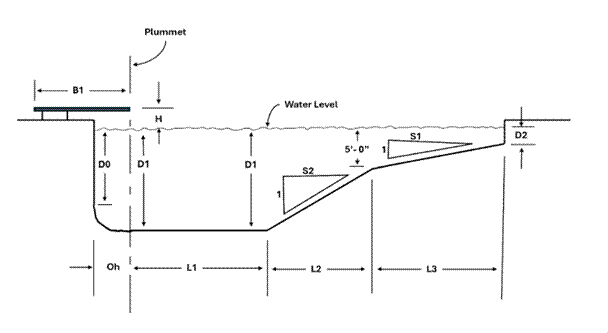
(3) The transitional radius from wall to floor are in
conformance with Article IV of the American National Standard for Public
Swimming Pools.
C. Diving Equipment. An owner of a legacy public pool shall
ensure that diving equipment is installed in compliance with §§7.2.5—7.2.5.6 of
the American National Standards for Public Swimming Pools.
D. Diving Board Clearance. An owner of a legacy public pool
shall ensure that unobstructed clearance is provided for a diving board in
conformance with the following minimum dimensions:
(1) A minimum height of 13
feet measured upward from the plummet of a diving board or greater than 13 feet
if specified by the manufacturer of the diving board;
(2) A clearance as required
in §D(1) of this regulation extending:
(a) 16 feet forward of the plummet;
(b) 8 feet behind the plummet; and
(c) 8 feet to both sides of the plummet;
(3) A minimum distance of 10
feet between the plummets of adjacent diving boards; and
(4) A minimum distance between a diving board plummet and a side
wall of:
(a) 10 feet for a diving
board 20 inches or less above the water line; and
(b) 12 feet for a diving
board greater than 20 inches above the water line.
E. Diving Boards Over Ten Feet Above Water. An owner of a legacy
public pool shall ensure that diving boards in excess of
10 feet above the water line and diving platforms are in
compliance with §7.2.4 of the American National Standard for Public
Swimming Pools.
F. Starting Blocks. An owner of a legacy public pool shall
ensure that a starting block:
(1) Is located on the pool deck so that a swimmer dives into a
minimum of 5 feet water depth; or
(2) At a pool constructed before
February 10, 1997, is located so that a swimmer dives into a minimum of:
(a) 5 feet water depth when the starting block is used without
supervision; or
(b) 4 feet water depth when the starting block is:
(i) Used in a controlled environment such as a swimming
competition under the supervision of an instructor; and
(ii) Restricted from unsupervised use or is removed when not under supervised use.
.41 Legacy Suction Entrapment Prevention.
A. To prevent a suction entrapment hazard, an owner of a legacy public pool or spa shall ensure that the requirements of §B—D are met.
B. Main Drain. The owner of a legacy public pool or spa shall ensure that a main drain, drain covering, outlet, fitting, and maximum velocity complies with 15 U.S.C. §8003 and ANSI/PHTA/ICC-7 2020, as incorporated by reference in Regulation .03 of this chapter.
C. Outlets, Fittings, and Maximum Velocity. The owner of a legacy pool or spa shall ensure the maximum velocity in the design of the drain piping does not exceed 6 feet per second when 100 percent of the circulation system design flow is drawn through the drain piping of any single drain.
D. Skimmers. The owner of a legacy public pool or spa shall ensure that a skimmer is:
(1) Connected to an equalization line, main drain line, vent, or
another skimmer that cannot be isolated by a valve or other means; or
(2) Provided with a vented lid.
.42 Legacy Chemical Storage Area.
An owner shall ensure that a legacy recreational pool, semipublic pool, or public spa has a chemical storage area that has:
A. A lockable door which can be opened from the inside; and
B. Ventilation that is sized at 2 cfm per square foot of floor area and that exhausts to the open air.
.43 Legacy Hydrostatic Relief Valves.
An owner shall ensure that a legacy inground recreational pool, semipublic pool, or public spa has hydrostatic relief valves as needed to relieve the hydrostatic pressure from ground water when the pool or spa is empty.
.44 Legacy Ventilation of Indoor Facilities.
An owner shall ensure that a legacy indoor recreational pool, semipublic pool, or public spa has:
A. A ventilating system capable of exhausting 1 1/2 cfm of air per square foot of enclosed area or dehumidifying the recirculated air from the enclosed area; and
B. Make-up air equal to the volume of exhausted air or as required in the specifications for the ventilation system.
.45 Legacy Plumbing.
A. Water Supply System. An owner shall ensure that a water
supply system at a legacy public pool or spa is in conformance with:
(1) COMAR 26.04.01;
(2) COMAR 26.04.03;
(3) COMAR 26.04.04;
(4) COMAR 09.20.01; and
(5) Local plumbing code requirements.
B. Sewage Disposal System. An owner shall ensure that a sewage
disposal system at a legacy public pool or spa is in conformance with:
(1) COMAR 26.04.02
(2) COMAR 26.04.03;
(3) COMAR 09.20.01; and
(4) Local plumbing code requirements.
C. Drinking Fountains. An owner shall ensure that a legacy
recreational pool, semipublic pool, or public spa enclosure has at least one
drinking fountain for every 5,000 square feet of water surface area.
D. Hose Bibbs. An owner of a legacy recreational pool,
semipublic pool, or public spa shall ensure that the following locations have
an accessible hose bibb equipped with an atmospheric vacuum breaker:
(1) On the deck at 150 feet intervals;
(2) In an equipment room; and
(3) In both a men's and a women's bathhouse.
E. Fill Spouts. If a fill spout is installed at a legacy public
pool or spa, the owner shall ensure that the fill spout is:
(1) Installed within 10 inches of a ladder or handrail or in
front of a lifeguard stand whose supports are immediately adjacent to the pool
or spa rim, so that the fill spout does not present a tripping hazard or a
puncture hazard;
(2) Not installed over a seat bench;
(3) Braced or constructed so the fill spout does not flex
downward; and
(4) Provided with a flexible cover on the tip of the fill spout
if the spout presents a potential for injury to an individual using a pool or
spa.
F. Backflow Prevention. An owner of a legacy public pool or spa
shall ensure that:
(1) A pool or spa facility has backflow protection for:
(a) A potable water supply, in accordance with COMAR 09.20.01;
and
(b) Wastewater, in accordance with COMAR 09.20.01; and
(2) An air gap that is two times the diameter of the fill spout separates the fill spout from the flood rim level of the pool or spa.
.46 Legacy Toilet, Hand Sink, and Shower Facilities.
A. Except as provided in §B of this regulation, an owner shall
ensure that a legacy recreational pool, semipublic pool, or public spa has:
(1) A bathhouse, toilets, hand sinks, and showers within 100
feet of an entrance gate to the pool or spa in accordance with the American
National Standard for Public Swimming Pools, Articles 19.1—19.6.13;
(2) At least a minimum number of toilets, hand sinks, and
showers based on:
(a) The maximum user load of the pool or spa set forth in
Regulation .32 of this chapter;
(b) Fixture ratios set forth in §A(1) of this regulation; and
(c) State and local building codes;
(3) 50 percent of the required fixtures designated for use by
each sex, unless the pool or spa is for one sex only; and
(4) At least 50 percent of the required showers are located
within a bathhouse.
B. An owner is not required to provide toilet, hand sink, and
shower facilities at a legacy recreational pool, semipublic pool, or public spa
when bathers have access to equivalent facilities in:
(1) Living quarters not more than 500 feet from a pool or a spa
entrance; or
(2) A building or buildings not more than 500 feet from a pool
or a spa entrance.
C. An owner shall ensure that equivalent facilities used by legacy recreational pool, semipublic pool, or public spa bathers and patrons of a recreational center, health club, marina, or other facility are in compliance with:
(1) §A of this regulation; and
(2) State or local plumbing codes regarding fixtures and
dressing area for the patrons sharing the equivalent facilities.
.47 Accommodations for Disabled Individuals.
An owner shall ensure that a legacy public pool or spa is in compliance with all applicable federal, State, and local codes governing facilities for disabled individuals, including COMAR 05.02.02.
MEENA SESHAMANI, MD, PhD
Secretary of Health
Title 11
DEPARTMENT OF TRANSPORTATION
Subtitle 15 MOTOR VEHICLE ADMINISTRATION—VEHICLE REGISTRATION
Notice of Proposed Action
[26-073-P]
The Administrator of the Motor Vehicle Administration proposes to:
(1) Recodify existing Regulation .04 to be .02, and repeal existing Regulation .05 under COMAR 11.15.20 Dump Service Registration; and
(2) Amend Regulation .02, amend and recodify existing
Regulations .06 and .07 to be Regulations .05 and .06
respectively, and recodify existing Regulations .05 and .08 to be
Regulations .04 and .07 respectively under COMAR 11.15.27 Four
or More Axle Dump Service Vehicles.
Statement of Purpose
The purpose of this action is to update existing regulations to eliminate the requirement for out of state dump service vehicles to purchase a Maryland registration if they are operating above 55,000 pounds of Gross Vehicle Weight Rating; and to reorganize for clarity.
Estimate of Economic Impact
I. Summary of Economic Impact. The MVA is currently requiring out of State dump service vehicles to purchase a Maryland registration if they are operating above 55,000 pounds of Gross Vehicle Weight Rating. This practice was found to violate the International Registration Plan (IRP) for which Maryland is a signatory. As a result, the MVA must permit vehicles that are properly apportioned in another state to operate on the roads with the same privileges as a Maryland based vehicle. This regulation removes the requirement to have a properly apportioned dump services vehicle in another state purchase a Maryland registration to operate above 55,000 pounds gross vehicle weight rating and substitutes a new certification process that out of State dump service vehicles must comply with.
II. Types of Economic Impact.
|
Impacted Entity |
Revenue
(R+/R-) Expenditure (E+/E-) |
Magnitude |
|
A. On issuing agency: |
|
|
|
Maryland Vehicle Administration |
(R-) |
Undetermined
|
|
B. On other State agencies: |
NONE |
|
|
C. On local governments: |
NONE |
|
|
|
Benefit
(+) Cost
(-) |
Magnitude |
|
D. On regulated industries or trade groups: |
|
|
|
Industries or trade groups |
(+) |
Undetermined
|
|
E. On other industries or trade groups: |
NONE |
|
|
F. Direct and indirect effects on public: |
NONE |
|
III. Assumptions. (Identified by Impact Letter and Number from Section II.)
A. There will be some loss of revenue to the State. All out of State dump service vehicles that are currently paying for Maryland registration will no longer need to purchase a Maryland registration but will instead be certified by the MVA at no cost. The MVA cannot determine how many out of State dump service vehicles are currently registered in Maryland.
D. The revenue loss to the State and the benefit on the industry or trade group is undetermined due to the MVA not being able to determine how many out of State dump service vehicles are currently registered in Maryland.
Economic Impact on Small Businesses
The proposed action has minimal or no economic impact on small businesses.
Impact on Individuals with Disabilities
The proposed action has no impact on individuals with disabilities.
Opportunity for Public Comment
Comments may be sent to Tracey C. Sheffield, Regulations Coordinator , MVA, 6601 Ritchie Highway N.E., Room 102, Glen Burnie, MD 21062, or call 410-768-7545, or email to [email protected]. Comments will be accepted through July 13, 2026. A public hearing has not been scheduled.
11.15.27 Four or More Axle Dump Service Vehicles
Authority: Transportation Article, §§12-104(b) and 13-919, Annotated Code of Maryland
.02 Definitions.
A. (text unchanged)
B. Terms Defined.
(1) (text unchanged)
(2) “Dump service registration” means registration of a vehicle under the provisions of Transportation Article, §13-919, Annotated Code of Maryland, or an apportioned vehicle properly registered in another state.
(3)—(5) (text unchanged)
[.06] .05 Certification.
A. Certification of compliance with Regulation .05 of this
chapter shall be[:]
[(1) Documented] documented on letterhead stationery by the manufacturer, second-stage manufacturer, or authorized dealer and [shall] include, in addition to information required by 49 CFR §§567.4 and 567.5:
[(a)] (1) The lift axle air pressure in pounds per square inch for an axle load of 12,000 pounds when the vehicle is evenly loaded between 65,000 and 70,000 pounds GVW[,]; and
[(b)] (2) The manufacturer's, second-stage manufacturer's, or authorized dealer's license number[; and
(2) Carried in the vehicle at all times and produced upon the demand of a law enforcement officer].
B. Before operating the dump service vehicle with a gross
vehicle weight above 55,000 pounds in Maryland, the vehicle owner shall submit
to the Administration:
(1) The certification completed by the manufacturer,
second-stage manufacturer, or authorized dealer in accordance with the
provisions of §A of this regulation [shall be submitted to the Motor
Vehicle Administration at the time of registration.];
[C. The owner of a vehicle, when applying for a dump service registration, shall certify]
(2) A certification that the vehicle shall be operated in
compliance with the requirements of these regulations [and complies with
the provisions of COMAR 11.15.20.05.];
(3) A dump service certification (Form VR-98); and
(4) A sideview photograph of the vehicle.
C. Upon receipt of the required
documents, the Administration shall issue a certification stating that the
vehicle meets the requirements of this regulation and Regulation .05 of this
chapter.
D. The certification issued by the
Administration under §C of this regulation shall be carried or otherwise
available for display in the vehicle at all times and produced upon the demand
of a law enforcement officer.
E. The Administration may revoke the
certification to operate this vehicle if the Administration finds that the
vehicle no longer meets the requirements of this regulation and Regulation .05
of this chapter.
[.07] .06 Vehicle Operation.
A.—D. (text unchanged)
E. A dump service vehicle
with four axels may operate at a maximum gross weight of 65,000 pounds when the
vehicle is operated on an interstate outside of Allegany or Garrett County
provided:
(1) It is properly registered in this
State or is an apportioned vehicle and properly registered in another state;
(2) The owner has the document issued by
the Administration under §C of this regulation; and
(3) The vehicle operator carries in the
cab a certificate of approval from the Administration while operating the
vehicle above a gross vehicle weight of 55,000 pounds.
F. A dump service vehicle used to haul
coal, logs, or pulpwood that is registered in this State in compliance with
Transportation Article, §13-919, Annotated Code of Maryland, or is an apportioned
vehicle and properly registered in another state and operated on Interstate
Route 68 in Allegany County or Garrett County is allowed a maximum gross weight
limitation of 70,000 pounds.
CHRISTINE NIZER
Administrator
Subtitle 01 PRESCRIPTION DRUG AFFORDABILITY BOARD
14.01.06 Implementation and Monitoring of Upper Payment Limits
Authority: Health-General Article, §§ 21-2C-03(f)(1),
21-2C-08(b), 21-2C-14, 21-2C-16, Annotated Code of Maryland
Notice of Proposed Action
[26-075-P]
The Maryland Prescription Drug Affordability Board proposes to adopt
new Regulations .01—.04 under a new chapter, COMAR 14.01.06
Implementation and Monitoring of Upper Payment Limits. This action was considered by the Board at an
open meeting held on April 13, 2026, notice of which was provided by
publication on the PDAB’s website, in accordance with General Provisions
Article, §3-302(c), Annotated Code of Maryland.
Statement of Purpose
The purpose of this action is to:
(1) Identify the entities subject to upper payment limits (UPL);
(2) Establish certain contracting provisions and reporting requirements;
(3) Establish certain guidelines concerning the application of upper payment limits to eligible governmental entities; and
(4) Establish upper payment limit monitoring and data reporting requirements.
Estimate of Economic Impact
I. Summary of Economic Impact. The proposed action has minimal economic impact because the regulation establishes the framework for implementing UPLs through contracting provisions, and imposes certain contract reporting requirements and data reporting requirements on governmental entities. The impact of the contract reporting and data reporting requirements is minimal. This proposed action does not set a UPL.
II. Types of Economic Impact.
|
Impacted Entity |
Revenue
(R+/R-) Expenditure (E+/E-) |
Magnitude |
|
A. On issuing agency: |
NONE |
|
|
B. On other State agencies: |
|
|
|
(1) Maryland Department of Health |
(E+) |
Minimal |
|
(2) Department of Public Safety and Correctional Services |
(E+) |
Minimal |
|
(3) Department of Budget and Management |
(E+) |
Minimal |
|
C. On local governments: |
|
|
|
(1) Municipal Governments |
(E+) |
Minimal |
|
(2) County Governments |
(E+) |
Minimal |
|
|
Benefit
(+) Cost
(-) |
Magnitude |
|
D. On regulated industries or trade groups: |
NONE |
|
|
E. On other industries or trade groups: |
|
|
|
(1) Pharmacy Benefit Managers |
(-) |
Minimal |
|
(2) Carriers that provide health benefits plans |
(-) |
Minimal |
|
(3) Government Contractors |
(-) |
Minimal |
|
F. Direct and indirect effects on public: |
NONE |
|
III. Assumptions. (Identified by Impact Letter and Number from Section II.)
B(1). See B(1).
B(2). See B(1).
B(3). The contract reporting requirements are minimal and the annual data reporting requirements for each governmental entity subject to a UPL largely concern types of information that may be captured by PBMS, and contractors.
C(1). See B(1).
C(2). See B(1).
E(1). Contractors, carriers that provide health benefit plans and PBMS, that contract with state and local governmental entities, may provide the data requested for reporting under the terms of their contracts. These entities may perform other functions in relation to implementing a UPL under the terms of their contracts.
E(2). See E(1).
E(3). See E(1).
Economic Impact on Small Businesses
The proposed action has minimal or no economic impact on small businesses.
Impact on Individuals with Disabilities
The proposed action has no impact on individuals with disabilities.
Opportunity for Public Comment
Comments may be sent to Christina Shaklee, Health Policy Analyst Advanced, Maryland Prescription Drug Affordability Board, 16900 Science Drive, Suite 112-114, Bowie, MD 20715, or call 410-703-7015, or email to [email protected]. Comments will be accepted through July 13, 2026. A public hearing has not been scheduled.
Open Meeting
Final action on the proposal will be considered by the Prescription Drug Affordability Board during a public meeting to be held on July 27, 2026 at 2:00 p.m., at to be determined..
.01 Scope.
A. These regulations establish mechanisms for implementing and
monitoring upper payment limits for eligible governmental entities.
B. The terms defined in COMAR 14.01.05.01 apply to this chapter.
C. These regulations apply to prescription drug products that
are:
(1) Purchased or paid for by a unit of State or local government
or an organization on behalf of a unit of State or local government, including:
(a) State or county correctional facilities;
(b) State hospitals; and
(c) Health clinics at State institutions of higher education; or
(2) Paid for through a health benefit plan on behalf of a unit
of State or local government, including a county, bicounty,
or municipal employee health benefit plan.
D. These regulations do not apply to:
(1) The Maryland State Medical Assistance Program;
(2) Eligible governmental entities that provide health benefits
through a Self-Insured Employer Group Waiver Plan (EGWP);
(3) The Maryland AIDS Drug Assistance Program (MDAP);
(4) Eligible government entities that receive Medicaid prices;
or
(5) Eligible government entities that purchase prescription drug
products under the 340B program.
.02 Contracting and Initial Reporting Requirements.
A. An eligible governmental entity shall require that the
provisions specified in §B of this regulation be included in all contracts:
(1) Through which prescription drug products are paid for or
purchased by, or on behalf of, the eligible governmental entity;
(2) That are executed or amended on or after January 1, 2028,
and take effect on or after January 1, 2028.
B. All contracts through which prescription drug products are
paid for or purchased by, or on behalf of, an eligible governmental entity
shall include the following provision in this, or substantially similar, form:
“The Contractor shall comply with all federal, State, and local
laws, regulations, and ordinances applicable to its activities and obligations
under this Contract, including any Maryland upper payment limits promulgated in
regulation and in effect during the term of the Contract.”
C. The Board shall develop a Reporting Submission Manual that
contains the forms, technical specifications, calculations, and required
reports for submitting the information and data required under §§D, E, and F of
this regulation.
D. Within 30 days of executing or amending a contract that
contains the terms required in §B of this regulation, an eligible governmental
entity shall certify, on the form provided that:
(1) The contract contains the specified terms; and
(2) The effective date and duration of the contract.
E. By December 31, 2026, an eligible governmental entity shall
submit to the Board information detailing the value of and contracting cycles
for contracts through which prescription drug products are paid for or
purchased by, or on behalf of, the eligible governmental entity including
health benefit plans.
F. On an annual basis, an eligible governmental entity shall
report to the Board by April 1:
(1) Total prescription drug budget for the prior calendar year;
(2) The sum of total gross spending for all prescription drug
products; and
(3) Total rebates, discounts, and price concessions received for
the prescription drug contract.
.03 Application of Upper Payment Limits.
A. This chapter and COMAR 14.01.07 do not prohibit a pharmacy
benefit manager, third party administrator, vendor, or other entity from
negotiating and applying more favorable rates.
B. An upper payment limit established under COMAR 14.01.07 shall
apply to all payments for drugs dispensed, administered, or purchased on or
after the effective date of the upper payment limit.
C. After an eligible governmental entity has executed or amended
a contract that contains the terms required in Regulation .02B of this chapter,
and that contract is in effect, the eligible governmental entity shall comply
with all upper payment limits established by the Board in COMAR 14.01.07 in
effect during the term of the contract.
.04 UPL Monitoring and Data Reporting.
A. For each prescription drug product for which a UPL has been
established and is in effect, an eligible governmental entity subject to that
UPL shall report the following data for the prescription drug product:
(1) Total gross spend
to the eligible governmental entity;
(2) Final net cost to the eligible governmental entity;
(3) Final net system ingredient cost;
(4) Formulary placement, if applicable, of the drug subject to
the UPL before implementation and after implementation;
(5) Units paid for or purchased in the preceding 12 months; and
(6) For payors:
(a) For each enrollee, calculate and report the GovUPLs in
effect during the prior calendar year; and
(b) Calculate and report a weighted average of all GovUPLs for
prescription drug products used during the reporting period based on
utilization (multiply each GovUPL by its assigned weight (the percent of usage
of the GovUPL), sum those products together).
B. The eligible governmental entity shall submit the data report
to the Board:
(1) By April 1, following the end of the first calendar year in
which the eligible governmental entity is subject to the UPL; and
(2) By April 1, for each subsequent calendar year in which the
eligible governmental entity is subject to the UPL.
ANDREW W. YORK
Executive
Director
WATER AND SCIENCE ADMINISTRATION
Water Quality Certification 25-WQC-0042
Hansel LLC
℅ Doldon
Moore
8321 Quince View
Ln
Owings, MD 20736
Add’l. Info: Pursuant to COMAR 26.08.02.10F(3)(c), The Maryland Department of the Environment is providing notice of its issuance of a Water Quality Certification 25-WQC-0042.
Location: 6099 Drum Point Road, Deal, MD 20751
The purpose of the
project is to improve navigable access and shoreline stabilization.
Description of
Authorized Work:
1. Replace 405 linear feet of bulkhead within 18
inches of an existing bulkhead; and,
2. Expand and reconfigure a marina by removing
existing structures and constructing the following:
a. Replacement in-kind of an existing
31-foot long by l7-foot wide by 10.6-foot tall covered
deck and marina office;
b. Main Dock: Construct a 63-foot long by 6-foot
wide floating pier with a 15-foot long by 5-foot wide gangway, a 285-foot by
6-foot “T”-shaped platform, eight 50-foot long by 5- foot wide finger piers,
six 35-long by 4-foot wide finger piers, and one 40-foot long by 4-foot wide
finger pier and sixteen mooring piles;
c. Dock B: Construct 53-foot long by 4-foot wide
fixed pier with a 35.5-foot long by 4-foot wide finger pier, a 21-foot long by
4-foot wide finger pier, and four mooring piles;
d. Dock C: Construct a 74-foot long by 4-foot
wide fixed pier with a 77.5-foot long by 4-foot wide finger pier, a 15-foot
long by 3-foot wide tapered finger pier, and four mooring piles;
e. Construct five fixed finger piers with nine
associated mooring piles:
i.
Two
25-foot long by 4-foot wide fixed finger piers
ii.
Two
14-foot long by 3-foot wide fixed tapered finger piers,
iii.
One
55-foot long by 4-foot wide fixed finger pier
f. All pier work to take place within 215 feet
channelward of the mean high water line.
3. Hydraulically dredge a new 87,324 square foot
area, including
a. A 19,857 square foot area to a depth of 5 feet
at mean low water
b. A 19,100 square foot area to a depth of 6 feet
at mean low water
c. A 48,367 square foot area to a depth of 7 feet
at mean low
d. And to deposit approximately 8,991 cubic yards
of dredged material on an approved upland disposal site located at 370 Deale
Rd., Deale, MD 20751; and to provide for periodic maintenance dredging for six
years.
The WQC and its
attachments may be viewed at the following link: https://mde.maryland.gov/programs/Water/WetlandsandWaterways/Pages/WQC.aspx
Appeal of Final
Decision: This Water Quality
Certification is a final agency decision. Any person aggrieved by the
Department’s decision to issue this WQC may appeal such decision in accordance
with COMAR 26.08.02.10F(4). A request for appeal shall be filed with the
Department within 30 days of publication of the final decision and specify in
writing the reason why the final decision should be reconsidered. A request for
appeal shall be submitted to: Secretary of the Environment, Maryland Department
of the Environment, 1800 Washington Boulevard, Baltimore, MD 21230. Any request
for an appeal does not stay the effectiveness of this WQC.
Contact: Jonathan Stewart at [email protected] or 410-537-3059.
[26-12-16]
Notice
of ADA Compliance
The State of Maryland is committed to
ensuring that individuals with disabilities are able to fully participate in
public meetings. Anyone planning to
attend a meeting announced below who wishes to receive auxiliary aids,
services, or accommodations is invited to contact the agency representative at
least 48 hours in advance, at the telephone number listed in the notice or
through Maryland Relay.
CANNABIS PUBLIC HEALTH ADVISORY COUNCIL
Date and Time: July 15, 2026, 4— 6 p.m.
Place: Google
Meet joining info
Video call link:
https://meet.google.com/xbq-mezq-cew
Or dial: (US) +1 209-441-6423 PIN: 973
393 744#,
Contact: Jody Sheely 443-683-1511
[26-12-03]
Date and Time: November 18, 2026, 3— 6 p.m.
Place: 108 Severn Ave, Annapolis, MD
Contact: Office Manager 410-974-2941
[26-12-05]
STATE COLLECTION AGENCY LICENSING BOARD
Date and Time: July 14, 2026, 2—3 p.m. Thereafter, the public meetings will take place the second Tuesday of every month, accessed via the Google Meet information below.
Place: Google
Meet joining info:
Video call link: https://meet.google.com/xvf-xcuh-dou
Or dial: (US) +1 716-332-3758 PIN: 696
128 539#
More phone numbers: https://tel.meet/xvf-xcuh-dou?pin=6064082328141
Add'l. Info: If necessary, the Board will convene in a closed session to seek the advice of counsel or review confidential materials, pursuant to General Provisions Article, Maryland Annotated Code §3-305.
Contact: Ayanna Daugherty 410-230-6019
[26-12-08]
DEPARTMENT OF THE ENVIRONMENT/AIR AND RADIATION ADMINISTRATION
Date and Time: June 30, 2026, 10 a.m.
Place: Virtual public hearing using the gotomeeting platform
Add'l. Info: The Maryland Department of
the Environment (MDE) gives notice of a public hearing concerning the
redesignation request and maintenance plan for the Baltimore Nonattainment Area
for the 2008 Ozone National Ambient Air Quality Standards (NAAQS).
A virtual public
hearing will be held on:
Thursday June 30, 2026
at 10 a.m. (EST)
Please join the
meeting from your computer, tablet or smartphone.
https://meet.goto.com/368118773
You can also dial in
using your phone.
Access Code:
368-118-773
United States (Toll
Free): 1 866 899 4679
The Public Hearing will be
held as required by federal law (Clean Air Act at 42 U.S.C. 7410(a) and 40 CFR
51.102). Interested persons are invited to attend and express their views.
After the Department considers the comments received, and revises the proposal
if necessary, all related items will be submitted to the U.S. Environmental
Protection Agency.
An electronic copy of the
proposed Redesignation Request and Maintenance Plan for the 2008 Ozone National
Ambient Air Quality Standards for the Marginal Baltimore Nonattainment Area SIP
revision will be available on the Maryland Department of the Environment’s
website at
https://mde.maryland.gov/programs/air/airqualityplanning/pages/index.aspx
Note: the public library
systems in Maryland can be used for Internet access to view the document.
Copies of the document can also be obtained via email by writing to
[email protected].
Written comments may be
presented at the hearing, emailed to [email protected], or mailed to
the Planning Program, MDE ARA, 1800 Washington Boulevard, Suite 730, Baltimore,
MD 21230. Comments must be received before 5:00 pm on June 30, 2026.
Anyone needing special accommodations at a public hearing should contact the Department’s Fair Practices Office at 410-537-3964. TTY users may contact the Department through the Maryland Relay Service at 1-800-735-2258.
Contact: Emily Bull 410-537-3281
[26-12-10]
Date and Time: June 23, 2026, 10a.m.—12p.m.
Place: Ocean City Convention Center, second floor, Ocean City, MD
Add'l. Info: portions of the meeting may be held in closed session, if public schools are CLOSED the meeting and any appeals will be rescheduled
Contact: Carl D. Witmer 410-924-3710
[26-12-07]
Date and Time: June 17, 2026, 9a.m.—4p.m.
Place: 1800 Washington Blvd, Baltimore, MD
Add'l. Info: Board of Well Drillers
Monthly Meeting for July:
Wednesday, July 29,
2026, 9a.m.—4 p.m.
Time zone:
America/New_York
Google Meet joining
info
Video call link:
https://meet.google.com/kyh-xmvs-wqp
Or dial: (US) +1 650-781-1437 PIN: 259 247 088#
More phone numbers:
https://tel.meet/kyh-xmvs-wqp?pin=7696863175989
Contact: Amanda Redmiles 410-537-4466
[26-12-02]
MARYLAND HEALTH BENEFIT EXCHANGE
Date and Time: August 4, 2026, 1— 2:30pm
Place: Virtual.
Please register for the meeting here: https://maryland-gov.zoomgov.com/meeting/register/SY5kM9AFTfOq-LT-jsNR3w
Add'l. Info: Please fill out this form to sign up for public comment or to request
accessibility accommodations: https://forms.gle/4Ji94REeRUNh62tu6
Contact: Becca Lane 410-547-7371
[26-12-12]
DEPARTMENT OF HOUSING AND COMMUNITY DEVELOPMENT
Date and Time: July 16, 2026, 10—11 a.m.
Place: Virtual.
Contact: [email protected] for meeting details.
Add'l. Info: A public hearing will be held to solicit comments on the Department’s FFY2027—FFY2028 Community Services Block Grant (CSBG) State Plan and projected reductions in CSBG funding for FFY2027. Written comments must be submitted no later than 4:00 p.m., August 13, 2026. Email comments to [email protected]
Contact: Angela Fraser 443-470-5931
[26-12-13]
Date and Time: Wednesday,
June 17th, 2026
1—3 p.m.
Place: 1st Floor Conference Room, Side B
100 Community Place
Crownsville, MD 21032
Add'l. Info: The Board shall coordinate the operation and maintenance of the Statewide Public Safety Interoperability Radio System, known as Maryland FiRST
Contact: Cesar Leon 410-697-9757
[26-12-17]
MARYLAND STATE LOTTERY AND GAMING CONTROL COMMISSION
Date and Time: June 25, 2026, 10 a.m.—12 p.m.
Place: Montgomery
Business Park
1800 Washington Blvd Ste 330, Baltimore, MD
Add'l. Info: The meeting is in person and livestreamed. The link will be available on the website the day of the meeting - https://www.mdgaming.com/commission-meeting-6-25-2026/
Contact: Kathy Lingo 410-230-8790
[26-12-06]
MARYLAND HEALTH CARE COMMISSION
Date and Time: June 18, 2026, 1—4 p.m.
Place: 4160 Patterson Avenue, Room 100, Baltimore, MD
Add'l. Info: Meeting will be hybrid. To attend via Zoom, please register on the Commission webpage: www.mhcc.maryland.gov
Contact: Valerie Wooding 410-764-3570
[26-12-01]
MARYLAND HEALTH CARE COMMISSION
Subject: Formal Start of Review
Add'l. Info: Subject Formal Start of
Review. The Maryland Health Care
Commission (MHCC) hereby gives notice of docketing of the following application
for Certificate of Need:
Quality One Care Home
Health, Inc Docket No.’s 26-R2-2476; 26-R2-2477 and 26-R2-2478 — Baltimore
City, Baltimore and Howard Counties Proposal: Establish a new HHA serving the
counties listed above. This filing is consistent with July 11, 2025, CON review
schedule and aligns with identified need. Project Budget cost: $44,000
MHCC shall review the
applications under Maryland Health-General Code Annotated, Section 19-101 et
seq., COMAR 10.24.01, and the applicable State Health Plan standards. Any
affected person may make a written request to the Commission to receive copies
of relevant notices concerning the application(s). All further notices of
proceedings on the application(s) will be sent only to affected persons who
have registered as interested parties.
Persons desiring to become
interested parties in the Commission’s review of the above- referenced
application(s) must meet the requirements of COMAR 10.24.01.01B(20) and (2) and
must also submit written comments to the Commission at [email protected]
no later than close of business July 13, 2026. These comments must state with
particularity the State Health Plan standards or review criteria that you
believe have not been met by the applicant(s) as stated in COMAR 10.24.01.08F.
Please refer to the Docket
Number listed above in any correspondence on the application(s). Copies of the
application are available for review in the office of MHCC during regular
business hours by appointment. All correspondence should be addressed to:
Wynee Hawk, Director
Center for Health Care
Facilities and Planning Maryland Health Care Commission
4160 Patterson Avenue
Baltimore, Maryland
21215
Contact: Deanna Dunn 443-844-7467
[26-12-11]
BOARD OF OCCUPATIONAL THERAPY PRACTICE
Date and Time: June 18, 2026, 9:30 a.m.—12 p.m.
Place: via
Google Meet, Video call link: https://meet.google.com/vtq-cjaw-fyq
Or dial: (US) +1 631-602-0205 PIN:
361 466 042#
Add'l. Info: Health Occupations Article, Title 10, Annotated Code of Maryland, and COMAR 10.46 amendments, additions, and revisions, including fee changes, may be discussed/voted on. Budget information may also be discussed. It may be necessary to go into executive session. Sign language interpreters and/or appropriate accommodations for qualified individuals with disabilities will be provided upon request. Please call 1-800-735-2255.
Contact: Lauren Murray 410-402-8556
[26-12-04]