Proposed Action on Regulations
\Title 05
DEPARTMENT OF HOUSING AND COMMUNITY DEVELOPMENT
Subtitle 22 [TENANT S EXCLUSIVE NEGOTIATION PERIOD AND RIGHT OF
FIRST REFUSAL] LANDLORD AND TENANT REGULATIONS
Notice of Proposed Action
[26-173-P]
The Secretary of Housing and Community Development proposes to:
(1) Recodify existing COMAR 05.22.01 Procedure to be COMAR
05.22.01 Tenant s Exclusive Negotiation Period and Right of First Refusal; and
(2) Adopt new Regulations .01 .07 under a new chapter, COMAR
05.22.02 Tenant's Optional Positive Rental Payment History Reporting.
Statement of Purpose
The purpose of this action is to describe procedures and
requirements for certain landlords to offer tenants optional positive rental
payment history reporting, required under Ch. 773, SB 335, Acts of 2026.
Estimate of Economic Impact
The proposed action has no economic impact.
Economic Impact on Small Businesses
The proposed action has minimal or no economic impact on small
businesses.
Impact on Individuals with Disabilities
The proposed action has no impact on individuals with
disabilities.
Opportunity for Public Comment
Comments may be sent to Mira Morgan, Senior Policy Analyst, Office
of Policy Development, Department of Housing and Community Development, 7800
Harkins Road, Lanham, MD 20706, or email to [email protected]. Comments
will be accepted through November 16, 2026. A public hearing has not been
scheduled.
05.22.02
Tenant s Optional Positive Rental Payment History Reporting
Authority: Housing and Community Development Article, 5-104; Real Property Article, 8-208.4, Annotated
Code of Maryland
.01 Purpose.
The purpose of this chapter is to prescribe the policies and
procedures relating to the tenant s positive rental payment history reporting
as outlined in Real Property Article, 8-208.4, Annotated Code of Maryland.
.02 Definitions.
A. In this chapter, the following terms have the meanings
indicated.
B. Terms Defined.
(1) Complete and Timely Payment.
(a) Complete and timely payment means payment of the monthly
rent in the full amount required by the lease, by the end of the final day of
any grace period allowed under the lease or applicable law.
(b) Complete and timely payment includes instances in which a
tenant made a complete and timely payment of periodic rent that was fully or
partially applied to other amounts due.
(2) Consumer reporting agency means any person or entity that,
for monetary fees or dues or on a cooperative nonprofit basis, regularly
engages, in whole or in part, in the practice of assembling or evaluating
consumer credit information or other information on consumers for the purpose
of furnishing consumer credit reports to third parties.
(3) Department means the Department of Housing and
Community Development, a principal department of the State.
(4) Offer means the written communication from a landlord to
their tenant that provides the tenant with the option to have the tenant's
positive rental payment history reported to at least one consumer reporting
agency.
(5) Positive Rental Payment History.
(a) Positive rental payment history means information
regarding a tenant s complete and timely payments of rent.
(b) Positive rental payment history does not include an
instance in which a tenant did not completely or timely make a rental payment.
(6) Reporting service provider means any person or entity
that, on behalf of a landlord, furnishes positive rental payment history to a
consumer reporting agency.
(7) Secretary means the Secretary of Housing and Community
Development.
.03 Notice and Offer Requirements for Tenant s Positive Rental
Payment History Reporting.
A. A. landlord that owns six or more residential rental units in
the State, including any residential rental units that the landlord owns or
controls in whole or in part, directly or indirectly, or through one or more
legal entities, shall include in a written lease the option to have the
tenant s positive rental payment history reported to at least one consumer
reporting agency, selected by the landlord. The offer made in a written lease
includes any writing into or attached to the lease.
B. For a lease entered into on or after October 1, 2026, the
offer of positive rental payment history reporting shall be made at the time of
the lease agreement and at least once annually thereafter.
(1) At the time of the lease agreement, the offer may be
included in the body of the lease or as an attachment to the lease or may be
made through a separate document.
(2) Subsequent annual offers shall be made through a separate
document and provided consistent with Regulation .04 of this chapter.
(3) Subsequent annual offers shall not be required if the tenant
is already enrolled in positive rental payment history reporting.
C. For leases entered into before October 1, 2026, the offer of
positive rental payment history reporting shall be made not later than January
1, 2027, and at least once annually thereafter.
D. A landlord shall deliver the offer to the tenant by:
(1) First-class U.S. Mail, with a certificate of mailing;
(2) A delivery service providing delivery tracking and
confirmation; or
(3) Electronic delivery, if the tenant has elected to receive
notices from the landlord in this manner. At any time, the tenant may elect to
receive positive rent reporting notices by electronic delivery.
E. If the offer is made by first-class U.S. mail or a delivery
service, the landlord shall provide the tenant with a self-addressed, stamped
envelope to return the written election of positive rental payment history
reporting. Postage and delivery costs may not be charged to the tenant.
F. A tenant may submit the tenant s completed written election
at any time after the tenant receives the offer from the landlord. The tenant
may submit the completed written election either by:
(1) The method by which the landlord delivered the offer;
(2) First-class U.S. Mail; or
(3) Any other reasonable method specified by the landlord.
G. The landlord shall begin reporting to the consumer reporting
agency or agencies, beginning with the next positive rental payment, after
receipt of the written election form, upon receiving written notice of the
tenant s election to participate in positive rental payment history reporting
and when approved by the consumer reporting agency or agencies to furnish such
information. A landlord shall be in compliance with
this section if it reports positive rental payment history to a consumer
reporting agency or agencies through a third-party whose primary business is to
report rental payment information to consumer reporting agencies.
H. A tenant may request additional copies of the written
election of positive rental payment history reporting or the opt-out form from
the landlord at any time. A landlord that receives a request from a tenant for
additional copies of the written election form or the opt-out form shall comply
with the request. A landlord that receives a request from a tenant for
additional copies of either form may not charge the tenant a fee for copies or
delivery of the copies.
I. If positive rental payment reporting is stopped, either
through the tenant opting out or through non-payment of reporting fees, the
landlord shall provide written notice that reporting has ceased. The notice
shall include the earliest date that the tenant may opt back into reporting.
.04 Form of Offer of Positive Rental Payment History Reporting.
A. The offer delivered to tenants under this chapter shall be in
the form provided in Appendix A of this chapter, subject to the provisions of
B of this regulation.
B. The Department may, with the approval of the Secretary, edit
or amend the form provided in Appendix A of this chapter to facilitate
compliance with Real Property Article, 8-208.4, Annotated Code of Maryland, or
other applicable law, as appropriate.
C. The form shall allow the tenant to participate by electronic
signature, consistent with Maryland's Uniform Electronic Transactions Act and
the federal E-SIGN Act, at any time.
D. A reporting service provider, or another agent acting on
behalf of a landlord under this chapter, shall not be liable under this chapter
for reasonable reliance on a landlord's representation regarding a tenant's
consent, eligibility, or elected delivery method.
E. If, before October 1, 2026, a tenant has provided documented
consent to reporting rent payment information to one or more consumer reporting
agencies, including by prior enrollment by application, lease, contract, or
electronic enrollment with a reporting service provider, the landlord may
report positive rental payment information without additional enrollment
action, once the offer is provided to tenant, where such offer is made no later
than January 1, 2027. The tenant retains the right to opt out at any time.
Note: Click
here for Appendix A.
.05 Reporting Fee.
A. If a tenant elects to have positive rental payment history
reported to a consumer reporting agency, the landlord may require that the
tenant pay a fee not to exceed the lesser of the actual cost to the landlord to
provide the reporting service or $10 per month. Upon request by a tenant or by
the Department, the landlord shall provide documentation of the actual costs
incurred by reporting positive rental payments.
B. The tenant s payment or nonpayment of a reporting fee may not
be reported to a consumer reporting agency.
C. The reporting fee is not rent and may not be credited towards
full or partial satisfaction of rent or any other obligation under the tenant s
lease.
D. Any unpaid reporting fees may not be withheld from a tenant s
security deposit.
E. If a tenant fails to pay any reporting fee required by the
landlord for 30 days or more:
(1) The landlord may stop reporting the tenant s complete and
timely rental payments; and
(2) The tenant may not elect positive rental payment history
reporting for a period of at least 6 months after the date on which the fee
first became due.
.06 Tenant Opt-Out.
A. For tenants that elect to participate in positive rental
payment history reporting, the landlord shall report all timely and complete rental
payments for each rental period after receiving the written election form,
until the tenant opts out of reporting.
B. Within 5 business days of receiving an opt-out form from the
tenant, the landlord shall cease to furnish new positive rental payment history
in the next regular reporting cycle.
C. A tenant who elects to have reporting stopped may not elect
positive rental payment history reporting again for a period of at least 6
months after the date of the tenant's written request to have reporting
stopped.
.07 Relation to Other Laws; Existing Agreements.
A. The procedural requirements of this chapter are in addition
to the procedural requirements of any other applicable provision of law.
B. A landlord may satisfy any obligation under this chapter
through a reporting service provider or another agent. Performance by such
provider or other agent constitutes performance by the landlord, and the
landlord remains responsible for compliance with this chapter.
JACOB DAY
Secretary
Title 09
DEPARTMENT OF LABOR
Subtitle 09 MARYLAND BOARD OF
ELECTRICIANS
09.09.03 General Regulations
Authority: Business Occupations and Professions Article, 6-205
and 6-307, Annotated Code of Maryland
Notice of Proposed Action
[26-169-P]
The Maryland State Board of Electricians proposes to adopt new
Regulation .03 and recodify existing Regulation .03 to be
Regulation .04 under COMAR 09.09.03 General Regulations. This action was considered at a public
meeting of the Maryland State Board of Electricians held on January 27, 2026,
notice of which was provided by posting on the Maryland State Board of
Electricians' website, in accordance with General Provisions Article,
3-302(c)(3)(ii), Annotated Code of Maryland
Statement of Purpose
The purpose of this action is to adopt a new regulation to require
that to be eligible for a master electrician license, an applicant must have
held a current journeyperson electrician license for at least 3 years and,
during that period, shall have completed the 3-year work experience requirement
for a master license.
Estimate of Economic Impact
The proposed action has no economic impact.
Economic Impact on Small Businesses
The proposed action has minimal or no economic impact on small
businesses.
Impact on Individuals with Disabilities
The proposed action has no impact on individuals with
disabilities.
Opportunity for Public Comment
Comments may be sent to Charles Marquette, Executive Director,
Mechanical Boards, Maryland Department of Labor, 100 S. Charles St., Tower 1,
Suite 3300, Baltimore, MD 21021, or call 410-230-6160, or email to
[email protected]. Comments will be accepted through November 16,
2026. A public hearing has not been scheduled.
Open Meeting
Final action on the proposal will be considered by Maryland State
Board of Electricians during a public meeting to be held on November 24, 2026
at 10:00 a.m., at Maryland Department of Labor, 100 S. Charles St., Baltimore,
MD 21021.
.03 Journeyperson License Required for Master License
Eligibility.
To be eligible for a master license, an applicant shall have
held, for a period of 3 years, a current journeyperson license issued by the
Board, and during that period shall have completed the 3-year work experience
requirement pursuant to Business Occupations and Professions Article,
6-304(b), Annotated Code of Maryland, to receive work experience credit toward
eligibility for a master license.
CHET BROWN
Chair
Title 10
MARYLAND
DEPARTMENT OF HEALTH
Subtitle 10 LABORATORIES
10.10.13 Medical Laboratories Testing
For Hereditary And Congenital Disorders In Newborn Infants
Authority: Health-General Article, 13-111, Annotated Code of
Maryland
Notice of Proposed Action
[26-180-P]
The Secretary of Health proposes to amend Regulation .15
under COMAR 10.10.13 Medical Laboratories Testing for Hereditary and
Congenital Disorders in Newborn Infants.
Statement of Purpose
The purpose of this action is to reduce the mandatory retention
period for blood-spot specimens from 25 years to 1 year for blood specimens
that have not been confirmed with a disorder listed in COMAR 10.10.13.12. This
change aligns with industry understanding as the integrity of the specimen is
questionable for many biochemical analytes after 1 year even with refrigerated
storage. Fewer years of retention for blood-spot specimens will result in less
need for secure space, refrigeration, inventory management, and staff time to
maintain and track specimens without jeopardizing the effectiveness of the
Newborn Screening program. Shorter retention will also reduce the number of
specimens subject to decades of retention and Division resources can be
reallocated from long-term specimen housing to screening, follow-up and lab
quality functions.
Estimate of Economic Impact
The proposed action has no economic impact.
Economic Impact on Small Businesses
The proposed action has minimal or no economic impact on small
businesses.
Impact on Individuals with Disabilities
The proposed action has no impact on individuals with disabilities.
Opportunity for Public Comment
Comments may be sent to Jordan Fisher Blotter, Director, Office of
Regulation and Policy Coordination, Maryland Department of Health, 201 West
Preston Street, Room 534 Baltimore, Maryland 21201, or call 410-767-0938, or
email to [email protected]. Comments will be accepted through November 16,
2026. A public hearing has not been scheduled.
.15 Test Blood-Spot
Specimens Use, Research, Storage, and Retention.
A. B. (text unchanged)
C. Storage. A permittee or researcher shall store a newborn infant
blood-spot specimen in a sealed, moisture-proof container at between 2 C and
[6 C] 8 C.
D. Retention.
(1) (text unchanged)
(2) The Department s public health laboratory shall retain and
maintain [for 25 years] a newborn infant s blood-spot specimen
after the blood-spot specimen is received for screening, supplemental testing,
or diagnostic testing[.] as follows:
(a) Blood-spot specimens reported as within the normal limit
shall be stored refrigerated at between 2 C and 8 C and may be destroyed after
1 year;
(b) Blood-spot specimens from infants reported as presumed
positive but not confirmed with a disorder in Regulation .12C of this chapter
shall be stored frozen at -20℃ or lower and may be destroyed after 1
year; and
(c) Blood-spot specimens from infants confirmed with a disorder
in Regulation .12C of this chapter shall be stored frozen at -20℃ or
lower and may be stored up to 25 years.
MEENA
SESHAMANI, MD, PhD
Secretary of Health
Subtitle 41 BOARD OF
EXAMINERS FOR AUDIOLOGISTS, HEARING AID DISPENSERS, SPEECH-LANGUAGE
PATHOLOGISTS, AND MUSIC THERAPISTS
Notice of Proposed Action
[26-175-P]
The Secretary of Health proposes to:
(1) Amend Regulations .02 and .04 under COMAR
10.41.02 Code of Ethics;
(2) Amend Regulations .02, .03, and .06 under COMAR
10.41.03 Licensure and Continuing Education;
(3) Amend Regulations .02, .04, and .05, adopt
new Regulation .06, and recodify existing Regulations .06 and .07
to be Regulations .07 and .08, respectively, under COMAR
10.41.05 Music Therapy;
(4) Amend Regulations .02 .04 and repeal Regulation .05
under COMAR 10.41.07 Cerumen Management;
(5) Amend and recodify existing Regulations .01-1, .03,
.06, .08, .10, and .11 to be Regulations .02,
.05, .08, .09, .11, and .12, respectively,
adopt new Regulation .03, and recodify existing Regulations .02, .04,
.05, .09, and .12 .14 to be Regulations .04, .06,
.07, .10, and .13 .15, respectively, under COMAR
10.41.08 Hearing Aid Dispensing;
(6) Amend Regulations .01, .06, .07, .09,
and .10 under COMAR 10.41.11 Speech-Language Pathology Assistants and
Audiology Assistants; and
(7) Amend Regulations .03 and .04 under COMAR
10.41.12 Supervision of Students.
This action was considered by the Board of Examiners for
Audiologists, Hearing Aid Dispensers, Speech-Language Pathologists, and Music
Therapists at a public meeting held on July 16, 2026, notice of which was given
by publication on the Board s website at
health.maryland.gov/boardsahs/Pages/Index.aspx pursuant to General Provisions
Article, 3 302(c), Annotated Code of Maryland.
Statement of Purpose
The purpose of this action is to:
(1) Update ethical responsibilities;
(2) Update and clarify licensure and continuing education
requirements;
(3) Revise and update certain definitions;
(4) Add scope of practice for hearing aid dispensers; and
(5) Remove obsolete language.
Estimate of Economic Impact
The proposed action has no economic impact.
Economic Impact on Small Businesses
The proposed action has minimal or no economic impact on small
businesses.
Impact on Individuals with Disabilities
The proposed action has no impact on individuals with disabilities.
Opportunity for Public Comment
Comments may be sent to Jordan Fisher Blotter, Director, Office of
Regulation and Policy Coordination, Maryland Department of Health, 201 West
Preston Street, Room 534, Baltimore, Maryland 21201, or call 410-767-0938, or
email to [email protected]. Comments will be accepted through November 16,
2026. A public hearing has not been scheduled.
10.41.02 Code of Ethics
Authority: Health Occupations
Article, 1-212, 2-205, and 2-314, Annotated Code of Maryland
.02 Ethical Responsibilities.
A. B. (text unchanged)
C. Professional Conduct.
(1) (7) (text unchanged)
(8) Licensees may not engage in self-referral as set forth in Health
Occupations Article, 1-302, Annotated Code of Maryland.
(9) Licensed audiologists shall comply with all federal
healthcare fraud and abuse laws, including but not limited to the:
(a) Federal Anti-Kickback Statute, 42 U.S.C. 1320a-7b;
(b) Stark Law, 42
U.S.C. 1395nn; and
(c) Sunshine Act, 42
U.S.C. 1320a-7h.
D. G. (text unchanged)
.04 Special Responsibilities.
A. G. (text unchanged)
H. The licensee shall:
(1) Maintain adequate records of
professional services rendered and products dispensed, including:
(a) (b) (text unchanged)
(c) License number and
signature on written client reports and evaluations;
(d) For audiograms,
the following information:
(i) The licensee s signature;
(ii) Audiometer used;
(iii) Calibration
date;
(iv) License number;
and
(v) The applicable
American National Standards Institute (ANSI) standard;
[(d)] (e) (text unchanged)
[(e)] (f) All documents
related to referrals or orders; and
(2) (text unchanged)
I. L. (text unchanged)
10.41.03 Licensure and Continuing Education
Authority: Health Occupations Article, 2-205, 2-302, 2-302.2, 2-304, 2-305, 2-308, 2-310, 2-310.2, [2-311(c)]
2-311(d), 2-312(b), 2-314(11), and 2-314.9,
Annotated Code of Maryland
.02 Definitions.
A. (text unchanged)
B. Terms Defined.
(1) (2) (text unchanged)
[(3) Credit means 1 semester hour except
when specified in these regulations. Credit is used only with reference to
fulfilling academic requirements for original licensure application.]
[(4)] (3) (text unchanged)
(4) Credit.
(a) Credit means 1
semester hour except when otherwise specified in these regulations.
(b) Credit is used
only with reference to fulfilling academic requirements for original licensure
application.
(5) (text unchanged)
(6) Health
screening means a non-diagnostic assessment on an individual to check for a
health condition before there are signs and symptoms.
[(6)] (7) [(7)] (8) (text
unchanged)
.03 Licensure
Requirements.
A. (text unchanged)
B. Supervision of
Professional Experience for Audiologists.
(1) Supervisory Plan for
Audiologists.
(a) (b) (text unchanged)
[(c) The Board may accept completion of the clinical
fellowship required for the American Speech-Language-Hearing Association
Certificate of Clinical Competence or completion of the mentored practice required
for American Board of Audiology Certification as meeting the requirements for
supervised practice in this chapter.]
(2) (text unchanged)
(3) To complete a clinical training, the applicant shall [be
employed as a professional] gain professional experience in the
field of audiology under appropriate on-site direct supervision for not less
than [9] 12 months with a minimum of 36 hours of work per
week. This requirement may also be met with part-time employment as follows:
(a) [14 16]
16 hours a week for a period of [24] 27 months;
(b) [17 20]
24 hours a week for a period of 18 months; or
(c) [21 24] 32 hours a week for a period of [15]
14 months[;].
[(d) 25 35 hours a week for a period of 12
months.]
(4) At least 80 percent
of the applicant's [employment] professional experience during
the clinical training shall be in direct client contact which includes:
(a) (b) (text unchanged)
(c) Treatment/management,
such as:
(i) (iii) (text unchanged)
(d) (text unchanged)
(5) An individual
serving as a supervisor:
(a) (b) (text unchanged)
(c) [Shall] May
not supervise [not] more than [three] two
limited licensees at one time; and
(d) (text unchanged)
(6) (text unchanged)
(7) Change in Supervisor
or [Place of] Professional [Employment] Experience
Training Site.
(a) During the period of limited licensure, if an individual
changes supervisor, or [place of] professional [employment]
experience training site, or both, the individual shall submit a revised
supervisory plan to the Board for Board approval.
(b) (text unchanged)
(8) (text unchanged)
C. Supervision of
Clinical Fellowship for Speech Pathologists.
(1) (2) (text unchanged)
(3) To complete a clinical fellowship, the applicant shall [be
employed as a professional] gain professional experience in the
field of speech-language pathology under appropriate supervision for not less
than 9 months with a minimum of 30 hours of work per week. This requirement may
also be met with part-time employment as follows:
(a) (c) (text unchanged)
(4) At least 80 percent
of the applicant's [employment] professional experience during
the clinical fellowship shall be in direct client contact, which includes:
(a) (d) (text unchanged)
(5) (6) (text unchanged)
(7) Change in Supervisor
or [Place of] Professional [Employment] Experience
Training Site.
(a) During the period of limited licensure, if an individual
changes supervisor, or [place of] professional [employment]
experience training site, or both, the individual shall submit a revised
supervisory plan to the Board for Board approval.
(b) (text unchanged)
(8) (text unchanged)
D. (text unchanged)
.06 Continuing Education Requirements.
A. Required Continuing Education Units (CEUs).
(1) Each licensed speech-language pathologist shall complete a
minimum 1 hour of cultural competency prior to the initial renewal of the
license.
(2) Prior to the initial renewal of the license, each licensed
audiologist shall complete a minimum of:
(a) 1 hour CEU of cultural competency;
(b) 2 hours CEUs related to ordering cultures and bloodwork
testing as it relates to the auditory or vestibular conditions in the human
ear; and
(c) 2 hours CEUs related to ordering of radiographic imaging as
it relates to the auditory or vestibular conditions in the human ear.
[(1)] (3) Within the 2-year renewal period immediately
preceding the licensee's application for renewal, the licensee shall earn 30
continuing education units (CEUs) as follows:
(a) (b) (text unchanged)
(c) Related training
that does not include annual training requirements for:
(i) Job orientation; or
(ii) Job maintenance[; or].
[(iii) Other general training or
information related to human health.]
[(2)] (4) [(5)] (7) (text
unchanged)
B. H. (text unchanged)
10.41.05 Music Therapy
Authority: Health Occupations
Article, 2-101, 2-201, 2-202(a), 2-206(a) and (d)(2), 2-501, and
2-4A-01 2-4A-25, Annotated Code of Maryland
.02 Definitions.
A. (text unchanged)
B. Terms Defined.
(1) (2) (text unchanged)
(3) Continuing Music
Therapy Education (CMTE) means continuing music therapy education that is 50
minutes in duration and is equivalent to 1 continuing education hour.
(4) Health
screening means a non-diagnostic assessment on an individual to check for a
health condition before there are signs and symptoms.
[(3)] (5) [(5)] (7) (text
unchanged)
.04 Renewal of Licensure.
A. B. (text unchanged)
C. At least [1 month] 60 days before a license
expires, the Board shall send to the licensee, by first-class mail or email to
the last known address of the licensee, a renewal notice that states the:
(1) (3) (text unchanged)
D. E. (text unchanged)
.05 Continuing Education Requirements.
A. The continuing
education requirements shall include proof of completion of at least 40 [hours]
CMTEs of continuing education in a program approved by CBMT or any
successor organization approved by the Board that includes:
(1) A minimum of 1 [CEU] CMTE in the area of cultural
competency;
(2) A minimum of 1 [CEU] CMTE in the area of ethics;
(3) [Supervision] A
minimum of 2 CMTEs in the area of supervision; and
[(4) Billing;
(5) Interdisciplinary
collaboration; and]
[(6)] (4) Related training
that does not include annual training requirements for:
(a) Job orientation; or
(b) Job maintenance[; or].
[(c) Other general training or information
related to human health.]
[B. It is recommended that a licensee
applying for the renewal of a license successfully complete, within the 2-year
licensing period as a part of the required 40 hours of Board-approved
continuing education programs, a minimum of 2 CEUs in the area of supervision.]
[C.] B. (text unchanged)
.06 Continuing Education Audit Procedures.
A. At each renewal
period, the Board shall audit 10 percent of the renewal applications received
for the renewal period.
B. The two Board
members who are licensed professional music therapists shall be audited for the
required CMTEs.
C. The Board shall
send notification of audit to licensees subject to audit.
D. The licensee being audited shall submit to the Board official
certificates or transcripts via mail or by electronic means showing evidence of
the continuing education required for renewal by the date indicated on the
audit notification.
E. The Board may take formal disciplinary action against the
licensee in accordance with COMAR 10.41.13, if the licensee:
(1) Submits a false
statement of continuing education; or
(2) Fails to submit the required documents by the date indicated
on an audit notification.
10.41.07 Cerumen Management
Authority: Health Occupations
Article, 2-101(n) and [2-205(a)(1)] 2-205(1),
Annotated Code of Maryland
.02 Definitions.
A. (text unchanged)
B. Terms Defined.
(1) (text unchanged)
[(2) "Medical liaison" means a
cooperative arrangement for consultation with a physician, preferably an
otolaryngologist.]
(2) Foreign body
means any object or substance that enters the ear from the outside.
(3) (text unchanged)
.03 Limitations.
[A. Before the removal of cerumen, the licensee shall obtain
the informed consent of the patient, or legally responsible adult, and maintain
documentation.]
[B.] A. (text unchanged)
B. Cerumen removal may not be
performed if anesthesia is required to complete the procedure.
.04 Training, Knowledge, and Skills.
[A. The] As documented in accredited audiology
program standards, the licensee shall be responsible for obtaining the
training, knowledge, and skills necessary to [perform] remove [cerumen
management]:
A. Cerumen; or
B. A foreign body from the external auditory canal that is not impacted
to the point that anesthesia is required.
[B. Failure to obtain the training before
performing cerumen management may subject the licensee to disciplinary action.
C. The licensee shall
obtain training that includes:
(1) Principles of
cerumen management including the anatomy of the ear canal and the ear drum and
classification of cerumen;
(2) Use of instruments;
(3) Techniques for
cerumen removal;
(4) Recognition of
complications;
(5) Recognition of
contraindications including but not limited to:
(a) Only hearing ear;
(b) Perforated tympanic
membrane;
(c) Inflammation,
tenderness, or drainage from the ear canal or middle ear;
(d) Ear surgery within
the past 6 months or tympanostomy tubes;
(e) Diabetes mellitus,
HIV infection, bleeding disorder, or other medical contraindications;
(f) Actual or suspected
foreign body;
(g) Stenosis or bony
exostosis of the ear canal;
(h) Dizziness occurring
during cerumen removal;
(i) Cerumen impaction that totally occludes the ear canal; and
(6) Clinical experience
gained under the direct supervision of a qualified professional.
D. The licensee shall maintain documentation evidencing the
satisfactory completion of the required training.]
10.41.08 Hearing Aid Dispensing
Authority: Health Occupations
Article, 2-101(d), 2-205, 2-302.1, 2-304, 2-308, 2-310.1, 2-311(c),
2-311 2-314.8, 2-314(10) and (11), and 2-314.9, Annotated Code
of Maryland
[.01-1] .02 Definitions.
A. (text unchanged)
B. Terms Defined.
(1) (text unchanged)
(2) Health
screening means a non-diagnostic assessment on an individual to check for a
health condition before there are signs and symptoms.
(3) Hearing aid
dome means a small silicone or plastic tip that fits over the speaker
(receiver) of a Receiver-in Canal (RIC) hearing aid.
(4) Locked hearing aid means a hearing aid that restricts a
licensed hearing aid dispenser from using locked, proprietary software,
proprietary programing software, or unlocked programming software to program,
fit, or modify the hearing aid.
[(2)] (5) [(4)] (7) (text
unchanged)
.03 Scope of Practice.
A. A licensed hearing
aid dispenser may not perform any of the following:
(1) For pediatric
patients:
(a) Testing;
(b) Ordering,
selling, dispensing, or fitting a prescription hearing aid; or
(c) Programming, modifying, or repairing a hearing aid;
(2) Tinnitus testing, evaluations, counseling, management,
device fitting, troubleshooting, programming verification or follow-up;
(3) Immittance
testing to include tympanometry, acoustic reflexes, acoustic delay, or
eustachian tube dysfunction testing;
(4) Cochlear implant evaluation, counseling, device selection,
activation, programming, reprogramming, verification, or testing;
(5) The removal of
cerumen from the external auditory canal; or
(6) The removal of a
foreign body from the external auditory canal.
B. A licensed hearing
aid dispenser may remove a hearing aid dome, except for the following clients:
(1) If the client is
diabetic;
(2) If the client is
on prescription or over-the-counter blood thinners;
(3) If the client s
hearing aid dome is beyond the second bend in the auditory canal;
(4) If the client has
a bleeding disorder;
(5) If the client has
a tympanic membrane perforation;
(6) If the client has
HIV/AIDS; or
(7) If the client has
a surgically altered ear.
[.03] .05 Examinations General.
A. (text unchanged)
B. Except for an
applicant who holds a valid license to provide hearing aid dispenser services
in another state or an applicant who holds a valid license to practice medicine
in this State or any other state, the applicant shall obtain 6 months training under
the supervision of a licensed hearing aid dispenser or licensed audiologist
before taking the examination given by the Board.
C. The Board shall:
(1) (text unchanged)
(2) Request that an
applicant, who holds a valid license to practice medicine in this State or any
other state and intends to sell hearing aids at retail, [take] pass
the practical examination given by the Board to ensure adequate protection to
the consumer.
D. (text unchanged)
E. Before taking the
Hearing Aid Dispensing Examination, a candidate shall provide the Board with [a
certificate of completion of the International Hearing Society course entitled Distance
Learning for the Professional in Hearing Health Sciences ] documentation
of completion of a nationally recognized, comprehensive hearing aid dispensing
training course approved by the Board.
[.06] .08 Practice of Limited Licensee.
A. B. (text unchanged)
C. The supervising hearing aid dispenser or audiologist shall
be immediately available and physically on-site.
D. Supervision shall
include training in those areas of the examination outlined in [Regulation
.05] Regulation .07 of this chapter.
E. J. (text unchanged)
K. The supervisor of a
limited licensee:
(1) (text unchanged)
(2) Shall conduct all required direct and continuous supervision as
defined in B of this regulation, at a Maryland [hearing aid dispensing]
practice [only] which dispenses hearing aids;
(3) (6) (text unchanged)
[.08] .09 Testing Procedures.
A. The licensee or holder of a limited license who is engaged in
the fitting and dispensing of hearing aids shall use appropriate non-diagnostic
testing procedures for a hearing aid fitting.
B. The licensee or
holder of a limited license shall perform the following minimum testing
procedures on each client evaluated prior to the fitting of a hearing aid or
hearing aids:
(1) (2) (text unchanged)
(3) Word recognition scores obtained using recorded [word
lists] stimuli or monitored live voice. Presentation level shall
be at least [40dB] 40dBHL above speech recognition
threshold or [at least 5dB above the threshold at 2000Hz, or both, if
within level of tolerance] uncomfortable listening levels (UCL) minus
5dBHL.
C. (text unchanged)
D. The use of probe microphone measurements are recommended to
verify the audibility of speech at [50dB] 50dBSPL, [65dB]
65dBSPL, and [80dB] 80dBSPL input levels as well as
MPO measurements to avoid damage to the peripheral auditory system and check
comfort of the hearing aid users.
E. The hearing aid
dispenser shall:
(1) Maintain and retain all test results as part of a client s
record. Part or all of the tests may be performed by [an otologist or]
a clinical audiologist, but the test may not be more than 6 months old
for the use of a hearing device fitting; and
(2) (text unchanged)
F. (text unchanged)
G. Before fitting or
selling a hearing aid to a potential client, the licensee shall refer the
client to a physician, preferably one specializing in the diseases of the ear,
if the licensee determines that the client has any of the following [conditions]
Food and Drug Administration s (FDA) red flag warnings:
(1) (9) (text unchanged)
[.10] .11 Disclosure.
A. A licensee shall deliver to an individual supplied with a
hearing aid[,] a receipt, that complies with the State Hearing
Aid Sales Act in accordance with Commercial Law Article, 14-2503, Annotated
Code of Maryland, and Health Occupations Article, 2-314.8, Annotated Code of
Maryland, containing:
(1) (4) (text unchanged)
(5) Date of the
consummation of the sale;
[(5)] (6) [Other terms of the sale, stated
clearly] The terms of any guarantee or written warranty, as required
by federal law or regulations, made to the purchaser with respect to the
hearing aid; and
[(6)] (7) (text unchanged)
B. (text unchanged)
[.11] .12 Continuing
Education Requirements.
A. Prior to
the initial renewal of the license, each licensed individual shall obtain a minimum
of 5 hours of CEUs specific to the removal of hearing aid domes. This training
shall be conducted by a licensed audiologist or physician who specializes in
diseases of the ear and include, at minimum:
(1) 1 hour CEU for infection
control;
(2) 1 hour CEU
including didactic instruction in the anatomy and physiology of the external
auditory canal;
(3) 1 hour CEU
relating to contraindications of hearing aid dome removals; and
(4) 1 hour CEU
including supervised, hands-on clinical training in the removal of a hearing
aid dome from the external auditory canal.
[A.] B. [F.] G. (text
unchanged)
10.41.11 Speech-Language Pathology Assistants and
Audiology Assistants
Authority: Health Occupations
Article, 2-101, 2-102, 2-205, 2-308, 2-311(c), 2-312(b), 2-314, [and]
2-319, 2-3B 01 2-3B-07, 2-401, 2-402.4, and 2-406,
Annotated Code of Maryland
.01 Definitions.
A. (text unchanged)
B. Terms Defined.
(1) (4) (text unchanged)
(5) Delegation
agreement means an agreement between: [a speech-language
pathology assistant or an audiology assistant and a supervising speech-language
pathologist or audiologist which identifies the supervising speech-language
pathologist or audiologist and the facility at which the speech-language
pathology assistant or the audiology assistant will be practicing.]
(a) A speech-language pathology assistant and a supervising
speech-language pathologist which identifies the supervising speech-language
pathologist and the facility at which the speech-language pathology assistant
will be practicing; or
(b) An audiology assistant and a supervising audiologist which identifies
the supervising audiologist and the facility at which the audiology assistant
will be practicing.
(6) Direct [supervision]
Supervision.
(a) (text unchanged)
(b) Direct supervision
includes:
(i) [the] The supervising audiologist
viewing and communicating with the [speech-language pathology assistant
or] audiology assistant via telecommunication technology to provide
clinical services[.]; or
(ii) The supervising
speech-language pathologist viewing and communicating with the speech-language
pathology assistant via telecommunication technology to provide clinical
services.
(c) (text unchanged)
(7) General
supervision means the supervision of a licensed:
(a) [speech-language pathology assistant or audiology]
Audiology assistant by a licensed [speech-language pathologist or]
audiologist who may or may not be present when the licensed [speech-language
pathology assistant or] audiology assistant assists in the practice of [speech-language
pathology or] audiology[.]; or
(b) Speech-language pathology assistant by a licensed
speech-language pathologist who may or may not be present when the licensed
speech-language pathology assistant assists in the practice of speech-language
pathology.
(8) (text unchanged)
(9) Professional
development hour (PDH) means 1 contact hour of instruction, presentation, or
study.
[(9)] (10) [(11)] (12) (text
unchanged)
.06 Speech-Language Pathology Assistant or
Audiology Assistant Scope of Practice.
A. B. (text unchanged)
C. Activities within the
scope of practice of a speech-language pathology assistant [or an
audiology assistant] may include the following:
(1) (4) (text unchanged)
(5) Participating with
the supervising speech-language pathologist [or audiologist] in
research projects, in-service training, and public relations programs; and
(6) Assisting the speech-language pathologists [or
audiologists] during patient assessments[; and
(7) Assisting the
audiologists with basic diagnostic tests, such as audiometry and tympanometry].
D. Activities not within
the scope of practice of a speech-language pathology assistant or an audiology
assistant include:
(1) [Performing
or interpreting] Interpreting the results of [diagnostic
evaluations] testing;
(2) (8) (text unchanged)
E. (text unchanged)
.07 Supervisor Responsibilities.
A. A supervising:
(1) [speech-language] Speech-language pathologist
[or audiologist] is responsible for the direction of all client
services provided by a speech-language pathology assistant [or an
audiology assistant.]; or
(2) Audiologist is responsible for the direction of all client
services provided by an audiology assistant.
B. A licensed full-time
(35 hours or more a week):
(1) [speech-language] Speech-language
pathologist [or audiologist] may not supervise more than the
equivalent of two full-time (35 hours or more a week) speech-language pathology
assistants [or audiology assistants.]; or
(2) Audiologist may
not supervise more than the equivalent of two full-time (35 hours or more a
week) audiology assistants.
C. A licensed part-time
(less than 35 hours a week):
(1) [speech-language] Speech-language
pathologist [or audiologist] may not supervise more than the
equivalent of one full-time (35 hours a week) speech-language pathology [assistant
or audiology assistant.] assistant; or
(2) Audiologist may
not supervise more than the equivalent of two full-time (35 hours a week)
audiology assistants.
D. A supervising
speech-language pathologist or audiologist shall:
(1) (text unchanged)
(2) Maintain on-going contact
with all clients seen by a speech-language pathology assistant [or an
audiology assistant] by participating in:
(a) (b) (text unchanged)
(3) (9) (text unchanged)
.09 License Renewal.
A. B. (text unchanged)
C. At least [1
month] 60 days before the license expires, the Board shall notify
the speech-language pathology assistant or the audiology assistant of the date
the license expires and the procedures for renewing the license.
D. F. (text unchanged)
G. A licensee who has
failed to renew a license to practice in this State by June [30] 1
of the year in which the license is due to be renewed is prohibited from
practicing in this State.
H. (text unchanged)
.10 Continuing Education Requirements.
A. A speech-language
pathology assistant [or an audiology assistant] shall obtain CEUs
as a means of staying current in the field.
B. The speech-language
pathology assistant [or the audiology assistant] shall earn a
minimum of ten CEUs as a condition of renewal as follows:
(1) (text unchanged)
(2) Five CEUs in
work-related areas that may include the recommended completion of:
(a) (b) (text unchanged)
(c) Related training
that does not include annual training requirements for:
(i) Job orientation; or
(ii) Job maintenance[; or
(iii) Other general
information related to health care].
C. An audiology
assistant shall obtain CEUs or PDHs as a means of staying current in the field.
D. The audiology
assistant shall earn a minimum of ten CEUs or PDHs as a condition of renewal as
follows:
(1) Five CEUs or PDHs in the area of clinical practice; and
(2) Five CEUs or PDHs
in work-related areas that may include the recommended completion of:
(a) A minimum of 1 CEU in the area of cultural competency;
(b) A minimum of 1 CEU in the area of ethics; and
(c) Related training
that does not include annual training requirements for:
(i) Job orientation; or
(ii) Job maintenance.
E. As a condition of
renewal, an audiology assistant shall obtain the signature of the supervising
audiologist verifying the CEUs or PDHs completed by the assistant during the
renewal period.
[C.] F. The speech-language pathology
assistant or the audiology assistant shall retain records documenting
completion of CEUs or PDHs.
[D.] G. (text unchanged)
[E.] H. If the speech-language pathology
assistant or the audiology assistant is audited by the Board, the
speech-language pathology assistant or the audiology assistant shall submit to
the Board the following:
(1) (2) (text unchanged)
(3) Documentation of earned CEUs or PDHs completed within
the 2 years immediately preceding the license expiration date.
10.41.12 Supervision of Students
Authority: Health Occupations
Article, 2-205 and 2-302, Annotated Code of Maryland
.03 Supervision.
A. E. (text unchanged)
F. The licensed audiologist or speech-language pathologist acting
as a supervisor shall have 3 years post-degree clinical experience[,
including clinical fellowship].
.04 Exceptions.
A. An audiology student who is enrolled full-time [as a 4th]
in the final year as a doctoral student at a university and has
completed 375 clinical training hours with 100 percent direct on-site
supervision may utilize the following schedule as a minimum for supervision:
(1) For 3 months or the
first 1/3 of the [4th] final year of clinical
work, whichever is longer 90 percent on-site supervision;
(2) For 3 months or the
second 1/3 of the [4th] final year of clinical
work, whichever is longer 75 percent on-site supervision; and
(3) For 3 months or the
last 1/3 of the [4th] final year of clinical
work, whichever is longer 50 percent on-site supervision.
B. (text unchanged)
C. An audiology student
who is enrolled full-time [as a fourth] in the final year as
a doctoral student at a university and holds a hearing aid dispenser
license shall follow the requirements of A of this regulation while working
toward the degree.
MEENA
SESHAMANI, MD, PhD
Secretary of
Health
Title 11
DEPARTMENT OF TRANSPORTATION
Subtitle 02 TRANSPORTATION SERVICE
HUMAN RESOURCES SYSTEM
11.02.03 Leave Benefits
Authority: State Personnel and Pensions Article, 9-1106 and
9-1108;Transportation Article, 2-102 and 2-103.4;
Annotated Code of Maryland
Notice of Proposed Action
[26-115-P]
The Secretary of the Maryland Department of Transportation proposes
to amend Regulation .11 and adopt new Regulation .19 under COMAR
11.02.03 Leave Benefits.
Statement of Purpose
The purpose of this action is to:
(1) Repeal Regulation .11D
Parental Leave under COMAR 11.02.03 Leave Benefits; and
(2) Adopt Regulation .19 Paid Family Medical Leave (PFML), Acts of
2025.
Estimate of Economic Impact
The proposed action has no economic impact.
Economic Impact on Small Businesses
The proposed action has minimal or no economic impact on small
businesses.
Impact on Individuals with Disabilities
The proposed action has no impact on individuals with
disabilities.
Opportunity for Public Comment
Comments may be sent to Carlisa Bydume, Policy & Legislation
Analyst , MD Department of Transportation , 7201 Corporate Center Dr., Hanover,
MD 21076, or call 4108651206, or email to [email protected]. Comments
will be accepted through November 16, 2026. A public hearing has not been
scheduled.
Editor s Note: The text of
this document will not be printed here because it appeared as a Notice of
Proposed/Emergency Action in : 53:20 Md. R. 993 996 (October
2, 2026), referenced as [26-115-E].
KATHRYN THOMAS
Secretary
Subtitle 17 MOTOR
VEHICLE ADMINISTRATION DRIVER LICENSING AND IDENTIFICATION DOCUMENTS
11.17.13 Point System:
Definition of Moving Violation and Assessment of Points
Authority: Transportation Article, 12-104(b) and 16-402,
Annotated Code of Maryland
Notice of Proposed Action
[26-168-P]
The Administrator of the Motor Vehicle Administration proposes to
amend Regulation .02 under COMAR 11.17.13 Point System: Definition of
Moving Violation and Assessment of Points.
Statement of Purpose
The purpose of this action is to add a moving violation that will
result in a one-point assessment on an individual s driving record upon
conviction pursuant to the passage of Ch. 667 (S.B. 698) and Ch. 668 (H.B.
474), Acts of 2026.
Estimate of Economic Impact
I. Summary of Economic Impact. This action will have no
economic impact on the Department to implement. There is a potential minimal
increase in general fund revenues due to the penalty provisions applicable
under Maryland Vehicle Law and a minimal impact on individuals who are convicted
of a violation of Maryland Law.
II. Types of Economic Impact.
|
Impacted Entity
|
Revenue
(R+/R-)
Expenditure
(E+/E-)
|
Magnitude
|
|
A. On issuing agency:
|
|
|
|
Maryland Vehicle
Administration
|
(R+)
|
Minimal
|
|
B. On other State agencies:
|
|
|
|
General Fund
|
(R+)
|
Minimal
|
|
C. On local governments:
|
NONE
|
|
|
|
Benefit
(+)
Cost
(-)
|
Magnitude
|
|
D. On regulated industries or
trade groups:
|
NONE
|
|
|
E. On other industries or
trade groups:
|
NONE
|
|
|
F. Direct and indirect
effects on public:
|
NONE
|
|
III. Assumptions. (Identified by Impact Letter and Number
from Section II.)
A. There is a potential minimal increase in general fund revenues
due to the penalty provisions B. and F. applicable under Maryland Vehicle Law,
and to the public for an individual convicted and fined by the Courts for
violations of the Maryland vehicle Law.
B. There is a potential minimal increase in general fund revenues
due to the penalty provisions B. and F. applicable under Maryland Vehicle Law,
and to the public for an individual convicted and fined by the Courts for
violations of the Maryland vehicle Law.
Economic Impact on Small Businesses
The proposed action has minimal or no economic impact on small
businesses.
Impact on Individuals with Disabilities
The proposed action has no impact on individuals with disabilities.
Opportunity for Public Comment
Comments may be sent to Tracey
C. Sheffield , Regulations Coordinator , MVA, 6601 Ritchie Highway NE Room 200
Glen Burnie, MD 21062, or call 4107687545, or email to
[email protected]. Comments will be accepted through November 16,
2026. A public hearing has not been scheduled.
.02 Assessment of Points.
A. (text unchanged)
B. Section Moving Violation.
(1) (81) (texted unchanged)
(82) 21-1135(B)(1) Failure to remove accumulated snow and ice.
[(82)] (83) [(93)] (94) (text
unchanged)
C. (text unchanged)
CHRISTINE NIZER
Administrator
Title 13A
STATE BOARD OF EDUCATION
Subtitle 11 PROGRAMS FOR ADULTS WITH
DISABILITIES
13A.11.01 Vocational
Rehabilitation Services
Authority: Education Article, 21-301 21-306 and 21-402 21-404,
Annotated Code of Maryland
Notice of Proposed Action
[26-162-P-I]
The State Board of Education proposes to amend Regulations .01,
.03 .10, and .12 .17 under COMAR 13A.11.01 Vocational
Rehabilitation Services. This action
was considered by the State Board of Education at its July 28, 2026 meeting.
Statement of Purpose
The purpose of this action is to align COMAR with the Code of
Federal Regulations listed in 34 CFR Part 361: State Vocational Rehabilitation
Services Program along with Agency operations and policy as written in DORS
Rehabilitation Service Manual (RSM).
Estimate of Economic Impact
The proposed action has no economic impact.
Economic Impact on Small Businesses
The proposed action has minimal or no economic impact on small
businesses.
Impact on Individuals with Disabilities
The proposed action has an impact on individuals with disabilities
as follows: DORS uses Medicare fees
(Baltimore City Rates) established by the Centers for Medicare and Medicaid
Services, updated annually, to leverage the most services to individuals with
disabilities.
Opportunity for Public Comment
Comments may be sent to Patrick Peto, Program Manager- Quality
Assurance, Policy & Planning, Maryland Division of Rehabilitation Services,
2301 Argonne Drive, Baltimore, Maryland 21218, or call 410-554-9536, or email
to [email protected]. Comments will be accepted through November 16,
2026. A public hearing has not been scheduled.
Open Meeting
Final action on the proposal will be considered by the State Board
of Education during a public meeting to be held on January 26, 2027 at 9:00
a.m., at 200 West Baltimore Street, Baltimore, MD 21201.
Editor s Note on Incorporation by Reference
Pursuant to State Government
Article, 7-207, Annotated Code of Maryland, the Division of Rehabilitation
Services Fee Schedule, Rehabilitation Services Manual V (RSM V) (Maryland State
Department of Education, updated through May 2026 has been declared a document
generally available to the public and appropriate for incorporation by
reference. For this reason, it will not be printed in the Maryland Register or
the Code of Maryland Regulations (COMAR). Copies of this document are filed in
special public depositories located throughout the State. A list of these
depositories was published in 53:1 Md. R. 10 (January 9, 2026), and is
available online at www.dsd.maryland.gov. The document may also be inspected at
the office of the Division of State Documents, 16 Francis Street, Annapolis,
Maryland 21401.
.01 Scope.
This chapter implements the Rehabilitation Act of 1973, as amended by
title IV of the Workforce Innovation and Opportunity Act (WIOA), 29 U.S.C.
701 et seq., 34 CFR 361 and 363, and Education Article, 21-301 21-304,
Annotated Code of Maryland, which establish a program of vocational
rehabilitation services to assist transitioning students, consistent with Regulation
.04A of this chapter, and adults with disabilities to become employed.
Regulations .10 .13 and .15 .17 of this chapter are State-imposed requirements.
.03 Definitions.
A. (text unchanged)
B. Terms Defined.
(1) Applicant means an individual who:
(a) (text unchanged)
(b) Has completed [and signed] the Division's
application form or provided equivalent information;
(c) Completed applications received for high school students, minors
(under age 18) or individuals with legal guardians must be signed by the
individual s representative;
[(c)](d) [(d)](e) (text
unchanged)
(2) Authorization
means a Division document authorizing a purchase from a provider.
[(2)] (3) [(4)] (5)
(text unchanged)
[(5)] (6) Competitive integrated
employment means work in the competitive labor market:
(a) That is performed on a full-time or part-time basis in an
integrated setting; [and]
(b) For which an individual is compensated at or above the minimum
wage but not less than the customary wage and level of benefits paid by the
employer for the same or similar work performed by individuals who are not
disabled[.]; and
(c) The employment setting provides the individual with
opportunities for advancement comparable with those available to employees
without disabilities in similar position.
[(6)] (7) [(10)] (11)
(text unchanged)
[(11)] (12) Employment outcome means
entering or retaining full-time or, if appropriate, part-time competitive integrated
employment in the integrated labor market, supported employment, or any other
type of employment that is consistent with an individual's strengths,
resources, priorities, concerns, abilities, capabilities, interests, and
informed choice, including: self-employment, telecommuting, or business
ownership.
[(12)] (13) [(13)] (14)
(text unchanged)
[(14)] (15) Family member or member of the
family means a relative or guardian of an individual with disabilities or
another individual living in the same household who has a substantial interest
in the well-being of the individual [and whose receipt of vocational
rehabilitation services is necessary to enable the applicant or eligible
individual to achieve an employment outcome] receiving vocational
rehabilitation services.
[(15)] (16) [(18)] (19)
(text unchanged)
[(19)] (20) Competitive Integrated
work setting means, with respect to:
(a) (b) (text unchanged)
[(20)] (21) [(25)] (26)
(text unchanged)
[(26) Purchase order means a Division
document authorizing a purchase from a provider.]
(27) (32) (text unchanged)
(33) Transitional employment , as used in the definition of
supported employment , means a series of temporary job placements in
competitive integrated employment with ongoing support services for
individuals with the most significant disabilities due to mental illness. In
transitional employment the provision of ongoing support services must include
continuing sequential job placements until job permanency is achieved.
(34) (text unchanged)
.03-1 Incorporation by Reference.
A. (text unchanged)
B. Documents Incorporated.
(1) Division of Rehabilitation Services Fee Schedule,
Rehabilitation Services Manual V (RSM V) (Maryland State Department of
Education, updated [through August 2014] May 2026).
(2) Medicare Fees ([109 percent of the] based on Baltimore metropolitan area
rates), established by the Center for Medicare and Medicaid Services, updated
annually.
.04 Referral and Application.
A. C. (text unchanged)
D. The Division shall conduct an assessment for determining
eligibility and vocational rehabilitation needs, as appropriate in each case,
including:
(1) (4) (text unchanged)
(5) The provision of vocational rehabilitation services during
trial work experiences[, or an extended evaluation, or both,] consistent
with Regulation .06 of this chapter for the purpose of determining whether the
individual can benefit from vocational rehabilitation services due to the
severity of the individual's disability.
.05 Eligibility.
A. C. (text unchanged)
D. An individual who is eligible for Maryland Mental Hygiene
Administration funded or Maryland Developmental Disabilities Administration
funded supported employment is presumed to be eligible for vocational
rehabilitation services and [to have a most significant disability]
subject to an Order of Selection in accordance with Regulation .13 of
this chapter:
(1) (2) (text unchanged)
E. G. (text unchanged)
H. The certification of eligibility or ineligibility shall be [dated
and signed by the vocational rehabilitation counselor] completed by the vocational rehabilitation
counselor and signature/start date entered by the supervisor or designee.
I. The rehabilitation counselor shall determine eligibility or
ineligibility not later than 60 days after the date of application unless:
(1) (text unchanged)
(2) Trial work experiences [or extended evaluation] is
necessary in accordance with Regulation .06 of this chapter.
.06 Trial Work Experiences [and Extended Evaluation].
A. The Division shall:
(1) Provide vocational rehabilitation services under trial work
experiences [or under an extended evaluation, if the individual cannot
participate in trial work,] to determine
vocational rehabilitation potential, if:
(a) (text unchanged)
(b) A determination cannot be made under Regulation .05B(2) of this
chapter because of the severity of the disability unless the applicant
participates in trial work experiences [or extended evaluation, or both];
(2) (text unchanged)
(3) Develop a written trial work plan [or extended
evaluation plan] for each individual who is provided vocational
rehabilitation services under this regulation;
(4) (text unchanged)
(5) Provide trial work experiences[, or extended evaluation
if the individual cannot participate in trial work,] before a
determination that an individual does not meet eligibility criteria because the
individual cannot benefit in terms of [an] a competitive
integrated employment outcome due to the severity of the disability.
B. The trial work plan [or extended evaluation plan]
shall be dated and signed by the vocational rehabilitation counselor.
C. (text unchanged)
.07 Individualized Plan for Employment.
A. An individualized plan for employment shall be initiated and
periodically updated by each eligible individual with assistance from the
DORS counselor as requested, and for the purpose of achieving competitive
integrated employment. Division staff shall advise each eligible individual
who can be served under the order of selection of the options for development
of the individualized plan for employment, including the availability of
technical assistance from the vocational rehabilitation counselor. The
individualized plan for employment shall be developed by the eligible
individual or, as appropriate, the individual and the individual's
representative, with assistance from the vocational rehabilitation counselor as
requested by the eligible individual. Vocational rehabilitation services shall
be provided in accordance with the written plan if approved by the Division.
B. (text unchanged)
C. The individualized plan for employment shall include, as
appropriate:
(1) (4) (text unchanged)
(5) The terms and conditions for the provision of vocational
rehabilitation services including the:
(a) (c) (text unchanged)
(d) Extent to which comparable services and benefits:
(i) (text unchanged)
(ii) Will be used; and
[(6) The comments of the eligible individual or, as
appropriate, the eligible individual and the individual's representative,
concerning the individualized plan for employment; and]
[(7)](6) A description of the availability of
the resources within the Client Assistance Program and a statement of the
individual's rights and the means by which the individual may express and seek
remedy for any dissatisfaction, including the right to:
(a) (b) (text unchanged)
D. J. (text unchanged)
K. The individualized plan for employment shall be reviewed by
the vocational rehabilitation counselor and the eligible individual, and/or the
individual s representative as appropriate, as often as necessary and at least
annually. This will include:
(1) A review of progress toward meeting the identified
employment outcome on the IPE;
(2) The status and continued use of goods which may have been
provided; and
(3) If the review indicates that changes are needed in the IPE,
the counselor and eligible individual/ authorized representative will jointly
redevelop and agree to its terms.
.08 Vocational Rehabilitation Services.
Vocational rehabilitation services are any goods or services
necessary to assist an individual with a disability in preparing for, securing,
retaining, or regaining an employment outcome that is consistent with the
strengths, resources, priorities, concerns, abilities, capabilities, interests,
and informed choice of the individual, including:
A. N. (text unchanged)
O. Specific post-employment services necessary to assist
individuals with disabilities to maintain, regain, or advance in employment provided
after the employment outcome has been achieved but before the individual is
reported as having exited the VR program;
P. S. (text unchanged)
.09 Comparable Services and Benefits.
A. (text unchanged)
B. This regulation does not apply to the following services:
(1) (2) (text unchanged)
(3) Placement services[;], including job search
and placement assistance, job retention services, follow-up services, and
follow-along services;
(4) (5) (text unchanged)
C. D. (text unchanged)
.10 Financial Participation of the Applicant or Eligible Individual
in the Cost of Services.
A. (text unchanged)
B. This regulation does not apply to the following:
(1) (2) (text unchanged)
(3) Services provided by teachers for the blind [employed by
the Division] and orientation and mobility services provided by
certified professional;
(4) (5) (text unchanged)
(6) Placement services, including job coaching and on-job training;
[and]
(7) Auxiliary aids or services, for example, interpreter services
or reader services, that an individual requires in order to participate in the
Vocational Rehabilitation Program[.];
(8) Vocational and Occupational training programs funded by DORS
and provided by the Workforce and Technology Center;
(9) GED training (all providers);and
(10) Reasonable accommodations when necessary for employment,
when not provided by the employer.
C. (text unchanged)
D. Available income shall be calculated by:
(1) (text unchanged)
(2) Subtracting any deductible medical and dental expenses of
the applicant or eligible individual as reported on the Internal Revenue
Service Form 1040, Schedule A, of the most recent federal tax return; and
(3) Subtracting any substantiated disability-related expenses of
the applicant or eligible individual not included in D(2) of this
regulation.
E. H. (text unchanged)
.12 Training in Institutions of Higher Education.
A. An eligible individual who requests financial assistance for
training and related services in institutions of higher education shall submit
an annual financial aid application to the U.S. Department of Education,
Student Financial Assistance Programs[, and provide the rehabilitation
counselor a copy of the resulting Student Aid Report,] as a condition
for the provision of those services.
B. H. (text unchanged)
.13 Order of Selection for Services.
A. Vocational rehabilitation services shall be provided based upon
the availability of funds and personnel resources.
B. (text unchanged)
.14 Closure of the Record of Services.
A. B. (text unchanged)
C. If a record of services is closed based on a determination that
an individual is ineligible for services, referral shall be made to other
agencies and programs[, including, when appropriate, the independent
living services program under COMAR 13A.11.03].
D. (text unchanged)
E. An individual shall be considered rehabilitated if the
individual has:
(1) (3) (text unchanged)
(4) Achieved [an]a competitive integrated
employment outcome consistent with the individual's strengths, resources,
priorities, concerns, abilities, interests, and informed choice which is in an
integrated setting; and
(5) (text unchanged)
[F. After an individual has been determined to be
rehabilitated, the Division shall provide post-employment services if necessary
to assist an individual to maintain or regain other suitable employment.]
[G.] F. (text unchanged)
.15 Financial Participation Schedule. (table proposed for repeal)
To determine amount of individual/family participation when the
available income is above $88,000, multiply the individual/family income times
the percentage. The Financial Participation Scale is based on the annual
Poverty Guidelines of the U.S. Department of Health and Human Services.
.16 Payment for Rehabilitation Services.
A. (text unchanged)
B. Payment Procedures.
(1) Payment may be made only for services that have been
preauthorized and approved by the Division through a signed [purchase
order] authorization or the use of the Division's purchasing
card.
(2) For purchases initiated by [purchase
order] authorization, the provider shall submit an invoice for
services rendered, along with any required reports, according to procedures
established by the Division.
(3) (4) (text unchanged)
C. D. (text unchanged)
.17 Payment for Goods.
A. Payment Procedures.
(1) Preauthorization.
(a) Payment may be made only for goods that have been preauthorized
and approved by the Division through a signed [purchase order] authorization
or by use of the Division's purchasing card.
(b) (text unchanged)
(2) For purchases initiated by [purchase order] authorization,
the provider shall submit the invoice for goods delivered according to
procedures established by the Division.
(3) (4) (text unchanged)
B. (text unchanged)
C. Purchase Limitations.
(1) Prescription goods, excluding medicinal cannabis, may be
purchased only after receipt of a current, valid prescription.
(2) (5) (text unchanged)
D. (text unchanged)
CAREY M. WRIGHT, ED.D.
State Superintendent of
Schools
Subtitle 12 EDUCATOR LICENSURE
13A.12.01 General Provisions
Authority: Education Article, 2-205, 2-303(g), 6-127,
6-701 6-708, and 8-3A-03; Family Law Article, 10-14A-01 and 10-119.3;
Annotated Code of Maryland
Notice of Proposed Action
[26-156-P]
The State Board of Education proposes to amend Regulation .05
under COMAR 13A.12.01 General Provisions. This action was considered by the State Board
of Education at its July 28, 2026 meeting.
Statement of Purpose
The purpose of this action is to outline the eligibility criteria
and processes associated with licensure reciprocity for military and foreign
service members and their spouses.
Estimate of Economic Impact
The proposed action has no economic impact.
Economic Impact on Small Businesses
The proposed action has minimal or no economic impact on small
businesses.
Impact on Individuals with Disabilities
The proposed action has no impact on individuals with disabilities.
Opportunity for Public Comment
Comments may be sent to Kelly Meadows, Assistant State
Superintendent, Maryland State Department of Education, 200 West Baltimore
Street, Baltimore, MD 21201, or call 410-767-0386, or email to
[email protected]. Comments will be accepted through November 16,
2026. A public hearing has not been scheduled.
Open Meeting
Final action on the proposal will be considered by the State Board
of Education during a public meeting to be held on January 26, 2027 at 9:00
a.m., at 200 West Baltimore Street, Baltimore, MD 21201.
.05 Military [Reciprocity] and Foreign Service.
A. Scope. This regulation does not apply to an individual who is
eligible to practice in the State under an interstate compact.
B. Foreign Service Members.
[A.] (1) A [servicemember] member
of the foreign service or spouse of a [servicemember] member
of the foreign service with a professional educator license or certificate
from another state [may apply for a comparable Maryland license] is
authorized to practice in Maryland under the license for the duration of the
assignment or detail if the [servicemember or spouse] member
of the foreign service or spouse of a member of the foreign service
meets all of the following requirements:
[(1)] (a) Has moved to reside in Maryland
because of [orders for military service] an assignment or
detail;
[(2)] (b) Provides a copy of the [military
orders] notification of assignment or detail to the Department as
part of [a licensure] an authorization application;
[(3)] (c) (text unchanged)
[(4)] (d) Remains in good standing with the
licensing authority that issued the license or certificate and with every other
licensing authority that issued an educator license or certificate to the [service
member] foreign service member or spouse.
[B.] (2) [A servicemember or spouse who
meets the criteria in (1) of this regulation shall meet the renewal
requirements for the Maryland license issued.] The member of the
foreign service or the spouse of a member of the foreign service may practice
under the license only in the discipline and to the extent of the scope of
practice within which the license allows the member of the foreign service or
the spouse of a member of the foreign service to practice in the other
jurisdiction state.
(3) The member of the foreign service or the spouse of a member
of the foreign service shall apply for a Maryland license if the member of the
foreign service or the spouse of a member of the foreign service is seeking to
add an area of licensure outside of the scope of the license issued in another
state.
(4) A member of the foreign service or the spouse of a member of
the foreign service authorized to practice in Maryland is subject to the same
disciplinary authority as an individual licensed by the Maryland State
Department of Education.
C. Military Service Members.
(1) An active service member or the spouse of an active service
member who relocates to the State because of orders for service and holds a
license issued by another state may practice in Maryland under the license for
the duration of the orders.
(2) The active service member or spouse of an active service
member shall submit an application that includes all of the following:
(a) Proof of the orders;
(b) A copy of the marriage certificate, if the applicant is a
spouse of an active service member;
(c) A notarized affidavit, under the penalty of law, affirming
all of the following:
(i) The applicant is the
individual described in the application;
(ii) All statements made in
the application are true, correct, and complete;
(iii) The applicant has read and understands the requirements to
receive a license and the scope of practice of the State;
(iv) The applicant certifies that the applicant meets and will
comply with the requirements and scope of practice of the State; and
(v) The applicant is in good standing in all states in which the
applicant holds or has held a license;
(d) The applicant is in good standing with the regulatory
authority that issued the license;
(e) No disciplinary action has been taken by a regulatory
authority against the applicant regarding the license;
(f) No investigation relating to unprofessional conduct is
pending against the applicant regarding the license; and
(g) The applicant has not voluntarily surrendered the license
while under investigation for unprofessional conduct by a regulatory authority.
(3) An active service member or spouse of an active service
member who is authorized to practice in the State under C(1) of this
regulation may only practice in the area or areas on the authorized license.
(4) An active service member or spouse of an active service
member who is authorized to practice in the State under C(1) of this
regulation shall obtain a Maryland Educator License if the individual wants to
practice in a different licensure area.
D. An individual who is authorized to practice under this
regulation is subject to the same disciplinary action as an individual who
holds a Maryland Educator License in accordance with COMAR 13A.12.06.
CAREY M. WRIGHT, ED.D.
State Superintendent of
Schools
Title 14
INDEPENDENT
AGENCIES
Subtitle 31 OFFICE FOR
CHILDREN
Notice of Proposed Action
[26-182-P]
The Secretaries of Health and Juvenile Services, the Acting
Secretary of Human Services, and the State Superintendent of Schools propose to:
(1) Adopt new Regulations .01 .11 under a new chapter, COMAR
14.31.10 Child Competency; and
(2) Adopt new Regulations .01 .11 under a new chapter, COMAR
14.31.11 Facilities for Children s Competency Attainment.
Statement of Purpose
The purpose of this action is to establish regulations in
accordance with Courts and Judicial Proceedings Article, 3 8A 17.12, Annotated
Code of Maryland which create a regulatory scheme for the provision of child
competency attainment services through the Facility for Children s Competency
Attainment Program (FFC).
Estimate of Economic Impact
The proposed action has no economic impact.
Economic Impact on Small Businesses
The proposed action has minimal or no economic impact on small
businesses.
Impact on Individuals with Disabilities
The proposed action has an impact on individuals with disabilities
as follows:
To the extent that individuals with disabilities require juvenile
competency attainment services, these regulations may impact them. These
regulations seek to clarify existing processes of MDH related to competency
attainment and MDH, MSDE, DHS, and DJS in the operation of the Facility for
Children for Competency Attainment Services.
Opportunity for Public Comment
Comments may be sent to Jordan Fisher Blotter, Director, Office of
Regulation and Policy Coordination, Maryland Department of Health, 201 West
Preston Street, Room 534, Baltimore, Maryland 21201, or call 410-767-0938, or
email to [email protected]. Comments will be accepted through November 16,
2026. A public hearing has not been scheduled.
14.31.10 Child Competency
Authority: Courts and Judicial Proceedings Article, 3-8A-01;
3-8A-17.1 3-8A-17.12, Annotated Code of Maryland
.01 Purpose.
This chapter contains regulations jointly adopted by the
following agencies: the Maryland Department of Health, the Department of Human
Services, the Department of Juvenile Services, and the Maryland State
Department of Education in accordance with the provisions of Courts and
Judicial Proceedings Article, 3-8A-17.1 3-8A-17.12, Annotated Code of
Maryland, relating to juvenile competency to proceed matters.
.02 Scope.
The chapter sets forth the general provisions for:
A. Juvenile competency to proceed evaluations conducted by the
Maryland Department of Health; and
B. Juvenile competency attainment services provided by the
Maryland Department of Health.
.03 Definitions.
A. In this chapter, the following terms have the meanings
indicated.
B. Terms Defined.
(1) Attainment provider means the professional providing
individualized psycho-educational instruction on an inpatient or outpatient
basis to aid a child found by the Court to be incompetent to proceed.
(2) Attainment Services.
(a) Attainment services means those individualized
psycho-educational instructional services necessary to aid an incompetent child
to understand the nature or object of the proceedings against them and to be
able to assist in their own defense.
(b) Attainment services do not include any other educational,
psychiatric, psychological, or social services that may be needed for a child's
general welfare.
(3) Child means an:
(a) Individual under the age of 18; or
(b) Individual under age 21 who has a pending juvenile
delinquency matter.
(4) Court means the circuit court for a county sitting as the
juvenile court.
(5) Custodian means a person or agency to whom legal custody
of a child has been given by order of the Court, other than the child's parent
or legal guardian.
(6) Detention means the temporary care of children who,
pending Court disposition, require secure custody to protect themselves or the
community in a physically restrictive facility.
(7) Evaluation means the examination and report set forth in
Courts and Judicial Proceeding Article, 3-8A-17.3, Annotated Code of Maryland.
(8) Facility for Children s Competency Attainment Program
(FFC) means a residential program operated by the Maryland Department of
Health that provides competency attainment services to a child in accordance
with Courts and Judicial Proceedings Article, 3-8A-17.6, Annotated Code of
Maryland.
(9) Incompetent to proceed means the child is not able to:
(a) Understand the nature or objective of the proceeding; or
(b) Assist in the child s defense.
(10) Mental health facility means any facility which provides
inpatient mental health treatment, including a residential treatment center,
psychiatric hospital, or acute care hospital with an inpatient psychiatric
unit.
(11) Office of Juvenile Pretrial Services means the division
of the Maryland Department of Health that oversees Court-Ordered services for
juveniles.
(12) Outpatient evaluation means the evaluation of any
juvenile who is not admitted to a Maryland Department of Health hospital or
facility.
(13) Petition means the pleading filed with the Court under
Courts and Judicial Proceedings Article, 3-8A-13, Annotated Code of Maryland,
alleging that:
(a) A child is a delinquent child;
(b) A child is a child in need of supervision; or
(c) An adult violated Courts and Judicial Proceedings Article,
3-8A-30, Annotated Code of Maryland.
(14) Qualified expert means a psychologist or psychiatrist
licensed in the State who:
(a) Has expertise in child development, with training in the
forensic evaluation of children, as approved by the Secretary of the Maryland
Department of Health;
(b) Is familiar with the competency standards contained in
Courts and Judicial Proceedings Article, 3-8A-17.1 3-8A-17.12, Annotated Code
of Maryland; and
(c) Is familiar with the treatment, training and restoration
programs for children that are available in the State.
.04 Training.
The Office of Juvenile Pretrial Services shall provide education
and training for qualified experts and attainment providers.
.05 Child Competency
Orders.
A. If the Maryland Department of Health is ordered by the Court
to conduct an evaluation of a child's competency to proceed, the evaluation
shall be performed by a qualified expert selected by the Office of Juvenile
Pretrial Services.
B. The Office of Juvenile Pretrial Services shall provide
administration and management of juvenile competency evaluations and attainment
services.
C. The Office of Juvenile Pretrial Services shall:
(1) Receive all orders;
(2) Assign qualified experts;
(3) Arrange for attainment services; and
(4) Facilitate communication with the Court.
.06 Child Competency
Evaluations.
A. Outpatient Evaluations.
(1) After receipt of the order, the Office of Juvenile Pretrial
Services or the assigned qualified expert shall schedule any necessary
outpatient evaluations for the child.
(2) Outpatient evaluations may occur in:
(a) The community;
(b) A placement setting including but not limited to a group
home or treatment facility; or
(c) A detention facility or other community-based location in
accordance with A(3) of this regulation.
(3) If the child is currently in a detention facility, the
qualified expert may:
(a) Examine the child in the detention facility; or
(b) Arrange with the Department of Juvenile Services to provide
secure transportation of the child to a community-based location.
B. Inpatient Evaluations. If the Court orders confinement of the
child in a mental health facility pending a competency evaluation pursuant to
Courts and Judicial Proceedings Article, 3-8A-17.2(c)(2), Annotated Code of
Maryland:
(1) The Maryland Department of Health shall:
(a) Designate a mental health facility, which may include a
residential treatment center; and
(b) Arrange for the evaluation to be conducted in the facility;
and
(2) The Department of Juvenile Services shall provide secure
transportation to and from the designated facility.
C. Notification of Evaluation Appointment. The Office of
Juvenile Pretrial Services or the assigned qualified expert shall provide
notification of the evaluation appointment to:
(1) The child's attorney;
(2) The child's parent or legal guardian; and
(3) If applicable, the child s custodian, or both.
D. Counsel for the child may:
(1) Be present at the examination; and
(2) Participate only as requested by the qualified expert.
E. Requests for Information.
(1) The Office of Juvenile Pretrial Services shall:
(a) Request the information specified in E(2) of this
regulation to assist in the evaluation from the following individuals:
(i) Defense counsel;
(ii) The assistant state s attorney; and
(iii) Department of Juvenile Services; and
(b) Share available information with the qualified expert.
(2) Within 5 days of the entry of the evaluation order, the
parties shall provide to the Office of Juvenile Pretrial Services the
information requested under E(1) of this regulation, including, but not
limited to:
(a) The petition and information about the alleged delinquent
act;
(b) Any police report related to the alleged delinquent act;
(c) Names, telephone numbers, and addresses of the:
(i) State's Attorney;
(ii) Attorney for the child;
(iii) Department of Juvenile Services representative; and
(iv) Judge ordering the evaluation;
(d) If applicable,
psychiatric and medical histories, including:
(i) Types of illnesses;
(ii) Dates of treatment; and
(iii) Names of persons or agencies providing treatment;
(e) Juvenile records;
(f) Criminal records;
(g) Subject to the requirements of the 34 CFR 99.10, Family
Educational Rights and Privacy Act of 1974 (FERPA), education records to
include any and all testing completed by the school system or provided to the
school system; and
(h) Any other information that the qualified expert deems
relevant to the evaluation, including any questionnaire provided by the Office
of Juvenile Pretrial Services.
F. Evaluation by the Qualified Expert. The qualified expert
shall evaluate the child in accordance with Courts and Judicial Proceedings
Article, 3-8A-17.3, Annotated Code of Maryland.
.07 Child Competency
Opinions and Reports.
A. Competency Opinions.
(1) The qualified expert shall examine the child and prepare a
report stating whether, in the expert's opinion, the child is incompetent to
proceed based on the factors set forth in Courts and Judicial Proceedings
Article, 3-8A-17.3(a)(3), Annotated Code of Maryland.
(2) The child may be opined competent to proceed based on a
totality of the factors set forth in Courts and Judicial Proceedings Article,
3-8A-17.3(a)(3), Annotated Code of Maryland, as long as any deficiencies the
child shows with respect to one or more of these factors is mild or can be
mitigated by the child's other strengths and abilities.
B. Filing of Report and Service.
(1) Within 45 days after the Court orders the evaluation, the
qualified expert shall file with the Court a competency report required under
Courts and Judicial Proceedings Article, 3-8A-17.3, Annotated Code of
Maryland.
(2) Upon filing the competency report with the Court, the
qualified expert shall provide the competency report to the:
(a) Child s attorney;
(b) State s attorney; and
(c) Department of Juvenile Services.
C. The Office of Juvenile Pretrial Services may request an
extension of an additional 15 days to complete the evaluation for good cause.
D. The competency report of the qualified expert shall:
(1) Meet the requirements set forth under Courts and Judicial
Proceedings Article, 3-8A-17.3, Annotated Code of Maryland; and
(2) Be submitted in the format approved by the Maryland
Department of Health.
E. Dangerousness Report. If the qualified expert believes that a
child is incompetent to proceed, the expert shall submit a separate report
which states whether the child poses a danger to themselves or to the person or
property of others.
F. The Department of Juvenile Services shall provide secure
transportation of the child to any Court appearances.
.08 Finding of Competent
to Proceed.
If the Court determines the child is competent and the Court
proceeds as set forth in Courts and Judicial Proceedings Article, 3-8A-17.5,
Annotated Code of Maryland, case management and supervision of the child shall
be immediately transferred to the Department of Juvenile Services.
.09 Finding of
Incompetent to Proceed.
A. This regulation is applicable if the Court orders the
Maryland Department of Health to provide attainment services in accordance with
Courts and Judicial Proceedings Article, 3-8A-17.6, Annotated Code of
Maryland.
B. The Maryland Department of Health shall provide attainment
services in the least restrictive environment if the Office of Juvenile
Pretrial Services receives a court order under Courts and Judicial Proceedings
Article, 3-8A-17.6(a), Annotated Code of Maryland, stating that:
(1) A child is incompetent to proceed;
(2) There is a substantial probability that the child may be
able to attain competency in the foreseeable future; and
(3) Services are necessary to attain competency.
.10 Competency
Attainment Services.
A. Provision of Attainment Services. Attainment services shall
be:
(1) Provided in the least restrictive environment; and
(2) Provided in the community unless the Court orders the child
to a Facility for Children s Competency Attainment Program under Courts and
Judicial Proceedings Article, 3-8A-17.6, Annotated Code of Maryland, or to a
psychiatric hospital in accordance with Health-General Article, Title 10,
Subtitle 6, Annotated Code of Maryland.
B. The Office of Juvenile Pretrial Services shall coordinate,
train, and oversee attainment providers.
C. An attainment provider shall submit weekly progress reports
to the Office of Juvenile Pretrial Services regarding the provision of
attainment services.
D. The initial provision of attainment services may not exceed a
period of 90 days from the initial finding of not competent to proceed.
E. The Maryland Department of Health shall file a child
competency report with the Court within 90 days of the issuance of the order
for attainment services.
F. A new competency evaluation may be performed at any time
after the Court orders attainment services when the Office of Juvenile Pretrial
Services has reason to believe the child may have attained competency.
G. Court-ordered Competency Attainment Services. If the Court
orders the Maryland Department of Health to provide competency attainment
services under Courts and Judicial Procedures Article, 3-8A-17.6, Annotated
Code of Maryland, the Maryland Department of Health shall file a written report
with the Court, with notice to counsel of the submission of the report, within
90 days after the court order, stating whether, in the opinion of the
Department, the child:
(1) Has attained competency;
(2) Remains incompetent to proceed, but may be able to attain
competency in the foreseeable future; or
(3) Remains incompetent to proceed, and is unlikely to attain
competency in the foreseeable future.
H. Competency Hearings.
(1) The Court shall hold a competency hearing in accordance with
Courts and Judicial Proceedings Article, 3-8A-17.4, Annotated Code of Maryland
within 15 days after the Court receives the report described in G of this
regulation.
(2) For good cause shown, the hearing date may be continued for
a reasonable period of time.
(3) At the competency hearing, if the Court determines that the
child is competent:
(a) The Court shall proceed in accordance with Courts and
Judicial Proceedings Article, 3-8A-17.5 Annotated Code of Maryland; and
(b) Case management and supervision of the child shall be
transferred to the Department of Juvenile Services to continue proceedings in
accordance with this chapter and Courts and Judicial Proceedings Article,
Annotated Code of Maryland.
I. Subsequent Competency Hearings.
(1) Subject to the time periods for dismissal of the case
specified in Courts and Judicial Proceedings Article, 3-8A-17., Annotated Code
of Maryland, if the Court determines that the child remains incompetent to
proceed, but may be able to attain competency in the foreseeable future, the
Court may order that services be continued in increments of not more than 6
months.
(2) If the Court orders additional attainment services:
(a) Within 6 months after the Court orders additional attainment
services, the Maryland Department of Health shall file a written report as
described in Courts and Judicial Proceedings Article, 3-8A-17.8(a), Annotated
Code of Maryland;
(b) The Court shall hold a competency hearing in accordance with
Courts and Judicial Proceedings Article, 3-8A-17.4, Annotated Code of Maryland
within 15 days after the Court receives the report; and
(c) For good cause shown, the hearing date may be continued for
a reasonable period of time.
(3) If the Court determines that the child remains incompetent
to proceed and is unlikely to attain competency in the foreseeable future, the
Court shall proceed in accordance with Regulation .11 of this chapter.
.11 Finding of
Competency Not Attainable.
Upon the Court's finding that a child is incompetent to proceed
and is unlikely to attain competency in the foreseeable future:
A. If the Court orders an emergency evaluation under
Health-General Article, 10-622, Annotated Code of Maryland to determine a
child's eligibility for admission to a psychiatric facility, the evaluation
shall be performed in the nearest emergency room designated for this purpose;
and
B. If the Court orders the Maryland Department of Health s
Developmental Disabilities Administration to evaluate the child within 30 days
to determine the child's eligibility for services under Health-General Article,
Title 7, Annotated Code of Maryland, the Order shall be:
(1) Sent to the Office of Juvenile Pretrial Services; and
(2) Forwarded to the Developmental Disabilities Administration,
along with the competency to proceed evaluation report or any reports regarding
the matter.
14.31.11
Facilities for
Children s Competency Attainment
Authority: Courts and Judicial Proceedings Article, 3-8A-01 and
3-8A-17.1 3-8A-17.12, Annotated Code of Maryland
.01 Purpose and Scope.
A. This chapter contains regulations jointly adopted by the
following agencies: the Maryland Department of Health, the Department of Human
Services, the Department of Juvenile Services, and the Maryland State
Department of Education in accordance with the provisions of Courts and
Judicial Proceedings Article, 3-8A-17.1 3-8A-17.12, Annotated Code of
Maryland, relating to a Facilities for Children s Competency Attainment Program
(FFC).
B. This chapter sets forth the general provisions for the
placement of children in a secure facility pursuant to Courts and Judicial
Proceedings Article, 3-8A-17.6, Annotated Code of Maryland.
.02 Definitions.
A. In this chapter, the following terms have the meanings
indicated,
B. Terms Defined.
(1) Attainment provider means the professional providing
individualized psycho-educational instruction on an inpatient or outpatient
basis to aid a child found by the Court to be incompetent to proceed.
(2) Attainment Services.
(a) Attainment services means those individualized
psycho-educational instructional services necessary to aid an incompetent child
to understand the nature or object of the proceedings against them and to be
able to assist in their own defense.
(b) Attainment services do not include any other educational,
psychiatric, psychological, or social services that may be needed for a child's
general welfare.
(3) Child means an:
(a) Individual under the age of 18; or
(b) Individual under age 21 who has a pending juvenile
delinquency matter.
(4) Clinician means a physician, a registered nurse, or an
advanced-practice registered nurse.
(5) Court means the circuit court for a county sitting as the
juvenile court.
(6) Criminal history record information has the meaning stated
in Criminal Procedure Article, 10-201, Annotated Code of Maryland.
(7) Criminal Justice Information System has the meaning stated
in Criminal Procedure Article, 10-201, Annotated Code of Maryland.
(8) Critical Threats to Security or Safety of Facility
Operations.
(a) Critical threats to security or safety of facility
operations means actions, events, or actors that have the potential to disrupt
essential services or halt essential operations of the facility.
(b) Critical threats to security or safety of facility
operations includes:
(i) Risks which have a high impact on essential facility
operations;
(ii) Risks which require immediate mitigation to prevent major
liability; or
(iii) Other risks which may disrupt essential facility
operations.
(9) Detention means the temporary care of children who,
pending Court disposition, require secure custody to protect themselves or the
community in a physically restrictive facility.
(10) Facility for Children s Competency Attainment Program
(FFC) means a residential program operated by the Maryland Department of
Health, the Department of Human Services, or the Department of Juvenile
Services that provides competency attainment services to a child in accordance
with Courts and Judicial Proceedings Article, 3-8A-17.6, Annotated Code of
Maryland.
(11) Grievance has the meaning stated in COMAR 10.21.14.02.
(12) Incompetent to proceed means the child is not able to:
(a) Understand the nature or objective of the proceeding; or
(b) Assist in the child s defense.
(13) Interagency means the shared responsibility and
collaboration of the:
(a) Maryland Department of Health;
(b) Department of Human Services;
(c) Department of Juvenile Services; and
(d) Maryland State Department of Education.
(14) Juvenile Services Education Program means the educational
program operated by the Department of Juvenile Services in accordance with
Human Services Article, Title 9, Subtitle 7, Annotated Code of Maryland.
(15) Office of Juvenile Pretrial Services means the division
of the Maryland Department of Health that oversees Court-Ordered services for
juveniles.
(16) Resident Grievance System has the meaning stated in COMAR
10.21.14.02.
(17) Restraint.
(a) Restraint means:
(i) A manual method or physical or mechanical device, material,
or equipment that immobilizes or reduces a child s ability to move the child s
arms, legs, body, or head freely; or
(ii) A drug or medication when used as a restriction to manage a
child s behavior or restrict the child s freedom of movement and when the drug
or medication is not a standard treatment or dosage for the child s medical or
psychiatric condition.
(b) Restraint does not include:
(i) Brief physical contact used to guide, redirect, or protect a
child that does not immobilize or restrict the child s movement;
(ii) A protective or adaptive device prescribed by a qualified
health care practitioner and used for its prescribed purpose; or
(iii) A vehicle safety restraint used as intended.
(18) Seclusion.
(a) Seclusion means the involuntary confinement of a patient
under the direction of a physician or registered nurse alone in a room which a
patient is physically prevented from leaving.
(b) Seclusion does not include:
(i) As needed time limited security measures implemented due to
critical threats to the security or safety of facility operations; or
(ii) A voluntary quiet or calming space from which the child is
free to leave or a routine security measure that does not prevent the child
from leaving the child s sleeping room.
(19) Staff means any employee, contractor, volunteer, intern,
student, or other individual who acts in a staff-like capacity.
.03 Facility for
Children Generally.
A. Placement. A child may only be placed in a Facility for
Children s Competency Attainment Program (FFC) pursuant to an order of the
Court in accordance with Courts and Judicial Proceedings Article, 3-8A-17.6,
Annotated Code of Maryland for the provision of competency attainment services.
B. Transfer of Records. When a child is transferred from a
Department of Juvenile Services detention center to an FFC, the Department of
Juvenile Services shall provide the receiving facility with records necessary
for the child s care, including:
(1) Medical records;
(2) Medication information;
(3) Treatment records; and
(4) Any other information necessary to support the child s
placement and services.
C. Personal Property.
(1) The Department of Juvenile Services shall transport any
clothing and personal property belonging to the child to the FFC.
(2) An FFC shall ensure that the child has access to necessary
personal items, including clothing and personal hygiene items, consistent with
the facility s policies.
D. Admission and Intake. An FFC shall establish and implement
procedures governing the admission and intake of children, including:
(1) Initial medical and behavioral health screening;
(2) Suicide risk screening;
(3) Review of court orders and legal status;
(4) Notification of the child s parent, guardian, or attorney,
as appropriate; and
(5) Orientation of the child to facility rules, services, and
grievance procedures.
E. Transportation. The Department of Juvenile Services shall
provide secure transportation for a child placed in an FFC, including but not
limited to transportation to:
(1) Court;
(2) Medical appointments; and
(3) Dental appointments.
F. Attainment Service Plan.
(1) The Maryland Department of Health, through the Office of
Juvenile Pretrial Services, shall develop and implement an individualized
attainment service plan for each child placed in a Facility for Children.
(2) The attainment service plan shall:
(a) Include psychoeducational instruction designed to assist the
child in understanding the nature or object of the proceedings;
(b) Include behavioral or developmental supports necessary to
facilitate competency attainment;
(c) Specify the frequency and duration of attainment services;
and
(d) Establish a schedule for monitoring progress and reporting
to the Court.
G. Coordination of Services. The Office of Juvenile Pretrial
Services, on behalf of the Maryland Department of Health, shall coordinate
attainment services including but not limited to:
(1) Monitoring service delivery;
(2) Assigning attainment providers; and
(3) Ensuring timely reporting to the Court.
H. Behavioral Management.
(1) An FFC shall develop and implement written policies and
procedures governing behavioral management.
(2) The behavioral management policies and procedures shall:
(a) Promote trauma-informed care and positive behavioral
supports;
(b) Emphasize the use of de-escalation techniques and conflict
resolution strategies;
(c) Limit the use of restraint or seclusion to circumstances
authorized under Regulation .07 of this chapter;
(d) Establish standards for appropriate behavioral
interventions;
(e) Establish procedures for crisis response and intervention;
and
(f) Require documentation and supervisory review of any incident
involving the use of force or physical intervention.
.04 FFC Rights and
Grievances.
A. Rights. A child admitted to an FFC has the right to:
(1) Be treated with dignity and respect;
(2) Be free from abuse or neglect;
(3) Be free from restraint and seclusion unless they are a
danger to themselves or others;
(4) A safe and clean environment;
(5) Consult legal counsel and religious advisors outside of
visiting hours;
(6) Receive visitors during reasonable visiting hours;
(7) Be offered at minimum, 1 hour of large muscle activity every
24 hours that takes place out-of-room and weather permitting, out-of-doors;
(8) Send or receive correspondence as set forth in the
facility s policy;
(9) Make or receive telephone calls during reasonable hours as
provided in the facility s policy;
(10) Have their personal values, beliefs, and wishes respected
as much as possible;
(11) Access to appropriate educational services as required by
State and federal law; and
(12) Submit any grievance to the Resident Grievance System to be
addressed.
B. Facility Rights Policies and Procedures. The facility shall
establish reasonable policies and procedures which shall be made available to
all children admitted to the facility and their parent or guardian, and upon
request for:
(1) Daily visiting hours;
(2) Security measures, including reasonable restrictions on
correspondence or visitation to allow for detection and elimination of
contraband;
(3) Access to personal property, including reasonable
restrictions on the amount or type of personal property brought to the
facility;
(4) Any approval process for individuals approved to visit, or
receive correspondence or telephone calls;
(5) Sending or receiving correspondence or telephone calls; and
(6) Any reasonable restrictions on timing or frequency of visits
by counsel or religious leader.
C. Grievance Procedure.
(1) A child and their parent or guardian shall receive the
facility s grievance procedure upon admission and upon request.
(2) The facility shall provide a grievance system and associated
procedures in accordance with COMAR 10.21.14 utilizing the Maryland Department
of Health s Resident Grievance System.
.05 FFC Staffing and
Background Checks.
A. Minimum Staffing Requirements.
(1) An FFC shall maintain staffing levels sufficient to ensure
the safety, supervision, and care of children placed in the facility.
(2) An FFC shall employ a program director whose duties shall
include:
(a) General oversight and supervision of staff;
(b) Unit scheduling; and
(c) Arranging for competency attainment services.
(3) An FFC shall have at least one clinician on-site at all
times.
B. Personnel Requirements.
(1) An FFC shall develop and implement written policies and
procedures governing staff hiring and training.
(2) An FFC s direct care staff shall receive training
appropriate to their responsibilities, including:
(a) Trauma-informed care:
(b) Crisis intervention and de-escalation techniques;
(c) Behavioral management practices;
(d) Suicide prevention; and
(e) Crisis prevention and intervention, including de-escalation
and the safe use and monitoring of restraint and seclusion authorized under
Regulation .07 of this chapter.
C. If at any time there is an FFC increase in the number of
children served by the facility, it shall increase the number of staff
proportionately.
D. Criminal Background Checks. All staff of an FFC shall be
subject to a criminal history records check upon employment and periodically
through the Department of Public Safety and Correctional Services Criminal
Justice Information System of state and federal records.
E. Employment Exclusions. An FFC may not hire any individual
with a prior conviction of any kind of the following offenses:
(1) Child abuse;
(2) Sexual abuse;
(3) Abuse or neglect of a vulnerable adult; or
(4) Any offenses listed in COMAR 12.10.01.20.
F. Child Abuse and Neglect Record Review. An FFC shall conduct a
child abuse and neglect record review at least every 2 years for each
individual employed at the facility and may not employ an individual:
(1) With an indicted finding of child abuse or neglect for
children;
(2) With any other finding which suggests the individual may be
a risk to children or adults; or
(3) Who refuses to sign a consent or release to allow for an
abuse or neglect review for any state in which the individual has lived.
.06 FFC Services
Provided.
A. FFC Services. An FFC shall:
(1) Provide crisis stabilization services;
(2) Establish procedures for medication evaluation and orders,
including evaluation and orders for emergency as needed (PRN) medication;
(3) Ensure coordination of clinical and behavioral health
services with the child s attainment service plan;
(4) Provide or arrange for routine medical, dental, and vision
care for children placed in the facility, including medication management and
monitoring for somatic conditions; and
(5) Provide or arrange for specialty and emergency medical
treatment as necessary.
B. Educational Services. The Juvenile Services Education Program
shall provide educational services, including special education and related
services, in accordance with applicable federal and State laws, policies, and
procedures.
.07 FFC Restraint and
Seclusion.
A. Definitions.
(1) In this regulation, the following terms have the meaning
indicated.
(2) Terms Defined.
(a) De-escalation means nonphysical strategies intended to
prevent and reduce agitation and avoid restraint or seclusion.
(b) Imminent threat means a threat that is occurring, about to
occur, or likely to continue in the near term, as shown by current and
observable behavior.
(c) Physical harm or bodily injury means:
(i) A cut, abrasion, bruise, burn, or disfigurement;
(ii) Physical pain;
(iii) Illness;
(iv) Impairment of the function of a bodily member, organ, or
mental faculty; or
(v) Any other injury to the body, no matter how temporary.
(d) Restraint chair means a chair designed to restrict a
child s movement through straps or other securing components.
B. General Requirements.
(1) An FFC shall minimize the use of restraint and seclusion
through the use of trauma-informed care, positive behavioral supports, and
de-escalation.
(2) Restraint or seclusion may be used only when:
(a) The child s current and observable behavior presents an
imminent threat of physical harm to the child or another individual; and
(b) Available less restrictive interventions have been attempted
and were unsuccessful or the child s current and observable behavior shows that
no available less restrictive intervention can be safely attempted.
(3) Staff shall select the intervention that, based on the
child s current and observable behavior, known medical or psychological risks,
and the circumstances of the emergency, the intervention is reasonably expected
to safely address the imminent threat with the least restriction and for the
shortest duration.
(4) Restraint or seclusion may not be used as punishment,
discipline, coercion, retaliation, for staff convenience or inadequate
staffing, or solely in response to noncompliance, verbal behavior, or property
damage that does not create an imminent threat of physical harm.
(5) Restraint or seclusion shall end as soon as the child no
longer presents an imminent threat of physical harm.
(6) Restraint and seclusion may not be used concurrently.
(7) Nothing in this regulation prohibits a staff member from
taking reasonable, brief physical action necessary to protect a child or
another individual from an imminent threat of serious physical harm until staff
trained under G of this regulation assume control.
C. Authorization and Monitoring.
(1) Restraint or seclusion of a child in an FFC shall be ordered
by a clinician.
(2) A clinician may only order restraint or seclusion of a child
in an FFC if physical restraint or seclusion is necessary to protect the child
or another individual from immediate physical harm.
(3) An FFC may not maintain a standing or as-needed order for
restraint or seclusion for any child.
(4) A child in an FFC may not be restrained or secluded for more
than 2 consecutive hours during any individual episode.
D. General Ordering Requirements.
(1) A clinician may order restraint or seclusion of a child in
an FFC if physical restraint or seclusion is necessary to protect the child or
another individual from immediate physical harm.
(2) Restraint must end as soon as possible, and immediately
after the emergency has abated.
(3) Continuous Staff Monitoring.
(a) During physical restraint or seclusion, at least one
one-to-one (1:1) staff member trained under G of this regulation shall remain
continuously present and maintain uninterrupted visual observation of the
child.
(b) The staff member shall be able to see the child s face,
monitor breathing and signs of physical or emotional distress, communicate with
the child, and immediately provide or summon assistance.
(c) Video monitoring may supplement, but may not replace, the
required staff observation.
(d) A clinician shall conduct an in-person assessment no later
than 15 minutes after the intervention begins and at least every 15 minutes
thereafter.
(4) Staff shall discontinue restraint immediately and notify
emergency medical services if the child shows any sign of respiratory distress,
loss of consciousness, or another serious medical concern.
E. Restraint.
(1) Only staff trained under G of this regulation may implement
or monitor restraint, except as provided in B(7) of this regulation.
(2) Staff shall only use:
(a) Restraint techniques and equipment approved for use at the
FFC; and
(b) The least amount of force necessary.
(3) Staff may not use prone restraint or a technique that
obstructs breathing, impairs circulation, obstructs observation of the child s
face, prevents the child from communicating distress, or applies pressure to
the child s head, neck, chest, abdomen, or back.
(4) During any restraint, staff shall ensure that the child s
head is monitored and appropriately supported.
(5) A restraint chair may only be used if:
(a) The specific equipment and procedure are approved for use at
the FFC and in the FFC s written policy and training program;
(b) Used in accordance with the manufacturer s instructions; and
(c) All staff involved in its use have been trained in its use.
(6) Handcuffs, waist restraints, ankle restraints, or other
transportation restraints may be used only by the Department of Juvenile
Services for secure transportation or to prevent an active escape.
(7) When applying or repositioning a restraint, staff shall
avoid the application of force on long bone joints.
(8) Emergency or As-needed Medication.
(a) An FFC may administer an emergency or as-needed medication
when:
(i) The medication is ordered by a practitioner authorized by
law to prescribe the medication;
(ii) The medication is prescribed to treat the child s medical
or psychiatric condition;
(iii) The medication and dosage are consistent with accepted
clinical treatment for the child s condition;
(iv) The medication is clinically indicated at the time it is
administered; and
(v) The medication is administered in accordance with applicable
consent, documentation, and medication-administration requirements.
(b) An emergency or as-needed medication may not be administered
solely for punishment, discipline, staff convenience, coercion, retaliation, or
to restrict the child s freedom of movement.
(c) The administration of an emergency or as-needed medication,
the reason for its administration, and the child s response shall be documented
in the records maintained by the FFC for the child.
F. Seclusion Rooms. A seclusion room:
(1) Shall permit uninterrupted visual observation of and
communication with the child;
(2) Shall comply with applicable fire and life-safety
requirements; and
(3) May include a child s room on the unit.
G. Staff Training.
(1) Before implementing or monitoring restraint or seclusion, a
staff member shall complete and demonstrate competency in a crisis prevention
and intervention training program approved by the FFC Monitoring and Compliance
Board.
(2) The approved training shall address at minimum:
(a) De-escalation techniques;
(b) The requirements for use of restraint and seclusion;
(c) Selection of the least restrictive intervention;
(d) Approved and prohibited procedures;
(e) Medical and psychological risks;
(f) Continuous observation;
(g) Documentation and notification requirements; and
(h) Post-incident review.
(3) Staff shall complete refresher training and demonstrate
continued competency at the intervals required by the approved training
program.
H. Documentation and Reporting.
(1) An FFC shall document each restraint or seclusion episode,
including at minimum:
(a) The current and observable behavior that created the
imminent threat;
(b) The less restrictive interventions attempted and the result,
or the facts showing why no available less restrictive intervention could be
safely attempted; the basis for selecting the intervention used;
(c) The type and duration of the intervention;
(d) Required orders, observations, and assessments;
(e) Any injury or medical concern; and
(f) The reason the intervention ended.
(2) The child s parent, guardian, or legal custodian shall be
notified as soon as practicable and no later than 24 hours after the
intervention.
(3) After the intervention ends, the FFC shall offer the child,
when the child is calm and able to participate, a voluntary opportunity to
discuss the incident and identify strategies that may reduce the need for
future restraint or seclusion.
(4) The FFC shall separately review the incident with involved
staff.
(5) The FFC shall maintain a restraint and seclusion log and
provide a deidentified quarterly report to the FFC Monitoring and Compliance
Board that includes the number and duration of restraint and seclusion episodes
and actions taken to reduce their use.
(6) The FFC Monitoring and Compliance Board shall make the
report publicly available within 1 month of its submission.
.08 FFC Security and
Hardware.
A. Fixtures and Furniture. The FFC shall utilize anti-ligature
fixtures and furniture for the protection of the child or others based on best
practices for facilities serving similar populations.
B. Security Measures. The FFC may utilize reasonable security
measures and hardware for the protection of the child or others and to prevent
elopements or critical threats to security or safety of facility operations.
.09 FFC Incident
Reporting.
A. Incident Reporting Policy. The FFC Monitoring and Compliance
Board shall establish an FFC incident reporting policy to report, at minimum,
the following incidents:
(1) Death;
(2) Serious injury;
(3) Inappropriate sexual behavior as outlined in COMAR 10.01.18;
(4) Allegations of abuse;
(5) Attempted suicide; and
(6) Hospitalization.
B. Incident Reporting Timeline. The incident reporting policy
shall set forth a timeline for reporting incidents which includes, at minimum:
(1) Immediate notification for death; and
(2) Within the next business day for all other incidents.
C. Notification Requirements. An FFC incident reporting policy
shall at minimum, provide notification to:
(1) An FFC program director;
(2) The FFC Monitoring and Compliance Board;
(3) When applicable:
(a) Child Protective Services;
(b) The federally designated Protection & Advocacy Agency;
(c) The appropriate local law enforcement entity; and
(d) The Juvenile Services Education Program; and
(4) Any additional incident reporting required by the Maryland
Department of Health, the Maryland State Department of Education, the Maryland
Department of Juvenile Services, or the Maryland Department of Human Services.
.10 FFC Monitoring and
Compliance Board.
A. Oversight Requirements.
(1) An FFC shall be subject to oversight to ensure compliance
with applicable federal and State laws and regulations.
(2) Primary oversight shall be conducted by the FFC Monitoring
and Compliance Board.
(3) The FFC Monitoring and Compliance Board shall approve staff
crisis prevention and intervention training programs as specified in Regulation
.07 of this chapter.
B. Membership. The FFC Monitoring and Compliance Board shall be
made up of:
(1) At least 1 representative from each of the following State
agencies:
(a) The Maryland Department of Health MDH HealthCare System;
(b) The Maryland Department of Health Developmental Disabilities
Administration;
(c) The Maryland State Department of Education; and
(d) The Maryland Department of Juvenile Services;
(e) The Maryland Department of Human Services; and
(f) The Governor s Office for Children; and
(2) Any additional members as designated by the chair.
C. Bylaws. The FFC
Monitoring and Compliance Board shall establish bylaws which provide for:
(1) Election or appointment of a chair of the board;
(2) Rotation and selection of members and length of terms;
(3) Meeting cadence;
(4) Dispute resolution;
(5) Review of grievances and complaints;
(6) Managing announced and unannounced inspections; and
(7) Any additional matters necessary for the effective operation
of the FFC Monitoring and Compliance Board.
D. Oversight Activities. Oversight activities of the FFC
Compliance Board shall include monitoring conducted by:
(1) The Maryland Department of Health;
(2) The Department of Juvenile Services Office of the Inspector
General; and
(3) Any other licensing or regulatory authority with a legal
right to inspect in an FFC.
.11 FFC Funding.
Funding for placement and services for a child placed in an FFC
shall be governed by an interagency agreement among:
A. The Maryland Department of Health;
B. The Department of
Human Services; and
C. The Department of Juvenile Services.
MEENA SESHAMANI, MD, PHD
Secretary of Health
Subtitle 39 INTERAGENCY
COMMISSION ON SCHOOL CONSTRUCTION
Notice of Proposed Action
[26-099-P]
The Interagency Commission on School Construction proposes to:
(1) Amend Regulations .04, .07, .08, .09,
.12, .14, .15, .18, .20, .23, .24,
and .27 under COMAR 14.39.02 Administration of the Public School
Construction Program; and
(2) Amend Regulations .01, .06, and .07 under COMAR
14.39.04 Project Delivery Methods.
This action was considered by the Interagency Commission on School
Construction at an open meeting held on June 11, 2026, notice of which was
given by publication on the General Assembly website pursuant to the General
Provisions Article, 3-302(c), Annotated Code of Maryland.
Statement of Purpose
The purpose of this action is to change the term maximum state
construction allocation to maximum state award, amend the requirement for the
75 percent Capital Improvement Program to be replaced with notification letters
to LEAs and local government entities indicating anticipated funding levels,
and clarify that certain facility status change requirements apply when schools
are no longer used for purposes eligible for school construction funding.
Estimate of Economic Impact
The proposed action has no economic impact.
Economic Impact on Small Businesses
The proposed action has minimal or no economic impact on small
businesses.
Impact on Individuals with Disabilities
The proposed action has no impact on individuals with disabilities.
Opportunity for Public Comment
Comments may be sent to Victoria Howard, Policy Analyst,
Interagency Commission on School Construction, 351 W. Camden St. Suite 701,
Baltimore MD 21201, or call 410-767-0600, or email to
[email protected]. Comments will be accepted through November 16,
2026. A public hearing has not been scheduled.
Open Meeting
Final action on the proposal
will be considered by The Interagency Commission on School Construction during
a public meeting to be held on December 10, 2026 at 9:00 AM, at
https://iac.mdschoolconstruction.org/?page_id=315.
14.39.02
Administration of the Public School Construction Program
Authority: Education Article, 4-126, 5-303, and 5-308; State
Finance and Procurement Article, 5-7B-07; Annotated Code of Maryland
.04 Capital Improvement Program.
A. C. (text unchanged)
D. Preliminary State Capital Improvement Program Reports.
(1) By [December 31] November 30 annually, the
IAC shall [approve a preliminary State capital improvement program for
the following fiscal year that:] provide to each LEA and local
governing body a report that details information for each project that a LEA
has requested for State funding in that year s CIP, including information on:
(a) [Identifies new construction projects, including
replacement schools and additions, renewal projects, renovation projects,
capital maintenance renovation projects, and relocatable facilities recommended
for local planning approval, project development and design funding approval,
or funding approval;] The status of the request; and
(b) [Identifies] If available, the [a
maximum] Maximum State [construction allocation] Award
for each project[; and] estimated or adopted by the IAC.
[(c) Totals 75 percent of the preliminary school
construction allocation, as determined under State Finance and Procurement
Article 8-113, Annotated Code of Maryland.]
(2) On or before December 31 and January 31 of each year, the
IAC shall provide to each LEA and each local governing body a report that
details information for each project that an LEA has requested for State
funding in that year s CIP, including information on:
(a) The status of the request;
(b) If available, the Maximum State Award as estimated or
adopted by the IAC; and
(c) The projected 100% Capital Award.
[(2)] (3) (text unchanged)
E. Interim State Capital Improvement Program.
(1) Before March 1 of each year, the IAC shall submit to the
presiding officers and the budget committees of the General Assembly and the
Department of Legislative Services an interim State capital improvement program
that totals 90 percent of the anticipated final capital budget by proposing:
(a) (e) (text unchanged)
(f) A [maximum] Maximum State [construction
allocation] Award for each project.
(2) The IAC shall take into account:
(a) The preliminary State Capital Improvement Program reports;
(b) (e) (text unchanged)
(3) (text unchanged)
(4) LEAs will have the opportunity to appeal project
recommendations at the commission meeting where these awards are presented as
set forth in the fiscal year cycle Capital Improvement Program Instructions.
F. Final State Capital Improvement Program IAC Approval.
(1) After May 1 and before June 1, provided that the capital budget
is approved during the regular General Assembly Session, the IAC shall approve
a final State capital improvement program that identifies new construction
projects, including replacement schools and additions, renewal projects,
renovation projects, capital maintenance projects, and relocatable facilities
recommended for planning approval or funding approval and that identifies a [maximum]
Maximum State [construction allocation] Award for
each project.
(2) The approval shall take into account:
(a) The [preliminary] interim State capital
improvement program;
(b) (f) (text unchanged)
(3) (text unchanged)
G. (text unchanged)
.07 Maximum State [Construction Allocation] Award.
A. The [maximum State construction allocation] Maximum
State Award is the maximum amount the State may fund of eligible costs for
each public school construction project.
B. The [maximum State construction allocation] Maximum
State Award for each approved public school construction project is set in
the State capital improvement program.
C. The [maximum State construction allocation] Maximum
State Award is set at the first year of construction funding approval.
D. The actual funding is based on the costs of approved contracts
and may be less than the [maximum State construction allocation] Maximum
State Award.
E. F. (text unchanged)
G. New Construction. The [maximum State construction
allocation] Maximum State Award for new construction is
calculated according to either:
(1) (2) (text unchanged)
H. Renewal.
(1) The [maximum] Maximum State [construction
allocation] Award for projects proposed to renew buildings or
portions of buildings, 16 years or older, is calculated according to either:
(a) The following
formula:
(i) (ii) (text unchanged)
(iii) Age of building portion containing the renewal as measured
from January 1 following the [IAC] December 31 report drafted
by the IAC under Regulation .04D(2) of this chapter [submission of
the preliminary State capital improvement program]: 40 years or
older 100 percent; 31 to 39 years 85 percent; 26 to 30 years 75 percent; 21 to
25 years 65 percent; 16 to 20 years 50 percent; and 0 to 15 years 0 percent.
(iv) (vi) (text unchanged)
(b) (text unchanged)
(2) Adjustments to the Maximum
State [Construction Allocation] Award for Renovation
Projects. The IAC may:
(a) Subtract funding from the [maximum State construction
allocation] Maximum State Award that the State has approved for
other projects less than 16 years old at that school; and
(b) Adjust the [maximum] Maximum State [construction
allocation] Award for renovation of a building that exceeds the
gross area baseline.
(3) (text unchanged)
I. Renovation.
(1) (text unchanged)
(2) The [maximum] Maximum State [construction
allocation] Award for a renovation is calculated by multiplying
the estimated costs of construction, including site work, by the Sate cost
share percentage.
(3) At the time of contract award, the actual funding is based on
the costs of items eligible for State participation, up to the [maximum]
Maximum State [construction allocation] Award.
(4) Adjustments to the Maximum State [Construction
Allocation] Award for a Renovation.
(a) The IAC may subtract from the [maximum] Maximum State
[construction allocation] Award funding approved for other projects not
older than 15 years old at that school.
(b) (text unchanged)
(5) (6) (text unchanged)
J. Addition. When a project involves an addition only, the IAC at
its discretion may calculate the [maximum] Maximum State [construction
allocation] Award according to either:
(1) The following formula:
(a) (text unchanged)
(b) Then use the lesser of that amount or the actual area of the
addition when calculating the [maximum] Maximum State [construction
allocation] Award according to E of this regulation; or
(2) (text unchanged)
K. Additon in Conjunction with Renewal or Renovation. When an
addition involves both an addition and a renovation or a renewal, the [maximum]
Maximum State [construction allocation] Award is
established by adding the renewal or renovation [maximum] Maximum
State [construction allocation] Award calculated
according to G or H of this regulation and the addition (new construction) [maximum]
Maximum State [construction allocation] Award calculated
according to J of this regulation.
L. Replacement.
(1) (text unchanged)
(2) Based on the review of the feasibility study, the IAC may set
the [maximum] Maximum State [construction
allocation] Award for a replacement school based on the cost of
renovating an existing school according to H of this regulation, or the cost
of building a new school according to G of this regulation.
(3) If the State approves renovating or renewing an existing school
and the LEA builds a replacement school, the IAC may reduce the [maximum]
Maximum State [construction allocation] Award for
that project by 15 percent.
(4) (text unchanged)
M. Forward-Funded Project. If the [maximum] Maximum
State [construction allocation] Award for a
forward-funded project is calculated according to the formulas in G, H, or I
of this regulation, the following factors shall be applied:
(1) (3) (text unchanged)
(4) For a renovation project, the amount of the awarded scope of
work, not to exceed the [maximum] Maximum State [construction
allocation] Award as developed in H(1)(a) of this regulation.
N. Cooperative Use Space.
(1) The [maximum] Maximum State [construction
allocation] Award for an approved project may include the State s
share of eligible costs to construct or renovate up to 3,000 gross square feet
of co-located or shared space to support LEA or community initiatives to serve
school children and the general community.
(2) (3) (text unchanged)
.08 Changes to the Maximum State
[Construction Allocation] Award.
After the IAC sets the [maximum] Maximum State
[construction allocation] Award in the State capital
improvement program:
A. The IAC may reduce the [maximum] Maximum State
[construction allocation] Award if a local board changes a
decision that was a reason for setting the approved scope of the project; and
B. The IAC may increase the [maximum] Maximum State
[construction allocation] Award for a capital maintenance
project when:
(1) (3) (text unchanged)
C. The IAC may increase the [maximum] Maximum State
[construction allocation] Award for a project other than a
capital maintenance project if the LEA documents that the:
(1) (3) (text unchanged)
D. (text unchanged)
.09 Project Development and Design Funding [Allocation.] Award.
A. The project development and design funding [allocation]
award is the maximum amount the State may fund of eligible project
development and design costs for a public school construction project.
B. The project development and design funding [allocation]
award for each approved public school project is set in the State
capital improvement program.
C. The project development and design funding [allocation] award
may not exceed 10 percent of a preliminary [maximum] Maximum
State [construction allocation] Award as set forth in
Regulation .06 of this chapter and as calculated in the year of the request for
project development and design funding.
D. (text unchanged)
.12 Eligible Expenditures.
A. B. (text unchanged)
C. New construction, as follows:
(1) (3) (text unchanged)
(4) Modular construction, that is, [factory-fabricated
structures that have the same quality systems or materials as used for
permanent school construction and that meet the standards of the COMAR 05.02.04]
a building assembly or system of building subassemblies manufactured in its
entirety, or in substantial part, off site and transported to a site for
installation or erection, with or without other specified components, as a
finished building or as part of a finished building that comprises two or more
modular building units.
D. L. (text unchanged)
.14 School Site Selection.
A. C. (text unchanged)
D. Before submitting the request for site approval to the IAC, the
LEA shall:
(1) (2) (text unchanged)
(3) Submit the school site selection to the State Superintendent
for approval or disproval in accordance with Education Article, 2-303(f),
Annotated Code of Maryland, for any site that will be used for the education
of students.
E. G. (text unchanged)
.15 New Construction, Renewal, and Renovation Projects.
A. K. (text unchanged)
L. State Payments.
(1) (text unchanged)
(2) The IAC or its designee shall review the request for payment
for determination of whether the request constitutes an eligible expense and
whether payment is within the [maximum] Maximum State [construction
allocation] Award.
(3) (text unchanged)
M. (text unchanged)
.18 Emergency Repairs.
A. C. (text unchanged)
D. Funding. The IAC may:
(1) (text unchanged)
(2) Determine whether the emergency repair funds will be deducted
from the [maximum] Maximum State [construction
allocation] Award for future building renewals and renovations
based on the nature and cost of the emergency repairs.
.20 Aging Schools Program.
A. B. (text unchanged)
C. Funding.
(1) (2) (text unchanged)
(3) An LEA may not use Aging Schools Program funds to supplement
the State [allocation] award received for any other
project.
D. F. (text unchanged)
G. State Payment. The LEA shall submit to the IAC one request for
payment per contract. The IAC or its designee shall review the request for
payment for determination of whether the request comprises eligible
expenditures and whether payment is within the LEA s allocation and
the project s award. The State shall pay the LEA through a single
reimbursement at project completion.
H. (text unchanged)
.23 Temporary or Partial Change in School Use.
A. When an LEA uses more than 10 percent of a school building for [educational]
purposes that are not eligible for State funding for public school
construction [other than as a school] for 5 years or less,
the LEA shall notify the IAC of the use, the anticipated time for the use, and
the expected date for reactivation as a school.
B. C. (text unchanged)
.24 Non-Public School Use Exceeding 5 Years.
When the LEA uses more than 10 percent of a school building [other
than as a public school] for purposes ineligible for State funding
for public school construction for more than 5 years and the State has debt
remaining for bonds, the proceeds of which were used to construct or renovate
that school, the IAC may require the LEA to pay a proportion of any lease
proceeds and assume the remaining State debt, all calculated as of the date the
LEA first began to use the school for purposes other than as a school.
.27 Assumption of State Debt, Capital Lease Financing Balances, and
Disposition Proceeds.
A. (text unchanged)
B. Reimbursement for Transferred School Building
(1) A county government is not required to reimburse the State for
outstanding debt service for a school building that is transferred to the
county government in accordance with A of this regulation, until [2]
5 years after the school building is transferred.
(2) After the [2-year] 5-year period ends, the
county government shall reimburse the State for outstanding debt service for a
school building in the amount that the county government would have been
required to pay when the school building was transferred to the county.
C. D. (text unchanged)
14.39.04 Project Delivery Methods
Authority: Education Article, 4-126, 5-112, and 5-303, Annotated Code
of Maryland
.01 Scope.
A. This chapter applies to a public school construction project for
building, improvement, supplies, or equipment for which an LEA will request
State funding if it[:]
[(1) Exceeds] exceeds $50,000 and has IAC
planning or funding approval[; or
(2) Requires review by the State Superintendent of Schools under
Education Article 2-303, Annotated Code of Maryland].
.06 Construction Management at Risk.
A. C. (text unchanged)
D. State Reimbursement.
(1) (text unchanged)
(2) Allowable post-GMP construction management services, as
determined by the IAC, shall be included in total construction cost as if the
CMR were a general contractor for purposes of determining the [maximum]
Maximum State [construction allocation] Award,
payment of requisitions, and project close out.
(3) Total State reimbursement of eligible costs may not
exceed the lesser of:
(a) (text unchanged)
(b) The [maximum]
Maximum State [construction allocation] Award.
(4) (text unchanged)
E. (text unchanged)
.07 Design-Build.
A. C. (text unchanged)
D. State Reimbursement.
[(1) If the LEA intends to seek State reimbursement, the LEA
shall distinguish between preconstruction and construction scopes of work to
allow the IAC or its designee to determine the costs that are eligible for
State reimbursement.]
[(2)] (1) [(4)] (3) (text
unchanged)
[(5)] (4) Total State reimbursement of
eligible costs may not exceed the lesser of:
(a) (text unchanged)
(b) The [maximum]
Maximum State [construction allocation] Award.
ALEX DONAHUE
Executive Director
Title 15
MARYLAND DEPARTMENT OF AGRICULTURE
Subtitle 05 PESTICIDE USE CONTROL
15.05.01 Use and Sale of
Pesticides, Certification of Pesticide Applicators and Pest Control
Consultants, and Licensing of Pesticide Businesses
Authority: Agriculture Article, 2-103, 5-104, 5-105, 5-106,
5-204, 5-207, and 5-210.2, Annotated Code of Maryland; Ch.598, 11, Acts of
2018
Notice of Proposed Action
[25-191-P]
The Maryland Department of
Agriculture proposes to amend Regulations .02, .04, .07 .09,
and .12 .14 under COMAR 15.05.01 Use and Sale of Pesticides,
Certification of Pesticide Applicators and pest Control Consultants, and
Licensing of Pesticide Businesses.
Statement of Purpose
The purpose of this action
is to:
(1) Effectuate legislation:
(a) Establishing
requirements for commercial application of general and restricted use
pesticides, and the private application of restricted use pesticides; and
(b) Requiring certified
private applicators to ensure that persons working under their supervision meet
certain requirements; and
(2) Implement certain
certification and training requirements pursuant to a State Certification Plan
approved by EPA. The requirements
include establishing:
(a) Knowledge and competency
standards that a pest control applicator, pest control consultant, and a public
agency applicator must demonstrate to be certified in certain categories of
pest control;
(b) Examination standards
for persons seeking certifications in pest control categories, and
(c) Standards for
recertification. See 40 CFR Part 171.303
(providing that a State may certify applicators of restricted use pesticides
only in accordance with a State certification plan approved by EPA that meets certain
requirements).
Estimate of Economic
Impact
I. Summary of Economic
Impact. The proposed action
effectuates recent legislation enacted into law (see Ch. 41, Acts of 2025 (SB
249; HB 114)). This legislation was
introduced in response to a 2017 EPA directive to State and Tribal certifying
agencies such as MDA to develop a certification and training program
designed to protect applicators, the public, and the environment by
strengthening competency standards for users of restricted use pesticides.
Consistent with this
legislation, the proposed action generally prohibits a person who is not a
certified applicator from using a restricted use pesticide the exception
being a person working under the direct supervision of a certified private applicator (e.g., a
farmer performing work on the farmer s own land) provided, however, the person
and the application meet certain other conditions (i.e., the person is at least
a certain age and the pesticide being applied is not a fumigant, a predator
control pesticide, sodium cyanide, or sodium fluoroacetate). The proposed action,
as called-for in the 2017 EPA directive, also implements certain certification
and training requirements pursuant to the Department s State Certification
Plan. See 40 CFR Part 171.303. The State Certification Plan that EPA
approved establishes: (a) knowledge and competency standards that a pest
control applicator, pest control consultant, and a public agency applicator
must demonstrate to be certified in certain categories of pest control; (b)
examination standards for persons seeking certifications in pest control
categories, and (c) standards for recertification.
In the Fiscal and Policy
Note for the 2025 legislation, the Department of Legislative Services while
noting that MDA had disagreed with its assessment advised that pest control
small businesses that currently use noncertifed applicators to apply restricted
use pesticides under the supervision of a certified applicator may be meaningfully
affected. Regardless of whose
assessment was correct, the Proposed Action, which effectuates the 2025
legislation, will have minimal, if any, economic impact beyond that
contemplated by this legislation. To
this end, MDA notes: (1) In developing the new State Certification Plan
called-for by EPA, MDA had held numerous meetings over a multi-year period,
beginning in 2017, with the regulated community, including licensees,
permittees, and certified pesticide applicators; and (2) As a result of the
plan s long roll-out, it appears that the regulated community had already
largely begun to meet these new requirements when this legislation was
enacted. In summary, if the Proposed
Action has an economic impact beyond that contemplated in the Fiscal and Policy
Note for 2025 legislation it effectuates, the impact will be minimal.
II. Types of Economic
Impact.
|
Impacted Entity
|
Revenue
(R+/R-)
Expenditure
(E+/E-)
|
Magnitude
|
|
A. On issuing agency:
|
NONE
|
|
|
B. On other State agencies:
|
NONE
|
|
|
C. On local governments:
|
NONE
|
|
|
|
Benefit (+)
Cost (-)
|
Magnitude
|
|
D. On regulated industries or trade groups:
|
|
|
|
Certified Applicators
|
(-)
|
Minimal
|
|
E. On other industries or trade groups:
|
NONE
|
|
|
F. Direct and indirect effects on public:
|
|
|
|
The Public
|
(+)
|
Indeterminable
|
III. Assumptions. (Identified by Impact Letter and Number
from Section II.)
D. The proposed action
effectuates legislation enacted into law in 2025 that was introduced in
response to a 2017 EPA directive to MDA and other State and Tribal certifying
agencies to develop a certification and training program designed to protect
applicators, the public, and the environment by strengthening competency
standards for users of restricted use pesticides. The proposed action, as called-for in the
2017 EPA directive, implements certain certification and training requirements
pursuant to the Department s State Certification Plan that EPA approved. Consistent with the 2025 legislation, the
Proposed Action generally prohibits a person who is not a certified applicator
from using a restricted use pesticide the exception being a person working
under the direct supervision of a
certified private applicator (e.g., a farmer performing work on the
farmer s own land) provided, however, the person and the application meet
certain other conditions (i.e., the person is at least a certain age and the
pesticide being applied is not a fumigant, a predator control pesticide, sodium
cyanide, or sodium fluoroacetate). In the Fiscal and Policy Note for the 2025
legislation, the Department of Legislative Services while noting that MDA had
disagreed with its assessment advised that pest control small businesses
that currently use noncertifed applicators to apply restricted use pesticides
under the supervision of a certified
applicator may be meaningfully affected. Regardless of whose assessment was correct,
the Proposed Action, which effectuates the 2025 legislation, will have minimal,
if any, economic impact beyond that contemplated by this legislation. To this end, MDA notes: (1) In developing the
new State Certification Plan called-for by EPA, MDA had held numerous meetings
over a multi-year period, beginning in 2017, with the regulated community,
including licensees, permittees, and certified pesticide applicators; and (2)
As a result of the plan s long roll-out, it appears that the regulated
community had already largely begun to meet these new requirements when this
legislation was enacted.
F. The purpose behind the proposed
action, among other things, is to establish requirements for the commercial
application of restricted use pesticides, including implementing changes to the
certification and training plan intended to protect applicators, the public,
and the environment by strengthening competency standards for users of
restricted use pesticides.
Economic Impact on Small
Businesses
The proposed action has
minimal or no economic impact on small businesses.
Impact on Individuals
with Disabilities
The proposed action has no
impact on individuals with disabilities.
Opportunity for Public
Comment
Comments may be sent to Rob
Hofstetter, Program Manager, Maryland Department of Agriculture, 50 Harry S.
Truman Drive, Annapolis, MD 21401, or call 410-841-5710, or email to
[email protected]. Comments will be accepted through November 16,
2026. A public hearing has not been scheduled.
.02 General
Requirements for Applying or Recommending Pesticides.
A. B. (text unchanged)
C. Limitations on Restricted
Use Pesticide.
(1) [A] Except as provided in C(2)
of this regulation, a person may not use a restricted use pesticide unless
that person is a certified applicator [or is a person working under the
supervision of a certified applicator].
(2) A person who is not
certified to apply a restricted use pesticide may apply a restricted use
pesticide if:
(a) The pesticide being
applied is not a fumigant, a predator control
pesticide, sodium cyanide, or sodium fluoroacetate;
(b) The person is working
under the direct supervision of a private applicator certified under this
chapter;
(c) The person is at least:
(i) 18 years old; or
(ii) 16 years old and is also an immediate family member, as that term is
defined under 40 C.F.R. 170.305, of the private applicator; and
(d)
The requirements of 40 CFR 171.201(b)(3) have not been met.
D. E. (text unchanged)
.04
Pest Control Employees Responsibilities of Employer, the Department, and
Employees.
A. Responsibility of
Licensee or Permittee.
(1) Registering Employees.
(a) Except as provided
in A(1)(b)of this regulation, [A] a licensee or
permittee shall register with the Department each employee who performs pest
control either when applying, respectively, for a license or permit, or within
30 days after the employee s employment.
(b) A licensee or permittee may not register an employee with
the Department unless the person is at least 18 years old.
(2) (8) (text unchanged)
B. C. (text unchanged)
.07 Private Applicator Certificate.
A. (text unchanged)
B. [Each] To
obtain a private applicator certificate, an applicant shall apply to the
Department, using a Departmental form for one or more of the following
categories.
(1) General Category.
This category authorizes a private applicator to conduct general agricultural
pest control using restricted use pesticides in areas not specified in B(2)
and (3) of this regulation.
(2) Non-Soil Fumigation.
This certification authorizes a private applicator to conduct pest control
involving the use of a fumigant to non-soil areas such as stored grain bins.
(3) Soil Fumigation. This
certification authorizes a private applicator to conduct pest control involving
the use of a fumigant to soil.
C. Each applicant for a
private applicator certificate shall be [16] 18 years old or older,
demonstrate proof of practical knowledge of pest control, and meet the
following requirements:
(1) Pay a certificate fee of
$7 per category;
(2) (text
unchanged)
D. (text unchanged)
E. Certification Renewal. A certificate may be
renewed every 3 years by:
(1) (text unchanged)
(2) Paying a certificate fee
of $7 per category; and
(3) (text unchanged)
F. Record-Keeping
Requirements. A person certified as a
private applicator shall maintain records, as indicated in this section, on
each general use or restricted use pesticide application. The records shall be held for 2 years, and
shall be available, on request to the Department. The following information shall be recorded:
(1) Name, [and] address and
certification number of certified applicator;
(2) (9) (text unchanged)
G. Training
Record-Keeping Requirements. A certified private applicator shall maintain
records of training for all non-certified applicators working under the
certified private applicator s direct supervision. These training records shall
include all requirements in 40 CFR 171.201(c)(3)and (e). The records shall be
held for 2 years and shall be immediately available, on request, to the
Department.
H. Competency Standards
for Private Applicators. To become a certified private applicator, the
applicant shall demonstrate the competencies found in 40 CFR 171.105 for each
Departmental Category and corresponding Federal Category.
I. Standards for
Recertification.
(1) Continuing Education
Course Evaluation. Courses are evaluated by a Departmental review of the
program agenda to ensure that the program will provide applicators with the
education to continue to show competency in Private Applicator General and any
pertinent application categories as provided in the category standards.
(2) Credits. Continuing
Education Credits will be awarded at a rate of 1 credit/unit per 30 minutes of
Departmental approved continuing education unit.
(3) Ensuring Standards.
The Department may send representatives to observe continuing education courses
to ensure compliance with the approved program agenda. A failure to comply with
the approved Departmental agenda shall result in penalties such as rescinding
course approval.
(4) Continuing Education
Providers. Continuing education course providers must verify attendance of
certified applicators for the entirety of the course.
J. Quantity of Education
Required. The following are the quantities of approved Continuing Education
Units/Credits required for recertification. Applicators must obtain credits in
categories that they are currently certified in the following amounts.
(1) Private Applicators
must obtain 4 credits in aggregate within the categories they possess once
every 3 years.
(2) Credits from
Commercial Core approved classes may be applied to recertification in any
category.
.08 Pest Control Applicator, Pest Control Consultant, and Public Agency Applicator Certification, and
Categories of Pest Control.
A. Certification. A person
shall apply to the Department, using Departmental forms, for certification as a
pest control applicator, pest control consultant, or public agency applicator
in any of the following categories or subcategories of pest control:
(1) Agricultural. This
category consists of the following subcategories:
(a) (b) (text unchanged)
[(c) Grain Treatment. This
subcategory authorizes a pest control applicator, public agency applicator, or
pest control consultant to perform pest control on, in, or around stored grain
to prevent insect and rodent damage, including the use of a fumigant for this
purpose.]
(2) (6) (text unchanged)
(7) Industrial,
Institutional, Structural, and Health Related Pest Control. This category
authorizes a pest control applicator, public agency applicator, or pest control
consultant to perform pest control in, on, or around any food handling
establishment, dwelling, business, or institution, such as schools, hospitals,
industrial establishments, boxcars, ships, and airplanes. Subcategories are:
(a) (d) (text unchanged)
[(e) Fumigation pest
control involving the use of a fumigant to treat structures or commodities.]
(8) Public Health Pest
Control. This category consists of the following two categories.
(a)
Public Health Public
Agency. This category applies to State, Tribal, Federal or other governmental
employees and contractors who use or supervise the use of restricted use
pesticides in government-sponsored public health programs for the management
and control of pests having medical and public health importance including, but
not limited to, the management and control of mosquitoes.
(b)
Public Health Commercial. This
category authorizes a pest control applicator, public agency applicator, or
pest control consultant to perform pest control in public health programs for
the management and control of pests having medical and public health importance
including, but not limited to, the management and control of mosquitoes.
(9) (10) (text unchanged)
(11) [Miscellaneous. This
category authorizes a pest control applicator, pest control consultant, or
public agency applicator to perform pest control in a category not included
above. Subcategories are: (a)] Wood treatment.[-] This category authorizes
pest control for the preservation of wood or wood products, including utility
pole maintenance, and includes, but is not limited to, pressure treatments,
dipping, soaking, diffusion, injection, and topical applications[;].
[(b) Tributyltin (TBT)
antifoulant paint pest control involving the use of marine antifoulant paints
containing tributyltin;
(c) Sewer root control
pest control involving the control of roots in sewer lines.]
(12) (13) (text unchanged)
(14) Fumigation. This
category authorizes a pest control applicator, pest control consultant, or
public agency applicator to perform pest control via fumigation. Subcategories
are as follows.
(a) Agricultural Non-Soil
Fumigation. This subcategory authorizes a pest control applicator, public
agency applicator, or pest control consultant to perform pest control on, in,
or around stored grain to prevent insect and rodent damage, including the use
of a fumigant for this purpose.
(b) Agricultural Soil
Fumigation. This subcategory authorizes a pest control applicator, public
agency applicator, or pest control consultant to perform pest control on soil
to control or prevent pests including the use of a fumigant for this purpose.
(c) Structural
Fumigation. This subcategory authorizes pest control involving the use of a
fumigant to treat structures or commodities.
(d) Sewer Root Control.
This subcategory authorizes pest control involving the control of roots in
sewer lines including the use of a fumigant for this purpose.
B. D. (text unchanged)
E. Commercial Core and
Category Standards. The Department requires that a pest control applicator,
pest control consultant, and public agency applicator demonstrate the requisite
knowledge and competency specified in E(15) of this regulation and that of any
of the following categories of pest control in which the person is certified or
seeking certification.
(1) Agriculture.
(a) Agricultural Plant.
Applicators must demonstrate practical knowledge of crops, grasslands, and
non-crop agricultural lands and the specific pests of those areas on which they
may be using restricted use pesticides. The importance of such competency is
amplified by the extensive areas involved, the quantities of pesticides needed,
and the ultimate use of many commodities such as food and feed. The required
knowledge includes preharvest intervals, restricted entry intervals,
phytotoxicity, potential for environmental contamination such as soil and water
problems, non-target injury, and other problems resulting from the use of
restricted use pesticides in agricultural areas. The required knowledge also
includes the potential for phytotoxicity due to a wide variety of plants to be
protected, for drift, for persistence beyond the intended period of pest
control, and for non-target exposures.
(b)
Agricultural Animal. Applicators must demonstrate practical knowledge of such animals and
their associated pests. The required knowledge includes specific pesticide
toxicity and residue potential, and the hazards associated with such factors as
formulation, application techniques, age of animals, stress, and extent of
treatment.
(2)
Forest. Applicators must demonstrate practical knowledge of types of forests,
forest nurseries, and seed production within the jurisdiction of the certifying
authority and the pests involved. The required knowledge includes the cyclic
occurrence of certain pests and specific population dynamics as a basis for
programming pesticide applications, the relevant organisms causing harm and
their vulnerability to the pesticides to be applied, how to determine when
pesticide use is proper, selection of application method and proper use of
application equipment to minimize non-target exposures, and appropriate
responses to meteorological factors and adjacent land use. The required
knowledge also includes the potential for phytotoxicity due to a wide variety
of plants to be protected, for drift, for persistence beyond the intended
period of pest control, and for nontarget exposures.
(3)
Ornamental or Turf.
(a)
Ornamental Exterior.
Applicators must demonstrate practical knowledge of pesticide problems
associated with the production and maintenance of ornamental plants. The
required knowledge includes the potential for phytotoxicity due to a wide
variety of plants to be protected, for drift, for persistence beyond the
intended period of pest control, and for non-target exposures. Because of the
frequent proximity of human habitations to application activities, applicators
in this category must demonstrate practical knowledge of application methods
that will minimize or prevent hazards to humans, pets, and other domestic
animals.
(b)
Ornamental Interior.
Applicators must demonstrate practical knowledge of pesticide problems
associated with the production and maintenance of ornamental plants in interior
landscapes. The required knowledge includes the potential for phytotoxicity due
to a wide variety of plants to be protected, for drift, for persistence beyond
the intended period of pest control, and for non-target exposures. Because of
the frequent proximity of human habitations to application activities,
applicators in this category must demonstrate practical knowledge of
application methods that will minimize or prevent hazards to humans, pets, and
other domestic animals.
(c)
Turf. Applicators must
demonstrate practical knowledge of pesticide problems associated with the
production and maintenance of turf. The
required knowledge includes the potential for phytotoxicity due to a wide
variety of plants to be protected, for drift, for persistence beyond the
intended period of pest control, and for non-target exposures. Because of the
frequent proximity of human habitations to application activities, applicators
in this category must demonstrate practical knowledge of application methods
that will minimize or prevent hazards to humans, pets, and other domestic
animals.
(4)
Seed Treatment. Applicators must demonstrate practical knowledge including recognizing
types of seeds to be treated, the effects of carriers and surface-active agents
on pesticide binding and germination, the hazards associated with handling,
sorting and mixing, and misuse of treated seed, the importance of proper
application techniques to avoid harm to non-target organisms, and the proper
disposal of unused treated seeds.
(5)
Aquatic. Applicators must demonstrate practical knowledge of the characteristics
of various aquatic use situations, the potential for adverse effects on
non-target plants, fish, birds, beneficial insects and other organisms in the
immediate aquatic environment and downstream, and the principles of limited
area application.
(6)
Right of Way and Weed. Applicators must demonstrate practical knowledge of the types of
environments (terrestrial and aquatic) traversed by rights-of-way, recognition
of target pests, and techniques to minimize non-target exposure, runoff, drift,
and excessive foliage destruction. The required knowledge also includes the
potential for phytotoxicity due to a wide variety of plants and pests to be
controlled, and for persistence beyond the intended period of pest control.
(7)
Industrial, Institutional and Health Related Pest Control.
(a)
General Pest Control.
Applicators must demonstrate a practical knowledge of general industrial,
institutional, and structural pests, including recognizing those pests and
signs of their presence, their habitats, their life cycles, biology, and
behavior as it may be relevant to problem identification and control.
Applicators must demonstrate practical knowledge of types of formulations
appropriate for control of general industrial, institutional and structural
pests, and methods of application that avoid contamination of food, minimize
damage to and contamination of areas treated, minimize acute and chronic
exposure of people and pets, and minimize environmental impacts of outdoor
applications.
(b)
Wood Destroying Insects.
Applicators must demonstrate a practical knowledge of industrial,
institutional, and structural wood destroying pests, including recognizing
those pests and signs of their presence, their habitats, their life cycles,
biology, and behavior as it may be relevant to problem identification and
control. Applicators must demonstrate practical knowledge of types of
formulations appropriate for control of industrial, institutional and
structural wood destroying pests, and methods of application that avoid
contamination of food, minimize damage to and contamination of areas treated,
minimize acute and chronic exposure of people and pets, and minimize
environmental impacts of outdoor applications.
(c)
Wildlife Control.
Applicators must demonstrate a practical knowledge of industrial,
institutional, and structural pests involving birds, mammals, reptiles, and
other wildlife not covered by the rodent control category, including
recognizing those pests and signs of their presence, their habitats, their life
cycles, biology, and behavior as it may be relevant to problem identification
and control. Applicators must demonstrate practical knowledge of types of
formulations appropriate for control of industrial, institutional and
structural pests involving birds, mammals, reptiles, and other wildlife not
covered by the rodent control category, and methods of application that avoid
contamination of food, minimize damage to and contamination of areas treated,
minimize acute and chronic exposure of people and pets, and minimize
environmental impacts of outdoor applications.
(d)
Rodent Control.
Applicators must demonstrate a practical knowledge of industrial,
institutional, and structural pests, including recognizing those pests and
signs of their presence, their habitats, their life cycles, biology, and
behavior as it may be relevant to problem identification and control.
Applicators must demonstrate practical knowledge of types of formulations
appropriate for control of industrial, institutional and structural pests, and
methods of application that avoid contamination of food, minimize damage to and
contamination of areas treated, minimize acute and chronic exposure of people
and pets, and minimize environmental impacts of outdoor applications.
(8)
Public Health Pest Control.
Applicators must demonstrate a practical knowledge of industrial,
institutional, and structural pests involving those of public health concern
including mosquitoes and ticks, including recognizing those pests and signs of
their presence, their habitats, their life cycles, biology, and behavior as it
may be relevant to problem identification and control. Applicators must
demonstrate practical knowledge of types of formulations appropriate for
control of industrial, institutional and structural pests involving those of
public health concern including mosquitoes and ticks, and methods of
application that avoid contamination of food, minimize damage to and
contamination of areas treated, minimize acute and chronic exposure of people
and pets, and minimize environmental impacts of outdoor applications.
(9)
Regulatory. Applicators must demonstrate practical knowledge of regulated
pests, applicable laws relating to quarantine and other regulation of regulated
pests, and the potential impact on the environment of restricted use pesticides
used in suppression and eradication programs. They must demonstrate knowledge
of factors influencing introduction, spread, and population dynamics of
regulated pests. This category is only issued to employees of public agencies
for enforcement of government mandated programs. Certified Applicators in this
category must pass one of the State approved categories of pest control related
to their enforcement program.
(10)
Demonstration and Research. Applicators must demonstrate practical knowledge of
the potential problems, pests, and population levels reasonably expected to
occur in a demonstration situation and the effects of restricted use pesticides
on target and non-target organisms. In addition, they must demonstrate
competence in each pest control category applicable to their
demonstrations.
(11)
Wood Treatment. Applicators must demonstrate a practical knowledge of
industrial, institutional, and structural pests, including recognizing those
pests and signs of their presence, their habitats, their life cycles, biology,
and behavior as it may be relevant to problem identification and control.
Applicators must demonstrate practical knowledge of types of formulations
appropriate for control of industrial, institutional and structural pests, and
methods of application that avoid contamination of food, minimize damage to and
contamination of areas treated, minimize acute and chronic exposure of people
and pets, and minimize environmental impacts of outdoor applications.
(12)
Consultant. This category authorizes a pest control consultant to perform pest
identification, provide technical advice on pest control procedures, and make
pesticide recommendations. Certification in this category is based on
experience or education, and passing the certification examinations in those
categories of pest control that consulting services will be offered.
Consultants only make pest control recommendations and do not apply pesticides
themselves.
(13)
Aerial. Applicators must
demonstrate knowledge and competence of aerial pesticide applications as stated
in 40 CFR 171.103 aerial category.
(14)
Fumigation. Applicators in
this category must demonstrate the knowledge and competence to use fumigant
pesticides as stated in 40 CFR 171.103 Non-soil fumigation and Soil Fumigation
Categories in addition to the area competencies listed in the subcategories
below:
(a)
Agricultural Non-Soil Fumigation. Applicators must demonstrate practical
knowledge of the pest problems and pest control practices associated with
performing fumigation applications of pesticides to sites other than soil
involving pests of grain silos, fruit and grain storage.
(b)
Agricultural Soil Fumigation. Applicators that use pesticides to fumigate soil
must demonstrate practical knowledge of the pest problems and pest control
practices associated with performing fumigation applications to sites including
soil.
(c)
Structural Fumigation. Applicators must demonstrate practical knowledge of the
pest problems and pest control practices associated with performing fumigation
applications of pesticides to sites other than soil involving pests of
structures and commodities.
(d)
Sewer Root Control. Applicators must demonstrate practical knowledge of the
pest problems and pest control practices associated with performing fumigation
applications of restricted use pesticides to sites other than soil involving
sewer roots.
(15) Core Standards. Applicators shall
demonstrate the knowledge and competency set forth in 40 CFR 171.103(c) Core
Standards, which is incorporated by reference, as amended.
F. Standards for Examinations.
(1) Examination
standards. The Department shall ensure that examinations conform to all of the
following standards:
(a) Examinations must be
presented and answered in writing and is closed book.
(b) Examinations must
consist of 50 multiple choice questions and candidates must answer at least 35
of the 50 questions correctly to pass the exam.
(c) The time limit for
examinations is 2 hours.
(d) Examinations must be
proctored by an individual designated by the certifying authority who is not
seeking certification at any examination session that the person is
proctoring.
(e) Each person seeking
certification must present, at the time of examination, a valid, government
issued photo identification or other form of similarly reliable identification
such as state issued identification card, social security card, bank checks,
library cards or any form of photo identification authorized by the Department
as proof of identity and age to be eligible for certification.
(f) Cellular phones are
not permitted inside the examination location.
(g) Calculators are
permitted during the examination provided the calculator is not located on a
cellular or communication device.
(h) Candidates shall be
monitored throughout the examination period.
(i) Candidates shall be
instructed in examination procedures before beginning the examination.
(j) Examinations are kept
secure before, during, and after the examination period. Candidates may have
access to the examination only in the presence of the proctor.
(k) Candidates may not
have verbal or non-verbal communication with anyone other than the proctor
during the examination period.
(l) Candidates may not
bring any reference materials to the examination. Candidates may only use
reference material provided to them as part of the examination packet and this
material must be collected at the end of the examination.
(m) No portion of the
examination or any associated reference materials provided as part of the
examination packet may be copied or retained by any person other than a person
authorized by the Department to copy or retain the examination or any associated
reference materials.
(n) The examination
proctor shall report to the Department any examination administration
inconsistencies or irregularities, including but not limited to:
(i) Cheating;
(ii) Use of unauthorized
materials; and
(iii) Attempts to copy or
retain the examination.
(o) Examination must be
conducted in accordance with any other requirements deemed as related to
examination administration.
(p) The Department
notifies each candidate of their exam results.
(q) Certification exams
in Maryland are based upon pesticide applicator training manuals developed by
the Pesticide Safety Education Program (PSEP) program at Cornell University,
University of Maryland Extension at University of Maryland, Maryland Department
of Agriculture and Pesticide Educational Resources Collaborative at Washington
State University.
(r) Subject areas include
laws and regulations, label comprehension, rates, treated area, environmental
concerns, first aid, safety, biology and life cycle of organisms,
identification of pests and pesticides, equipment, application methods,
behavior and signs, WPS and Ag Pest Control related standards.
(G) Standards for
Recertification.
(1) Continuing Education
Course Evaluation. Courses are evaluated by a Departmental review of the
program agenda to ensure that the program will provide applicators with the
education to continue to show competency in commercial core and any pertinent
application categories as provided in the category standards.
(2) Credits. Continuing
Education Credits will be awarded at a rate of 1 credit/unit per 30 minutes of
Departmental approved continuing education.
(3) Ensuring Standards.
The Department may send representatives to observe continuing education courses
to ensure compliance with the approved program agenda. Failure to comply with
the approved Departmental agenda shall result in penalties such as rescinding
course approval.
(4) Continuing Education
Providers. Continuing education course providers must verify attendance of
certified applicators for the entirety of the course.
H.
Quantity of Education Required.
(1) The following are the quantities of approved Continuing Education
Units/Credits required for recertification. Applicators must obtain credits in
categories that they are currently certified in the following amounts:
(a) Categories 1, 3, 7, 8, 9, 10, 13, and 14 set forth in E of this
regulation must obtain 8 credits in aggregate within categories they possess
once per licensing year.
(b) Categories 2, 5, and 6 set forth in E of
this regulation must obtain 6 credits in aggregate within categories they
possess once per licensing year.
(c) Categories 4 and 11 set forth in E of this regulation must obtain 4
credits in aggregate within categories they possess once every 3 years.
(2) Credits from Core approved classes may be
applied to recertification in any category.
.09 Examinations for
Certification of Pest Control Applicator, Pest Control Consultant, and Public
Agency Applicator.
A. Each applicant for certification shall pass a written examination,
given by the Department, in each category for which the applicant qualifies. Each
applicant shall pass the written core examination given by the Department.
Each applicant shall apply to the Department at least 1 month before the
scheduled examination date and specify the category in which the applicant
seeks to be certified.
B. F. (text unchanged)
.12 Records.
Each licensee and permit holder shall maintain for 2 years
records of each pest identification, pesticide recommendation, or pesticide
application, and shall make these records immediately available, on request, to
the Department. The following information shall be recorded, when applicable:
A. Name of applicator or consultant and certification number;
B. D. (text unchanged)
E. Address of [treated] property where pesticide has been applied;
F. Name of owner or tenant of property where pesticide has been
applied and the owner s or tenant s address if the person s address is
different than the treated property;
G. Common or brand name and EPA registration number of pesticide
or pesticides used or recommended;
H. J. (text unchanged)
K. Time of day of application; [and]
L. The direction and estimated velocity of the wind at the site when the
pesticide was applied, although this information need not be recorded if the
application consists of baits in bait stations or is made in, or within 3 feet
of, a structure[.] and
M. If required by the label, confirmation that a sensitive crop locator
was used.
.13 Dealer Permit
Operation, Requirements, and Restrictions.
A. D. (text unchanged)
E. Records. A person who sells or distributes restricted use pesticides
shall maintain records, as indicated below, on the sale or distribution of each
restricted use pesticide. These records shall be held for 2 years, and shall be
available, on request, to the Department. The following information shall be
recorded:
(1) Name and EPA Registration Number of pesticide or pesticides
sold or distributed, including formulation;
(2) (3) (text unchanged)
(4) Name and address of purchaser or receiver; [and]
(5) Name and address of the certified applicator, if different from
E(4) of this regulation[.]; and
(6) Categories of pest control certification.
KEVIN ATTICKS
Secretary
Title 26
DEPARTMENT OF THE ENVIRONMENT
Subtitle
08 WATER POLLUTION
26.08.02 Water Quality
Authority: Environment
Article , 9-303.1, 9-313―9-316, 9-319, 9-320―9-325, 9-327, and
9-328, Annotated Code of Maryland
Notice of Proposed
Action
[26-116-P-I]
The Maryland Department of
Environment proposes to amend Regulations .03-2, .03-3, .04,
.04-2, and .08 under COMAR 26.08.02 Water Quality.
Statement of Purpose
The purpose of this action
is to amend existing regulations under COMAR 26.08.02. Federal regulations at
40 CFR 131.20 require that states review and, as necessary, revise their water
quality standards every 3 years. This review process is known as the Triennial
Review. This action fulfills Maryland s Triennial Review requirement. The
review revealed several necessary amendments and additions to the water quality
standards, including:
(1) Updates to numeric
toxics criteria;
(2) Adopting recreational
criteria for cyanotoxins;
(3) Updates to the list of
Tier II (high quality) waters; and
(4) Amending designated
uses which reflect existing uses.
Estimate of Economic
Impact
I. Summary of Economic
Impact. The proposed revisions to
Water Quality Criteria, Designated Use Class and Antidegradation Policy will
have minimal economic impacts to the regulated community. Exploration of
available discharge monitoring report data demonstrates no significant
exceedances of the proposed water quality criteria in current facility
discharges. New Tier II watersheds have been identified following state
antidegradation policies. Future projects by private entities that require a Wetlands
and Waterways permit within these watersheds may be subject to a Tier II review
application fee. The application fee cost is $402 for a minor project or
modification and $1,608 for a major project or modification.
The proposed updates
ensure human health and aquatic life protection by aligning criteria with
federal recommendations. The general public will benefit from the continued
protection of high-quality waters and those waters that support cold water
obligate species such as brown trout. The economic impact is outweighed by the
general public benefits from cleaner streams, healthier aquatic life
communities, and better environmental protections.
II. Types of Economic
Impact.
|
Impacted Entity
|
Revenue (R+/R-)
Expenditure
(E+/E-)
|
Magnitude
|
|
A. On issuing agency:
|
|
|
|
Maryland Department of the Environment
|
(R+)
|
Minimal
|
|
B. On other State agencies:
|
NONE
|
|
|
C. On local governments:
|
NONE
|
|
|
|
Benefit (+)
Cost (-)
|
Magnitude
|
|
D. On regulated industries or trade groups:
|
|
|
|
Private entities
|
(-)
|
Minimal
|
|
E. On other industries or trade groups:
|
NONE
|
|
|
F. Direct and indirect effects on public:
|
|
|
|
General public
|
(+)
|
Significant
|
III. Assumptions.
(Identified by Impact Letter and Number from Section II.)
A(1). The agency will
receive application fees.
D(1). Future projects by
private entities that require a Wetlands and Waterways permit within the newly
designated Tier II watersheds may be subject to a Tier II review application
fee. The application fee cost is $402 for a minor project or modification and
$1,608 for a major project or modification.
F(1). The general public
will receive benefits from cleaner streams, healthier aquatic life communities,
and better environmental protections as a result of the new proposed water
quality standards.
Economic Impact on
Small Businesses
The proposed action has
minimal or no economic impact on small businesses.
Impact on Individuals
with Disabilities
The proposed action has
no impact on individuals with disabilities.
Opportunity for Public
Comment
Comments
may be sent to Melinda Cutler, Natural Resource Planner IV, Maryland Department
of the Environment, 1800 Washington Boulevard, Baltimore, MD 21230, or call
410-537-3958, or email to [email protected]. Comments will be
accepted through November 18, 2026. The Department of the Environment will hold
a hybrid public hearing for the proposed action on October 29th, 2026 at 5:30
p.m. Interested stakeholders may attend the public hearing virtually or
in-person at the Catonsville Library, 1100 Frederick Rd, Catonsville, MD 21228.
To register to attend the public hearing either in-person or virtually, please
visit the following link: https://mde.maryland.gov/programs/water/TMDL/WaterQualityStandards/Pages/Maryland-2025-Triennial-Review-of-Water-Quality-Standards.aspx.
Editor s
Note on Incorporation by Reference
Pursuant to State Government Article, 7-207, Annotated Code of
Maryland, the Procedures for Applying the Mussel-Absent Ammonia Criteria to
Maryland Surface Waters (Maryland Department of the Environment, February 25,
2026) has been declared a document generally available to the public and
appropriate for incorporation by reference. For this reason, it will not be
printed in the Maryland Register or the Code of Maryland Regulations (COMAR).
Copies of this document are filed in special public depositories located
throughout the State. A list of these depositories was published in 53:1 Md. R.
10 (January 9, 2026), and is available online at www.dsd.maryland.gov. The
document may also be inspected at the office of the Division of State
Documents, 16 Francis Street, Annapolis, Maryland 21401.
.03-2
Numerical Criteria for Toxic Substances in Surface Waters.
A. F. (text unchanged)
G. Tables of Ambient Water Quality Criteria.
(1) Table 1. Toxic Substances Criteria for Ambient Surface Waters
Inorganic Substances.
|
Substance
|
CAS#
|
Aquatic
Life (μg/L)
|
Human
Health for
Consumption of:
|
|
Fresh Water
|
Estuarine
Water
|
Salt Water
|
Drinking
Water
+
Organism
(μg/L)
|
Organism
Only
(μg/L)
|
Drinking
Water
MCL
(mg/L)
|
|
Acute
|
Chronic
|
Acute
|
Chronic
|
Acute
|
Chronic
|
|
Antimony (text
unchanged)
|
|
|
|
|
|
|
|
|
|
|
|
Arsenic
|
7440382
|
340
|
150
|
|
|
69
|
36
|
0.18[d]c
|
1.4a,[d] c
|
0.010
|
|
Asbestos Chromium VI (text unchanged)
|
|
|
|
|
|
|
|
|
|
|
|
Copper1
|
7440508
|
13
|
9
|
6.1
|
|
4.8
|
3.1
|
1,300[d] c
|
|
1.3[c] b
|
|
Cyanide
|
57125
|
22
|
5.2
|
|
|
1
|
1
|
[140] 4
|
[140] 400
|
0.2
|
|
Lead1
|
7439921
|
65
|
2.5
|
|
|
210
|
8.1
|
|
|
0.015[c] b
|
|
Mercury (text unchanged)
|
|
|
|
|
|
|
|
|
|
|
|
[Methylmercuryb]
|
[22967926]
|
|
|
|
|
|
|
|
[0.3 mg/kg in fish
tissue]
|
|
|
Nickel1 Zinc1 (text
unchanged)
|
7440020
|
470
|
52
|
|
|
74
|
8.2
|
610
|
4,600
|
|
1 Refer
to D of this regulation.
2 The more stringent of
these criteria or the discharge requirements in COMAR 26.08.03.06 shall be used
as the basis for determining discharge permit limitations.
a This criterion will be applied against the actual
measurement of inorganic arsenic (As+3) rather than total arsenic.
[b Per EPA
recommendation, total mercury concentrations, as opposed to methylmercury, will
be used in MDE fish consumption risk-calculation. This approach is deemed to be
most protective of human health and most cost-effective.]
[c]b Lead and Copper are regulated by a
treatment technique that requires systems to control the corrosiveness of their
water. If more than 10 percent of tap water samples exceed the action level,
water systems must take additional steps. The values listed are technically
action levels.
[d]c Criterion is based on a carcinogenic
risk level of 10-5.
* Drinking water MCLs apply to Public Water Supply designated
waters only.
(2) (3) (text unchanged)
(4) Table 4. Toxic Substances for Ambient Water Quality Criteria
Organic Compounds.
|
Substance
|
CAS#
|
Aquatic
Life (μg/L)
|
Human
Health for
Consumption of:
|
|
Fresh
Water
|
Salt
Water
|
Drinking
Water
+
Organism
(μg/L)
|
Organism
Only
(μg/L)
|
Drinking
Water
MCL
(mg/L)
|
|
Acute
|
Chronic
|
Acute
|
Chronic
|
|
1,1 Dichloroethylene (DCE) (text unchanged)
|
|
|
|
|
|
|
|
|
|
1,1,1-Trichloroethane (TCA)
|
71556
|
|
|
|
|
[200] 10000
|
200000
|
0.2
|
|
1,1,2,2-Tetrachloroethane
|
79345
|
|
|
|
|
[1.7] 2a
|
[40] 30a
|
|
|
1,1,2-Trichloroethane
|
79005
|
|
|
|
|
[5.9] 5.5a
|
[160] 89a
|
0.005
|
|
1,2,4-Trichlorobenzene
|
120821
|
|
|
|
|
[35] 0.71a
|
[70] 0.76a
|
0.07
|
|
1,2,4,5-Tetrachlorobenzene 1,2-Dichloroethane
(text
unchanged)
|
|
|
|
|
|
|
|
|
|
1,2-Dichloropropane
|
78875
|
|
|
|
|
[5] 9a
|
[150] 310a
|
0.005
|
|
1,2-Diphenylhydrazine
1,2-Trans-Dichloroethylene
(text unchanged)
|
|
|
|
|
|
|
|
|
|
1,3-Dichlorobenzene
|
541731
|
|
|
|
|
[320] 7
|
[960] 10
|
|
|
1,3-Dichloropropene
|
542756
|
|
|
|
|
[3.4] 2.7a
|
[210] 120a
|
|
|
1,4-Dichlorobenzene 2,4,5-Trichlorophenol
(text unchanged)
|
|
|
|
|
|
|
|
|
|
2,4,6-Trichlorophenol
|
88062
|
|
|
|
|
[14] 15a
|
[24] 28a
|
|
|
2,4-Dichlorophenol
|
120832
|
|
|
|
|
[77] 10
|
[290] 60
|
|
|
2,4-Dimethylphenol (text unchanged)
|
|
|
|
|
|
|
|
|
|
2,4-Dinitrophenol
|
51285
|
|
|
|
|
10
|
300
|
|
|
2,4-Dinitrotoluene
|
121142
|
|
|
|
|
[1.1] 0.49a
|
[34] 17a
|
|
|
2-Chloronapthalene (text unchanged)
|
|
|
|
|
|
|
|
|
|
2-Chlorophenol
|
95578
|
|
|
|
|
[81] 30
|
[150] 800
|
|
|
2-Methyl-4,6-Dinitrophenol 3-Methyl-4-Chlorophenol
(text unchanged)
|
|
|
|
|
|
|
|
|
|
Acrolein
|
107028
|
3
|
3
|
|
|
[6] 3
|
[9] 400
|
|
|
Acrylonitrile (text unchanged)
|
|
|
|
|
|
|
|
|
|
Benzene
|
71432
|
|
|
|
|
[22] 5.8a
|
[510] 160a
|
0.005
|
|
Benzidine Bis(Chloromethyl) Ether
(text
unchanged)
|
|
|
|
|
|
|
|
|
|
Bromoform1
|
75252
|
|
|
|
|
[See
Trihalomethanes] 70a
|
[1400] 1200a
|
|
|
Carbon tetrachloride (text unchanged)
|
|
|
|
|
|
|
|
|
|
Chlorobenzene
|
108907
|
|
|
|
|
[130] 100
|
[1600] 800
|
0.1
|
|
Chlorodibromomethane1 Chlorophenoxy
Herbicide (2,4,5-TP) (text unchanged)
|
|
|
|
|
|
|
|
|
|
Dichlorobromomethane1
|
75274
|
|
|
|
|
[See
Trihalomethanes] 9.5a
|
[170] 270a
|
|
|
Dinitrophenols (text unchanged)
|
|
|
|
|
|
|
|
|
|
Ethylbenzene
|
100414
|
|
|
|
|
[530] 68
|
[2100] 130
|
0.7
|
|
Hexachlorobenzene (text unchanged)
|
|
|
|
|
|
|
|
|
|
Hexachlorobutadiene
|
87683
|
|
|
|
|
[4.4] 0.1a
|
[180] 0.1a
|
|
|
Hexachlorocyclopenta-diene (text unchanged)
|
|
|
|
|
|
|
|
|
|
Hexachloroethane
|
67721
|
|
|
|
|
[14] 1a
|
[33] 1a
|
|
|
Hexachlorocyclohexane
(HCH)-Technical Nonylphenol (text unchanged)
|
|
|
|
|
|
|
|
|
|
Perfluorooctane sulfonic acid (PFOS)
|
1763231
|
71
|
0.25
|
|
|
|
|
|
|
Perfluorooctanoic acid (PFOA)
|
335671
|
3100
|
100
|
|
|
|
|
|
|
Phenol
Tetrachloroethylene (text unchanged)
|
|
|
|
|
|
|
|
|
|
Toluene
|
108883
|
|
|
|
|
[1300] 57
|
[15000] 520
|
1
|
|
Trichloroethylene (TCE) Vinyl
chloride (text unchanged)
|
|
|
|
|
|
|
|
|
1 Four compounds
(bromoform, chlorodibromomethane, chloroform, and dichlorobromomethane) are
found in combination and comprise a category of contaminants called
"trihalomethanes" formed as a result of drinking water disinfection.
The concentration of any of these compounds [individually, or all of
them] in sum, may not exceed 80 micrograms per liter in drinking
waters. For compounds in the trihalomethane group without values
listed above in Table 4, the concentration may not individually exceed 80
micrograms per liter in drinking waters. This criterion is equal to the
Safe Drinking Water Act Maximum Contaminant Level.
a Criterion is based
on a carcinogenic risk level of 10-5.
* Drinking water MCLs apply to Public Water Supply designated
waters only.
(5) Table 5. Toxic Substances for
Ambient Water Quality Criteria-Polycyclic Aromatic Hydrocarbons and Phthalates.
|
Substance
|
CAS#
|
Aquatic Life (μg/L)
|
Human Health for
Consumption of:
|
|
Fresh Water
|
Salt Water
|
Drinking Water
+
Organism
(μg/L)
|
Organism
Only
(μg/L)
|
Drinking
Water
MCL
(mg/L)
|
|
Acute
|
Chronic
|
Acute
|
Chronic
|
|
Acenaphthene Benzo(k)Fluoranthene (text unchanged)
|
|
|
|
|
|
|
|
|
|
Chrysene
|
218019
|
|
|
|
|
[0.038] 1.2a
|
[0.18] 1.3a
|
|
|
Dibenzo(a,h)Anthracene Di-n-Butyl
Phthalate (text unchanged)
|
|
|
|
|
|
|
|
|
a Criterion is based
on a carcinogenic risk level of 10-5.
* Drinking water MCLs apply to Public Water Supply designated
waters only.
(6) Table 6. Toxic Substances for Ambient Water Quality Criteria
Pesticides and Chlorinated Compounds.
|
Substance
|
CAS#
|
Aquatic Life (μg/L)
|
Human Health for
Consumption of:
|
|
Fresh Water
|
Salt Water
|
Drinking Water
+
Organism
(μg/L)
|
Organism
Only
(μg/L)
|
Drinking
Water
MCL
(mg/L)
|
|
Acute
|
Chronic
|
Acute
|
Chronic
|
|
2, 3, 7, 8-TCDD (Dioxin) Endosulfan Sulfate (text unchanged)
|
|
|
|
|
|
|
|
|
|
Endrin
|
72208
|
0.086
|
0.036
|
0.037
|
0.0023
|
[0.059] 0.03
|
[0.060] 0.03
|
0.002
|
|
Endrin Aldehyde Pentachlorobenzene (text unchanged)
|
|
|
|
|
|
|
|
|
|
Pentachlorophenol (PCP)1
|
87865
|
19
|
15
|
13
|
7.9
|
[2.7] 0.3a
|
[30] 0.4a
|
0.001
|
1The freshwater aquatic
life criteria for PCP are expressed as a function of pH.
Refer to D of this regulation.
a Criterion is based on a
carcinogenic risk level of 10-5.
* Drinking water MCLs apply to Public Water Supply designated
waters only.
H. Acute Numeric Toxic Substance Criteria for Ammonia for the
Protection of Fresh Water Aquatic Life.
(1) The use of Tables 3 and 4 requires documentation acceptable to the
Department of the absence of freshwater mussels using the methods outlined in
the document Procedures for Applying the Mussel-Absent Ammonia Criteria to
Maryland Surface Waters (Maryland Department of the Environment, February
25, 2026) , which is incorporated by reference.
(2) (8) (text unchanged)
(9) Table 4. Acute Water Quality Criteria for Freshwater Aquatic
Life for Ammonia Where Salmonids Are Absent and Freshwater Mussels Are Absent
(milligrams of nitrogen per liter) 1. (table unchanged)
1 The acute water
quality criteria for total ammonia where salmonids are [present] absent
and freshwater mussels are absent were calculated using the following equation,
which may also be used to calculate unlisted values: Acute water quality
criteria for ammonia (salmonids [present] absent and
freshwater mussels absent) = (formula unchanged)
I. Chronic Numeric Toxic Substance Criteria for Ammonia, Expressed
as a 30-day Average, for the Protection of Fresh Water Aquatic Life.
(1) (6) (text unchanged)
(7) Table 3. Chronic Ammonia Criteria for Waters Where Freshwater
Fish Early Life Stages Are Absent and Freshwater Mussels Are Absent (milligrams
of nitrogen per liter). 1 (table unchanged)
1 The freshwater
chronic water quality criteria for total ammonia where fish early life stages
are [present] absent [but] and
freshwater mussels are absent were calculated using the following equation,
which may also be used to calculate unlisted values:
Freshwater chronic water quality criterion for ammonia (fish early life
stages absent and freshwater mussels absent)=CCC= (formula unchanged)
J. K. (text unchanged)
L. Toxics Criteria for Biological Tissues.
(1) Table 1. Toxic Substances Criteria for Biological Tissues to
Protect Aquatic Life and Human Health Consumption.
|
Substance
|
CAS#
|
Aquatic Life (mg/kg)
|
Human Health Consumption (mg/kg)
|
|
Fresh Water (chronic)
|
Salt Water (chronic)
|
|
|
Wet Weight in
Invertebrate
|
Wet Weight in Fish
|
Wet Weight in
Invertebrate
|
Wet Weight in Fish
|
Wet Weight in
Fish Tissue
|
|
Perfluorooctane Sulfonate (PFOS)
|
1763231
|
0.028
|
0.201 in Whole-Body Tissues
0.087 in Muscle Tissue
|
|
|
|
|
Perfluorooctanoic Acid (PFOA)
|
335671
|
1.18
|
6.49 in Whole-Body Tissues
0.133 in Muscle Tissue
|
|
|
|
|
Methylmercury a
|
22967926
|
|
|
|
|
0.3
|
a Per
EPA recommendation, total mercury concentrations, as opposed to methylmercury,
will be used in MDE fish consumption risk-calculation. This approach is deemed
to be most protective of human health and most cost-effective.
.03-3
Water Quality Criteria Specific to Designated Uses.
A. Criteria for Class I Waters Water Contact Recreation and Protection
of Nontidal Warmwater Aquatic Life.
(1) Bacteriological.
(a) Table 1. Bacteria Indicator Criteria Magnitudes
|
|
|
Geometric Mean
|
Statistical Threshold Value
|
|
Indicator
|
Enterococci
(fresh or marine) culturable
|
35
|
130
|
|
E. coli
(fresh) culturable
|
126
|
410
|
All Magnitudes in Table 1 are expressed as counts per 100 [milliters] milliliters. These Bacteria Indicator
Criteria Magnitudes represent values that are for protection of recreational
use.
(b) (d) (text unchanged)
(2) Cyanotoxins.
(a) Table 1. Cyanotoxin Criteria Magnitudes to Protect
Recreation.
|
Cyanotoxin
|
Magnitude
(ug/L)
|
Duration
|
Frequency
|
|
Microcystin
|
8
|
1 in 10-day assessment period across a
recreational season
|
Not more than 3 excursions in a
recreational season in more than 1 year1
|
|
Cylindrospermopsin
|
15
|
1An
excursion is defined as a 10-day assessment period with any toxin concentration
higher than the recommended criteria magnitude.
(b) The cyanotoxin criteria
for microcystin and cylindrospermopsin are applicable to all recreational water
body areas.
(c) The criteria magnitude
values for microcystin and/or cylindrospermopsin may not be exceeded in over
three 10-day assessment periods over the course of a single recreational season
for more than one year.
[(2)] (3) [(7)] (8)
(text unchanged)
B. Criteria for
Subcategory Class I-P Waters Water Contact Recreation, Protection of Nontidal
Warmwater Aquatic Life and Public Water Supply. The following criteria apply:
(1) The criteria for Class
I waters in [ A(1) (6)] A(1) (7) of this regulation;
and
(2) (text unchanged)
C. Criteria for Class II
Waters Support of Estuarine and Marine Aquatic Life and Shellfish Harvesting.
(1) (2) (text unchanged)
(3) Cyanotoxins same as Class I waters.
[(3)] (4) [(8)] (9)(text
unchanged)
[(9)] (10) Water Clarity Criteria
for Seasonal Shallow-Water Submerged Aquatic Vegetation Subcategory.
(a) (text unchanged)
(a-1) If none of [ C(9)(a)(i), (ii), or (iii)] C(10)(a)(i),
(ii), or (iii) applies, the segment has not attained the water clarity
designated use.
(b) (text unchanged)
(c) Table 3. SAV Acreage Restoration Goals. (table unchanged)
1 The segments West
Branch Patuxent River (WBRTF-application depth = 0.5 meters), and Lower
Patuxent River Mesohaline Subsegments 3 and 6 (PAXMH3 & PAXMH6-application
depths = 0.5 meters), and the Anacostia River Tidal Fresh (ANATF-application
depth = 0.5 meters) are not listed above because the SAV Restoration goal for
each segment is 0 acres, based on no historical mapped SAV and because the
available bathymetry data is too limited to allow for a calculation of an SAV
restoration acreage goal using the method described in the U.S. Environmental
Protection Agency publication Ambient Water Quality Criteria for Dissolved
Oxygen, Water Clarity and Chlorophyll a for the Chesapeake Bay and its tidal
Tributaries 2007 Addendum (EPA 903-R-07-003) . These segments have been
assigned a water clarity criteria and application depth. Attainment of the
shallow-water designated use will be determined using the method outlined in [ C(9)(a)(iii) and (e)] C(10)(a)(iii)
and (e) of this regulation.
2 (text unchanged)
(d) (e) (text unchanged)
[(10)] (11) (text unchanged)
[(11)] (12) Compliance Schedules
for Protection of Downstream Uses in Tidal Waters.
(a) The compliance schedule provisions of COMAR 26.08.04.02C are
applicable to discharge permits issued to existing dischargers which contain
new or revised effluent limitations based on water quality standards contained
in [ C(8) and (9)] C(9) and (10) of this regulation.
(b) An upstream state issuing discharge permits to existing dischargers
which contain new or revised effluent limitations based on the water quality
standards contained in [ C(8) and (9)] C(9) and (10) of
this regulation may apply the compliance schedule provisions of COMAR
26.08.04.02C.
C-1. Criteria for
Class II-P Waters Support of Estuarine and Marine Aquatic Life and Shellfish
Harvesting and Public Water Supplies. The following criteria apply:
(1) The criteria for Class II waters in [ C(1) (8), (9)(a) (c),
(10), and (11)] C(1) (9), (10)(a) (c), (11), and (12) of this
regulation; and
(2) (text unchanged)
D. Criteria for
Class III Waters Nontidal Cold Water.
(1) (text unchanged)
(2) Cyanotoxins - same as Class I waters.
[(2)] (3) [(8)] (9)
(text unchanged)
E. Criteria for Class
III-P Waters Nontidal Cold Water and Public Water Supplies.
(1) (text unchanged)
(2) The following criteria
apply:
(a) The criteria for Class III waters in [ D(1) (7)] D(1) (8)
of this regulation; and
(b) (text unchanged)
F. Criteria for
Class IV Waters Recreational Trout Waters.
(1) (text unchanged)
(2) Cyanotoxins
same as Class I waters.
[(2)] (3) [(7)] (8)
(text unchanged)
G. Criteria for Class IV-P
Waters Recreational Trout Waters and Public Water Supplies. The following
criteria apply:
(1) The criteria for Class IV waters in [ F(1) (6)] F(1) (7)
of this regulation; and
(2) (text unchanged)
H. (text unchanged)
.04
Antidegradation Policy.
A. B. (text unchanged)
C. Certain waters of this State possess an existing quality that is
better than the water quality standards established for them and are defined
as Tier II: High Quality Waters. The quality of these Tier II waters
shall be maintained and protected unless:
(1) The Department determines a change in quality is justifiable as a
result of necessary economic or social development in the Tier II watershed
area in which the waters are located, as defined in COMAR 26.08.02.04-2A;
and
(2) The change will not diminish uses made of, or presently existing, in
these waters[.]; and
(3) The requirements for intergovernmental coordination as described in
COMAR 26.08.02.04-2J are fully satisfied; and
(4) Public participation requirements as
described in 26.08.02.04-2M are fully satisfied.
D. Certain waters of this State possess an existing quality that is
better than the water quality standards established for them and are defined as
Tier III: Outstanding National Resource Waters. The quality of these Tier III
waters shall be maintained and protected.
[D.]E. To accomplish the
objective of maintaining existing water quality:
(1) (text unchanged)
(2) Nonpoint sources shall achieve all cost effective and reasonable
best management practices for nonpoint source control; and [.]
(3) The Department shall determine if
additional requirements to maintain existing water quality are necessary as
part of an applicant s Antidegradation permit review.
[E.] F. (text unchanged)
[F. The Department shall provide public notice
and opportunity for a public hearing on the proposed change before:
(1) Permitting a change in high quality waters; or
(2) Changing the stream use designation.]
G. Public Notice and Public Hearings.
(1) The Department shall provide public notice as described in COMAR
26.08.02.04-2M and an opportunity for a public hearing on the proposed change
before permitting an impact in high quality waters.
(2) The Department will provide public notice and a public hearing on a
proposed change to a stream use designation.
[G.] H. (text unchanged)
[H.] I. Maryland's
Antidegradation Procedure Flow Chart. (existing chart proposed for repeal)
NOTE: The chart below is proposed as all new text.
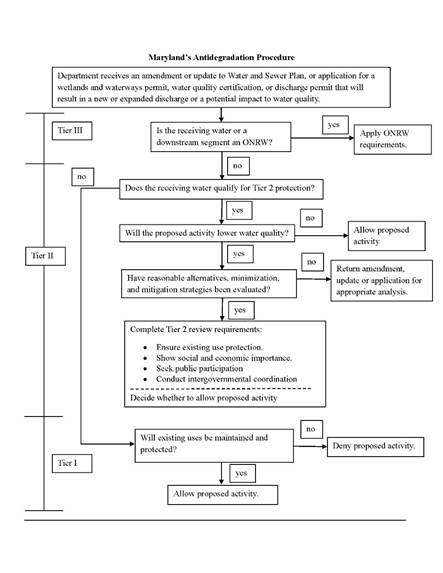
.04-2 Antidegradation
Policy Implementation Procedures: Tier II Level of Protection High Quality
Waters.
A. In Maryland, the term Tier II water is defined as a water
body with water quality that measures significantly better than that required
by water quality standards to support its designated uses. A Tier II watershed
is defined as the area of land that contributes runoff to a Tier II waterbody
and any discharges to streams upstream of and including the Tier II waterbody.
Significantly better is evaluated statistically to demonstrate at least a 90
percent certainty that the mean of the available data is better than the
applicable standard (for example, the criterion is outside the outer bound of
the 90 percent confidence interval). Water quality is considered significantly
better and waters may be listed as Tier II, if the exclusion under D of this
regulation does not apply and if:
(a) (text unchanged)
(b) Maryland Biological Stream Survey assessment data indicate
that both fish and benthic values of the index of biological integrity (IBI)
are 4.00 or greater.
B. Compilation and Maintenance of the List of High Quality Tier II
Waters. The Department shall compile and maintain a public list of the Tier II
waters. That list is contained in N of this regulation. All readily available
information may be considered to determine a listing. Tier II listings shall be
made only for those specific characteristics for which monitoring data
indicates the water body exceeds numeric water quality criteria or thresholds
established under the narrative standards for biocriteria. The Department shall
consider information available from the categories listed under A and D of
this regulation. A water body designated as Tier II for a characteristic
shall remain designated Tier II water even if its assimilative capacity is
diminished after designation, unless the Department determines that the Tier II
designation was in error.
C. (text unchanged)
D. Waters That May Not Be Listed as Tier II. [Water bodies
included in the List of Impaired Waters (303(d) List) are not Tier II waters
for the impairing substance.] A water body may not be designated as
Tier II for a water quality characteristic if that water body is already listed
as impaired for that characteristic on the List of Impaired Waters (303(d)
List).
E. Antidegradation Review General. An antidegradation review of
updated, new, or proposed amendments to Water and Sewerage Plans (County
Plans), wetlands and waterways permits or authorizations, water quality
certifications, or discharge permits in a Tier II watershed is required to
assure consistency with antidegradation requirements. An applicant for proposed
amendments to County Plans, a wetlands and waterways permit or authorization,
water quality certification, or discharge permits in a Tier II watershed that
will result in a new, or an increased, permitted annual discharge of pollutants
or a potential impact to water quality shall evaluate alternatives to eliminate
or reduce discharges or impacts. If impacts are unavoidable (as defined in H
of this regulation), an applicant shall prepare and document a social and
economic justification. The Department shall determine, through the public
processes for each of these permits or authorizations, whether these activities
can be justified.
F. Need for Tier II Antidegradation Review.
(1) Permits and Authorizations. Before submitting an application for a
new or major modification of an existing discharge permit or Notice of Intent
for authorization under a general permit, wetlands and waterways permit or
authorization, or water quality certification, the discharger or applicant
shall determine whether the receiving water body is in a Tier II watershed by
consulting the list of Tier II waters.
(2) (3) (text unchanged)
G. Tier II Antidegradation Review.
(1) (2) (text unchanged)
(3) If the analysis in G(1) of this regulation shows that the
alternatives are not cost effective and feasible, the applicant shall [provide]
minimize the use of the assimilative capacity of the water body by providing
the Department with: [plans to configure or structure the discharge
or other regulated activities that may cause a potential water quality impact
so as to minimize the use of the assimilative capacity of the water body. The
assimilative capacity of the water body is the difference between the water
quality at the time the water body was designated as Tier II, the baseline, and
the water quality criterion.]
(a) Plans to configure or structure the discharge or other regulated
activities that may cause a potential water quality impact; and
(b) Plans to minimize permanent impacts to the Tier II watershed through
mitigation.
(4) The assimilative capacity of the water body is the difference
between the water quality at the time the water body
was designated as Tier II, the baseline, and the water quality criterion.
[(4)] (5) (text unchanged)
H. (text unchanged)
I. Social and Economic Justification (SEJ).
(1) An SEJ shall be submitted if:
(a) (text unchanged)
(b) The cumulative degradation resulting from nonpoint source pollution
and any other permitted discharges or authorizations would diminish
water quality.
(2) (text unchanged)
J. K. (text unchanged)
L. Department Responsibilities.
(1) (2) (text unchanged)
(3) When the Department proposes to issue a tentative determination to
either issue or deny the permit application or authorization, the notice
of tentative determination shall state that these waters are designated as Tier
II and, if applicable, that a social and economic justification is available
for review.
(4) (5) (text unchanged)
M. Public Participation.
(1) Public participation for a permit to discharge [to] or
authorization in a Tier II watershed is the same as that required for any
permit subject to the Administrative Procedure Act or the requirements of
Environment Article, Title 1, Subtitle 6, Annotated Code of Maryland.
(2) (3) (text unchanged)
N. List of Tier II Waters Based on Maryland Biological Stream Survey
(fish and benthic macroinvertebrate) Index Scores.
Title 30
MARYLAND INSTITUTE FOR EMERGENCY MEDICAL SERVICES SYSTEMS (MIEMSS)
Subtitle 01 GENERAL
30.01.02 Documents
Incorporated by Reference
Authority: Education Article, 13-509 and 13-516; Annotated Code
of Maryland
Notice of Proposed Action
[26-150-P-I]
The State Emergency Medical Services Board proposes to amend
Regulation .01 under COMAR 30.01.02 Documents Incorporated by
Reference. This action was
considered by the State EMS Board at its open meeting held August 11, 2026.
Statement of Purpose
The purpose of this action is to amend the year of the incorporated
document to reflect the most current edition.
Estimate of Economic Impact
The proposed action has no economic impact.
Economic Impact on Small Businesses
The proposed action has minimal or no economic impact on small
businesses.
Impact on Individuals with Disabilities
The proposed action has no impact on individuals with
disabilities.
Opportunity for Public Comment
Comments may be sent to Timothy Chizmar, M.D., State EMS Medical
Director, MIEMSS, 653 West Pratt Street, Baltimore, MD 21201, or call (410)
706-0880, or email to [email protected]. Comments will be accepted through
October 18, 2026. A public hearing has not been scheduled.
Editor s Note on Incorporation by Reference
Pursuant to State Government
Article, 7-207, Annotated Code of Maryland, the Maryland Medical Protocols for
Emergency Medical Services (MIEMSS July 1, 2026 Edition) has been declared a
document generally available to the public and appropriate for incorporation by
reference. For this reason, it will not be printed in the Maryland Register or
the Code of Maryland Regulations (COMAR). Copies of this document are filed in
special public depositories located throughout the State. A list of these
depositories was published in 53:1 Md. R. 10 (January 9, 2026), and is
available online at www.dsd.maryland.gov. The document may also be inspected at
the office of the Division of State Documents, 16 Francis Street, Annapolis,
Maryland 21401.
.01 Incorporation by Reference.
A. (text unchanged)
B. Documents Incorporated.
(1) Maryland Medical Protocols for Emergency Medical Services
(MIEMSS July 1, [2023] 2026 Edition) . This document can
be obtained through the Maryland Institute for Emergency Medical Services
Systems at 653 W. Pratt Street, Baltimore, Maryland 21201 (410-706-4449).
(2) (4) (text unchanged)
THEODORE R. DELBRIDGE, MD, MPH
Executive Director
Title 31
MARYLAND INSURANCE ADMINISTRATION
Subtitle 10 HEALTH INSURANCE
GENERAL
31.10.41Assignment of Benefits
to Nonpreferred Providers
Authority: Insurance Article, 2-109(a)(1),14-205.2, [and]
14-205.3, and 14-410.1, Annotated Code of Maryland
Notice of Proposed Action
[26-177-P]
The Insurance Commissioner proposes to amend Regulations .02
and .05 .07 under COMAR 31.10.41 Assignment of Benefits to
Nonpreferred Providers.
Statement of Purpose
The purpose of this action is to the statutory changes under Senate
Bill 813 from the 2026 Legislative Session. These regulations clarify that
carrier includes dental plan organizations and adds references to dentist
to the existing assignment of benefits regulations.
Estimate of Economic Impact
The proposed action has no economic impact.
Economic Impact on Small Businesses
The proposed action has minimal or no economic impact on small
businesses.
Impact on Individuals with Disabilities
The proposed action has no impact on individuals with disabilities.
Opportunity for Public Comment
Comments may be sent to Jessica
Blackmon, Government Relations and Regulatory Affairs Specialist, Maryland
Insurance Administration, 200 St. Paul Place, Suite 2700, Baltimore, MD 21202,
or call 410-468-2019, or email to [email protected]. Comments
will be accepted through November 16, 2026. A public hearing has not been
scheduled.
.02 Terms Defined.
A. (text unchanged)
B. Terms Defined
(1) (2) (text unchanged)
(3) Carrier means an insurer,
[or] nonprofit health service plan, or
dental plan organization.
(4) (text unchanged)
(5) Dental plan
organization has the meaning stated in Insurance Article, 14-401(c),
Annotated Code of Maryland.
[(5)](6) [(6)](7) (text unchanged)
[(7)](8) Insured [has
the meaning stated in Insurance Article, 14-201, Annotated Code of Maryland] means a person covered for benefits under a
preferred provider insurance policy
offered or administered by an insurer, nonprofit health service plan, or dental
plan organization.
[(8)](9) [(13)](14) (text unchanged)
.05 Assignment of
Benefits Nonpreferred Providers.
A. This regulation applies to carriers who receive claims for
services provided by physicians or
dentists who are nonpreferred providers but are not on-call physicians or
hospital-based physicians.
B. (text unchanged)
C. Except as provided in Insurance Article, 14-205.3(g) and 14-410.1(g),
Annotated Code of Maryland, a carrier that receives a claim for services
provided by a nonpreferred provider described in A of this regulation who
accepts an assignment of benefits under a preferred provider insurance policy
shall pay the nonpreferred provider directly if the nonpreferred provider:
(1) (2) (text
unchanged).
.06 Required Disclosure for
Nonpreferred Providers Seeking Assignment of Benefits.
A. Except for a nonpreferred provider who is an on-call physician
or a hospital-based physician, a nonpreferred provider who is a physician or a dentist shall provide a copy of the
disclosure set forth in B of this regulation to each insured before performing
a health care service for the insured in order to qualify for an assignment of
benefits under a preferred provider insurance policy.
B. The disclosure text required by A of this regulation shall be
printed in at least 12 point type and shall read as follows:
IMPORTANT NOTICE REGARDING
YOUR HEALTH INSURANCE
Your [doctor] provider is
not a part of your health insurer s network. You may pay more for the services
provided by your [doctor] provider
because:
Your [doctor s] provider s charge may be higher than the
amount your health insurer will pay and, if so, you may be required to pay the
difference; and
Your coinsurance, deductible and out-of-pocket maximum may be
higher because your [doctor] provider
is not in your health insurer s network.
Your [doctor] provider
may charge you for services not covered under your health insurance contract.
Your [doctor] provider
will [provide] give you [with] the
following information before performing the services for you:
An estimate of the cost of the services;
Any payment terms that apply; and
Whether your [doctor] provider
will charge you interest on any unpaid balance, and the amount of the interest,
if any.
I, [patient s name] __________________________ received the
information above and authorize my health insurer to reimburse my [doctor] provider directly for the services
[provided] rendered [today s
date]_______________.
.07 Notice to Insureds by
Carriers.
A. A carrier shall provide the information listed in B of this
regulation with the payment to the insured for health care services if:
(1) The
carrier receives a claim for health care services provided by a physician or a dentist who is a nonpreferred
provider and who is not an on-call physician or a hospital-based physician; and
(2) The
insured did not provide an assignment of benefits to the physician or dentist who provided the health care
services.
B. D. (text unchanged)
MARIE GRANT
Insurance Commissioner
31.10.53 Coordination
of Benefits
Authority: Insurance Article, 2-109(a)(1) and 15-104;
Health-General, 19-713.1, Annotated Code of Maryland
Notice of Proposed Action
[26-181-P]
The Insurance Commissioner proposes to adopt new Regulations .01 .11
under a new chapter, COMAR 31.10.53 Coordination of Benefits.
Statement of Purpose
The purpose of this action is to adopt the NAIC Coordination of
Benefits Model Regulation, which a majority of other states have already done.
In Maryland, coordination of benefits provisions in health insurance contracts
filed with the MIA for approval have historically been reviewed for consistency
with the NAIC Model, but the Model has not been formally adopted to date.
Adopting the NAIC standards in Maryland regulations will promote greater
uniformity in how carriers process claims when an individual is covered by more
than one plan, and will facilitate MIA enforcement of those standards. Any
differences between the proposed regulations and the NAIC Model are solely
intended to ensure that the language conforms to the Division of State
Documents style manual and that the regulations comply with existing
Maryland-specific laws related to coordination of benefits.
Estimate of Economic Impact
The proposed action has no economic impact.
Economic Impact on Small Businesses
The proposed action has minimal or no economic impact on small
businesses.
Impact on Individuals with Disabilities
The proposed action has no impact on individuals with disabilities.
Opportunity for Public Comment
Comments may be sent to Jessica Blackmon, Government Relations and
Regulatory Affairs Specialist, Maryland Insurance Administration, 200 St. Paul
Place, Suite 2700, Baltimore, MD 21202, or call 410-468-2019, or email to
[email protected]. Comments will be accepted through November
16, 2026. A public hearing has not been scheduled.
.01 Purpose and Scope.
A. The purpose of this
chapter is to:
(1) Establish a uniform order
of benefit determination under which plans pay claims;
(2) Reduce duplication of
benefits by permitting a reduction of the benefits to be paid by plans that,
pursuant to rules established by this chapter, do not have to pay benefits
first; and
(3) Provide greater
efficiency in the processing of claims when an individual is covered under more
than one plan.
B. This chapter does not
require carriers to use a coordination of benefits provision in a plan, but if
a carrier includes in a plan any provision for the reduction of benefits
payable because of other insurance, the provision for the reduction of benefits
shall be consistent with the requirements of this chapter.
.02 Definitions.
A. In this chapter, the
following terms have the meanings indicated.
B. Terms Defined.
(1) Allowable Expense.
(a) Allowable expense means
any health care expense, including coinsurance or copayments and without
reduction for any applicable deductible, that is covered in full or in part by
any of the plans covering the individual.
(b) Allowable expense does
not include:
(i) If a plan is advised by a
covered individual that all plans covering the individual are high-deductible
health plans and the individual intends to contribute to a health savings
account established in accordance with 223 of the Internal Revenue Code of
1986, the primary high-deductible health plan's deductible, except for any
health care expense incurred that may not be subject to the deductible as
described in 223(c)(2)(C) of the Internal Revenue Code of 1986;
(ii) An expense or a portion
of an expense that is not covered by any of the plans;
(iii) An expense that a
provider by law or in accordance with a contractual agreement is prohibited
from charging a covered individual;
(iv) If an individual is
confined in a private hospital room, the difference between the cost of a
semi-private room in the hospital and the private room, unless one of the plans
provides coverage for private hospital room expenses;
(v) If an individual is
covered by 2 or more plans that compute their benefit payments on the basis of
usual and customary fees or relative value schedule reimbursement or other
similar reimbursement methodology, any amount charged by the provider in excess
of the highest reimbursement amount for a specified benefit; and
(vi) If an individual is
covered by 2 or more plans that provide benefits or services on the basis of
negotiated fees, any amount in excess of the highest of the negotiated fees.
(2) Birthday means the
month and day of an individual's birth in a calendar year and does not include
the year in which the individual is born.
(3) Carrier means:
(a) An insurer;
(b) A nonprofit health
service plan;
(c) A health maintenance
organization; or
(d) A dental plan
organization.
(4) Claim.
(a) Claim means a request
that benefits of a plan be provided or paid.
(b) Claim includes benefits
that are in the form of:
(i) Services, including
supplies:
(ii) Payment for all or a
portion of the expenses incurred;
(iii) A combination of
B(4)(b)(i) and (ii) of this regulation; or
(iv) An indemnification.
(5) Closed panel plan means
a plan that provides health benefits to covered individuals primarily in the
form of services through a panel of providers that:
(a) Have contracted with or
are employed by the plan; and
(b) Excludes benefits for
services provided by non-panel providers, except for the following:
(i) For a health maintenance
organization (HMO) contract, covered services as described at Health-General
Article, 19-701(d), Annotated Code of Maryland;
(ii) For a plan offered in
accordance with Insurance Article, 14-205.1, Annotated Code of Maryland, that
conditions payment of benefits on the use of preferred providers (also referred
to as an exclusive provider organization or EPO ), covered services as
described at Insurance Article, 14-205.1(a)(1) (3), Annotated Code of
Maryland; and
(iii) For a dental plan organization (DPO),
covered services in the event of an emergency or an authorized referral by a
member of the provider panel.
(c) Closed panel plan
includes:
(i) A HMO plan offered in
accordance with Health-General Article; Title 19, Subtitle 7, Annotated Code of
Maryland;
(ii) A preferred provider (EPO) plan offered in accordance with
Insurance Article, 14-205.1, Annotated Code of Maryland; or
(iii) A DPO plan offered in
accordance with Insurance Article, Title 14, Subtitle 4, Annotated Code of
Maryland;
(6) Complying plan means a
plan that has coordination of benefit determination rules that comply with this
chapter.
(7) Consolidated Omnibus
Budget Reconciliation Act of 1985 or COBRA means coverage provided under a
right of continuation pursuant to federal law.
(8) Coordination of
benefits or COB means a provision establishing an order in which plans pay
their claims, and permitting secondary plans to reduce their benefits so that
the combined benefits of all plans do not exceed total allowable expenses.
(9) Custodial parent means:
(a) The parent awarded
custody of a child by a court decree; or
(b) In the absence of a court
decree, the parent with whom the child resides more than one half of the
calendar year without regard to any temporary visitation.
(10) Group-type Contract.
(a) Group-type contract
means a contract that is not available to the general public and is obtained
and maintained only because of membership in or a connection with a particular
organization or group, including blanket coverage.
(b) Group-type contract
does not include an individually underwritten and issued guaranteed renewable
policy even if the policy is purchased through payroll deduction at a premium
savings to the insured or member.
(11) High-deductible health
plan has the meaning given the term under 223 of the Internal Revenue Code of
1986, as amended by the Medicare Prescription Drug, Improvement and
Modernization Act of 2003.
(12) Hospital Indemnity Benefits.
(a) Hospital indemnity
benefits means benefits not related to expenses incurred.
(b) Hospital indemnity
benefits does not include reimbursement-type benefits even if they are
designed or administered to give the covered individual the right to elect
indemnity-type benefits at the time of claim.
(13) Intensive care policy
means a health insurance policy that:
(a) Is individually
underwritten;
(b) Is guaranteed renewable;
(c) provides benefits only
for treatment received in the specifically designated facility of a hospital
that provides the highest level of care and is restricted to patients who are
physically and critically ill or injured; and
(d) does not provide benefits
on an expense-incurred basis.
(14) Non-complying plan
means a plan that:
(a) Is excess to other plans;
(b) Is always secondary to
other plans; or
(c) Uses order of benefit
determination rules that are inconsistent with those contained in this chapter.
(15) Plan.
(a) Plan means a form of
coverage with which coordination is allowed.
(b) Plan includes:
(i) Group and nongroup
insurance contracts and subscriber contracts;
(ii) Uninsured arrangements
of group or group-type coverage;
(iii) Group and nongroup
coverage through closed panel plans;
(iv) Group-type contracts;
(v) The medical care
components of long-term care contracts, such as skilled nursing care;
(vi) Medicare or other
governmental benefits, as permitted by law, except as provided in B(15)(c)(ix)
of this regulation; and
(vii) Group and non-group
insurance contracts and subscriber contracts that pay or reimburse for the cost
of dental care.
(c) Plan does not include:
(i) Hospital indemnity
coverage benefits or other fixed indemnity coverage;
(ii) Accident only coverage;
(iii) A specified disease
policy;
(iv) Specified accident
coverage;
(v) Limited benefit health
coverage, as defined under Maryland law;
(vi) An intensive care
policy;
(vii) School accident-type
coverages that cover students for accidents only, including athletic injuries,
either on a twenty-four hour basis or on a to and from school basis;
(viii) Benefits provided in
long-term care insurance policies for non-medical services;
(ix) A Medicare supplement
policy;
(x) A state plan under
Medicaid;
(xi) A governmental plan,
which, by law, provides benefits that are in excess of those of any private
insurance plan or other nongovernmental plan; or
(xii) Personal injury
protection benefits under a motor vehicle liability insurance policy.
(16) Policyholder means the
primary insured or member named in a non-group insurance policy.
(17) Primary plan means a
plan whose benefits for an individual's health care coverage must be determined
without taking the existence of any other plan into consideration.
(18) Secondary plan means a
plan that is not a primary plan.
(19) Specified disease
policy means a health insurance policy that:
(a) Is individually
underwritten;
(b) Is guaranteed renewable;
(c) Provides benefits only
for:
(i) A disease or diseases
specified in the policy or for a treatment unique to a specified disease or
diseases; or
(ii) Additional benefits for
a disease or diseases specified in the policy or for treatment unique to a
specified disease or diseases; and
(d) Does not provide benefits on an expense-incurred basis.
.03 Application of Definitions Used in Coordination of Benefits
Provisions.
A. A carrier shall define the
terms used in a coordination of benefits provision in a manner that is
consistent with the definitions found in Regulation .02 of this chapter.
B. Allowable Expense
Definition in Contract.
(1) A carrier shall specify
in its allowable expense definition that:
(a) Except as provided in
B(1)(b) of this regulation, if an individual is covered by one plan that
calculates its benefits or services on the basis of usual and customary fees or
relative value schedule reimbursement or other similar reimbursement methodology
and another plan that provides its benefits or services on the basis of
negotiated fees, the primary plan's payment arrangement shall be the allowable
expense for all plans.
(b) If the provider has
contracted with the secondary plan to provide the benefit or service for a
specific negotiated fee or payment amount that is different than the primary
plan's payment arrangement and if the provider's contract permits, that negotiated
fee or payment shall be the allowable expense used by the secondary plan to
determine its benefits.
(2) The definition of
allowable expense may exclude certain types of coverage or benefits such as
dental care, vision care, prescription drug, or hearing aids.
(3) A plan that limits the
application of COB to certain coverages or benefits may limit the definition of
allowable expense in its contract to expenses that are similar to the
expenses that it covers.
(4) When COB is restricted to
specific coverages or benefits in a contract, the definition of allowable
expense shall include similar expenses to which COB applies.
(5) When a plan provides
benefits in the form of services, the reasonable cash value of each service
will be considered an allowable expense and a benefit paid.
(6) The amount of the
reduction may be excluded from allowable expense when a covered individual s
benefits are reduced under a primary plan because the covered individual:
(a) Does not comply with the
plan provisions concerning second surgical opinions or precertification of
admissions or services; or
(b) Has a lower benefit
because the covered individual did not use a preferred provider.
C. Plan Definition in
Contract.
(1) If separate parts of a
plan for members of a group are provided through alternative contracts that are
intended to be part of a coordinated package of benefits, the definition of
plan shall indicate that:
(a) The separate parts of the
plan shall be considered one plan; and
(b) There is no coordination
of benefits among the separate parts of the plan.
(2) If a plan coordinates
benefits, its contract shall state the types of coverage that will be
considered in applying the COB provision of that contract.
(3) Whether the contract uses
the term plan or some other term such as program, the contractual
definition may not be broader than the definition of plan in this chapter.
(4) If the definition of
plan in the contract includes Medicare or other governmental benefits, that
part of the plan definition may be limited to the hospital, medical, and
surgical benefits of the governmental program.
(5) The reference to
long-term care insurance for non-medical services in the definition of plan
includes:
(a) Personal care;
(b) Adult day care;
(c) Homemaker services;
(d) Assistance with
activities of daily living;
(e) Respite care;
(f) Custodial care; and
(g) Contracts that pay a
fixed daily benefit without regard to expenses incurred or the receipt of
services.
D. Primary Plan Definition in
Contract.
(1) A definition of plan
used in a carrier s contract shall indicate that a plan is primary if:
(a) The plan has no order of
benefit determination rules, or its rules differ from those permitted by this
chapter; or
(b) All plans that cover the
individual use the order of benefit determination rules required by this
chapter and, under those rules, the plan determines its benefits first.
.04 Use of Model COB Contract
Provision.
A. The model text set forth
in Regulation .11 of this chapter:
(1) Contains a model COB
provision for use in carrier s contracts; and
(2) The use of this model COB
provision is subject to the provisions of B D of this regulation, and to the
provisions of Regulations .05 and .06 of this chapter.
B. Use of the Model COB
Contract Provision.
(1) A carrier is not required
to use the specific words and format of the COB Contract provision contained in
Regulation .11 of this chapter.
(2) A carrier may make
changes to the COB provision contained in Regulation .11 of this chapter to:
(a) Fit the language and
style of the rest of the contract; or
(b) Reflect differences among
plans that provide services, that pay benefits for expenses incurred, and that
indemnify.
(3) Other than allowed in (2)
above, a carrier may not make changes to the COB provision contained in
Regulation .11 of this chapter.
C. A COB provision may not be
used that permits a plan to reduce its benefits on the basis that:
(1) Another plan exists and
the covered individual did not enroll in that plan;
(2) An individual is or could
have been covered under another plan, except with respect to Part B of
Medicare; or
(3) An individual has elected
an option under another plan providing a lower level of benefits than another
option that could have been elected.
D. A plan may not contain a
provision that its benefits are always excess or always secondary, except
in accordance with the rules permitted by this chapter.
E. Closed Panel Plans.
(1) Generally, under the
terms of a closed panel plan, benefits are not payable if the covered
individual does not use the services of a closed panel provider, except as
provided for in Regulation .01B(5)(b) of this chapter.
(2) Except as described in
E(3) and (4) of this regulation, coordination of benefits does not occur if a
covered individual is enrolled in two or more closed panel plans and obtains
services from a provider in one of the closed panel plans because the other
closed panel plan (the one whose providers were not used) has no liability.
(3) Coordination of benefits
may occur during the plan year when the covered individual receives emergency
services that would be covered by both closed panel plans.
(4) If coordination of
benefits occurs as described in E(3) of this regulation, the secondary plan
shall use the provisions of Regulation .07 of this chapter to determine the
amount it must pay for the benefit.
F. A plan may not use a COB
provision, or any other provision that allows it to reduce its benefits with
respect to any other coverage the covered individual may have that does not
meet the definition of plan under Regulation .02B(15) or is inconsistent with
Regulation .03C of this chapter.
.05 Rules for Coordination of
Benefits.
A. When an individual is
covered by two or more plans, the rules for determining the order of benefit
payments are set forth in B D of this regulation and Regulation .06 of this
chapter.
B. Payment by Primary Plans
and Secondary Plans.
(1) The primary plan shall
pay or provide its benefits as if the secondary plan or plans did not exist.
(2) If the primary plan is a
closed panel plan and the secondary plan is not a closed panel plan, the
secondary plan shall pay or provide benefits as if it were the primary plan
when a covered individual uses a non-panel provider, except for under the following
circumstances:
(a) If the closed panel plan
is a HMO, the HMO will be the primary plan if it is determined the service
received from the non-panel provider is a covered service in accordance with
Health-General Article, 19-701(d), Annotated Code of Maryland. The non-panel
provider will be reimbursed in accordance with Health-General Article,
19-710.1, Annotated Code of Maryland;
(b) If the closed panel plan
is an EPO, the EPO will be the primary plan if it is determined the service
received from the non-panel provider is a covered service in accordance with
Insurance Article, 14-205.1(a)(1) (3), Annotated Code of Maryland; or
(c) If the closed panel plan
is a DPO, the DPO will be the primary plan if it is determined the service
received from the non-panel provider is a covered emergency service or is the
result of an authorized referral.
(3) Multiple Contracts
Providing Coordinated Coverage.
(a) When multiple contracts
providing coordinated coverage are treated as a single plan under this chapter,
Regulations .05 and .06 of this chapter apply only to the plan as a whole, and
coordination among the component contracts is governed by the terms of the
contracts.
(b) If more than one carrier
pays or provides benefits under the plan, the carrier designated as primary
within the plan shall be responsible for the plan s compliance with this
chapter.
(4) Rules When More Than One
Secondary Plan Exists.
(a) If an individual is
covered by more than one secondary plan, the order of benefit determination
rules of this chapter decide the order in which secondary plans benefits are
determined in relation to each other.
(b) Each secondary plan shall
take into consideration the benefits of the primary plan or plans and the
benefits of any other plan, which under this chapter, has its benefits
determined before those of that secondary plan.
C. Plans Having Order of
Benefit Determination Provisions Inconsistent With This Chapter.
(1) Except as provided in
C(2) of this regulation, a plan that does not contain order of benefit
determination provisions that are consistent with this chapter is always the
primary plan unless the provisions of both plans, regardless of the provisions of
this subsection, state that the complying plan is primary.
(2) Coverage that is obtained
by virtue of membership in a group and designed to supplement a part of a basic
package of benefits may provide that the supplementary coverage shall be excess
to any other parts of the plan provided by the contract holder.
(3) Examples of the
supplementary coverage described in C(2) of this regulation include:
(a) Major medical coverages
that are superimposed over base plan hospital and surgical benefits; and
(b) Insurance type coverages
that are written in connection with a closed panel plan to provide
out-of-network benefits.
D. A plan may take into
consideration the benefits paid or provided by another plan only when, under
the rules of this chapter, it is secondary to that other plan.
.06 Order of Benefit
Determination.
A. A plan determines its
order of benefits using the first of the rules listed in B G of this
regulation that applies.
B. Non-Dependent or
Dependent.
(1) Subject to B(2) of this
regulation, the plan that covers the individual other than as a dependent, such
as an employee, member, subscriber, policyholder, or retiree, is the primary
plan and the plan that covers the individual as a dependent is the secondary
plan.
(2) If the individual is a
Medicare beneficiary, the order of the benefits is reversed from the rule
described in B(1) of this regulation so that the plan covering the individual
as an employee, member subscriber, policyholder or retiree is the secondary
plan and the other plan covering the individual as a dependent is the primary
plan if, as a result of the provisions of Title XVIII of the Social Security
Act and implementing regulations, Medicare is:
(a) Secondary to the plan
covering the individual as a dependent; and
(b) Primary to the plan
covering the individual as other than a dependent, such as a retired employee.
C. Dependent Child Covered
Under More Than One Plan.
(1) Unless there is a court
decree stating otherwise, plans covering a dependent child shall determine the
order of benefits as described in C(2) (4) of this regulation.
(2) For a dependent child
whose parents are married or are living together, whether or not they have ever
been married:
(a) The plan of the parent
whose birthday falls earlier in the calendar year is the primary plan; or
(b) If both parents have the
same birthday, the plan that has covered the parent longest is the primary
plan.
(3) For a dependent child
whose parents are divorced or separated or are not living together, whether or
not they have ever been married:
(a) If a court decree states
that one of the parents is responsible for the dependent child s health care
expenses or health care coverage and the plan of that parent has actual
knowledge of those terms, that plan is primary;
(b) If the parent the court
decree states is responsible for the dependent child s health care expenses or
health care coverage has no health care coverage for the dependent child s
health care expenses, but that parent s spouse does, that parent s spouse s
plan is the primary plan, except that this C(3)(b) of this regulation shall
not apply with respect to any plan year during which benefits are paid or
provided before the entity has actual knowledge of the court decree provision;
(c) If a court decree states
that both parents are responsible for the dependent child s health care
expenses or health care coverage, the provisions of C(2) of this regulation
shall determine the order of benefits;
(d) If a court decree states
that the parents have joint custody without specifying that one parent has
responsibility for the health care expenses or health care coverage of the
dependent child, the provisions of C(2) of this regulation shall determine the
order of benefits; or
(e) If there is no court
decree allocating responsibility for the child's health care expenses or health
care coverage, the order of benefit for the child shall be as follows:
(i) The plan covering the
custodial parent;
(ii) The plan covering the
custodial parent's spouse;
(iii) The plan covering the
non-custodial parent; and
(iv) The plan covering the
non-custodial parent's spouse.
(4) For a dependent child
covered under more than one plan of individuals who are not the parents of the
child, the order of benefits shall be determined, as applicable, under C(2) or
(3) of this regulation as if those individuals were parents of the child.
(5) For a dependent child who
has coverage under either or both of their parents plans and also has their
own coverage as a dependent under a spouse s plan, the order of benefits shall
be determined in accordance with F of this regulation.
(6) In the event the
dependent child s coverage under their spouse s plan began on the same date as
the dependent child s coverage under either or both of their parents plans,
the other of benefits shall be determined by applying the provisions of C(2)
of this regulation to the dependent child s parent or parents and the dependent
child s spouse.
D. Active Employee or Retired
or Laid-Off Employee.
(1) The plan that covers an
individual as an active employee or the dependent of an active employee is the
primary plan.
(2) The plan covering the
same individual described in D(1) of this regulation as a retired or laid-off
employee or as a dependent of a retired or laid-off individual is the secondary
plan.
(3) If the other plan does
not have the rules described in D(1) and (2) of this regulation, and as a
result, the plans do not agree on the order of benefits, the rules described in
D(1) and (2) of this regulation are ignored.
(4) The rules described in
D(1) and (2) of this regulation do not apply if the rule in B of this
regulation can determine the order of benefits.
E. COBRA or State
Continuation Coverage.
(1) If an individual whose
coverage is provided pursuant to COBRA or under a right of continuation
pursuant to state or other federal law is covered under another plan, the plan
covering the individual as an employee, member, subscriber, or retiree, or as
the dependent of an employee, member, subscriber, or retiree is the primary
plan, and the plan covering that same individual pursuant to COBRA or under a
right of continuation pursuant to state or other federal law is the secondary
plan.
(2) If the other plan does
not have the rule described in E(1) of this regulation, and if, as a result,
the plans do not agree on the order of benefits, the rule described in E(1) of
this regulation is ignored.
(3) The rule described in
E(1) of this regulation does not apply if the rule described in B of this
regulation can determine the order of benefits.
F. Longer or Shorter Length
of Coverage.
(1) If the rules set forth in
B E of this regulation do not determine the order of benefits:
(a) The plan that covered the
individual for the longer period of time is the primary plan; and
(b) The plan that covered the
individual for the shorter period of time is the secondary plan.
(2) To determine the length
of time an individual has been covered under a plan, two successive plans shall
be treated as one if the covered individual was eligible under the second plan
within 24 hours after coverage under the first plan ended.
(3) The start of a new plan
does not include:
(a) A change in the amount or
scope of a plan s benefits;
(b) A change in the entity
that pays, provides, or administers the plan s benefits; or
(c) A change from one type of
plan to another, such as, from a single employer plan to a multiple employer
plan.
(4) The individual s length
of time covered under a plan is measured from the individual's first date of
coverage under that plan.
(5) If the individual s first
date of coverage under a plan is not readily available for a group plan, the
date the individual first became a member of the group shall be used as the
date from which to determine the length of time the individual s coverage under
the present plan has been in force.
G. If none of the rules
described in B F of this regulation determines the order of benefits, the allowable expenses shall be shared equally
between the plans.
.07 Procedure to Calculate Benefits and Pay a Claim for Secondary
Plans.
A. In determining the amount
to be paid on a claim by the secondary plan, should the plan wish to coordinate
benefits, the secondary plan shall calculate the benefits it would have paid on
the claim in the absence of other health coverage and apply that calculated
amount to any allowable expense under its plan that is unpaid by the primary
plan.
B. The secondary plan may
reduce its payment as calculated under A of this regulation by the amount so
that, when combined with the amount paid by the primary plan, the total
benefits paid or provided by all plans for the claim do not exceed 100 percent
of the total allowable expense for that claim.
C. In addition to paying
benefits as described in A B of this regulation, the secondary plan shall
credit to its plan deductible any amounts it would have credited to its
deductible in the absence of other health care coverage.
.08 Notice to Covered
Individuals.
A plan shall, in its
explanation of benefits provided to covered individuals, include the following
language, If you are covered by more than one health benefit plan, you should
file all your claims with each plan.
.09 Miscellaneous Provisions.
A. A secondary plan that
provides benefits in the form of services may recover the reasonable cash value
of the services from the primary plan, to the extent that benefits for the
services are covered by the primary plan and have not already been paid or
provided by the primary plan. Nothing in this A of this regulation shall be
interpreted to require a plan to reimburse a covered individual in cash for the
value of services provided by a plan that provides benefits in the form of
services.
B. Rules When Non-Complying
Plan is Involved.
(1) A plan with order of
benefit determination rules that comply with this chapter ( complying plan )
may coordinate its benefits with a plan that is excess or always secondary
or that uses order of benefit determination rules that are inconsistent with
those contained in this chapter ( non-complying plan ) on the following basis:
(a) If the complying plan is
the primary plan, it shall pay or provide its benefits first;
(b) If the complying plan is
the secondary plan, it shall pay or provide its benefits first, but the amount
of the benefits payable shall be determined as if the complying plan were the
secondary plan. In such a situation, the payment shall be the limit of the
complying plan s liability.
(c) If the non-complying plan
does not provide the information needed by the complying plan to determine its
benefits within a reasonable time after the non-complying plan is requested to
do so, the complying plan shall assume that the benefits of the non-complying
plan are identical to its own, and shall pay its benefits accordingly. If,
within 2 years of payment, the complying plan receives information as to the
actual benefits of the non-complying plan, the complying plan shall adjust
payments accordingly.
(2) If the non-complying plan
reduces its benefits so that the covered individual receives less in benefits
than the covered individual would have received had the complying plan paid or
provided its benefits as the secondary plan and the non-complying plan paid or
provided its benefits as the primary plan, and governing state law allows the
right of subrogation as described in B(3) of this regulation, then the
complying plan shall advance to the covered individual or on behalf of the
covered individual an amount equal to the difference.
(3) In no event shall the
complying plan advance more than the complying plan would have paid had it been
the primary plan less any amount it previously paid for the same expense or
service. In consideration of the advance, the complying plan shall be subrogated
to all rights of the covered individual against the non-complying plan. The
advance by the complying plan shall also be without prejudice to any claim it
may have against a non-complying plan in the absence of subrogation.
C. COB Provisions and
Subrogation Provisions.
(1) A COB provision differs
from a subrogation provision.
(2) Provisions for COB or for
subrogation may be included in health care benefits contracts without
compelling the inclusion or exclusion of the other.
D. If the plans cannot agree
on the order of benefits within 30 calendar days after the plans have received
all of the information needed to pay the claim, the plans shall immediately pay
the claim in equal shares and determine their relative liabilities following
payment, except that no plan shall be required to pay more than it would have
paid had it been the primary plan.
.10 Effective Date for
Existing Contracts.
A. A contract that provides
health care benefits and that was issued before the effective date of this
chapter shall be brought into compliance with this chapter by:
(1) The later of:
(a) The first anniversary
date or renewal date of the contract that occurs after the effective date of
this chapter; or
(b) Twelve months following
the effective date of this chapter; or
(2) The expiration of any applicable collectively bargained contract
pursuant to which the contract of health care benefits was written.
.11 Model COB Contract
Provision.
The model coordination of
benefits provision referenced in Regulation .04A of this chapter shall read as
follows:
COORDINATION OF THIS
CONTRACT S BENEFITS WITH OTHER BENEFITS
The Coordination of Benefits
(COB) provision applies when an individual has health care coverage under more
than one Plan. Plan is defined below.
The order of benefit
determination rules govern the order in which each Plan will pay a claim for benefits. The Plan that pays first is called the Primary plan. The Primary
plan must pay benefits in accordance with its policy terms without regard
to the possibility that another Plan
may cover some expenses. The Plan
that pays after the Primary plan is
the Secondary plan. The Secondary plan may reduce the benefits
it pays so that payments from all Plans
do not exceed 100% of the total Allowable
expense.
DEFINITIONS
A. A Plan is any of the
following that provides benefits or services for medical or dental care or
treatment. If separate contracts are used to provide coordinated coverage for
members of a group, the separate contracts are considered parts of the same
plan and there is no COB among those separate contracts.
(1) Plan includes: group and non-group
insurance contracts, health maintenance organization (HMO) contracts, closed
panel plans or other forms of group or group-type coverage (whether insured or
uninsured); medical care components of long-term care contracts, such as skilled
nursing care; and Medicare or any other federal governmental plan, as permitted
by law.
(2) Plan does not include: hospital indemnity coverage or other fixed
indemnity coverage; accident only coverage; a specified disease policy;
specified accident coverage; limited benefit health coverage, as defined under
Maryland law; an intensive care policy; school accident type coverage; benefits
for non-medical components of long-term care policies; Medicare supplement
policies; Medicaid policies; coverage under other federal governmental plans,
unless permitted by law; or personal injury protection benefits under a motor
vehicle liability insurance policy.
Each contract for coverage
under (1) or (2) is a separate Plan.
If a Plan has two parts and COB
rules apply only to one of the two, each of the parts is treated as a separate Plan.
B. This plan means, in a COB
provision, the part of the contract providing the health care benefits to which
the COB provision applies and which
may be reduced because of the benefits of other plans. Any other part of the
contract providing health care benefits is separate from this plan. A contract
may apply one COB provision to
certain benefits, such as dental benefits, coordinating only with similar
benefits, and may apply another COB
provision to coordinate other benefits.
C. The order of benefit determination rules determine whether This plan is a Primary plan or Secondary
plan when the individual has health care coverage under more than one Plan.
When This plan is primary, it determines payment for its benefits first
before those of any other Plan
without considering any other Plan s
benefits. When This plan is
secondary, it determines its benefits after those of another Plan and may reduce the benefits it
pays so that all Plan benefits do
not exceed 100% of the total Allowable
expense.
D. Allowable expense is a
health care expense, including deductibles, coinsurance and copayments, that is
covered at least in part by any Plan
covering the individual. When a Plan
provides benefits in the form of services, the reasonable cash value of each
service will be considered an Allowable
expense and a benefit paid. An expense that is not covered by any Plan covering the individual is not an Allowable expense. In addition, any
expense that a provider by law or in accordance with a contractual agreement is
prohibited from charging a covered individual is not an Allowable expense.
The following are examples of
expenses that are not Allowable expenses:
(1) The difference between
the cost of a semi private hospital room and a private hospital room is not an Allowable expense, unless one of the Plans provides coverage for private
hospital room expenses.
(2) If an individual is
covered by 2 or more Plans that
compute their benefit payments on the basis of usual and customary fees or
relative value schedule reimbursement methodology or other similar
reimbursement methodology, any amount in excess of the highest reimbursement
amount for a specific benefit is not an Allowable
expense.
(3) If an individual is
covered by 2 or more Plans that
provide benefits or services on the basis of negotiated fees, an amount in
excess of the highest of the negotiated fees is not an Allowable expense.
(4) If an individual is
covered by one Plan that calculates
its benefits or services on the basis of usual and customary fees or relative
value schedule reimbursement methodology or other similar reimbursement
methodology and another Plan that
provides its benefits or services on the basis of negotiated fees, the Primary plan s payment arrangement
shall be the Allowable expense for
all Plans. However, if the provider
has contracted with the Secondary plan
to provide the benefit or service for a specific negotiated fee or payment
amount that is different than the Primary
plan s payment arrangement, and if the provider s contract permits, the
negotiated fee or payment shall be the Allowable
expense used by the Secondary plan
to determine its benefits.
(5) The amount of any benefit
reduction by the Primary plan
because a covered individual has failed to comply with the Plan provisions is not an Allowable
expense. Examples of these types of plan provisions include second surgical
opinions, precertification of admissions, and preferred provider arrangements.
E. Closed panel plan is a Plan that provides health care benefits
to covered individuals primarily in the form of services through a panel of
providers that have contracted with or are employed by the Plan, and that excludes coverage for services provided by other
providers, except in cases of emergency or referral by a panel member.
F. Custodial parent is the
parent awarded custody by a court decree or, in the absence of a court decree,
is the parent with whom the child resides more than one half of the calendar
year excluding any temporary visitation.
G. Intensive care policy is
a health insurance policy that (1) is individually underwritten, (2) is
guaranteed renewable, (3) provides benefits only for treatment received in the
specifically designated facility of a hospital that provides the highest level
of care and is restricted to patients who are physically and critically ill or
injured, and (4) does not provide benefits on an expense-incurred basis.
H. Specified disease policy
is a health insurance policy that (1) is individually underwritten; (2) is
guaranteed renewable; (3) provides benefits only for (a) a disease or diseases
specified in the policy or for a treatment unique to a specified disease or
diseases; or (b) additional benefits for a disease or diseases specified in the
policy or for treatment unique to a specified disease or diseases; and (4) does
not provide benefits on an expense-incurred basis.
ORDER OF BENEFIT DETERMINATION RULES
When an individual is covered
by two or more Plans, the rules for
determining the order of benefit payments are as follows:
A. The Primary plan pays or provides its benefits according to its terms
of coverage and without regard to the benefits of under any other Plan.
B. (1) Except as provided in Paragraph (2), a Plan that does not contain a coordination of benefits provision
that is consistent with this regulation is always primary unless the provisions
of both Plans state that the
complying plan is primary.
(2) Coverage that is obtained by virtue of membership in a group
that is designed to supplement a part of a basic package of benefits and
provides that this supplementary coverage shall be excess to any other parts of
the Plan provided by the contract
holder. Examples of these types of situations are major medical coverages that
are superimposed over base plan hospital and surgical benefits, and insurance
type coverages that are written in connection with a Closed panel plan to provide out-of-network benefits.
C. A Plan may consider the
benefits paid or provided by another Plan
in calculating payment of its benefits only when it is secondary to that other Plan.
D. Each Plan determines its
order of benefits using the first of the following rules that apply:
(1) Non-Dependent or
Dependent. The Plan that covers the
individual other than as a dependent, for example as an employee, member,
policyholder, subscriber or retiree is the Primary
plan and the Plan that covers
the individual as a dependent is the Secondary
plan. However, if the individual is a Medicare beneficiary and, as a result
of federal law, Medicare is secondary to the Plan covering the individual as a dependent; and primary to the Plan covering the individual as other
than a dependent (e.g. a retired employee); then the order of benefits between
the two Plans is reversed so that
the Plan covering the individual as
an employee, member, policyholder, subscriber or retiree is the Secondary plan and the other Plan is the Primary plan.
(2) Dependent Child Covered
Under More Than One Plan. Unless there is a court decree stating otherwise,
when a dependent child is covered by more than one Plan the order of benefits is determined as follows:
(a) For a dependent child
whose parents are married or are living together, whether or not they have ever
been married:
The Plan of the parent whose birthday falls earlier in the calendar
year is the Primary plan; or
If both parents have the
same birthday, the Plan that has
covered the parent the longest is the Primary
plan.
(b) For a dependent child
whose parents are divorced or separated or not living together, whether or not
they have ever been married:
(i)
If a court decree states that one of the parents is responsible for the
dependent child s health care expenses or health care coverage and the Plan of that parent has actual
knowledge of those terms, that Plan
is primary. This rule applies to plan years commencing after the Plan is given notice of the court
decree;
(ii)
If a court decree states that both parents are responsible for the dependent
child s health care expenses or health care coverage, the provisions of
Subparagraph (a) above shall determine the order of benefits;
(iii)
If a court decree states that the parents have joint custody without specifying
that one parent has responsibility for the health care expenses or health care coverage
of the dependent child, the provisions of Subparagraph (a) above shall
determine the order of benefits; or
(iv)
If there is no court decree allocating responsibility for the dependent child s
health care expenses or health care coverage, the order of benefits for the
child are as follows:
* The Plan
covering the Custodial parent;
* The Plan
covering the spouse of the Custodial
parent;
* The Plan
covering the non-custodial parent;
and then
* The Plan
covering the spouse of the non-custodial
parent.
(c) For a dependent child
covered under more than one Plan of
individuals who are not the parents of the child, the provisions of
Subparagraph (a) or (b) above shall determine the order of benefits as if those
individuals were the parents of the child.
(d) For a dependent child who
has coverage under either or both of their parents plans and also has their
own coverage as a dependent under a spouse s plan, the rule in Paragraph (5)
below applies.
(e) In the event the
dependent child s coverage under their spouse s plan began on the same date as
the dependent child s coverage under either or both of their parents plans,
the other of benefits shall be determined by applying the birthday rule in Subparagraph
(a) above to the dependent child s parent(s) and the dependent child s spouse.
(3) Active Employee or
Retired or Laid-off Employee. The Plan
that covers an individual as an active employee, that is, an employee who is
neither laid off nor retired, is the Primary
plan. The Plan covering that
same individual as a retired or laid-off employee is the Secondary plan. The same would hold true if an individual is a
dependent of an active employee and that same individual is a dependent of a
retired or laid-off employee. If the other Plan
does not have this rule, and as a result, the Plans do not agree on the order of benefits, this rule is ignored.
This rule does not apply if the rule labeled D(1) can determine the order of
benefits.
(4) COBRA or State
Continuation Coverage. If an individual whose coverage is provided pursuant to
COBRA or under a right of continuation provided by state or other federal law
is covered under another Plan, the Plan covering the individual as an
employee, member, subscriber, or retiree or covering the individual as a
dependent of an employee, member, subscriber, or retiree is the Primary plan and the COBRA or state or
other federal continuation coverage is the Secondary
plan. If the other Plan does not
have this rule, and as a result, the Plans
do not agree on the order of benefits, this rule is ignored. This rule does not
apply if the rule labeled D(1) can determine the order of benefits.
(5) (a) Longer or Shorter
Length of Coverage. The Plan that
covered the individual as an employee, member, policyholder, subscriber, or
retiree longer is the Primary plan
and the Plan that covered the
individual the shorter period of time is the Secondary plan.
(b) To determine the length
of time an individual has been covered under a plan, two successive plans shall
be treated as one if the covered individual was eligible under the second plan
within 24 hours after coverage under the first plan ended.
(c) The start of a new plan
does not include:
(i) A change in the amount or scope of a plan s benefits;
(ii) A change in the entity that pays, provides, or administers
the plans benefits; or
(iii) A change from one type of plan to another, such as, from a
single employer plan to a multiple employer plan
(d) The individual's length
of time covered under a plan is measured from the individual's first date of
coverage under that plan. If that date is not readily available for a group
plan, the date the individual first became a member of the group shall be used
as the date from which to determine the length of time the individual's
coverage under the present plan has been in force.
(6) If the preceding rules do
not determine the order of benefits, the Allowable
expenses shall be shared equally between the Plans meeting the definition of Plan. In addition, This plan
will not pay more than it would have paid had it been the Primary plan.
EFFECT ON THE BENEFITS OF THIS PLAN
A. When This plan is
secondary, it may reduce its benefits so that the total benefits paid or
provided by all Plans during a plan
year are not more than the total Allowable
expenses. In determining the amount to be paid for any claim, the Secondary plan will calculate the
benefits it would have paid in the absence of other health care coverage and
apply that calculated amount to any Allowable
expense under its Plan that is
unpaid by the Primary plan. The Secondary plan may then reduce its
payment by the amount so that, when combined with the amount paid by the Primary plan, the total benefits paid
or provided by all Plans for the
claim do not exceed the total Allowable
expense for that claim. In addition, the Secondary plan shall credit to its plan deductible any amounts it
would have credited to its deductible in the absence of other health care
coverage.
B. If a covered individual is enrolled in two or more Closed panel plans and if, for any
reason, including the provision of service by a non-panel provider, benefits
are not payable by one Closed panel plan,
COB shall not apply between that Plan and other Closed panel plans.
RIGHT TO RECEIVE AND RELEASE
NEEDED INFORMATION
Certain facts about health
care coverage and services are needed to apply these COB rules and to determine benefits payable under This plan and other Plans. [Insert name of carrier] may get
the facts it needs from or give them to other organizations or individuals for
the purpose of applying these rules and determining benefits payable under This plan and other Plans covering the individual claiming
benefits. [Insert name of carrier] need not tell, or get the consent of, any
individual to do this. Each individual claiming benefits under This plan must give [insert name of
carrier] any facts it needs to apply those rules and determine benefits
payable.
FACILITY OF PAYMENT
A payment made under another Plan may include an amount that should
have been paid under This plan. If
it does, [insert name of carrier] may pay that amount to the organization that
made that payment. That amount will then be treated as though it were a benefit
paid under This plan. [Insert name
of carrier] will not have to pay that amount again. The term payment made
includes providing benefits in the form of services, in which case payment
made means the reasonable cash value of the benefits provided in the form of
services.
RIGHT OF RECOVERY
If the amount of the payments
made by [insert name of carrier] is more than it should have paid under this COB provision, it may recover the
excess from one or more of the individuals it has paid or for whom it has paid;
or any other individual or organization that may be responsible for the
benefits or services provided for the covered individual. The amount of the
payments made includes the reasonable cash value of any benefits provided in
the form of services.
MARIE GRANT
Insurance Commissioner
Title 36
MARYLAND STATE LOTTERY AND GAMING CONTROL
AGENCY
Subtitle 07 INSTANT BINGO MACHINES IN ANNE
ARUNDEL AND CALVERT COUNTIES
Notice of Proposed Action
[26-174-P]
The Maryland State Lottery and Gaming Control Agency proposes to:
(1) Amend Regulations .01
and .03 under COMAR 36.07.01 General; and
(2) Amend Regulation .08
under COMAR 36.07.06 Technical Standards.
This action was considered at the
Maryland State Lottery and Gaming Control Commission's open meeting held on
August 27, 2026.
Statement of Purpose
The purpose of this action is to
implement legislative changes to Criminal Law Article, 12-308, Annotated Code
of Maryland (effective July 1, 2026), which provides that an electronic
instant bingo machine is not required to print a paper ticket for each game of
instant bingo played unless the player elects to print the ticket. The action adds a new F to COMAR
36.07.06.08 that would implement legislative changes to Criminal Law Article,
12-308, Annotated Code of Maryland (effective July 1, 2026), which provides
that an electronic instant bingo machine is not required to print a paper
ticket for each game of instant bingo played unless the player elects to print
the ticket. The proposed amendment to D is stylistic, consistent with the
Style Manual for Maryland Regulations.
Estimate of Economic Impact
The proposed action has no
economic impact.
Economic Impact on Small Businesses
The proposed action has minimal
or no economic impact on small businesses.
Impact on Individuals with Disabilities
The proposed action has no impact
on individuals with disabilities.
Opportunity for Public Comment
Comments may be sent to Jennifer
Beskid -MLGCA-, Director, Legislation and Policy, Maryland State Lottery and
Gaming Control Agency, 1800 Washington Boulevard, Suite 330, or call
4435714390, or email to [email protected]. Comments will be accepted
through November 16, 2026. A public hearing has not been scheduled.
36.07.01 General
Authority: Criminal Law Article,
12.301.1 and 12-308; State Government Article 9-110, Annotated
Code of Maryland
.01 Scope.
A. B. (text unchanged)
C. An instant ticket bingo
machine may be configured to:
(1) Print a paper ticket for
each game of instant bingo played; or
(2) Allow a player to elect
whether to receive a printed ticket.
[C.] D. [D.]
E. (text unchanged)
.03 Repair and Replacement.
A. C. (text unchanged)
D. Instant bingo machines that
are repaired or serve as a replacement:
(1) [shall] Shall comply with the technical
standards as provided under COMAR 36.07.06; and
(2) May be configured to:
(a) Print a paper ticket for each game of instant bingo
played; or
(b) Allow a player to elect whether to receive a
printed ticket.
E. (text unchanged).
36.07.06 Technical Standards
Authority: Criminal Law Article, 12-301.1 and 12- 8 308; State
Government Article, 9-110; Annotated Code of Maryland
.08 Instant Bingo Machine Additional Requirements.
A. C. (text unchanged)
D. A manufacturer [and/or] or operator,
or both shall equip an instant bingo machine with a maintenance log for
use in documenting each time a:
(1) (2) (text unchanged)
E. (text unchanged)
F. Player Election to Print a Ticket.
(1) A manufacturer or operator, or both, may configure an
instant bingo machine to allow a player to elect whether to print a ticket.
(2) If an instant bingo machine is configured to allow a
player to elect a printed ticket, the machine shall:
(a) Conspicuously display a mechanism by which a player may
make the election; and
(b) Print the ticket.
JEREMY P. BAKER,
Director, State
Lottery and Gaming Control Agency
Special Documents
MARYLAND DEPARTMENT OF NATURAL RESOURCES
FISHING AND BOATING SERVICES
Closure of Lancaster Oyster Bar (Charles County)
Effective 10/3/2026 Public Notice
WHAT THIS NOTICE
DOES
The Secretary of the
Maryland Department of Natural Resources announces that effective at 12:01
a.m., October 3, 2026, a portion of Lancaster oyster bar (Charles County) is
closed to all oyster harvest.
AREA CLOSED
All of the waters of
Lancaster oyster bar (Charles County) enclosed by a line beginning at a point
at or near Lat. 38 16.471' N, Long. 76 49.406' W, then running 254 True to a
point at or near Lat. 38 16.368' N, Long. 76 49.876' W, then running 351
True to a point at or near Lat. 38 16.641' N, Long. 76 49.931 W, then running
81 True to a point at or near Lat. 38 16.701' N, Long. 76 49.460' W, then
running 169 True to the point of beginning.
PURPOSE OF THIS
CLOSURE
This area is being
closed to protect recently planted spat-on-shell and seed oysters. This closure
was requested by the Charles County Oyster Committee.
WHO THIS NOTICE
AFFECTS
This closure applies
to all individuals who catch oysters recreationally or commercially.
AUTHORITY
Code of Maryland
Regulations 08.02.04.11G
FOR FURTHER
INFORMATION CONTACT:
Fishing and Boating
Services at 410-260-8302
JOSH KURTZ
Secretary of Natural Resources
[26-21-10]
Closure of Portion of Wicomico River (Charles County)
Effective 10/3/2026 Public Notice
WHAT THIS NOTICE
DOES
The Secretary of the
Maryland Department of Natural Resources announces that a portion of the
Charles County side of the Wicomico River is closed to all oyster harvest until
further notice. This notice supersedes all notices affecting the described area
effective prior to October 3, 2026.
AREA CLOSED
Except as described
below, all of the waters of Wicomico River (Charles County) enclosed by a line
beginning at a point on shore defined by Lat. 38 16.702' N, Long 76 50.287' W;
then running 69 True to a point defined by Lat. 38 16.927' N, Long. 76 49.547'
W; then running 330 True to the green "7W" defined by Lat.
38 17.855' N, Long. 76 50.217' W; then running 340 True to the green
"9W" defined by Lat. 38 19.023' N, Long. 76 50.747' W; then running
344 True to the green "11W" defined by Lat. 38 19.406' N, Long.
76 50.885' W; then running 321 True to the green "13W" defined by
Lat. 38 19.833' N, Long. 76 51.328' W; then running 323 True to the red
"14W" defined by Lat. 38 19.975' N, Long. 76 51.466' W; then running
20 True to the red "16W" defined by Lat. 38 20.810' N, Long.
76 51.082' W; then running 22 True to the green "17W" defined by
Lat. 38 21.605' N, Long. 76 50.684' W; then running 299 True to the green
"19W" defined by Lat. 38 21.907' N, Long. 76 51.380' W; then running
280 True to a point on shore defined by Lat. 38 21.942' N, Long. 76 51.642' W;
then following the shoreline, including all creeks and coves, back to the point
of the beginning.
EXCEPTION TO THE
CLOSED AREA
The area described in
the notice listed below is the exception to the closed area. Details of the
opening are in the notice.
●
Opening of Wicomico
Middleground Oyster Bar (Charles County)
PURPOSE OF THIS
CLOSURE
This closure is
necessary due to concerns about spat-on-shell plantings, small-sized oysters
and slow growth of the oysters in the specified area. By delaying the opening
of this area, smaller oysters will be given additional time to reach market
size. This closure was requested by the Charles County Oyster Committee.
WHO THIS NOTICE
AFFECTS
This closure applies
to all individuals who catch oysters recreationally or commercially.
EFFECTIVE DATE
This notice is
effective at 12:01 a.m. October 3, 2026. The area is closed until further
notice. A new notice will be issued if the area or portion of the area is
opened to harvest.
AUTHORITY
Code of Maryland
Regulations 08.02.04.11G
FOR FURTHER
INFORMATION CONTACT:
Fishing and Boating
Services at 410-260-8302
JOSH KURTZ
Secretary of Natural Resources
[26-21-11]
Opening of Wicomico Middleground Oyster Bar (Charles
County) Effective 10/3/2026 Public Notice
WHAT THIS NOTICE
DOES
The Secretary of the
Maryland Department of Natural Resources announces that effective at 12:01
a.m., October 3, 2026, a portion of Wicomico Middleground oyster bar is open to
oyster harvest. This notice supersedes all previous public notices opening or closing
the described area.
AREA OPENED
All of the waters of
Wicomico Middleground oyster bar (Charles County) enclosed by a line beginning
at a point defined by Lat. 38 17.468 N, Long. 76 50.180 W, then running
269 True to a point defined by Lat. 38 17.466 N, Long. 76 50.352 W, then
running 335 True to a point defined by Lat. 38 17.770 N, Long. 76 50.535
W, then running 71 True to the green 7W marker at a point defined by Lat. 38
17.855 N, Long. 76 50.217 W, then running 176 True to the point of
beginning.
PURPOSE OF THIS
OPENING
This area is being
opened to allow the harvest of market-sized oysters. This opening was requested
by the Charles County Oyster Committee. Based on Department survey work, there
are enough market-sized oysters to support this opening.
WHO THIS NOTICE
AFFECTS
This opening applies
to all individuals who catch oysters recreationally or commercially.
AUTHORITY
Code of Maryland
Regulations 08.02.04.11G
FOR FURTHER
INFORMATION CONTACT:
Fishing and Boating
Services at 410-260-8302
JOSH KURTZ
Secretary of Natural Resources
[26-21-12]
DEPARTMENT OF THE ENVIRONMENT
SUSQUEHANNA RIVER BASIN COMMISSION
Actions Taken at the September 16, 2026 Meeting
AGENCY:
Susquehanna River
Basin Commission
ACTION: Notice.
SUMMARY: As part of its regular business
meeting held on September 16, 2026 in Bloomsburg, Pennsylvania, the Commission
approved the applications of certain water resources projects and took
additional actions, as set forth in the Supplementary Information below.
DATE: September 16, 2026.
ADDRESSES:
Susquehanna River
Basin Commission, 4423 N. Front Street, Harrisburg, PA 17110-1788.
FOR FURTHER INFORMATION CONTACT: Jason
E. Oyler, General Counsel and Secretary, telephone: (717) 238-0423, ext. 1312, fax: (717) 238-2436; e-mail: joyler@srbc.gov. Regular mail inquiries may be sent to the above address. See also the
Commission website at www.srbc.gov.
SUPPLEMENTARY INFORMATION: The
Commission took the following actions at its September 16, 2026 business
meeting: 1) adopted the preliminary FY2028 budget;
2) adopted the member jurisdiction allocation requests for FY0208; 3) approved
a Memorandum of Understanding (MOU); 4) approved a grant agreement; 5) adopted
a Sustainable Water Resources Fund Policy (Resolution 2026-07); and 6) acted on
15 regulatory program water projects, tabling one as listed below.
Project Applications Approved:
1. Project Sponsor
and Facility: 3 Springs Water Company,
Inc., Laurel Run Borough, Luzerne County, Pa.
Application for consumptive use of up to 0.051 mgd (peak day).
2. Project
Sponsor: Aqua Pennsylvania, Inc. Project Facility: Susquehanna Division, Athens Borough,
Bradford County, Pa. Application for
groundwater withdrawal of up to 2.880 mgd (30-day average) from Well
20.
3. Project Sponsor
and Facility: Cargill Meat Solutions
Corporation, Wyalusing Borough, Bradford County, Pa. Applications for groundwater withdrawals
(30-day averages) of up to 0.180 mgd from Well 6, 0.080 mgd from Well 7, and
0.150 mgd from Well 8.
4. Project
Sponsor: Columbia Water Company. Project Facility: East Donegal Division, East Donegal Township,
Lancaster County, Pa. Application for
groundwater withdrawal of up to 0.324 mgd (30-day average) from Well 1.
5. Project Sponsor
and Facility: EQT ARO LLC (Loyalsock
Creek), Hillsgrove Township, Sullivan County, Pa. Application for surface water withdrawal of
up to 1.700 mgd (peak day).
6. Project Sponsor
and Facility: Expand Operating LLC
(Susquehanna River), Ulster Township, Bradford County, Pa. Application for surface water withdrawal of
up to 4.000 mgd (peak day).
7. Project
Sponsor: Greek Peak Holdings, LLC. Project Facility: Greek Peak Mountain Resort, Town of Virgil,
Cortland County, N.Y. Applications for
surface water withdrawal of up to 7.200 mgd (peak day) from Gridley Creek and
consumptive use of up to 1.584 mgd (peak day).
8. Project
Sponsor: Heritage Hills Associates. Project Facility: Heritage Hills Golf Resort & Conference
Center, Springettsbury and York Townships, York County, Pa. Applications for surface water withdrawal of
up to 0.249 mgd (30-day average) from an unnamed tributary to Mill Creek and
consumptive use of up to 0.249 mgd (30-day average).
9. Project Sponsor
and Facility: Mars Wrigley Confectionery
US, LLC, Elizabethtown Borough, Lancaster County, Pa. Application for consumptive use of up to
0.150 mgd (30-day average).
10. Project Sponsor
and Facility: Montgomery Water
Authority, Clinton Township, Lycoming County, Pa. Application for groundwater withdrawal of up
to 0.246 mgd (30-day average) from Well 5.
11. Project Sponsor
and Facility: Mount Joy Borough
Authority, East Donegal Township, Lancaster County, Pa. Applications for groundwater withdrawals
(30-day averages) of up to 1.300 mgd from Well 1 and 1.270 mgd from Well
2.
12. Project
Sponsor: New Enterprise Stone & Lime
Co., Inc. Project Facility: Alfred Sand and Gravel Quarry, Town of
Alfred, Allegany County, N.Y.
Applications for groundwater withdrawal of up to 0.288 mgd (30-day
average) from Well 1 and consumptive use of up to 0.279 mgd (peak day).
13. Project
Sponsor: Veolia Water Pennsylvania,
Inc. Project Facility: Newberry Operation, Newberry Township, York
County, Pa. Applications for groundwater
withdrawals (30-day averages) of up to 0.076 mgd from Reeser Well 1,
0.076 mgd from Reeser Well 2, 0.066 mgd from Susquehanna Village Well 1,
and 0.066 mgd from Susquehanna Village Well 2.
14. Project Sponsor and Facility:
Williamsport Municipal Water Authority, Williamsport City, Lycoming
County, Pa. Applications for groundwater
withdrawals (30-day averages) of up to 1.300 mgd from Well 10 and 0.374 mgd
from Well 11.
Project Tabled:
1. Project Sponsor and Facility:
Middlesex Township Municipal Authority, Middlesex Township, Cumberland
County, Pa. Application for groundwater
withdrawal of up to 0.914 mgd (30-day average) from Well 2.
Authority: Public Law 91-575, 84 Stat. 1509 et seq.,18 CFR parts 806, 807, and 808.
Dated: September 21, 2026
JASON E. OYLER
General Counsel and Secretary to the Commission
[26-21-05]
WATER AND SCIENCE
ADMINISTRATION
Water Quality Certification 26-WQC-0002
Baltimore County Dept of Environmental Protection and Sustainability
111 W Chesapeake Ave,
Rm 305
Towson, MD 21204
Add l. Info: Pursuant to COMAR 26.08.02.10F(3)(c), The
Maryland Department of the Environment is providing notice of its issuance of a
Water Quality Certification 25-WQC-0002.
Location: Near 425 Walnut Grove Rd & Maritime Cir,
Essex., 39.285483 / -76.451811, Baltimore, MD 21221
The purpose of the
project is to improve navigable access and control shoreline erosion.
Description of
Authorized Work:
1.
Remove an
existing deteriorated pier.
2.
Excavate
approximately 10,765 square feet of existing phragmites
3.
Fill and
grade with 413 cubic yards of sand along 820 feet of eroding shoreline and
plant
with approximately 25,965 square feet of marsh
vegetation.
4.
Emplace
an 880-foot long by 17-foot wide array of wave attenuation devices (WAD)
with stone scour protection, four 20-foot wide
vent openings and six obstruction signs, all
extending a maximum of 170 feet channelward of
the mean high water line.
The WQC and its
attachments may be viewed at the following link:
https://mde.maryland.gov/programs/Water/WetlandsandWaterways/Pages/WQC.aspx
Appeal of Final
Decision: This Water Quality
Certification is a final agency decision. Any person aggrieved by the
Department s decision to issue this WQC may appeal such decision in accordance
with COMAR 26.08.02.10F(4). A request for appeal shall be filed with the
Department within 30 days of publication of the final decision and specify in
writing the reason why the final decision should be reconsidered. A request for
appeal shall be submitted to: Secretary of the Environment, Maryland Department
of the Environment, 1800 Washington Boulevard, Baltimore, MD 21230. Any request
for an appeal does not stay the effectiveness of this WQC.
Contact:
Willem Brown at [email protected] or 410-537-3622.
[26-21-21]
Water Quality Certification 26-WQC-0006
ORT Farms LLLP c/o
Jose Suarez
PO Box 366218 Bonita
Springs, FL 34136
Add l. Info: Pursuant to COMAR 26.08.02.10F(3)(c), The
Maryland Department of the Environment is providing notice of its issuance of a
Water Quality Certification 26-WQC-0006.
Location: 27129 & 27144 Otwell Rd, Oxford, Talbot
The purpose of this
proposed work is to provide shoreline erosion control.
Description of
Authorized Work:
1.
Construct
a 2,470-linear foot low profile stone, sand containment sill; and fill and
grade with
1,657 cubic yards of sand along 2,470 feet of eroding shoreline and
plant with approximately
37,282 square feet of marsh vegetation including a 140 linear foot
section of unplanted beach
nourishment filled and grade with 90 cubic yards of sand extending a
maximum of 25 feet
channelward of the mean high water line;
2.
Construct a 495 linear foot low
profile stone, sand containment sill; and fill and grade with 325
cubic yards of sand along 495 feet of eroding shoreline and plant with
approximately 8,776
square feet of marsh vegetation extending a maximum of 18 feet
channelward of the mean high
water line;
3.
Construct a 1,962-linear foot low
profile stone, sand containment sill; and fill and grade with
2,227 cubic yards of sand along 1,962 feet of eroding
shoreline and plant with approximately
40,090 square feet of marsh vegetation extending a maximum
of 24 feet channelward of the
mean high water line.
The WQC and its
attachments may be viewed at the following link:
https://mde.maryland.gov/programs/Water/WetlandsandWaterways/Pages/WQC.aspx
Appeal of Final
Decision: This Water Quality
Certification is a final agency decision. Any person aggrieved by the
Department s decision to issue this WQC may appeal such decision in accordance
with COMAR 26.08.02.10F(4). A request for appeal shall be filed with the
Department within 30 days of publication of the final decision and specify in
writing the reason why the final decision should be reconsidered. A request for
appeal shall be submitted to: Secretary of the Environment, Maryland Department
of the Environment, 1800 Washington Boulevard, Baltimore, MD 21230. Any request
for an appeal does not stay the effectiveness of this WQC.
Contact:
Michaela Armstrong at [email protected] or 410-537-4182
[26-21-22]
Water Quality Certification
26-WQC-0009
Costco
45940
Horseshoe Drive #150
Sterling,
VA 20166
Attn:
Sheina Salinsky
Add l. Info: Pursuant to COMAR 26.08.02.10F(3)(c), The
Maryland Department of the Environment is providing notice of its issuance of a
Water Quality Certification 26-WQC-0009
Location: 5214 Green Valley Road, Monrovia, Maryland 21770
The purpose of the
project is to construct over 500,000 square feet modern logistics facility with
associated infrastructure.
Description of Authorized
Work:
The
project will permanently impact 2,828 square feet of scrub-shrub nontidal
wetland, 31,162 square feet of emergent nontidal wetland, 77,508 square feet of
25-foot nontidal wetland buffer, and 745 linear feet (7,006 square feet) of
stream.
The WQC and its
attachments may be viewed at the following link:
https://mde.maryland.gov/programs/Water/WetlandsandWaterways/Pages/WQC.aspx
Appeal of Final
Decision. This Water Quality Certification is a final agency decision. Any
person aggrieved by the Department s decision to issue this WQC may appeal such
decision in accordance with COMAR 26.08.02.10F(4). A request for appeal shall
be filed with the Department within 30 days of publication of the final
decision and specify in writing the reason why the final decision should be
reconsidered. A request for appeal shall be submitted to: Secretary of the
Environment, Maryland Department of the Environment, 1800 Washington Boulevard,
Baltimore, MD 21230. Any request for an appeal does not stay the effectiveness
of this WQC.
Contact: Pavla Dilnesahu at [email protected] or 410-537-3806.
[26-21-23]
General Notices
Notice
of ADA Compliance
The State of Maryland is committed to
ensuring that individuals with disabilities are able to fully participate in
public meetings. Anyone planning to
attend a meeting announced below who wishes to receive auxiliary aids,
services, or accommodations is invited to contact the agency representative at
least 48 hours in advance, at the telephone number listed in the notice or
through Maryland Relay.
STATE COLLECTION AGENCY LICENSING BOARD
Subject: Public Meeting
Date and Time: November 10, 2026, 2 3 p.m. Thereafter, the public meetings will take
place the second Tuesday of every month, accessed via the Google Meet
information below.
Place: Google
Meet joining info:
Video call link:
https://meet.google.com/xvf-xcuh-dou
Or dial: (US) +1 716-332-3758 PIN: 696 128 539#
More phone numbers:
https://tel.meet/xvf-xcuh-dou?pin=6064082328141
Add'l.
Info: If
necessary, the Board will convene in a closed session to seek the advice of
counsel or review confidential materials, pursuant to General Provisions
Article, Maryland Annotated Code 3-305.
Contact: Ayanna Daugherty
410-230-6019
[26-21-01]
FIRE PREVENTION COMMISSION
Subject: Public Meeting
Date and Time: October 22, 2026,
10 a.m. 12 p.m.
Place: Joseph
R. Robison Laurel Municipal Center
8103 Sandy Spring Road, Laurel, MD
Add'l. Info: Portions of the meeting may be held in closed session,
if public schools are CLOSED the meeting and any appeals will be rescheduled.
Contact: Michele M Nicol -State Police- 410-414-3601
[26-21-14]
MARYLAND DEPARTMENT OF HEALTH
Subject: Public Meeting
Date and Time: November 5, 2026,
9 a.m. 1 p.m. Virtual meeting Please see details below.
Add'l. Info: Please be advised that the
November 5, 2026, Pharmacy and Therapeutics (P&T) Committee public meeting
will be conducted virtually via a Webinar. As soon as available, the classes of drugs to
be reviewed, speaker registration guidelines, and the procedure for registering
to attend the virtual meeting will be posted on the Maryland Pharmacy Program
website at:
https://health.maryland.gov/mmcp/pap/Pages/Public-Meeting-Announcement-and-Procedures-for-Public-Testimony.aspx.
Submit questions to
[email protected]
Contact: Sierra Roberson (410) 767-1455
[26-21-02]
MARYLAND DEPARTMENT OF HEALTH
Subject: Receipt of Application
Add'l. Info: The Maryland Department of
Health (MDH) is currently accepting applications and nominations for physicians
and pharmacists to serve on the Maryland Medicaid Drug Use Review (DUR) Board
beginning January 2027. The DUR Board includes up to twelve (12) licensed,
actively practicing physicians and pharmacists in Maryland. Members are
appointed by the Secretary of MDH and serve one term of three (3) years from
the date of their appointment with the option to serve an additional three (3)
year term.
All interested applicants
are required to submit a formal application through the
Maryland Department of
Health s (MDH) Office of Appointments and Executive
Nominations
application link at https://health.maryland.gov/oaen/Pages/Index.aspx
Applications must be
submitted no later than Friday, October 30, 2026.
Thank you for your
consideration of this request. Any additional questions
regarding applications may be addressed to
[email protected]
Contact: Lynn Frendak
[email protected]
[26-21-03]
MARYLAND HEALTH CARE COMMISSION
Subject: Receipt of Application
Add'l. Info: MHCC Notice
Proposed Acquisition
of Property, Bed Rights and Operating Rights of Althea Woodland Nursing Home
The Maryland Health Care
Commission (MHCC) reviews nursing home acquisitions to ensure they support
Maryland s goals of health equity, increased access and better care. On
September 23, 2026, MHCC accepted a complete application from Adam Sanders,
through his companies Woodland Holdco, Incorporated and Woodland Propco LLC, to
become the sole owner of the real estate, bed rights, and operations of Althea
Woodland Nursing Home. Mr. Sanders is the current Administrator of Althea
Woodland Nursing Home. These changes are scheduled to happen no earlier than
November 20, 2026.
Who s involved?
Althea Woodland
Nursing Home is a four-star nursing home facility located at 1000 Daleview
Drive in Silver Spring, MD. It has 50 beds 19 private room beds, 24
semi-private room beds (two beds per room), 3 triple-room beds (three beds per
room), and 4 quad-room beds (four beds per room). Currently, 30.6% of its
residents are enrolled in Medicaid.
Woodland Holdco,
Incorporated is a corporation that is wholly owned by Adam Sanders. The current
owner of the bed rights and operations of Althea Woodland is Silver Spring
Health, LLC, owned by Toni and Philip Meyer. After this transaction, Adam
Sanders via Woodland Holdco, Incorporated will own 100% of the bed rights and
operations.
Woodland Propco LLC is a
single member LLC owned by Adam Sanders. The current owner of the real property
is Mountainaire Health, LLC, owned by Toni and Philip Meyer. After this
transaction, Adam Sanders via Woodland Propco LLC will own 100% of the real property.
Adam Sanders is the current
Administrator of Althea Woodland Nursing Home. He is also the part owner and
primary operating partner of Hill Haven Nursing Home, a three-star facility in
Commerce, Georgia.
About the deal:
The deal is scheduled
to take place no earlier than November 20, 2026. The applicant posted notice to
the residents, their representatives, and staff on July 30, 2026. If this deal
proceeds, Silver Spring Health, LLC will remain the operator and licensee, with
Woodland Holdco, Incorporated owning 100% of its membership interest. Silver
Spring Health, LLC will also enter into a lease agreement with Woodland Propco
LLC. Adam Sanders, through his ownership of Woodland Holdco, Incorporated and
Woodland Propco LLC, will have ultimate control of the real property,
operations, and bed rights.
Neither Adam Sanders
nor his related entities, Woodland Holdco, Incorporated and Woodland Propco
LLC, currently own any facilities in Maryland. After the transaction, Adam
Sanders via his companies will control 50 beds in Montgomery County. Per the
application, the applicant intends on maintaining Medicaid utilization
consistent with Montgomery County s benchmark (40.5%). Additionally, the
applicant plans to make adjustments to the facility layout to ensure no
resident room exceeds two occupants.
What s Next?
MHCC is reviewing this
deal to understand how it could affect the public interest for communities in
Maryland. After completing the review, the Commission will issue a decision
about whether the deal may proceed as planned.
We want to hear from you!
MHCC is inviting
public comments from individuals who: (i) reside in Althea Woodland Nursing
Home, (ii) have family members who reside in Althea Woodland Nursing Home or
(iii) are employed at Althea Woodland Nursing Home.
All comments must be
submitted to the Commission via [email protected]. For additional
details, please visit the Commission s Public Comments page.
Please submit comments
by October 22 for it to be considered during this review process.
For additional
information, please contact Shannon Ward, Program Manager at 410-764-3232 or
[email protected]
Contact: Deanna Dunn 443-844-7467
[26-21-08]
MARYLAND HEALTH CARE COMMISSION
Subject: Exemption from Certificate of Need
Place: Baltimore, MD
Add'l. Info: The Maryland Health Care
Commission (MHCC) hereby gives notice of the formal start of review of the
following Exemption Request from Certificate of Need:
Reach Behavioral
Health (Baltimore City) Docket No.
26-30-EX020
Reach Behavioral
Health intends to establish a Track One Alcoholism and Drug Abuse Intermediate
Care Facility (ICF) at ASAM Level 3.7 Medically Monitored Intensive Inpatient
and ASAM Level 3.7 Withdrawal Management Services. The facility will include
twenty adult ICF beds located at 200 Central Ave, Baltimore, Maryland, 21202.
A copy of the complete Exemption Request is available,
for review on the Commission s website at www.mhcc.maryland.gov.
All correspondence should be addressed to:
Wynee Hawk, Director
Center for Health Care
Facilities Planning & Development
Maryland Health Care
Commission
4160 Patterson Avenue
Baltimore, Maryland
21215-2299
Contact: Deanna Dunn 443-844-7467
[26-21-13]