
|
Maryland Register
Issue Date: November 13, 2026
Volume 53 • Issue 23 • Pages 1151 — 1185
IN THIS ISSUE
Governor
Judiciary
Regulations
Errata
Special Documents
General Notices
|
Pursuant to State Government Article, §7-206, Annotated Code of Maryland, this issue contains all previously unpublished documents required to be published, and filed on or before October 26, 2026 5 p.m.
Pursuant to State Government Article, §7-206, Annotated Code of Maryland, I hereby certify that this issue contains all documents required to be codified as of October 26, 2026.
Gail S. Klakring
Administrator, Division of State Documents
Office of the Secretary of State
|

|
Information About the Maryland Register and COMAR
MARYLAND REGISTER
The Maryland Register is an official State publication published every
other week throughout the year. A cumulative index is published quarterly.
The Maryland Register is the temporary supplement to the Code of
Maryland Regulations. Any change to the text of regulations published in COMAR, whether by adoption, amendment,
repeal, or emergency action, must first be published in the Register.
The following information is also published regularly in the Register:
• Governor’s Executive Orders
• Attorney General’s Opinions in full text
• Open Meetings Compliance Board Opinions in full text
• State Ethics Commission Opinions in full text
• Court Rules
• District Court Administrative Memoranda
• Courts of Appeal Hearing Calendars
• Agency Hearing and Meeting Notices
• Synopses of Bills Introduced and Enacted
by the General Assembly
• Other documents considered to be in the public interest
CITATION TO THE
MARYLAND REGISTER
The Maryland Register is cited by volume, issue, page number, and date.
Example:
• 19:8 Md. R. 815—817 (April 17,
1992) refers to Volume 19, Issue 8, pages 815—817 of the Maryland Register
issued on April 17, 1992.
CODE OF MARYLAND
REGULATIONS (COMAR)
COMAR is the official compilation of all regulations issued by agencies
of the State of Maryland. The Maryland Register is COMAR’s temporary
supplement, printing all changes to regulations as soon as they occur. At least
once annually, the changes to regulations printed in the Maryland Register are
incorporated into COMAR by means of permanent supplements.
CITATION TO COMAR
REGULATIONS
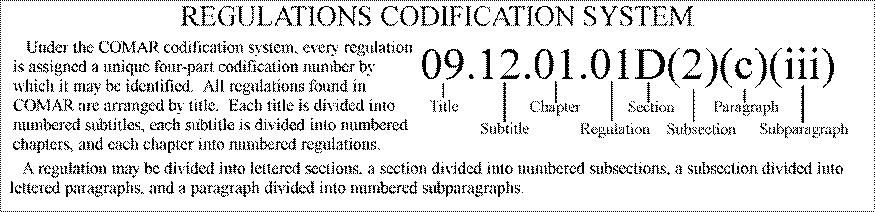
COMAR regulations are cited by title number, subtitle number, chapter
number, and regulation number. Example: COMAR 10.08.01.03 refers to Title 10,
Subtitle 08, Chapter 01, Regulation 03.
DOCUMENTS INCORPORATED
BY REFERENCE
Incorporation by reference is a legal device by which a document is made
part of COMAR simply by referring to it. While the text of an incorporated
document does not appear in COMAR, the provisions of the incorporated document
are as fully enforceable as any other COMAR regulation. Each regulation that
proposes to incorporate a document is identified in the Maryland Register by an
Editor’s Note. The Cumulative Table of COMAR Regulations Adopted, Amended or
Repealed, found online, also identifies each regulation incorporating a
document. Documents incorporated by reference are available for inspection in
various depository libraries located throughout the State and at the Division
of State Documents. These depositories are listed in the first issue of the
Maryland Register published each year. For further information, call
410-974-2486.
HOW TO RESEARCH REGULATIONS
An
Administrative History at the end of every COMAR chapter gives information
about past changes to regulations. To determine if there have been any
subsequent changes, check the ‘‘Cumulative Table of COMAR Regulations Adopted,
Amended, or Repealed’’ which is found online at http://www.dsd.state.md.us/PDF/CumulativeTable.pdf.
This table lists the regulations in numerical order, by their COMAR number,
followed by the citation to the Maryland Register in which the change occurred.
The Maryland Register serves as a temporary supplement to COMAR, and the two
publications must always be used together. A Research Guide for Maryland
Regulations is available. For further information, call 410-260-3876.
SUBSCRIPTION
INFORMATION
For subscription forms for the Maryland Register and COMAR, see the back
pages of the Maryland Register. Single issues of the Maryland Register are $15.00
per issue.
CITIZEN PARTICIPATION IN
THE REGULATION-MAKING PROCESS
Maryland citizens and other interested
persons may participate in the process by which administrative regulations are
adopted, amended, or repealed, and may also initiate the process by which the
validity and applicability of regulations is determined. Listed below are some
of the ways in which citizens may participate (references are to State
Government Article (SG),
Annotated
Code of Maryland):
• By submitting data or views on proposed
regulations either orally or in writing, to the proposing agency (see
‘‘Opportunity for Public Comment’’ at the beginning of all regulations
appearing in the Proposed Action on Regulations section of the Maryland
Register). (See SG, §10-112)
• By petitioning an agency to adopt, amend,
or repeal regulations. The agency must respond to the petition. (See SG
§10-123)
• By petitioning an agency to issue a
declaratory ruling with respect to how any regulation, order, or statute
enforced by the agency applies. (SG, Title 10, Subtitle 3)
• By petitioning the circuit court for a
declaratory judgment
on
the validity of a regulation when it appears that the regulation interferes
with or impairs the legal rights or privileges of the petitioner. (SG, §10-125)
• By inspecting a certified copy of any
document filed with the Division of State Documents for publication in the
Maryland Register. (See SG, §7-213)
Maryland
Register (ISSN 0360-2834).
Postmaster: Send address changes and other mail to: Maryland Register, State
House, Annapolis, Maryland 21401. Tel. 410-260-3876. Published biweekly, with
cumulative indexes published quarterly, by the State of Maryland, Division of
State Documents, State House, Annapolis, Maryland 21401. The subscription rate
for the Maryland Register is $225 per year (first class mail). All
subscriptions post-paid to points in the U.S. periodicals postage paid at
Annapolis, Maryland, and additional mailing offices.
Wes Moore, Governor; Michael W. Lore, Interim Secretary
of State; Gail S. Klakring, Administrator;
Tracey A. Johnstone, Editor, Maryland Register; Tarshia N. Neal, Subscription Manager; Tami Cathell, Help Desk, COMAR and
Maryland Register Online.
Front cover: State House,
Annapolis, MD, built 1772—79.
Illustrations by Carolyn Anderson, Dept. of General Services
Note: All
products purchased are for individual use only. Resale or other compensated
transfer of the information in printed or electronic form is a prohibited
commercial purpose (see State Government Article, §7-206.2, Annotated Code of
Maryland). By purchasing a product, the buyer agrees that the purchase is for
individual use only and will not sell or give the product to another individual
or entity.
Closing Dates for the Maryland
Register
Schedule of Closing Dates and
Issue Dates for the
Maryland Register .............................................................. 1154
COMAR Research Aids
Table
of Pending Proposals ..................................................... 1155
Index of COMAR Titles Affected in
This Issue
COMAR
Title Number and Name Page
07 Department of Human Services ..................................... 1170
08 Department of Natural Resources ................................. 1167
09 Maryland Department of Labor .......................... 1167, 1171
10 Maryland Department of Health ......................... 1167, 1172
11 Department
of Transportation ....................................... 1175
12 Department
of Public Safety and Correctional Services ... 1176
13A State Board of Education ............................................. 1168
14 Independent Agencies ........................................ 1168, 1176
18 Department of Assessments and Taxation .................... 1178
21 State Procurement Regulations .................................... 1168
26 Department of the Environment ................................... 1179
37 Maryland Department of Disabilities.............................. 1169
PERSONS
WITH DISABILITIES
Individuals
with disabilities who desire assistance in using the publications and services
of the Division of State Documents are encouraged to call (410) 974-2486, or
(800) 633-9657, or FAX to (410) 974-2546, or through Maryland Relay.
The Governor
EXECUTIVE
ORDER 01.01.2026.15
State of Maryland Workplace Substance Misuse
Policy . 1158
EXECUTIVE
ORDER 01.01.2026.17
Housing Innovation . 1161
The Judiciary
SUPREME
COURT OF MARYLAND
DISCIPLINARY
PROCEEDINGS . 1166
Final Action on Regulations
08 DEPARTMENT OF NATURAL
RESOURCES
FISHERIES
SERVICE
Striped
Bass . 1168
09 DEPARTMENT OF LABOR
BOARD
OF FORESTERS
General
Regulations . 1168
10 MARYLAND DEPARTMENT OF
HEALTH
FOOD
Food
Service Facilities . 1168
Food
and Drink Processing and Transportation . 1168
BOARD
OF PHARMACY
Licensure
by Reciprocity . 1168
Sterile
Pharmaceutical Compounding . 1169
13A STATE BOARD OF
EDUCATION
LOCAL
SCHOOL ADMINISTRATION
Local
Boards of Education . 1169
Programs
of Pupil Services . 1169
Specialists . 1169
Staff
Requirements . 1169
Provider
and Staff Requirements . 1169
14 INDEPENDENT AGENCIES
COMMISSION
ON CRIMINAL SENTENCING POLICY
Criminal
Offenses and Seriousness Categories . 1169
21 STATE PROCUREMENT
REGULATIONS
CONTRACT
FORMATION AND AWARD
Bid
and Contract Security/Bonds . 1169
CONTRACT
TERMS AND CONDITIONS
Mandatory
Contract Provisions—All Contracts (except as provided under COMAR 21.05.07,
21.07.02, and
21.07.03) 1169
SOCIOECONOMIC
POLICIES
Good
Labor Practices Evaluation Factor 1169
37 MARYLAND DEPARTMENT OF
DISABILITIES
GENERAL
PROVISIONS
Regulations
and Related Procedures . 1170
OFFICE
OF PERSONAL CARE SERVICES
Attendant
Care Program .. 1170
Proposed Action on Regulations
07 DEPARTMENT OF HUMAN
SERVICES
SOCIAL
SERVICES ADMINISTRATION—PRIVATE CHILD PLACEMENT AGENCIES
Private
Adoption . 1170
09 DEPARTMENT OF LABOR
BOARD
OF PROFESSIONAL LANDSCAPE ARCHITECTS
General
Regulations . 1171
Fees . 1171
Continuing
Professional Competency Requirements . 1171
OFFICE
OF CEMETERY OVERSIGHT
Crematories—Definitions . 1172
Crematories—Permit
and Registration Process
and Fees . 1172
Crematories—Inspections,
Complaints, and
Discipline . 1172
Crematories—Crematory
Procedures . 1172
Crematories—Code
of Ethics . 1172
10 MARYLAND DEPARTMENT OF
HEALTH
FREESTANDING
AMBULATORY CARE FACILITIES
Freestanding
Ambulatory Surgical Facilities
. 1172
HOSPITALS
Residential
Service Agencies . 1173
HEALTH
SERVICES COST REVIEW COMMISSION
Uniform
Accounting and Reporting System for Hospitals and Related Institutions 1174
11 DEPARTMENT OF
TRANSPORTATION
MARYLAND
TRANSPORTATION AUTHORITY
Electronic
Toll Collection and Toll Violation
Enforcement 1175
12 DEPARTMENT OF PUBLIC
SAFETY AND CORRECTIONAL SERVICES
PAROLE
COMMISSION
General
Regulations . 1176
14 INDEPENDENT AGENCIES
MARYLAND
TECHNOLOGY DEVELOPMENT CORPORATION
Maryland
Venture Fund . 1176
Investment
Committee . 1176
18 DEPARTMENT OF
ASSESSMENTS AND TAXATION
BUSINESS
ORGANIZATIONS
Acceptance
of Documents . 1178
EXEMPTIONS
Disabled
Veteran, Surviving Spouse, Disabled Active Duty Service Member 1178
26 DEPARTMENT OF THE
ENVIRONMENT
HAZARDOUS
SUBSTANCES RESPONSE PLAN AND VOLUNTARY CLEANUP
Procedures
for Hazardous Substance Response . 1179
Voluntary
Cleanup Program .. 1179
Errata
COMAR 13A.07.15 . 1181
Special Documents
DEPARTMENT
OF THE ENVIRONMENT
WATER AND SCIENCE ADMINISTRATION
Water Quality Certification 26-WQC-0046 . 1182
Informational Public Meeting
Announcement: Maryland’s Draft 2026 Integrated Report of
Surface Water Quality . 1182
General Notices
STATE
COLLECTION AGENCY LICENSING BOARD
Public
Meeting . 1184
MARYLAND
CYBERSECURITY COUNCIL
Public
Meeting . 1184
MARYLAND
HEALTH CARE COMMISSION
Public
Meeting . 1184
MARYLAND
DEPARTMENT OF HEALTH/ STATE COMMUNITY HEALTH WORKER ADVISORY COMMITTEE
Public
Meeting . 1184
MARYLAND
INSURANCE ADMINISTRATION
Public
Hearing . 1184
MARYLAND
STATE LOTTERY AND GAMING CONTROL COMMISSION
Public
Meeting . 1184
BOARD
OF OCCUPATIONAL THERAPY PRACTICE
Public
Meeting . 1185
COMAR
Online
The Code of Maryland Regulations is available
at www.dsd.state.md.us as a free service of the Office of the Secretary of
State, Division of State Documents. The full text of regulations is available
and searchable. Note, however, that the printed COMAR continues to be the only
official and enforceable version of COMAR.
The Maryland Register is
also available at www.dsd.state.md.us.
For additional information,
visit www.dsd.maryland.gov,
Division of State Documents, or call us at (410) 974-2486 or 1 (800) 633-9657.
Availability
of Monthly List of
Maryland Documents
The Maryland Department of Legislative
Services receives copies of all publications issued by State officers and
agencies. The Department prepares and distributes, for a fee, a list of these
publications under the title ‘‘Maryland Documents’’. This list is published
monthly, and contains bibliographic information concerning regular and special
reports, bulletins, serials, periodicals, catalogues, and a variety of other
State publications. ‘‘Maryland Documents’’ also includes local publications.
Anyone wishing to receive
‘‘Maryland Documents’’ should write to: Legislative Sales, Maryland Department
of Legislative Services, 90 State Circle, Annapolis, MD 21401.
CLOSING DATES AND ISSUE DATES THROUGH
December 2027†
|
Issue
Date
|
Emergency
and Proposed
Regulations
5
p.m.*
|
Notices,
etc.
10:30
a.m.
|
Final
Regulations
10:30
a.m.
|
|
2026
|
|
|
|
|
November30***
|
November 9
|
November16
|
November18
|
|
December 11
|
November23
|
November30
|
December 2
|
|
December28***
|
December 7
|
December14
|
December16
|
|
2027
|
|
|
|
|
January 8
|
December21
|
December28
|
December30
|
|
January 22
|
January 4
|
January 11
|
January 13
|
|
February 5**
|
January 15
|
January 25
|
January 27
|
|
February 19
|
February 1
|
February 8
|
February 10
|
|
March 5**
|
February 12
|
February 22
|
February 24
|
|
March 19
|
March 1
|
March 8
|
March 10
|
|
April 2
|
March 15
|
March 22
|
March 24
|
|
April 16
|
March 29
|
April 5
|
April 7
|
|
April 30
|
April 12
|
April 19
|
April 21
|
|
May 14
|
April 26
|
May 3
|
May 5
|
|
May 28
|
May 10
|
May 17
|
May 19
|
|
June 11**
|
May 21
|
May 31
|
June 2
|
|
June 25
|
June 7
|
June 14
|
June 16
|
|
July 9
|
June 21
|
June 28
|
June 30
|
|
July 23**
|
July 2
|
July 12
|
July 14
|
|
August 6
|
July 19
|
July 26
|
July 28
|
|
August 20
|
August 2
|
August 9
|
August 11
|
|
September 3
|
August 16
|
August 23
|
August 25
|
|
September 17**
|
August 30
|
September 3
|
September 8
|
|
October 1
|
September13
|
September20
|
September22
|
|
October 15
|
September27
|
October 4
|
October 6
|
|
October 29**
|
October 8
|
October 18
|
October 20
|
|
November 12
|
October 25
|
November 1
|
November 3
|
|
November29***
|
November 8
|
November15
|
November17
|
|
December 10
|
November22
|
November29
|
December 1
|
|
December27***
|
December 6
|
December13
|
December15
|
† Please note that this table is provided for
planning purposes and that the Division of State Documents (DSD) cannot
guarantee submissions will be published in an agency’s desired issue. Although
DSD strives to publish according to the schedule above, there may be times when
workload pressures prevent adherence to it.
* Also note that proposal deadlines are for
submissions to DSD for publication
in the Maryland Register and do not take into account the 15-day AELR review
period. The due date for documents containing 8 to 18 pages is 48 hours before
the date listed; the due date for documents exceeding 18 pages is 1 week before
the date listed.
NOTE:
ALL DOCUMENTS MUST BE SUBMITTED IN TIMES NEW ROMAN, 9-POINT,
SINGLE-SPACED FORMAT. THE PAGE COUNT REFLECTS THIS FORMATTING.
** Note closing date changes due to holidays.
*** Note issue date changes due to holidays.
The regular closing date for Proposals and
Emergencies is Monday.
Cumulative Table of COMAR Regulations
Adopted, Amended, or Repealed
This table, previously printed in the
Maryland Register lists the regulations, by COMAR title, that have been
adopted, amended, or repealed in the Maryland Register since the regulations
were originally published or last supplemented in the Code of Maryland
Regulations (COMAR). The table is no longer printed here but may be found on
the Division of State Documents website at www.dsd.state.md.us.
Table of Pending Proposals
The table below lists proposed changes to
COMAR regulations. The proposed changes are listed by their COMAR number,
followed by a citation to that issue of the Maryland Register in which the
proposal appeared. Errata and corrections pertaining to proposed regulations
are listed, followed by “(err)” or “(corr),” respectively. Regulations
referencing a document incorporated by reference are followed by “(ibr)”. None
of the proposals listed in this table have been adopted. A list of adopted
proposals appears in the Cumulative Table of COMAR Regulations Adopted,
Amended, or Repealed.
03 COMPTROLLER OF THE TREASURY
03.04.02 .19 • 53:19 Md. R.
946 (9-18-26)
05 DEPARTMENT OF HOUSING AND COMMUNITY DEVELOPMENT
05.22.01 • 53:21 Md. R. 1043 (10-16-26)
05.22.02. .01—.07 •
53:21 Md. R. 1043 (10-16-26)
07 DEPARTMENT OF HUMAN SERVICES
07.03.25.04 •
53:18 Md. R. 881 (9-04-26)
07.05.03.10 •
53:23 Md. R. 1170 (11-13-26)
08 DEPARTMENT OF NATURAL RESOURCES
08.02.01 .11 •
53:20 Md. R. 1001 (10-02-26)
08.02.05.07, .13, .20 • 53:19 Md. R. 947 (9-18-26)
08.02.11.01,.03 • 53:20 Md. R. 1002 (10-02-26)
08.02.13.03, .05 • 53:10 Md. R. 461 (5-15-26)
08.19.01.01—.05 • 53:20 Md. R. 1004 (10-02-26)
08.19.02.01–.06 • 53:20 Md. R. 1004 (10-02-26)
08.19.03.01 • 53:20 Md. R. 1004 (10-02-26) (ibr)
08.02.19.04 • 53:22 Md. R. 1111 (10-30-26)
08.19.04.02, .04—.13, .15,.16 • 53:20 Md. R. 1004 (10-02-26)
08.19.05.02 • 53:20 Md. R. 1004 (10-02-26)
08.19.06.03 • 53:20 Md. R. 1004 (10-02-26)
08.02.19.08 • 53:22 Md. R. 1112 (10-30-26)
09 MARYLAND DEPARTMENT OF LABOR
09.03.10.01, .06 • 53:7 Md. R. 331 (4-3-26)
09.03.14.01, .16, .17 • 53:22 Md.
R. 1113 (10-30-26)
09.08.01.01, .03,
.04, .28 • 53:2 Md. R. 70
(1-23-26)
09.08.06.02 • 53:2 Md. R. 70 (1-23-26)
09.08.07.02 • 53:2 Md. R. 70 (1-23-26)
09.09.03.03, .04 • 53:21 Md. R.
1045 (10-16-26)
09.10.01.45 •
53:20 Md. R. 1015 (10-02-26)
09.10.02.24 •
53:20 Md. R. 1016 (10-02-26)
09.10.03.02 •
53:20 Md. R. 1017 (10-02-26)
09.10.04.04 •
53:20 Md. R. 1018 (10-02-26)
09.10.04.06 •
53:20 Md. R. 1018 (10-02-26)
09.10.04.07 •
53:20 Md. R. 1019 (10-02-26)
09.10.03.01-2,
.01-3 • 52:24 Md. R 1206
(12-01-25)
09.14.06.16 • 53:6 Md. R. 296 (3-20-26)
09.19.02.04 • 53:1 Md. R. 31 (1-09-26)
09.19.02.04 • 53:8 Md. R. 359 (4-17-26)
09.22.02.03, .05 • 52:6 Md. R. 273 (3-21-25)
• 52:16
Md. R. 850 (8-8-25)
09.28.01.05 • 53:23 Md. R. 1171 (11-13-26)
09.28.03.01—.03 • 53:23 Md. R. 1171 (11-13-26)
09.28.04.01, .02, .05 • 53:23 Md. R. 1171 (11-13-26)
09.34.05.01—.02 • 53:23 Md. R. 1172 (11-13-26)
09.34.06.01—.14 • 53:23 Md. R. 1172 (11-13-26)
09.34.07.01—.06 • 53:23 Md. R. 1172 (11-13-26)
09.34.08.01—.12 • 53:23 Md. R. 1172 (11-13-26)
09.34.09.01—.02 • 53:23 Md. R. 1172 (11-13-26)
10 MARYLAND DEPARTMENT OF HEALTH
Subtitles 01—08 (1st volume)
10.01.07.01, .02,
.04—.10 • 52:24 Md.R 1207 (12-01-25) (ibr)
10.05.05.05, .09 • 53:23 Md. R. 1172 (11-13-26)
10.06.01.01, .02, .17 •
53:22 Md. R. 1114 (10-30-26)
10.07.05.10 •
53:23 Md. R. 1173 (11-13-26)
Subtitle 09 (2nd volume)
10.09.02.07 • 53:8 Md. R. 360 (4-17-26) (ibr)
10.09.63.03—.06 •
53:19 Md. R. 949 (9-18-26)
10.09.90.17 • 53:5 Md. R. 248 (3-06-26)
Subtitles 10—22 (3rd volume)
10.10.13.15 •
53:21 Md. R. 1045 (10-16-26)
10.18.02.01—.06, .08,
.09 • 53:22 Md. R. 1114 (10-30-26)
10.18.08.02,.07—.10 • 53:22 Md. R. 1114 (10-30-26)
10.18.11.01—.05 • 53:19 Md. R. 952 (9-18-26) (ibr)
Subtitles 23—36 (4th volume)
10.25.13,.01—.05 • 53:22 Md. R. 1118 (10-30-26)
10.29.23.01.02 •
53:18 Md. R. 890 (9-04-26)
10.29.24.01—.15 •
53:18 Md. R. 890 (9-04-26)
10.29.25.01—.13 •
53:18 Md. R. 890 (9-04-26)
10.29.26.01—.05 •
53:18 Md. R. 890 (9-04-26)
10.29.27.01,.02 •
53:18 Md. R. 890 (9-04-26)
10.31.03 .01—.06 • 53:22 Md. R. 1119 (10-30-26)
10.32.25.01—.06 • 52:13 Md. R. 670 (6-27-25)
10.34.02.03 • 53:10 Md. R. 463 (5-15-26)
10.34.29 .01—04 • 53:22 Md. R. 1121 (10-30-26)
Subtitles 37—52 (5th volume)
10.37.01.02 • 53:23 Md. R. 1174 (11-13-26) (ibr)
10.38.12.01—.05 • 53:11 Md. R. 495 (5-29-26)
10.39.01,.02, .05, .06, .07, .10 • 53:22 Md. R. 1122
(10-30-26)
10.39.02,.09 • 53:22 Md. R. 1122 (10-30-26)
10.41.02.02, .04 • 53:9 Md. R. 420 (5-01-26)
10.41.02.02, .04 • 53:21 Md. R. 1046 (10-16-26)
10.41.03.02, .03, .06 • 53:21 Md. R. 1046 (10-16-26)
10.41.05.02, .04—.08 • 53:21 Md. R. 1046 (10-16-26)
10.41.07.02—.05 • 53:21 Md. R. 1046 (10-16-26)
10.41.08.01-1, .02—.15 • 53:21 Md. R. 1046 (10-16-26)
10.41.11.01, .06, .07, .09, .10 • 53:21 Md. R. 1046
(10-16-26)
10.41.12.03, .04 • 53:21 Md. R. 1046 (10-16-26)
10.42.02.02,06 • 52:14 Md. R 720 (7-11-25)
10.44.01 .05—.08,
.12, .16, .18, .20, .22, .24 • 53:22 Md. R. 1123 (10-30-26)
10.52.12.05 • 53:5 Md. R. 257 (3-06-26)
Subtitles 53—69 (6th volume)
10.61.01 .01—.06 • 53:22 Md. R. 1125 (10-30-26)
10.63.01 .01—.08 • 53:17 Md. R. 713 (8-21-26) (ibr)
10.63.02.01—.06 •
53:17 Md. R. 713 (8-21-26)
10.63.03.01—.21 •
53:17 Md. R. 713 (8-21-26)
10.63.04.01—.09 •
53:17 Md. R. 713 (8-21-26)
10.63.05.01—.07 •
53:17 Md. R. 713 (8-21-26)
10.63.06.01—.21 •
53:17 Md. R. 713 (8-21-26)
10.63.08.02, .03, .05 •
53:17 Md. R. 713 (8-21-26)
10.63.08.01—.06 •
53:17 Md. R. 713 (8-21-26)
10.63.09.01—.06 •
53:17 Md. R. 713 (8-21-26)
10.63.10.01—.06 •
53:17 Md. R. 713 (8-21-26)
10.63.11.01—.11 •
53:17 Md. R. 713 (8-21-26)
10.63.12.01—.06 •
53:17 Md. R. 713 (8-21-26)
10.63.13.01—.06 •
53:17 Md. R. 713 (8-21-26)
10.63.14.01—.06 •
53:17 Md. R. 713 (8-21-26)
10.63.15.01—.09 •
53:17 Md. R. 713 (8-21-26)
10.63.16.01—.06 •
53:17 Md. R. 713 (8-21-26)
10.63.17.01—.06 •
53:17 Md. R. 713 (8-21-26)
10.63.18.01—.06 •
53:17 Md. R. 713 (8-21-26)
10.63.19.01—.06 •
53:17 Md. R. 713 (8-21-26)
10.63.20.01—.07 •
53:17 Md. R. 713 (8-21-26)
10.63.21.01—.07 •
53:17 Md. R. 713 (8-21-26)
10.63.22.01—.06 •
53:17 Md. R. 713 (8-21-26)
10.63.23.01—.07 •
53:17 Md. R. 713 (8-21-26)
10.63.24.01—.06 •
53:17 Md. R. 713 (8-21-26)
10.63.25.01—.06 •
53:17 Md. R. 713 (8-21-26)
10.63.26.01—.07 •
53:17 Md. R. 713 (8-21-26)
10.63.27.01—.08 •
53:17 Md. R. 713 (8-21-26) (ibr)
10.63.28.01—.07 •
53:17 Md. R. 713 (8-21-26)
10.63.29.01—.07 •
53:17 Md. R. 713 (8-21-26)
10.63.30.01—.07 •
53:17 Md. R. 713 (8-21-26)
10.63.31.01—.07 •
53:17 Md. R. 713 (8-21-26)
10.63.32.01—.07 •
53:17 Md. R. 713 (8-21-26)
10.63.33.01—.07 •
53:17 Md. R. 713 (8-21-26)
10.63.34.01—.16 •
53:17 Md. R. 713 (8-21-26)
10.63.35.01—.09 •
53:17 Md. R. 713 (8-21-26)
10.63.36.01—.06 •
53:17 Md. R. 713 (8-21-26)
10.63.37.01—.06 •
53:17 Md. R. 713 (8-21-26)
10.63.38. .01—.05 •
53:17 Md. R. 713 (8-21-26)
10.63.39.01—.10 •
53:17 Md. R. 713 (8-21-26)
10.67.08.02 • 53:5
Md. R. 248 (3-06-26)
11 DEPARTMENT OF TRANSPORTATION
Subtitles 11—23 (MVA)
11.02.03.11, .19 • 53:21 Md. R. 1051 (10-16-26)
11.07.07.02, .06 • 53:23 Md. R. 1175 (11-13-26)
11.11.05.02—.04, .06 • 52:13 Md. R. 682 (6-27-25)
11.11.05.04 •
53:22 Md. R. 1125 (10-30-26)
11.17.13.02 •
53:21 Md. R. 1052 (10-16-26)
12 DEPARTMENT OF PUBLIC
SAFETY AND CORRECTIONAL SERVICES
12.08.01.03 • 53:23 Md. R. 1176 (11-13-26)
12.08.03.01—.06 • 53:8 Md. R. 363 (4-17-26)
13A STATE BOARD OF EDUCATION
13A.02.10.01—.16 • 53:4 Md. R. 202 (2-20-26)
13A.02.11.01—.04 • 53:20 Md. R. 1019 (10-02-26)
13A.05.04.01—.03 • 52:17 Md. R 889 (8-22-25)
• 53:3 Md. R. 126 (2-6-26)
13A.05.15, .01—.09 • 53:22 Md. R. 1126 (10-30-26)
13A.07.06.08 • 53:20 Md. R. 1020 (10-02-26)
13A.07.15.01, .02 • 53:20 Md. R. 1021 (10-02-26)
13A.08.01.05 • 53:4 Md. R. 207 (2-20-26)
13A.08.01.10-1 • 53:3 Md. R. 127 (2-6-26)
13A.11.01.01, .03—.10, .12—.17 • 53:21 Md. R. 1052
(10-16-26) (ibr)
13A.12.01.05 • 53:21 Md. R. 1055 (10-16-26)
13A.12.02.03 • 53:20 Md. R. 1022 (10-02-26)
13A.12.04.09 • 53:20 Md. R. 1022 (10-02-26)
13A.12.05.05, .06, .10 • 53:8 Md. R. 367 (4-17-26)
13A.16.08.03 •
53:18 Md. R. 903 (9-04-26)
13A.16.10.02 •
53:18 Md. R. 903 (9-04-26)
13A.17.08.03 •
53:18 Md. R. 903 (9-04-26)
13A.17.10.02 • 53:18 Md. R. 903 (9-04-26)
14 INDEPENDENT AGENCIES
14.01.04.01—.06 • 53:18 Md. R. 905 (9-04-26)
14.01.01.05 • 53:18 Md. R. 905 (9-04-26)
14.01.06.01—.04 • 53:12 Md. R. 567 (6-12-26)
14.01.07.01 • 53:13 Md. R. 607 (6-26-26)
14.01.07.02 • 53:13 Md. R. 608 (6-26-26)
14.04.06.07 • 53:23 Md. R. 1176 (11-13-26)
14.04.07.03, .04 • 53:23 Md. R. 1176 (11-13-26)
14.23.01.01, .19 • 53:3 Md. R. 128 (2-6-26)
14.26.01.01—.18 • 53:20 Md. R. 1023 (10-02-26)
14.31.10.01—.11 • 53:21 Md. R. 1056 (10-16-26)
14.31.11.01—.11 •
53:21 Md. R. 1056 (10-16-26)
14.39.02.04, .07, .08, .09,
.12, .14, .15, .18, .20, .23, .24, .27 • 53:21 Md. R. 1063
(10-16-26)
14.39.04.01, .06, .07 •
53:21 Md. R. 1063 (10-16-26)
15 MARYLAND DEPARTMENT OF
AGRICULTURE
15.05.01 .02, .04, .07—.09, .12—.14 • 53:21 Md. R.
1066 (10-16-26)
15.06.04.01—.07 • 53:2 Md. R. 81 (1-23-26)
17 DEPARTMENT OF BUDGET AND MANAGEMENT
17.04.03.22 • 53:20
Md. R. 1023 (10-02-26)
18 DEPARTMENT OF
ASSESSMENTS AND TAXATION
18.02.03.05 • 53:6 Md. R. 301 (3-20-26)
18.04.07.02 • 53:23 Md. R. 1178 (11-13-26)
18.06.03.01, .02 • 53:23 Md. R. 1178 (11-13-26)
19A STATE ETHICS COMMISSION
19A.06.01.01,.02 • 53:6 Md. R. 301 (3-20-26)
19A.06.02.01 • 53:6 Md. R. 301 (3-20-26)
19A.06.03.01 • 53:6 Md. R. 301 (3-20-26)
19A.06.04.01—.08 • 53:6 Md. R. 301 (3-20-26)
20 PUBLIC SERVICE COMMISSION
20.50.09 .01, .02, .05, .06,
.09—.14 • 53:19 Md. R. 953 (9-18-26)
21 STATE PROCUREMENT REGULATIONS
21.05.03.03 •
53:19 Md. R. 960 (9-18-26)
21.07.01 .33 • 53:19 Md. R. 960 (9-18-26)
21.11.18.01—.06 • 53:19 Md. R. 960 (9-18-26)
24 DEPARTMENT OF COMMERCE
24.05.01.06, .08, .10 • 53:1 Md. R. 42 (1-09-26)
26 DEPARTMENT OF THE ENVIRONMENT
Subtitles 01—07 (Part 1)
26.04.01.01,
01-1,06-2, 07, 07-1, 19, 20, 20-1, 20-2, 21, 37 • 53:22 Md. R. 1129
(10-30-26)
26.04.14.01—.12 • 53:3 Md. R. 129 (2-6-26)
Subtitles 08—12 (Part 2)
26.08.02 .03-2,
.03-3, .04, .04-2, .08 • 53:21 Md. R. 1072 (10-16-26) (ibr)
26.08.05 .02 •
53:22 Md. R. 1129 (10-30-26)
Subtitles 13—18 (Part 3)
26.13.11.01 • 52:10 Md. R. 478 (5-16-25)
26.14.01.02 • 53:23 Md. R. 1179 (11-13-26)
26.14.03.02 • 53:23 Md. R. 1179 (11-13-26)
26.16.08.05 • 52:26 Md. R. 1352 (12-26-25)
Subtitles 19—30 (Part 4)
26.21.01.01—.04, .07, .08, .10—.14, .18—.25, .27,.29 •
53:13 Md. R. 614 (6-26-26)
26.21.02.03—.06 • 53:13 Md. R. 614 (6-26-26)
26.21.03.05 • 53:13 Md. R. 614 (6-26-26)
26.21.04.03, .06,.09 • 53:13 Md. R. 614 (6-26-26)
27 CRITICAL AREA COMMISSION FOR THE CHESAPEAKE AND ATLANTIC COASTAL
BAYS
27.01.12,.02, .04, .07
• 53:22 Md. R. 1139 (10-30-26)
30 MARYLAND INSTITUTE FOR EMERGENCY MEDICAL SERVICES SYSTEMS
(MIEMSS)
30.01.02 .01 • 53:21 Md. R.
1082 (10-16-26) (ibr)
31 MARYLAND INSURANCE ADMINISTRATION
31.04.16 .02, .04—.07 • 53:19
Md. R. 963 (9-18-26)
31.08.13.04 • 53:19 Md. R. 963 (9-18-26)
31.10.41.02, .05—.07 • 53:21 Md. R. 1082 (10-16-26)
31.10.53.01—.11 • 53:21 Md. R. 1083 (10-16-26)
33 STATE BOARD OF ELECTIONS
33.07.07.01—.03 • 52:25 Md. R. 1280 (12-12-25)
33.22.01.01 • 53:7 Md. R. 334 (4-3-26)
33.22.02.01 • 53:7 Md. R. 334 (4-3-26)
34 DEPARTMENT OF
PLANNING
34.04.07.02, .03, .05 • 52:25 Md. R. 1285 (12-12-25)
36 MARYLAND STATE LOTTERY AND GAMING CONTROL AGENCY
36.03.06.01 • 52:26 Md. R. 1353 (12-26-25)
36.07.01.01,.03 • 53:21 Md. R. 1091 (10-16-26)
36.07.06.08 •
53:21 Md. R. 1091 (10-16-26)
36.10.10.01 •
52:26 Md. R.1353 (12-26-25)
37 MARYLAND
DEPARTMENT OF DISABILITIES
37.03.01 .01—.07 • 53:19 Md. R. 965 (9-18-26)
37.03.02 .01—.04 •
53:19 Md. R. 966 (9-18-26)
The Governor
EXECUTIVE ORDER 01.01.2026.15
(Rescinds Executive Order 01.01.2023.16)
(Rescinds Executive Order 01.01.1991.16)
State of Maryland Workplace Substance Misuse Policy
WHEREAS, The Drug-Free Workplace Act of
1988 requires that any State that receives federal funds must establish a
drug-free workplace, including a policy on the use of substances, employee drug
awareness program, and procedures for employees to report their own
convictions.
WHEREAS, The State of Maryland is committed to making good
faith efforts to ensure a safe, secure, and substance-free workplace for its
employees consistent with the Drug-Free Workplace Act of 1988.
WHEREAS, The State of Maryland is a Recovery Friendly
Workplace that recognizes substance use disorders as a serious public health
concern that affects the lives of many Maryland residents. Prevention of
substance misuse and access to adequate support can lead to a reduction in
absenteeism, injuries on the job, and losses in productivity for Maryland
employers, including the State of Maryland.
WHEREAS, In higher risk occupations, employees with
substance use concerns may require additional support to avoid impaired
decisions that have harmful or dangerous effects on their co-workers or the
public.
WHEREAS, Voters in Maryland approved the legalization of
adult-use cannabis through a constitutional amendment and the General Assembly
enacted legislation to enable this legalization.
WHEREAS, Within the context of the legalization of adult-use
cannabis, the State of Maryland reinforces its commitment to protect the
health, safety, and welfare of its employees and the public, and ensure a
substance-free work environment.
NOW, THEREFORE, I, WES MOORE, GOVERNOR OF THE STATE OF
MARYLAND, BY VIRTUE OF THE AUTHORITY VESTED IN ME BY THE CONSTITUTION AND LAWS
OF MARYLAND, HEREBY RESCIND EXECUTIVE ORDER 01.01.2023.16 AND PROCLAIM THE
FOLLOWING EXECUTIVE ORDER, EFFECTIVE IMMEDIATELY:
A. Scope. This
policy applies to all individuals employed by the Executive Branch of the
Maryland State Government.
B. Definitions.
The following words have the meanings indicated:
1. “Alcohol” means any form of ethanol, or any
beverage or substance containing ethanol.
2. “Alcohol-Related Offense” means a crime that
requires alcohol possession or consumption as an element of the offense.
3. “Cannabis” means the plant Cannabis Sativa L.
and any part of the plant, including all derivatives, extracts, cannabinoids,
isomers, acids, salts, and salts of isomers, whether growing or not, with a
delta-9-tetrahydrocannabinol concentration greater than 0.3% on a dry weight
basis. Cannabis includes cannabis products but does not include hemp or hemp
products as defined by § 14–101 of the Agriculture Article.
4. “Cannabis-Related Offense” means any crime that
involves the use, sale, possession, distribution, dispensation, manufacture, or
transfer of cannabis under Md. Code Ann., Crim. Law §§ 5-101 through 5-1101,
excluding civil use offenses set forth in Crim. Law 5-601(c)(2)(ii).
5. “Controlled Dangerous Substance” means any
substance, excluding cannabis, that is controlled under the Federal Controlled
Substances Act, 21 U.S.C. § 801, et seq., as amended, and/or the Maryland
Controlled Dangerous Substances Act, Md. Code Ann., Crim. Law §§ 5-101 through
5-1101.
6. “Controlled Dangerous Substance Offense” means:
a. A controlled
dangerous substance violation, under Md. Code Ann., Crim. Law §§ 5-101 through
5-1101;
b. An offense of the law of any other jurisdiction
if the prohibited conduct would be a controlled dangerous substance violation
if committed in this State;
c. Driving or attempting to drive while under the
influence of a controlled dangerous substance under Md. Code Ann., Transp. §
21-902; or
d. Operating or attempting to operate a vessel
while impaired by a controlled dangerous substance under Md. Code Ann., Nat.
Res. § 8-738.
7. “Conviction” means:
a. A judgment of
conviction, whether entered upon a finding of guilt or acceptance of a guilty
plea or plea of nolo contendere, and the imposition of sentence; or
b. The staying of the entry of judgment and the
placing of the defendant on probation after a finding of guilty or the
acceptance of a plea of nolo contendere.
8. “Drug” means any controlled dangerous
substance, non-prescription drug, or prescription drug, taken into the body,
which may impair one’s mental faculties and/or change one’s mood and/or
physical performance.
9. “Drug-Related Offenses” means:
a. Crimes listed under
the Maryland Controlled Dangerous Substances Act, Md. Code Ann., Crim. Law §§
5-101 through 5-1101.
b. Driving or attempting to drive while under the
influence of drugs or drugs and alcohol under Md. Code Ann., Transp. § 21-902.
c. Operating or
attempting to operate a vessel while under the influence of drugs or drugs and
alcohol under Md. Code Ann., Nat. Res. § 8-738.
10.“Employee” means:
a. A
merit-protected (classified), at will (unclassified), contractual, key
employee, or other employee or official in the Executive Branch;
b. A volunteer who provides a service to or for a
unit in the Executive Branch; or
c. A member of a
Board or Commission in the Executive Branch.
11. “Impaired”
means reduced cognitive or physical ability that results from use of drugs,
alcohol, cannabis, or controlled dangerous substances.
12. “Intoxicating
Cannabinoid” means a product intended for human consumption or inhalation that
contains more than 0.5 milligrams of tetrahydrocannabinol per serving.
13. “Medical
Cannabis” means all parts of any plant of the genus cannabis, whether growing
or not, including:
a. The seeds of the
plant;
b. The resin extracted from any part of the plant;
and
c. Any compound,
manufacture, salt, derivative, mixture, or preparation of the plant, its seeds,
or resin including tetrahydrocannabinol and all other naturally produced
cannabinoid derivatives, whether produced directly or indirectly by extraction.
d. Medical cannabis does not include:
i. Hemp, as defined in
Md. Code Ann., Agric. § 14-101;
ii. Mature stalks of the
plant or fiber produced from the mature stalks;
iii. Oil or cake made
from the seeds of the plant;
iv. Any other compound,
manufacture, salt, derivative, mixture, or preparation of the mature stalks,
fiber, oil, or cake; or
v. The sterilized seed of the plant that is
incapable of germination.
14. “Non-Prescription
Drug” means any over-the-counter drug that is available without a written
prescription by an authorized medical professional.
15. “Prescription Drug”
means a drug that may be dispensed only on the prescription of a health
practitioner who is authorized by law to prescribe the drug
16. “Safety-Sensitive
Employee” means an employee who operates heavy machinery and includes, but are
not limited to, an operator of a crane, winch, or top loader and a driver of
hustler or forklift.
17. “Sensitive Employee”
means an employee whose classification or position has been designated
sensitive by the Secretary of Budget and Management or the Secretary's
designated representative, or the employee’s appointing authority.
18. “Sensitive
Classification” means a classification in which the Secretary of Budget and
Management or the Secretary's designated representative has determined that any
of the following conditions exists:
a. An employee in the
classification has a substantially significant degree of responsibility for the
safety of others and there is a potential that impaired performance of the
employee could result in death of or injury to the employee or others;
b. An employee in the classification is required
to carry a firearm;
c. An employee in the
classification is directly involved in efforts to interdict the flow of
narcotics; or
d. An employee in the classification is directly
involved with narcotics law enforcement.
19. “Sensitive Position”
means a position for which an appointing authority has determined that any of
the conditions listed in Section B (18) of this executive order exists, but
which is not in a sensitive classification.
20. “Substance” means
alcohol, drugs, or cannabis.
21. “Substance Misuse”
means:
a. The use of an illegal
drug that results in workplace impairment and/or impaired job performance;
b. The intentional misuse of any legal drug that
results in workplace impairment and/or impaired job performance;
c. The intentional use
of any prescription drug in a manner inconsistent with its medically
prescribed, intended use, or under circumstances where its use is not
permitted, that results in workplace impairment and/or impaired job
performance;
d. The use of alcohol where such use results in
workplace impairment and/or impairs job performance; or
e. The use of cannabis
where such use results in workplace impairment and/or impairs job performance.
22. “Workplace” means
any place where an employee is performing work for the State of Maryland.
23. “Work Time” means
time during which an employee:
a. Is on duty, whether
at the employee’s principal work site or at a remote location as part of the
State's telework program;
b. Participates in training activities as a job
assignment;
c. Is on the employer's
premises and is on call and waiting for work;
d. Is not on the employer's premises, but is on
call and waiting for work, and the employee's personal activities are
substantially restricted;
e. Is changing into and
removing program-specified clothing and equipment necessary for the performance
of the job;
f. Participates in
activities that are job-related immediately before the beginning or immediately
after the end of an assigned shift;
g. Travels to and from work after being recalled
to work by the appointing authority or the appointing authority's designated
representative after the employee has completed the standard workday;
h. Travels to and from work after being called to
work by the appointing authority or the appointing authority's designated
representative on the employee's scheduled day off if the employee works fewer
than 8 hours as a result of being called on the employee's scheduled day off;
or
i. Travels between home
and a work site other than the assigned office, in accordance with the Standard
Travel Regulations.
j. Work time includes
any other time defined as work time under the Fair Labor Standards Act, 29
U.S.C. § 201 et seq., if applicable.
C. General Policy.
The State of Maryland establishes the following Substance Misuse Policy for the
Executive Branch of State Government:
1. All employees in the workplace must be capable
of performing their duties. An employee shall not report to work, or spend any
work time, in an unfit condition to perform their duties.
2. Substance misuse by any employee is prohibited
at all times.
3. Employees experiencing substance use problems
are encouraged to seek assistance through:
a. Their employer;
b. Self-referral to the state administered
Employee Assistance Program (“EAP”);
c. Self-referral to the
MyMDCares program or similar state-sponsored assistance program; or
d. Self-referral to an alternative certified
rehabilitation program.
D. Substance Misuse
Policy.
1. An employee shall not
report to work, or spend any work time, under the influence of alcohol,
cannabis, intoxicating cannabinoids or controlled dangerous substances. Any
employee who reports to work, or spends any work time, with their mental or
physical abilities impaired by alcohol, cannabis, or controlled dangerous
substances, is in violation of this policy and shall be subject to disciplinary
action.
2. Employees may not consume alcohol or controlled
dangerous substances or consume, smoke, or otherwise ingest cannabis or
intoxicating cannabinoid or controlled substances on State property, at any
worksite, or during work hours or while on work time. This conduct is also
prohibited for employees on official business, whether on or off State
Property.
3. The unlawful manufacture, distribution,
dispensation, possession, or use of cannabis, intoxicating cannabinoids or
controlled substances is prohibited on State property, at any worksite, or
during work hours or while on work time.
4. Employees are prohibited from consuming and/or
being under the influence of alcohol, cannabis, an intoxicating cannabinoid, or
a controlled dangerous substance while operating State equipment, vehicles, or
other property.
5. Employees are prohibited from committing
offenses related to alcohol, cannabis, intoxicating cannabinoids or controlled
dangerous substances.
6. Employees who plead guilty, accept a plea of
nolo contendere, receive a probation before judgment, or are convicted of an
offense relating to alcohol, cannabis, intoxicating cannabinoids or controlled
dangerous substances are in violation of this policy and must report the
disposition of the case to their supervisor and/or appointing authority no
later than five (5) workdays after the disposition.
7. Medical Cannabis. Employees who are
registered and certified medical cannabis patients may not possess, consume,
smoke, or otherwise ingest cannabis on State property, at any worksite or
during work time.
a. Employees who are
registered and certified medical cannabis patients are responsible for
consulting the certifying provider to ascertain whether the medical cannabis
will interfere with the safe performance of their job duties.
b. If the use of any medical cannabis could
compromise an employee's performance or
the safety of the employee, fellow employees, or the public, it is the
employee's responsibility to notify their supervisor and/or appointing
authority and use appropriate leave to avoid unsafe work practices.
8. Prescription & Over-The-Counter Drugs.
Prescription and over-the-counter drugs must be taken in standard dosage and/or
according to a physician’s prescription.
a. Employees who take
prescribed or over-the-counter medications are responsible for consulting the
prescribing physician and/or pharmacist to ascertain whether the medication
will interfere with the safe performance of their job duties.
b. If the use of any prescription or over-the
counter drug could compromise an employee's performance or the safety of the
employee, fellow employees, or the public, it is the employee's responsibility
to notify their supervisor and/or appointing authority and use appropriate
leave to avoid unsafe work practices.
c. An employee shall not
report to work, or spend any work time, under the inappropriate influence of
prescription or over-the-counter drugs. Any employee who reports to work, or
spends any work time, with their mental or physical abilities inappropriately
impaired by prescription or over-the-counter drugs is in violation of this
policy and shall be subject to disciplinary action.
E. Sanctions for Non-Sensitive and Non-Safety Sensitive Employees.
1. A non-sensitive or
non-safety sensitive employee who violates the Substance Misuse Policy as
described in Section D shall:
a. On the first instance
be referred to the state-administered EAP and subject to any other appropriate
disciplinary actions;
b. On the second instance, at a minimum, be
suspended for at least five (5) days, be referred to the state-administered
EAP, be required to participate successfully in a state-approved treatment
program, and be subject to any other appropriate disciplinary actions, up to
and including termination;
c. On the third
instance, be terminated.
F. Sanctions for
Sensitive and Safety-Sensitive Employees.
1. A sensitive or safety-sensitive employee shall
be suspended for fifteen (15) days and required to successfully participate in
a state- approved substance use treatment program designated by the state-
administered EAP the first time and subject to progressive action upon
subsequent offenses where the employee is:
a. Convicted of an
at-the-workplace offense related to alcohol, cannabis or controlled dangerous
substances; or
b. Found under the influence of alcohol, cannabis
or controlled dangerous substances while at the workplace.
2. A sensitive or safety-sensitive employee
convicted of an out-of-workplace offense related to alcohol, cannabis or
controlled dangerous substances shall:
a. On the first
conviction be referred to the state-administered EAP and subject to any other
appropriate disciplinary actions;
b. On the second conviction, at a minimum, be
suspended for at least five (5) days, be referred the state-administered EAP,
be required to participate successfully in a state approved treatment program,
and be subject to any other appropriate disciplinary actions, up to and
including termination;
c. On the third
conviction, be terminated.
3. A sensitive or safety-sensitive employee who
tests positive for a controlled dangerous substance as a result of a random
drug test shall be suspended for five (5) workdays and be required to
successfully participate in a drug treatment program approved by the state, as
provided for by the appointing authority's drug testing protocol. Employees may
be subject to progressive discipline upon subsequent offenses.
4. A sensitive or safety-sensitive employee who
misuses, at work or on work time, a legally prescribed drug or an
over-the-counter drug shall:
a. On the first instance
be referred to the state-administered EAP and subject to any other appropriate
disciplinary actions;
b. On the second instance, at a minimum, be
suspended for at least five (5) days, be referred to the state-administered
EAP, be required to participate successfully in a treatment program, and be
subject to any other appropriate disciplinary actions, up to and including
termination;
c. On the third
instance, be terminated.
G. Assistance and
Treatment.
1. An employee may request referral to the
state-administered EAP for access to confidential professional assistance for
substance use problems or may self-refer to the MyMDCares program or similar
state-sponsored assistance program to receive confidential professional
assistance.
2. Employees will not face disciplinary action
solely for requesting referral to the state-administered EAP or voluntarily
obtaining other assistance and/or treatment for a substance use problem. The
State of Maryland encourages any employee who needs such assistance and
treatment to seek and obtain it. However, participation in a treatment or
recovery program will neither relieve employees from the requirement of
satisfactory job performance, nor insulate them from termination or adverse
personnel actions for failing to comply with any of the State’s policies and
procedures.
3. Substance misuse-related disciplinary actions,
up to and including termination, may be, but do not have to be, held in
abeyance pending an employee’s completion of an assistance and treatment
program approved by the State. The option of holding a disciplinary action in
abeyance is not an employee entitlement or right but is a privilege to be
granted at the discretion of the appointing authority, in consultation with the
Department of Budget and Management, or the individual responsible for Human
Resources for the respective State agency under appropriate circumstances.
H. Implementation.
1. The Secretary of Budget and Management and the
head of every other personnel system in the Executive Branch shall adopt such
policies and regulations as are necessary or desirable for the implementation
of this Executive Order.
2. All appointing authorities and supervisory
employees are responsible for implementing, enforcing, and monitoring
compliance with the requirements of this Executive Order.
3. All employees are required to acknowledge
receipt of a copy of this Executive Order by returning an acknowledgement of
receipt to their supervisor for insertion in their personnel file.
4. Agencies with employees that are subject to
other regulations or rules related to employee substance misuse and out of
workplace use of drugs or cannabis are exempt from the conflicting requirements
in this policy.
I. Enforcement.
1. If a supervisor or appointing authority
observes any signs of possible substance misuse in any employee during working
hours, this shall constitute reasonable grounds for an investigation.
2. If a non-supervisory employee observes any
signs of possible substance misuse in any employee during working hours and
reports it to a supervisor or appointing authority, this shall constitute
reasonable grounds for an investigation.
3. A supervisor and/or appointing authority, on
observing such signs or receiving a report, in consultation with the Department
of Budget and Management, or the individual responsible for Human Resources for
the respective State agency, should investigate by appropriate measures.
4. If the supervisory investigation supports a
conclusion of substance misuse by the investigated employee(s), the supervisor
and/or appointing authority shall consult the Department of Budget and
Management, the individual responsible for Human Resources for the respective
State agency, or the State Medical Director to determine the appropriate next
steps, which may include testing.
5. When an appointing authority learns or based on
observation or reliable information, suspects that an employee has committed an
alcohol-related offense, cannabis-related offense, controlled dangerous
substance offense, or other drug-related offense, the appointing authority
shall refer the matter to the appropriate law enforcement authority for further
investigation and prosecution.
6. All employees shall cooperate fully with law
enforcement authorities in the investigation and prosecution of suspected
criminal violations.
J. Employee Education. All appointing authorities
shall educate and inform their employees about:
1. The dangers of drug
and alcohol misuse in the workplace;
2. The State of
Maryland's policy of maintaining a drug-free and recovery-friendly workplace;
3. Any drug and alcohol misuse counseling,
rehabilitation, and the state-administered EAP that is available; and
4. The penalties that may be imposed upon
employees for violations of this Executive Order.
K. This policy
does not constitute or create an express or implied contract. It is not
intended to, and does not, create contractual obligations with respect to any
matter it covers.
L. This Executive
Order shall be implemented in a manner that is consistent with all applicable
statutes and regulations. Nothing in this Executive Order shall operate to
contravene any State or federal law or to affect the State's receipt of federal
funding.
M. If a State entity is subject to a federal
law or regulation that conflicts with this Executive Order, the federal law or
regulation shall take precedence.
N. If any
provision of this Executive Order or its application to any person, entity, or
circumstance is held invalid by any court of competent jurisdiction, all other
provisions or applications of the Executive Order shall remain in effect to the
extent possible without the invalid provision or application. To achieve this
purpose, the provisions of this Executive Order are severable.
GIVEN Under My Hand and the Great
Seal of the State of Maryland, in the City of Annapolis, this 4th Day of
September 2026.
WES MOORE,
Governor
ATTEST:
SUSAN C. LEE,
Secretary of State
[26-23-11]
EXECUTIVE ORDER 01.01.2026.17
Housing Innovation
WHEREAS, Maryland faces an acute housing
shortage, with an estimated 184,000 new units needed by the end of 2030 to meet
current demand and projected population growth;
WHEREAS,
The high cost of housing in the state, driven by undersupply, is a significant
constraint on economic growth, making it harder for the state to attract and
retain a skilled workforce and preventing working Maryland families from
finding homes near their jobs and from attaining homeownership;
WHEREAS,
The Moore-Miller Administration and Maryland General Assembly have taken
significant actions to protect housing stability, promote homeownership,
increase supply, streamline permitting and approval processes, and reduce
housing costs;
WHEREAS,
Further impactful State-level initiatives and partnerships are needed to build
upon previous successes and existing programs, maintain momentum, and focus
State resources on the urgent housing affordability crisis;
WHEREAS,
As part of the Moore-Miller Administration’s commitment to increasing
affordability and ensuring all Marylanders are able to obtain safe, stable
housing that fits their needs, State government must develop and implement
innovative solutions to high building costs and other constraints on housing
construction; and
WHEREAS,
In order for Maryland to address its housing crisis and prevent population loss
and economic stagnation, State government must build upon previous actions to
spur housing construction by working to champion pro-housing legislation in the
Maryland General Assembly and other reforms, developing innovative solutions to
the high costs of building housing, accelerating the adoption of new, more
cost-efficient construction techniques, and developing a workforce optimized to
address the State’s urgent need for more housing.
NOW,
THEREFORE, I WES MOORE, GOVERNOR OF THE STATE OF MARYLAND, BY VIRTUE OF THE
AUTHORITY VESTED IN ME BY THE CONSTITUTION AND LAWS OF MARYLAND, HEREBY
PROCLAIM THE FOLLOWING EXECUTIVE ORDER, EFFECTIVE IMMEDIATELY:
A. Maryland Housing
Innovation Incubator.
1. Establishment.
a. There is hereby
established as a unit within the Maryland Department of Housing and Community
Development (“DHCD”), the Maryland Housing Innovation Incubator (“Incubator”).
b. The Incubator shall serve as the State’s
housing construction research, development, and innovation hub and shall
identify, evaluate, test, and advance transformative solutions to address the
underlying causes of Maryland's housing shortage.
c. DHCD shall designate a Director of the Incubator who shall coordinate
and oversee the Incubator’s activities pursuant to this Executive Order.
d. DHCD may designate other State personnel or contractors to administer
and support the Incubator’s activities.
e. Subject to applicable law, the Incubator may:
i. Pursue funding opportunities to support its’ programs and activities;
and
ii. Receive and administer
funding from State appropriations, philanthropic contributions, grants,
partnerships, and other lawful funding sources.
2. Responsibilities. The
Incubator shall:
a. Conduct research and
analysis concerning housing production, affordability, land use, permitting,
infrastructure, supply chains, construction methods, housing finance, workforce
development, and other factors affecting Maryland’s housing supply;
b. In consultation with the Advisory Council
established under Section B of this Executive Order, identify opportunities to
modernize, simplify, and improve State and local regulations, policies, and
administrative processes affecting housing production and affordability;
c. Design, implement, and evaluate pilot projects intended to test
innovative approaches to housing challenges, including:
i. Emerging construction
technologies;
ii. Innovative
construction methods and processes;
iii. Policies or regulatory changes to support
adoption of new technologies and methods; and
iv. Innovative financial products and business models;
d. Ensure pilot programs
are designed to produce measurable outcomes and practical findings and
recommendations for implementation by State and local governments;
e. Develop and implement recommendations for
scaling successful pilot programs and innovative practices throughout the
State;
f. Develop recommendations concerning regulatory reform, process
improvement, administrative modernization, technological innovation, financing
tools, workforce development strategies, and other actions intended to increase
housing supply and improve housing outcomes;
g. Subject to available resources and personnel, provide technical
assistance, guidance, best practices, model policies, and implementation
support to State agencies, local governments, housing providers, and other
stakeholders; and
h. Within six (6) months of the effective date of this Executive Order,
launch an initiative to support the expanded deployment of factory-built and
modular housing, as described in Section C below.
3. Collaboration and
Partnerships.
a. The Incubator shall
collaborate with the Governor’s Innovation Team and may partner with State
agencies, local governments, institutions of higher education, nonprofit
organizations, research institutions, foundations, industry organizations,
private-sector entities, and any other entities or individuals determined to be
appropriate.
b. The Incubator shall provide opportunities for
entrepreneurs, researchers, practitioners, and subject matter experts in the
construction, real estate, design, technology, infrastructure, finance,
planning, and related sectors to collaborate in identifying and advancing
innovative housing solutions.
c. The Incubator may convene or participate in working groups, advisory
panels, stakeholder forums, innovation challenges, demonstration projects, and
other collaborative initiatives to advance its mission.
4. Research and
Programs.
a. The Incubator shall
engage subject matter experts from a broad range of disciplines to explore
innovative solutions to Maryland’s housing supply and affordability challenges.
b. The Incubator may conduct research, feasibility studies,
demonstrations, and pilot programs related to housing policy, development
practices, financing tools, regulatory modernization, construction innovation,
public-sector process improvement, and other housing-related topics.
c. The Incubator shall prioritize the housing topics recommended by the
Advisory Council established under Section B of this Executive Order, for
focused research, policy development, and pilot program implementation.
d. On at least a quarterly basis, the Incubator shall provide the
Advisory Council with a report on its activities, findings, and recommendations
for policy reform based on its research and findings.
5. Reporting. On or
before October 1, 2027, and annually thereafter, DHCD shall submit a report to
the Governor summarizing the Incubator’s progress, including:
a. Research activities;
b. Partnerships and new funding sources established;
c. Pilot programs launched or completed;
d. Measurable outcomes of the pilot programs; and
e. Findings and recommendations.
B. Maryland Housing
Innovation Advisory Council.
1. Establishment.
a. There is hereby
established a Housing Innovation Advisory Council (“Advisory Council”) to:
i. Identify sources of
funding for the Incubator;
ii. Advise and recommend priority topics of study
to the Incubator; and
iii. Based on the Incubator’s findings, recommendations, and other
relevant information, formalize and advance recommendations for legislative,
regulatory, and budgetary actions to address Maryland’s undersupply of housing
and resulting high housing costs.
b. The Advisory Council shall be administered by DHCD in consultation
with the Office of the Governor.
2. Membership.
a. The Advisory Council
shall consist of not fewer than twenty (20) and no more than thirty-two (32)
members, as designated below:
i. The Secretary of
Housing and Community Development, or the Secretary's designee;
ii. The Secretary of the Environment, or the
Secretary's designee;
iii. The Secretary of Labor, or the Secretary’s designee;
iv. The Secretary of Transportation, or the Secretary's designee;
v. The Secretary of Planning, or the Secretary's designee;
vi. The Special Secretary of the Governor’s Office for Children, or the
Secretary’s designee;
vii. The Comptroller, or the Comptroller's designee;
viii. Three (3) members of the Maryland House of Delegates, appointed by
the Speaker of the House;
ix. Three (3) members of the Maryland Senate, appointed by the President
of the Senate; and
x. Additional invitees,
at the discretion of the Secretary of Housing and Community Development, to
include:
1. One (1) representative from the Maryland
Association of Counties;
2. One (1) representative from the Maryland Municipal League;
3. Up to six (6) elected local government officials;
4. Up to four (4) representatives from housing or construction trade
associations;
5. Up to two (2) representatives from labor unions or other
worker-serving organizations;
6. Up to two (2) representatives from housing advocacy organizations;
7. Up to two (2) representatives from affordable housing developers;
8. One (1) representative from a local planning department in the State;
9. One (1) representative from a local health department in the State;
10. One (1) representative from a financial institution in the State;
11. One (1) representative from an institution of higher education in
the State; and
12. Up to two (2) representatives
from community stakeholder organizations.
b. The Secretary of
Housing and Community Development shall designate the Chair of the Advisory
Council.
3. Administration.
a. The Advisory
Council shall meet as often as its duties require, but no less than quarterly,
at the time and place determined by the Chair.
b. The Chair shall
convene and preside over the meetings of the Advisory Council.
c. The Advisory
Council shall hold its first meeting within one hundred twenty (120) calendar
days of the effective date of this Executive Order.
d. The Advisory
Council may form ad hoc subcommittees to promote and advance specific
legislative, regulatory, or budgetary reforms recommended by the Advisory
Council.
e. The Advisory
Council’s ad hoc subcommittees may meet in between the full Advisory Council’s
official meetings.
f. The Advisory
Council shall be staffed by DHCD.
g. Members of the
Advisory Council may not receive any compensation for their services but may be
reimbursed for reasonable expenses incurred by travel for the performance of their
duties, in accordance with the Standard State Travel Regulations, and as
provided in the State budget.
4. Duties. The
Advisory Council shall:
a. On a quarterly
basis, identify and recommend to the Incubator potential sources of funding and
priority topics for study, research, evaluation, and pilot programs;
b. Based on the
findings and recommendations of the Incubator, develop formal recommendations
for legislative, regulatory, and budgetary actions to implement and support the
findings and recommendations of the Incubator;
c. Beginning on July
1, 2027, and biannually thereafter, report to the Governor and the General
Assembly on the activities of the Advisory Council, including:
i. Recommended
priority topics for study, research, evaluation, and pilot programs by the
Incubator;
ii. The findings and
recommendations of the Incubator; and
iii. Any formal
recommendations for legislative, regulatory, or budgetary actions resulting
from the findings and recommendations of the Incubator; and
d. Develop
recommendations that may address regulatory reform, process improvement,
administrative modernization, technological innovation, financing tools,
workforce development strategies, and other actions intended to increase the
supply of housing and improve housing outcomes in Maryland.
C. Governor’s
Initiative to Accelerate Factory-Built Housing Production.
1. Establishment.
a. There is hereby
established the Governor's Initiative to Accelerate Factory-Built Housing
Production (“Initiative”), to address housing affordability in Maryland by
exploring and encouraging the adoption of innovative construction methods,
financing tools, and technical assistance.
b. The Initiative shall be initiated and
implemented by DHCD under the auspices of the Maryland Housing Innovation
Incubator and in consultation with the Office of the Governor.
2. Factory-Built Housing
Summit.
a. Within six (6) months
of the effective date of this Executive Order, DHCD shall provide funding and
technical assistance to support a Factory-Built Housing Summit (“Summit”), to
identify barriers to the production, financing, permitting, approval, shipping,
and deployment of factory-built and modular housing in Maryland and develop
recommendations to increase the use of these housing technologies.
b. DHCD shall invite stakeholders from the
housing, construction, manufacturing, finance, labor, and local government
sectors to participate in the Summit.
c. Within sixty (60) days after the Summit, DHCD shall prepare and
publish an Action Plan that recommends:
i. Administrative,
regulatory, legislative, and programmatic actions to accelerate the production
and adoption of factory-built and modular housing in Maryland: and
ii. Studies and pilot programs that should be
undertaken by the Maryland Housing Innovation Incubator.
3. Technical
Assistance and Support for Local Government.
a. DHCD, in
coordination with the Maryland Department of Planning, shall establish a pilot
technical assistance program to assist local governments seeking to modernize
zoning, permitting, inspection, and development review processes related to
factory-built and modular housing.
b. DHCD and the
Maryland Department of Planning shall identify and disseminate best practices
for local governments to streamline approval processes and remove barriers to
factory-built and modular housing.
c. To the extent
permitted by law and subject to available funding, DHCD shall evaluate the use
of Community Development Block Grant funds and other available grant programs
to support local government initiatives that facilitate the production and
deployment of factory-built and modular housing.
4. Modernization of
Regulatory Standards.
a. DHCD, in coordination
with the Maryland Department of Labor and other relevant State agencies, shall
review existing regulations governing factory-built and modular housing and
develop recommendations for amendments to the Code of Maryland Regulations to
modernize and streamline standards, inspection procedures, certification
requirements, and administrative processes, while maintaining public health,
safety, and quality standards.
b. DHCD shall submit its recommendations
regarding the regulatory framework to the Governor by March 1, 2027.
5. State Framework for
Pre-Approved Plans.
a. DHCD, in
consultation with the Maryland Department of Planning, shall develop a
framework for the review and approval of standardized modular housing plans
that may be utilized throughout Maryland.
b. The framework
shall explore State-level pre-approval of modular housing designs and shall
provide guidance to local jurisdictions regarding the recognition and use of
approved plans.
c. To develop the
framework, DHCD shall consult with local governments, building officials,
modular manufacturers, architects, engineers, and housing providers.
6. Innovative
Financing Strategies.
a. DHCD shall
evaluate and report on barriers, gaps, pain points, and opportunities related
to financing and capital stacks for projects involving factory-built or modular
housing and identify innovative financing tools and programs that may support
the adoption and scaling of factory-built and modular housing in Maryland.
b. The evaluation
should consider financing mechanisms for manufacturers, developers, nonprofit
housing providers, local governments, and homebuyers, as well as opportunities
to leverage public-private partnerships and federal resources.
c. DHCD shall
identify any legislative, regulatory, or administrative actions necessary to
facilitate implementation of viable financing tools and submit its
recommendations to the Governor and General Assembly by March 1, 2027.
7. Reporting. On or
before July 1, 2028, DHCD shall submit to the Governor a report summarizing
activities undertaken pursuant to this Executive Order including progress
toward the objectives of the Initiative, the implementation of the Action Plan,
and any additional recommendations to accelerate the production and adoption of
factory-built and modular housing in Maryland.
D. State Modular
Workforce Partnership.
1. Establishment.
a. DHCD, in
coordination with the Maryland Department of Labor, shall establish a Modular
Workforce Partnership (“Partnership”) to strengthen and expand the workforce
pipeline supporting factory-built and modular housing in Maryland.
b. The Partnership
shall include representatives from State agencies, institutions of higher
education, community colleges, trade associations, labor organizations, modular
manufacturers, housing developers, workforce development organizations, and
other stakeholders as determined appropriate by DHCD and the Department of
Labor.
c. Within DHCD, the
Partnership shall be initiated and implemented under the auspices of the
Housing Innovation Incubator.
2. Responsibilities.
The Partnership shall:
a. Evaluate current
and projected workforce needs associated with factory-built and modular housing
production and deployment in Maryland;
b. Study and make
recommendations regarding workforce training, credentialing, apprenticeship
opportunities, and curriculum development necessary to support the growth of
the modular housing sector;
c. Identify
opportunities to align existing workforce development programs with the needs
of modular manufacturers, contractors, developers, and local governments;
d. Develop strategies
to expand outreach and recruitment for existing training and other workforce
development programs related to housing construction; and
e. Recommend
strategies to recruit and retain workers in occupations supporting
factory-built and modular housing.
3. Modular Workforce
Academy Framework.
a. The Partnership
shall develop a framework for the establishment of a Modular Workforce Academy
to be administered through a participating Maryland institution of higher
education including community colleges.
b. The framework
shall address:
i. Curriculum design
and industry-recognized credentials;
ii. Apprenticeship
and internship opportunities;
iii. Partnerships
with manufacturers, contractors, and housing providers;
iv. Workforce
recruitment strategies; and
v. Opportunities for
dual enrollment, continuing education, and incumbent worker training.
c. The framework
shall identify potential funding sources, implementation strategies, and
opportunities to leverage existing State workforce development resources.
4. Maryland
Corps/Service Year Option Workforce Opportunities.
a. DHCD, in
collaboration with the Maryland Department of Service & Civic Innovation,
and in consultation with the Maryland Department of Labor and other relevant
State agencies, shall identify opportunities to incorporate factory-built and
modular housing workforce development into the Maryland Corps/Service Year
Option Programs.
b. These efforts
shall be coordinated with new and expanded high school-level registered
apprenticeship programs and shall involve collaboration with manufacturers,
educational institutions, nonprofit organizations, workforce development
organizations, housing providers, labor unions, and other worker-serving
organizations to create opportunities for participants to receive hands-on
training and work experience in housing construction, manufacturing,
rehabilitation, and related fields.
5. Modular Solutions
for Vacant Property Redevelopment.
a. DHCD shall work
with the Baltimore Vacants Reinvestment Council and other relevant entities to
evaluate opportunities to incorporate factory-built and modular housing
solutions into existing vacant-property revitalization initiatives.
b. Such efforts may
include incentives, pilot programs, workforce development initiatives, and
demonstration projects supporting:
i. Rehabilitation of
vacant properties;
ii. Infill
development;
iii. Scattered-site
housing development; and
iv. Other
neighborhood revitalization efforts.
c. Special
consideration shall be given to projects that create workforce development
opportunities for Maryland residents and support local hiring.
6. Baltimore Modular
Training Facility and Demonstration Site.
a. DHCD shall
collaborate with Baltimore City, educational institutions, industry partners,
and other stakeholders to develop a plan to establish a modular construction
training facility and demonstration site within Baltimore City.
b. The plan shall
identify potential locations, partnership structures, funding opportunities,
workforce development benefits, and opportunities to coordinate with housing
construction innovation initiatives operating within the State.
c. DHCD shall report
its findings and recommendations to the Governor, the General Assembly, and the
Mayor and City Council of Baltimore.
7. Employer and
Training Program Assistance.
a. DHCD, the Maryland
Department of Labor, and Maryland Department of Planning shall identify
opportunities to provide incentives, technical assistance, and other support to
employers, educational institutions, apprenticeship programs, and workforce
development providers seeking to expand or adapt training programs to support
factory-built and modular housing occupations.
c. Such assistance
may include support related to:
i. Manufacturing and
construction skills;
ii. Digital design
and production technologies;
iii. Supply chain and
logistics management;
iv. Building
inspection and code compliance;
v. Permitting and
development review processes;
vi. Land use planning
and development administration; and
vii. Other
occupations necessary to support the factory-built and modular housing
industry.
8. Reporting. On or
before July 1, 2028, DHCD and the Maryland Department of Labor shall submit a
joint report to the Governor summarizing actions taken pursuant to this
Executive Order including the progress of the Partnership, development of the
Modular Workforce Academy, and recommending any additional measures necessary
to strengthen Maryland's factory-built and modular housing workforce pipeline.
E. General
Provisions.
1. This Executive
Order shall be implemented in a manner that is consistent with all applicable
statutes and regulations. Nothing in this Executive Order shall operate to
contravene any State or federal law or to affect the State's receipt of federal
funding.
2. If any provision
of this Executive Order or its application to any person, entity, or
circumstance is held invalid by any court of competent jurisdiction, all other
provisions or applications of the Executive Order shall remain in effect to the
extent possible without the invalid provision or application. To achieve this
purpose, the provisions of this Executive Order are severable.
GIVEN Under My Hand and the Great Seal of the State of Maryland, in the
City of Baltimore, this 1st Day of October 2026.
WES MOORE,
overnor
ATTEST:
SUSAN C. LEE,
Secretary of State
[26-23-12]The JudiciarySUPREME COURT OF MARYLAND
DISCIPLINARY PROCEEDINGS
* * * * * * * * * *
This is to certify that by an Order
of this Court dated October 22, 2026 ROBERT WILLIAM THOMPSON (CPF#
7811010340) As of October 22,
2026, Robert William Thompson has been placed on disability inactive status by
consent, and his name has been stricken from the register of attorneys in this
Court. Notice of this action is given in accordance with Maryland Rule 19-761(b).
* * * * * * * * * *
[26-23-08]
Final Action on Regulations
Symbol Key
• Roman type
indicates text already existing at the time of the proposed action.
• Italic
type indicates new text added
at the time of proposed action.
• Single underline, italic indicates new text added at the time of final
action.
• Single
underline, roman indicates existing text added at the time of final action.
• [[Double
brackets]] indicate text deleted at the time of final action.
Title 08
DEPARTMENT OF NATURAL RESOURCES
Subtitle 02 FISHERIES SERVICE
08.02.15 Striped Bass
Authority: Natural Resources Article, §4-215, Annotated Code of
Maryland
Notice of Final Action
[26-131-F]
On November 4, 2026, the Secretary of Natural Resources adopted
amendments to Regulation .07 under COMAR 08.02.15 Striped Bass.
This action, which was proposed for adoption in 53:19 Md. R. 948—949 (September
18, 2026), has been adopted as proposed.
Effective Date: November 23, 2026.
JOSH KURTZ
Secretary of Natural Resources
Title 09
DEPARTMENT OF LABOR
Subtitle 29 BOARD OF FORESTERS
09.29.01 General Regulations
Authority: Business Occupations and Professions Article,
§§7-206(a)(1), 7-304(b), and 7-305(b)(1)(i), Annotated Code of Maryland
Notice of Final Action
[26-134-F]
On October 16, 2026, the Maryland Board of Foresters adopted
amendments to Regulation .02 under COMAR 09.29.01 General
Regulations. This action, which was proposed for adoption in 53:18 Md. R.
882—883 (September 4, 2026), has been adopted as proposed.
Effective Date: November 23, 2026.
MICHAEL HUNEKE
Chair, Board of Foresters
Title 10
MARYLAND DEPARTMENT OF HEALTH
Subtitle 15 FOOD
Notice of Final Action
[26-146-F]
On November 4, 2026, the Secretary of Health adopted amendments
to:
(1) Regulations .02, .25, .26, .28, and
.30 under COMAR 10.15.03 Food Service Facilities; and
(2) Regulation .15 under COMAR 10.15.04 Food and Drink
Processing and Transportation.
This action, which was proposed for adoption in 53:19 Md. R.
950—951 (September 18, 2026), has been adopted as proposed.
Effective Date: November 23, 2026.
MEENA SESHAMANI, MD, PHD
Secretary of Health
Subtitle 34 BOARD OF PHARMACY
10.34.15 Licensure by
Reciprocity
Authority: Health Occupations Article, §§12-205 and 12-305,
Annotated Code of Maryland
Notice of Final Action
[26-100-F]
On October 27, 2026, the Secretary of Health adopted amendments to
Regulation .01 under COMAR 10.34.15 Licensure by Reciprocity.
This action, which was proposed for adoption in 53:15 Md. R. 668 (July 24,
2026), has been adopted as proposed.
Effective Date: November 23, 2026.
MEENA SESHAMANI, MD, PHD
Secretary of Health
Subtitle
34 BOARD OF PHARMACY
10.34.19 Sterile
Pharmaceutical Compounding
Authority: Health Occupations Article, §§12-205, 12-403, 12-503,
12-505, 12-6C-01, and 12-6C-03, Annotated Code of Maryland
Notice of Final Action
[25-234-F]
On October 29, 2026, the Secretary of Health adopted amendments to
Regulations .01—.03 and .05—.19 under COMAR 10.34.19 Sterile
Pharmaceutical Compounding. This action, which was proposed for adoption in
52:23 Md. R. 1164—1171 (November 14, 2025), has been adopted as proposed.
Effective Date: July 1, 2027.
MEENA SESHAMANI, MD, PHD
Secretary of Health
Title 13A
STATE BOARD OF EDUCATION
Subtitle 02 LOCAL SCHOOL
ADMINISTRATION
13A.02.01 Local Boards of
Education
Authority: Education Article, §§2-205, 4-101, 4-105, 4-106, 5-101,
5-109, and 7-103, Annotated Code of Maryland
Notice of Final Action
[26-080-F]
On October 29, 2026, the State Board of Education adopted
amendments to Regulation .01 under COMAR 13A.02.01 Local Boards of
Education. This action, which was proposed for adoption in 53:13 Md. R.
605—606 (June 26, 2026), and reproposed for adoption in 53:18 Md. R. 902
(September 4, 2026), has been adopted as reproposed.
Effective Date: November 23, 2026.
CAREY M. WRIGHT, ED.D.
State Superintendent of Schools
Notice of Final Action
[26-121-F]
On October 29, 2026, the State Board of Education adopted:
(1) Amendments to Regulation .01 and new Regulation .16
under COMAR 13A.05.05 Programs of Pupil Services; and
(2) Amendments to Regulation .11 under COMAR 13A.12.04
Specialists.
This action, which was proposed for adoption in 53:18 Md. R.
902—903 (September 4, 2026), has been adopted as proposed.
Effective Date: November 23, 2026.
CAREY M. WRIGHT, ED.D.
State Superintendent of Schools
Notice of Final Action
[26-111-F]
On October 29, 2026, the State Board of Education adopted
amendments to:
(1) Regulations .09, .09-1,
.10, and .10-1 under COMAR 13A.16.06 Staff Requirements; and
(2) Regulations .06 and .06-1 under COMAR
13A.18.06 Provider and Staff Requirements.
This action, which was proposed for adoption in 53:16 Md. R.
691—692 (August 7, 2026), has been adopted as proposed.
Effective Date: November 23, 2026.
CAREY M. WRIGHT, ED.D.
State Superintendent of Schools
Title 14
INDEPENDENT AGENCIES
Subtitle 22 COMMISSION ON CRIMINAL
SENTENCING POLICY
14.22.02 Criminal Offenses and
Seriousness Categories
Authority: Criminal Procedure Article, §6-211, Annotated Code of
Maryland
Notice of Final Action
[26-141-F]
On October 20, 2026, the Maryland State Commission on Criminal
Sentencing Policy adopted amendments to Regulations .01 and .02
under COMAR 14.22.02 Criminal Offenses and Seriousness Categories. This
action, which was proposed for adoption in 53:18 Md. R. 911—920 (September 4,
2026), has been adopted as proposed.
Effective Date: December 1, 2026.
DAVID SOULE
Executive Director
Title 21
STATE PROCUREMENT REGULATIONS
Notice of Final Action
[26-117-F]
On October 21, 2026, the Secretary of the Maryland Department of
General Services adopted:
(1) Amendments to Regulation .10 under COMAR 21.06.07 Bid
and Contract Security/Bonds;
(2) New Regulation .32 under COMAR 21.07.01 Mandatory
Contract Provisions—All Contracts (except as provided under COMAR 21.05.07,
21.07.02, and 21.07.03); and
(3) New Regulations .01—.06 under a new chapter, COMAR
21.11.17 Good Labor Practices Evaluation Factor.
This action, which was proposed for adoption in 53:17 Md. R.
821—824 (August 21, 2026), has been adopted as proposed.
Effective Date: November 23, 2026.
ATIF CHAUDHRY
Secretary of General Services
Title 37
MARYLAND DEPARTMENT OF DISABILITIES
Subtitle 01 GENERAL PROVISIONS
37.01.01 Regulations
and Related Procedures
Authority: Human Services Article, §7-110, Annotated Code of
Maryland
Notice of Final Action
[26-082-F]
On October 22, 2026, the Maryland Department of Disabilities
adopted new Regulations .01—.03 under a new title, Title 37 Maryland
Department of Disabilities, under a new subtitle, Subtitle 01 General
Provisions, under a new chapter, COMAR 37.01.01 Regulations and Related
Procedures. This action, which was proposed for adoption in 53:18 Md. R.
922 (September 4, 2026), has been adopted as proposed.
Effective Date: November 23, 2026.
CAROL BEATTY
Secretary
Subtitle 02 OFFICE OF PERSONAL CARE
SERVICES
37.02.01 Attendant Care
Program
Authority: Human Services Article, §§7-110 and 7-404, Annotated
Code of Maryland
Notice of Final Action
[26-086-F]
On November 2, 2026, the Maryland Department of Disabilities
adopted the repeal of existing Regulations .01—.13 under COMAR
14.11.01 Attendant Care Program and adopted new Regulations .01—.13
under a new title, Title 37 Maryland Department of Disabilities, under a
new subtitle, Subtitle 02 Office of Personal Care Services, under a new
chapter, COMAR 37.02.01 Attendant Care Program. This action, which was
proposed for adoption in 53:18 Md. R. 922—925 (September 4, 2026), has been
adopted as proposed.
Effective Date: November 23, 2026.
CAROL BEATTY
Secretary
Proposed Action on Regulations

Title 07
DEPARTMENT OF
HUMAN SERVICES
Subtitle 05 SOCIAL SERVICES ADMINISTRATION—PRIVATE
CHILD PLACEMENT AGENCIES
07.05.03 Private Adoption
Authority: Family Law Article, §§5-101, 5-301—5-414, 5-3A-01 et
seq., 5-4A-01 et seq., 5-4B-01 et seq., 5-524, and 5-525,
Annotated Code of Maryland (Agency Note; Federal Regulatory Reference: 42
U.S.C. §670 et seq.; 45 CFR 1355)
Notice of Proposed Action
[26-199-P]
The Department of Human Services proposes to amend Regulation .10
under COMAR 07.05.03 Private Adoption.
Statement of Purpose
The purpose of this action is to relieve the burden of face to face
initial inquiries for private adoption agencies. The in-person requirement is
unnecessarily burdensome considering inquiry interviews occur prior to
submitting an application to become an adoptive parent. In virtual and
telephone inquiry interviews, potential applicants can also ask questions in
real time before deciding whether to submit an application. Additionally,
face-to-face interviews are already part of the application and home study
process, and at least one interview must occur in the applicant's home.
Therefore a face-to-face inquiry interview is an unnecessary barrier for
individuals exploring adoption.
Estimate of Economic Impact
The proposed action has no economic impact.
Economic Impact on Small Businesses
The proposed action has minimal or no economic impact on small
businesses.
Impact on Individuals with Disabilities
The proposed action has no impact on individuals with disabilities.
Opportunity for Public Comment
Comments may be sent to Daniel Cohen, Legislative Analyst,
Department of Human Services, 25 S Charles St, Baltimore, MD 21201, or call
(443) 610-5619, or email to [email protected]. Comments will be
accepted through December 14, 2026. A public hearing has not been scheduled.
.10 Application for Adoptive Parent.
A. Inquiry Process. An applicant shall complete an agency inquiry
process before the agency offers an application form for a home study. The
process shall be as follows:
(1) Appropriate agency staff conducts an inquiry interview which:
(a) Shall be:
(i) A virtual, telephonic, or face-to-face interaction[,];
and
(ii) (text unchanged)
(b) (text unchanged)
(2)—(4) (text unchanged)
B.—D. (text unchanged)
STACY RODGERS
Acting Secretary of Human Services
Title 09
DEPARTMENT OF LABOR
Subtitle 28 BOARD OF
[EXAMINERS OF] PROFESSIONAL LANDSCAPE ARCHITECTS
Notice of Proposed Action
[26-193-P]
The Board of Professional Landscape Architects proposes to amend:
(1) Regulation .05 under COMAR 09.28.01 General
Regulations;
(2) Regulations .01—.03 under COMAR 09.28.03 Fees;
and
(3) Regulations .01, .02, and .05 under COMAR
09.28.04 Continuing Professional Competency Requirements.
This action was considered at the August 3, 2026 Board of
Professional Landscape Architects public meeting notice of which was given
under General Provisions Article, §3-302, Annotated Code of Maryland.
Statement of Purpose
The purpose of this action is to update the regulations of the
Board of Professional Landscape Architects to match the statutory amendments
made to the Board's statute during the 2026 legislative session. Specifically,
this action updates the name of the Board throughout the regs to the Board of
Professional Landscape Architects from the Board of Examiners of Landscape
Architects and creates a fee for the newly created emeritus status license for
retired landscape architects.
Estimate of Economic Impact
The proposed action has no economic impact.
Economic Impact on Small Businesses
The proposed action has minimal or no economic impact on small
businesses.
Impact on Individuals with Disabilities
The proposed action has no impact on individuals with disabilities.
Opportunity for Public Comment
Comments may be sent to Dorian Price, Administrative Specialist
Board of Professional Landscape Architects, Department of Labor, 100 S. Charles
St, Tower 1, Baltimore, MD 21202, or call 410-230-6010, or email to
[email protected]. Comments will be accepted through January 18, 2027.
A public hearing has not been scheduled.
Open Meeting
Final action on the proposal will be considered by the Board of
Professional Landscape Architects during a public meeting to be held on January
25, 2027 at 1:30 pm, at 100 S. Charles Street, Tower 1, Baltimore, MD 2120, video conferencing at
https://meet.google.com/omc-qmbg-qfd, or by dialing in from a phone: (US)
+1 413-998-6090 PIN: 587 641 053#
09.28.01 General Regulations
Authority: Business Occupations and
Professions Article, §§9-206(a), 9-207(a), and 9-304(2), Annotated
Code of Maryland
.05 Embossing Seals and Rubber Stamp Facsimiles.
A. For the purpose of sealing and signing all final drawings,
plans, specifications, reports, and other contract documents, referred to in
Business Occupations and Professions Article, §9-501, Annotated Code of
Maryland, each [licensed] professional landscape architect
shall obtain an individual seal to be used on documents prepared by the
licensee or under the licensee’s supervision. The seal shall imprint the name
of the landscape architect and the license number.
B. A rubber stamp facsimile of the seal and the live signature of
the professional landscape architect may be applied to tracings to
produce legible reproduction of the drawings or to prints made from the
tracings. This provision, however, does not in any manner modify the
requirements of Business Occupations and Professions Article, §9-501, Annotated
Code of Maryland, in reference to use of the impression seal and signature.
09.28.03 Fees
Authority: Business Occupations and
Professions Article, §§9-206(a), 9-207(a), 9-304(2), and 9-309.1,
Annotated Code of Maryland
.01 Purpose.
This chapter is intended to carry out the provisions of Business
Regulation Article, §§2-106.1 and 2-106.2, Annotated Code of Maryland, and
Business Occupations and Professions Article, Title 9, Annotated Code of
Maryland. In particular, it is intended to set various fees in order to cover
the actual documented direct and indirect costs of fulfilling the statutory and
regulatory duties of the State Board of Architects, the State Board of
Certified Interior Designers, the State Board of [Examiners of] Professional
Landscape Architects, the State Board for Professional Engineers, and the State
Board for Professional Land Surveyors.
.02 Definitions.
A. (text unchanged)
B. Terms Defined.
(1) “Board” means the State Board of [Examiners of] Professional
Landscape Architects;
(2) (text unchanged)
(3) “License fee” means the fee paid by an applicant or licensee,
as applicable, in connection with the issuance and renewal of a license and the
issuance of a reciprocal or emeritus status license.
(4)—(5) (text unchanged)
.03 Fees and Costs.
A. The Secretary and the design boards have agreed to average their
direct and indirect costs, based on the calculation of costs performed by the
Secretary in consultation with the design boards. Based on these calculations,
the Board sets the following fees:
(1)—(4) (text unchanged)
(5) Emeritus status license fee—$56.
B.—C. (text unchanged)
09.28.04 Continuing
Professional Competency Requirements
Authority: Business Occupations and
Professions Article §9-309, Annotated Code of Maryland
.01 Purpose.
The State legislature has determined that, in order to safeguard
the health, safety, and welfare of the public, [licensed] professional
landscape architects must comply with the continuing professional competency
(CPC) requirements as a prerequisite for the renewal of a license
.02 Definitions.
A. (text unchanged)
B. Terms Defined.
(1) (text unchanged)
(2) “Board” means the State Board of [Examiners of] Professional
Landscape Architects.
(3)—(9) (text unchanged)
.05 Nonqualifying Activities.
Activities that do not meet the criteria set forth in Regulation
.04 of this chapter shall be considered to be nonqualifying activities,
including, but not limited to, the following:
A. Regular employment as a [licensed] professional
landscape architect or teacher or serving as an expert witness;
B.—E. (text unchanged)
CHRISTOPHER SCHEIN
Chair
Subtitle 34 OFFICE OF CEMETERY
OVERSIGHT
Notice of Proposed Action
[26-138-P]
The Office of Cemetery Oversight proposes to repeal:
(1) Existing Regulations .01 and .02 under COMAR
09.34.05 Crematories—Definitions;
(2) Existing Regulations .01—.14 under COMAR 09.34.06
Crematories—Permit and Registration Process and Fees;
(3) Existing Regulations .01—.06 under COMAR 09.34.07
Crematories—Inspections, Complaints, and Discipline;
(4) Existing Regulations .01—.12 under COMAR 09.34.08
Crematories—Crematory Procedures; and
(5) Existing Regulations .01—.02 under COMAR 09.34.09
Crematories—Code of Ethics.
This action was considered at the July 23 Office of Cemetery
Oversight Advisory Council public meeting, notice of which was given under
General Provisions Article, §3-302, Annotated Code of Maryland.
Statement of Purpose
The purpose of this action is to repeal the existing regulations
related to crematory facilities. Regulatory authority was consolidated under
the Board of Morticians and Funeral Directors in CH188/SB413/HB698 (2026). The
Office of Cemetery Oversight no longer regulates crematory facilities.
Estimate of Economic Impact
The proposed action has no economic impact.
Economic Impact on Small Businesses
The proposed action has minimal or no economic impact on small
businesses.
Impact on Individuals with Disabilities
The proposed action has no impact on individuals with
disabilities.
Opportunity for Public Comment
Comments may be sent to Deborah Rappazzo, Executive Director,
Office of Cemetery Oversight, Maryland Department of Labor, 100 S. Charles
Street, Tower I, Baltimore, MD 21201, or call 410-230-6228, or email to
[email protected]. Comments will be accepted through
December 14, 2026. A public hearing has not been scheduled.
Open Meeting
Final action on the
proposal will be considered by the Office of Cemetery Oversight during a public
meeting to be held on December 3, 2026 at 9:30, at 100 S. Charles Street, Tower
1, Baltimore, MD 2120, video conferencing
at meet.google.com/npb-abku-qim, or access the
meeting by dialing in from a phone: (US)+1 978-728-3773 PIN:
895 495 072#.
DEBORAH RAPPAZZO
Executive Director
Title 10
MARYLAND DEPARTMENT OF HEALTH
Subtitle 05 FREESTANDING
AMBULATORY CARE FACILITIES
10.05.05 Freestanding Ambulatory Surgical Facilities
Authority: Health-General Article, §19-3B-01 et seq., Annotated
Code of Maryland
Notice of Proposed Action
[26-202-P]
The Secretary of Health proposes to amend Regulations .05 and
.09 under COMAR 10.05.05 Freestanding Ambulatory Surgical Facilities.
Statement of Purpose
The purpose of this action is to:
(1) Amend the requirements for the reappointment term of a provider
at a freestanding ambulatory surgical facility to align the requirements with
that of the facility’s accreditation organization, if applicable; and
(2) Remove obsolete requirements relating to written transfer
agreements for Medicare participating hospitals.
Estimate of Economic Impact
I. Summary of Economic Impact. This proposal will have a
positive but indeterminable economic impact on freestanding ambulatory surgical
facilities because the requirements for re-appointment are being aligned with
that of the facility’s accrediting organization, eliminating the need for a
facility to re-credential providers more often than is required by their
accrediting body.
II. Types of Economic Impact.
|
Impacted Entity
|
Revenue
(R+/R-)
Expenditure
(E+/E-)
|
Magnitude
|
|
A. On issuing agency:
|
NONE
|
|
|
B. On other State agencies:
|
NONE
|
|
|
C. On local governments:
|
NONE
|
|
|
|
Benefit
(+)
Cost
(-)
|
Magnitude
|
|
D. On regulated industries or
trade groups:
|
|
|
|
Freestanding Ambulatory
Surgical Facilities
|
(+)
|
Indeterminable
|
|
E. On other industries or
trade groups:
|
NONE
|
|
|
F. Direct and indirect
effects on public:
|
NONE
|
|
III. Assumptions. (Identified by Impact Letter and Number
from Section II.)
D. Aligning providers’ reappointment term with the facility’s
accreditation requirements will eliminate the need for a facility to
re-credential providers more often than is required by their accrediting body,
which should lower a facility’s operational costs. Given that different
facilities have different numbers of credentialed providers, it is not possible
at this time to estimate the magnitude of this positive economic impact.
Economic Impact on Small Businesses
The proposed action has minimal or no economic impact on small
businesses.
Impact on Individuals with Disabilities
The proposed action has no impact on individuals with disabilities.
Opportunity for Public Comment
Comments may be sent to Jordan Fisher Blotter, Director, Office of
Regulation and Policy Coordination, Maryland Department of Health, 201 West
Preston Street, Room 534, Baltimore, Maryland 21201, or call 410-767-0938, or
email to [email protected]. Comments will be accepted through December 14,
2026. A public hearing has not been scheduled.
.05 Personnel.
A.—B. (text unchanged)
C. Reappointment.
(1) The administrator shall establish a procedure for the [biennial] term of reappointment of each
physician, dentist, or podiatrist[.] that:
(a) If accredited by an accreditation organization, the term
may not exceed the term established by the standards of the accreditation
organization that accredits the freestanding ambulatory surgical facility; and
(b) If not accredited by an accreditation organization, the
term may not exceed 36 months.
(2) The procedures shall include an evaluation of the
following for all physicians, dentists, or podiatrists:
[(1)] (a)—[(2)] (b) (text unchanged)
D.—E. (text unchanged)
.09 Hospitalization.
A. (text unchanged)
B. Procedures for emergency transfer to a hospital shall include,
at a minimum:
[(1) Having a
written transfer agreement with a local Medicare participating hospital or
requiring all physicians, dentists, or podiatrists performing surgery in the
freestanding ambulatory surgical facility to have admitting privileges at such
a hospital;]
[(2)] (1)—[(4)] (3) (text
unchanged)
MEENA
SESHAMANI, MD, PHD
Secretary of
Health
Subtitle 07 HOSPITALS
10.07.05 Residential Service Agencies
Authority: Health-General Article, Title 19, Subtitle 4A, Annotated
Code of Maryland
Notice of Proposed Action
[26-204-P]
The Secretary of Health proposes to amend Regulation .10
under COMAR 10.07.05 Residential Service Agencies.
Statement of Purpose
The purpose of this action is to establish requirements for
reporting and publication of data for the creation of a registry for home
health care providers in the State.
Estimate of Economic Impact
I. Summary of Economic Impact. This proposed action has a
minimal but otherwise unquantifiable economic impact on residential service
agencies (RSAs) in the State. This regulatory package outlines new reporting
requirements to the Department for the development of a care registry. RSAs
will be responsible for collecting the information at least quarterly and then
reporting the information to the Department. Additionally, the RSAs will be
responsible for managing the exemption process for applicable employees
utilizing a form developed by the Department. While the Department cannot
estimate the exact cost of compliance with these new requirements, the
Department anticipates that any economic impact would be minimal.
II. Types of Economic Impact.
|
Impacted Entity
|
Revenue
(R+/R-)
Expenditure
(E+/E-)
|
Magnitude
|
|
A. On issuing agency:
|
NONE
|
|
|
B. On other State agencies:
|
NONE
|
|
|
C. On local governments:
|
NONE
|
|
|
|
Benefit
(+)
Cost
(-)
|
Magnitude
|
|
D. On regulated industries or
trade groups:
|
|
|
|
Residential Service Agencies
|
(-)
|
Minimal
|
|
E. On other industries or
trade groups:
|
NONE
|
|
|
F. Direct and indirect
effects on public:
|
NONE
|
|
III. Assumptions. (Identified by Impact Letter and Number
from Section II.)
D. This proposal outlines additional reporting requirements for
Residential Service Agencies in the State. The Department anticipates that the
burden associated with compliance with these new requirements will be minimal
but otherwise unquantifiable by the Department.
Economic Impact on Small Businesses
The proposed action has minimal or no economic impact on small
businesses.
Impact on Individuals with Disabilities
The proposed action has an impact on individuals with disabilities
as follows:
Individuals with disabilities who utilize or are looking to utilize
home health care services will be positively impacted by this proposal, which
will establish a publicly available registry for home health care providers,
allowing individuals in need of these services to consult the registry in their
search.
Opportunity for Public Comment
Comments may be sent to Jordan Fisher Blotter, Director, Office of
Regulation and Policy Coordination, Director, Office of Regulation and Policy
Coordination, 201 West Preston Street, Room 534, Baltimore, Maryland 21201, or
call 410-767-0938, or email to [email protected]. Comments will be accepted
through December 14, 2026. A public hearing has not been scheduled.
.10 Employee, Independent
Contractor, and Contractual Employee Requirements.
A.—H. (text unchanged)
I. Information to be Provided to the Department.
(1) Term Defined.
(a) For the purposes of this section, the following term has the
meaning indicated.
(b) “Regulated caregiver” means an individual:
(i) Employed by a residential service agency to provide home
health care or household or family support services for a client; and
(ii) Licensed or certified in the State under Health Occupations
Article, Annotated Code of Maryland.
(2) Public Data.
(a) The Department may provide data regarding regulated
caregivers in the State in accordance with The Maryland Public Information Act,
General Provisions Article, §§4-101—4-601, Annotated Code of Maryland.
(b) Department Website Publication.
(i) The Department shall publish information collected under
§I(3)(a)—(f) of this regulation regarding regulated caregivers in the State on
the Department’s website.
(ii) The Department may publish a caregiver’s personal mailing
address or personal phone number on the Department’s website if the caregiver
voluntarily provided this information in accordance with §I(2)(b)(iv) of this
regulation.
(iii) The Department shall provide an opportunity for
un-regulated caregivers to voluntarily submit the data collected under §I(3) of
this regulation and the un-regulated caregiver’s individual mailing address and
individual phone number for publication on the Department’s website.
(iv) The Department shall provide an opportunity for regulated
caregivers to voluntarily submit the caregiver’s individual mailing address and
individual phone number for publication on the Department’s website.
(c) The Department shall disclose data as required unless exempt
under The Maryland Public Information Act, General Provisions Article,
§§4-101—4-601, Annotated Code of Maryland.
(3) An agency shall provide the following information to the
Department regarding each individual employed by the agency who is licensed or
certified in the State under Health Occupations Article, Annotated Code of
Maryland:
(a) Full name;
(b) Employing agency;
(c) List of completed home care trainings or certifications;
(d) Languages spoken;
(e) Areas served;
(f) Job title;
(g) Mailing address, which may be the regulated caregiver’s
employment or home address; and
(h) Phone number, which may be the regulated caregiver’s
employment or personal phone number.
(4) The information shall be submitted by the agency:
(a) In the manner determined by the Department; and
(b) At least quarterly.
(5) Exemptions.
(a) An agency shall automatically receive from the Department an
exemption from reporting for any regulated caregiver if an exemption is
appropriate for the health, safety, or wellbeing of the regulated caregiver.
(b) An agency shall keep a total of the number of regulated
caregivers the agency has determined to be exempt from §I(3) of this
regulation.
(c) The Department may request from an agency a total of the
number of regulated caregivers the agency has determined to be exempt from
§I(3) of this regulation.
MEENA SESHAMANI, MD,
PhD
Secretary of Health
Subtitle 37 HEALTH SERVICES COST
REVIEW COMMISSION
10.37.01 Uniform Accounting
and Reporting System for Hospitals and Related Institutions
Authority: Health-General
Article, §§19-207, 19-215, and 19-303, Annotated Code of Maryland
Notice of Proposed Action
[26-207-P-I]
The Health Services Cost Review Commission proposes to amend
Regulation .02 under COMAR 10.37.01 Uniform Accounting and Reporting
System for Hospitals and Related Institutions. This action was considered by the Commission
at an open meeting held on September 9, 2026, notice of which was given through
the Commission’s website.
Statement of Purpose
The purpose of this action is to update the Commission’s manual
entitled “Accounting and Budget manual for Fiscal and Operation Management
(October 1, 2024),” which has been incorporated by reference.
Estimate of Economic Impact
The proposed action has no economic impact.
Economic Impact on Small Businesses
The proposed action has minimal or no economic impact on small
businesses.
Impact on Individuals with Disabilities
The proposed action has no impact on individuals with disabilities.
Opportunity for Public Comment
Comments may be sent to Wayne Nelms, Chief, Audit & Integrity,
Health Services Cost Review Commission, 4160 Patterson Avenue, Baltimore,
Maryland 21215, or call 410.764.2605, or email to [email protected].
Comments will be accepted through December 14, 2026. A public hearing has not
been scheduled.
Open Meeting
Final action on the proposal will be considered by Health Services
Cost Review Commission during a public meeting to be held on December 9, 2026
at 1 p.m. at 4160 Patterson Avenue, Baltimore, Maryland 21215.
Editor’s Note on Incorporation by Reference
Pursuant to State Government
Article, §7-207, Annotated Code of Maryland, the Accounting and Budget
Manual for Fiscal and Operating Management (October 1, 2026) has been declared
a document generally available to the public and appropriate for incorporation
by reference. For this reason, it will not be printed in the Maryland Register
or the Code of Maryland Regulations (COMAR). Copies of this document are filed
in special public depositories located throughout the State. A list of these
depositories was published in 53:1 Md. R. 10 (January 9, 2026), and is
available online at www.dsd.maryland.gov. The document may also be inspected at
the office of the Division of State Documents, 16 Francis Street, Annapolis,
Maryland 21401.
.02 Accounting System; Hospitals.
A. The Accounting System.
(1) (text unchanged)
(2) The “Accounting and Reporting Systems for Hospitals”, also
known as the Accounting and Budget Manual for Fiscal and Operating Management [(October
1, 2024)] (October 1, 2026) is incorporated by reference.
(3)—(5) (text unchanged)
B.—D. (text unchanged)
KEVIN SEXTON
Chair
Title 11
DEPARTMENT OF TRANSPORTATION
Subtitle 07 MARYLAND TRANSPORTATION
AUTHORITY
11.07.07 Electronic Toll
Collection and Toll Violation Enforcement
Authority: Courts and Judicial Proceedings Article, §§7-301 and
7-302;
Transportation Article, §§4-205, 4-312, 21-1414, 21-1415, 26-401, and 27-110,
Annotated Code of Maryland
Notice of Proposed Action
[26-176-P]
The Executive Director of the Maryland Transportation Authority
proposes to amend Regulations .02 and .06 under COMAR 11.07.07
Electronic Toll Collection and Toll Violation Enforcement. The proposal was
unanimously approved by the MDTA Board at their open meeting on July 30, 2026.
Statement of Purpose
The purpose of this action is to allow the Maryland Transportation
Authority to toll a Class G vehicle (trailer) but only if the license plate
image of the motor vehicle cannot be captured or the registered owner cannot be
determined from the image, based on CY 2025 transactions, the MDTA estimates
that it loses approximately $11,000,000 annually in uncollected revenue from
commercial vehicles due to its inability to notice the owner of a Class G
vehicle. These amendments align with H.B. 246 of the 2026 session of the
Maryland General Assembly. H.B. 246 was signed into law on May 12, 2026, and
takes effect on January 1, 2027.
Estimate of Economic Impact
I. Summary of Economic Impact. Based on CY 2025
transactions, the MDTA estimates that it loses approximately $11,000,000
annually in uncollected revenue from commercial vehicles due to its inability
to notice the owner of a Class G vehicle.
II. Types of Economic Impact.
|
Impacted Entity
|
Revenue
(R+/R-)
Expenditure
(E+/E-)
|
Magnitude
|
|
A. On issuing agency:
|
|
|
|
MDTA
|
(R+)
|
$11,000,000
annually
|
|
B. On other State agencies:
|
NONE
|
|
|
C. On local governments:
|
NONE
|
|
|
|
Benefit
(+)
Cost
(-)
|
Magnitude
|
|
D. On regulated industries or
trade groups:
|
NONE
|
|
|
E. On other industries or
trade groups:
|
|
|
|
Commercial Vehicles
|
(-)
|
$11,000,000
annually
|
|
F. Direct and indirect
effects on public:
|
NONE
|
|
III. Assumptions. (Identified by Impact Letter and Number
from Section II.)
A. Based on CY 2025 transactions, the MDTA estimates that it loses
approximately $11,000,000 annually
in uncollected revenue from commercial vehicles due to its inability to notice
the owner of a Class G vehicle.
E. MDTA’s inability to collect tolls from a motor vehicle with an
obscured or missing front mounted license plate results in the dismissal of
about 500,000 commercial vehicle toll transactions. The fiscal estimate assumes an average toll
rate of $24.83 and collection rate of 88 percent. The estimate is based on CY
2025 transactions.
Economic Impact on Small Businesses
The proposed action has minimal or no economic impact on small
businesses.
Impact on Individuals with Disabilities
The proposed action has no impact on individuals with disabilities.
Opportunity for Public Comment
Comments may be sent to Bradley Ryon , Manager of Government
Relations , MDTA, 2310 Broening Highway, Baltimore, MD 21224, or call
410-387-5253, or email to [email protected]. Comments will be accepted
through December 14, 2026. A public hearing has not been scheduled.
.02 Definitions.
A. (text unchanged)
B. Terms Defined.
(1)—(3) (text unchanged)
(4) “Class G (trailer) vehicle” has the meaning stated in Transportation Article, §13-927, Annotated
Code of Maryland.
[(4)](5)—[(31)](32) (text
unchanged)
.06 Toll Collection by Recorded Image.
A. The Authority may use the recorded image of a motor vehicle
passing through a Maryland toll collection facility to determine liability for
tolls due. If the license plate image
of the motor vehicle cannot be captured or the registered owner cannot be
determined from the image, the Authority may use the recorded image of the Class
G (trailer) vehicle towed by the motor vehicle to determine
liability for tolls due.
B.—C. (text unchanged)
D. Notice of Toll Due (NOTD)
(1) The Authority shall send the person alleged to be liable that
was involved in a video toll transaction a NOTD containing:
(a)—(h) (text unchanged)
(i) A warning that failure
to pay the video toll, request a transfer of liability in the manner and time
prescribed, or the late payment of the video toll, will result in a Toll
Violation subject to a citation and a civil penalty, in the amount set forth in
Regulation .09 of this chapter, and that continued failure to pay may lead
to refusal or suspension of the motor vehicle or Class G (trailer) vehicle
registration and referral to the CCU;
(j)—(k) (text unchanged)
(2)—(4) (text unchanged)
E.—F. (text unchanged)
BRUCE GARDNER
Executive Director
Title 12
DEPARTMENT OF PUBLIC SAFETY AND CORRECTIONAL SERVICES
Subtitle 08 PAROLE COMMISSION
12.08.01 General Regulations
Authority: Correctional Services Article, §§2-109 and 7-207,
Annotated Code of Maryland
Notice of Proposed Action
[26-206-P]
The Secretary of Public Safety and Correctional Services in
cooperation with the Chairman of the Maryland Parole Commission proposes to repeal
existing Regulation .03 and adopt new Regulation .03 under COMAR
12.08.01 General Regulations.
Statement of Purpose
The purpose of this action is to update the number of commissioners
that make up the Maryland Parole Commission to align with Correctional Services
Article, §7-202, Annotated Code of Maryland, and to revise the formatting of
Regulation .03 to conform to COMAR style requirements.
Estimate of Economic Impact
The proposed action has no economic impact.
Economic Impact on Small Businesses
The proposed action has minimal or no economic impact on small
businesses.
Impact on Individuals with Disabilities
The proposed action has no impact on individuals with disabilities.
Opportunity for Public Comment
Comments may be sent to Ernest Eley, Jr., Maryland Parole
Commission, Maryland Department of Public Safety and Correctional Services,
6776 Reisterstown Road Suite 302, Baltimore, MD 21215, or call 410-585-3225, or
email to [email protected]. Comments will be accepted through December
14, 2026. A public hearing has not been scheduled.
.03 Composition of the
Commission.
A. The Parole Commission
consists of ten commissioners who are appointed by the Secretary of Public
Safety and Correctional Services with the:
(1) Approval of the Governor;
and
(2) Advice and consent of the
Senate.
B. The commissioners shall
each be appointed to serve a 6-year term and may be reappointed by the
Secretary for a second or subsequent term.
C. The Secretary shall appoint a chairperson from the ten commissioners
with the approval of the Governor.
D. The Chairperson shall:
(1) Serve as the executive and administrative head of the Commission;
(2) Coordinate the
assignments and duties of other members of the Commission; and
(3) Direct the duties of the
employees and other personnel.
CAROLYN J. SCRUGGS
Secretary of Public
Safety and Correctional Services
Title 14
INDEPENDENT AGENCIES
Subtitle 04 MARYLAND TECHNOLOGY
DEVELOPMENT CORPORATION
Notice of Proposed Action
[26-195-P]
The Maryland Technology Development Corporation proposes to amend:
(1) Regulation .07 under COMAR 14.04.06 Maryland Venture
Fund; and
(2) Regulations .03, and .04 under COMAR 14.04.07
Investment Committee.
Statement of Purpose
The purpose of this action is to amend COMAR 14.04.07.03 and .04
Investment Committee. Amendments to COMAR 14.04.07 Investment Committee contain
a few clean-up changes and also require TEDCO and the Committee to adopt a
process for considering remedies, including divestment, for investments in a
business that no longer meets the definition of a qualified business.
Amendments to COMAR 14.04.06.07 Maryland Venture Fund are to make the
regulations consistent with the changes in COMAR 14.04.07. Amended regulations are
in compliance with Maryland 2026 Ch. 380 and §§10-408 and 10-470 of the
Annotated Code of Maryland.
Estimate of Economic Impact
I. Summary of Economic Impact. The proposed regulations to
amend COMAR 14.04.07.04 Investment Committee and COMAR 14.04.06.07.B Maryland
Venture Fund enable TEDCO to have a more controlled investment exit, improving
TEDCO’s ability to enhance returns for state money and offsetting negative
financial outcomes.
II. Types of Economic Impact.
|
Impacted Entity
|
Revenue
(R+/R-)
Expenditure
(E+/E-)
|
Magnitude
|
|
A. On issuing agency:
|
|
|
|
TEDCO
|
(E+)
|
Minimal
|
|
B. On other State agencies:
|
NONE
|
|
|
C. On local governments:
|
NONE
|
|
|
|
Benefit
(+)
Cost
(-)
|
Magnitude
|
|
D. On regulated industries or
trade groups:
|
NONE
|
|
|
E. On other industries or
trade groups:
|
NONE
|
|
|
F. Direct and indirect
effects on public:
|
NONE
|
|
III. Assumptions. (Identified by Impact Letter and Number
from Section II.)
A. Administrative costs of implementing regulations.
Economic Impact on Small Businesses
The proposed action has minimal or no economic impact on small
businesses.
Impact on Individuals with Disabilities
The proposed action has no impact on individuals with disabilities.
Opportunity for Public Comment
Comments may be sent to Katie Hardy, Assistant Director Government
Relations, Maryland Technology Development Corporation, 10960 Grantchester Way,
Suite 120, Columbia, MD 21044, or call 4107409422, or email to
[email protected]. Comments will be accepted through December 14, 2026. A
public hearing has not been scheduled.
14.04.06 Maryland Venture Fund
Authority: Economic Development Article, §§10-409 and 10-4A-27,
Annotated Code of Maryland
.07 Procedures and Guidelines for Investment Decisions.
[A. In General. Except as provided in §§B and C of
this regulation,] TEDCO shall select businesses for investment by
Maryland Venture Fund in accordance with the application process set forth in
COMAR 14.04.02.
[B. Enterprise Fund.
For Enterprise Fund investments:
(1) TEDCO may not acquire an
ownership interest in a business that exceeds 25 percent of the business; and
(2) Within 15 years of making
the investment, TEDCO shall divest itself of the investment.]
14.04.07 Investment Committee
Authority: Economic Development Article, §10-408 and §10-470,
Annotated Code of Maryland
.03 Investment Committee Established.
A. (text unchanged)
B. Composition. The Investment Committee shall consist of three or
more [directors] members. Each member of the
Investment Committee shall serve for a term of 1 year and until the [director’s]
member’s successor is duly appointed and qualifies.
C. Procedures for Appointment. The
Board shall elect the members of the Investment Committee by the same
procedures as set forth in the TEDCO Bylaws that the Board uses for the
election of officers. In considering [directors] members
for appointment to the Investment Committee, the Board and any nominating
committee of the Board shall consider appropriate qualifications for serving on
the Investment Committee, including:
(1) (text unchanged)
(2) Potential conflicts that may impair the [director’s] member’s ability to participate in
the matters before the Investment Committee.
D. (text unchanged)
.04 Standards for Review and Approval of Investments.
A. Responsibilities of the
Committee.
(1) Consider and Determine Substantial Economic Impact. Upon
request by [Chief Executive Officer of] TEDCO, the Investment
Committee shall determine whether an investment in a business will have a
substantial economic impact in the State. If the Investment Committee
determines that an investment will have a substantial economic impact in the
State, the Investment Committee shall authorize TEDCO to make the investment.
If the Investment Committee does not determine that the investment will have a
substantial economic impact in the State, the Investment Committee may not
authorize TEDCO to make the investment.
(2) Monitor Investments. In
addition to any other meeting for the purpose of approving an investment under
§A(1) of this regulation, the Investment Committee shall meet at least two
times per year and as needed to review:
(a)—(b) (text unchanged)
(3) Post-Investment [Determinations] Remedies.
[For the first 5 years after making an investment, if] If
TEDCO identifies a business that ceases to be a qualified business, TEDCO shall
notify the Investment Committee. To the extent possible and available, TEDCO
shall deliver to the Investment Committee information sufficient for the
Investment Committee to determine whether the business has had a substantial
economic impact in the State or is reasonably projected to have a substantial
economic impact in the State. If the business is no longer a qualified
business, the Investment Committee shall consider and approve remedies for
TEDCO which may include divestment or any other remedy that is in TEDCO’s best
interest.
(4) 15-Year Investments Remedy. Within 15 years after making an
equity investment, the Investment Committee shall review and approve remedies
for such an investment, which may include divestment or any other remedy that
is in TEDCO’s best interest.
[(4)] (5) Information Considered. [In
considering whether an investment has had or will have a substantial economic
impact in the State, the] The Investment Committee may rely on
information provided by TEDCO and may conduct its own investigation in
considering:
(a) Whether the investment has had or will have substantial
economic impact in the State; and
(b) A remedy under §A(3) and (4) of this regulation.
KATIE HARDY
Assistant Director
Title 18
DEPARTMENT OF ASSESSMENTS AND TAXATION
Subtitle 04 BUSINESS
ORGANIZATIONS
18.04.07 Acceptance of
Documents
Authority: Commercial Law Article, §21-117; Corporations and
Associations Article, §§1-102, 1-203, and 1-406;
Tax-Property Article, §2-201; Annotated Code of Maryland
Notice of Proposed Action
[26-203-P]
The Department of Assessments and Taxation proposes to amend Regulation
.02 under COMAR 18.04.07 Acceptance of Documents.
Statement of Purpose
The purpose of this action is to add a process by which a corrected
document may retain its original filing date if it is resubmitted and accepted
for record within 30 days after the initial notice of rejection.
Estimate of Economic Impact
The proposed action has no economic impact.
Economic Impact on Small Businesses
The proposed action has minimal or no economic impact on small
businesses.
Impact on Individuals with Disabilities
The proposed action has no impact on individuals with disabilities.
Opportunity for Public Comment
Comments may be sent to Maria Mathias, Associate Director,
Department of Assessments and Taxation, 700 E Pratt St, Suite 2100, Baltimore,
MD 21202, or call 410-767-1170, or email to [email protected].
Comments will be accepted through December 14, 2026. A public hearing has not
been scheduled.
.02 Procedure.
A. (text unchanged)
B. Resubmitted Paper Filings. A
corrected document submitted in paper form, or hard copy, shall retain the date
on which the document was first received by the Department as the acceptance
date if the document is resubmitted and accepted for record within 30 days
after the Department mails the initial notice of rejection.
[B.] C. Other Resubmitted Filings. A resubmitted
document may retain the date that the document is first received by the
Department as the acceptance date if, at the program manager’s discretion, the
filer demonstrates good cause for that acceptance date.
[C.] D. Improper Rejection. If the Department
incorrectly rejects a document, then the acceptance date shall be the original
date that the document is received by the Department.
ALEXANDER GREENSPAN
Assistant Attorney
General
Subtitle 06 EXEMPTIONS
18.06.03 Disabled Veteran,
Surviving Spouse, Disabled Active Duty Service Member
Authority: Tax Property Article, §§2-201, 2-202, and 7-208,
Annotated Code of Maryland
Notice of Proposed Action
[26-201-P]
The Department of Assessments and Taxation proposes to amend
Regulation .01 and adopt new Regulation .02 under COMAR
18.06.03 Disabled Veteran, Surviving Spouse, Disabled Active Duty Service
Member.
Statement of Purpose
The purpose of this action is to clarify the definition of primary
residence for the purposes of a married couple where both individuals receive a
100 percent Disability Rating from the VA, and the process by which a second
property may be granted the exemption following a divorce. Also clarifies that
the definition of "curtilage" for the purposes of the Disabled
Veterans' Exemption is in line with that for the Homestead Tax Credit.
Estimate of Economic Impact
The proposed action has no economic impact.
Economic Impact on Small Businesses
The proposed action has minimal or no economic impact on small
businesses.
Impact on Individuals with Disabilities
The proposed action has no impact on individuals with disabilities.
Opportunity for Public Comment
Comments may be sent to Adam Lewis, State Supervisor - Real
Property Division, Department of Assessments and Taxation, 700 E Pratt St,
Suite 2100, or call 410-767-1199, or email to [email protected]. Comments
will be accepted through December 14, 2026. A public hearing has not been
scheduled.
.01 Legal Residence.
A.—C. (text unchanged)
D. Primary Residence After Divorce.
(1) A married
couple is entitled to only one primary residence for taxation purposes.
(2) Because Maryland does not recognize any “legal separation” aside
from divorce, separation alone will not entitle each individual spouse to claim
a primary residence for him or herself outside of the marital home.
(3) Formerly
married individuals may register a primary residence for each individual by
submitting a court order granting the divorce.
.02
Curtilage.
A. Term Defined.
“Curtilage”, as set forth in Tax-Property Article, §7-208, Annotated Code of
Maryland, has the same meaning as “curtilage” as that term is defined in COMAR
18.07.01.01 (B)(6).
(1) Curtilage
includes only the principal residence and structures necessary to support the
principal residence.
(2) Portions of a
dwelling that is rented or occupied by more than 2 families are not included in
the curtilage.
(3) Land assessed
at a preferential rate is not included in the curtilage.
(4) Land used to
support other structures is not included in the curtilage.
B. Only the
amount of the total curtilage value is eligible for the exemption set forth in
Tax-Property Article, §7-208, Annotated Code of Maryland.
VINCENT GUIDA
Assistant Attorney
General
Title 26
DEPARTMENT OF THE ENVIRONMENT
Subtitle 14 HAZARDOUS SUBSTANCES RESPONSE PLAN AND
VOLUNTARY CLEANUP
Notice of Proposed Action
[26-200-P]
The Secretary of the Environment proposes to amend:
(1) Regulation .02 under COMAR 26.14.01 Procedures for
Hazardous Substance Response; and
(2) Regulation .02 under COMAR 26.14.03 Voluntary Cleanup
Program.
Statement of Purpose
The purpose of this action is to revise COMAR 26.14 so that State
regulations for the Voluntary Cleanup Program include those per- and
polyfluoroalkyl substances (PFAS) that were added to the definition hazardous
substances in the federal regulations as of July 8, 2024, in 40 CFR §302.4.
This action revises the regulations in COMAR 26.14 is to ensure that, for the
purposes of MDE’s Voluntary Cleanup Program, “contamination” includes releases,
discharges, or threatened releases of materials identified as hazardous
substances under CERCLA (the Comprehensive Environmental Response,
Compensation, and Liability Act).
The revisions to COMAR 26.14 are intended to ensure that releases
of CERCLA hazardous substances are subject to cleanup provisions without making
them controlled hazardous substances under the State’s hazardous waste
regulations (COMAR 26.13.01 – 26.13.10) since PFAS have not been designated as
federal RCRA (Resource Conservation and Recovery Act) hazardous wastes.
Estimate of Economic Impact
I. Summary of Economic Impact. The primary economic impact
of the regulatory amendments is expected to be incurred by development entities
enrolled in the Maryland Department of the Environment's (MDE’s) Voluntary
Cleanup Program (VCP). These entities
will be required to sample certain per- and polyfluoroalkyl substances (PFAS)
when there is a potential recognized environmental condition for which PFAS
could have been release. There may also
be remediation requirements when presence of certain PFAS have human or
ecological receptors at levels potentially impacting human health and the
environment.
II. Types of Economic Impact.
|
Impacted Entity
|
Revenue
(R+/R-)
Expenditure
(E+/E-)
|
Magnitude
|
|
A. On issuing agency:
|
|
|
|
Department of the Environment
|
(E+)
|
Site
dependent
|
|
B. On other State agencies:
|
|
|
|
(Various)
|
(E-)
|
Not
reliably quantifiable
|
|
C. On local governments:
|
|
|
|
(Various)
|
(E-)
|
Not
reliably quantifiable
|
|
|
Benefit
(+)
Cost
(-)
|
Magnitude
|
|
D. On regulated industries or
trade groups:
|
|
|
|
Industrial or commercial
facilities with suspected releases of PFAS
|
(-)
|
Not reliably quantifiable
|
|
E. On other industries or
trade groups:
|
NONE
|
|
|
F. Direct and indirect
effects on public:
|
|
|
|
Private well owners;
subsistence fishers, general public.
|
(+)
|
Not reliably quantifiable
|
III. Assumptions. (Identified by Impact Letter and Number
from Section II.)
A. Costs on issuing agency will be implementation costs (risk
assessment reviews).
The proposed action is not anticipated to require the hiring of any
new staff. Implementation is expected to
be able to be accomplished using existing resources.
B. State agencies enrolled in the VCP are relatively few.
Economic impact not reliably quantifiable because Agency
expenditures for PFAS sampling are dependent on the number of potential
locations and number and type of remediation activities necessary for potential
identified receptors.
C. Local governments enrolled in the VCP are relatively few.
Economic impact not reliably quantifiable because Agency
expenditures for PFAS sampling are dependent on the number of potential
locations and number and type of remediation activities necessary for potential
identified receptors.
D. Economic impact not reliably quantifiable because an entity's
expenditures for PFAS sampling are dependent on the number of potential
locations and number and type of remediation activities necessary for potential
identified receptors.
In the preamble of the Federal Register notice for the proposal of
the federal regulations on designation of perfluorooctanoic acid (PFOA) and
perfluorooctanesulfonic acid (PFOS) as CERCLA hazardous substances, the EPA
reached this decision after evaluating the available scientific and technical
information about PFOA and PFOS and determining that they may present a
substantial danger to the public health or welfare or the environment when
released. Based on recent studies, EPA estimated a total United States disease
burden of $62.6 billion related to PFOA and PFOS in the U.S. in 2018.
While manufacturers of PFAS are not operating in the state of
Maryland, there are users of materials containing PFAS across the State,
including release of Aqueous Film Forming Foam (AFFF), biosolid land
application, industrial discharge and stack emissions, landfills, and more. It
is difficult to estimate the potential dollar amount of state disease burden in
the State. However, some
industries/government entities have begun remediation activities to address
PFAS contamination of groundwater, while others are in the characterization
stages.
Expenditures for PFAS sampling and remediation will decrease as
more labs provide sample analysis and new, advanced, and emerging remediation
technologies are tested.
F. The public will continue to benefit from the identification,
treatment, and remediation of PFAS in the environment occurs, and will benefit
from a reduction of PFAS in commercial and domestic products through bans and
limits, but the magnitude of the benefit is not reliably quantifiable.
Economic Impact on Small Businesses
The proposed action has minimal or no economic impact on small
businesses.
Impact on Individuals with Disabilities
The proposed action has no impact on individuals with disabilities.
Opportunity for Public Comment
Comments may be sent to Barbara Krupiarz, Program Administrator,
Maryland Department of the Environment, Land Restoration Program, 1800
Washington Blvd., STE 625, Baltimore, MD 21230-1719, or call 410 537-3459, or
email to [email protected]. Comments will be accepted through
December 14, 2026. A public hearing has not been scheduled.
26.14.01 Procedures for Hazardous Substance
Response
Authority: Environment Article, §§4-405(a)(7), 7-208(e)(10), and 7-208(f),
Annotated Code of Maryland
.02 Definitions.
A. In this [chapter] subtitle, the
following terms have the meanings indicated.
B. Terms Defined.
(1)—(4) (text unchanged)
(5) “Hazardous substance” means any substance:
(a) (text unchanged)
(b) Identified as a controlled hazardous substance [by
the Department in the Code of Maryland Regulations] in COMAR
26.14.03.02B.
(6)—(15) (text unchanged)
26.14.03 Voluntary Cleanup
Program
Authority: Environment Article, Title 2, Subtitle 2, and Title
7, Subtitle 5, Annotated Code of Maryland
.02 Definitions.
A. (text unchanged)
B. Terms Defined.
(1)—(4) (text unchanged)
(5) “Contamination” means a release, discharge, or threatened
release of:
(a) A controlled hazardous substance[, as defined in
Environment Article, §7–201(b), Annotated Code of Maryland]; or
(b) (text unchanged)
[(6) “Department” means the Maryland Department of the
Environment. ]
(6) Controlled Hazardous Substance.
(a) “Controlled hazardous substance” has the meaning stated in
Environment Article, §7-201(b), Annotated Code of Maryland.
(b) “Controlled hazardous substance” includes:
(i) A substance designated as a hazardous substance in 40 CFR
§302.4, which is incorporated by reference in §C of this regulation; and
(ii) A hazardous waste as defined in COMAR 26.13.02, except as
provided in COMAR 26.13.02.06.
(7)—(8) (text unchanged)
[(9) “Federal act” means the Comprehensive
Environmental Response, Compensation, and Liability Act of 1980, as amended by
the Superfund Amendments and Reauthorization Act of 1986.
(10) “Hazardous substance” means a substance:
(a) Defined as a hazardous substance under §101(14) of the
federal act; or
(b) Identified as a controlled hazardous substance by the
Department in COMAR. ]
[(11)] (9)—[(13)] (11)
(text unchanged)
[(14) “Person” means an individual, trust, firm, joint
stock company, federal agency, corporation, including a government corporation,
partnership, association, State, municipality, commission, political
subdivision of a State, or interstate body. ]
[(15)] (12)—[(17)](14) (text
unchanged)
C. Incorporation by Reference. When used in §B of this
regulation, the federal regulations as of July 8, 2024, in 40 CFR §302.4 are
incorporated by reference.
SERENA MCILWAIN
Secretary of the Environment
Errata
COMAR 13A.07.15
At 53:20 Md. R. 1021 (October 2, 2026), column 1, line 16
from the bottom:
For: The proposed action has no economic impact.
Read:
I. Summary of Economic Impact. MSDE estimates that
the amendments, requiring local education agencies to complete an audit of
hiring practices to ensure alignment with Maryland statute and regulations,
will cost between $35,000 to $75,000 per district if an outside consultant is
used. If the LEA uses internal staff, the cost may be less.
II. Types of Economic Impact.
|
Impacted Entity
|
Revenue (R+/R-)
Expenditure (E+/E-)
|
Magnitude
|
|
A. On issuing agency:
|
NONE
|
|
|
B. On other State agencies:
|
NONE
|
|
|
|
|
|
|
C. On local governments:
|
|
|
|
(1) Local Education Agencies
|
(E-)
|
$35,000 to $75,000
|
|
|
Benefit (+)
Cost (-)
|
Magnitude
|
|
D. On regulated industries or trade groups:
|
NONE
|
|
|
|
|
|
|
E. On other industries or trade groups:
|
NONE
|
|
|
|
|
|
|
F. Direct and indirect effects on public:
|
NONE
|
|
|
|
|
|
III. Assumptions. (Identified by Impact Letter and
Number from Section II.)
C(1). MSDE estimates that the amendments, requiring local
education agencies to complete an audit of hiring practices to ensure alignment
with Maryland statute and regulations, will cost between $35,000 to $75,000 per
district if an outside consultant is used. If the LEA uses internal staff, the
cost may be less.
[26-23-13]
Special Documents
DEPARTMENT OF THE ENVIRONMENT
WATER AND SCIENCE ADMINISTRATION
Water Quality Certification
26-WQC-0046
Baltimore City
City Hall, 100 North
Holiday Street, Room 250
Baltimore, MD 21202
Attn: Adam Boarman,
Chief of Capitol Development
Westport Capital
Development
15 West Aylesbury
Road, Suite 500
Timonium, MD 21093
Attn: DJ Widlake
Add’l.
Info: Pursuant
to COMAR 26.08.02.10F(3)(c), The Maryland Department of the Environment is
providing notice of its issuance of a Water Quality Certification 26-WQC-0046
Location: Smith Cove of the Middle Branch
of Patapsco River; 2913 Waterview Avenue, Baltimore City
The purpose of this proposed work is to
improve water quality, enhance shoreline resiliency, increase habitat
diversity, and improve public access.
Description of Authorized Work:
Construct the Smith Cove Project
(SCP) by constructing the following:
NONTIDAL IMPACTS:
I. Temporarily impact 83,891 square
feet of emergent nontidal wetlands, 19,302 square feet of the nontidal wetland
impacts are associated with creation of the stormwater management pond and
64,589 square feet of existing nontidal wetlands will be enhanced by removing
invasive Phragmites and planting native plants), 12,821 square feet of the
25-foot nontidal wetland buffer, and 1,217 square feet (69 linear feet) of
perennial stream. An additional 90,000 square feet of nontidal wetlands will be
created within the stormwater management pond using wetland benches.
TIDAL IMPACTS:
II. Stormwater Management (SWM)
Facility:
a. Construct a perimeter stone berm and
sheet pile wall that includes approximately 280 linear feet of stone berm
(21,366 square feet) and 815 linear feet of sheet pile extending a maximum of
220 feet channelward of the mean high water line; and construct the following
features landward of the perimeter berm and sheet pile wall:
i. Fill and grade with 7,960 CY of fill
and plant with 119,654 square feet of marsh vegetation, including 29,915 square
feet of high marsh vegetation and 89,739 square feet of low marsh vegetation;
ii. Construct 2.20 acres of deep pool
(wet basin retention pond);
iii. Construct 938 square feet of stone
riffle;
iv. Construct approximately 620 linear
feet of 12-foot wide maintenance access road (3,407 square feet);
v. The SWM facility also includes
forebays located in the inlets, a weir spillway, approximately 60 linear feet
of storm drain pipe with associated stone protection, and a polypropylene
liner.
b. Construct the following features all
within 30 feet channelward of the sheet pile wall:
i. Habitat tiles attached to the sheet
pile wall;
ii. 120 2-foot by 2-foot reef balls;
iii. 18 root wads.
III. Living Shoreline:
a. Construct approximately 1,500 linear
feet of segmented stone sand containment sills, and fill and grade with up to
1,658 cubic yards of clean sand to establish 38,884 square feet of marsh
vegetation, including 24,343 square feet of high marsh vegetation and 14,541
square feet of low marsh vegetation; extending a maximum of 36 feet channelward
of the existing mean high water line.
b. Emplacement of woody debris features
as depicted on the plans.
IV. Boardwalk:
a. Construct approximately 670 linear
feet of 15.25-foot wide boardwalk.
The WQC and its
attachments may be viewed at the following link:
https://mde.maryland.gov/programs/Water/WetlandsandWaterways/Pages/WQC.aspx
Appeal of Final
Decision: This Water Quality
Certification is a final agency decision. Any person aggrieved by the
Department’s decision to issue this WQC may appeal such decision in accordance
with COMAR 26.08.02.10F(4). A request for appeal shall be filed with the
Department within 30 days of publication of the final decision and specify in
writing the reason why the final decision should be reconsidered. A request for
appeal shall be submitted to: Secretary of the Environment, Maryland Department
of the Environment, 1800 Washington Boulevard, Baltimore, MD 21230. Any request
for an appeal does not stay the effectiveness of this WQC.
Contact: Matt Wallach at [email protected] or 410-207-0893
[26-23-10]
Informational Public Meeting
Announcement:
Maryland’s Draft 2026 Integrated Report
of Surface Water Quality
Under the federal Clean Water Act, states must evaluate their water
quality every two years and publish a list of waters that fail to meet the
water quality standards set for them. This list of impaired waters is included
in the State’s biennial Integrated Report (IR) of Surface Water Quality.
Waterbodies listed under Category 5 of the IR are classified as impaired and
may require the development of Total Maximum Daily Loads (TMDLs) to guide
restoration. The Maryland Department of the Environment (MDE) is announcing the
availability of the Draft 2026 IR for public review and comment.
The public review and comment period for the
2026 IR will run from November 16, 2026- December 18, 2026. The Draft IR is posted on MDE’s
website at https://mde.maryland.gov/programs/water/TMDL/Integrated303dReports/Pages/2026IR.aspx. Hard copies of
the Draft IR may be requested by calling Becky Monahan at (410) 537-3947. Please note that the Department charges a
fee to cover printing and shipping costs. Public comments or questions on
the IR may be directed in writing to Becky Monahan, MDE, Water and Science
Administration, 1800 Washington Blvd., Baltimore, Maryland 21230, or emailed to
[email protected], on or before December
18th.
The Department is hosting a virtual informational public meeting for
the IR at 6 pm on Tuesday, December 8, 2026. Please register for the
virtual meeting at https://forms.gle/pvdDh1Sak97oYsqm7. Any hearing-impaired person may request a
closed caption option for the meeting in advance. An in-person meeting may also be requested in
advance, if necessary. The virtual meeting
will be recorded, and a copy will be posted on the IR webpage. After addressing all comments received during
the public review period, a final IR will be prepared and submitted to the U.S.
Environmental Protection Agency for approval. Please contact Becky Monahan at [email protected] or (410) 537-3947
with any meeting requests or questions.
Draft 2026 IR Public Meeting Announcement
Date: December 8th, 2026.
Start Time: 6:00 p.m.
Event Address: Virtual- Google Meets
Virtual Registration: https://forms.gle/pvdDh1Sak97oYsqm7
Contact: Becky Monahan at (410)537-3947 or [email protected]
[26-23-09]
General Notices
Notice
of ADA Compliance
The State of Maryland is committed to
ensuring that individuals with disabilities are able to fully participate in
public meetings. Anyone planning to
attend a meeting announced below who wishes to receive auxiliary aids,
services, or accommodations is invited to contact the agency representative at
least 48 hours in advance, at the telephone number listed in the notice or
through Maryland Relay.
STATE COLLECTION AGENCY LICENSING BOARD
Subject: Public Meeting
Date and Time: December 8, 2026,
2—3 p.m. Thereafter, the public meetings will take place the second Tuesday of
every month, accessed via the Google Meet information below.
Place: Google Meet joining info:
Video call link: https://meet.google.com/xvf-xcuh-dou
Or dial: (US) +1 716-332-3758 PIN: 696 128 539#
More phone numbers:
https://tel.meet/xvf-xcuh-dou?pin=6064082328141
Add'l. Info: If necessary, the Board will convene in a closed session to seek the
advice of counsel or review confidential materials, pursuant to General
Provisions Article, Maryland Annotated Code §3-305.
Contact: Ayanna Daugherty
410-230-6019
[26-23-03]
MARYLAND CYBERSECURITY COUNCIL
Subject: Public Meeting
Date and Time: November 18, 2026,
10—11 a.m. This is a meeting of the Subcommittee on Individual Digital Rights,
Trustworthy AI, and Cyber Crime
Place: Virtual. Please contact:
[email protected],
Add'l. Info: Note: all meetings of the Council are announced on its website at
https://www.umgc.edu/administration/leadership-and-governance/boards-and-committees/maryland-cybersecurity-council
Contact: Greg von Lehmen .
[26-23-06]
MARYLAND HEALTH CARE COMMISSION
Subject: Public Meeting
Date and Time: November 19, 2026,
1— 4 p.m.
Place: 4160 Patterson Avenue, Room 100, Baltimore, MD
Add'l. Info: Meeting will be hybrid.
To attend via Zoom, please register on the Commission webpage:
www.mhcc.maryland.gov
Contact: Valerie Wooding
410-764-3570
[26-23-01]
MARYLAND DEPARTMENT OF HEALTH/ STATE COMMUNITY HEALTH
WORKER ADVISORY COMMITTEE
Subject: Public Meeting
Date and Time: December 16, 2026,
1 p.m. — 3 p.m.
Place: This is a virtual meeting held via Google Hangout. The
meeting hangout link and call in line are available on the Maryland CHW State
Advisory Committee webpage at:
https://health.maryland.gov/pophealth/Community-Health-Workers/Pages/Advisory-Committee.aspx,
Add'l. Info: The Maryland CHW State Advisory Committee meets quarterly. Members of the
public are welcome to attend, but are requested to pre-register with this link.
Link:
https://docs.google.com/forms/d/e/1FAIpQLSenbz-qRQYU_TQoF6LQJiP4-q0a1EvWPKz4R4RS2GG5KvxT4g/viewform?gxids=7757
Contact: Latiqua Holley
(443) 835-9292
[26-23-05]
MARYLAND INSURANCE ADMINISTRATION
Subject: Public Hearing
Date and Time: December 17, 2026,
1—4 p.m.
Add'l. Info: The Maryland Insurance Administration will conduct a public hearing on
specific rate increase requests being made by certain Long-Term Care Insurance
carriers operating in Maryland. The hearing will focus on a rate increase
requests before the Maryland Insurance Administration. In the individual
long-term care market, this includes requests from Bankers Life and Casualty
Company, Genworth Life Insurance Company, State Farm Mutual Automobile
Insurance Company, and Transamerica Life Insurance Company. In the group
long-term care market, this includes requests from Continental Casualty
Company, Genworth Life Insurance Company and Transamerica Life Insurance
Company. The purpose of the hearing is for insurance company officials to
explain the reasons for the rate increase, and for the MIA to consider whether
the proposed rate increase is in compliance with Maryland’s laws and
regulations relating to long-term care insurance. Interested stakeholders will
also have the opportunity to provide comments at the hearing. Prior to the
hearing, copies of each company’s actuarial memorandum will be posted to the
Maryland Insurance Administration’s website.
Thursday December 17, 2026, 1—4 p.m.
The Zoom information is below:
When: December 17, 2026, 01:00 PM Eastern Time (US and
Canada) Topic: Long-Term Care Hearing Register in advance for this hearing:
https://maryland-insurance.zoomgov.com/webinar/register/WN_zVfEBU38S_SA2U77UkVgwA
After registering, you will receive
a confirmation email containing information about joining the hearing. Information
for the Maryland Relay Service can be found at doit.maryland.gov/mdrelay If you
wish to provide oral testimony, please RSVP to Nancy Muehlberger. Testimony
will only be heard from those who have RSVP’d in advance of the public hearing.
Written comments and RSVPs should be sent to Nancy Muehlberger by December 11,
2026, either by email to [email protected] or by mail to 200 St.
Paul Place, Suite 2700, Baltimore, Md. 21202 or by fax to 410-468-2038.
Any questions regarding this matter
should be directed to Nancy Muehlberger, Analyst, by December 11, 2026 by email
to [email protected].
For more information on the hearing, please see the following link:
https://insurance.maryland.gov/Consumer/Pages/long-term-care/Long-Term-Care-Hearing-December-17-2026.aspx
Contact: Nancy Muehlberger
410-468-2050
[26-23-07]
MARYLAND STATE LOTTERY AND GAMING CONTROL COMMISSION
Subject: Public Meeting
Date and Time: November 19, 2026,
10 a.m.—12 p.m.
Place: Montgomery Business Park 1800 Washington Blvd. Ste
330, Baltimore, MD
Add'l. Info: The meeting will be in person and virtual. A link to
watch the meeting will be available on the day of the meeting on the website -
https://www.mdgaming.com/commission-meeting-11-19-2026/
Contact: Kathy Lingo
410-230-8790
[26-23-04]
BOARD OF OCCUPATIONAL THERAPY PRACTICE
Subject: Public Meeting
Date and Time: November 20, 2026,
9:30 a.m.—12 p.m.
Place: via Google Meet,
Add'l. Info: Health Occupations Article, Title 10, Annotated Code of
Maryland, and COMAR 10.46 amendments, additions, and revisions, including fee
changes, may be discussed/voted on. Budget information may also be discussed.
It may be necessary to go into executive session. Sign language interpreters
and/or appropriate accommodations for qualified individuals with disabilities
will be provided upon request. Please call 1-800-735-2255.
Contact: Lauren Murray
410-402-8556
[26-23-02]